
Carp Bait Science
Carp bait science starts with a clear question. Find out how bait behaves in water, what evidence supports feeding attractants, and how nutritional value differs from a visible cloud.
These starting routes lead to full scientific guides. The more detailed reference sections remain below, including proteins, processing, hydrolysates, pH, preservation and testing.
For actual weighed examples to examine alongside these principles, visit the homemade boilie recipes collection, where example formulas, historic mixes and development baits are clearly distinguished.
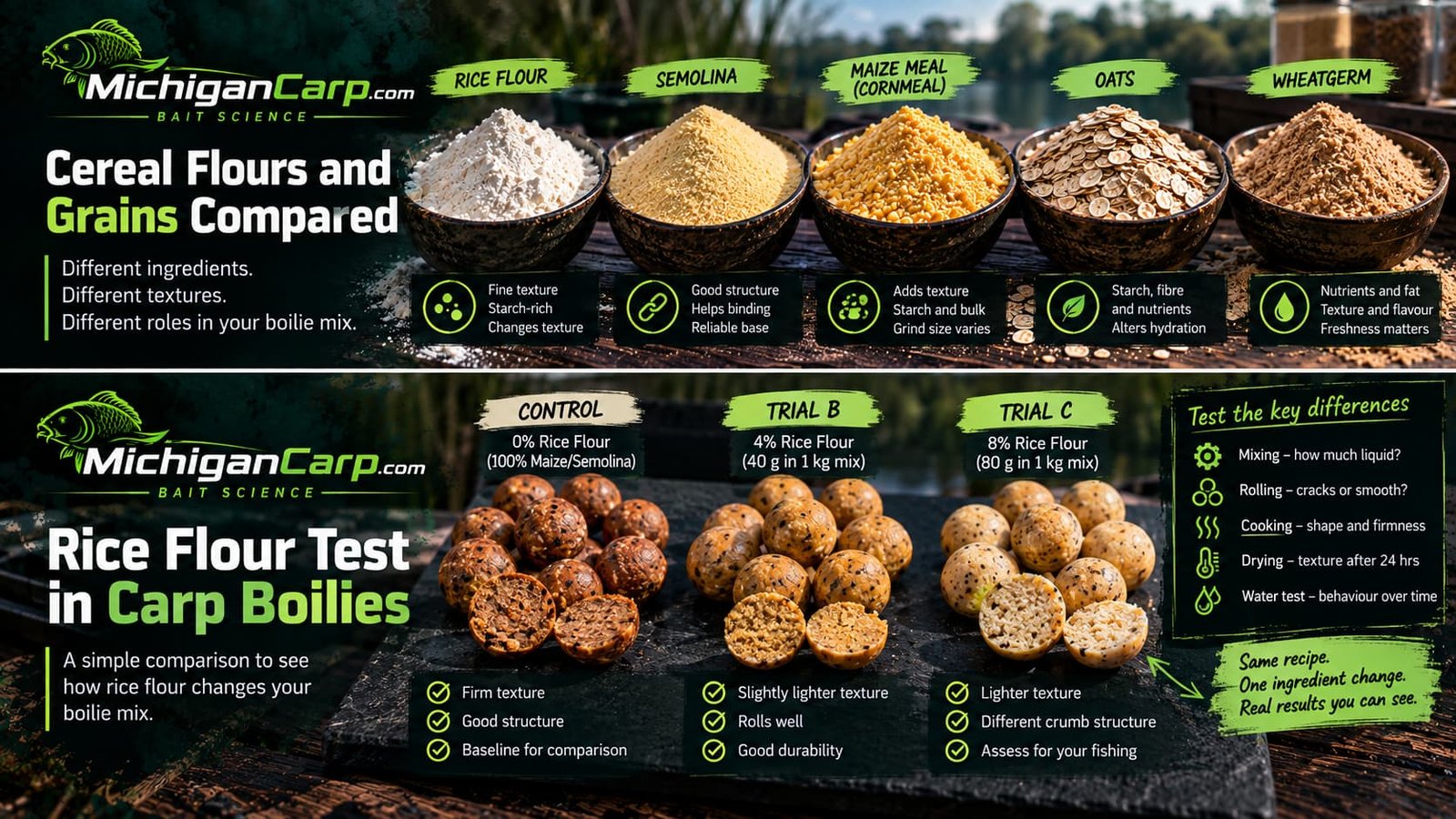

Carp Bait Science: Choose Your Starting Question
Pick the subject that matters for the bait you are making. These are starting points, not competing claims that every bait needs every additive.
What Does My Boilie Actually Release?
Separate powder solubility from finished-bait leakage, water uptake, swelling and physical breakdown.
Understand solubility and leakage →What Counts as a Feeding Attractant?
Examine release, detection, taste, acceptance and the limits of what ingredient chemistry alone can prove.
Explore feeding attractants →Is the Bait Useful After Carp Eat It?
Learn the difference between digestibility, nutritional value, softness and rapid release.
Understand carp bait digestibility →Ingredient Solubility Is Not a Guarantee of Boilie Leakage.
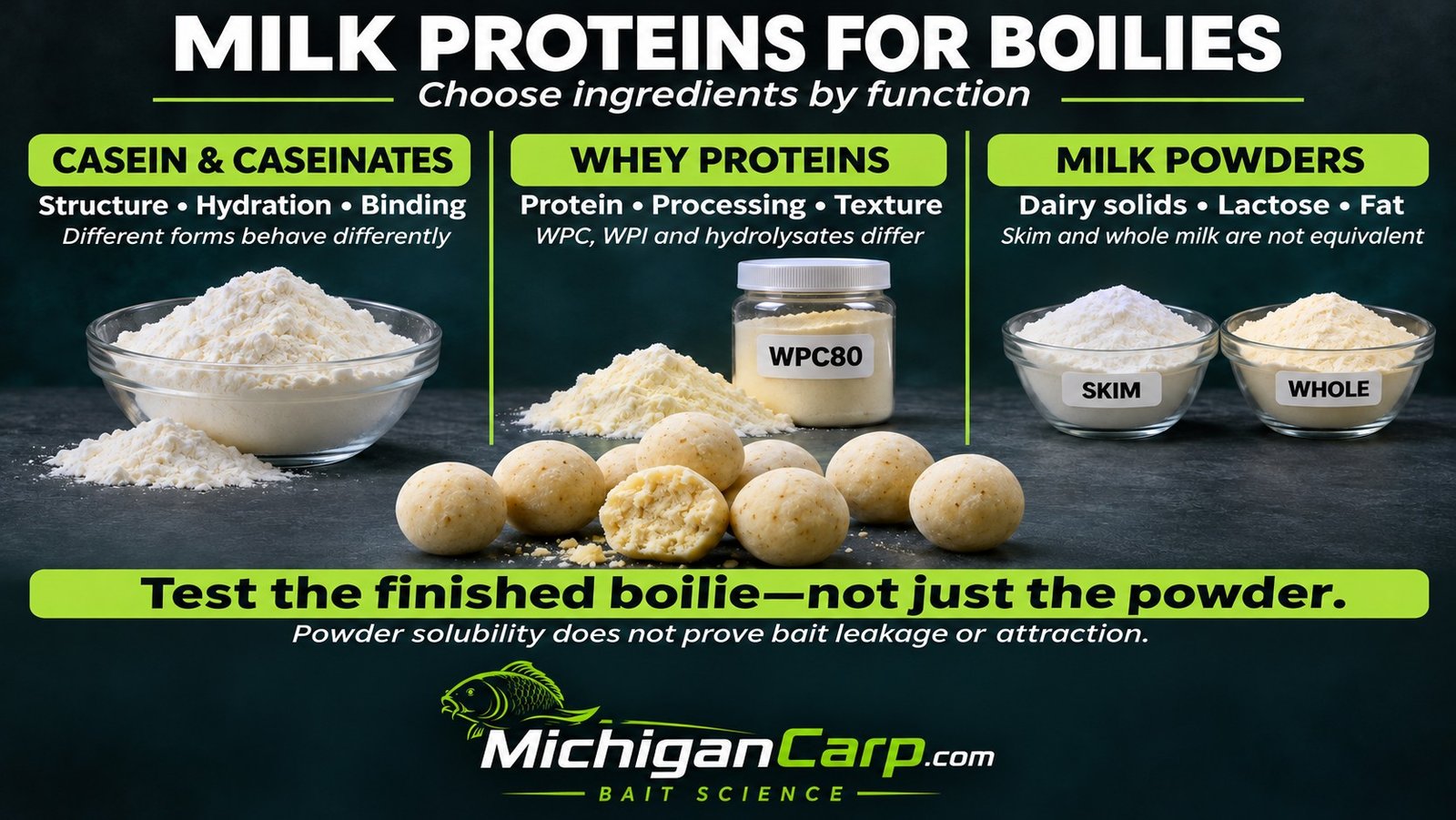
How a dairy powder disperses in a glass of water is not the same as what happens once that powder has been mixed with eggs, rolled, cooked and dried into a boilie. The complete bait matrix matters.
Our Milk Proteins Hub brings together caseins, whey proteins, everyday dairy powders, UK–USA ingredient terminology and practical formulation. Follow it when you want the specialist ingredient details behind this scientific principle.
Solubility, Leakage and Bait Behaviour
Carp bait science separates a visible cloud from actual material release. A bait does not need to fall apart to work: a hard bait can still release useful material, while a bait that clouds visibly may release little dissolved food signal. This section explains how finished bait behaves in water.
How Bait Releases Signal
Follow the path from water entering the bait to soluble material moving out into the surrounding water.
Solubility and leakage →Why Some Baits Leak Faster
Release rate changes with ingredients, matrix structure, cooking, drying, bait diameter, water access and conditions.
Leakage guide →Surface Area Matters
Whole boilies, chops, crumb, paste and small bait pieces expose different surfaces and release material differently.
Surface area →Digestion, Food Value and Ingredient Processing
In carp bait science, digestibility is not the same as softness, and extra processing is not automatically an improvement. The practical question is whether carp can use what they eat and whether processing helps that ingredient perform its intended bait job.
Carp Bait Digestibility
Understand nutrient use, ingredient quality, preparation and why high protein alone does not prove bait quality.
Digestibility →Why Carp Have No Stomach
Carp do not need us to imitate a missing stomach. They need bait that makes sense through intake, selection, grinding and digestion.
Carp digestion →Process Ingredients Properly
Use grinding, cooking, hydration, drying, fermentation or enzyme treatment only when there is a clear reason.
Processing guide →Process an Ingredient for a Reason, Not Because It Sounds Advanced.
Grinding, cooking, fermenting, hydrolysing, enzyme-treating and drying can all change bait behaviour. But extra processing can also make the system harder to understand.
The question is always practical: did the processing improve solubility, safety, digestibility, texture, storage, leakage or bait consistency for this specific job?
Proteins, Amino Acids and Hydrolysates
Protein percentage alone does not measure bait quality. Whole proteins, peptides, hydrolysates and free amino acids all behave differently in a complete bait system.
Proteins and Peptides
Separate whole proteins, peptide fractions, hydrolysates and free amino acids instead of treating them as one vague protein signal.
Protein science →Amino Acids
Free amino acids can be water-active food-related signals, but they are not the same thing as complete protein nutrition.
Amino acids →Hydrolysates
Hydrolysates can add soluble protein-derived material, but different products vary in peptide size, taste, concentration and placement.
Hydrolysates →Fermentation, Yeast, CSL and Food Liquids
Fermentation, yeast extracts, CSL-style liquids and hydrolysates are not the same thing. They can all support food signal, but they belong in different places depending on the baiting job.
Fermented and Food-Signal Baits
Understand fermented particles, food liquids, hydrolysates, yeast products, CSL, crumb and active food-signal systems.
Food-signal baits →Fermented Liquids vs Hydrolysates
Use broad fermented liquids differently from concentrated protein hydrolysates and targeted hookbait signals.
Compare liquids →Yeast, CSL and Fermented Liquids
Separate yeast extract, liquid yeast, CSL-style liquids and fermented grain products before mixing them together.
Yeast and CSL →Salts, Acids, pH, Minerals, Fats and Sweetness
Carp bait science treats salt, acids, pH, minerals, sugars, sweeteners and fats as separate variables. They can change different aspects of bait behaviour, but none should be treated as part of one magic attraction category.
Salt, Acids and Minerals
Separate taste, mineral nutrition, natural-food context and formulation chemistry instead of calling everything a mineral signal.
Salt and minerals →pH and Bait Performance
pH can influence protein behaviour, preservative systems, fermentation monitoring and how some ingredients behave.
pH guide →Sugars, Fats and Energy
Sweetness, carbohydrate, oils and fats affect more than smell. They can change paste, energy value, leakage and water behaviour.
Sugars and sweeteners →Heat, Enzymes and Finished Bait Structure
A finished boilie is not just an ingredient list. Mixing, heat, water, proteins, starches, drying and storage all change how the bait behaves after it is made.
What Boiling and Heat Do
Heat can set structure, denature proteins, gelatinize starches, affect enzymes and change how the finished bait rehydrates.
Heat and boiling →Enzymes and Phytase
Enzymes are specialist tools. Phytase and protease ideas need substrate, moisture, temperature, pH and time to matter.
Enzyme guide →Anti-Nutritional Factors
Seeds, grains, legumes and plant meals can bring useful bait value, but preparation and inclusion level still matter.
Anti-nutritional factors →Test Physical Behaviour at Home. Test Fish Response at the Lake.
A jar test can show softening, swelling, cracking, visible dispersion and hookbait durability. Visual observations alone do not measure dissolved attractants or prove that carp will prefer the bait.
Practical carp bait science uses controlled home comparisons to examine physical behaviour. Fishing results can help evaluate the complete approach, but location, weather, presentation and chance also affect catches.
- Home tests: water uptake, softening, swelling, visible breakdown, buoyancy and texture.
- Fishing tests: bites, liners, feeding signs, nuisance pressure, repeatability and session context.
- Storage tests: smell, mould, texture, pH where relevant, water behaviour and retained-sample checks.
Practical MichiganCarp view: do not confuse a lively-looking jar with a proven carp bait. Use jar tests to understand behaviour, not to declare a bait successful.
Testing, Preservation and Storage
Carp bait science does not end when a mix rolls well. A working bait must also survive cooking, drying, treatment, storage, casting, nuisance fish and the time it spends in water.
Test Boilies Before Fishing
Check water uptake, softening, cracking, breakdown, hookbait strength, buoyancy and batch consistency.
Test boilies →Preservatives
Preservation choices affect stability, water behaviour and practical storage. They should be designed, not guessed.
Preservatives →Store Boilies Properly
Freezer bait, air-dried bait, shelf-life bait and glugged bait all need different storage logic.
Storage guide →Specialist Ingredient Families
Use these guides when you need ingredient-specific thinking rather than broad bait science. Specialist ingredients should strengthen a coherent bait, not become the whole bait. For the difference between liver powder, liquid liver and hydrolysed products, start with Liver Hydrolysate for Carp Bait.
Milk Proteins
Casein, caseinates, whey proteins and milk powders can add structure, solubility, digestibility and food value when used properly.
Milk proteins →Green Lipped Mussel
GLM belongs inside the wider protein, mineral and natural-food discussion, not as a mysterious shortcut.
GLM explained →Nucleotides
Nucleotides are part of serious savoury food-signal thinking, but they should still sit inside a complete bait system.
Nucleotides →Put Carp Bait Science into Practice
Bait Science explains why ingredients and finished bait behave the way they do. Use the other bait hubs when the question is what to use, how to prepare it or how to make boilies.
Bait Guide
Use Bait Guide when the decision is whether corn, boilies, particles, tiger nuts, pellets, packbait or a combination fits the session.
Bait Guide →The Bait Shed
Use The Bait Shed when the practical job is bait prep, boilie treatment, liquids, glugs, particle safety, storage or testing.
The Bait Shed →Boilie School
Use Boilie School when you want the step-by-step route through boilie basics, ingredients, base mixes, liquids, process and fishing.
Boilie School →Compare Ingredients
Use Compare Ingredients when the decision is one material versus another and you need practical function, not hype.
Compare ingredients →Carp Bait Calculator
Use the calculator when you need to plan ingredient quantities and scale a practical bait-making mix rather than guess at amounts.
Carp Bait Calculator →UK–USA Bait Glossary
Translate UK and US ingredient names and boilie-making terms before selecting or substituting ingredients in a recipe.
UK–USA glossary →Tactics
Use Tactics when the real problem is location, timing, baiting level or whether carp are even in front of you.
Tactics →Watercraft
Use Watercraft to read wind, weed, oxygen, temperature, pressure, feeding signs and conditions before baiting.
Watercraft →Carp Bait Science: Sources and Evidence
In carp bait science, match the evidence to the question. Ingredient specifications describe a powder; controlled bait tests examine the finished mix; fish-response studies examine behaviour. These answer different questions and should not be confused.
Ingredient references for the milk-protein example
- U.S. Dairy Export Council: WPC80 — product definition and typical protein, lactose, fat and moisture composition.
- American Dairy Products Institute: Edible Caseinates Standard — ingredient identity, composition limits and identification of the caseinate form.
These industry references support ingredient identification and composition. They are not carp feeding trials and do not establish attraction, leakage from a cooked boilie or improved catch rates. Check the actual supplier specification when choosing a product.
For the wider carp bait science topics, follow the specialist guides above and examine the evidence alongside each claim. Keep practical observations, ingredient chemistry and controlled fish-response results clearly distinguished.
Bait Science Should Make Decisions Simpler, Not More Confusing.
The value of carp bait science is not adding every liquid, powder, amino acid, enzyme, acid, mineral and extract to the same mix. It is understanding the problem clearly enough to choose fewer ingredients more intelligently.
Find the carp. Decide what job the bait needs to do. Choose ingredients for real functions. Create enough food signal for the situation. Provide appropriate food value. Process the bait sensibly. Test the finished bait. Then judge the system through fishing.