
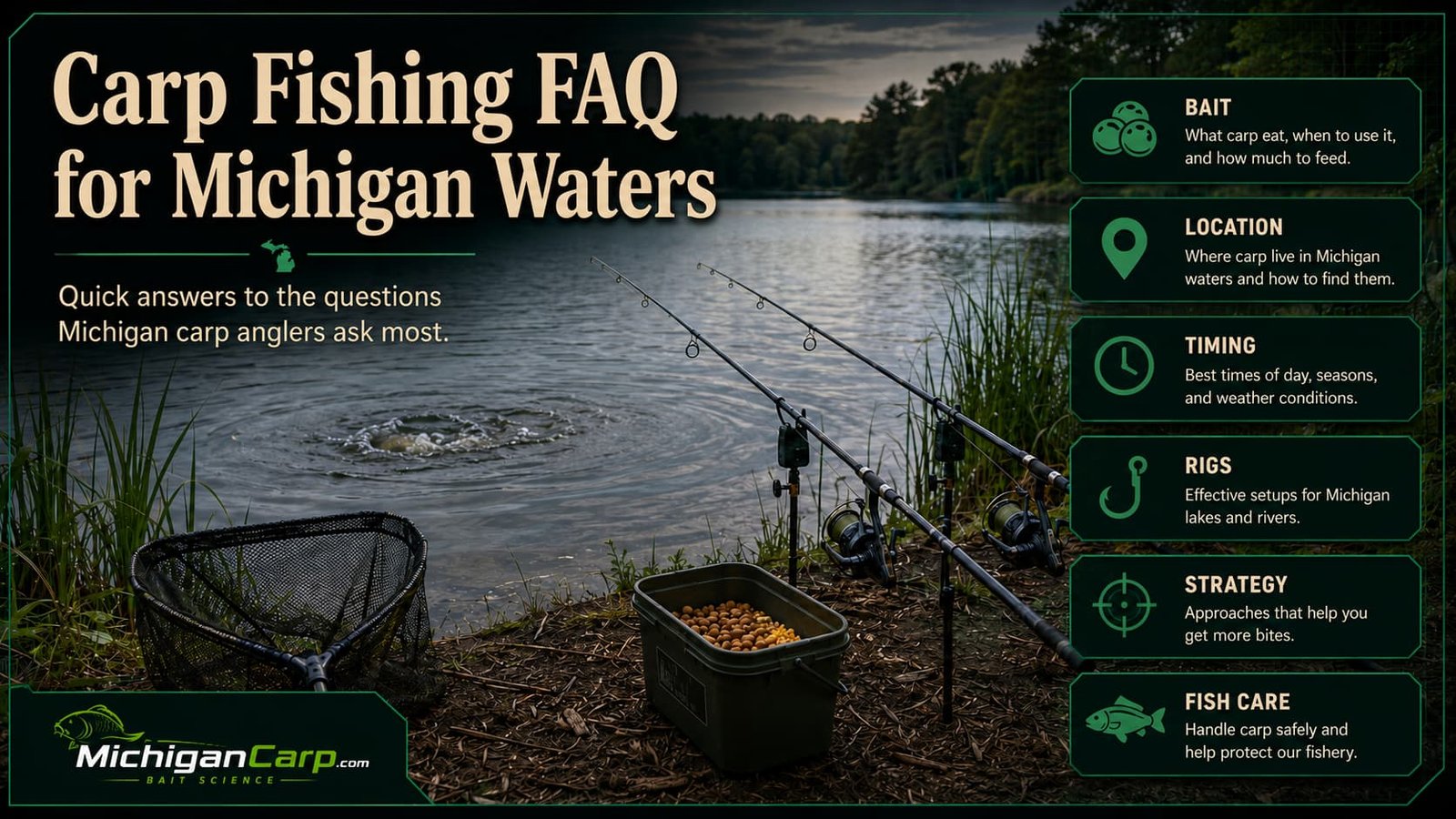
This carp fishing FAQ gives quick, practical answers to the questions Michigan anglers ask most. It covers bait, location, timing, rigs, baiting, bank strategy, fish care and how to build a simple plan for lakes, rivers, channels and public waters.
Carp fishing can look complicated from the outside. There are boilies, particles, hair rigs, alarms, rod pods, leaders, weed beds, depth changes, weather windows, baiting strategies and fish-care rules. But the foundation is simple: find carp, fish safely, use bait they can confidently eat, and protect the fish once you catch them.
This FAQ is a fast-answer guide. For deeper explanations, follow the linked MichiganCarp.com articles under each section.
For the main location process, start with How to Find Carp in Lakes. For the full tactics hub, use Carp Fishing Tactics in Michigan.
Quick Start
What is the easiest way to start carp fishing in Michigan?
The easiest way to start is to choose a water with visible carp activity, fish one or two rods safely from the bank, use simple bait such as sweetcorn, maize, tiger nuts or boilies, and focus on finding fish before worrying about advanced rigs.
Start with a safe bank, an unhooking mat, landing net, strong main line, sharp hooks and a basic hair rig. Watch for bubbles, clouded water, rolling fish, reed movement, liners and shallow feeding signs. A simple setup in the right place will beat an expensive setup in the wrong place.
What matters most in carp fishing?
Location matters most. Bait, rigs and tackle all help, but only after you find water that carp are actually using. Carp move between food, safety, comfort and travel routes. The better you read those clues, the more consistent your fishing becomes.
For the full location system, read How to Find Carp in Lakes.
Can I catch carp from public banks in Michigan?
Yes. Many Michigan carp are caught from public banks, campgrounds, parks, channels, dam ponds, river mouths, inland lakes and shoreline access areas. The challenge is choosing banks that combine legal access with real carp habitat, safe casting angles and a safe landing area.
Before fishing, check public access, local rules, parking, bank safety and whether the swim allows proper fish care.
Bait Questions
What is the best bait for carp in Michigan?
There is no single best bait for every water. Good carp baits include sweetcorn, maize, tiger nuts, peanuts, hemp, boilies, pellets, method mix, packbait and natural-food-based hookbaits. The best bait depends on location, season, fish activity, nuisance fish, bottom type and how much confidence carp have in the area.
For a full overview, read Carp Bait Guide for Michigan Lakes.
Are boilies good for Michigan carp?
Yes. Boilies can be very effective for Michigan carp, especially when you want a selective hookbait, a durable food signal, or a bait that avoids some nuisance fish. They are not magic, though. A boilie in the wrong place is still just a bait in empty water.
Boilies work best when they match the situation: smaller or chopped baits for cautious feeding, harder hookbaits around nuisance fish, balanced hookbaits over silt, and food-bait boilies for longer confidence-building sessions.
For boilie learning, start with Boilie School.
Are particles good carp bait?
Yes. Particles such as maize, hemp, tiger nuts, pigeon seed and prepared peanuts can be excellent carp bait when prepared safely. They are useful for holding carp in an area, creating feeding confidence and matching natural grubbing behavior.
Particles must be soaked, boiled and stored properly. Unsafe preparation can harm fish. For details, read Particle Prep for Carp Fishing.
How much bait should I use?
Use less bait when searching, in cold water, during short sessions, or when you have not confirmed carp are present. Increase bait only when signs, liners, rolling fish, clouding or bites show that carp are using the area.
Heavy baiting can work on proven waters, but it can also lock you into a bad swim. A small accurate patch in the right place is usually better than a bucket of bait in the wrong place.
Should I prebait for carp?
Prebaiting can help when you have identified a safe, legal, repeatable carp location. It is most useful when carp are already likely to visit the area and you want to build feeding confidence over time.
Do not prebait blindly. First confirm access, signs, bottom type, safe landing and whether the area has a real reason to hold carp.
Location and Watercraft
Where do carp usually live in lakes?
Carp use areas that provide food, safety, comfort and movement. Good places to check include weed beds, reed lines, lily pads, soft silt, mussel beds, snail areas, shallow warming bays, inflows, outflows, points, drop-offs, channels, windward banks and quiet margins.
For the main process, read How to Find Carp in Lakes.
Where do carp hold during the day?
During daylight, carp often hold in safer or more comfortable water. That can mean deeper water near food, weed beds, shade, reed lines, quiet pressure zones, mid-depth patrol routes or the open-water side of cover.
Carp may feed shallow at dawn or dusk but sit farther back during bright or busy periods. For the full guide, read Where Carp Hold During the Day.
How do I know carp are feeding?
Look for repeated bubbles, fizzing, clouded water, rolling fish, tails, bow waves, liners, reed movement, weed movement and fish showing in the same zone more than once. Repeated signs in the right location matter more than one random splash.
For the detailed guide, read Signs Carp Are Feeding.
What depth should I fish for carp?
There is no fixed best depth. Carp may feed shallow, patrol mid-depth weed edges, or hold deeper depending on season, temperature, oxygen, pressure, weed, wind and light. The best depth is usually the one that connects food and safety.
For depth selection, read Best Depth for Carp Fishing in Michigan Lakes.
Are weed beds good for carp fishing?
Yes. Weed beds can hold food, oxygen, shade, cover and carp confidence. The safest and most productive spot is often the clean edge, hole, lane or open-water side of the weed rather than the thickest part.
For the full guide, read Weed Beds and Carp Fishing in Michigan.
Does wind help carp fishing?
Wind can help when it improves the swim by moving food, adding ripple, creating color, increasing cover, changing temperature or improving comfort. But wind is not automatically good. Cold, dangerous or unfishable wind can hurt the swim.
For the full moving-water guide, read Wind, Waves and Current Carp Fishing.
Does oxygen matter for carp fishing?
Yes. Oxygen can strongly affect carp location, especially in warm weather, still water, dying weed or stagnant bays. Carp may use wind ripple, green weed, inflows, shade, depth or low-light periods when comfort improves.
For details, read Dissolved Oxygen and Carp Fishing.
Timing Questions
What is the best time of day to catch carp?
Dawn, dusk and night are often strong periods, especially in clear, shallow, pressured or warm water. Carp may also feed during the day if conditions are right: wind ripple, cloud cover, stable weather, low pressure, colored water or natural-food activity.
The best time is when food, safety, comfort and confidence overlap. For more, read Carp Bite Windows in Michigan.
What is the best season for carp fishing in Michigan?
Spring, summer and fall can all be productive. Spring often focuses on warming shallow water. Summer often revolves around weed, oxygen, night movement and low-light windows. Fall can concentrate fish around food routes, remaining green weed and depth transitions.
For the seasonal hub, read Michigan Carp Fishing Seasons.
Do carp feed in cold water?
Yes, but feeding windows are usually shorter and location becomes more important. In cold water, carp may group tighter, move less and respond better to small accurate baiting than heavy feeding.
Stable deeper water, soft silt, slow-current zones and short warming windows can be important.
Do carp feed in hot weather?
Yes, but hot weather can make oxygen, shade, wind and timing more important. A hot, still, shallow bay may look good but fish poorly in the middle of the day. Dawn, dusk, night, inflows, wind-rippled weed edges and deeper comfort routes can be better.
For temperature guidance, read Carp Water Temperature Guide for Michigan Lakes.
Rigs and Tackle
What is the best carp rig for beginners?
A simple hair rig is the best starting point for most carp anglers. It separates the bait from the hook, improves hooking mechanics and works with corn, maize, tiger nuts, boilies and many other hookbaits.
Keep it simple before adding advanced rigs. Sharp hooks, safe leads and clean presentation matter more than complicated rig names.
What rigs should I use in Michigan?
Use rigs that match the bottom and fish-care risk. Bottom-bait rigs work on clean firm areas. Wafter rigs can help over light debris or silt. Pop-up rigs can help over weed, soft silt or uneven bottom. Solid bags or sticks can improve presentation in tricky spots.
For the full guide, read The Complete Michigan Carp Rig Guide.
Do I need bite alarms?
Bite alarms are useful for longer sessions, night fishing and multiple rods, but they do not replace attention. You still need safe line angles, correctly set rods, a landing plan and enough awareness to react quickly.
What line should I use for carp?
Line choice depends on water, fish size, snags, weed, rocks, casting distance and boat traffic. Many Michigan carp situations require stronger tackle than casual anglers expect, especially around weed, mussels, stumps or big public waters.
Use tackle strong enough to land fish safely, not just light enough to cast easily.
Are safe rigs important?
Yes. Safe rigs are essential. A carp should not be left trailing heavy leads or unsafe fixed tackle if the line breaks. Use safe lead clips, drop-off inline systems or other responsible setups that protect fish.
For fish-care thinking, read Fish Care and Safety.
Strategy Questions
How do I fish big lakes for carp?
Do not try to fish the whole lake. Narrow big water into zones: public access, bays, points, weed edges, depth changes, wind lines, holding water, feeding routes and safe landing areas. Give each rod a job instead of casting randomly.
For the full article, read Advanced Big-Lake Carp Tactics for Michigan Waters.
How should I use three rods?
Use three rods to test three different reasons: one on feeding water, one on a travel route and one on deeper safety or holding water. This gives you information as well as coverage.
Do not place all three rods on the same guess unless signs clearly justify it.
Should I move swims if nothing happens?
Move when the swim gives no reason to stay: no signs, poor conditions, unsafe presentation, bad wind, heavy disturbance or a better researched option nearby. Stay when evidence keeps building: repeated signs, liners, activity, good wind, safe presentation or a clear route.
Sometimes the best decision is to return later when the timing improves.
How do I research new carp waters?
Use lake maps, satellite imagery, public access information, fisheries reports, Master Angler clues, shoreline structure, depth changes, weed, bays, points, river mouths and recon walks. Build a shortlist before committing bait and time.
For the full research workflow, read How to Research New Carp Waters in Michigan.
Should I fish margins or cast far out?
Fish where the carp have a reason to be. Sometimes that is a close margin, reed line or shallow bay. Sometimes it is a mid-depth weed edge, shelf or deeper safety route. Distance only helps if it reaches better water.
Fish Care
Do carp need special handling?
Yes. Carp are large, powerful fish and should be handled carefully. Use a large landing net, padded unhooking mat, water for wetting the mat and sling, and keep fish low to the ground. Avoid standing with carp for photos unless you are experienced and the fish is secure.
Should carp be released in Michigan?
MichiganCarp.com promotes responsible catch-and-release carp fishing. Carp are long-lived sport fish that deserve careful handling, safe rigs and proper release. Always follow current local rules, but from a carp-angling perspective, safe release is central to the sport.
What should I have ready before the bite?
Before casting, have your landing net, unhooking mat, forceps, sling, water bucket, camera plan and safe landing route ready. Do not wait until a carp is in the net to figure out where you will unhook it.
For the complete guide, read Fish Care and Safety.
Quick Reference
| Question | Fast answer | Deeper guide |
|---|---|---|
| Where should I start? | Find carp before choosing bait | How to Find Carp in Lakes |
| What bait should I use? | Match bait to water, season and fish activity | Carp Bait Guide |
| What depth is best? | Fish depth that connects food and safety | Best Depth for Carp |
| When should I fish? | Fish when comfort, food, safety and confidence overlap | Bite Windows |
| What rig should I use? | Use safe rigs that match the bottom | Complete Rigs Guide |
| How do I protect carp? | Use safe rigs, mats, nets and careful handling | Fish Care and Safety |
Where To Go Next
This FAQ hub is the fast-answer starting point. For the deeper version of any topic, use the main MichiganCarp.com guides below.
- How to Find Carp in Lakes — the main location process for Michigan lake carp fishing
- How to Research New Carp Waters in Michigan — public tools, maps, access checks and pre-trip planning
- Signs Carp Are Feeding — bubbles, fizzing, clouding, rolling fish, liners and real feeding clues
- Where Carp Hold During the Day — daytime holding water, shade, weed, depth and pressure zones
- Best Depth for Carp Fishing in Michigan Lakes — depth changes, shallow feeding water and deeper safety water
- Advanced Big-Lake Carp Tactics for Michigan Waters — big-water session strategy, wind, zones, baiting rhythm and safe bank fishing
- Watercraft and Conditions for Michigan Carp Fishing — wind, oxygen, weed, temperature, pressure and bite windows
- Carp Bait Guide for Michigan Lakes — choosing bait by water, season, session length and fish activity
- The Complete Michigan Carp Rig Guide — safe rig choices for Michigan bottoms, weed, silt and bigger carp
- Fish Care and Safety — landing, handling, unhooking, photos and release
Carp teach you if you let them. Start with location, read the water, keep baiting controlled, fish safe rigs and protect the fish.