If you are new to boilies, start here.
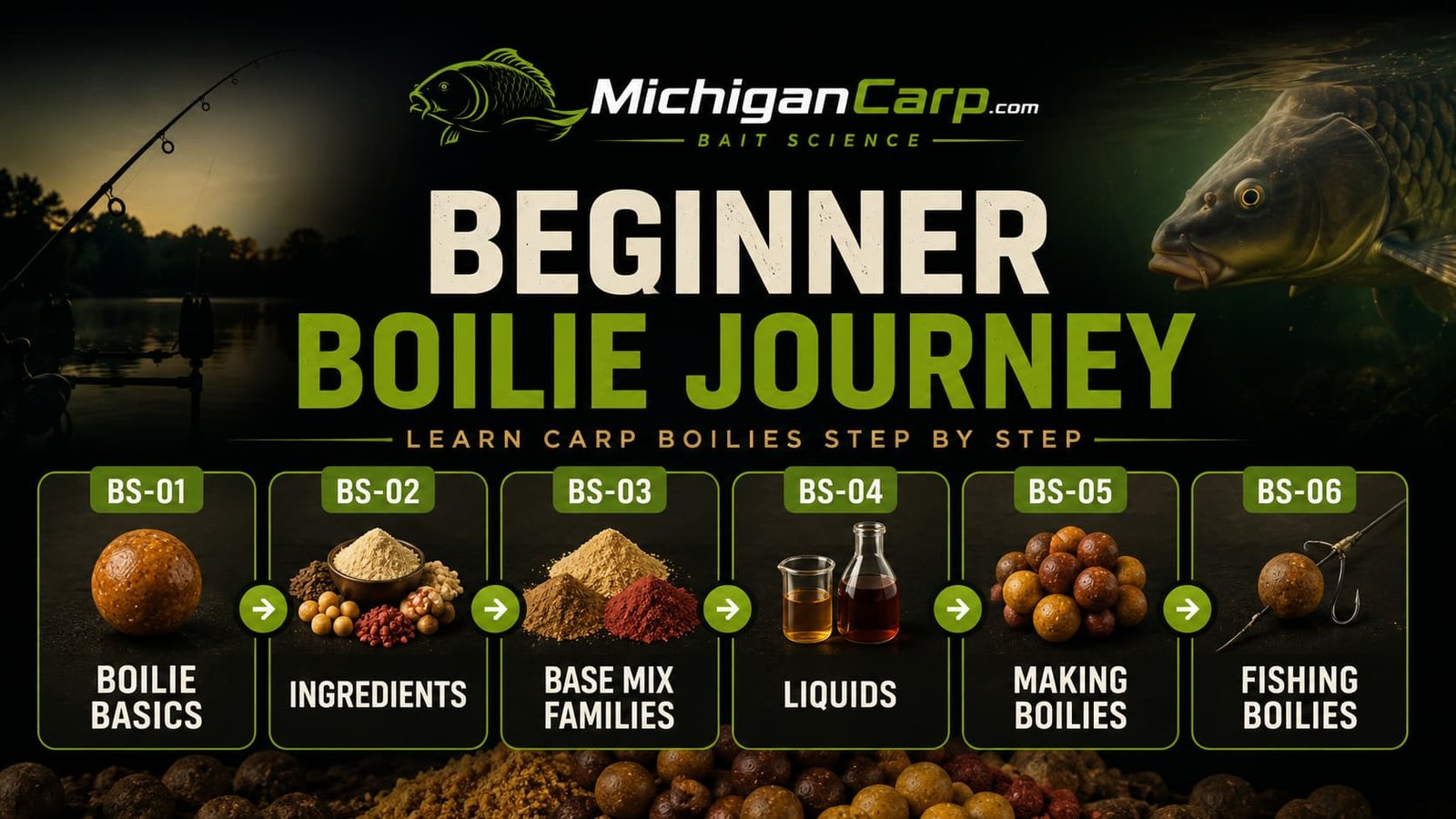
The beginner boilie journey is the simple route through Boilie School. It shows you what to learn first, what to leave until later, and how to avoid the usual bait-making confusion.
Boilie making can look complicated from the outside.
One angler talks about fishmeal. Another talks about milk proteins. Someone else says birdfood is the answer. Then you hear about hydrolysates, solubles, oils, glugs, wafters, pop-ups, shelf-life bait, freezer bait, rolling tables, drying racks and baiting campaigns.
That can make boilies feel harder than they really are.
The truth is simpler.
You do not need to understand every ingredient on day one. You do not need a complicated recipe. You do not need ten liquids. You do not need secret powders.
You need a clean learning route.
Learn the system before chasing the recipe.
This page is the beginner route map for Boilie School. The main hub gives you the full series. This page explains the easiest way to move through it without getting lost.
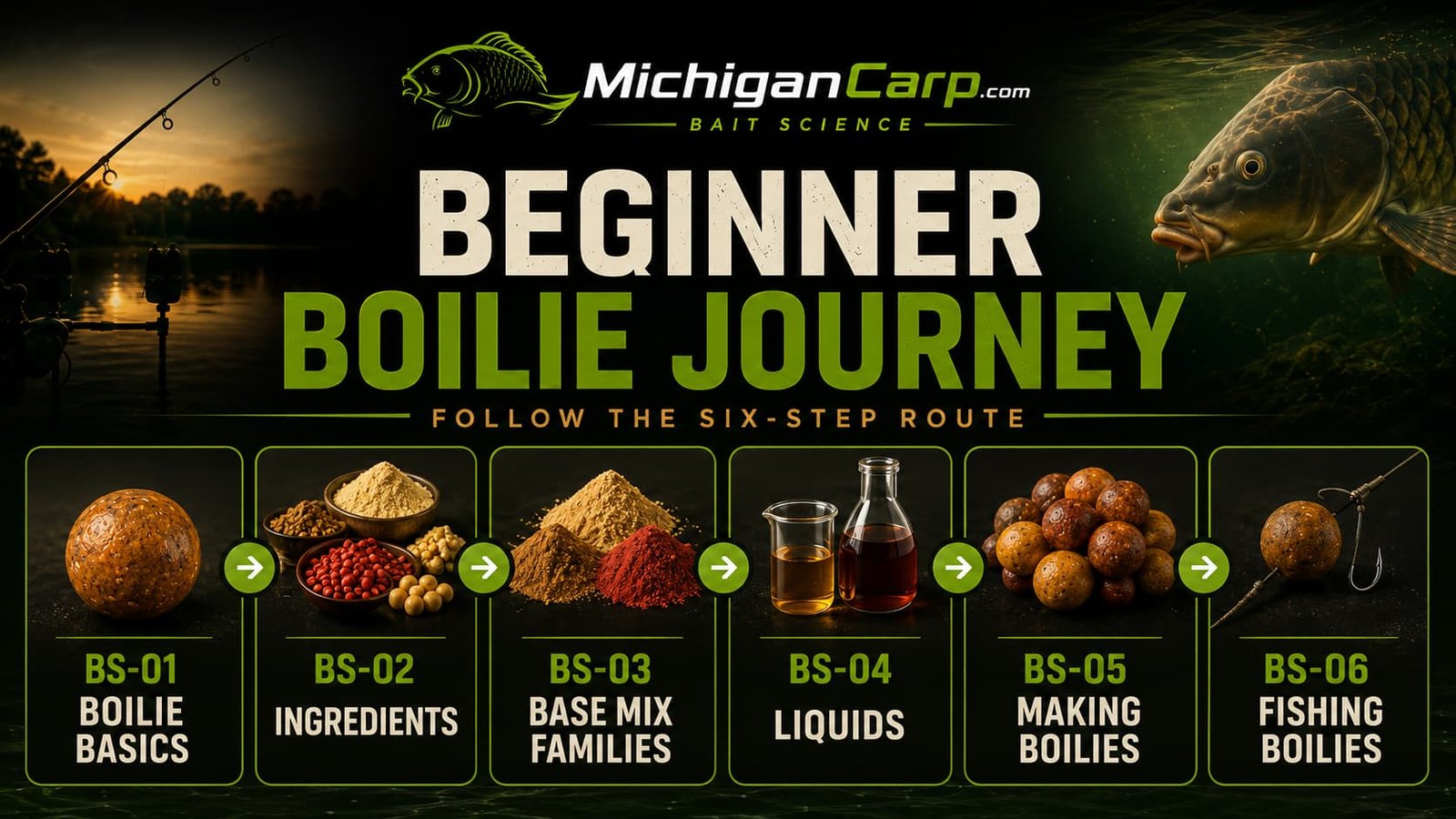
Start with Boilie School BS-01: Boilie Basics, then work forward through the six lessons. When you are ready for deeper technical material, move into Bait Science and the specialist boilie guides.
Before fishing unfamiliar water, always check the official Michigan Fishing Regulations.
Table of Contents
Quick Start: Beginner Boilie Journey
If you are completely new to boilies, follow this order.
| Step | Read first | What it teaches |
|---|---|---|
| 1 | BS-01 — Boilie Basics | What boilies are, why carp anglers use them and when they make sense |
| 2 | BS-02 — Boilie Ingredients Explained | What ingredient groups actually do inside a boilie |
| 3 | BS-03 — Boilie Base Mix Families | How marine, birdfood, milk/nut and hybrid baits differ |
| 4 | BS-04 — Boilie Liquids and Additives | How to build a clean liquid phase without additive chaos |
| 5 | BS-05 — Making Boilies Step by Step | How to mix, rest, roll, cook, dry, test and store bait |
| 6 | BS-06 — Using Boilies on the Bank | How to fish boilies with location, baiting control and presentation |
This order matters because each lesson solves a different beginner problem.
If you skip straight to recipes, you may make bait without understanding it. If you skip straight to liquids, you may overload the bait. If you skip the making process, you may ruin a good formula. If you skip bank strategy, you may blame the bait when the real problem is location.
Who This Beginner Boilie Journey Is For
This page is for anglers who want to understand boilies without wasting money or building complicated bait too early.
It is especially useful if you are new to carp boilies, have only used shop-bought bait, want to make homemade boilies, have had bait crack or go soft, do not understand what ingredients do, or feel your bait-making has become too cluttered.
Many bait makers do not need more ingredients first.
They need a cleaner system.
The beginner boilie journey is not about making the most advanced bait possible. It is about building enough understanding to make sensible decisions.
Start simple enough to learn. Repeat it enough to trust. Improve it slowly enough to understand.
What Not to Do First
Do not start by buying every ingredient you see mentioned online.
Do not build a first recipe that contains fishmeal, birdfood, milk proteins, tiger nut flour, peanut meal, hydrolysate, CSL, oil, sweetener, multiple flavors, essential oils and preservatives all at once.
That may sound advanced, but if you do not know what each part is doing, it becomes a kitchen-sink bait.
| Beginner mistake | Why it causes problems | Better first move |
|---|---|---|
| Buying too many ingredients | You do not know what each one changed | Learn ingredient jobs first |
| Using too many liquids | The bait becomes harder to roll, repeat and understand | Use one main liquid direction |
| Making a huge first batch | You may waste bait if the formula or process is wrong | Make a small test batch |
| Changing everything after one blank | You cannot tell whether bait, location or presentation was the problem | Change one thing at a time |
| Blaming bait before watercraft | Boilies cannot catch carp that are not in front of you | Find carp first |
A beginner bait should teach you something. It should help you understand paste feel, rolling, cooking, drying, water behavior, hookbait strength and how carp respond to the bait.
A bait with too many variables teaches very little.
The Six-Step Boilie School Route
The six Boilie School lessons are the foundation. Read them in order if you are new.
Step 1 — Learn What Boilies Are
Start with Boilie School BS-01: Boilie Basics.
This lesson explains what boilies are, why carp anglers use them, how bottom baits, wafters, pop-ups and snowman hookbaits differ, and when boilies make sense beside particles, corn, packbait or other bait.
The key idea is simple:
A boilie is not just a round bait. It is a repeatable food item with a job.
That job may be a durable hookbait, a small feeding patch, a selective bait, a campaign bait or a consistent food source for repeat sessions.
Read BS-01 before worrying about recipes.
Step 2 — Learn What Ingredients Do
Next read Boilie School BS-02: Boilie Ingredients Explained.
A boilie recipe is not just a list of attractive powders. Every ingredient should have a job.
Some ingredients help the bait roll. Some bind. Some add protein. Some bring fat. Some create texture. Some dissolve into the water. Some support taste, hardness, shelf life or bait structure.
BS-02 teaches the most useful beginner question:
What job is this ingredient doing?
That is more useful than asking whether an ingredient is “good.” An ingredient is only good when it fits the formula and the fishing job.
Step 3 — Choose a Base Mix Family
Then read Boilie School BS-03: Boilie Base Mix Families.
This lesson explains the main bait directions: marine, birdfood, milk/nut and hybrid boilies.
| Family | Simple beginner meaning |
|---|---|
| Marine | Fishmeal, marine meals, savoury proteins and marine-style food signals |
| Birdfood | Prepared birdfoods, cereals, seed texture and versatile bait structure |
| Milk/nut | Milk powders, milk proteins, tiger nut, peanut, almond, coconut and creamy non-marine bait direction |
| Hybrid | A deliberate blend of more than one family, not a random pile of ingredients |
Most real boilies are hybrids, but beginners should understand the main family before blending everything together.
BS-03 helps you choose direction before choosing a recipe.
Step 4 — Build the Liquid Phase Without Chaos
Then read Boilie School BS-04: Boilie Liquids and Additives.
Liquids are where many beginners lose control. The dry mix may be sensible, then the liquid phase becomes a pile of CSL, hydrolysate, yeast liquid, molasses, oil, sweetener, flavor and another flavor.
That does not automatically make bait better. It often makes bait harder to understand and harder to repeat.
For beginners, the better order is:
Eggs first.
One main liquid direction.
Support only if it has a job.
Flavor last.
That is enough for most beginner bait.
Step 5 — Learn the Making Process
Then read Boilie School BS-05: Making Boilies Step by Step.
A good formula can still fail on the bench. The paste may be too wet. The bait may crack. The boilies may go too soft. The finished bait may mold. The hookbaits may not survive.
BS-05 teaches the repeatable process: measure accurately, mix the liquid phase first, add dry mix gradually, rest the paste, roll consistent sizes, cook enough but not forever, dry for the job, test the finished bait and store it properly.
This is where homemade bait becomes reliable.
The goal is not to become a factory. The goal is to make the same bait the same way every time.
Step 6 — Learn How to Fish Boilies
Finally read Boilie School BS-06: Using Boilies on the Bank.
This lesson takes the bait from the bench to the bank.
BS-06 explains single hookbaits, small dinner-plate baiting, campaign feeding, whole boilies, chopped boilies, crumb, particles, hookbait choice, top-up decisions and seasonal adjustments.
This is where the biggest bank-side lesson appears:
Do not ask a boilie to do the job of watercraft.
Find carp first. Then use boilies intelligently.
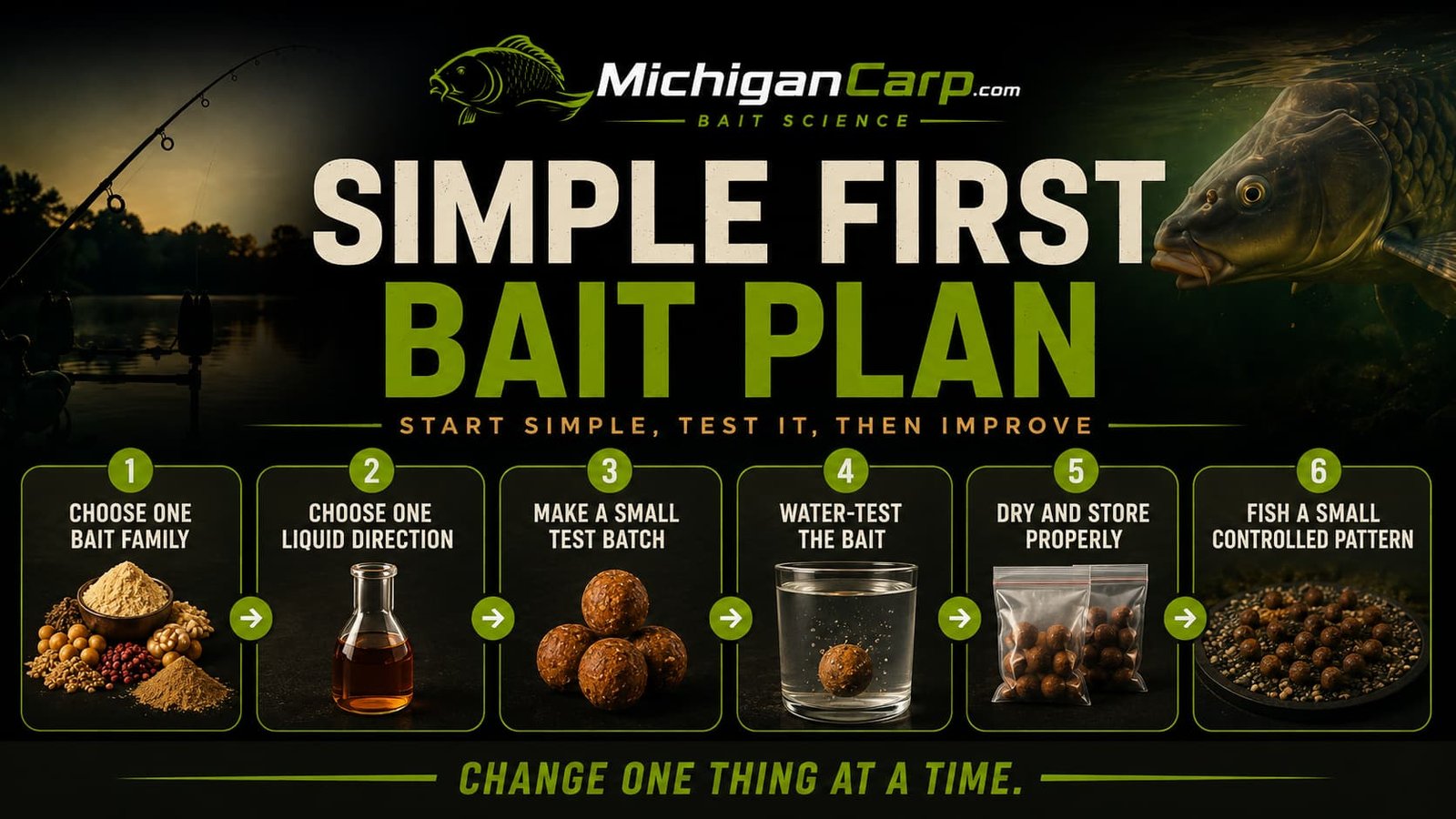
A Simple First-Bait Plan
After reading the main Boilie School route, do not immediately build the most complicated bait possible.
Start with a small, controlled first project.
| First-bait decision | Beginner choice |
|---|---|
| Bait family | Choose one main family: birdfood, milk/nut or a simple hybrid |
| Liquid direction | Choose one main signal: sweet/cream, nut/dairy, yeast/fermented or savoury |
| Batch size | Make a small test batch before making a large amount |
| Hookbait type | Start with a bottom bait on clean bottom, then test wafters or pop-ups when needed |
| Testing | Check softening, cracking, swelling, leakage and hookbait strength before fishing |
| Fishing | Use a small baiting pattern and record what happens |
For testing finished bait, use How to Test Boilies Before Fishing. For storage, use How to Store Homemade Boilies. For preparing boilies before a session, use How to Prepare Boilies for Carp Fishing.
How to Improve Without Chaos
The most important beginner upgrade rule is simple.
Change one thing at a time.
Do not change base mix, liquid phase, flavor, size, hardness, hookbait type, baiting amount and location all at once.
If you change everything, you learn nothing.
| Controlled upgrade | What it teaches |
|---|---|
| Change one liquid | Whether that liquid improves handling, water behavior or confidence |
| Adjust drying time | How firmness, leakage and hookbait strength change |
| Test whole vs chopped boilies | How surface area changes release and feeding response |
| Compare bottom bait vs wafter | Whether pickup or presentation is limiting the bait |
| Try smaller bait in cooler water | Whether fish respond better to a smaller food item |
| Keep bait the same and move location | Whether the problem was bait or watercraft |
For bait release, use Carp Bait Solubility and Leakage, Why Some Carp Baits Leak Faster Than Others and Why Surface Area Matters in Carp Bait.
What to Read After the Main Six Lessons
After the six Boilie School lessons, move into deeper guides based on the problem you want to solve.
| What you want to improve | Read next |
|---|---|
| Milk/nut/birdfood formulation | How to Formulate a Milk, Nut and Birdfood Boilie Base Mix |
| Milk ingredients | Milk Powders in Boilie Making and Milk Replacer for Carp Bait |
| Hydrolysates | How to Use Hydrolysates in Carp Bait |
| Boiling and drying | How to Boil and Dry Boilies Properly |
| Bait problems | Boilie Problems: Real Causes and Fixes |
| Particles beside boilies | Particles for Carp Fishing Guide |
| Rigs and presentation | The Complete Michigan Carp Rig Guide |
| Full bait-science library | Bait Science |
Do not try to absorb the whole bait library in one sitting. Use the next article that solves the problem in front of you.
Michigan Notes
Michigan carp fishing is different from heavily developed European carp waters.
Many of our waters are large, public, full of natural food, affected by boat traffic, lightly targeted by specialist carp anglers and influenced by weed, depth, wind, temperature and seasonal movement.
That changes the beginner boilie journey.
A good Michigan boilie system should be repeatable, affordable enough to use, safe to store, suitable beside particles, durable enough for real sessions, simple enough to understand and connected to watercraft.
The goal is not to copy every overseas bait trend.
The goal is to build a bait and fishing system that works for your water.
That starts with the basics.
Common Beginner Boilie Mistakes
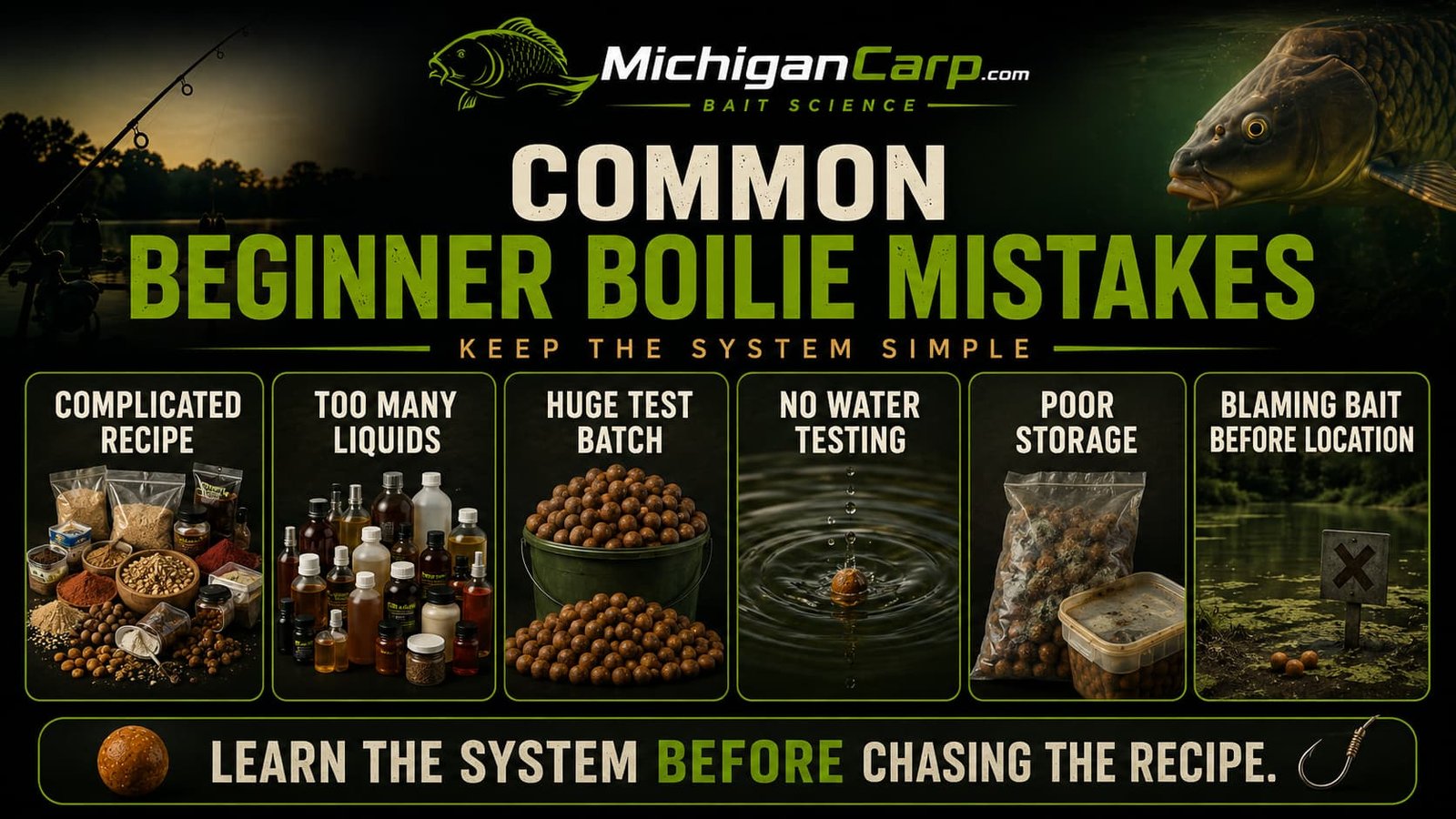
| Mistake | Why it hurts learning | Better practice |
|---|---|---|
| Starting with recipes before understanding ingredients | You copy percentages without knowing what each ingredient does | Read BS-02 before making major recipe changes |
| Buying too many additives | The bait becomes confusing before the basics are learned | Use fewer liquids with clearer jobs |
| Ignoring the making process | Good ingredients can still produce poor bait | Learn mixing, resting, rolling, cooking, drying and storage |
| Fishing boilies without finding carp | Bait cannot solve an empty swim | Use watercraft first |
| Changing bait too quickly | One blank session may be location, timing or presentation | Test bait fairly over enough fishing |
| Making huge test batches | Failures become expensive | Make small batches until the bait is proven |
| Using every article at once | The learning path becomes overwhelming | Follow BS-01 to BS-06 first |
My Practical View
The best beginner boilie journey is not complicated.
First, learn what boilies are. Then learn what ingredients do. Then understand the bait families. Then keep the liquid phase simple. Then make the bait repeatably. Then fish it properly.
Only after that should you start making serious upgrades.
This route prevents the biggest bait-making mistake: trying to solve every problem with more ingredients.
Most beginners do not need a longer shopping list.
They need a clearer system.
Start simple enough to learn. Repeat it enough to trust. Improve it slowly enough to understand.
That is the real beginner boilie journey.
FAQ
Where should I start if I am new to boilies?
Start with Boilie School BS-01: Boilie Basics, then follow the sequence through BS-06.
Do I need expensive ingredients to make boilies?
No. Beginners should start with simple, repeatable ingredients and learn the process before buying specialist powders or liquids.
Should I make homemade boilies or buy them first?
Either can work. Shop-bought boilies are convenient, but homemade boilies teach ingredient function, process control and bait confidence.
What is the biggest beginner boilie mistake?
The biggest mistake is starting too complicated. A bait with too many ingredients and liquids is hard to understand, hard to repeat and hard to improve.
What boilie style should a beginner start with?
A simple birdfood or milk/nut style is often a practical starting point, but the best choice depends on your water, season and baiting plan.
Do boilies work in Michigan?
Yes. Boilies can work in Michigan when they are used with good location, sensible baiting and proper presentation.
Should I start with bottom baits, wafters or pop-ups?
Start with bottom baits on clean bottoms. Use wafters or pop-ups when the lake bed, rig and presentation require them.
How much bait should a beginner use?
Start light. A single hookbait, tiny trap or small dinner-plate patch is usually better for learning than heavy baiting.
Should I use boilies with particles?
Yes, but keep the mix controlled. Particles can create feeding activity while boilies provide hookbait control and a repeated food item.
How do I know if my boilies are made properly?
Water-test them. Check softening, cracking, swelling, leakage, buoyancy and hookbait strength before fishing seriously.
Should beginners use glugs and soaks?
Not at first. Learn the bait itself before adding extra hookbait treatments. Use glugs and soaks later when they have a clear job.
Can I skip straight to recipes?
You can, but you will learn more if you understand ingredient jobs, bait families and the making process first.
How should I improve my first bait?
Change one thing at a time. If you change several ingredients, liquids and fishing methods at once, you will not know what helped.
Next Steps
- Back to Boilie School Hub
- Start BS-01: Boilie Basics
- Continue to BS-02: Boilie Ingredients Explained
- Read BS-03: Boilie Base Mix Families
- Read BS-04: Boilie Liquids and Additives
- Read BS-05: Making Boilies Step by Step
- Read BS-06: Using Boilies on the Bank
- How to Test Boilies Before Fishing — test the bait before relying on it.
- How to Store Homemade Boilies — keep batches safe and organized.
- Bait Science — move into the deeper technical library when ready.