

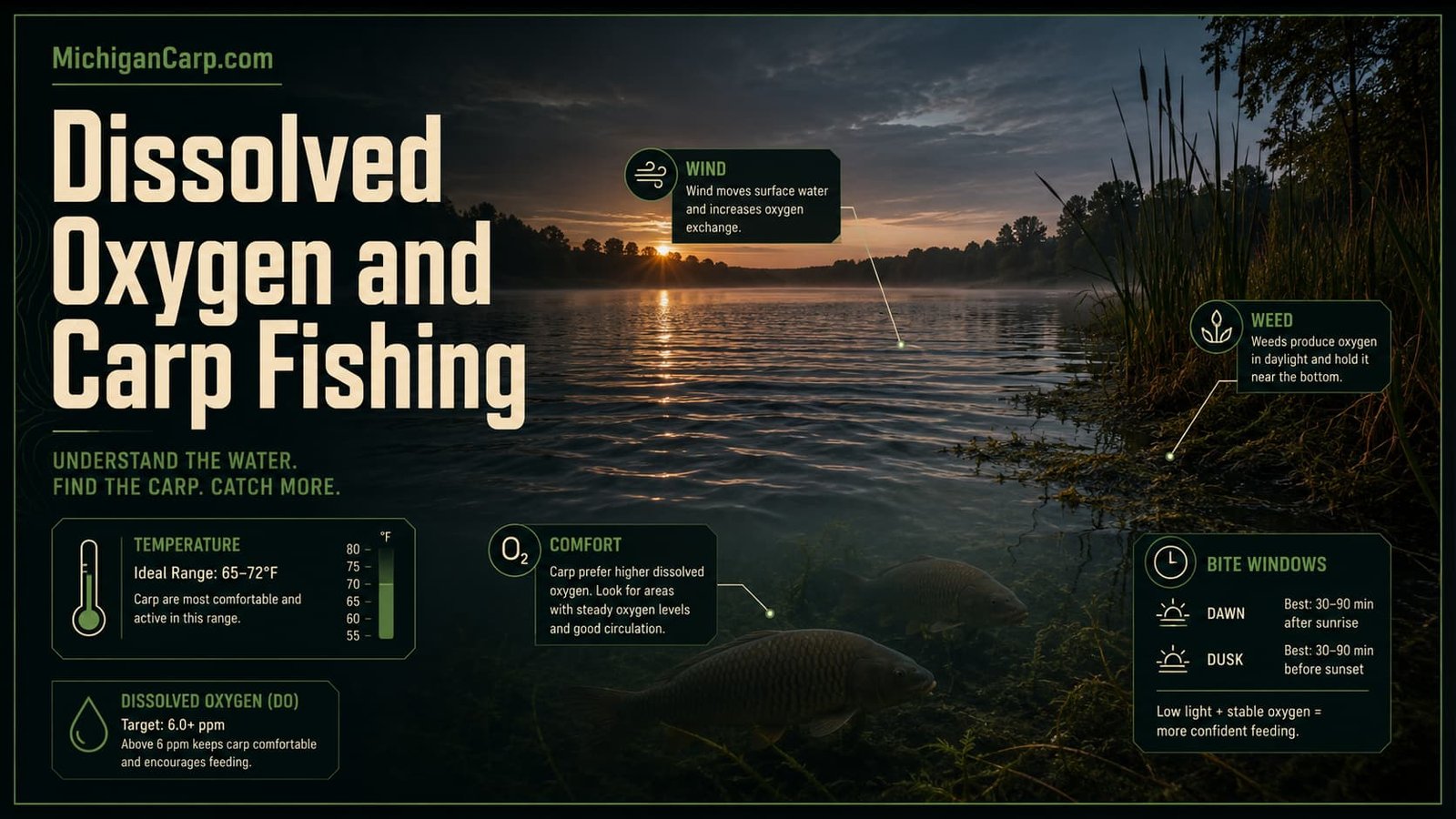
Dissolved oxygen and carp fishing are closely connected because oxygen helps decide where carp can stay comfortable, move confidently and feed properly. It does not make carp feed by itself. It does not replace location, bait, rigs or timing. But in warm weather especially, oxygen can explain why one area of a lake feels alive while another area looks dead.
Most carp anglers think about bait, rigs, water temperature, wind, weed, depth and weather. All of those matter. Oxygen sits underneath many of them.
Wind can improve oxygen and move food. Healthy weed can hold oxygen, shade and natural life. Hot stagnant water can become uncomfortable. Inflows can refresh a swim. Dying weed can create poor conditions. Deeper water can be safer, but not always better if the oxygen profile is wrong.
That is the practical point for Michigan carp fishing: oxygen is not just a science term. It is a watercraft clue.
If you understand dissolved oxygen, you start to understand why carp are rarely positioned at random. They are usually balancing four needs:
oxygen, temperature, food and safety.
When those four things come together in the same area, you have found water worth fishing.
For the wider condition-reading system, start with Watercraft and Conditions for Michigan Carp Fishing. For temperature decisions, read Carp Water Temperature Guide for Michigan Lakes. For timing, use Carp Bite Windows in Michigan.
Table of Contents
Quick Answer: Why Dissolved Oxygen Matters to Carp
Dissolved oxygen affects carp fishing by influencing where carp can hold, travel and feed comfortably.
In cool conditions, oxygen may not be the first thing you think about. In hot summer weather, it can become one of the most important location clues on the lake. Carp can still feed in warm water, but they usually choose areas where warmth, oxygen, food and safety overlap.
The best oxygen clues are often visible without a meter. Look for wind ripple, healthy green weed, inflows, shaded water, moving water, clear weed edges, low-light activity and carp showing repeatedly in the same comfortable zones.
| Oxygen clue | What it can mean | Carp fishing response |
|---|---|---|
| Wind ripple | Surface movement can improve oxygen, cover and food movement | Check windward banks, ripple lines and weed edges |
| Healthy green weed | Can hold food, cover and oxygen during daylight | Fish safe edges, clear holes and channels |
| Inflows | May bring oxygen, cooler water or food movement | Fish seams, slacks and nearby holding water |
| Hot still water | May become uncomfortable or oxygen-poor | Look for wind, shade, depth, inflows or low-light periods |
| Dying weed | Decay can reduce comfort and make presentation difficult | Avoid the worst areas and find cleaner green edges |
| Clear deep water | May give security, but not always feeding confidence | Connect depth to food, oxygen and movement routes |
The key rule is simple:
Oxygen does not work alone. Read it with water temperature, wind, weed, depth, light and fish signs.
What Is Dissolved Oxygen?
Dissolved oxygen is oxygen mixed into the water. Fish need oxygen in the water to live, move and feed. A lake can look calm and attractive from the bank, but that does not mean every part of it feels equally comfortable to a carp.
The U.S. Geological Survey explains that dissolved oxygen is the amount of oxygen dissolved in water and available to aquatic organisms. It also notes that oxygen enters water from the atmosphere and that dissolved oxygen is used by aquatic life. For the science background, read USGS: Dissolved Oxygen and Water.
For carp anglers, the exact oxygen number is not always available or necessary. You do not need a laboratory-grade oxygen meter to make better decisions. What you need is the ability to recognize where oxygen is likely to be better, where it may be worse, and how oxygen interacts with the rest of the lake.
Dissolved oxygen can be influenced by:
wind, waves, water temperature, weed growth, algae, inflows, current, depth, decay, sunlight, night and day cycles, storms, stratification, lake shape, basin depth and water movement.
That list looks technical, but on the bank it becomes practical. Ask simple questions:
Is there wind ripple? Is water moving? Is the weed healthy or dying? Are fish showing near inflows? Are carp feeding at night instead of during the day? Are shallow areas lifeless during heat? Are fish concentrated around wind, weed, shade, depth or current?
Oxygen is one more reason to read the water before you cast.
Oxygen Does Not Make Carp Feed by Itself
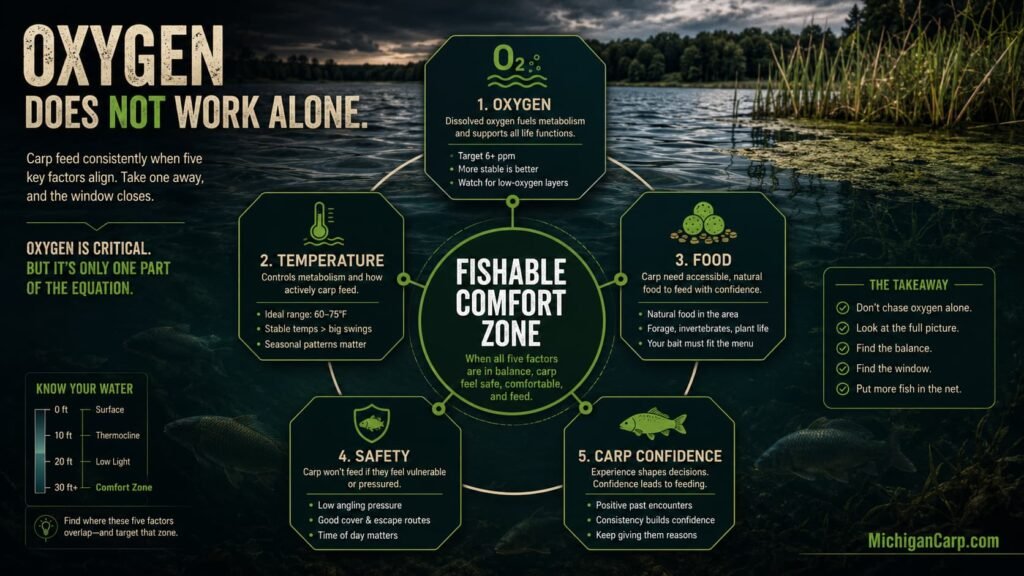
One of the biggest mistakes is treating oxygen as a magic switch.
Carp do not feed just because oxygen is present. They feed when oxygen is part of a wider comfort pattern. A wind-rippled bank with no food, no safe route and no carp nearby may still be poor. A weedy bay with food and cover may still fish badly if it becomes hot, stagnant and uncomfortable. A deep area may feel safe but still fail if there is no reason for carp to feed there.
Oxygen matters because it helps define usable water.
Think of it this way. Carp need oxygen to be comfortable, but they still need a reason to be in that spot. Food, security, temperature, timing and route choice all matter. The best carp areas often combine several of these advantages at once.
Good oxygen thinking does not replace normal watercraft. It improves it.
Instead of asking, “Where is the oxygen?” ask:
Where is the most comfortable water that also gives carp food, safety and a reason to return?
Why Oxygen Matters More in Summer
Oxygen matters all year, but it becomes especially important during warm weather.
Warm water can make carp more active, but very warm water can also make some areas less comfortable. USGS explains that cold water can hold more dissolved oxygen than warm water, and that dissolved oxygen levels are often lower in summer and fall when water temperature is higher. For more background, read USGS: Temperature and Water.
This does not mean shallow summer fishing is bad. Carp often feed shallow in summer, especially at night, at dawn, at dusk, near weed edges, around inflows, on wind-rippled banks, or where natural food is present.
The point is that summer shallow water needs extra checks.
A shallow bay that was excellent in spring may become poor during a hot, still afternoon. A wind-rippled weed edge beside that same bay may be much better. A shaded margin that stays comfortable may outfish an exposed sunny margin. An inflow may become important if it freshens a bay and brings food movement.
In summer, ask:
Is there oxygen? Is there water movement? Is the weed healthy? Is the area comfortable at this time of day? Are carp actually showing or feeding? Is the best bite window likely to be after dark, at dawn, during cloud cover or after a cooling change?
In hot weather, oxygen can decide whether a swim is alive or dead.
Oxygen and Water Temperature
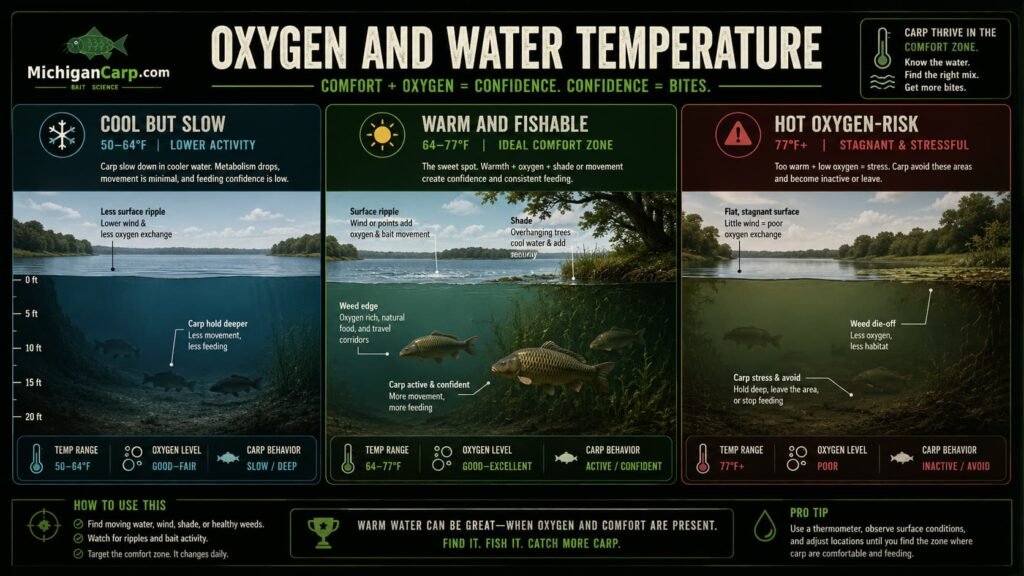
Water temperature and dissolved oxygen should be read together.
A thermometer tells you how warm the water is. Oxygen helps explain whether that water is comfortable enough for carp to use properly.
A lake at 76°F with wind ripple, healthy weed and showing fish can be excellent. A shallow back corner at 76°F with no ripple, dying weed and no movement may be poor. The number is the same, but the water is not the same.
This is why the new Carp Water Temperature Guide for Michigan Lakes belongs directly beside this article. Temperature gives you the broad seasonal stage. Oxygen tells you whether the area is comfortable enough to fish hard.
In spring, warming water can be more important than oxygen. In summer, comfort and oxygen become stronger filters. In fall, cooling water and weed change can move carp away from old summer areas. In winter, oxygen is usually less obvious to anglers, but stable water and safe access still matter.
The mistake is chasing the warmest water all year. Carp usually want the best balance of warmth, oxygen, food and safety.
Wind, Waves and Oxygen
Wind is one of the easiest oxygen clues to read from the bank.
Wind moves surface water. It creates ripple. It can break up light. It can push food, color, warmth, cooler water or oxygen into a bank. It can turn a dead-looking edge into a fishable area. It can also make a swim unsafe, unfishable or too rough for accurate presentation.
A steady summer wind blowing into a weed edge can be very different from a flat, hot, stagnant bay. Carp may use the windward side because it offers oxygen, food movement and cover. They may also sit just off the hardest push, using seams, side edges, calmer pockets or water just behind the main wave action.
Do not simply cast into the strongest wind because it looks “carpy.” Read the details.
Good wind-and-oxygen areas include wind-rippled weed edges, reed lines with moving water, colored margins, inflow-influenced banks, wave-washed food shelves, points with softer inside water, and areas where ripple creates cover without making fish care unsafe.
For the dedicated guide, read Wind, Waves and Current Carp Fishing.
Weed Beds, Oxygen and Carp Location
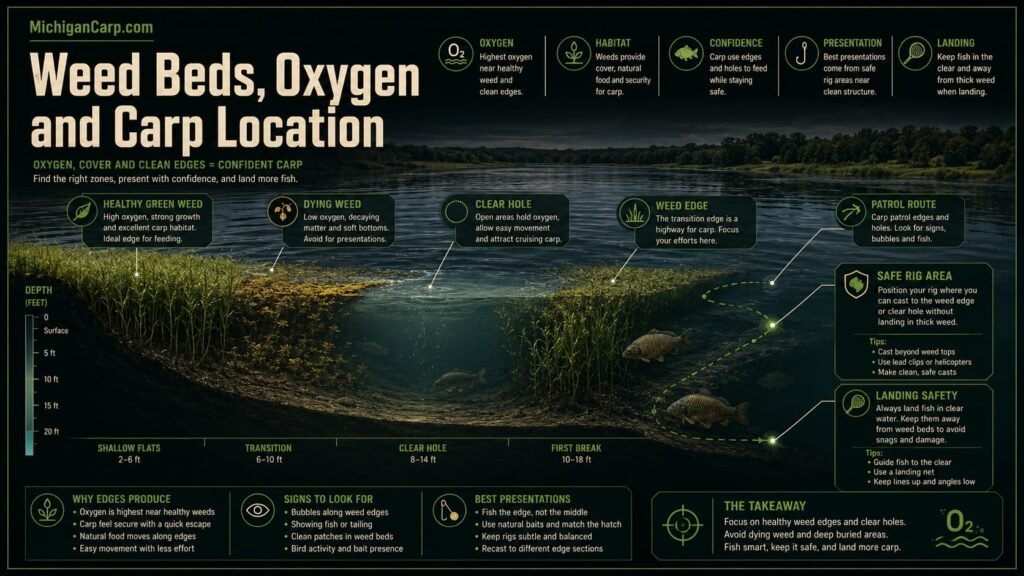
Weed beds and oxygen are closely connected, but weed is not automatically good.
Healthy green weed can be excellent. It can hold natural food, shade, cover, insects, snails, edges, patrol routes and oxygen during daylight. A green weed edge with wind ripple on it can be one of the best summer features on a Michigan lake.
Dying weed is different. Rotting vegetation can make presentation difficult, foul the line, create poor smell, reduce comfort and push fish toward cleaner edges. That does not mean the whole area is useless. Often the best spot is the remaining green weed, the clean edge, the gap, the channel, or the transition between dying weed and better water.
Fishable weed is the key.
A thick weed bed full of carp is not a good swim if every hooked fish will bury itself and break off. Oxygen and food do not override fish care. If you cannot present a rig cleanly, control the fight and land carp safely, the swim is not right.
Better weed-related oxygen spots include outside weed edges, clean holes, channels, windward weed, green weed beside depth, weed near inflows, reed edges, pad edges and clear lanes carp can use confidently.
For the full weed guide, read Weed Beds and Carp Fishing in Michigan.
Inflows, Current and Oxygen
Inflows can be excellent carp features because they may bring oxygen, movement, cooler water, food, color, insects, drifting particles and a clear route into a swim.
But not every inflow is good every day.
An inflow can be too cold in spring. It can be too muddy after heavy rain. It can be too shallow, too disturbed, too public, too fast, too snaggy or simply not connected to where carp are moving. The best inflow is not always the strongest flow. Often the edge, slack, seam or downstream food trap is more useful than the main push.
Good inflow and oxygen situations include hot summer conditions, warm rain after dry weather, cooler water entering a warm bay, flowing water entering a stagnant area, insects or food washing in, baitfish activity, carp rolling near the edge of the flow, weed beds close to the inflow, slack water beside the flow, and colored water or a defined seam.
Carp often feed on edges. That includes current seams, slacks, softer water beside the inflow, downstream food traps, weed edges near the flow, deeper holes beside moving water, points where flow spreads and slows, and areas where food settles.
Fish the usable edge, not necessarily the most violent water.
Oxygen and Deeper Water
Many anglers assume deeper water is always better during summer heat.
Sometimes it is. Sometimes it is not.
Deeper water may offer cooler, more stable conditions, but depending on the lake, depth, stratification and oxygen profile, deeper water may not always be the most comfortable or productive zone. Some lakes develop layers, and deep water can become less useful if the lower layer has poor oxygen.
For bank anglers, this means depth should not be chosen blindly. Do not fish deep just because the air is hot. Fish deeper when depth gives carp comfort and still connects to food, oxygen and movement.
Good deeper oxygen areas often connect to feeding flats, weed edges, shelves, channels, inflows, drop-offs, natural food and safe movement routes.
A 10-foot edge beside a weedbed may be better than 25 feet of lifeless basin. A shaded 6-foot margin with ripple may beat a deep dead zone. A deep channel that connects two food areas may be excellent. The point is connection.
For depth decisions, read Best Depth for Carp Fishing in Michigan Lakes.
Hot, Still Water and Oxygen Risk
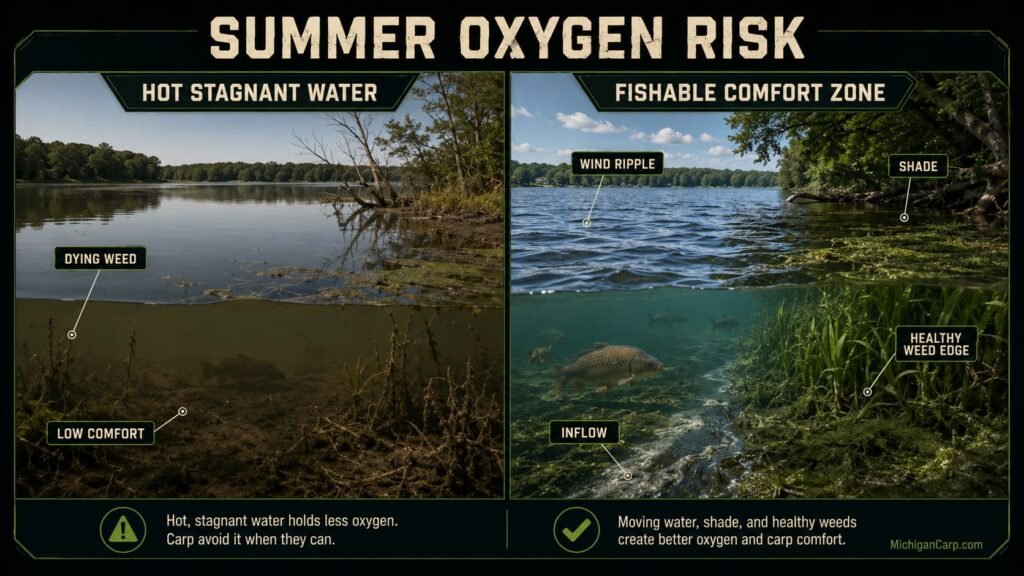
Hot, still water is one of the main times dissolved oxygen becomes a practical fishing issue.
A shallow back bay on a calm, sunny afternoon can look tempting because it is warm and full of surface life. But warmth alone is not enough. If the water is stagnant, full of dying weed, heavy algae, poor smell and no fish signs, it may be uncomfortable.
That is when carp often shift to better water.
They may use wind-rippled margins, shade, inflows, weed edges, deeper safety water, moving water, night feeding windows or dawn routes. They may still visit shallow areas, but the timing becomes tighter. A swim that is poor at 3 PM may be alive at first light or after dark.
This is why hot-weather carp fishing should be planned around comfort, not just bait. A big bucket of feed will not fix a dead oxygen situation.
In very warm weather, fish care also becomes more important. Avoid overplaying fish, keep mats and slings wet, have the net ready, photograph quickly, return fish properly and do not fish areas where landing will be slow or dangerous. For site guidance, use Fish Care and Safety. For human heat safety, check NOAA / National Weather Service Heat Safety.
Dying Weed, Algae and Poor Water
Dying weed and heavy algae can change a swim quickly.
Some algae and weed are normal parts of lake life. Carp will often feed around vegetation, silt, insects, snails and detritus. The problem is not the presence of weed. The problem is when the area becomes stale, decaying, foul, too thick, difficult to present in, or uncomfortable for fish.
USGS notes that bacteria can consume oxygen as organic matter decays, and that stagnant water with rotting organic material can be hard on aquatic life, especially in summer. That is the practical reason anglers should pay attention to dying weed and poor water.
Warning signs include heavy rotting smell, black decaying weed, dead fish, no small fish activity, no carp signs, thick surface scum, bait coming back foul, rigs buried in mush, excessive debris on the line, and a swim that feels lifeless despite looking “weedy.”
When weed begins dying back, do not automatically abandon the whole section of lake. Carp may move to nearby cleaner edges, remaining green weed, reed lines, deeper routes, hard/soft transitions, inflow edges, open holes, or food areas just outside the worst decay.
In fall, this shift can be especially important. The best carp may still be nearby, but not in the same exact spot they used during peak summer weed growth.
For harmful algal bloom background and health cautions, read EPA: Freshwater Harmful Algal Blooms. Do not fish, wade, handle bait, or put dogs near water that appears unsafe or is under a local advisory.
Dawn, Dusk and Night Oxygen Windows
Oxygen helps explain why dawn, dusk and night can be so important in summer carp fishing.
At dawn, the lake is usually quieter. Boat traffic is reduced. Light is low. Carp may still be moving from night feeding areas. A warm lake may have cooled enough for fish to use margins more confidently.
At dusk, daytime pressure begins to fade. Light drops. Shallow areas may become safer. Carp may leave cover, weed or deeper comfort zones and move onto feeding routes.
At night, carp often use margins and shallow food areas more confidently, especially on clear, pressured, hot or busy waters. Night does not guarantee oxygen is perfect, but it often creates a better overlap of safety, lower light and comfort.
This is why oxygen belongs beside bite-window thinking. A bite window opens when conditions overlap. In summer, oxygen is often one of those conditions.
Use Carp Bite Windows in Michigan to connect oxygen with timing.
How to Read Oxygen Without a Meter
A dissolved oxygen meter can be useful, but most carp anglers will not carry one. That is fine. You can still make better decisions by reading practical oxygen clues.
Start with water movement. Wind ripple, wave action, inflows, current seams and moving water are all worth checking. Then look at weed. Healthy green weed, clean edges, open pockets and reed lines often matter more than thick unfishable vegetation. Then look at temperature and timing. Hot still afternoons are different from dawn, dusk, night or cool windy weather.
Watch the fish. Carp showing repeatedly in one area are telling you something. Bubbles, fizzing, rolling, flat spots, reed movement, colored water and liners are all better clues than guessing from the car park.
Also watch what is missing. No small fish, no insects, foul smell, dead water, rotting weed, hot flat surface and no movement can all suggest that a swim is not comfortable at that time.
Use this simple checklist:
| Question | Why it matters |
|---|---|
| Is there wind ripple? | Ripple can improve comfort, cover and movement |
| Is the weed healthy? | Healthy weed can hold food and oxygen; dying weed can be poor |
| Is there moving water? | Inflows and current can refresh a swim |
| Is the water hot and still? | Stagnant heat can reduce comfort |
| Are carp showing repeatedly? | Fish signs beat theory |
| Is there safe landing access? | No oxygen clue is worth unsafe fish care |
Baiting When Oxygen Is Good or Poor
Oxygen should influence baiting.
When carp are comfortable and feeding repeatedly, you can often fish more positively. That may mean controlled particles, boilie crumb, chopped boilies, method mix, pellets where allowed, corn, tiger nuts, or a food bait placed accurately where fish are already moving.
When oxygen is questionable, baiting should usually become tighter and more cautious. Do not try to create a big feeding situation in dead water. Find better water first. A small accurate trap in a comfortable zone is better than a big baited area in a poor one.
In summer, bait can also sour or break down faster in hot shallow water. Particles, method mix, wet groundbait and high-oil baiting should be used with control. Feed what the situation needs, not what you brought in the bucket.
Good oxygen plus fish signs can justify more bait. Poor oxygen plus no fish signs should push you toward moving, reducing bait, changing timing, or waiting for a better window.
For bait strategy, use Carp Bait Guide for Michigan Lakes. For summer bait, read Best Carp Bait for Summer Fishing.
Rig Placement and Fish Care in Oxygen-Sensitive Conditions
Oxygen is not only about getting bites. It also affects how responsibly you fish.
Hot, weedy, low-oxygen conditions can make playing and landing carp more demanding. A carp hooked in thick weed during hot weather may be under more stress than a fish hooked cleanly in open, comfortable water. Long fights, snagged fish, poor landing angles and slow unhooking all become bigger problems.
That does not mean you should avoid all summer weed fishing. It means you should choose fishable edges, safe holes, controlled rig placement and landing areas where fish can be played efficiently.
Before casting, ask:
Can I land a fish from here? Can I keep it out of the worst weed? Is the line angle safe? Is the mat ready? Is the net ready? Is the water too warm for long fights? Is the swim comfortable for the carp after release?
Good watercraft is not only finding carp. It is choosing a setup that lets you catch and release them safely.
For rig safety, use The Complete Michigan Carp Rig Guide. For handling and release, use Fish Care and Safety.
A Simple Oxygen-Based Location Plan
Use this plan when oxygen may be part of the puzzle, especially from late spring through early fall.
Step 1: Start with the season
In spring, warming water may matter most. In summer, oxygen and comfort become stronger filters. In fall, weed change and cooling water can move carp. In winter, stability and access matter more than obvious oxygen clues.
Step 2: Check temperature trend
A warm number alone is not enough. Ask whether the lake is warming, cooling or stable. Then ask whether oxygen and comfort match that temperature.
Step 3: Find movement
Look for wind, ripple, inflows, current seams, healthy weed, shade and areas where water is not dead or stagnant.
Step 4: Find food and cover
Oxygen without food is not enough. Connect oxygen clues to weed edges, silt, mussels, snails, insects, reeds, points, channels, bays or known feeding routes.
Step 5: Match timing
In hot conditions, dawn, dusk and night may be better than midday. In spring or cold water, the warmest part of the day may be better.
Step 6: Bait carefully
Feed to the window. If fish are comfortable and returning, build slowly. If the water is questionable, use small accurate traps or move.
Step 7: Protect the fish
Do not fish unsafe weed, poor landing angles, dangerous heat, lightning, or water that looks unhealthy. A swim full of carp is still the wrong swim if you cannot land and release them properly.
Common Oxygen Mistakes
Assuming warm water is always better
Warm water can help carp activity, but hot stagnant water can be poor. Comfort matters more than warmth alone.
Fishing the thickest weed instead of the safest edge
Carp may use thick weed, but the fishable edge is usually the better angling choice.
Ignoring wind ripple
A light ripple can change light, comfort, oxygen and food movement. Flat calm is not always better.
Over-baiting dead water
If the water is uncomfortable, more bait rarely fixes it. Find better water first.
Assuming deep water is automatically best in summer
Depth helps only when it connects to oxygen, comfort, food and movement.
Ignoring dying weed
Dying weed can change a swim fast. Look for clean edges, remaining green weed and nearby routes.
Forgetting fish care in hot weather
Warm water, weed and long fights can increase stress. Rig placement and landing efficiency matter.
My Practical MichiganCarp View
For Michigan carp fishing, I treat dissolved oxygen as a practical comfort clue.
I do not think anglers need to turn every session into a science project. You do not need to know the exact oxygen reading in every swim. But you should know when oxygen is likely to matter and what visible clues point toward better water.
On big natural lakes, oxygen may connect to wind, weed edges, depth, inflows and low-light movement. On smaller lakes and ponds, hot stagnant corners can switch off quickly. On weedy waters, healthy green edges can be excellent, while dying weed can make carp shift. On public summer waters, the best oxygen and confidence may overlap at dawn, dusk or night.
The main lesson is simple:
Do not fish where carp merely could be. Fish where carp can stay comfortable enough to feed.
That is what dissolved oxygen helps you understand.
FAQ
What is dissolved oxygen in carp fishing?
Dissolved oxygen is oxygen mixed into the water. Carp need oxygen to live, move and feed. For anglers, it helps explain why carp choose some areas and avoid others, especially in warm weather.
Does low oxygen stop carp feeding?
Low oxygen can make carp uncomfortable and reduce feeding confidence. Carp may move to wind, weed edges, inflows, shade, deeper comfort water or low-light feeding windows.
Is oxygen more important in summer?
Yes. Oxygen can matter all year, but warm water holds less dissolved oxygen than cooler water, so summer heat makes oxygen and comfort more important.
Do carp like wind because of oxygen?
Wind can help because it creates ripple, moves food, breaks up light and can improve oxygen near the surface. Carp may use windward banks, weed edges, seams and colored water when the rest of the lake is too still or exposed.
Are weed beds good for oxygen?
Healthy green weed can be good because it holds food, cover and oxygen during daylight. Dying weed can be poor because decay and debris can reduce comfort and make presentation difficult.
Should I fish deeper water when oxygen is low?
Sometimes, but not automatically. Deeper water only helps when it gives carp comfort and still connects to food, oxygen and movement. In some lakes, deeper layers may not be the best oxygen zone.
Can I read oxygen without a meter?
Yes. Look for wind ripple, healthy weed, inflows, moving water, shade, fish signs, low-light movement and areas that feel alive. Avoid hot stagnant water, foul dying weed and dead-looking corners with no signs.
Does bait choice change when oxygen is poor?
Yes. In poor or uncertain oxygen conditions, use smaller, tighter baiting or move to better water. Do not try to create a big feeding spell in water carp do not want to use.
Are inflows always good for oxygen?
No. Inflows can be excellent, but they can also be too cold, muddy, fast, disturbed or unsafe. Fish the seams, slacks and nearby holding areas rather than blindly casting into the strongest flow.
How does oxygen connect to bite windows?
Bite windows often open when oxygen, temperature, food, safety, light and pressure overlap. In summer, oxygen improvement can be one of the reasons carp suddenly feed at dawn, dusk, night, after wind, or after a cooling change.
Next Steps
Read these next:
- Carp Water Temperature Guide for Michigan Lakes
- Carp Bite Windows in Michigan
- Wind, Waves and Current Carp Fishing
- Weed Beds and Carp Fishing in Michigan
- Summer Carp Fishing in Michigan
- Best Depth for Carp Fishing in Michigan Lakes
- Watercraft and Conditions for Michigan Carp Fishing
- Fish Care and Safety
Dissolved oxygen is not a shortcut and it is not a magic answer. It is one of the clues that helps you read comfort. Find water where oxygen, temperature, food and safety overlap, then fish it carefully, accurately and safely.