
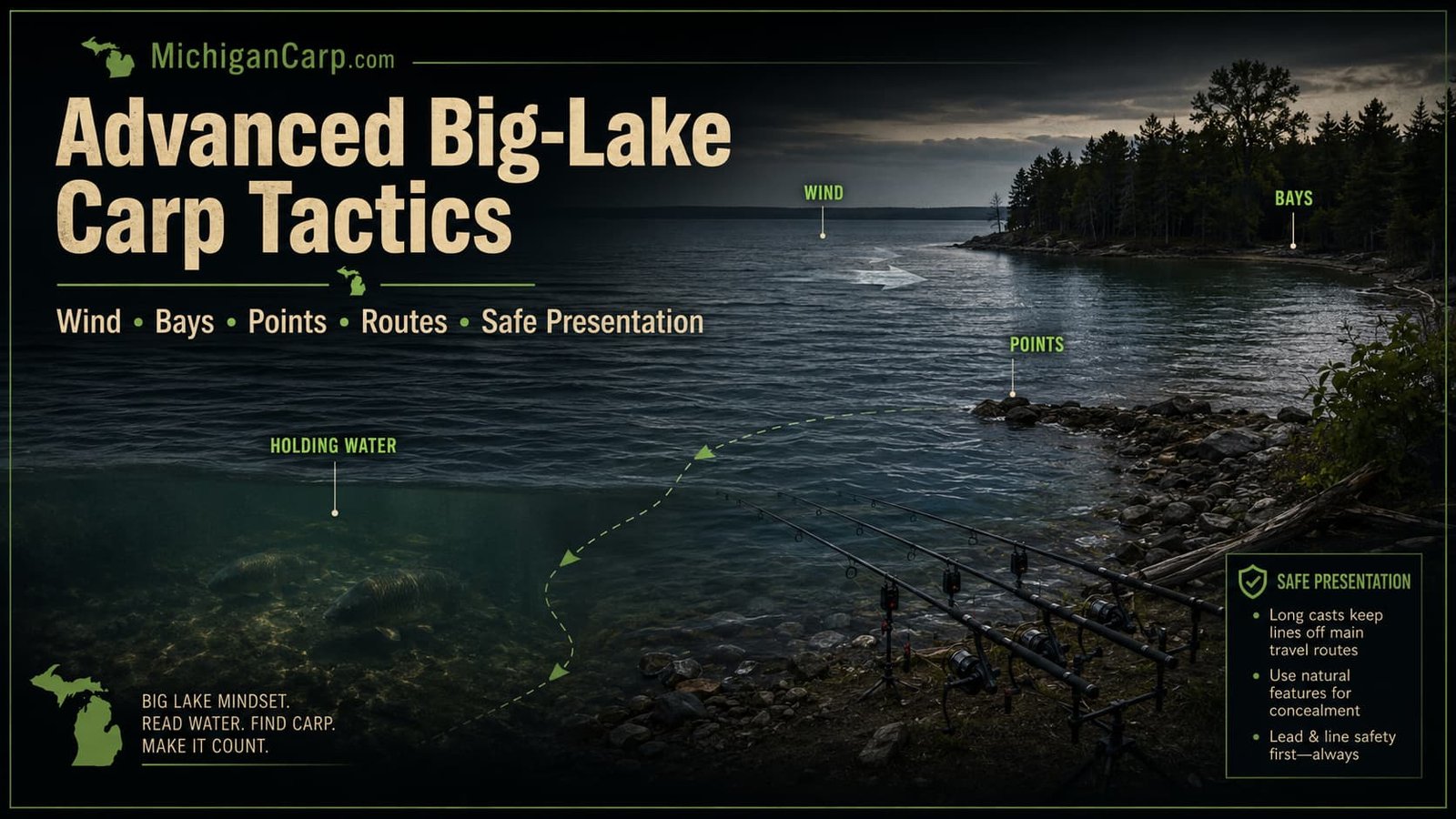
Advanced big lake carp tactics are not about making carp fishing complicated. They are about narrowing huge water into smaller, repeatable decisions: where carp can feed, where they can hold, how they move between those areas, when they feel safe enough to visit, and where a bank angler can present a rig without creating fish-care problems.
Big Michigan lakes can look overwhelming. There may be miles of shoreline, limited public access, boat traffic, weed beds, deep basins, shallow bays, wind lanes, river mouths, points, drop-offs, docks, campgrounds, channels and wide open water that all look possible. If you try to fish all of it, you end up guessing.
The goal is not to cover more water blindly. The goal is to reduce the lake to a short list of high-probability zones.
For the foundation process, start with How to Find Carp in Lakes. For pre-trip research, use How to Research New Carp Waters in Michigan. This article builds on both and applies them to larger waters where distance, access, wind, pressure and long-session decisions matter more.
Table of Contents
Quick Answer: Big-Lake Carp Tactics That Matter Most
On big waters, the best tactic is usually not a special rig or a giant baiting campaign. It is a better decision chain. Research the water first. Choose access with fishable water in front of you. Use wind, depth, weed, points, bays and pressure to narrow the lake. Watch for signs. Fish safe routes between holding water and feeding water. Bait with control. Stay only when the swim keeps giving you reasons to stay.
| Big-lake problem | What it means | Best tactical response |
|---|---|---|
| Too much water | You cannot fish the whole lake | Narrow it to bays, points, routes, weed edges and access zones |
| Limited bank access | The best-looking area may not be fishable | Choose safe access with depth, food, routes and landing space |
| Changing wind | Carp may shift with ripple, warmth, oxygen and food movement | Fish wind when it improves the zone, not as a blind rule |
| Daytime silence | Carp may be holding, not feeding | Fish the route from holding water to feeding water |
| Boat pressure | Public-water disturbance can move carp off exposed water | Watch dawn, dusk, night, quiet corners and no-wake edges |
| Three rods wasted | Random spread gives poor feedback | Give each rod a job: feeding, route, safety water |
| Overbaiting | Too much bait can lock you into a bad swim | Start controlled, then build only when signs justify it |
| Unsafe features | Weed, snags, rocks and distance can cause lost fish | Fish the safe edge and plan the landing before casting |
The simple rule is:
Do not try to fish a big lake. Fish the best small part of the big lake.
Why Big Lakes Are Different
Small ponds often let you learn carp movement quickly. You can see most of the water, hear fish at night, watch margins, and move without losing the whole session. Big lakes do not work that way.
On a large lake, carp may have several feeding zones, several holding zones and several routes between them. They may use one bay in spring, a windward weedline in summer, a deeper edge during bright pressure, a quiet margin after boat traffic fades, and a different route when the wind changes. The lake may fish like several smaller waters joined together.
That means big-lake fishing rewards process. You need a way to narrow the water before you arrive, then a way to test your assumptions once you are there. The mistake is treating a big lake like a giant pond and hoping a baited spot will pull fish from anywhere.
Big-lake carp tactics are built around five questions:
- Where can carp feed naturally?
- Where can carp hold safely during the day?
- How do they travel between those zones?
- When do conditions make the route fishable?
- Can I land fish safely from this bank?
If you cannot answer those questions, the swim is still a guess.
Research Before You Arrive
Big-lake tactics start before the rods leave the truck.
Use maps, satellite imagery, public access information, fisheries reports, Master Angler clues, lake contours, boat launch locations, parks, campgrounds, road ends and shoreline structure to build a shortlist. Michigan DNR provides inland lake maps for many lakes, but also notes that those maps may not fully represent current conditions. That is important: maps help you plan, but the lake still has to confirm the plan. Use Michigan DNR Inland Lake Maps as a starting point.
For trophy-potential clues, the Michigan DNR Master Angler Program can be useful because it records large fish submissions and can show where big fish have been caught, when they were caught and what general methods were used. It is not a secret-spot list and should not be treated that way. Use it as one clue, not proof. Use Michigan DNR Master Angler and State Record Information carefully and respectfully.
Before a trip, look for:
- public banks that are actually legal and practical to fish;
- large shallow bays connected to deeper water;
- points that create wind lines and travel routes;
- weed beds, reed lines, pads and visible vegetation edges;
- old channels, narrows, river mouths, inflows and outflows;
- campground banks with night access and landing space;
- quiet corners away from heavy boat traffic;
- depth changes within realistic casting range;
- wind options for different directions;
- safe places to net and release fish.
For the complete pre-trip workflow, read How to Research New Carp Waters in Michigan.
Narrow Huge Water Into Zones
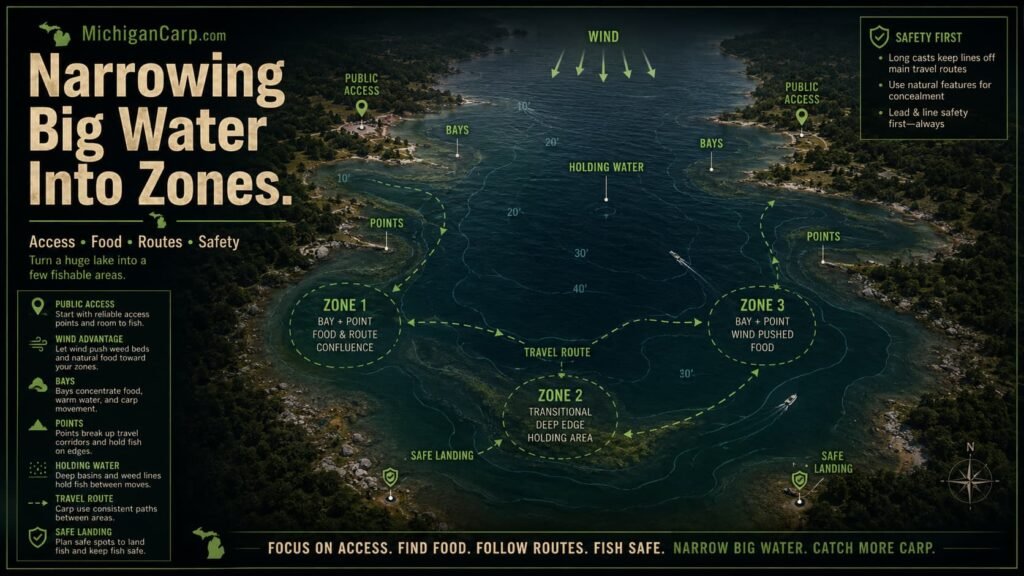
A big lake becomes manageable when you stop seeing it as one giant piece of water.
Break it into zones. A bay mouth is a zone. A windward weed edge is a zone. A campground bank with depth within casting range is a zone. A shallow flat beside a channel is a zone. A point with deep water on one side and a food-rich bay on the other is a zone.
Each possible zone needs a reason. Access alone is not a reason. Deep water alone is not a reason. A beautiful view is not a reason. A good big-lake zone usually has several things working together: food, cover, comfort, movement, safe access and timing.
Good zones often include:
- Bay mouths where carp move between shallow feeding water and deeper lake water;
- points that concentrate wind, food movement and patrol routes;
- weed edges that provide food, shade, oxygen and safety;
- drop-offs near flats, reeds or silt;
- narrows and channels that naturally funnel movement;
- wind lines that create ripple, color and confidence;
- quiet pressure zones where carp can hold during boat traffic;
- campground or public banks that combine access with real fish habitat.
Do not pick ten areas to fish at once. Pick two or three possible zones. Watch them. Compare them. Fish the one that gives the clearest reason.
Use Wind, Bays, Points and Depth Together
Wind is a major big-lake clue because it affects surface movement, food drift, ripple, water color, comfort and sometimes oxygen. But wind is only useful when it improves the water carp are likely to use.
A warm wind pushing into a shallow bay can be excellent in spring. A steady summer ripple on a weed edge can give carp confidence and improve comfort. A crosswind across a point can create a route. Wind hitting a dead, snaggy, unfishable bank is just a problem.
Points matter because they connect water. A point may give carp a patrol line, a wind edge, a depth change and access to both shallow and deeper water. Bays matter because they often contain food, warmer water, silt, vegetation and low-light feeding opportunities. Depth matters because it gives carp safety and movement options.
The strongest big-lake zones often combine all four:
- a windward bay mouth with weed and deeper water nearby;
- a point where wind pushes across a shelf;
- a reed-lined bay with a channel lip within casting range;
- a weed edge that drops into mid-depth holding water;
- a quiet side of a point after boat traffic starts;
- a deeper safety route that produces liners before dusk feeding.
For a dedicated guide, read Wind, Waves and Current Carp Fishing. For depth decisions, read Best Depth for Carp Fishing in Michigan Lakes.
Find Holding Water and Feeding Water
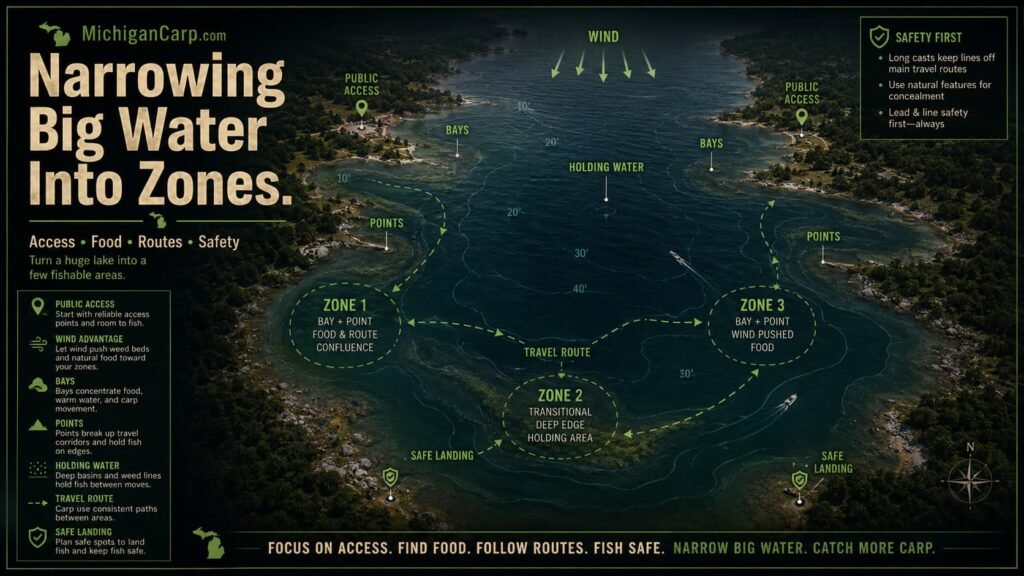
On big lakes, carp may feed in one place and hold in another. That is why a swim can look perfect at dawn and feel dead by noon, or show no activity all afternoon and suddenly produce at dusk.
Holding water is where carp feel safe and comfortable. Feeding water is where carp expect food. The route between them can be the best place to fish because carp may use it repeatedly even when they are not staying on the baited area for long.
Daytime holding water may include:
- deeper water near a bay;
- the open-water side of a weed bed;
- shade, reeds or pads;
- a quiet bank away from boat pressure;
- a channel lip or depth transition;
- a safe corner with oxygen and cover;
- mid-depth water close to shallow food.
Feeding water may include:
- soft silt with bubbles and clouding;
- weed holes and clear lanes;
- reed bases and pad edges;
- mussel or snail areas;
- shallow flats in low light;
- wind-blown food lines;
- inflows, outflows and food traps.
The key tactic is not always to cast into the middle of either zone. Often the best rod is on the clean edge, exit line, shelf or route that connects the two.
For the detailed holding-water guide, read Where Carp Hold During the Day. For feeding clues, read Signs Carp Are Feeding.
Use Weed Beds Without Losing Fish
Weed is one of the most important big-lake features because it can hold natural food, shade, oxygen, confidence and safe movement. Michigan EGLE describes native aquatic plants as valuable because they oxygenate water and provide habitat and food resources for fish and wildlife. Use Michigan EGLE: Native Aquatic Plants for the habitat background.
For carp anglers, weed is useful but dangerous. The thickest weed may hold carp, but it may not be the right place to put a rig. A fishable weed edge is better than an impossible jungle. A clear hole is better than a buried hookbait. A safe lane is better than a heroic cast into cover you cannot control.
On big waters, look for:
- the outside edge of weed close to depth;
- clear holes inside lighter weed;
- lanes between pads and open water;
- weed beds close to wind ripple;
- weed ending on a shelf or drop-off;
- fishable reed gaps and margin shade;
- safe line angles and open landing water.
Do not fish weed purely because carp are there. Fish weed where the carp are likely to move and where you can land them safely.
For the full weed article, read Weed Beds and Carp Fishing in Michigan. For rig safety, read The Complete Michigan Carp Rig Guide.
Read Oxygen and Temperature on Big Water
On big lakes, comfort can move carp as much as food does. Hot, still, low-oxygen water may look good but fish poorly. Wind-rippled water, inflows, green weed, shade, deeper routes and low-light periods can all become more important when the lake warms.
USGS explains that cold water can hold more dissolved oxygen than warm water, and that stagnant water tends to hold less dissolved oxygen than rapidly moving water. Use USGS: Dissolved Oxygen and Water for the science background.
In practical terms, oxygen and temperature help explain why carp may shift from a shallow bay to a wind-rippled edge, from a dead corner to an inflow seam, or from bright open water to deeper comfort water during the day.
Do not treat oxygen as a magic answer. Read it with weed, wind, temperature trend, depth, signs and safe access. A theoretical oxygen clue is weaker than real fish activity. But when oxygen, temperature, wind and signs line up, they can explain why one large-water zone is alive and another looks empty.
For deeper detail, read Dissolved Oxygen and Carp Fishing and Carp Water Temperature Guide for Michigan Lakes.
Plan for Boat Pressure and Public-Water Disturbance
Big public waters change through the day. A swim that looks calm at 6 a.m. may be full of boats, jet skis, swimmers, kayaks, wakes and bank noise by noon. Carp may still be in the area, but they may move tighter to weed, deeper water, shade, quiet corners, no-wake zones or routes they use after the lake settles.
This is why dawn, dusk, night and post-traffic windows matter so much. On pressured big waters, the best location may be the route carp use when disturbance drops, not the place they would feed if the lake was always quiet.
Look for pressure escape clues:
- fish showing before boat traffic starts;
- liners on deeper rods during the day;
- margin activity after dark;
- weed edges producing when open flats go quiet;
- bites after evening boat traffic fades;
- quiet banks that look ordinary but keep showing signs.
Boat pressure does not always ruin a swim. Sometimes it tells you where the safe zone is. The fish may only move a short distance, but that short distance can decide the session.
Use Three Rods as a Tactical System
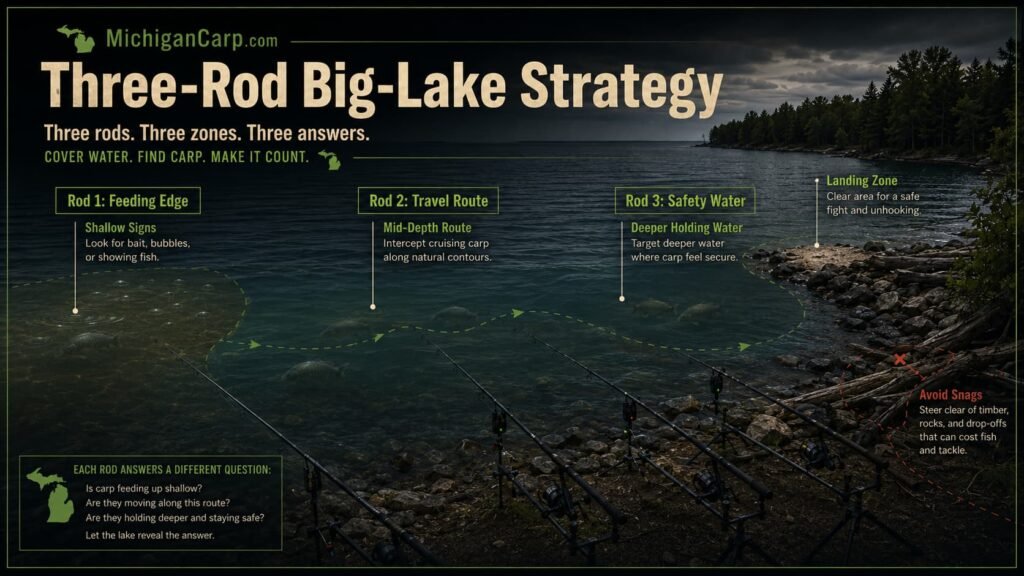
Three rods should not mean three guesses.
On big water, each rod should answer a question. One rod can test feeding water. One rod can test the travel route. One rod can test deeper safety water. The exact layout changes with the swim, but each rod needs a job.
A useful three-rod big-lake plan might look like this:
- Rod 1: a shallow feeding edge, clean weed hole, silt patch or margin route;
- Rod 2: a mid-depth patrol line, bay mouth, shelf or weed edge;
- Rod 3: deeper safety water, a channel lip or holding route.
This gives feedback. If the shallow rod works at dawn and dusk, you may have a feeding window. If the mid-depth rod gets liners all afternoon, you may be on a travel route. If the deeper rod produces in bright conditions, the carp may be holding farther back than expected.
Do not spread rods so far apart that you cannot manage them. Do not cross line angles through weed or boat lanes. Do not fish a rod in an unsafe snag area just to “cover water.” Safe control matters more than maximum spread.
A three-rod setup should help you read the lake, not just increase the number of hookbaits in the water.
Baiting Rhythm on Big Waters
Big-lake baiting is about rhythm, not dumping feed blindly.
Heavy bait can work when you already know fish are using an area and you are building a longer campaign. But on new or uncertain big water, too much bait can be a trap. It can lock you into the wrong zone, feed nuisance fish, spread carp away from the hookbait, or make you wait in dead water because you feel committed.
Start with the location. Then bait to match the job.
For a search session, use controlled baiting: small amounts of particle, chopped boilie, crumb, PVA sticks, or a compact patch around a clean presentation area. For a longer session on a proven zone, build gradually when signs, liners, rolling fish or bites show that carp are present.
Think in three baiting modes:
| Baiting mode | When to use it | Practical approach |
|---|---|---|
| Search mode | New water or uncertain swim | Small controlled bait, easy to adjust or move |
| Route mode | Carp are passing through | Accurate bait on the line of movement, not a huge spread |
| Hold-and-build mode | Repeated signs or proven area | Increase bait carefully to keep fish returning |
On Michigan waters, particles, boilie crumb, chopped boilies, tiger nuts, maize, hemp, peanuts and method-style mixes can all have a place. The important part is not the ingredient list. It is whether the bait fits the location, bottom, fish activity and session length.
For bait decisions, read Carp Bait Guide for Michigan Lakes and Particle Prep for Carp Fishing.
When to Stay, Move or Return Later
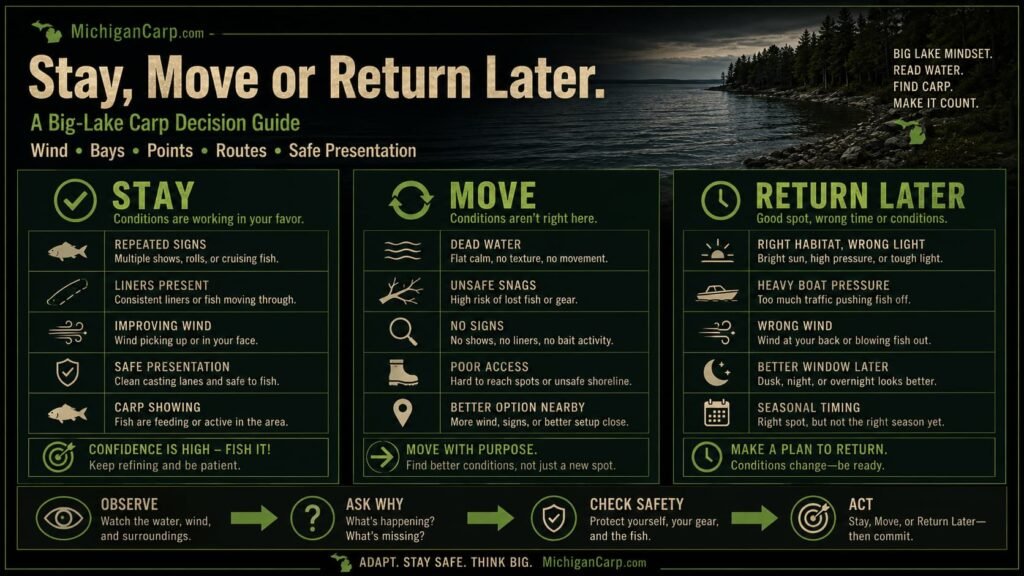
Big-lake anglers waste a lot of time in swims that no longer deserve confidence.
The answer is not to move constantly. It is also not to sit stubbornly in dead water. You need a decision system.
Stay when the swim keeps giving reasons
Stay when you see repeated signs, liners, rolling fish, bubbling, clouding, weed movement, dusk activity, good wind, safe presentation or a clear connection between holding water and feeding water. Even without a bite, a swim can be worth staying in if the evidence keeps building.
Move when the swim gives no reason
Move when the water stays dead, the wind turns wrong, boat pressure destroys the presentation, weed makes the rig unsafe, or another researched zone gives a stronger case. On a short search session, a dead swim should not get the whole day just because it was convenient.
Return later when the timing is wrong
Some big-lake spots are good but not right now. A shallow bay may be a dawn or dusk swim. A campground margin may be a night swim. A windward bank may need a warmer wind. A pressured swim may need the boats to leave. Do not write off good habitat because you viewed it at the wrong time.
Ask three questions before moving:
- Have I seen any proof carp are using this water?
- Are the conditions improving or declining?
- Is there a better zone I can fish safely?
If the answer is no proof, declining conditions and a better safe option, move.
Long-Session Strategy
Long sessions on big water are different from quick evening trips.
With more time, you can watch patterns develop. You may see dawn signs, midday holding clues, evening movement, night feeding, wind changes and boat-pressure patterns. The mistake is to use extra time only to sit longer. Use it to learn faster.
On a two- or three-night session, build the plan around zones and windows:
- watch the water before committing all rods;
- start with controlled bait rather than a huge dump;
- give rods different jobs;
- record which rod gets liners, signs or bites;
- adjust by zone, depth and timing;
- bait more only when fish give you a reason;
- keep one rod available for visible signs if possible;
- protect safe landing routes before dark.
Big-lake sessions often improve when you stop thinking of the swim as one spot. Fish it as a small system: margin, weed edge, route, deeper water, feeding window and pressure response.
Safe Bank Fishing on Big Water
Big water can create big fish-care problems if the swim is chosen badly.
Distance, weed, rocks, zebra mussels, stumps, current, boat wakes, steep banks and poor landing access can all turn a promising spot into a bad decision. Before casting, ask how the fish will be played, where it will run, where the line will touch, where the net will go and where the fish will be unhooked.
Safe big-lake tactics include:
- choosing a clear landing zone before fishing;
- avoiding impossible weed and snag angles;
- using line and leaders appropriate to the water;
- keeping rods close enough to react quickly;
- using safe lead arrangements;
- not fishing across heavy boat lanes;
- having net, mat, sling and water ready;
- leaving fish alone if they are in unfishable cover.
A swim is not a good carp swim if you cannot land and release carp properly from it.
For fish-care setup, read Fish Care and Safety.
Common Big-Lake Mistakes
Trying to fish the whole lake
You cannot cover a large lake by spreading bait and hope. Narrow the water into zones with food, safety, movement and access.
Choosing access before carp location
The easiest bank is not always the right bank. Start with carp reasons, then choose the safest fishable access.
Fishing deep water without a reason
Depth matters when it connects to food, safety or movement. Random deep water is still random water.
Following wind blindly
Wind helps when it improves the swim. Cold, unsafe, unfishable or dead windward water is not automatically good.
Overbaiting too early
Heavy bait before confirmation can lock you into a bad area. Start controlled and build when fish activity justifies it.
Ignoring boat pressure
On public waters, boat traffic can change carp location through the day. Watch early, late and after pressure drops.
Putting three rods on the same guess
Three rods should test different parts of the system: feeding, route and safety water.
Fishing unsafe weed or snags
Carp being present is not enough. The swim must allow clean presentation, control, netting and safe release.
My Practical MichiganCarp View
For big Michigan waters, I do not see advanced tactics as secret tricks. I see them as better discipline.
Research the water before you go. Do not waste time fishing empty access. Use wind, bays, points, weed, depth and pressure to reduce the lake. Watch for signs. Understand where carp hold during the day and where they feed during windows. Put each rod somewhere with a reason. Bait with control. Move or return later when the evidence says the timing is wrong.
The best big-lake anglers are not just casting farther or baiting heavier. They are reducing uncertainty.
Big water becomes easier when you stop trying to fish all of it.
FAQ
What makes big-lake carp fishing different?
Big lakes have more water, more routes, more access problems, more wind influence, more boat pressure and more possible holding areas. The tactic is to narrow the lake into fishable zones with clear reasons.
Where should I start on a big Michigan lake?
Start with public access that connects to real carp habitat: bays, points, weed edges, depth changes, inflows, outflows, quiet corners, channels or routes between feeding water and safety water.
Should I fish the wind on big lakes?
Fish the wind when it improves the swim by adding ripple, food movement, warmth, oxygen, color or confidence. Do not fish dangerous or unfishable wind just because it is windward.
How many rods should I use on a big lake?
Use the number of rods you can manage safely and legally. With three rods, give each rod a job: one on feeding water, one on a route and one on deeper or safer holding water.
Should I bait heavily on big waters?
Not at first. Start with controlled baiting until fish activity confirms the area. Increase bait only when signs, liners, bites or repeated visits justify it.
How long should I give a big-lake swim?
That depends on the session and whether you are prebaiting. On a search session, no signs, poor conditions and a better safe option may justify moving. On a campaign, the same swim may deserve more time if past evidence supports it.
Are big-lake carp usually far out?
Not always. Carp may feed close to margins, reeds, weed and shallow bays during low light or quiet periods. Distance only helps when it reaches a better zone.
How do boat wakes affect carp location?
Boat traffic can push carp off exposed areas and into weed, shade, deeper water, quiet corners or low-light routes. It can also make presentation and fish care harder, so line angle and landing safety matter.
What is the biggest mistake on big lakes?
The biggest mistake is fishing where access is easy without understanding why carp would use the water. Convenience is not location.
What is the best advanced tactic for big lakes?
The best advanced tactic is a repeatable decision process: research, narrow the water, observe signs, fish routes, bait with control, and protect fish safety.
Next Steps
Use these guides to build the full big-lake system:
- How to Find Carp in Lakes
- How to Research New Carp Waters in Michigan
- Where Carp Hold During the Day
- Signs Carp Are Feeding
- Best Depth for Carp Fishing in Michigan Lakes
- Weed Beds and Carp Fishing in Michigan
- Wind, Waves and Current Carp Fishing
- Dissolved Oxygen and Carp Fishing
- Carp Water Temperature Guide for Michigan Lakes
- Carp Bite Windows in Michigan
- Carp Bait Guide for Michigan Lakes
- The Complete Michigan Carp Rig Guide
- Fish Care and Safety
- Carp Fishing Tactics in Michigan
- Watercraft and Conditions for Michigan Carp Fishing
Advanced big-lake carp fishing is not about guessing harder. It is about making better decisions with bigger water in front of you.