
Water temperature is one of the most useful clues in Michigan carp fishing. It affects where carp hold, how far they move, how long they feed, when they use shallow water, how much bait they are likely to tolerate, and whether a swim is improving or fading.
The important thing is not just the number on the thermometer. A lake warming from 44°F to 48°F can fish better than a lake sitting at 52°F after a sharp cold front. A shallow bay rising all afternoon may be more important than the main basin reading. A hot summer margin can look alive but fish poorly if oxygen, weed, pressure or timing are wrong.
This carp water temperature guide explains how to use water temperature as a practical decision tool for Michigan lakes, dam ponds, drowned river mouths, river-connected systems, canals, channels and public-access waters.
For the wider seasonal picture, start with Michigan Carp Fishing Seasons. For reading wind, oxygen, weed and weather alongside temperature, use Watercraft and Conditions for Michigan Carp Fishing. For year-round movement, read Seasonal Carp Movement in Michigan.
The simple rule is this:
Do not fish the calendar. Fish the water in front of you.
Table of Contents
Quick Start: Carp Water Temperature at a Glance
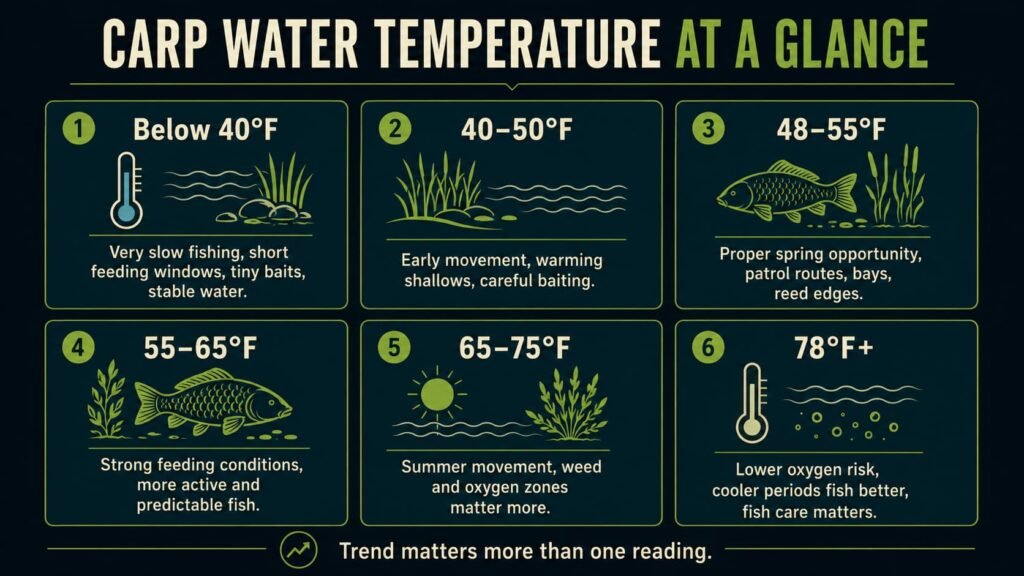
Use this table as a practical starting point, not as a rigid rulebook. Carp can feed outside these ranges, especially when the trend, food supply, oxygen, pressure and location are right.
| Water temperature | What it usually means | Best starting approach |
|---|---|---|
| Below 40°F | Very slow fishing, short windows, limited movement | Stable water, tiny feed, small hookbaits, warmest part of the day |
| 40–48°F | Early movement can begin, especially after sun or stable weather | Protected shallows, dark bottoms, reed edges, light baiting |
| 48–55°F | Proper spring opportunity, more signs and more movement | Patrol routes, bays, margins near depth, small accurate feed |
| 55–65°F | Strong spring feeding, wider movement, pre-spawn activity | Margins, shelves, weed edges, bars, controlled baiting |
| 65–75°F | Summer feeding and movement, but oxygen and pressure matter | Low light, wind-affected water, weed edges, shade and night windows |
| Above 75°F | Heat, oxygen, fish care and timing become more important | Avoid stagnant water, fish cooler windows, stay organized and handle fish quickly |
If you only remember a few things from this carp water temperature guide, remember these:
- Below 45°F, keep bait small, accurate and easy to eat.
- 45–52°F can produce good early-season windows when the water is rising or stable.
- 52–60°F is often a strong spring range for movement, patrol routes and feeding.
- 60–68°F can bring confident feeding, pre-spawn activity and shallow-water use.
- Above 68°F, oxygen, weed, shade, pressure and timing become more important.
- Rising or stable water often beats a warmer number that is falling after a cold front.
- On big Michigan lakes, one or two degrees can be enough to move fish.
Temperature Trend Matters More Than One Reading
A single thermometer reading can help, but the trend tells the story.
A lake at 48°F after three warming days may fish better than a lake at 52°F after a sharp cold front. A shallow bay rising from 43°F to 49°F during the afternoon may pull carp in even if the main lake still feels cold. A summer lake sitting at 79°F may produce better at night than during the day because oxygen, light and comfort change through the cycle.
When checking water temperature, ask:
- Is the temperature rising?
- Is it falling?
- Has the weather been stable?
- Are nights warming or cooling?
- Is the shallow water warmer than the main lake?
- Is wind pushing warmer surface water into a bay?
- Has a cold rain entered the system?
- Is a heatwave reducing oxygen?
- Is fall cooling creating a feeding window?
This is why keeping notes is so important. Write down the water temperature, weather trend, wind direction, time of bites and depth. After a few sessions, patterns start to appear.
For wider timing decisions, read Carp Bite Windows in Michigan.
Michigan Notes: Why Lakes Do Not Warm Evenly
Michigan carp fishing can punish anglers who treat the whole lake as one temperature.
Northern Michigan waters can stay deceptively cold even when the air feels mild. Shallow bays can warm faster than the main basin. Dark bottoms can gain heat quicker than pale sand. Wind can move warmer surface water into one corner while chilling another. A dam pond with current, depth and river influence can behave differently from a shallow natural lake.
Watch for:
- cold nights dragging progress back
- shallow bays warming first
- dark bottoms holding heat better
- bigger lakes lagging behind smaller waters
- protected reed edges warming before exposed banks
- stable runs of weather producing the best windows
- inflows, channels and current changing the local pattern
A couple of calm sunny days can wake up one end of a lake while another area still feels lifeless. Wind can help, but only if it pushes into water carp already have a reason to use.
For reading lake structure and features, use Reading a Lake Like a Carp Angler. For depth decisions, use Best Depth for Carp Fishing in Michigan Lakes.
Below 40°F: Very Cold Water and Short Windows
Below 40°F, carp fishing becomes highly precise. Carp can still be caught where safe, legal, ice-free access exists, but they usually move less, feed less often and respond poorly to heavy baiting.
Look for:
- stable deeper water
- slow current
- soft silt pockets
- areas close to winter holding water
- slight warm-water influence where legal and safe
- quiet banks with minimal disturbance
Baiting should be minimal. Think small hookbaits, tiny PVA sticks, a little crumb, a few grains of corn or a very tight patch of attraction. The aim is not to build a big feeding area. The aim is to place something acceptable close to fish that may only feed briefly.
For cold-water bait choice, read Best Carp Bait for Cold Water and Best Liquids for Carp Fishing in Cold Water.
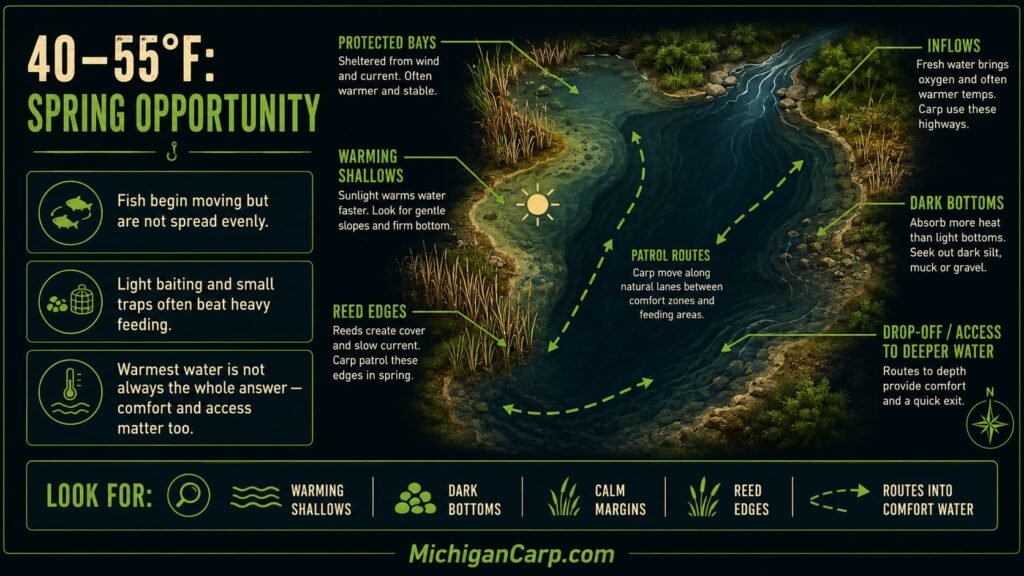
40–48°F: Early Movement and Warming Shallowness
The 40–48°F range is often where the season starts to feel possible again. Carp may not feed heavily, but they can begin visiting areas that warm faster than the rest of the lake.
This is a classic early spring range in Michigan. A protected shallow bay, reed edge, dark-bottom margin or soft silt pocket can become interesting before the rest of the water feels ready. Carp may slide in during the warmest part of the day, especially after several stable or sunny days.
Good areas often include:
- protected shallow bays
- dark-bottom corners
- reed edges
- soft silt near deeper safety water
- sun-facing banks
- inflows if they are warmer than the main lake
- routes between deeper water and shallow comfort water
Do not overbait this range. A few bright grains, a small boilie, a tiger nut, a light stick mix or a single hookbait can be enough. The biggest mistake is feeding as though the fish are already in late spring mode.
For dedicated early-season location, read Spring Carp Fishing in Michigan and Where to Fish for Carp in Spring on Michigan Waters.
48–55°F: Proper Spring Opportunity
From roughly 48°F to 55°F, carp often become more consistent. They may move farther, show more clearly and visit spring feeding areas with more confidence.
This does not mean every shallow swim becomes good. The best areas still need food, warmth, safety and a route back to deeper water. But the odds improve. You may see more rolling, fizzing, clouding, reed movement and shallow patrols.
Good signs include:
- routes into shallow water
- faint bubbling around silt
- rolling or showing near reed edges
- clean margins with food
- dark-bottom bays
- areas that warm several degrees during the day
- stable weather rather than sharp cold fronts
This is where a controlled baiting approach starts to make more sense. Small beds of corn, hemp, crumb, chopped boilies, tiger nuts, light particles or a careful method mix can all work when carp are actually present.
The key is still accuracy. Feed the route or the small area the fish are using, not the whole bay.
55–65°F: Strong Feeding, Pre-Spawn Movement and More Confidence
The 55–65°F range can produce excellent carp fishing in Michigan. Fish may be moving more freely, natural food is increasing, and shallow areas can become much more active.
This is also where spawning confusion can begin. Carp may be visible, active and noisy without being easy to catch. Pre-spawn fish can feed strongly, but active spawning fish are often focused on reproduction rather than bait.
Common carp are associated with shallow vegetated spawning areas, and Michigan DNR notes that common carp generally prefer shallow, muddy habitats with aquatic vegetation and spawn in spring. For species background, see Michigan DNR: Common Carp and Suckers.
In practical fishing terms, separate three phases:
Pre-spawn feeding
Carp may feed well, move widely and use shallow routes, bay mouths, reed edges, weed growth and soft-bottom food areas. This can be one of the best windows of the year.
Active spawning
Carp may crash, roll, chase, push through vegetation and show everywhere, but they may be poor targets from a normal fishing point of view. Give them space when they are clearly spawning.
Post-spawn recovery
Fish can become inconsistent for a while, then gradually return to feeding areas as conditions settle.
For the full behavior guide, read The Spawning Cycle — Before, During and After.
What Water Temperature Do Carp Spawn At?
Carp spawning is not triggered by one exact number everywhere. Day length, weather stability, shallow water warming, lake type, vegetation, depth, sex ratio and local conditions all matter.
As a practical Michigan angling guide, watch carefully once shallow water is moving through the 60s°F, especially when warm nights and stable weather arrive. Some fish may begin showing spawning behavior before or after the range you expect, and different areas of the same lake can be ahead or behind.
For a broader aquaculture reference, FAO material on common carp propagation describes an optimal spawning temperature range around 18–22°C, which is roughly 64–72°F. See FAO: Artificial Propagation of Warm-Water Finfishes. That is useful background, but a fishing decision still has to be made from the water in front of you.
Do not mistake visible carp for feeding carp. If fish are clearly spawning, crashing through reeds and ignoring bait, the best answer is usually to leave them alone and look for fish that are actually feeding before or after the main spawning activity.
65–75°F: Summer Feeding, Weed, Oxygen and Pressure
The 65–75°F range can be excellent. Carp are active, natural food is abundant, weed beds are developing and feeding windows can become more repeatable.
But this is where many Michigan anglers start making summer mistakes. Warm water does not automatically mean easy fishing. Boat traffic, weed, oxygen, nuisance fish, turtles, bright sun, pressure and timing can all change the result.
In this range, look for:
- weed edges rather than solid weed
- clear holes inside weed beds
- shade lines
- inflows and moving water
- wind lanes that bring food and oxygen
- mussel beds and natural food zones
- dawn, dusk and night routes
- quiet banks away from heavy daytime pressure
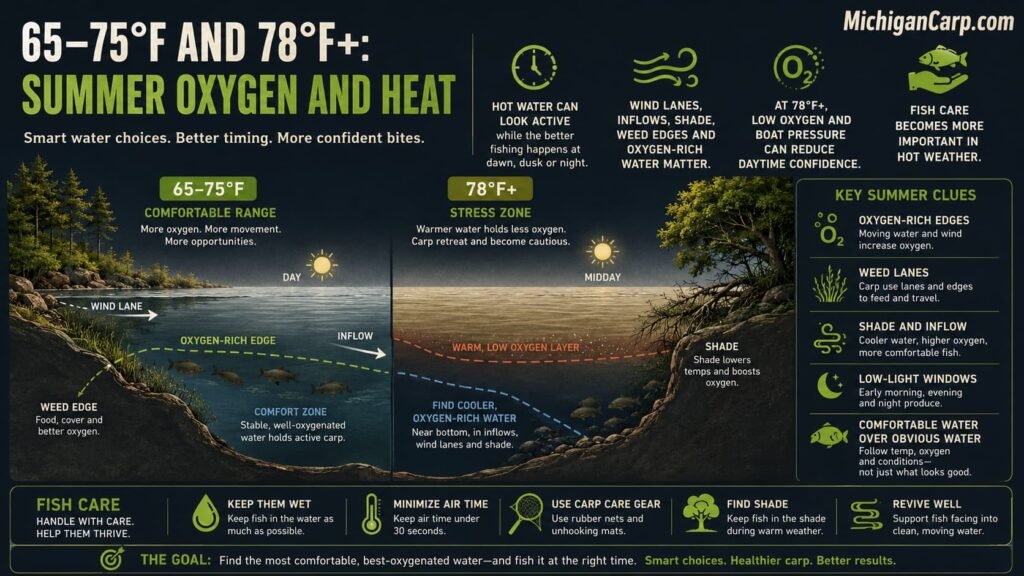
Summer can support more bait than early spring, but only when carp are staying in the area. If you are getting liners, bubbling, repeated shows or bites, you can build the swim. If signs are brief, keep bait tighter and fish for windows.
For summer-specific strategy, read Summer Carp Fishing in Michigan. For summer bait choice, read Best Carp Bait for Summer Fishing.
Above 75°F: Heat, Oxygen and Fish Care Come First
Above 75°F, carp may still feed, but conditions can become trickier. Hot, still, shallow water can carry less oxygen, nuisance fish can become more active, and carp may shift feeding toward low-light or nighttime windows.
This is not just a catch-rate issue. It is also a fish-care issue.
In hot weather, avoid treating every visible carp as a good target. Pay attention to oxygen, water movement, weed condition and how hard fish fight. Keep the net, mat, sling, camera and release route ready before you cast. Do not overplay fish. Do not leave carp out of water longer than necessary.
Better hot-weather starting points include:
- wind-affected water
- healthy weed edges
- inflows
- shade
- deeper routes near food
- night routes
- early morning and dusk windows
- areas with lower boat pressure
Hot water does not mean “use more of everything.” It means read the whole system. If carp are feeding hard, you can feed. If the swim is stagnant, pressured or low in oxygen, more bait will not fix the problem.
For oxygen decisions, read Dissolved Oxygen and Carp Fishing in Michigan Lakes. For safe handling, use Fish Care and Safety.
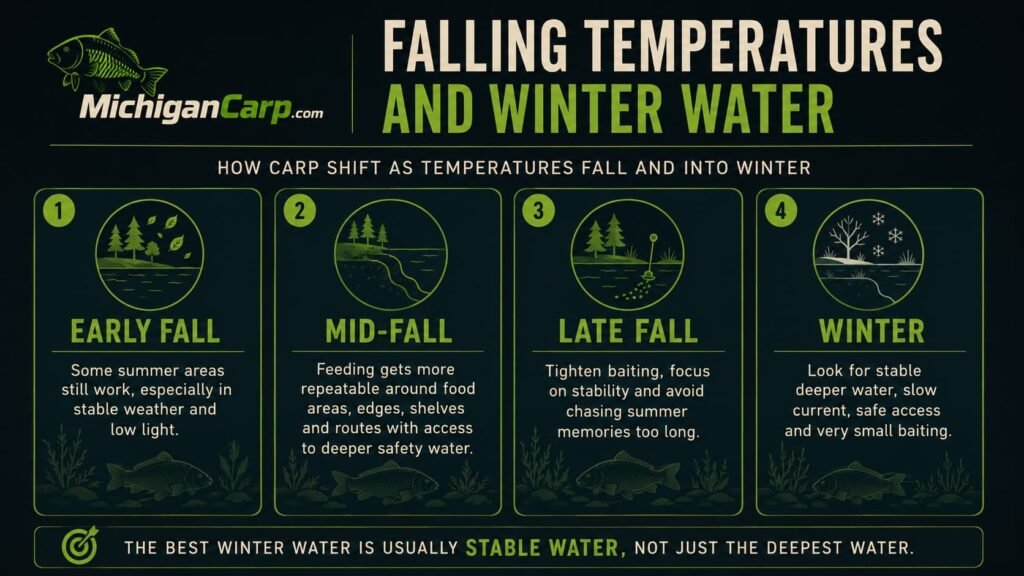
Falling Fall Temperatures: Food Windows Before Winter
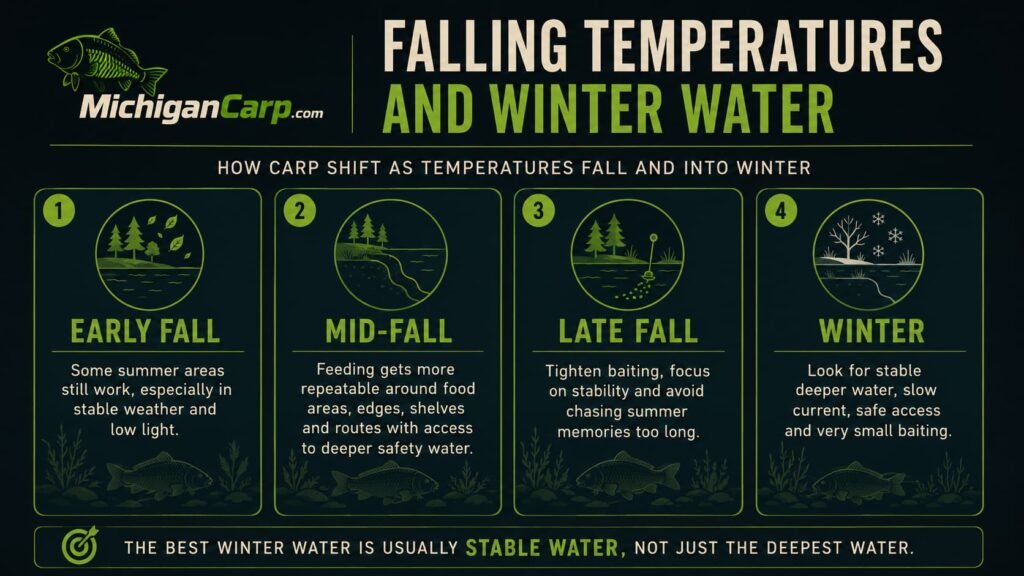
Fall can be one of the best periods of the year for Michigan carp fishing.
As water temperatures begin falling from summer highs, boat pressure drops, weed changes, natural food becomes more concentrated and carp often feed before winter. But the fall pattern is not simple. Early fall can still fish like summer. Mid-fall can produce strong food-led windows. Late fall can become more like cold-water fishing.
The key is trend.
A gradual cooling trend can keep fish feeding steadily. A hard cold front can shorten windows. A mild spell after cold weather can briefly switch fish back on.
In fall, look for:
- deeper routes near feeding areas
- weed edges that remain healthy
- dying weed transitions
- soft silt
- mussel and snail areas
- river mouths and channels
- drop-offs near flats
- areas where fish can move between food and winter comfort
- wind-blown banks during stable conditions
Baiting can be more food-value focused than spring, but it still needs control. Boilies, chopped boilies, corn, hemp, tiger nuts, prepared particles, crumb and method mix can all work when carp are feeding. Late fall asks for more accuracy and less waste.
For dedicated fall strategy, read Fall Carp Fishing in Michigan.
Temperature and Depth
Temperature and depth are connected.
In spring, shallow water may warm faster than deep water. In summer, shallow water may become too warm, too weedy or too low in oxygen during certain periods. In fall, deeper routes may become more important as fish prepare for colder conditions. In winter, stable deeper water may hold fish.
But depth is never just a number.
Ask:
- Where is the warmest useful water?
- Where is the most comfortable water?
- Is there food at that depth?
- Is there oxygen?
- Can carp move safely from holding water to feeding water?
- Is the bottom fishable?
- Can I land fish safely from this angle?
A shallow dark-bottom lake warms differently than a deep clear lake. A weedy reservoir behaves differently than a Great Lakes channel. A small bay connected to a large lake may warm faster than the main basin. Depth should always be chosen with temperature trend in mind.
For the dedicated depth article, use Best Depth for Carp Fishing in Michigan Lakes.
Temperature and Wind
Wind can change how temperature affects carp location.
A warm wind in spring can push surface warmth, food and comfortable water into a bay or bank. A cold wind can chill shallow margins and push fish away. In summer, wind can help oxygenate water, move food, break up bright conditions and make carp more confident. In fall, wind can activate a food-rich bank during a cooling trend.
But wind is not magic. A wind-blown bank with no food, no safe depth and no fish route may still be poor. A sheltered bank may be better if it is warmer, safer or connected to a holding area.
Use wind with temperature, not instead of it.
For the full guide, read Wind, Waves and Current Carp Fishing. For official forecasts before a session, check NOAA / National Weather Service.
Temperature and Baiting Amount
Water temperature should change how much bait you introduce.
Cold water usually means shorter feeding windows, slower movement and a lower tolerance for heavy bait. Warm water can support more feeding, but only when carp are actually present and conditions are safe. Hot water can increase activity but also create oxygen, nuisance fish and fish-care problems.
| Situation | Baiting approach | Main mistake |
|---|---|---|
| Very cold water | Tiny feed, single hookbaits, small PVA sticks | Trying to build a big bed of bait |
| Early spring warming | Small accurate patches, easy food, careful observation | Overbaiting before fish are ready |
| Late spring / pre-spawn | Controlled feed where carp are genuinely feeding | Mistaking spawning activity for feeding |
| Summer feeding | Build only when fish stay in the area | Feeding heavily in dead or pressured water |
| Hot, low-oxygen periods | Tighter traps, low-light timing, careful fish care | Assuming warm water always means more bait |
| Fall cooling | Food-value bait where routes and signs confirm fish | Fishing random water with too much confidence |
| Late fall | Smaller, accurate feed near stable routes | Feeding like it is still September |
For bait choice by water type and season, read Carp Bait Guide for Michigan Lakes.
How to Take Useful Water Temperature Readings
You do not need to turn carp fishing into a laboratory exercise. A simple thermometer can help if you use it consistently.
Take readings in places that answer real fishing questions:
- near the bank you plan to fish
- inside a shallow bay
- at the mouth of the bay
- near an inflow
- on the windward bank
- on the sheltered bank
- in the morning and late afternoon
- after a cold night
- after several sunny days
- after a cold front or warm rain
Do not treat one reading as gospel. Use it to compare areas and trends. If one bay is 3°F warmer than the main lake in spring and has soft silt, reeds and signs of carp, that is useful. If a hot shallow margin is warmer than everything else in July but stagnant and lifeless, that is also useful.
The goal is not to find the “perfect” number. The goal is to understand what the temperature is telling you about carp location, comfort and feeding risk.
Common Water Temperature Mistakes
Fishing the air temperature instead of the water
A warm sunny day does not mean the lake is warm. Michigan water can lag far behind the air, especially on larger or deeper waters.
Ignoring cold nights
A shallow bay may improve all afternoon, then lose progress overnight. Spring success often depends on several stable days, not one warm afternoon.
Overbaiting cold water
Early spring and winter punish heavy baiting. Fish for one bite first, then build only if signs justify it.
Assuming summer is automatically easy
Warm water can mean active carp, but it can also mean low oxygen, heavy weed, nuisance fish, boat pressure and better night feeding than daytime fishing.
Mistaking spawning for feeding
Visible carp are not always feeding carp. Active spawning behavior can look exciting but produce poor fishing and should be treated with restraint.
Ignoring trend
Rising, stable and falling water are often more important than the exact number.
My Practical MichiganCarp View
For Michigan carp fishing, I use water temperature as a decision tool, not a rulebook.
In early spring, I want warming water, protected shallows, nearby safety water and signs that carp are actually using the area. In summer, I care less about chasing the warmest water and more about oxygen, weed, shade, food, pressure and timing. In fall, I watch the cooling trend and look for food-rich areas connected to deeper routes. In winter or very cold water, I want stability, safety, tiny feed and realistic expectations.
The best question is not:
What temperature do carp feed at?
The better question is:
What does this temperature tell me about where carp are likely to be today?
Answer that, and bait choice becomes much easier.
FAQ
What is the best water temperature for carp fishing?
Carp can be caught across a wide range, but spring and fall warming or stable periods can be especially useful. As a practical Michigan guide, 48–65°F often brings strong movement and feeding potential, while summer fishing depends more heavily on oxygen, weed, pressure and timing.
Do carp feed in cold water?
Yes, carp can feed in cold water, but feeding windows are usually shorter and location becomes more important. Use tiny feed, small hookbaits, accurate casting and stable water.
Is 40°F too cold for carp fishing?
It is difficult, but not impossible where safe, legal, ice-free access exists. Expect short windows, subtle signs and very light baiting.
What water temperature starts spring carp fishing?
There is no exact start, but early movement often becomes more realistic as shallow areas climb through the 40s°F and remain stable or warming. Protected bays, dark bottoms and reed edges can wake up before the main lake.
What temperature do carp spawn at?
Spawning depends on more than one number, but shallow water moving through the 60s°F into stable warm conditions is an important practical warning zone. FAO material describes common carp spawning temperature around 18–22°C, roughly 64–72°F, but local lake conditions still matter.
Are visible carp always feeding?
No. Carp may show, roll, chase, spawn or cruise without feeding. During active spawning, visible carp can be poor targets. Look for feeding signs such as steady bubbling, clouded silt, repeat visits to a spot and fish returning calmly to food areas.
Does summer heat make carp easier to catch?
Not always. Summer can be excellent, but heat also brings oxygen issues, boat pressure, nuisance fish, heavy weed and better low-light feeding. Dawn, dusk and night can be more important than midday warmth.
Should I use more bait in warm water?
Only if carp are present and feeding confidently. Warm water may allow stronger feeding, but heavy bait in the wrong place still fails. In hot or low-oxygen conditions, tighter baiting and better timing are often smarter.
Is falling water temperature bad for carp fishing?
A sharp drop can slow fishing, especially after a cold front. Gradual fall cooling can be excellent because carp may feed around remaining food sources before winter.
Should I measure water temperature every session?
It helps, especially in spring and fall. The value is not just the number; it is comparing areas, tracking trends and learning which conditions produce bites on your waters.
Next Steps
Use these guides next:
- Michigan Carp Fishing Seasons
- Watercraft and Conditions for Michigan Carp Fishing
- Seasonal Carp Movement in Michigan
- Spring Carp Fishing in Michigan
- Summer Carp Fishing in Michigan
- Fall Carp Fishing in Michigan
- Winter Carp Fishing in Michigan
- Dissolved Oxygen and Carp Fishing
- Carp Bite Windows in Michigan
- Wind, Waves and Current Carp Fishing
- Carp Bait Guide for Michigan Lakes
- Fish Care and Safety
Water temperature will not tell you everything, but it will stop you guessing. Read the trend, compare areas, match the season, watch the fish, and let the lake tell you how much bait, depth and patience the session really needs.