

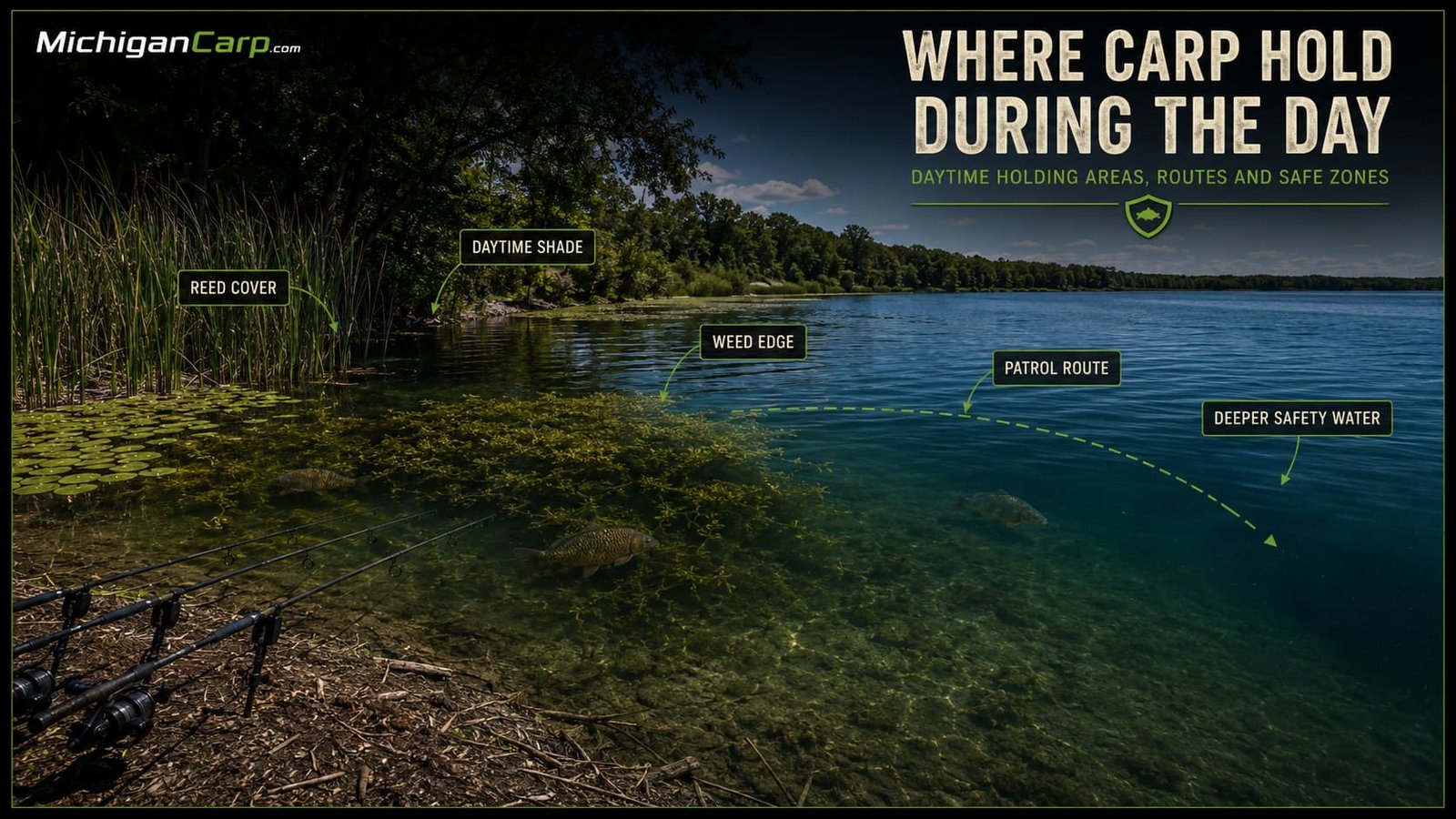
Where carp hold during the day is not always the same place they feed. That is one of the most important location lessons in Michigan carp fishing. Carp may feed on a shallow flat at first light, drift back to a weed edge after the sun rises, sit in deeper safety water through bright pressure, then move again at dusk when the lake quiets down.
Carp rarely wander randomly around a lake. They use holding areas because those areas offer comfort, safety, oxygen, shade, cover, stable temperature, low disturbance or easy access to food. A good daytime holding zone gives carp a place to pause without being exposed, stressed or too far from the next feeding opportunity.
This article focuses on the specific question:
Where do carp sit, rest, patrol or hold during the day when they are not obviously feeding?
For the wider parent process, start with How to Find Carp in Lakes. For visible feeding clues, use Signs Carp Are Feeding. This article sits between those two: it helps you understand where carp may be when they are present but not giving you obvious feeding signs.
Table of Contents
Quick Answer: Where Carp Hold During the Day
During daylight, carp often hold in areas that provide safety, comfort and a route back to food. The exact location changes with season, water temperature, oxygen, light, wind, weed growth, boat traffic and angling pressure.
| Daytime holding area | Why carp use it | How to fish it |
|---|---|---|
| Deeper water near food | Security, stable temperature and quick access to feeding areas | Fish the shelf, lip or route rather than random deep water |
| Weed beds and weed edges | Cover, shade, oxygen, food and confidence | Fish clean holes, lanes and safe outside edges |
| Reeds, pads and shaded margins | Low light, cover, insects, silt and quiet water | Fish quietly with strong tackle and a safe landing route |
| Soft silt near cover | Natural food, warmth and rooting opportunities | Look for bubbles, clouding and repeated signs |
| Drop-offs and depth changes | Routes between feeding water and safety water | Fish the transition line, not just the deepest water |
| Boat-pressure escape zones | Reduced disturbance during busy daylight periods | Watch quiet corners, no-wake areas and protected banks |
| Wind-affected weed or edges | Ripple, cover, food movement and oxygen | Fish the wind only when it improves the holding zone |
| Low-light exit routes | Movement lines from daytime holding to evening feeding | Place one rod on the route before the bite window opens |
The simple rule is:
Find the safe daytime holding water, then fish the edge or route that connects it to food.
Holding Water Is Not Always Feeding Water
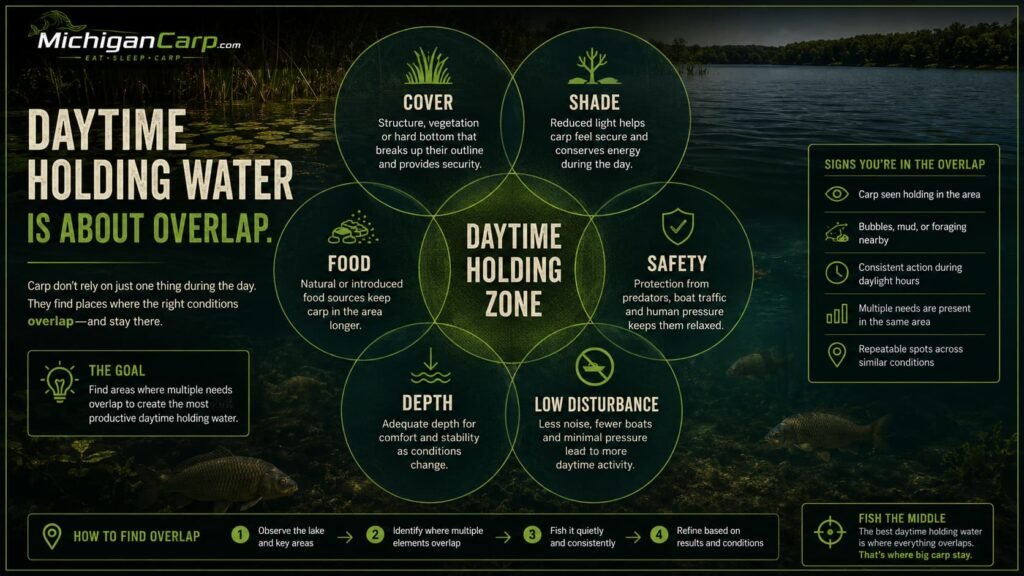
A common mistake is assuming carp spend all day exactly where they feed. Sometimes they do, but often they do not.
A shallow bay may hold carp at dawn, go quiet under bright sun, then come alive again at dusk. A weed bed may hold carp through the day, while the clean gravel edge beside it produces the bite. A deeper shelf may not contain much natural food, but it may be the safe place carp use before sliding onto a silt flat or margin later.
That means a blank daylight swim does not always mean carp are absent from the area. They may simply be holding just off the feeding spot, sitting in cover, using a deeper lip, tucked into shade, or waiting for light, wind, pressure or oxygen to change.
Think of daytime location in three connected parts:
Holding water is where carp feel safe and comfortable.
Feeding water is where carp expect to find food.
Travel water is the route between them.
When you understand that chain, you stop casting randomly at the middle of the lake. You start fishing edges, exits, patrol lines and timing windows.
Deep Safety Water Near Feeding Areas
Deeper water can be one of the most reliable daytime holding areas, especially in clear, pressured or bright conditions. Carp may use depth for security, temperature stability and separation from bank disturbance, boats, predators and overhead pressure.
But “deep water” by itself is not enough. Random deep water can be empty. The productive deep zone is usually connected to something else: a shallow bay, weed edge, channel lip, silt flat, mussel bed, point, reed line, inflow, outflow or evening feeding route.
On many inland Michigan lakes, a useful daytime pattern is shallow food near deeper safety water. Carp can hold off the feeding area, then slide in when conditions improve. This is especially important on clear lakes, pressured campground waters, dam ponds, drowned river mouths and big public waters where carp may not want to sit exposed in bright water all day.
Good deep-holding clues include:
- a shelf dropping from shallow feeding water;
- a weed edge falling into deeper water;
- a channel or old riverbed near flats;
- a point with deep water on one side;
- a bay mouth with a defined lip;
- repeated liners along one depth line;
- fish showing briefly but not staying shallow;
- daytime quiet followed by dusk activity nearby.
Do not automatically cast to the deepest water you can reach. Often the better spot is the first clean shelf, the top of the drop, the bottom of the lip, or the route from depth to food.
For the full depth system, read Best Depth for Carp Fishing in Michigan Lakes.
Weed Beds, Shade and Daytime Cover
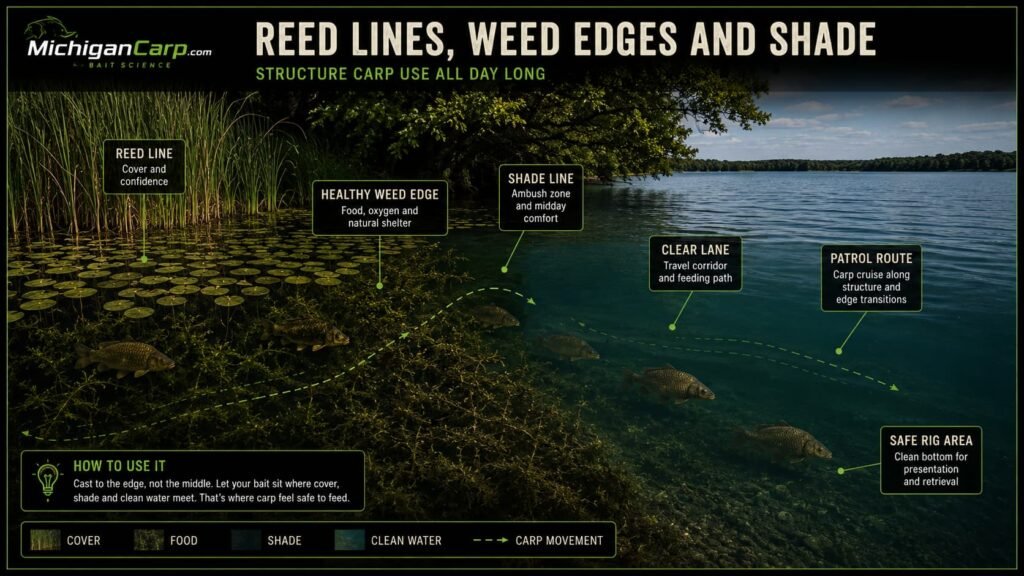
Weed beds are one of the strongest daytime carp-holding features on Michigan lakes.
Healthy aquatic vegetation can provide cover, shade, oxygen, natural food and security. Michigan EGLE describes native aquatic plants as valuable for inland lakes because they oxygenate water and provide habitat and food resources for fish and wildlife. The practical fishing lesson is simple: when weed is healthy, fishable and connected to food or depth, carp often have a reason to be there. Use Michigan EGLE: Native Aquatic Plants for the habitat background.
Carp may sit inside weed during bright daylight, especially when the lake is clear or pressured. They may also use the outside edge as a patrol route. The most fishable spot is often not the thickest weed. It is the clean edge, the hole, the lane, the pad opening, the reed gap, or the edge where weed meets firmer bottom.
Shade works in a similar way. Overhanging trees, steep banks, docks where legal and safe, reed shadows, pad shade and dark weed can all give carp confidence during the day. Shade is especially useful when it lines up with food, low disturbance and a clear exit route.
Good weed and shade holding clues include:
- pads ticking or moving without obvious wind;
- reeds knocking or trembling;
- bubbles along the inside or outside weed edge;
- clouded water near clear holes;
- carp bow waves under shade;
- liners near the open-water side of weed;
- fish showing at dawn or dusk near the same bed;
- safe landing access from the bank.
Good weed fishing is precise. Thick weed may hold carp, but it may not be responsible to fish directly in it. Fish the safe edge, not the impossible middle.
For the full article, read Weed Beds and Carp Fishing in Michigan. For rig choices around weed, use The Complete Michigan Carp Rig Guide.
Reeds, Lily Pads and Quiet Margins
Reeds, lily pads and quiet margins can hold carp during the day because they offer cover, food, shade and low disturbance. These areas are especially important on public waters where open banks, boat lanes and bright shallow flats receive pressure.
A reed line can act as a holding zone, a feeding edge and a travel route. Carp may sit just inside cover, push through gaps, root along the base, or move along the outside edge before entering shallow feeding water. Lily pads can work the same way, especially when there are clear holes, silt pockets or clean lanes nearby.
Margins are easy to underestimate. Many anglers cast past carp that are sitting close to the bank because the far water looks more impressive. During the day, a quiet margin with shade, weed, silt, insects and low foot traffic can hold carp that would never sit in an exposed open bay.
The challenge is safety. Reed and pad fishing requires strong tackle, close control, clean line angles and a clear landing route. A holding area is not a good swim if every hooked fish is likely to become stuck.
Fish close cover only when you can manage the fight. Keep the net ready. Keep the mat ready. Stay near the rods. Do not fish impossible cover just because carp are there.
For fish-care decisions, read Fish Care and Safety.
Soft Silt and Natural-Food Beds
Soft silt can be both a feeding area and a holding area. It often contains insect larvae, snails, worms, detritus and other natural food sources. Carp may root directly in it, hold nearby, or patrol the edge when conditions are right.
The key is to separate productive silt from dead, foul or unfishable bottom. Productive silt often has life around it: bubbles, small fizzing, clouding, birds, weed edges, insect activity, snail shells, mussels nearby or repeated carp signs. Dead silt may feel black, foul, very soft and difficult to present on.
Carp may hold near silt during the day because it gives them food access without needing to travel far. But hookbait presentation matters. A heavy rig buried in soft bottom may not work well. A balanced hookbait, lighter lead arrangement, short chod-style approach, wafter, pop-up, PVA stick or clean edge presentation may be better depending on the bottom.
Useful silt holding spots include:
- soft pockets inside weed;
- silt beside reed beds;
- the edge between clean bottom and soft bottom;
- bay mouths with insect-rich sediment;
- quiet corners with bubbles and clouding;
- deeper silt close to a shallow feeding flat.
Do not avoid all silt. Learn to read it. Some of the most natural carp-feeding areas are not clean gravel or sand.
Drop-Offs, Shelves and Transition Lines
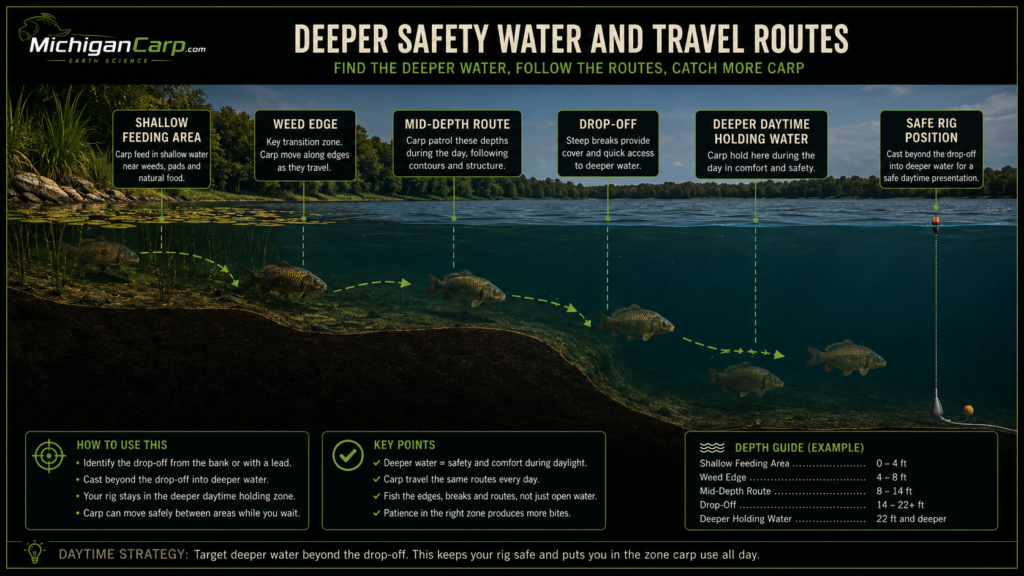
Transition lines are often more important than the deepest or shallowest water.
A drop-off gives carp quick access between food and safety. A shelf lets them patrol without committing fully to the shallows. A weedline that follows a depth change can become a natural daytime highway. A bay mouth can act like a doorway between shallow feeding water and the main lake.
Carp often hold where they can move with minimum risk. That might be halfway down a slope, tight to the weed edge, along the bottom of a shelf, or on the open-water side of a shallow flat. These locations allow fish to slide up, drop back or patrol without crossing exposed water for long.
Look for:
- the first drop outside a shallow bay;
- weed ending on a clean depth line;
- a channel edge close to feeding flats;
- a point where one side is shallow and one side is deeper;
- gravel or hard bottom falling into silt;
- reeds with deeper water close by;
- liners at the same distance or depth;
- dusk bites after quiet daylight holding.
When in doubt, fish the transition. A bait on a clean line between safety and food is often more useful than a bait placed deep in either zone.
Wind-Protected Water vs Wind-Affected Water
Carp can hold in sheltered water during the day, but they can also hold on wind-affected water. The better choice depends on what the wind is doing to the swim.
Sheltered bays can be useful when they are warmer, quieter, darker, protected from boat pressure, or connected to weed and food. In spring, protected shallow water can warm faster than the main lake. In clear conditions, carp may use shade and calm cover to feel safe.
Wind-affected water can be useful when it adds ripple, oxygen, food movement, color and confidence. A steady ripple on a weed edge can make carp more comfortable. Wind pushing into a bay can move surface food and warm water. A crosswind along a shelf can create a patrol line.
The mistake is using “fish the wind” as a blind rule. Cold wind, violent waves, unsafe banks, poor line control and unfishable weed can all turn wind into a problem.
Ask what the wind is doing:
- Is it warming or cooling the area?
- Is it pushing food into habitat?
- Is it adding cover and ripple?
- Is it improving oxygen?
- Is it making the bank unsafe?
- Is it pushing carp into or away from the holding zone?
For the full moving-water system, read Wind, Waves and Current Carp Fishing.
Oxygen, Temperature and Daytime Comfort
Daytime holding water is strongly affected by comfort. Carp may avoid water that looks good if it is too hot, too bright, too stagnant, too disturbed or low in oxygen.
USGS explains that cold water can hold more dissolved oxygen than warm water, and that stagnant water tends to contain less oxygen than rapidly moving water. In practical carp terms, hot, still, decaying weed water can be less attractive than a wind-rippled edge, inflow seam, shaded margin or deeper comfort route. Use USGS: Dissolved Oxygen and Water for the science background.
This does not mean carp always abandon shallow water in summer. They may still use shallow water during dawn, dusk, night, wind ripple or storm windows. But during bright daylight, comfort often pushes them toward weed, shade, inflows, depth, ripple or quiet holding zones.
Temperature trend also matters. A warming spring margin may pull carp in during the afternoon. A hot summer margin may fade by midday. A fall shelf may become useful when cooling water moves food and fish toward more stable routes.
For the full oxygen article, read Dissolved Oxygen and Carp Fishing. For temperature, read Carp Water Temperature Guide for Michigan Lakes.
Boat Pressure and Human Disturbance
On many Michigan public waters, daytime carp location is not only about natural features. It is also about pressure.
Boat traffic, jet skis, swimmers, bank noise, campground activity, repeated casting, bright headlamps at dawn, foot traffic, dogs, kayaks and angling pressure can all change where carp feel safe. A perfect-looking shallow margin may become poor once the lake gets busy. A quieter corner, weed edge or deeper route may hold more fish simply because carp can sit there without constant disturbance.
Pressure does not always push carp miles away. Sometimes it moves them slightly deeper, tighter to weed, under shade, behind a point, into a no-wake zone, onto a less obvious bank, or onto a route they use after dark.
Useful pressure clues include:
- fish showing before boat traffic starts;
- bites only after the lake quiets down;
- liners on deeper rods during the day;
- activity in no-wake or low-traffic areas;
- margins producing only at night;
- carp using shaded or weedy banks instead of open flats.
Do not judge a public-water swim only at noon on a busy day. Watch it early, late and after pressure fades. Daytime holding water often reveals itself by what happens before and after the disturbance.
Seasonal Holding Patterns
Carp holding areas change through the year. The same swim can be excellent in spring, average in summer and poor in fall if temperature, weed and food shift.
Spring
In spring, carp may hold near deeper safety water but visit shallow warming zones when conditions improve. Reed edges, dark-bottom bays, soft silt, protected corners and shallow water close to depth are all worth watching. The best holding areas often connect cold-water safety to warming food.
Summer
In summer, daylight holding water often involves weed, shade, oxygen, pressure escape and deeper comfort. Carp may feed shallow at night or low light, then sit near weed edges, inflows, shade or depth during bright periods.
Fall
In fall, carp may hold along food routes, remaining green weed, shelves, bay mouths and depth transitions. As shallow weed dies or food shifts, the best holding areas may move closer to deeper water or more reliable natural-food zones.
Winter and very cold water
In winter or very cold water, holding areas become more stable. Carp may group in deeper basins, slow-current zones, channels, soft silt, sheltered water or deeper areas close to food. Movement can be limited and feeding windows may be short.
For the full seasonal system, use Michigan Carp Fishing Seasons.
How to Fish Daytime Holding Areas
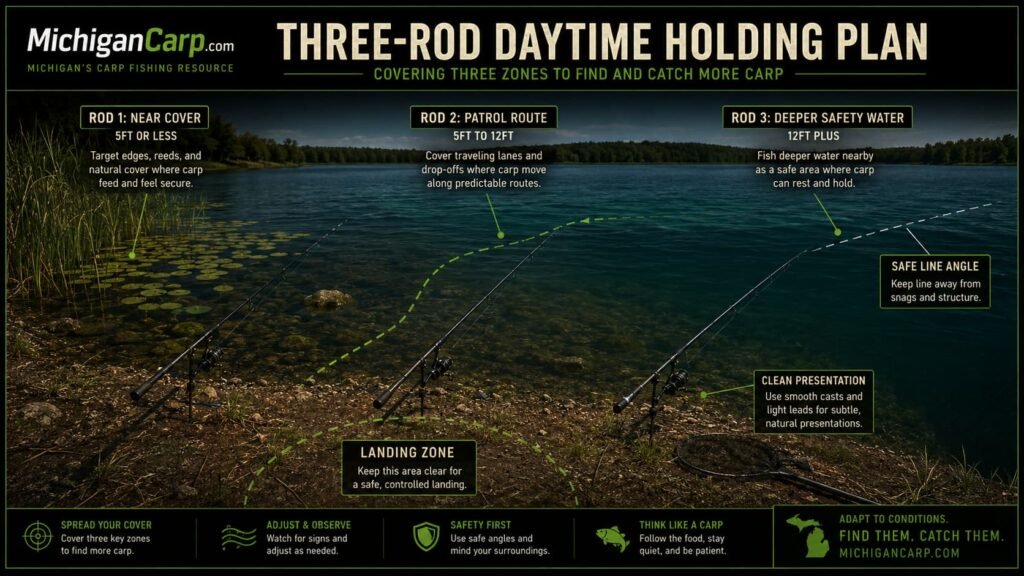
Finding holding water does not always mean casting into the middle of it.
If carp are buried in thick weed, reeds, pads, timber or snags, the safest and most effective place may be the edge. Fish the lane they use to leave cover. Fish the clear hole where they feed. Fish the shelf just outside the weed. Fish the route from holding water to evening feeding water.
Three rods can cover three different jobs:
- Rod 1: the clean edge of the holding zone;
- Rod 2: the patrol route or exit line;
- Rod 3: nearby deeper safety water or feeding approach.
This tells you more than three rods all cast to the same guess. If the edge rod produces liners, carp may be moving but not feeding. If the route rod catches at dusk, the holding water is probably correct. If the deeper rod gets daytime activity, fish may be sitting back from the feature.
Bait lightly until the area proves itself. Holding fish may not want a big bed of bait dropped on their heads. A single hookbait, small PVA stick, a few chopped boilies, a controlled particle patch or a subtle food signal may be enough to turn a holding route into a bite.
Keep presentation clean. A bait buried in weed or deep silt may be close to carp but still ineffective. The best spot is the place carp will use and you can fish properly.
Common Mistakes With Daytime Holding Water
Fishing only the obvious shallow feeding area
Carp may feed shallow early and late but hold farther back during the day. Fish the connected route, shelf or weed edge instead of assuming the shallow flat is always the answer.
Casting into the thickest cover
Thick cover may hold fish, but it may not be safe or fishable. The clean edge is often the better choice.
Ignoring pressure
Boat traffic, bank noise and bright daylight can push carp into quieter water. Public lakes often change dramatically between dawn, midday and evening.
Assuming deep water is always better
Deep water is useful when it connects to food, comfort or safety. Random depth without a reason is just random water.
Overbaiting resting fish
Heavy bait can spook holding fish or make them cautious. Start controlled and increase only when signs, liners or bites justify it.
Not planning the landing route
A holding-zone swim is not responsible if you cannot safely land the fish. Think about weed, snags, line angle, net position and mat space before casting.
My Practical MichiganCarp View
For Michigan carp fishing, I see daytime holding water as the missing link between finding carp and catching them consistently.
It is easy to focus only on feeding signs. Bubbles, clouding, rolling fish and tails are exciting because they tell you carp are active. But plenty of sessions are won by understanding where carp wait before they feed, where they sit when the lake is bright, and which route they use when the bite window opens.
The best holding water usually has several things working together: weed, depth, shade, oxygen, safety, food nearby and a clean exit route. A single feature can help, but overlap is stronger.
I do not want to cast into random deep water and hope. I want to find the place carp can hold safely, then fish the edge or route that makes sense.
Find where they hold. Find where they feed. Fish the line between the two.
FAQ
Where do carp hold during the day?
Carp often hold in deeper water near food, weed beds, reed lines, shaded margins, soft silt, drop-offs, quiet pressure zones and routes between feeding water and safety water.
Do carp hold deeper during daylight?
They often do in clear, bright, pressured or hot conditions, but depth alone is not enough. The best deeper water usually connects to food, weed, safety or a travel route.
Do carp sit in weed during the day?
Yes. Weed can provide cover, shade, food, oxygen and confidence. The safest fishing is usually on clean edges, holes or lanes rather than in the thickest weed.
Are carp in shallow water during the day?
They can be, especially in spring, colored water, shade, wind ripple, low pressure or quiet conditions. In bright or pressured conditions, they may hold near the shallow water rather than directly in it.
Should I fish directly where carp are holding?
Sometimes, but it is often better to fish the edge, exit route or nearby feeding zone. Casting into the middle of heavy cover can be unsafe and less effective.
What depth do carp hold in during the day?
There is no fixed depth. Productive holding depth depends on lake type, clarity, pressure, season, oxygen, weed, temperature and nearby food. Focus on connected depth changes rather than a single number.
Do carp hold in silt?
Carp may hold near soft silt or feed in it, especially when it contains natural food. Look for bubbles, clouding, weed edges and repeated signs to separate productive silt from dead water.
How does boat traffic affect daytime carp location?
Boat traffic can push carp away from exposed shallows and into weed, depth, shade, quiet corners, no-wake areas or less obvious routes. Dawn, dusk and post-traffic periods can reveal the pattern.
How do I know a holding area is worth fishing?
Look for repeated signs, liners, nearby food, depth changes, weed, shade, safe presentation and a route to feeding water. A good holding area should explain why carp would stay there.
What is the best way to fish a daytime holding zone?
Fish the safe edge, patrol route or exit line with controlled baiting and clean presentation. Keep rods manageable and avoid heavy weed or snag situations where fish cannot be landed safely.
Next Steps
Read these next:
- How to Find Carp in Lakes
- Signs Carp Are Feeding
- Best Depth for Carp Fishing in Michigan Lakes
- Weed Beds and Carp Fishing in Michigan
- Wind, Waves and Current Carp Fishing
- Dissolved Oxygen and Carp Fishing
- Carp Water Temperature Guide for Michigan Lakes
- Carp Bite Windows in Michigan
- Carp Fishing Tactics in Michigan
- Watercraft and Conditions for Michigan Carp Fishing
- Fish Care and Safety
Where carp hold during the day is one of the keys to consistent lake fishing. Find the safe water, connect it to food, and fish the clean route between the two.