

A carp session checklist is useful because it keeps your decisions in the right order when excitement, habit or frustration start pulling you in different directions.
The purpose is not to make carp fishing robotic. Lakes change, carp move, weather develops and no checklist can tell you exactly where a fish will be.
What a good checklist can do is stop avoidable mistakes: unloading into the first convenient swim, changing rigs when the real problem is location, adding bait because the alarms are quiet, or packing up just before the water reaches its most useful feeding window.
This page is the practical companion to Carp Session Planning in Michigan. That article explains how to build the overall plan. This checklist is the operational version to keep available before leaving home, when you arrive, before the first cast, while the rods are fishing and before you leave.
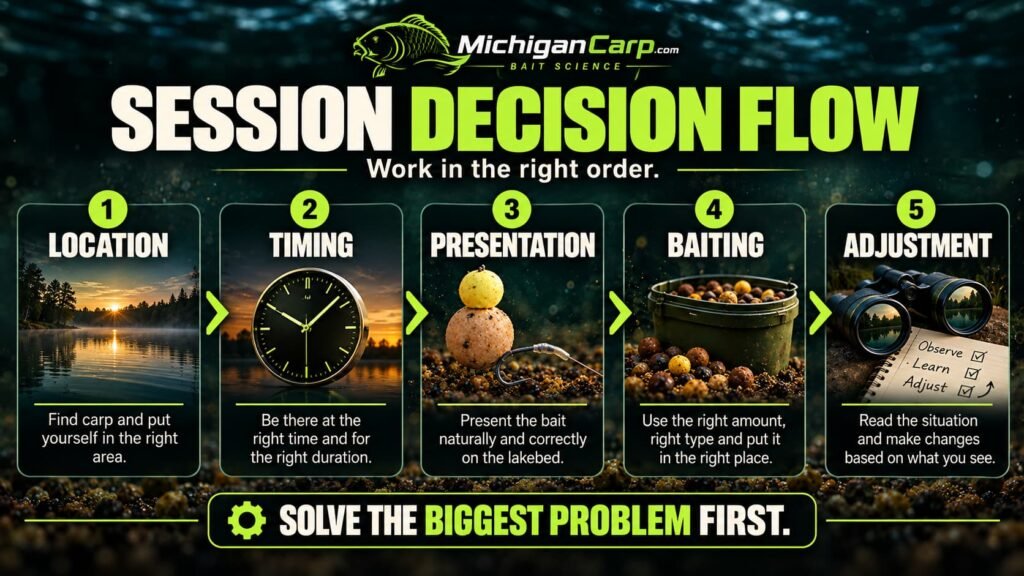
Use the same decision order whenever possible: location → timing → presentation → baiting → adjustment.
Table of Contents
Quick Start: The 60-Second Carp Session Checklist
If you want the shortest useful version, work through these questions in order.
| Stage | Main Question | Decision |
|---|---|---|
| Before leaving | What have season and recent conditions changed? | Choose the type of water and timing worth investigating |
| On arrival | Where is the strongest evidence for carp now? | Watch before unloading |
| Before casting | Can I present and land a carp safely here? | Check lakebed, depth, snags, line path and landing route |
| First baiting decision | What does the bait actually need to accomplish? | Attract, hold, create a trap or support existing feeding |
| During the session | Is new evidence supporting or contradicting my original plan? | Observe before changing anything |
| Move or stay | Is there stronger evidence somewhere else, or is the expected window still ahead? | Move for evidence; stay for a reason |
| Before leaving | What did the water teach me? | Record the useful pattern, including blanks |
The order matters.
A technically perfect rig in empty water is still fishing empty water. If the location does not make sense, return to How to Find Carp in Lakes before worrying about smaller changes.
Before You Leave Home
A session begins before the rods are loaded.
You do not need to predict exactly where the carp will be. You do need a sensible starting hypothesis and at least one alternative.
Check the recent pattern, not only today’s forecast
A mild afternoon after several freezing nights is not the same situation as the same air temperature after a week of stable weather.
Likewise, a new wind may improve one area while making another colder, rougher or unsafe.
Before leaving, check:
| Check | Ask Yourself | What It May Change |
|---|---|---|
| Season | What seasonal stage are the carp likely to be in? | Starting depth, movement and likely feeding periods |
| Water-temperature trend | Is the water warming, cooling or relatively stable? | Shallow versus stable water and timing |
| Wind | What has it been doing, not merely what will it do later? | Bank choice, water movement, cover and safety |
| Light and clarity | Will the water be bright, shaded, clear, stained or wind-colored? | Observation, confidence and timing |
| Session length | Do I have three hours, overnight or several days? | Mobility, baiting and how long a theory deserves |
| Access | Can I legally reach and fish the intended water? | Which options genuinely remain available |
| Safety | Are storms, waves, heat, cold or strong wind likely to become an issue? | Whether that bank—or the entire trip—is sensible |
For the underlying condition work, use Carp Water Temperature Guide for Michigan Lakes and Wind, Waves and Current for Michigan Carp Fishing.
For current forecasts and warnings, check the National Weather Service.
For licenses, current regulations and water-specific restrictions, use the official Michigan DNR Fishing Regulations rather than relying on an old article or last season’s information.
Have a Plan A and a Plan B
Plan A is the type of water you currently have the strongest reason to investigate.
Plan B is what you will check if Plan A fails.
That is enough.
Do not decide from your kitchen table that one exact swim must produce.
On Arrival: Watch Before You Unload
One of the easiest ways to make a session harder is to unload everything before deciding whether the swim deserves you.
Stop where you can observe without unnecessarily disturbing the water.
Look at the margins first, then the wider lake.
Compare what the wind is actually doing with what the forecast predicted. Look at exposed water, sheltered water, weed edges, reeds, points, bay mouths, channels, margins and any obvious route between feeding and holding water.
Look for repeated evidence
Useful signs can include:
- repeated rolls or shows
- bow waves
- tails
- purposeful bubbling or fizzing
- clouded water
- disturbed reeds or weed
- repeated liners once fishing
- fish consistently moving along the same route
One roll tells you that a carp was there.
Repeated signs in the same zone tell you much more.
Use Signs Carp Are Feeding when you need to separate feeding evidence from general carp activity.
If you see no carp, you still need a reason for choosing the water.
Food, comfort, safety, cover, depth and movement routes can all provide a sensible starting hypothesis.
Convenience alone cannot.
Ask Why Carp Would Use the Area
Before setting up, try to explain why a carp might use the water in front of you.
Is it:
- feeding water?
- holding water?
- a travel route?
- a depth transition?
- a weed edge?
- a sheltered area?
- warming water?
- a low-light opportunity?
- a quieter alternative to disturbed water?
You do not need several reasons.
One strong reason supported by conditions or actual fish activity is better than five weak theories.
On large Michigan waters, this question becomes particularly useful because apparently attractive banks can still be miles from the water the carp are currently using.
Before the First Cast: Confirm the Spot and Presentation
Only after the general area makes sense should the exact lakebed and rig become the main questions.
You do not need to map every square yard.
You need enough information to know whether the rig can fish effectively and whether a hooked carp can be landed safely.
| Decision | Question | Minimum Answer Needed |
|---|---|---|
| Exact zone | Am I fishing food, a route, transition or holding area? | I can explain why carp might use it |
| Bottom | Is it firm, silty, weedy, rocky, shelly or mixed? | The hookbait can remain available |
| Depth | How does the spot connect with shallower or deeper water? | I understand the route, not just one depth number |
| Snags | What happens immediately after a carp is hooked? | I can control the fish safely |
| Line path | Does the line cross weed, rock, shell, boat traffic or sharp structure? | The line can remain protected |
| Terminal safety | What happens if the mainline or leader fails? | The fish can separate from dangerous terminal components |
| Presentation | Will the hook and hookbait settle correctly? | The setup matches the actual bottom |
| Landing route | Can I net the fish safely from this bank? | Mat, net and landing position are workable |
For detailed substrate work, use Reading the Bottom for Carp.
Do not choose a complicated rig because the lake looks complicated.
Choose the simplest presentation that solves the actual problem in front of you.
Match the Rig to the Situation
Once the lakebed is understood, rig selection becomes much easier.
On clean firm ground, a straightforward bottom-bait or balanced presentation may be all that is required.
Over soft silt, weed or debris, the presentation may need to be changed so that the hookbait and hook remain available.
The important principle is not to begin with a favorite rig and then search for somewhere to use it.
Begin with the lakebed and hookbait job, then choose the rig.
For the full comparison, use Complete Michigan Carp Rig Guide.
Decide the Baiting Job Before Feeding
Baiting because nothing is happening is not a strategy.
Before putting free bait into the swim, ask what you want it to accomplish.
Are you trying to:
- get one quick bite?
- stop traveling fish?
- hold a group that is already feeding?
- strengthen an existing natural feeding area?
- build a longer feeding situation?
- test whether carp will respond before committing more bait?
A multi-day booking does not automatically require a multi-day quantity of bait on arrival.
Starting with a controlled amount gives you information and leaves room to increase the feed if the fish response justifies it.
Large initial baiting can be appropriate in the right circumstances, particularly where substantial numbers of carp are clearly feeding, but it should be a deliberate decision rather than an automatic rule.
For the wider bait-selection framework, use the Carp Bait Guide for Michigan Lakes.
While Fishing: Keep Reading the Water
The rods going out does not end the watercraft.
Keep looking beyond the alarms.
Useful new evidence includes:
- carp repeatedly appearing elsewhere
- fish beginning to show over or beside your rods
- liners becoming concentrated on one route
- the wind changing
- boat traffic stopping or increasing
- light levels changing
- the expected bite period arriving
- weed moving into the swim
- a presentation returning fouled
- one part of the lake becoming noticeably more active
A quiet alarm is not evidence by itself.
The question is whether the water around the rig still makes sense.
Run a Mid-Session Review
When something changes, review the session in the same order.
1. Location
Are carp still likely to use this water?
If repeated signs show that fish have moved elsewhere, changing hookbait flavor is unlikely to solve the problem.
2. Timing
Is the expected feeding window still ahead?
A good area can appear completely dead outside its useful period.
3. Presentation
Are the rigs actually fishing correctly?
A rig returning covered in weed or buried in debris gives you a real reason to change it.
4. Baiting
Has the feed helped?
Are carp showing and feeding? Has activity increased? Has the swim gone quiet immediately after a large top-up?
5. Small refinements
Only after the first four questions make sense should smaller changes such as hookbait size, buoyancy, color or rig refinement become priorities.
For a deeper version of this process, use On-the-Water Adjustments.
Move or Stay? Use Evidence, Not Boredom
This is one of the hardest session decisions because both patience and mobility can be correct.
Stay when
The area still has credible fish activity, the conditions continue to favor it, the expected feeding period has not yet arrived, or moving would mean abandoning stronger evidence for a weaker guess.
Move when
Repeated fish activity is developing elsewhere, changing conditions have clearly altered the value of the swim, the original reason for choosing the area has disappeared, or your present location no longer offers safe or effective fishing.
Do not stay simply because setting up took a long time.
Equally, do not move simply because you are bored.
Move for evidence. Stay for a reason.
Short Sessions Need a Different Tempo
The order of decisions remains the same, but limited time changes how aggressively you use the checklist.
If you only have a few hours, prioritize water offering a chance now.
Do not spend most of a short session trying to create a feeding situation that may need all night to develop.
A practical short-session checklist is:
| Question | Practical Approach |
|---|---|
| Where is the best evidence now? | Start with current signs and current conditions |
| How much feature finding is necessary? | Enough to establish a safe, fishable presentation |
| How much bait? | Start controlled unless fish response supports more |
| When should I move? | When stronger evidence appears elsewhere |
| What gear matters? | Stay mobile enough to act on genuine signs |
| What timing matters? | Fish the strongest available window rather than an idealized one |
Multi-Day and Big-Water Sessions
Long sessions create another danger: assuming that because you are staying for several days, the carp will eventually come to you.
That can happen, but it should not become the plan.
On large water, use the checklist as an elimination tool.
First select a section of the lake with a believable combination of season, food, depth, cover, conditions and access.
Then narrow that area to a usable route or feature such as:
- bay mouth
- weed edge
- channel edge
- point
- margin shelf
- depth transition
- hard-to-soft transition
- sheltered holding area
Watch how fish activity changes through the session.
If there is no evidence, do not automatically respond by making the baited area larger.
Big water magnifies location mistakes.
Michigan Session Safety Checks
Safety belongs inside the session decision—not after the swim has already been chosen.
Before fishing, consider:
| Check | Question |
|---|---|
| Weather | Could lightning, strong wind, waves, heat or cold make the bank unsafe? |
| Boat traffic | Can lines and hooked fish remain clear of navigation? |
| Snags | Can I realistically prevent a carp reaching dangerous cover? |
| Mainline | Is abrasion from rock, shell, zebra mussels or structure likely? |
| Landing | Can I reach the water safely with the net? |
| Night fishing | Are rods, net, mat, lights and the bank route organized before darkness? |
| Fish care | Is everything needed for unhooking, weighing and release ready before a bite? |
| Access | Am I legally allowed to fish and remain here for the planned period? |
| Regulations | Have I checked current rules rather than relying on memory? |
A productive-looking feature is not worth fishing if the likely outcome is a cut-off carp, an unsafe landing or conflict with other water users.
Sometimes the better fishing decision is to fish the safer edge of a feature rather than the feature itself.
Before Packing Up: Record What the Lake Taught You
A capture is useful information.
A blank can be useful information too.
The important thing is to record enough context for the result to mean something later.
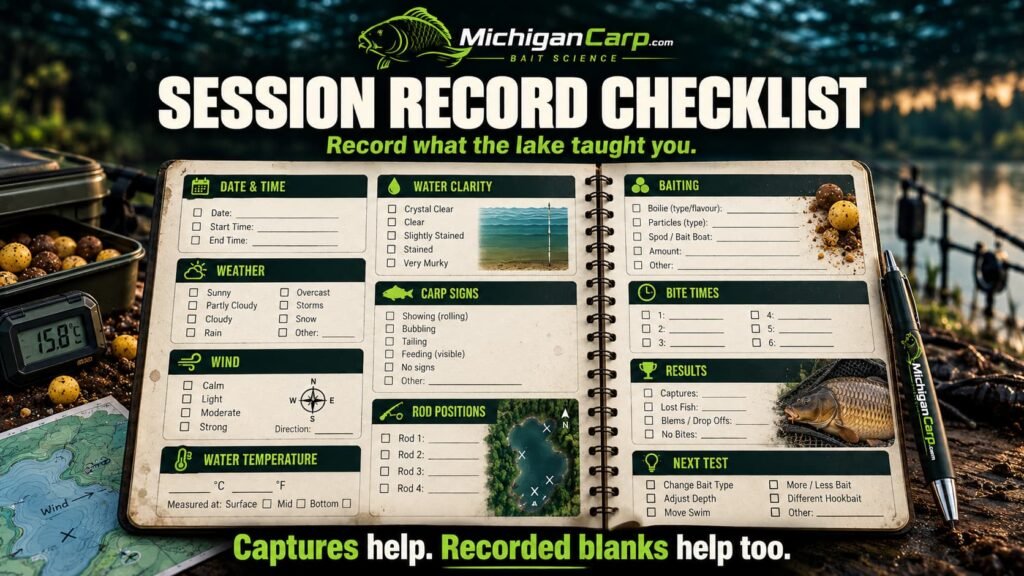
Useful notes include:
| Record | Note |
|---|---|
| Date and session time | Arrival, first cast and final pack-up |
| Weather pattern | Warming, cooling, stable, front or significant rain |
| Wind | Direction, strength and meaningful changes |
| Water temperature | Only when actually measured; record where and when |
| Water clarity | Clear, stained, algae affected or wind-colored |
| Carp signs | What happened, where and whether it repeated |
| Rod positions | Feeding water, route, transition or search area |
| Bite times | Include liners and lost fish where useful |
| Baiting | What went in and approximately how much |
| Result | Captures, losses, liners, feeding signs or inactivity |
| Next test | One thing worth repeating or changing next time |
One capture does not prove a pattern.
Repeated observations gradually do.
The same route producing at a similar time, the same bank improving under a particular wind, or a shallow spring area repeatedly becoming active after several hours of warming are far more useful than isolated memories.
Record failures as well.
Several comparable blanks can eliminate a weak theory.
Common Carp Session Checklist Mistakes
Choosing the swim before reading the water
Parking, comfort and familiarity can make a swim convenient.
They do not make carp use it.
Starting with rigs
If location is wrong, moving from one fashionable presentation to another solves very little.
Treating every carp sign as feeding
A roll confirms presence.
Repeated feeding disturbance provides a stronger case.
Adding bait whenever nothing happens
More bait cannot repair dead water, wrong timing or a fouled presentation.
Changing several things at once
Move the rod, change the rig, change the hookbait and increase the feed simultaneously and you learn very little from the result.
Staying because you already invested time
The lake does not care how long the bivvy took to erect.
Moving because the alarms are quiet
Quiet alarms do not prove the swim is wrong.
If the location still makes sense and the expected window is ahead, patience may be the correct decision.
Robert’s Practical MichiganCarp View
The checklist is most valuable when it prevents you from solving the wrong problem.
Over many years of carp fishing, including large natural lakes and Michigan impoundments, I have repeatedly found that the temptation is to make small tackle or bait changes when the important question is much bigger.
Are the carp actually using this water?
Once that question is reasonably settled, everything else becomes easier.
Then timing matters.
Then presentation.
Then baiting.
Only after those foundations make sense do the finer rig and hookbait decisions deserve much attention.
This does not mean every successful session follows a neat sequence. Carp fishing rarely behaves that conveniently.
The value of the checklist is that when something goes wrong, it gives you a sensible place to start looking.
Frequently Asked Questions
What is the most important part of a carp session checklist?
Location. Start by asking whether carp have a credible reason to use the water in front of you. Timing, presentation and baiting become much more useful once that question has a sensible answer.
How long should I watch the water before casting?
There is no useful universal time. Obvious shallow water may reveal fish quickly, while a large quiet lake can require much longer observation. Watch until you have either found meaningful evidence or formed a defensible location hypothesis.
Should I move if I see a carp elsewhere?
Not automatically. One isolated show is weaker evidence than repeated activity. Watch the area, consider whether it can be fished safely and decide whether the new evidence is genuinely stronger than the evidence supporting your current position.
Should I add bait when a swim goes quiet?
Only when there is a reason. If carp have been feeding and appear to have cleaned up the area, topping up may be sensible. If the water is empty, the timing is wrong or the presentation has failed, more bait may simply compound the problem.
Should every rod fish a different area?
Not necessarily. Multiple rods can test different parts of the same theory—for example a feeding area, adjacent travel line and nearby transition. Completely unrelated placements make the information harder to interpret.
What should I record after a blank session?
Record the same useful information you would after a capture: conditions, wind, fish signs, water temperature if measured, position, timing, baiting, liners and any meaningful changes. Several well-recorded blanks can be valuable evidence.
Is this checklist only for beginners?
No. Experienced anglers often work through the same questions automatically. Writing them down simply keeps the decision order clear when a session becomes frustrating or complicated.
Next Steps
Use this checklist as the operational page and move to the specialist article that owns the particular decision you are facing:
- Carp Session Planning in Michigan — build the overall plan before fishing.
- How to Find Carp in Lakes — rebuild the location picture.
- Signs Carp Are Feeding — separate feeding evidence from general activity.
- Reading the Bottom for Carp — understand substrate, depth and transitions.
- Carp Bite Windows in Michigan — decide whether timing may be the missing piece.
- On-the-Water Adjustments — diagnose a live session without changing everything at once.
- Wind, Waves and Current — reassess location when water movement changes.
- Carp Water Temperature Guide — connect the session to the seasonal water-temperature trend.
Final rule: find the reason carp should use the water, confirm it with the strongest evidence available, present safely, bait with a purpose and change the plan only when the lake gives you a better reason.