

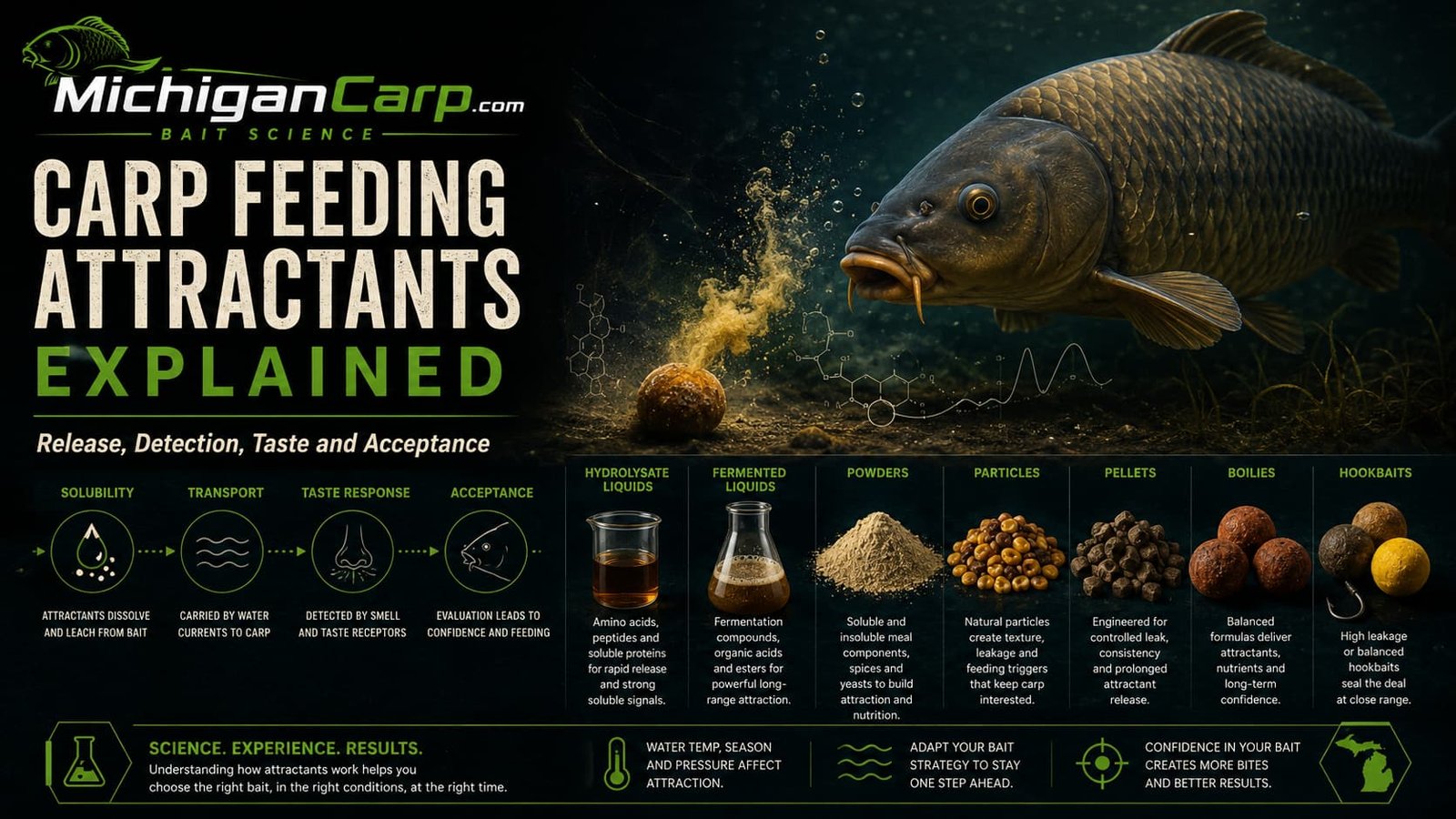
Carp feeding attractants are one of the most misunderstood subjects in bait making.
A new liquid, powder, flavor or extract appears. Someone catches fish on it. Before long, it is described as a trigger, a stimulant, a long-range attractor, a confidence signal, a taste enhancer or a natural food cue.
Sometimes those descriptions contain part of the truth. The problem is that they are often treated as though they all mean the same thing.
They do not.
A bait has to pass through several stages before a carp actually eats it. Material must become available from the bait. Water must move that material. The carp must detect something relevant. It may investigate. It may taste or mouth the bait. Then it may accept, reject or repeatedly sample it.
That is why I prefer to understand carp feeding attractants as part of a response chain:
Release → Transport → Detection → Investigation → Tasting → Acceptance
An ingredient can help one part of that chain without automatically doing all the others. A strong flavor may help define bait identity without being a proven feeding stimulant. A hydrolysate may add soluble protein-derived fractions without becoming a magical long-range beacon. A salt, acid or sweetener may affect taste, formulation or bait confidence without dragging carp across a lake.
That is the central idea of this article:
Do not ask which attractant is strongest. Ask what job the bait needs the ingredient to do.
Table of Contents
Quick Answer
Carp feeding attractants are ingredients or treatments intended to improve one or more parts of the bait-response process. They may help bait release material, send signals through the water, encourage investigation, improve taste, support acceptance or increase confidence around the hookbait.
The best bait attractant is not one universal product. The correct choice depends on the bait form, water temperature, session length, feeding situation, hookbait mechanics and what stage of the response chain you are trying to improve.
| Attractant type | Main practical job | Best used in |
|---|---|---|
| Amino acids | Taste and chemical signal support | Specialist liquids, hydrolysates, yeast, liver, soluble food systems |
| Hydrolysates | Soluble protein-derived food cues | Boilies, crumb, pellets, paste, hookbait treatments |
| Fermented liquids | Food-system character, organic acids and transformed bait signals | Particles, pellets, crumb, method mix, wider baiting areas |
| Yeast products | Savoury soluble material and food-bait support | Boilies, crumb, paste, milk/nut/cereal baits |
| Salts and minerals | Taste, formulation and physiological support | Base mixes, particles, method mixes, hookbait treatments |
| Sweeteners and flavors | Palatability, identity and short-range taste support | Hookbaits, boilies, glugs, method mixes and profile building |
The practical rule is simple: choose the attractant by function, not reputation.
What Is a Carp Feeding Attractant?
The word attractant is used very loosely in fishing. Anglers may use it to describe anything that appears to draw fish toward bait, increase investigation, improve palatability, increase bait sampling, increase consumption or help bait release detectable material.
Those are not identical effects.
For practical bait making, I use carp feeding attractant as a broad angling term for an ingredient or treatment intended to improve one or more stages of the bait-response process.
That definition is deliberately cautious. It avoids claiming that every useful bait ingredient physically pulls carp from long distance. It also recognizes something important: an ingredient can be valuable even if its main effect happens after the carp has already reached the bait.
University of Florida IFAS Extension describes feed attractants in aquaculture as ingredients used to enhance palatability and promote feed intake, while also noting that visual, gustatory and olfactory systems can all be involved and that responses can be species-specific. For the broader aquaculture background, read A Review of Feed Attractants as a Guide for Aquaculture Operations.
For carp anglers, that means we should be careful. A bait ingredient may increase investigation, improve local taste response or make a hookbait more acceptable without proving that it works as a long-range beacon.
The Six Stages of Bait Attraction
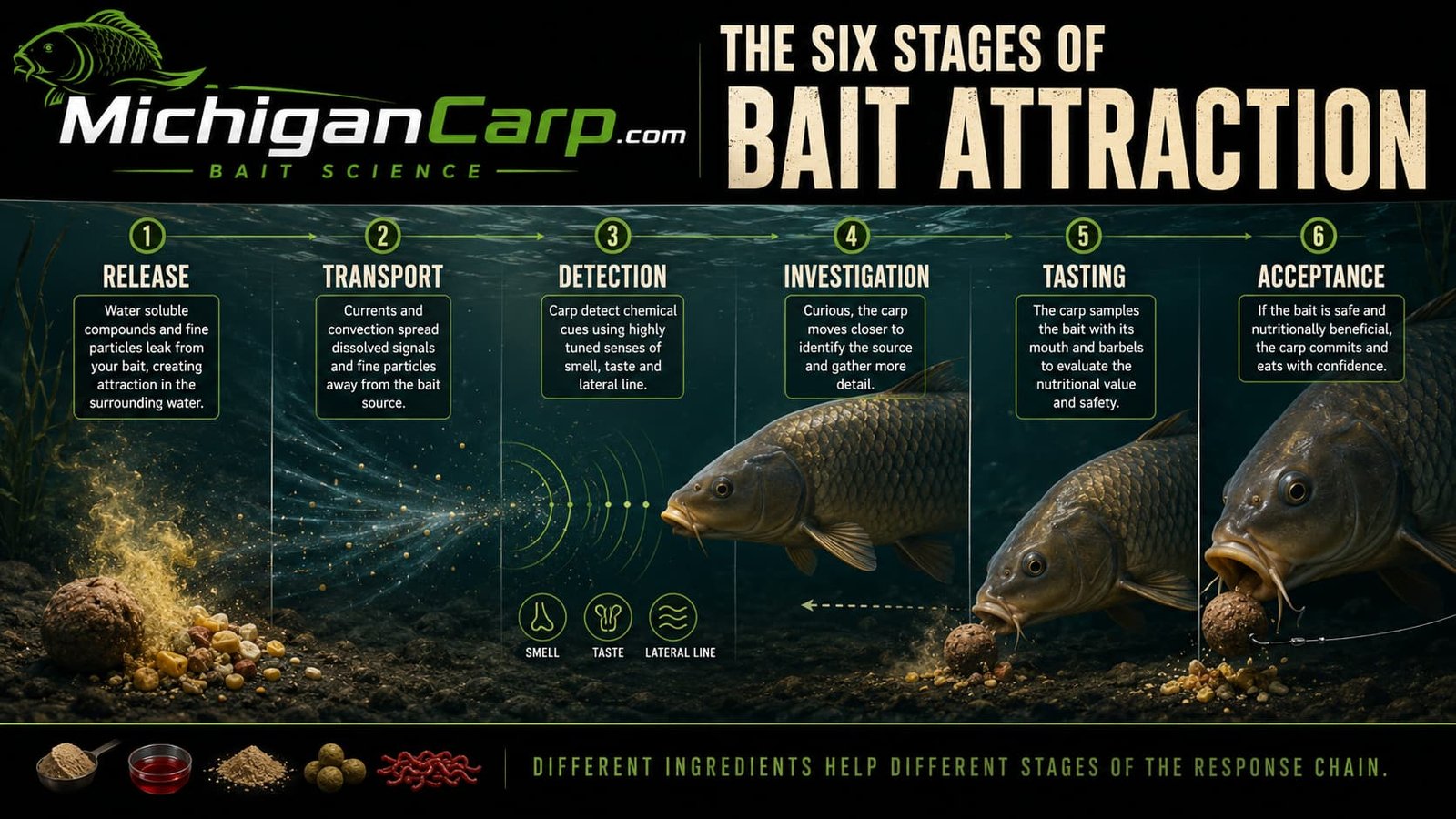
The most useful way to understand carp feeding attractants is to separate the response chain into six stages.
1. Release
Before a signal can exist in the water, material has to become available from the bait.
Release depends on ingredient solubility, bait hydration, cooking, drying, surface area, particle size, porosity, liquid viscosity and the finished bait structure. A useful ingredient can be present in a bait and still release poorly if the bait matrix is too tight or the ingredient is locked away.
This is why a whole boilie, chopped boilie, paste, pellet and crumb do not behave identically even when they contain similar ingredients. For the deeper technical guide, read The Science of Carp Bait Solubility and Leakage.
2. Transport
Once material leaves the bait, it does not stay in a perfect cloud. It is affected by diffusion, current, turbulence, undertow, wave action, convection and dilution.
This matters because anglers often imagine an attractant as an invisible rope connecting the bait to carp across the lake. Real water does not behave that neatly. A released signal may create useful local information, but it may also be mixed, moved, stretched and diluted.
The better question is not, “How far does this attractant pull fish?” The better question is, “What does the bait release, and how will this water move that information?”
3. Detection
Carp use chemical senses to interact with food. Olfaction and gustation both matter, but they should not be treated as the same sense.
Olfaction involves detection of dissolved chemical information through the olfactory system. Gustation involves taste receptors associated with sampling and evaluating food. Detection can start a response, but detection does not guarantee feeding.
A fish can detect something without eating it.
4. Investigation
After detecting a chemical or physical cue, a carp may alter direction, approach, search, browse, inspect particles or sample bait. This middle stage is important because anglers often jump from “detected” to “attracted” to “eaten” as if those are the same event.
They are not.
An ingredient that increases investigation may still be useful even if it does not directly increase consumption. Useful observations include liners, repeated bubbling, increased movement through the area, nuisance-fish response, time to first bite and repeated action on one treatment.
5. Tasting
Carp do not simply inhale every detected food object and commit instantly. They can mouth, test, reject and re-sample.
Common carp gustatory research has shown that L-cysteine and L-proline can stimulate taste response in agar-pellet trials, with concentration and compound differences mattering. That supports a more careful bait-making view: individual compounds can matter, but they do not all perform identically. For the specific common-carp amino-acid study, see Gustatory Response of Common Carp to Variable Concentrations of Two Stimulatory Amino Acids.
The question is not only, “Can the carp find it?” It is also, “What happens when the carp samples it?”
6. Acceptance
The final stage is consumption. At this point, taste, texture, hardness, particle size, bait familiarity, previous experience, hunger, competition and nutritional context may all matter together.
This is why I resist describing any single ingredient as the answer to attraction. A bait is a system. An excellent soluble food cue cannot fix poor texture, a badly balanced hookbait, unsuitable presentation, excessive baiting or poor location.
Research on carp-fish taste behavior using food objects has also shown that grasping, retention, repeated handling and rejection are part of the feeding process. For more background on food-object testing in common carp and related cyprinids, see Taste Responses of Carp Fishes to Carboxylic Acids: Feeding Behavior.
Types of Carp Feeding Attractants
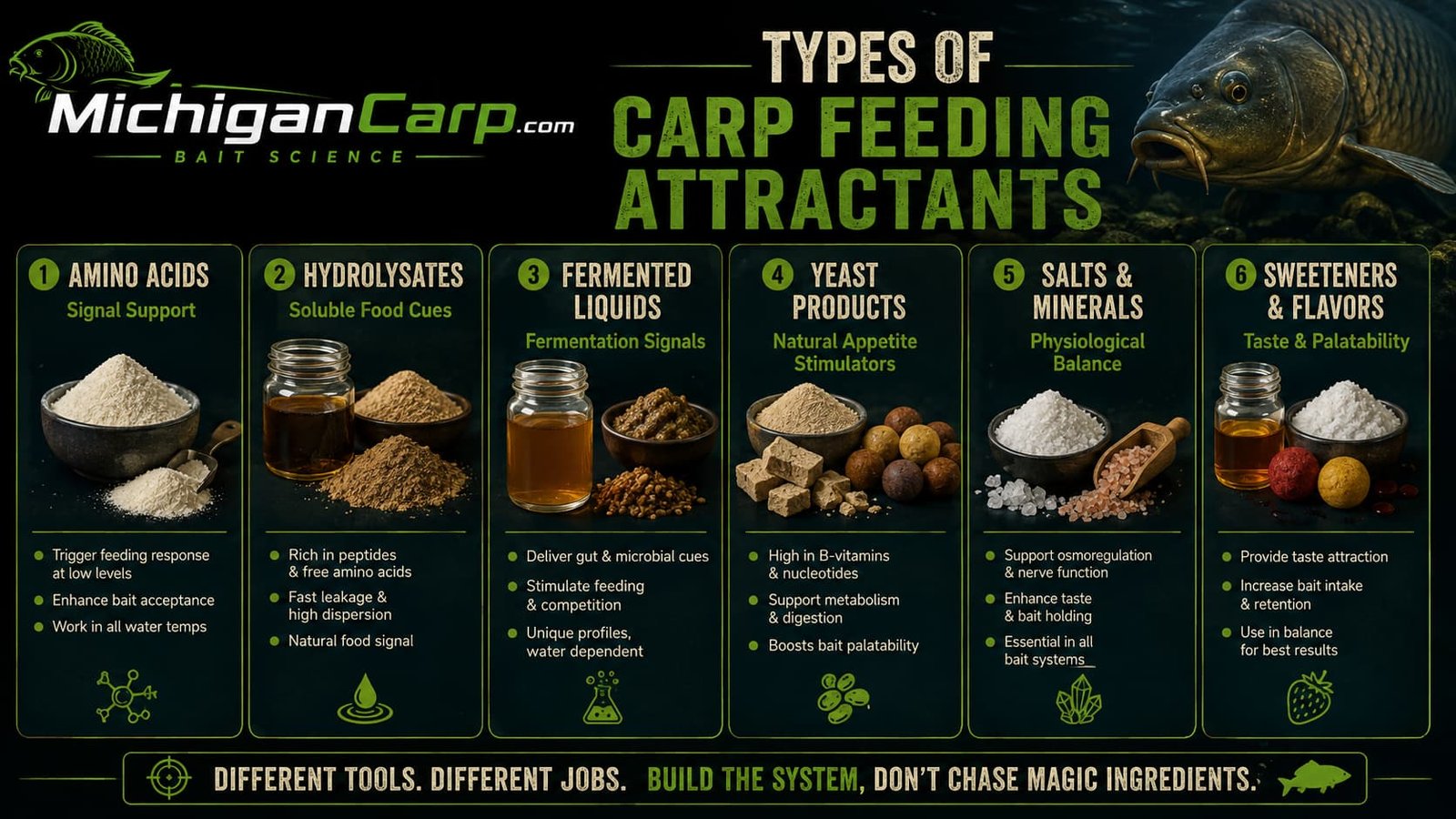
Different carp feeding attractants help different parts of the system. The mistake is expecting one ingredient to do everything.
Amino Acids
Free amino acids are among the most heavily discussed carp bait attractants. There is good reason to take them seriously, but the phrase “contains amino acids” tells us very little by itself.
The profile matters. The concentration matters. The mixture matters. The bait carrying them matters.
FAO training material on fish feeding notes that dietary feeding stimulants studied in fish have included mixtures of L-amino acids, glycine betaine, inosine and inosine-5-monophosphate in different species and contexts. For the wider fish-feed background, read FAO’s section on feed additives and feeding stimulants.
The practical bait-making lesson is simple: amino acids can support a signal system, but they do not replace food value, texture, location or presentation.
Hydrolysates
Hydrolysates are often marketed as super-attractants. I think that is the wrong way to understand them.
A protein hydrolysate is produced by breaking some peptide bonds within a protein source. Depending on the source and process, the finished ingredient may contain larger protein fragments, medium peptides, smaller peptides, free amino acids, salts and other soluble material.
That is why two products labeled hydrolysate can be quite different.
The practical value is that a good hydrolysate can add more readily soluble protein-derived fractions to a bait system. I like hydrolysates most in boilie crumb, chopped boilies, pellets, paste, selected boilie treatments, hookbait conditioning and small targeted traps. For the dedicated guide, read How to Use Hydrolysates in Carp Bait.
Fermented Liquids
Fermented liquids belong in the attractant discussion, but they should not be treated as liquid hydrolysates.
Fermentation is a biological transformation process. Depending on the substrate and fermentation system, the finished liquid may contain changing combinations of organic acids, transformed carbohydrates, microbial metabolites, soluble nitrogen-containing material and other food-derived compounds.
For practical carp fishing, controlled fermented food liquids can fit naturally into particles, maize, grain mixes, pellets, crumb, method mixes and wider feeding areas. Their value is often not that they are magically stronger than everything else. It is that they fit economical food-based baiting systems very well.
For the broader modern guide, read Fermented and Food-Signal Baits for Carp. For practical liquid selection, also read When to Use Each Type of Carp Bait Liquid.
Yeast Products
Yeast products deserve their own place in the discussion. I do not think all yeast ingredients should simply be grouped under fermented liquids.
A yeast extract or yeast-based ingredient can contribute savoury character, soluble food material, B-vitamin background, nucleotide-related fractions, compatibility with boilies, usefulness in crumb and support in milk, nut, cereal and non-marine bait systems.
This is one of the reasons I like yeast products in my own bait thinking. They can add savoury depth without forcing the entire bait into an obvious fishmeal or meat identity.
For the specialist compound side of this subject, read Nucleotides in Carp Bait.
Salts, Acids and Minerals
This is an area where carp-bait claims can become too loose.
Salt, acids and minerals are important formulation ingredients, but they should not all be described as generic attraction signals. Salt can contribute to taste, ionic composition, formulation and preservation systems. Organic acids can affect pH, preservation systems and taste, but different acids should not be treated as one sensory category. Minerals may contribute nutritional and formulation roles, but mineral content alone does not prove long-range attraction.
For the dedicated acid guide, read Organic Acids in Carp Bait. For pH and bait behavior, read How pH Changes Carp Bait Performance.
Sugars, Sweet Liquids and Sweeteners
The word sweet creates another problem. Anglers often group together molasses, honey, corn syrup, milk sugars, sweet flavor glugs, NHDC, sucralose and other high-intensity sweeteners as though they all perform the same job.
They do not.
A sugar syrup may contribute carbohydrate, viscosity, stickiness, moisture, fermentation substrate and surface coating. A high-intensity sweetener may be used at a much lower level for a different taste role. A flavor-led sweet glug may be mostly about identity and palatability rather than nutrition.
Do not choose a sweet ingredient simply because carp are said to like sweet things. Choose the actual ingredient for its actual function. For the deeper guide, read Sugars, Sweeteners and Carbohydrates in Carp Bait.
Flavors and Aromas
I still use flavors. I do not think they should dominate every discussion of attraction.
A flavor can help define bait identity, create continuity between hookbait and feed, create intentional contrast, support a fruit, cream, nut or spice profile and make batches more consistent. What a flavor cannot do is replace location, bait release, food value or good presentation.
Human smell intensity is not a reliable measure of underwater bait performance. A bait that fills the garage with aroma is not automatically communicating better in the lake.
Which Attractants Fit Which Bait Form?

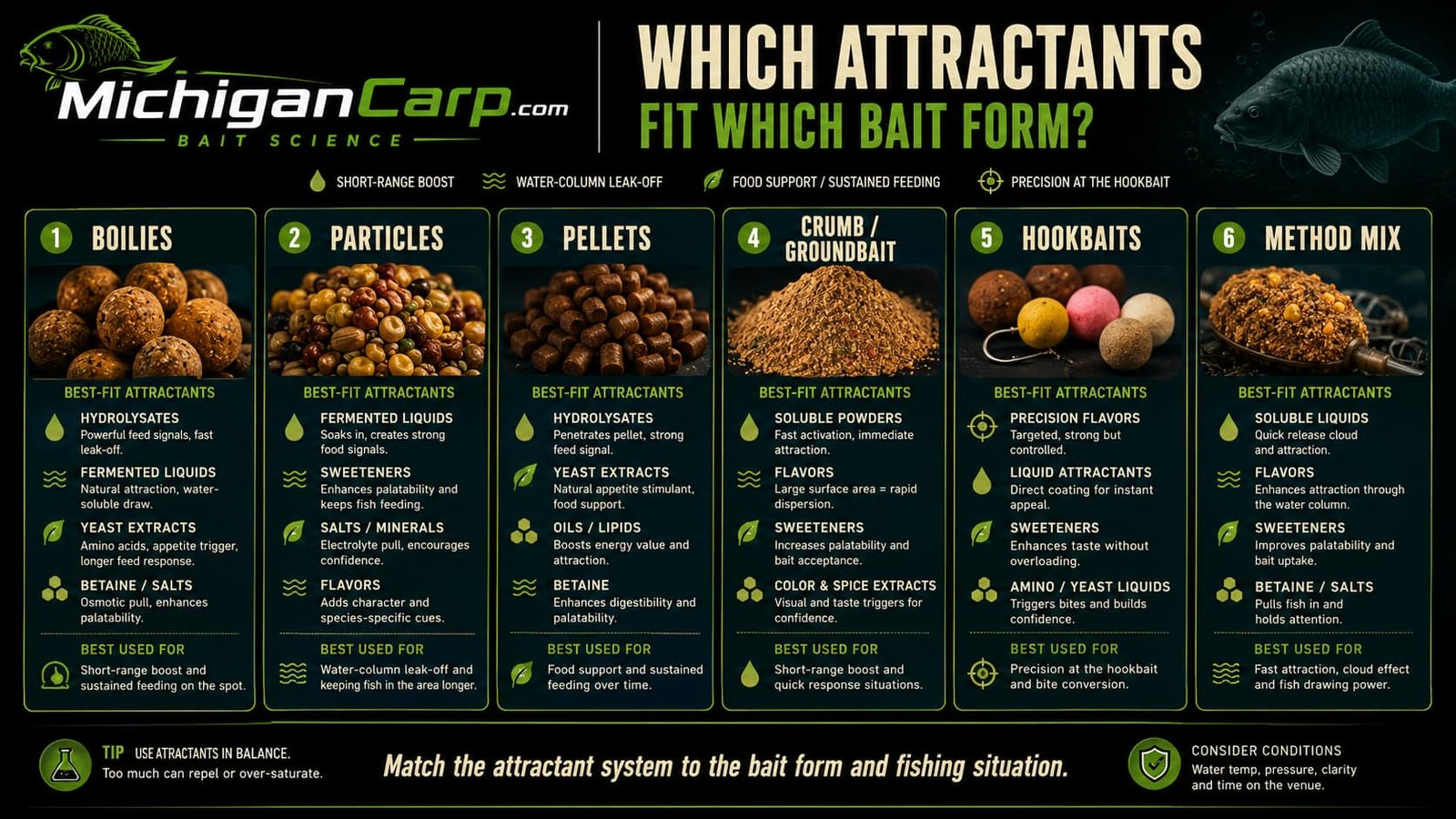
The same attractant can behave differently depending on the bait carrying it. That is why bait form matters as much as ingredient reputation.
Boilies
In a boilie, think about the liquid phase, dry mix inclusion, cooking stability, drying, finished bait porosity and post-boil treatment. I prefer to build the boilie first, then decide what the attractant needs to add.
Hydrolysates, yeast extracts, fermented liquids, betaine, salts and selected flavors can all work in boilies, but they should support the bait’s structure and purpose. Do not turn a good food bait into an overloaded liquid sponge.
Particles
Particles already provide recognizable food material, texture and feeding activity. Useful liquid systems can include CSL-style liquids, fermented corn liquids, molasses where appropriate and compatible food-based treatments.
With particles, economy and compatibility usually matter more than concentration. A five-gallon bucket of prepared maize, hemp, pigeon conditioner, peanuts or tiger nuts does not need an expensive tiny-bottle treatment to work.
Pellets
Pellets can absorb liquids well, but they can also soften, collapse or become difficult to use. Treat a small test batch first. Apply lightly, allow absorption time, check texture, and only add more if the pellets still behave properly.
The best pellet treatment supports controlled leakage without destroying casting, catapulting, PVA use or feeding texture.
Crumb and Chopped Boilies
Crumb and chopped boilies are one of my favorite places for attractant ingredients. They have increased exposed surface area, faster hydration and shorter diffusion distance than intact boilies.
Useful options include hydrolysates, yeast extract, fermented liquids, soluble powders, matching boilie treatments and small amounts of flavor or sweetener. The goal is local activity, not liquid saturation.
Hookbaits
Hookbaits allow precise treatment because only a small amount of bait is involved. Possible jobs include continuity with free bait, deliberate contrast, savoury depth, protein-derived treatment, sweet support, flavor identity or close-range taste support.
Always recheck hardness, buoyancy, balance, skin strength and durability. A treatment that destroys presentation is not an improvement.
Method Mix and Packbait
With method mix and packbait, bait mechanics come first. A liquid must not ruin packing, casting, breakdown, release or handling.
The best attractant for a method mix is one that supports the physical system. If it turns the bait into soup, paste, glue or dust at the wrong time, it is not helping.
When Feeding Attractants Matter Most
I find carp feeding attractants most useful when the baiting situation is compact and controlled.
Short Sessions
Small crumb traps, pellet patches and treated hookbaits can work quickly without requiring a large food bed. This is where a well-chosen attractant can make the immediate rig area more active.
Cold and Cool Water
In cold and cool water, I prefer lower food volume, accurate placement and open bait forms. The advantage is not that attractants defeat temperature. It is that they fit small, efficient baiting systems.
Singles and Small Traps
When the total amount of bait is low, a precise hookbait or crumb treatment becomes economically and practically sensible. You are not trying to flavor a whole lake. You are trying to improve the bait right where the rig is fishing.
Moving Water
In moving water, repeated small release surfaces can be more useful than simply increasing liquid concentration. The current can help transport material, but it can also dilute it quickly.
Big Michigan Waters
On big Michigan waters, location still comes first. Once a route, bay, edge, weedline, hard spot or feeding area is identified, a controlled bait signal can help make the rig area more active. It will not replace watercraft.
When Attractants Are Overrated
Attractants are overrated when anglers expect them to fix problems that are not really attractant problems.
- poor location;
- an empty swim;
- bad presentation;
- excessive baiting;
- unsuitable hookbait mechanics;
- spoiled bait;
- poor particle preparation;
- bad timing.
This is one of the simplest lessons in carp fishing. The bottle is not always the problem. Sometimes the answer is to move, reduce bait, change depth, wait for the feeding window or improve presentation.
My Practical Michigan System
For much of my own fishing, I think in three layers.
1. Wider Food Area
This is where particles, pellets, boilies, chops and broader feed belong. The liquid role is usually economical and compatible rather than expensive and extreme.
On places like Michigan dam ponds, big inland lakes and channels, I want the wider food area to make sense as food. I am not trying to make every particle into a laboratory experiment.
2. Active Rig Area
This is where crumb, chopped boilies, crushed pellets, small particles and one selected active treatment can make the bottom around the rig more interesting.
The rig area is where I am more willing to use a hydrolysate, yeast liquid, fermented food liquid or matching bait treatment. It is local, controlled and easier to test.
3. Hookbait
The hookbait is where precision matters most. A hookbait treatment may provide continuity, contrast, taste, flavor identity or close-range confidence, but only if the bait still fishes correctly.
That gives me a simple system:
- food across the area;
- activity around the rig;
- precision at the hookbait.
The attractant supports the strategy. It does not replace it.
How to Test an Attractant Properly
Attractant testing is difficult because carp fishing contains many variables. One session rarely proves much. A better approach is to keep as much as possible the same and change only one treatment at a time.
Keep the same hookbait size, rig, color, baiting quantity, location quality and fishing time where possible. Then change one attractant treatment.
| Rod | Treatment | Purpose |
|---|---|---|
| Rod 1 | Untreated control | Shows what the base bait does without extra treatment |
| Rod 2 | Protein-derived or savoury treatment | Tests hydrolysate, yeast, liver or savoury liquid support |
| Rod 3 | Fermented, sweet or flavor-led treatment | Tests a different signal path without changing the whole bait |
Record time to bite, number of takes, repeated action, nuisance-species response, hookbait condition after several hours and whether the same pattern appears across sessions.
Repeated patterns are more useful than one lucky fish. For broader home bait testing, read How to Test Boilies Before Fishing.
Common Mistakes
Calling Every Liquid an Attractant
A carrier, flavor, syrup, oil, hydrolysate and fermented liquid do not automatically do the same job. Name the function before you add the liquid.
Assuming Detection Means Consumption
A carp can detect a compound without eating the bait. Detection is one stage. Acceptance is another.
Treating All Amino Acids as Equal
Different amino acids can produce different taste and feeding responses. “Contains amino acids” is not enough information by itself.
Treating Hydrolysate as Magic
Hydrolysates differ by protein source, processing method, degree of hydrolysis, molecular profile, salt content and concentration. Use the right hydrolysate for the right job.
Confusing Fermentation With Rotting
Controlled fermentation and spoilage are not the same process. A useful fermented food liquid should be managed, understood and used in a way that supports bait safety and function.
Choosing by Human Smell
The strongest-smelling bait in the bucket is not automatically the strongest underwater signal. Human nose appeal is not the same as carp taste, detection or acceptance.
Ignoring Bait Form
The same liquid behaves differently on crumb, pellet, boilie, particle mix and hookbait. Always match the attractant system to the carrier.
Adding Too Many Ingredients
A bait does not automatically improve as the ingredients list becomes longer. Ingredient stacking can make testing impossible and may damage bait mechanics.
FAQ
What is the best carp feeding attractant?
There is no single best carp feeding attractant for every bait and fishing situation. The correct choice depends on whether the bait needs improved release, soluble protein-derived material, fermented food compounds, taste support, flavor identity or a more precise hookbait treatment.
Do amino acids attract carp?
Carp can respond to specific free amino acids, but individual amino acids do not all perform the same job. Concentration, mixture, bait form and fishing context matter. Amino acids should support a bait system rather than replace it.
Are hydrolysates good carp attractants?
Hydrolysates can be useful because they supply mixtures of smaller protein-derived fractions. Their effect depends on protein source, processing, concentration and the bait carrying them. They are useful tools, not magic ingredients.
Are fermented liquids good for carp?
Fermented liquids can be useful in particles, pellets, crumb, method mix and wider food-based baiting systems. Their value depends on the starting material, fermentation process, freshness, pH, bait form and how much is used.
Do strong-smelling baits attract more carp?
Not automatically. Human smell intensity does not tell you how much relevant material enters the water or how carp will respond after detection and tasting.
Do attractants matter more in cold water?
Not because they defeat cold water by themselves. Cold-water fishing often favors smaller, more precise baiting systems, which makes controlled liquid treatments, crumb, pellets and active hookbaits especially practical.
Can you use too many carp feeding attractants?
Yes. Excessive liquid, incompatible ingredients and uncontrolled stacking can damage bait mechanics, confuse testing and create bait that looks clever on paper but fishes badly.
Should every hookbait be glugged?
No. A hookbait should only be treated when the treatment has a clear purpose and does not damage hardness, buoyancy, balance, skin strength or durability.
Final Thoughts
The strongest bait is not necessarily the bait with the longest attractant list.
The strongest system is the one where every part has a job. The food area feeds. The rig area creates local activity. The hookbait fishes correctly. The ingredients release material. The carp can detect and evaluate it. And the angler is in the right place at the right time.
That is what feeding attraction looks like when we strip away the marketing language.
Do not ask:
What is the strongest attractant?
Ask:
What stage of the bait-response chain am I trying to improve?
That question leads to better bait decisions, cleaner testing and more confidence in what you are putting in the water.
Next Steps
Continue through the MichiganCarp.com Bait Science series with these related guides:
- The Science of Carp Bait Solubility and Leakage
- How to Use Hydrolysates in Carp Bait
- Fermented and Food-Signal Baits for Carp
- When to Use Each Type of Carp Bait Liquid
- Nucleotides in Carp Bait
- Sugars, Sweeteners and Carbohydrates in Carp Bait
- How pH Changes Carp Bait Performance
- How to Test Boilies Before Fishing
- Bait Science