
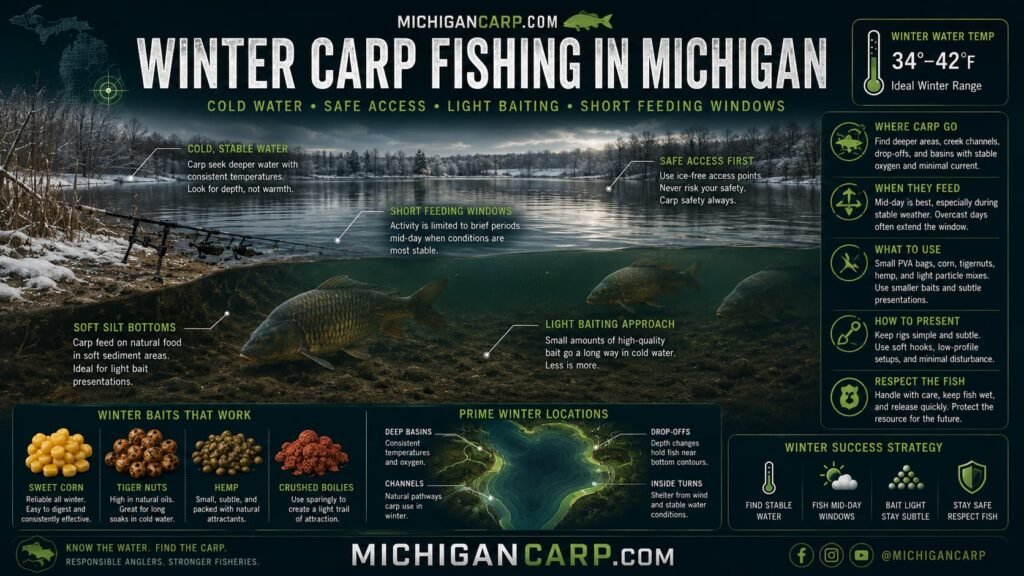
Winter carp fishing in Michigan is possible, but it is not the same as spring, summer or fall fishing.
Cold water changes everything.
Carp still feed in winter, but they usually feed less often, move less distance and give fewer obvious signs. Feeding windows can be short. Location becomes more exact. Baiting has to be lighter. Safe access matters more. Fish care matters more. Weather and ice conditions can decide whether a session is realistic before bait choice even enters the conversation.
That is the first winter lesson.
Winter carp fishing in Michigan starts with safety and access, then location, then bait.
On many inland lakes, practical winter carp fishing may be limited by ice, unsafe banks, closed access, snow, frozen margins or lack of open water. On some rivers, channels, dam systems, discharge-influenced areas, marinas where legal, or ice-free public waters, winter carp may still be catchable if you fish carefully and legally.
This guide explains winter carp fishing in Michigan, including cold-water location, ice-free access, stable deeper water, soft silt pockets, short feeding windows, subtle signs, light baiting, small hookbaits, winter weather windows, fish care and common mistakes.
For the full year-round seasonal framework, read Michigan Carp Fishing Seasons.
For the broader location process, read How to Find Carp in Lakes.
For visible activity and subtle signs, read Signs Carp Are Feeding.
For bait choice by venue and season, read Best Carp Bait for Michigan Lakes.
Before any winter session, check current weather through NOAA / National Weather Service and confirm fishing rules, access and regulations through Michigan DNR Fishing.
The simple winter rule is this:
Fish safely, fish precisely, bait lightly, and expect short windows rather than all-day feeding.
Table of Contents
Quick Start: Winter Carp Fishing in Michigan
Use this table as the quick winter strategy guide.
| Winter Situation | Where to Look | Feeding Pattern | Best Bait Approach | Biggest Mistake |
|---|---|---|---|---|
| Ice-free lake edge | Deeper nearby water, soft silt, sheltered margins | Short windows, subtle signs | Small hookbaits, tiny PVA, light crumb | Feeding too much |
| River or channel | Slow seams, deeper holes, inside bends, slack water | Carp may feed in stable current areas | Single hookbaits, small crumb, careful placement | Fishing heavy flow blindly |
| Dam pond or reservoir | Old channels, basin edges, soft silt, stable depth | Fish may hold tight to comfort zones | Minimal bait, high accuracy | Moving too often |
| Mild winter spell | Shallow windows near deeper water, sunlit margins | Brief improvement in activity | Small bait increase if signs appear | Assuming one mild day changes everything |
| After cold front | Deeper stable water, low disturbance areas | Very slow feeding | Singles, tiny traps, patience | Chasing signs that are not there |
| Clear cold water | Deeper routes, shade, subtle bottom features | Carp may be spooky and slow | Fine presentation, low disturbance | Too much casting |
| Dirty winter water | Slack edges, inside bends, warmer inflows if safe/legal | Carp may rely on close-range food | Stronger scent/crumb, small bait | Fishing too far away |
| Unsafe ice or bank | Do not fish | No fish is worth unsafe access | Stay home or choose safe water | Risking ice, slips or poor fish care |
Winter carp fishing is not about covering lots of water with bait.
It is about finding a place carp already use, placing a small amount of bait accurately, and waiting for a short opportunity.
Winter Carp Fishing Starts With Safety
Winter fishing has a different risk level.
Cold air, cold water, ice, snow, frozen banks, short daylight, numb hands, icy nets and difficult fish care all matter. A summer swim that is easy to fish can become dangerous in winter. A bank that looks fine can be slick. A shallow edge can be unstable. Ice shelves can break. Frozen mats, slings and nets can make proper carp care harder.
No carp is worth unsafe access.
Before fishing, ask:
Can I reach the swim safely?
Can I land a carp safely?
Can I return it safely?
Is the bank icy, steep or unstable?
Is the water open enough to fish and play a carp properly?
Will my net, mat and sling function in freezing conditions?
Is the session legal and allowed at this access point?
If the answer is uncertain, choose another water or wait.
Winter carp fishing also requires better preparation. Keep spare dry clothes in the vehicle. Carry traction if banks are icy. Keep fish-care gear ready before casting. Avoid deep snowbanks, ice shelves and steep frozen slopes. Do not fish alone in risky conditions if help would be difficult.
This article focuses on carp strategy, but safety comes first. The best winter bait plan is irrelevant if the swim is not safe to fish.
How Cold Water Changes Carp Behavior
Cold water slows everything down.
Carp are still capable of feeding, but they usually do not move like summer fish. They may hold in stable areas for long periods. They may feed for short windows. They may not travel far to find bait. They may ignore heavy beds of food. They may show very few visible signs.
This is why winter carp fishing is often more precise than active.
In warm water, carp may patrol large weed beds, feed across big shallow flats, move through baited areas repeatedly and clear significant amounts of food. In winter, they may sit near deeper stable water, soft silt, slow current, basin edges, old channels or sheltered areas and only feed briefly when conditions allow.
A small difference in location can matter.
One side of a channel may hold slower water. One soft silt pocket may hold more natural food. One basin edge may provide comfort. One sunlit margin may become active for a short period during a mild spell. One slack behind current may hold fish when the main flow does not.
The key winter question is not:
Where can I make carp feed?
The better question is:
Where are carp already comfortable enough to feed for a short time?
That shift changes everything.
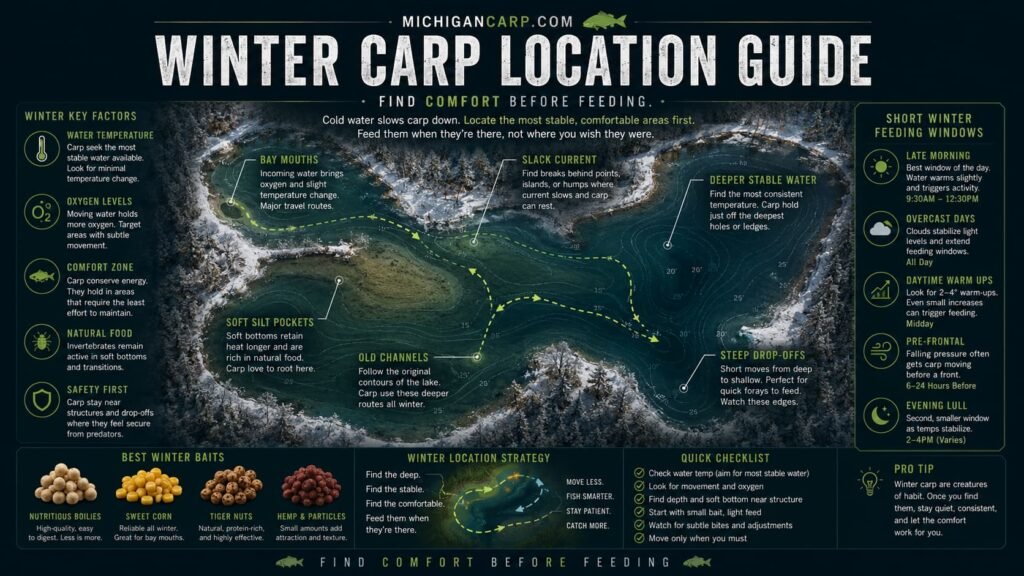
Best Winter Carp Locations in Michigan
Winter carp location depends heavily on the type of water.
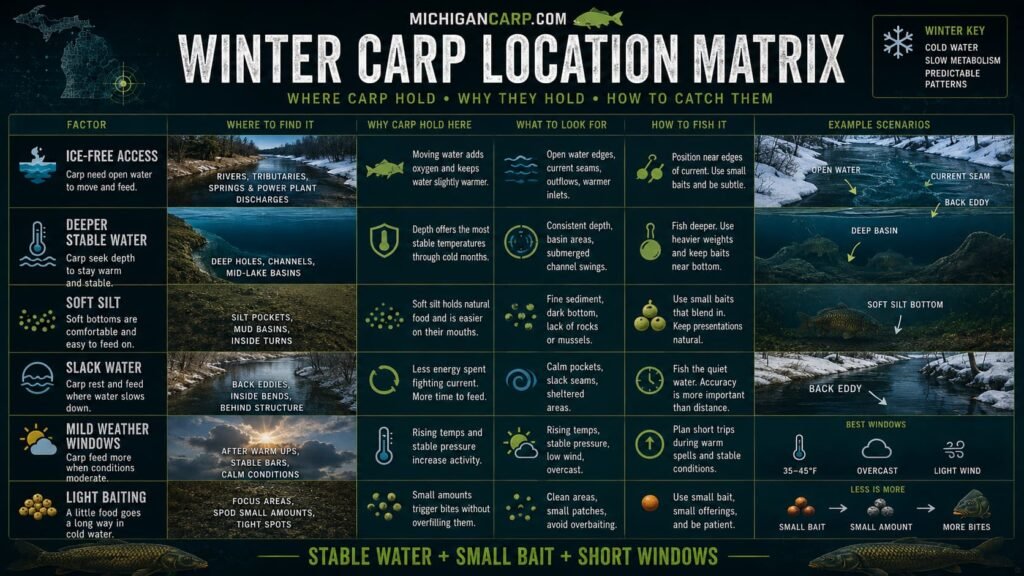
On inland lakes, open-water access may be limited. If fishable water is available, look for deeper stable areas, basin edges, soft silt pockets, bay mouths, channels, sheltered corners and routes close to known winter holding water. Carp may still visit shallower areas during mild spells, but they usually need nearby stability.
On rivers and channels, look for slower water. Inside bends, slack edges, deeper holes, current seams, back eddies, marina entrances where legal, and areas just off the main push can all matter. Carp may avoid the strongest current in cold water but still use areas where food drifts past slowly.
On dam ponds and reservoirs, old channels, deeper basins, soft-bottom pockets, creek arms, slack margins and areas with depth close to food can be important. These waters can be especially sensitive to flow, drawdown, cold rain and sudden weather changes.
Warm-water influence can attract fish, but it must be legal, safe and sensible to fish. Industrial, marina, discharge or current-influenced areas may have restrictions, private access, unsafe banks or special conditions. Do not assume access is allowed.
Good winter locations usually share four traits:
stable water
nearby food
low disturbance
a realistic short feeding window
A spot does not have to be dramatic. In winter, a small soft-bottom area near a deeper route can be better than a huge attractive-looking bay that is too cold, too shallow or unsafe.
For lake layout and depth scouting, use Michigan DNR Inland Lake Maps.
Ice-Free Water, Rivers, Channels and Dam Ponds
Winter carp fishing in Michigan often depends on finding safe, legal, ice-free water.
That may mean rivers, channels, dam ponds, lower sections of reservoirs, marina areas where fishing is allowed, or lake sections that remain open during mild periods. Each type of water behaves differently.
Rivers and channels can offer more winter opportunity than fully frozen lakes, but flow matters. Carp may hold in slower water, inside bends, deeper holes, slack margins and softer edges. Strong current can be difficult when water is cold because fish may not want to expend energy fighting it.
Dam ponds and reservoirs can hold winter carp, but changing levels, flow, ice, steep banks and snags can create problems. A spot that looks accessible in summer may be unsafe in winter. Look for stable edges, old channels, softer bottoms and areas where carp can sit comfortably near food.
Ice-free lake areas can be valuable if access is safe. Deeper edges, bay mouths, soft silt and sheltered areas close to deeper water are worth attention. But do not fish near unsafe ice shelves, unstable edges or places where a hooked carp would be difficult to land and return.
Winter fish can be catchable, but the margin for error is smaller.
Choose waters where you can fish properly, not just waters that happen to have open water.
Winter Feeding Signs Are Subtle
Do not expect winter carp to show like summer carp.
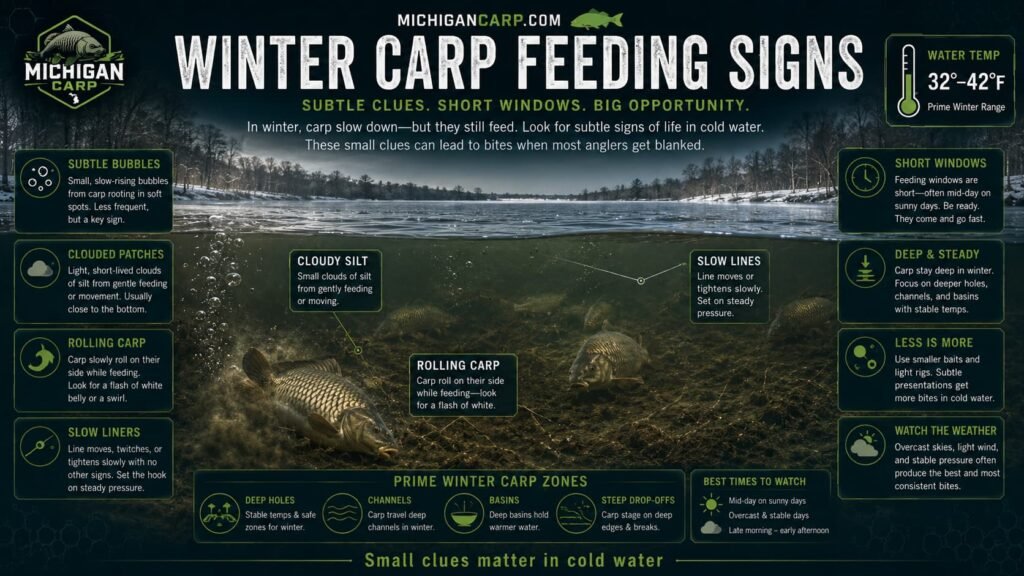
You may not see tails, crashing fish, strong bubbling or obvious mud clouds. Winter signs are often small and easy to miss. A few slow bubbles, a gentle liner, one rolling fish, a small patch of clouded water, or repeated activity at the same time may be all you get.
The best winter signs are repeated.
One bubble means little. A small patch of bubbles appearing near a soft-bottom area at the same time on two mild afternoons is more useful. One liner may be random. Repeated soft liners on the same rod may show carp are close.
Rolling fish in winter can be valuable, but still does not automatically mean feeding. A roll may show the holding zone, the depth band or a route. If a fish rolls over deeper water near a bay mouth or current seam, think about where it may feed nearby rather than casting directly at the splash.
Clouded water can still matter in winter, especially in shallow or medium-depth silt during a mild window. But it may be small and brief.
Winter sign reading requires patience. The lake may not give you much, so the small clues matter.
For detailed sign interpretation, read Signs Carp Are Feeding.
Winter Bait Strategy
Winter bait strategy should be simple and controlled.
The biggest winter baiting mistake is using summer amounts.
Cold-water carp may eat, but they usually do not need a lot of bait to stop. In many winter situations, a small hookbait with a tiny amount of attraction is enough. You are not trying to build a large feeding area. You are trying to put a bait where carp are already comfortable enough to feed.
Good winter options include small boilies, trimmed boilies, corn, maize, small tiger nut pieces, crumb, tiny PVA sticks, small mesh bags, soluble powders, and very light particle traps. The key is not just the bait type. It is the amount.
Boilies can work well in winter if used carefully. Smaller boilies, halves, crumb and singles can be better than large beds of whole bait. A high-confidence food bait is useful, but only if it is placed correctly.
Corn can be effective because it is visible, familiar and easy to use in small amounts. Maize is tougher and can be useful where you want a more durable grain. Tiger nuts can work, especially as a hookbait or in very small amounts, but they should not be piled in heavily in cold water.
Crumb can be useful because it creates attraction without giving carp too much to eat. Tiny PVA sticks or small bait parcels can keep attraction close to the hookbait.
Avoid heavy oil use in very cold water. Some oils become thicker and less effective in cold conditions. Soluble attraction, crumb, light liquids and small food signals usually make more sense.
For bait comparison, read Best Carp Bait for Michigan Lakes and Boilies vs Corn vs Particles for Carp.
How Much Bait to Use in Winter
Use less than you think.
That is the safest winter baiting rule.
If carp are not feeding, more bait will not solve the problem. If carp are feeding briefly, too much bait can fill them or leave uneaten food in the swim. If the fish only visit for a short window, a tight, attractive trap is usually better than a spread of bait.
For short winter sessions, a single hookbait, a tiny PVA stick, a pinch of crumb, or a few grains of corn can be enough.
For longer sessions, you can add very small amounts after activity. If you get a liner, a bite, repeated bubbles or clear signs, add a small top-up. Do not dump a large amount because one fish rolled.
For known winter holding areas, light repeated baiting may work if conditions allow and the water is safe, but the amount should still be modest. Winter baiting is about confidence and precision, not volume.
A good winter baiting rule is:
Make the bait easy to find, but do not give carp a meal they do not need.
Rod Placement in Cold Water
Winter rod placement should be more precise than summer rod placement.
In warm water, you may use rods to search a wider zone. In winter, random spreading can waste time. Each rod should have a clear purpose.
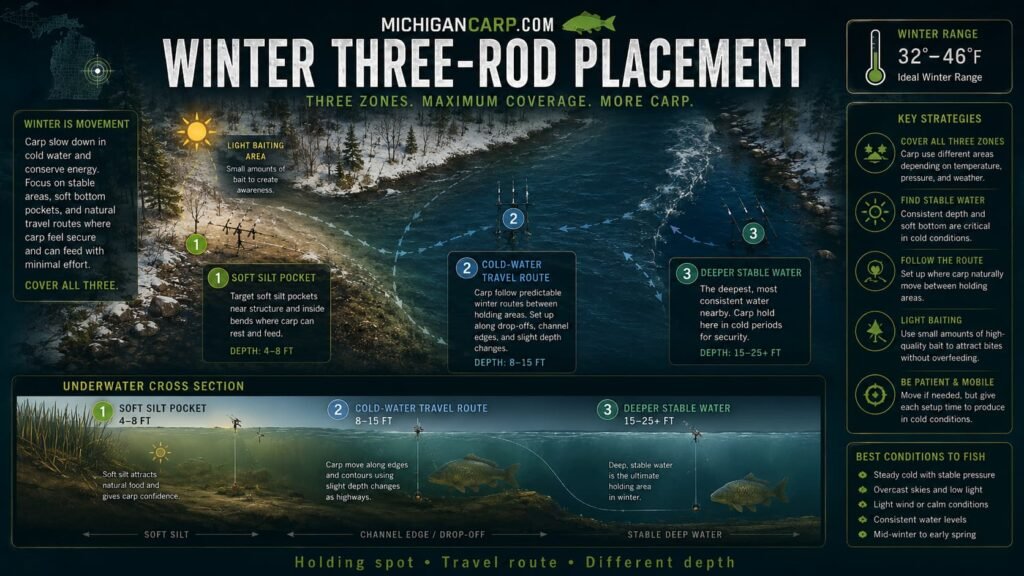
A simple winter three-rod layout is:
one rod on the most likely holding or feeding spot
one rod on a nearby route
one rod on slightly different depth or bottom
On a lake, that might mean one rod on a soft silt pocket, one on the bay mouth and one on the deeper edge. On a river, it might mean one rod in the slack, one on the seam and one on the softer inside edge. On a dam pond, it might mean one rod on the old channel edge, one on a soft-bottom shelf and one on slightly deeper stable water.
Do not keep recasting unless you have a reason. In winter, disturbance can hurt more than it helps. If the bait is presented properly, give it time.
Line angles matter too. Carp may be less active and more cautious. Keep lines sensible, avoid unnecessary disturbance and do not fish where ice, debris or current will constantly pull the rig out of position.
Winter carp fishing is often about choosing the right window.
Stable conditions can be better than dramatic changes. A mild spell after several cold days may help. A few days of slightly warmer weather can be more important than one warm afternoon. Sun on a sheltered margin may create a brief opportunity. A cold rain, sharp front or sudden temperature drop can make feeding very short.
The best winter windows often include:
stable mild weather
slightly warmer afternoons
low wind or manageable wind
safe access
open water
a known holding area
a small amount of feeding evidence
This does not mean winter carp only feed on warm days. They can feed in cold conditions, but the better windows are usually easier to identify when temperature and stability improve.
Wind is different in winter than summer. A warm wind can help, but a cold wind can make exposed banks miserable and unproductive. Shelter can matter more. Fish comfort and angler safety both count.
Do not let a forecast tempt you into unsafe conditions. Ice, lightning, extreme cold, high winds, dangerous roads and unsafe banks are reasons to wait.
Winter Fish Care
Fish care is important all year, but winter creates extra problems.
Cold air can damage exposed fish tissue if fish are kept out too long. Wet mats, slings and nets can freeze. Icy ground can be dangerous. Numb hands make handling slower. Short daylight can make landing and returning fish more awkward.
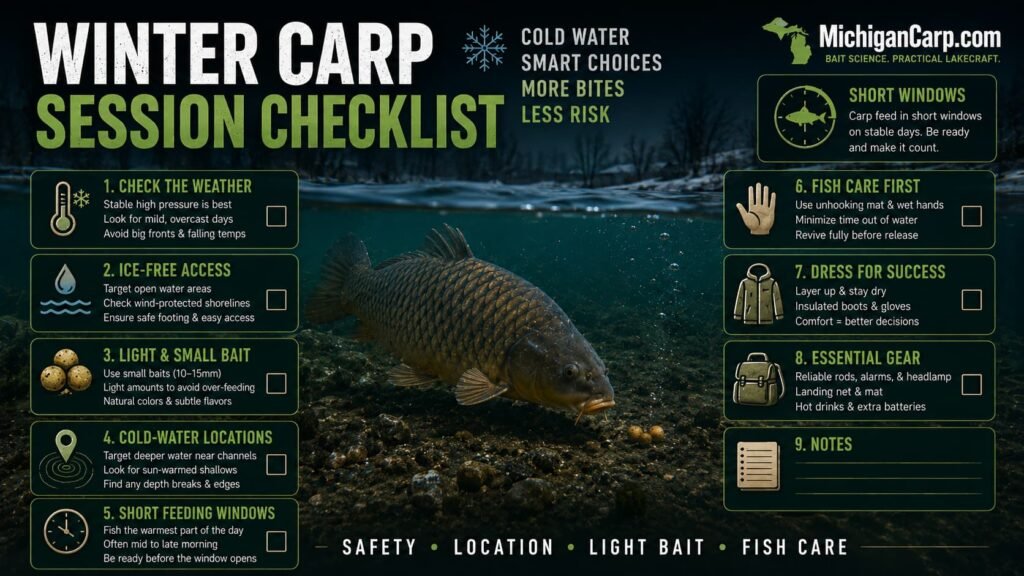
Have everything ready before you cast.
Your net should be assembled. Your mat should be ready. Your sling and forceps should be accessible. Your camera plan should be simple. In cold conditions, the fish should be unhooked, photographed if needed and returned efficiently.
Avoid laying fish on frozen ground. Keep the fish wet and protected. Do not delay for long photo sessions. If conditions are too cold to handle fish properly, reconsider the session.
Winter carp may fight differently, but they still deserve full care. Strong tackle, safe rigs, suitable landing areas and quick handling matter.
This is especially important on steep banks, icy edges, rivers and dam ponds where landing can become difficult.
Winter Session Plan
A good winter session starts with choosing the right water.
Do not choose a venue only because it has produced in summer. Choose a venue with safe access, open water, likely winter holding areas and realistic landing options.
Before the session, check weather, access and rules. Look for mild, stable conditions if possible. Study the map for deeper areas, soft silt, channels, slack water, basin edges and bay mouths.
When you arrive, watch carefully. Winter signs may be subtle. Do not rush to bait heavily. If you have confidence in the spot, place small baits accurately and give them time.
Start with very light baiting. One rod can fish the best holding area, one the route, and one a slightly different depth or bottom. Use small hookbaits, tiny traps and low disturbance.
During the session, avoid constant recasting. If nothing happens, decide whether the location is wrong or the window has not opened. Moving in winter should be based on evidence, not impatience.
If you get a bite or strong signs, top up lightly. Do not assume one carp means a summer-style feeding spell.
At the end of the session, record the details: weather, water type, wind, time of bite, depth, bottom, bait amount and signs. Winter patterns are often specific, and notes matter.
Common Winter Carp Fishing Mistakes
The first mistake is ignoring safety.
Unsafe ice, steep frozen banks, poor access, short daylight and difficult landing conditions are not minor details. They decide whether the session should happen.
The second mistake is feeding too much. Winter carp usually do not need large bait beds. A small accurate trap is often better.
The third mistake is fishing summer locations without winter logic. Shallow bays, weed edges and margins can still work during mild spells, but stable deeper water, soft silt and routes often matter more.
The fourth mistake is moving too often. Winter windows can be short. If you are confident in the location, constant recasting and moving can reduce your chance.
The fifth mistake is ignoring subtle signs. A small bubble patch, a gentle liner or one roll may be the only clue you get.
The sixth mistake is using baits that are too large, too oily or too much for the conditions. Winter bait should be attractive but controlled.
The final mistake is poor fish care. Cold conditions require preparation, speed and proper equipment.
My Practical View
Winter carp fishing in Michigan is not something I would approach casually.
The first question is always safety. Can I fish legally, land fish safely and return them properly? If not, I do not care how good the spot looks.
After that, I want stable water, soft food-holding bottom, low disturbance and a reason for carp to be there. I am not trying to bait a whole area into life. I am trying to place a small, attractive bait where carp already have some reason to feed.
I would rather fish one good winter spot carefully than keep moving around with bait everywhere.
My winter baiting is light. Small boilies, trimmed hookbaits, corn, tiny PVA sticks, crumb, and very small controlled traps make more sense than big beds of particles or boilies. If carp prove they are feeding, I can add a little more. Until then, less is usually safer.
The final rule is simple:
In winter, safety comes first, location comes second, bait comes third, and the feeding window may be short.
FAQ
Can you catch carp in winter in Michigan?
Yes, carp can be caught in winter in Michigan where safe, legal, ice-free water is available. Feeding windows are usually shorter and baiting should be very light.
Where do carp go in winter?
Winter carp often use deeper stable water, soft silt pockets, basin edges, old channels, slack river areas, sheltered zones and routes close to food and comfort.
What is the best winter carp bait?
Good winter carp baits include small boilies, corn, maize, tiny tiger nut pieces, crumb, small PVA sticks and single hookbaits. Use small amounts.
How much bait should I use in winter?
Use very little bait. A single hookbait, tiny PVA stick, pinch of crumb or a few grains of corn can be enough in cold water.
Do carp feed in cold water?
Yes. Carp can feed in cold water, but usually less often and for shorter windows than in warmer seasons.
What time of day is best for winter carp?
The warmest part of the day can be useful, especially during mild spells, but known holding areas may produce at any time during short feeding windows.
Are rivers better than lakes in winter?
Rivers and channels can offer more ice-free winter opportunity, but flow, safety and access matter. Carp often prefer slower seams, slacks and deeper stable areas.
Are boilies good for winter carp?
Boilies can work in winter, especially small boilies, trimmed boilies, singles and crumb. Avoid heavy beds of bait unless carp clearly prove they are feeding.
Are tiger nuts good in winter?
Tiger nuts can work as a hookbait or in very small amounts, but they should not be used heavily in cold water.
Should I use packbait in winter?
Small amounts of packbait or crumb can work, but large packbait applications are usually too much in cold water. Keep attraction tight and controlled.
What are winter carp feeding signs?
Winter signs are often subtle: slow bubbles, light liners, one roll, a small clouded patch or repeated activity in the same area.
Is ice fishing for carp safe?
Only fish where conditions are legal and safe. This article focuses on open-water winter carp fishing. Do not risk unsafe ice, unsafe banks or poor fish care.
What is the biggest winter carp fishing mistake?
The biggest mistake is ignoring safety or feeding too much bait before carp show they are willing to feed.
Should I move swims in winter?
Move only with evidence. In winter, constant moving and recasting can hurt your chances. A good winter spot often needs time.
Next Steps
Use these supporting guides next:
Spring Carp Fishing in Michigan
Summer Carp Fishing in Michigan
Finding Carp in Big Michigan Lakes
How to Find Natural Carp Feeding Areas in Michigan Lakes
Best Carp Bait for Michigan Lakes
Boilies vs Corn vs Particles for Carp