

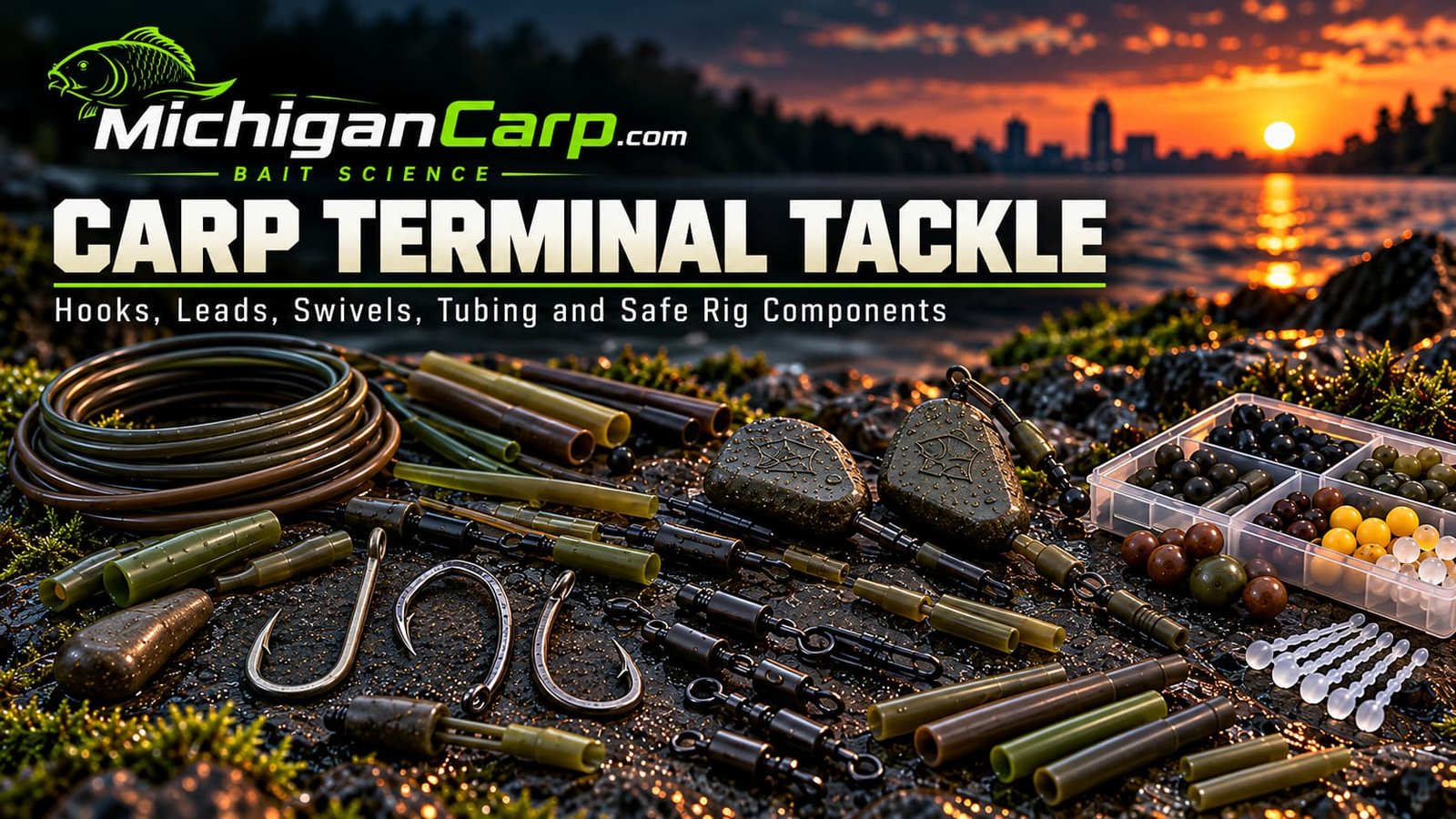
Carp terminal tackle for Michigan needs to do three things well:
hold the fish, present the bait correctly and behave safely if something goes wrong.
The small components at the end of the line may look insignificant compared with rods, reels and mainline, but this is where the complete fishing system becomes precise.
Hooks, hooklinks, swivels, lead clips, tubing, anti-tangle sleeves, bait stops, rig rings and other small parts all have specific jobs.
The answer is not to carry every rig component made.
It is to carry a small selection of dependable parts that fit together properly and solve real fishing problems.
For the wider system, use Carp Fishing Gear for Michigan.
For complete rig selection, use the Complete Carp Rig Guide.
For lead clips, inline systems and helicopter mechanics, use Carp Lead Systems for Michigan.
For mainline, leaders and abrasion, use Carp Fishing Line and Leaders for Michigan.
The rule for this article is:
EVERY COMPONENT SHOULD HAVE A JOB.
Table of Contents
Quick Start: What Terminal Tackle Do You Actually Need?
A useful carp terminal-tackle box can be surprisingly small.
| Component | Priority | Main Job |
|---|---|---|
| Strong carp hooks | Essential | Hooking and holding the carp |
| Coated braid hooklink | Essential | General rig construction |
| Size 8 swivels | Essential | Reliable connections |
| Quick-change swivels | Useful | Faster rig changes |
| Lead clips + tail rubbers | Essential for clip systems | Lead attachment/release |
| Inline lead components | Useful | Compact presentations |
| Rig tubing | Essential for many setups | Fish protection and tangle reduction |
| Anti-tangle sleeves | Essential with QC swivels | Separation and connection security |
| Bait stops | Essential | Secure hair-rigged baits |
| Baiting needle | Essential | Mount boilies, corn and nuts |
| Bait drill | Useful | Hard hookbaits and tiger nuts |
| Bait screws | Later | Wafters and pop-ups |
| Rig rings / micro swivels | Later | D rigs and movement |
| Hook beads / kickers | Later | Specialist rig mechanics |
| Tungsten putty | Useful | Balance and pinning |
| Scissors | Essential | Clean rig construction |
| Rig puller | Essential | Knot testing |
A beginner does not need every specialist accessory.
Start with:
hooks + hooklink + swivels + safe lead components + tubing + sleeves + bait stops + basic tools
Then add specialist components when a particular rig requires them.
Terminal Tackle Is Not the Same as a Rig
This article is about the parts.
A rig is the finished arrangement.
Examples include:
- Hair Rig;
- Blowback Rig;
- Slip-D Rig;
- Ronnie/Spinner Rig;
- Multi Rig;
- Chod Rig.
Terminal tackle is what those rigs are made from.
That distinction matters because it prevents a common problem: buying a tackle box full of parts before understanding one complete safe presentation.
The decision sequence should be:
- Find the carp.
- Read the bottom.
- Choose the hookbait.
- Choose the rig.
- Choose the lead system.
- Select only the components that rig actually needs.
- Test the assembled system.
Do not build a rig around the contents of the tackle box.
Build the tackle box around the rigs you genuinely use.
Hooks: Spend Attention Here First
The hook is one part of the terminal system where failure immediately matters.
It must:
- prick quickly;
- remain sharp;
- hold under pressure;
- have enough wire strength for the water;
- match the rig and hookbait.
Michigan public water can be hard on hook points.
Rock, zebra mussels, gravel, timber and concrete can blunt a hook without producing an obvious snag.
Check the point before every recast.
Practical Hook Sizes
For my style of fishing, sizes 6 and 4 cover a great deal of general carp fishing.
A size 2 can make sense with:
- larger hookbaits;
- heavier tackle;
- weed;
- rough water;
- big carp;
- situations where the rig mechanics suit the larger hook.
Do not choose hook size from carp weight alone.
Hookbait size, rig mechanics and the fishing situation matter too.
Hook Pattern
This article does not need to duplicate the specialist hook guide.
The broad rule is:
- wide gape — strong general starting pattern;
- curve shank — useful where aggressive turning is wanted;
- specialist stiff/chod patterns — use with rigs designed for them.
For the full subject, use Hook Patterns for Carp Fishing.
Test Every Hook
Check:
- point;
- barb;
- eye closure;
- wire;
- coating;
- shape.
If a hook has touched hard structure, check it again.
Never assume a hook is sharp simply because it came straight from the packet.
Hooklink Materials: Keep the Choice Simple
Hooklink material connects the hook to the rest of the terminal system.
For most anglers, three categories cover nearly everything.
Supple Braid
Supple braid offers excellent movement and is easy to tie.
It works well for:
- simple hair rigs;
- particles;
- corn;
- tiger nuts;
- boilies.
Its weakness is tangle resistance.
Longer casts and uncontrolled flight can allow a very supple hooklink to wrap around other components.
Coated Braid
For general Michigan fishing, coated braid is one of the most versatile hooklink materials.
The coating provides:
- extra stiffness;
- better separation;
- reduced tangling;
- controlled movement.
A short stripped section near the hook can restore flexibility where required.
Stiff and Fluorocarbon Hooklinks
Stiff materials have specialist applications.
They can help:
- push a hookbait away from the lead;
- create repeatable rig mechanics;
- reset certain presentations;
- build D-rig or stiff-boom arrangements.
They are not necessary simply because a rig looks more sophisticated.
For the wider line and abrasion system, use Carp Fishing Line and Leaders for Michigan.
Swivels and Quick-Change Connections
A swivel is small, cheap and easy to overlook.
It is also load-bearing.
A dependable swivel should:
- rotate smoothly where required;
- have closed, clean eyes;
- fit the lead system correctly;
- withstand substantially more pressure than normal fish-playing loads.
Size 8 Swivels
Size 8 has become a common carp-tackle standard because many lead clips and inline inserts are designed around it.
But do not assume every manufacturer’s size 8 is dimensionally identical.
Test the actual parts together.
Quick-Change Swivels
Quick-change swivels are useful because they allow the hooklink to be removed without cutting knots.
They should normally be used with a suitable anti-tangle sleeve or other retainer so the rig cannot accidentally leave the crook.
The important word is compatible.
A swivel that almost fits a clip is not good enough.
Lead Clips, Inline Components and Running Parts
This is where Terminal Tackle begins to overlap with the dedicated Lead Systems article, so we only need the component-level rules here.
Lead Clips
A lead clip system normally requires components that fit together correctly:
- clip;
- appropriate swivel;
- tail rubber;
- lead swivel or lead attachment.
A clip is not safe merely because it is called a lead clip.
The assembled system must behave correctly.
Do not jam the tail rubber farther onto the clip simply because you do not want to lose a lead.
For detailed lead-release mechanics, use Carp Lead Systems for Michigan.
For a manufacturer’s explanation of how lead clips are intended to operate, see Korda’s Lead Clip Guide.
Inline Components
Inline leads can produce very compact presentations.
The important component question is whether:
- the insert fits correctly;
- tubing or leader material can move as intended;
- knots cannot jam the system;
- the lead can behave safely after a break-off.
Running Components
Running setups usually require fewer parts.
That simplicity can be an advantage.
Use beads, swivels and sleeves only where they have a defined purpose.
Do not turn a simple running system into a complicated semi-fixed arrangement by adding unnecessary stops and restrictions.
Rig Tubing
Rig tubing is one of the most useful simple components in a carp tackle box.
It can:
- help protect the fish from direct mainline contact;
- reduce tangles;
- tidy the final section;
- help route the line around the rig.
But tubing is not automatically an abrasion leader.
It should not be treated as a substitute for appropriate line or leader material around severe:
- zebra mussels;
- sharp rock;
- riprap;
- timber.
That distinction belongs in Carp Fishing Line and Leaders for Michigan.
Check the Bore
The mainline should pass through without being damaged.
Check for:
- splits;
- crushed ends;
- internal debris;
- damaged sections.
Replace damaged tubing rather than repeatedly trimming tiny sections from it.
Anti-Tangle Sleeves
Anti-tangle sleeves are simple and useful.
They can:
- cover a quick-change swivel;
- help retain the hooklink;
- push the hooklink away from the lead during the cast;
- reduce tangles.
The sleeve should fit properly.
Too loose and it may fail to retain the rig.
Too tight and it may distort other components.
Again, compatibility matters more than branding.
Bait Stops and Extender Stops
Bait stops are among the lowest-risk, most useful pieces of tackle you can buy.
They hold bait on the hair.
They work with:
- boilies;
- corn;
- maize;
- tiger nuts;
- artificial baits;
- snowman combinations.
Extender stops are useful when you want to alter the effective hair length without retying the entire rig.
This is also an area where inexpensive tackle is often perfectly adequate.
A bait stop does not carry the same safety consequence as a hook or swivel.
Bait Screws, Rig Rings and Micro Swivels
These become useful once you move beyond very simple hair rigs.
Bait Screws
Useful for:
- pop-ups;
- wafters;
- boilies that hold a screw securely.
They allow fast hookbait changes.
Rig Rings
Rig rings can create controlled movement on:
- D rigs;
- blowback arrangements;
- sliding hookbait mounts.
Micro Swivels
Micro swivels add rotational freedom.
They can help hookbaits rotate without twisting the hooklink.
The mistake is adding them because they look technical.
Use them when the rig design requires them.
Hook Beads, Kickers and Shrink Tube
These components alter hook mechanics.
Hook Beads
They retain:
- rig rings;
- micro swivels;
- moving hookbait mounts.
Their position can materially affect the rig.
Kickers
Kickers can:
- extend the hook shank;
- alter the exit angle of the hooklink;
- help the hook turn.
Shrink Tube
Shrink tube can perform similar mechanical jobs but requires heating.
None of these parts should replace a basic understanding of how the hook is supposed to turn and take hold.
Tungsten Putty and Small Sinkers
Tungsten putty is useful for fine adjustment.
It can:
- balance pop-ups;
- pin hooklinks;
- counterbalance hookbait buoyancy.
Use the minimum required.
Too much putty can create a bulky, unnatural section and change the mechanics of the rig.
Test the finished presentation in the edge.
A balanced hookbait should behave the way you intend in water, not merely look right on the tackle table.
Baiting Needles, Drills and Rig Tools
These are not glamorous pieces of tackle, but they are essential.
Baiting Needle
Use the appropriate needle for the bait.
A fine needle may suit boilies.
Hard particles and nuts may need a stronger latch needle or drill.
Bait Drill
Very useful for:
- tiger nuts;
- hard hookbaits;
- cork inserts;
- hardened boilies.
Scissors
Use proper sharp rig scissors.
Poor scissors can flatten or fray braid instead of cutting it cleanly.
Rig Puller
A rig puller lets you test knots much harder than you comfortably can with bare fingers.
Every finished hooklink should be tested before it goes into the water.
Match Components to the Hookbait
Terminal tackle should support the bait.
Corn and Maize
Usually simple.
Hair rig + bait stop is often all that is required.
Tiger Nuts
A bait drill and suitable hair stop are useful.
Double nuts or snowman arrangements may require a longer hair.
Bottom-Boilie Fishing
Hair rigs, Slip-D rigs and other bottom-bait presentations can all work depending on the bottom and hookbait.
Do not change terminal components simply because the bait diameter changes slightly.
Wafters
Balanced baits may benefit from:
- rings;
- screws;
- controlled hair length;
- careful hook balance.
Pop-Ups
Pop-up rigs may require:
- bait screws;
- rig rings;
- micro swivels;
- beads;
- putty;
- specialist hooklink material.
Those components should be added because the rig needs them.
Match Components to Michigan Water
Clean Lakebed
Keep the system simple.
You normally do not need the strongest, largest version of every component.
Weed
Prioritize:
- strong hooks;
- dependable hooklinks;
- safe lead release;
- clean connections.
Zebra Mussels and Riprap
The main abrasion solution belongs in the line/leader system.
Terminal components should still be inspected for:
- rough edges;
- damaged coatings;
- cut tubing;
- damaged hooklinks.
Timber
Strength matters.
So does realistic fish control.
Do not treat stronger hooks and swivels as permission to fish an impossible snag.
Silt
The primary issue is presentation rather than component strength.
Avoid unnecessarily bulky assemblies that pull the hooklink or hookbait into soft material.
For bottom interpretation, use Reading the Bottom for Carp.
Budget Terminal Tackle: Where to Save and Where to Be Careful
Budget tackle is not automatically bad.
Premium tackle is not automatically good.
The correct question is:
What happens if this component fails?
That gives us a much better buying hierarchy.
Lower-Risk Items
I am relatively comfortable saving money on things such as:
- bait stops;
- extender stops;
- rig boxes;
- bait drills;
- simple baiting tools;
- storage accessories.
Higher-Risk Items
I test far more carefully:
- hooks;
- swivels;
- quick-change connections;
- hooklink;
- lead clips;
- inline inserts;
- leader components.
These are either load-bearing or directly involved in fish safety.
Judge the actual product.
Check consistency.
Pull-test it.
Check fit.
If something feels wrong, discard it.
A cheap component that passes proper testing may be useful.
An expensive component that does not fit the rest of the system correctly is still the wrong component.
The Compatibility Test
One of the most important terminal-tackle lessons is that individual components cannot be judged separately.
A good swivel can still be wrong for a particular lead clip.
A good tail rubber can still grip the wrong clip too tightly.
A good sleeve can still be too loose on a quick-change swivel.
Before fishing:
assemble the exact components together.
Then test:
- fit;
- movement;
- security;
- release;
- knot clearance;
- tubing clearance.
Do not assume that components from different brands automatically share identical dimensions.
The Break-Off Safety Test
Every rig should be considered from the fish’s point of view.
Ask:
If the mainline breaks, what remains attached to the carp?
You do not want the fish towing:
- a trapped heavy lead;
- an unnecessarily long unsafe leader;
- jammed terminal components;
- multiple snagged sections of tackle.
That is why lead-system mechanics matter.
This article covers the individual components.
The full break-off mechanics belong in Carp Lead Systems for Michigan.
Korda’s current technical guidance also emphasizes that lead-system safety depends on correct component assembly and allowing the lead or terminal system to separate appropriately after a mainline failure.
Safe Component Check Before Every Cast
Before the rig goes back out, check the final system.
Hook
- sharp;
- not opened;
- no damaged point.
Hooklink
- no fraying;
- no crushed coating;
- knot tested.
Swivel
- seated correctly;
- no damage;
- connection secure.
Lead System
- lead attached correctly;
- release mechanism functioning;
- no jammed inserts.
Tubing / Leader
- no cuts;
- components move as intended.
Hookbait
- secure;
- hook point clear;
- hook gape not blocked.
Complete Rig
Pull-test it.
Drop it into the margin.
Watch how it settles.
If the rig does not behave correctly at your feet, do not assume it will magically improve 70 yards away.
Common Terminal Tackle Mistakes
The first mistake is buying too many components before mastering a simple rig.
The second is trusting hooks without checking the point.
The third is assuming all similarly sized swivels and clips fit one another.
The fourth is jamming a tail rubber so tightly that the lead cannot release as intended.
The fifth is using a quick-change swivel without correctly retaining the hooklink.
The sixth is using tubing as though it were a heavy abrasion leader.
The seventh is adding beads, putty, rings or kickers without understanding their mechanical job.
The eighth is allowing the hookbait to obstruct the hook gape.
The ninth is failing to pull-test knots and swivels.
The tenth is assuming expensive automatically means safe.
Terminal tackle only becomes safe when it is assembled and tested as a system.
A Practical Michigan Terminal-Tackle Box
For general Michigan carp fishing, I would build the box around a relatively small core.
Core
- strong size 6 hooks;
- strong size 4 hooks;
- a few size 2 hooks where justified;
- coated braid hooklink;
- size 8 swivels;
- quick-change swivels;
- anti-tangle sleeves;
- lead clips;
- tail rubbers;
- suitable inline components;
- rig tubing;
- bait stops;
- extender stops;
- baiting needles;
- bait drill;
- scissors;
- rig puller.
Add When Needed
- bait screws;
- rig rings;
- micro swivels;
- hook beads;
- kickers;
- shrink tube;
- tungsten putty;
- specialist stiff hooklink.
That box will build a very large proportion of useful carp presentations without carrying dozens of duplicate products.
MichiganCarp Practical View
I prefer simple terminal tackle.
That does not mean I only fish one rig.
It means I want each component to justify being there.
I would rather fish:
a sharp hook + strong hooklink + dependable swivel + safe lead system
than a more complicated presentation covered in components I do not need.
The more difficult the water becomes, the more important compatibility and testing become.
Weed, zebra mussels, timber and rough public-water fishing are not situations where I want to discover that a swivel nearly fits or a lead clip only releases sometimes.
Know the job.
Choose the part.
Test the complete assembly.
Then fish it with confidence.
FAQ
What is carp terminal tackle?
Carp terminal tackle is the collection of smaller components used at the rig end of the setup, including hooks, hooklinks, swivels, clips, tubing, sleeves, bait stops, bait screws, rings, beads and putty.
What terminal tackle should I buy first?
Start with strong hooks, coated hooklink, swivels, lead clips, tail rubbers, tubing, anti-tangle sleeves, bait stops, a baiting needle, scissors and a rig puller.
What hook size should I use?
Sizes 6 and 4 cover a great deal of general carp fishing. Size 2 can be useful for larger hookbaits, stronger tackle and rougher water where the rig mechanics justify it.
Do all size 8 swivels fit all lead clips?
Not necessarily. Manufacturer dimensions can differ. Test the exact swivel and clip together.
Do I need rig tubing?
It is useful on many conventional carp setups because it can protect the fish near the rig and reduce tangles. It is not a substitute for an abrasion leader in severe rock, shell or timber.
Are lead clips safe?
They can form part of a safe lead system when the components are compatible and correctly assembled. Detailed lead-system safety is covered in the dedicated Lead Systems article.
Do I need bait screws?
Not for simple hair rigs. They become useful for wafters, pop-ups and certain D-rig or spinner-style presentations.
What are anti-tangle sleeves for?
They help push the hooklink away from the lead system and can securely cover certain quick-change connections.
Is budget terminal tackle safe?
Some budget tackle can be perfectly usable. Low-risk accessories are easy places to save money. Load-bearing and fish-safety components should be inspected and tested much more critically.
Can I mix tackle brands?
Yes, provided the components fit correctly and the complete system passes your safety and pull tests.
Should I test swivels and hooks before using them?
Yes. Hooks should be inspected for point quality and strength, while swivels and connections should be pull-tested as part of the assembled rig.
What is the biggest terminal-tackle mistake?
Using components because they look right without understanding how the complete assembly behaves during the cast, fight or break-off.
Next Steps
Use Hook Patterns for Carp Fishing for the detailed hook-pattern decision.
Use Carp Lead Systems for Michigan for inline, lead-clip and helicopter mechanics.
Use Carp Fishing Line and Leaders for Michigan for abrasion and leader choice.
Use the Complete Carp Rig Guide to choose the finished presentation.
Use Carp Fishing Gear for Michigan for the complete equipment route.
The practical rule is:
SHARP.
STRONG.
COMPATIBLE.
SAFE.
If a component does not improve one of those four things, ask whether it needs to be on the rig at all.