

Carp bite windows are the short periods when carp are more likely to feed confidently. They are not magic times on a clock. They happen when several conditions line up at once: location, food, light level, oxygen, temperature, pressure, safety, weather trend and fish movement.
Sometimes a bite window lasts hours. Sometimes it lasts twenty minutes. Sometimes it happens at dawn. Sometimes it happens after dark. Sometimes it follows a wind change, a pressure shift, a thunderstorm, a cooling rain, a warm spring afternoon, or the first ripple after a flat calm spell.
Sometimes the lake feels dead all day, then two rods go within ten minutes.
That is not always luck.
Often, the carp were nearby, but the conditions were not right until the window opened. Understanding bite windows is one of the most important parts of carp fishing watercraft. It helps explain why the same swim can look lifeless at noon and produce at dusk, why a windward weed edge can suddenly switch on, why a shallow margin may only produce at night, and why over-baiting during a closed window can be a mistake.
This guide explains how carp bite windows work in Michigan carp fishing, what causes them, how to recognize them, and how to be ready when they open.
For the wider conditions system, use Watercraft and Conditions for Michigan Carp Fishing. For seasonal timing, start with Michigan Carp Fishing Seasons. For temperature-specific decisions, use Carp Water Temperature Guide for Michigan Lakes.
Table of Contents
Quick Answer: What Is a Carp Bite Window?
A carp bite window is a period when carp are more willing to move, search, feed and pick up bait because conditions have become favorable.
The mistake is thinking a bite window is only about time of day. Dawn, dusk and night can be excellent, but the clock is only one part of the picture. A true bite window is usually created by overlap. Light level may improve. Boat traffic may drop. Oxygen may rise. Wind may push food into a bank. A cold front may pass. A shallow bay may warm. A storm may freshen the water. Carp may finally feel safe enough to enter a margin they avoided in daylight.
That is why one angler can sit through six quiet hours and then get three chances in half an hour. The fish did not magically appear from nowhere. More often, they moved when the conditions made the area worth using.
The practical job is simple:
Choose a swim where carp are likely to pass, then stay organized enough to take advantage of the short windows when they feed.
Bite Windows Are About Overlap, Not One Trigger
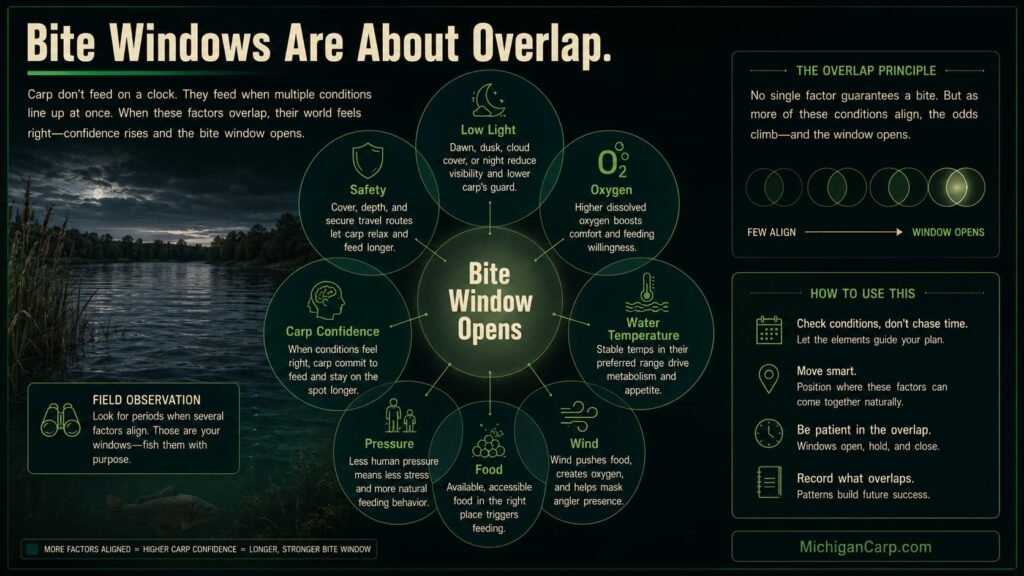
Many anglers try to simplify carp feeding into one factor.
They ask whether dawn is best, whether dusk is best, whether low pressure is best, whether a south wind is best, whether the moon phase matters, or whether the water is warm enough. Those questions are useful, but none of them works alone.
The best bite windows usually happen when several conditions overlap.
A summer dawn window may be strong because the light is low, boat traffic has not started, oxygen has recovered overnight, carp have been moving in the margins, and the water is quiet. A fall afternoon window may happen because a mild wind has pushed into a food-rich bank during stable weather. A spring midday window may work because shallow water has warmed a few degrees after cold nights. A night window may open because pressured carp finally feel safe enough to feed close in.
A single trigger may help. A stack of triggers is stronger.
That is why bite windows are part of watercraft, not superstition.
| Trigger | Why it can help | When to be careful |
|---|---|---|
| Low light | Carp may move closer and feed with more confidence | Low light does not help if the swim has no fish or food |
| Warming water | Spring carp may become more active in shallow areas | A cold front after warming can shut a shallow swim down |
| Wind | Can move food, oxygen, color and warmer surface water | Strong wind can make presentation and fish care unsafe |
| Oxygen improvement | Carp may feed better where water is comfortable | Hot, stagnant water can look alive but fish poorly |
| Reduced pressure | Margins and shallow areas may become usable again | Quiet water still needs a feeding reason |
| Weather change | Cloud, ripple, rain or post-front stability can shift movement | Violent storms and lightning are safety problems, not opportunities |
The table matters because it keeps you honest. Do not choose a swim because of one nice-looking factor. Choose it because several clues point to carp being comfortable enough to feed there.
Dawn Bite Windows
Dawn is one of the classic carp feeding times because several useful changes happen together.
Light is low. Margins are quieter. Boat traffic has usually not started. The lake has had all night to settle. In warm weather, oxygen can be better than it was late the previous afternoon. In pressured areas, carp that avoided the bank during daylight may still be close enough to catch before human activity builds again.
That makes dawn especially useful on Michigan lakes with campground pressure, docks, swimmers, day boats, clear water, shallow weed, or obvious margins that become busy later in the day.
Dawn does not mean you should cast randomly into the sunrise. The best dawn swims are usually areas carp already had a reason to visit during the night: reed edges, clean holes in weed, soft silt, shallow food shelves, protected bay mouths, inflows, wind lanes, or deeper routes that lead into feeding water.
For a dawn window, the work starts before first light. Rigs should already be placed or ready to place accurately. The landing net should be ready. The mat should be wet and positioned. The swim should be organized enough that you are not stumbling around in the half-light looking for forceps, bait needles or headlamp batteries.
On short sessions, dawn can be the whole point of the trip. On longer sessions, dawn often tells you what the fish did overnight. Liners, fizzing, rolling, topping, subtle flat spots, bubbling and short sharp bites can all tell you whether to stay, adjust or move.
For summer fishing, dawn often pairs well with Summer Carp Fishing in Michigan. For cold-water sessions, dawn is not always the best period because the water may still be at its coldest. In early spring, late morning or afternoon warming may beat first light.
Dusk Bite Windows
Dusk is another powerful bite window, but it works slightly differently from dawn.
By evening, the day’s pressure often begins to fade. Boats leave. Swimmers go home. Bank disturbance drops. Light levels soften. Wind may ease or change. Shallow water that was too bright or exposed during the day can become usable again. Carp that held off a margin, weed edge or bay mouth may start drifting in to feed.
Dusk is especially important in summer and early fall. During warm weather, carp may spend the day in safer water, weed, shade or deeper comfort zones, then move onto shallower food areas as light drops. On public waters, dusk can also mark the change from people-dominated water to carp-dominated water.
The danger with dusk is impatience. Many anglers pack up just as the swim is improving. They fish the dead part of the afternoon, lose confidence, then leave when the light starts falling and the lake finally begins to move.
A good dusk plan starts earlier. Watch the water during the afternoon. Note where fish show, where fizzing appears, where small fish are active, where the wind has pushed into, and where shade is forming. Then make a controlled decision before the window arrives. Dusk is not the time to be changing everything in panic.
If a swim has shown no signs all day but suddenly gives liners, flat spots, bubbling, reed movement or quiet rolling fish at last light, tighten the baiting and be ready. You may only get one short spell.
Night Bite Windows
Night fishing can be extremely productive for carp where it is legal, safe and practical.
At night, carp may move shallower, feed more confidently, use margins, patrol weed edges, visit clear spots and travel routes they avoid during bright daylight. This is especially true on clear waters, pressured lakes, campground waters, busy summer venues and swims with heavy daytime disturbance.
Night windows can be excellent, but they punish sloppy preparation.
Before dark, you should already know where the rods are going, how you will land a fish, where the snags are, where the weed is, where the net will go, where your headlamp is, and whether the access point allows you to be there. Do not discover at 2 AM that the bank is unsafe, your mat is buried under gear, or your rods are blocking a public path.
Night fishing also changes bait and presentation. Carp may come closer, but they still need a reason to feed. Small accurate patches, prepared particles, chopped boilies, crumb, method mix, tiger nuts, corn or a good food bait can all work when they match the water. Heavy random baiting in the dark can ruin a short window if the fish are only passing through.
For night bait choices, use Best Carp Bait for Night Fishing. For safety and handling, use Fish Care and Safety. Before fishing after dark on public water, check Michigan Carp Fishing Regulations and the rules for that exact access point.
Midday Bite Windows
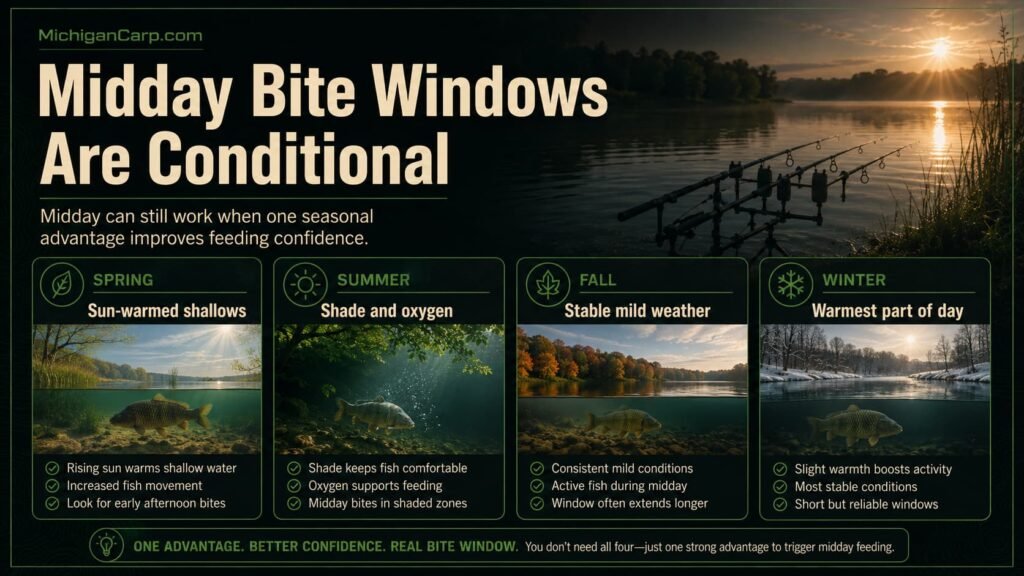
Midday is not always bad.
In summer, bright midday conditions can be difficult on clear, shallow, pressured water. Carp may back away from exposed margins, tuck into weed, hold deeper, move under shade or simply wait for lower light. But in spring, fall and winter, midday can be one of the best parts of the day.
In early spring, shallow bays can warm through late morning and early afternoon. A swim that is lifeless at sunrise may become the best water on the lake by 2 PM. In late fall or winter, the warmest part of the day may create the only realistic feeding window. On windy or colored water, midday light may not be a problem at all.
The question is not “is midday good?” The question is “what is midday changing?”
If midday brings warmth to a spring bay, it can help. If it brings boat traffic and bright sun to a clear summer margin, it can hurt. If it brings ripple, cloud cover and food movement to a fall bank, it can help. If it brings heat and low oxygen to stagnant water, it can hurt.
That is why water temperature and oxygen have to sit beside bite-window thinking. Use Carp Water Temperature Guide for Michigan Lakes and Dissolved Oxygen and Carp Fishing together rather than treating bite times as fixed rules.
Weather Windows and Pressure Changes
Weather can create bite windows, but it is easy to misunderstand.
Carp do not feed because a phone app shows a certain pressure number. They respond to the whole situation around the weather: wind direction, cloud cover, temperature trend, water movement, oxygen, light level, rain, boat pressure and whether the change improves the area they are using.
A gentle weather change can switch a swim on. A hard cold front can shut shallow water down. A warm wind in spring can push comfort into a bay. A cooling breeze after summer heat can make carp more willing to feed. Cloud cover can make clear water feel safer. Light rain can reduce surface disturbance and human pressure. A thunderstorm may change the lake quickly, but lightning and severe weather are safety issues first.
The best way to think about weather is not “good” or “bad.” Think in terms of what the weather is doing to the water.
| Weather change | Possible bite-window effect | Practical response |
|---|---|---|
| Warm spring afternoon | Shallows may wake up | Watch protected bays, reed edges and dark bottoms |
| Stable mild spell | Carp may feed more predictably | Repeat the best route or food area |
| Cold front | Shallow confidence may drop | Reduce bait and keep a route to stable water covered |
| Summer cooling breeze | Oxygen and comfort may improve | Try wind lanes, weed edges and low-light timing |
| Cloud after bright sun | Clear water may become safer | Watch margins and visible patrol routes |
| Heavy storm risk | Fishing may become unsafe | Leave early; no bite is worth lightning or dangerous water |
For a dedicated pressure guide, read Barometric Pressure and Weather Fronts for Carp Fishing in Michigan. For official weather and lightning safety, check NOAA / National Weather Service and NWS Lightning Safety before fishing exposed banks, piers, campgrounds or big-water shorelines.
Oxygen Windows in Summer
Oxygen can be one of the biggest hidden reasons a summer bite window opens or closes.
Warm water can hold less dissolved oxygen than cooler water, and stagnant water with decaying organic matter can become harder on fish during summer. USGS explains that dissolved oxygen is needed by fish and other aquatic life, and that warm water holds less dissolved oxygen than cool water. For background, see USGS: Dissolved Oxygen and Water and USGS: Temperature and Water.
In practical carp fishing terms, this means the hottest-looking water is not always the best water. A shallow, still, weedy corner can look full of life but produce poorly if carp are uncomfortable. The better summer window may happen where wind, weed edges, inflows, shade, depth or night cooling make fish more comfortable.
Oxygen windows often show up around:
Early morning: the lake has cooled, disturbance is low and carp may still be moving from night feeding areas.
Wind changes: a new ripple can bring oxygen, food movement and confidence to a flat bank.
Inflow areas: moving water can be attractive if it is safe, legal and not too cold, muddy or disturbed.
Healthy weed edges: weed can hold food and cover, but solid decaying weed or unfishable weed can create presentation and fish-care problems.
After heat breaks: a cooler night, cloud, rain or breeze after oppressive heat can create a short improvement.
When summer fishing feels dead, ask whether the carp are actually absent or whether they are present but uncomfortable. If they are present but not feeding, a better-timed window may matter more than changing bait.
Boat Pressure and Public-Water Bite Windows
Michigan carp fishing is often public-water fishing. That means boat pressure, swimmers, campers, dog walkers, kayaks, launches, docks and general disturbance can shape the bite window as much as bait choice.
On busy summer waters, carp may still feed, but they may shift their confidence to early morning, late evening, night, quiet weather, weekdays, or areas with less human traffic. A swim that looks perfect at noon on a Saturday may only become fishable after the lake settles down.
Boat pressure does not always push carp miles away. Sometimes it pushes them tighter to cover. Sometimes it moves them deeper. Sometimes it makes them avoid open shallow water until the light drops. Sometimes they tolerate it but feed less confidently. The only way to know is to watch the water and keep notes.
Useful signs after pressure drops include:
fish returning to a margin, small fizzing patches appearing, reed stems moving, small fish or turtles leaving bait alone, liners becoming more deliberate, and repeated shows along the same route.
The mistake is blaming bait when the real issue is timing. If the fish only use the area from 8 PM to midnight, changing flavor at 2 PM will not fix the session.
Seasonal Bite Windows
Every season creates different bite windows.
Spring windows are often built around warming water, shallow comfort, protected bays, reed edges, nearby depth and stable weather. A short afternoon window can outperform an all-night sit if the water is still cold. As spring develops, pre-spawn feeding can be excellent, but active spawning behavior should not be confused with normal feeding.
Summer windows are often built around low light, oxygen, weed edges, shade, wind, boat pressure and night confidence. Carp may feed harder than in spring, but they still do not feed everywhere. The best summer bite windows are usually in water that remains comfortable.
Fall windows can be excellent because cooling water, dropping boat pressure, food concentration and changing weed can pull carp onto repeatable routes. Early fall may still behave like summer. Mid-fall can produce strong food-led windows. Late fall often asks for tighter baiting and more precise timing.
Winter and very cold-water windows are usually short, subtle and tied to stability. The warmest part of the day may matter more than dawn. Tiny feed, small hookbaits, careful location and realistic expectations become more important.
Use Spring Carp Fishing in Michigan, Summer Carp Fishing in Michigan, Fall Carp Fishing in Michigan and Winter Carp Fishing in Michigan to match the bite-window idea to the actual season.
Moon Phase and Solunar Bite Windows
Moon phase and solunar theory can be useful, but they should never outrank real conditions.
Some anglers dismiss moon phase completely. Others treat it like the main control switch. The practical approach sits in the middle. Moonlight, night brightness, solunar periods and fish movement may help explain patterns on some waters, especially after you have enough session notes. But moon phase does not replace location, temperature, oxygen, wind, pressure, food, safety or fish actually being in front of you.
Use the moon as a supporting clue, not a reason to ignore the lake.
If two likely windows look similar, moonlight or a solunar period may help you decide when to watch harder or stay longer. But if the wind, oxygen, temperature, access and fish signs are wrong, the moon will not save a poor swim.
For the dedicated discussion, read Moon Phases and Solunar Theory for Carp Fishing in Michigan.
Baiting During Bite Windows
Bite-window thinking should change how you bait.
If the window is short, do not feed as though carp are camping in the swim for twelve hours. Short windows often reward accurate traps, small patches, crumb, chopped boilies, prepared particles, a tight method area, a few tiger nuts, a handful of corn, or a hookbait that leaks enough signal quickly without overfeeding the spot.
If the window is longer and fish are returning repeatedly, you can build more confidence. That is when steady baiting, repeated small top-ups, boilie crumb, particles or a food-bait approach can work well. The key is to let the fish tell you. Do not decide the bait amount from the bucket. Decide it from the water.
| Window type | Best baiting style | Common mistake |
|---|---|---|
| Short dawn window | Accurate rigs, small patch, minimal disturbance | Recasting and feeding too much during the best minutes |
| Spring warming window | Light bait, easy food, careful buildup | Feeding like it is late spring before fish are ready |
| Summer night window | Controlled particles, boilies, crumb or method where fish return | Spreading bait too wide in darkness |
| Weather-change window | Be ready before the change arrives | Changing rigs and bait while the window is open |
| Fall food window | Food-value bait where routes and signs confirm fish | Fishing old summer areas too long |
| Cold-water window | Tiny feed and one-bite accuracy | Trying to create a big feeding situation |
For bait decisions, use Carp Bait Guide for Michigan Lakes. For cold-water bait, use Best Carp Bait for Cold Water. For summer bait, use Best Carp Bait for Summer Fishing.
Rig and Presentation During Short Feeding Spells
A bite window is not useful if your rig is not fishing properly when it opens.
Short feeding spells punish lazy presentation. If the rig is buried in weed, sitting in chod, tangled, too far from the route, or placed where you cannot safely land a fish, the window may pass without a chance. This matters on Michigan waters because many good carp areas involve weed edges, soft silt, zebra mussels, timber, reed beds, rocks, current, boat traffic or awkward banks.
The rig does not need to be complicated. It needs to match the bottom and be ready before the carp arrive.
On clean spots, simple bottom-bait rigs, wafters or balanced hookbaits may be enough. On weed edges or light debris, a pop-up, Ronnie-style presentation, multi rig or carefully balanced rig may be better. In heavy weed or snaggy areas, fish safety and landing angle matter more than squeezing a bait into a risky spot.
The important point is that bite windows should not become panic windows. If you know the bottom, know the range, know the safe landing angle and have rigs prepared, you can fish calmly when the lake wakes up.
For rig choice, use The Complete Michigan Carp Rig Guide. For depth and presentation decisions, use Best Depth for Carp Fishing in Michigan Lakes.
How to Recognize a Bite Window Opening
A bite window often announces itself before the first proper bite.
The signs are not always dramatic. Carp may roll once in the same lane. A reed stem may move. You may see tiny patches of fizzing. A flat spot may appear in ripple. A liner may lift the bobbin and drop back. Small fish may scatter. The water may cloud slightly over silt. A margin that looked empty may suddenly feel alive.
The key is repetition.
One splash could be anything. Repeated subtle signs in the same zone are more important. If fish keep showing along the same line, if bubbles keep appearing near the same patch, if liners arrive from the same direction, or if the lake changes at the same time as light, wind or pressure, pay attention.
When a window opens, avoid doing too much. Many anglers ruin a short window by recasting every rod, throwing in too much bait, walking the bank, shining lights, talking loudly, or changing rigs when they should be waiting.
Often the best move is small: tighten the bait, recast one rod accurately, top up lightly, lower disturbance, and let the other rods keep fishing.
When to Move and When to Wait
Bite windows create one of the hardest decisions in carp fishing: should you stay or move?
If you are in a known feeding area with good signs, good timing and a window that has not arrived yet, waiting can be the right choice. If you are in empty water with no signs, poor conditions, wrong depth, bad access or no reason for carp to visit, waiting is just wasting time.
Separate patience from stubbornness.
Patience means you have a reason to believe the window is coming. Stubbornness means you are staying because you already set up and do not want to admit the swim is wrong.
A good decision system looks like this:
| Situation | Best response |
|---|---|
| Known route, good weather trend, no bites yet | Wait and keep disturbance low |
| Repeated fish signs just out of range | Move one rod or adjust range |
| Dead swim, no signs, wrong conditions | Move or reset the plan |
| Short liners during low light | Stay alert; the window may be opening |
| Heavy weed or unsafe landing angle | Do not risk fish care for a possible bite |
| Storm, lightning or unsafe wind | Leave or shelter; safety comes first |
For the wider tactical approach, use Carp Fishing Tactics in Michigan.
Session Planning Around Bite Windows
Good session planning is not about predicting every bite. It is about putting yourself in the right place before the likely window opens.
Before a session, ask what kind of window you are actually fishing for. Is it a spring warming window? A summer night window? A fall feeding route? A short dawn chance on a pressured campground lake? A cooling-rain opportunity after heat? A wind change on a big-water bank?
That answer should shape everything: arrival time, swim choice, bait amount, rod placement, food prep, lighting, landing gear, range, backup swim and how long you wait before adjusting.
A dawn session may require arriving in the dark and being quiet. A dusk session may require watching during the afternoon and setting traps before the light fades. A night session requires legal access, safe bank setup, lights, alarms, landing gear and a plan for handling fish efficiently. A weather-window session requires checking forecasts and not confusing dangerous storms with opportunity.
The biggest planning mistake is turning up after the window has already happened. The second biggest mistake is being present but not ready.
Use the Sessions section to connect bite windows to real session planning.
A Simple Michigan Bite Window Plan
Use this simple process before your next session.
Step 1: Choose the seasonal story
Start with the season. Spring warming, summer comfort, fall food and winter stability all create different windows. Do not fish a summer night plan in early spring just because it worked in July.
Step 2: Check the water temperature trend
Do not ask only what the temperature is. Ask whether it is rising, falling or stable. A warming spring bay and a cooling summer bay can both be good for different reasons.
Step 3: Read oxygen and water movement
Look for wind, ripple, inflows, weed edges, shade, current, and areas where fish can stay comfortable. Summer windows especially depend on this.
Step 4: Decide the likely time window
Choose the likely bite period before you fish. Dawn, dusk, night, midday warming, pre-front movement and post-heat cooling all require different preparation.
Step 5: Match bait amount to the window
Short window, small bait. Longer feeding spell, build carefully. Cold water, tiny feed. Summer feeding, feed only when fish are present and comfortable.
Step 6: Be ready before it opens
Rigs should be fishing, the landing area should be clear, and the baiting plan should already be decided before the best minutes arrive.
Step 7: Record what happened
Write down bite times, fish signs, wind, water temperature, weather, baiting, moonlight, pressure, depth and what changed. Your own notes will become more useful than generic rules.
Common Bite Window Mistakes
Fishing by the clock only
Dawn and dusk are useful, but they are not automatic. The best window is the one where carp, food, safety and conditions overlap.
Arriving too late
If the dawn window is the target, arriving at sunrise may already be too late. If the dusk window is the target, you need the swim ready before light drops.
Over-baiting a short window
Some bite windows only need a small trap. Too much bait can spread fish out, distract them, or leave them feeding after your best rig is no longer in the right place.
Changing everything during the best minutes
A short bite window is not the time to rebuild rigs, sort bait buckets or make noise in the swim. Be ready beforehand.
Ignoring safety at night
Night windows can be brilliant, but unsafe banks, bad lighting, poor fish care, illegal access and storm risk can turn a good idea into a bad session.
Blaming bait for a timing problem
If carp only feed in that swim after dark, a better flavor at noon will not solve the problem. Timing, location and confidence may be the real issue.
Not keeping notes
Bite windows become clearer when you track them. Without notes, every session feels isolated. With notes, you start to see patterns.
My Practical MichiganCarp View
For Michigan carp fishing, I treat bite windows as a practical planning tool, not a superstition.
I do not believe every bite can be predicted. Carp are still carp. Weather changes, other anglers, boat traffic, spawning behavior, bait pressure, water clarity, weed growth and plain randomness all play a part. But I do believe most good sessions become more understandable when you look at the window that produced the fish.
Was it low light? Was it warming water? Was it a wind change? Was it a quiet period after boat traffic? Was it night confidence? Was it a fall food route? Was it oxygen after heat? Was it a shallow bay finally reaching a usable temperature?
Once you start thinking that way, you stop asking only, “What bait should I use?”
You start asking the better question:
When are carp most likely to use this exact area with enough confidence to feed?
That question catches more fish.
FAQ
What is the best time of day to catch carp?
Dawn, dusk and night are often strong carp feeding times, especially in summer or on pressured waters. In spring, fall and cold water, the best window may be late morning or afternoon if that is when the water warms or stabilizes.
Do carp feed more at night?
They can, especially on clear, pressured or busy waters where daytime disturbance makes shallow feeding less comfortable. Night fishing still needs safe access, good organization, fish care and accurate presentation.
Are carp bite windows predictable?
They are partly predictable when you track season, water temperature, wind, pressure, oxygen, light level, fish signs and bite times. They are not guaranteed clock events.
Is dawn or dusk better for carp?
Both can be excellent. Dawn often benefits from quiet water and overnight movement. Dusk often benefits from falling light and reduced daytime pressure. The better choice depends on the water, season and conditions.
Do weather fronts create carp bite windows?
Yes, weather changes can create windows when they improve comfort, light, water movement, oxygen or confidence. Severe weather and lightning are safety issues and should not be treated as fishing opportunities.
Does water temperature affect bite windows?
Yes. Water temperature affects movement, comfort, oxygen, feeding intensity and seasonal behavior. The trend is often more important than one reading.
Do carp feed during the middle of the day?
Yes, especially in spring, fall and colder conditions when midday warming helps. In hot, clear summer water, midday may be weaker unless wind, shade, depth or oxygen make the area comfortable.
Should I bait heavily before a bite window?
Only when the situation justifies it. Short windows often need tight, controlled baiting. Longer feeding spells may allow more bait, but only if carp are present and returning.
How do I know a bite window is starting?
Watch for repeated signs: fizzing, liners, rolling, reed movement, clouded silt, flat spots, margin activity or fish moving along the same route. Repetition matters more than one random sign.
Can moon phase help predict carp bite windows?
It can be a supporting clue, especially if your own notes show patterns, but it should not overrule water temperature, location, oxygen, wind, pressure, food, safety or visible fish behavior.
Next Steps
Use these guides next:
- Watercraft and Conditions for Michigan Carp Fishing
- Carp Water Temperature Guide for Michigan Lakes
- Barometric Pressure and Weather Fronts for Carp Fishing in Michigan
- Dissolved Oxygen and Carp Fishing
- Wind, Waves and Current Carp Fishing
- Michigan Carp Fishing Seasons
- Carp Fishing Tactics in Michigan
- Sessions
- Carp Bait Guide for Michigan Lakes
- Fish Care and Safety
A bite window is not a guarantee. It is an opportunity. Choose water where carp have a reason to be, understand what conditions are improving, keep your baiting controlled, stay organized, and be ready when the lake gives you the short spell you came for.