


Salt and minerals in carp bait can influence taste, ionic strength, ingredient balance, paste behavior and the chemical signal surrounding a finished bait.
That makes salt a legitimate formulation ingredient.
It does not make salt a guaranteed carp attractor, sea salt a superior ingredient or an electrolyte powder a shortcut to advanced bait science.
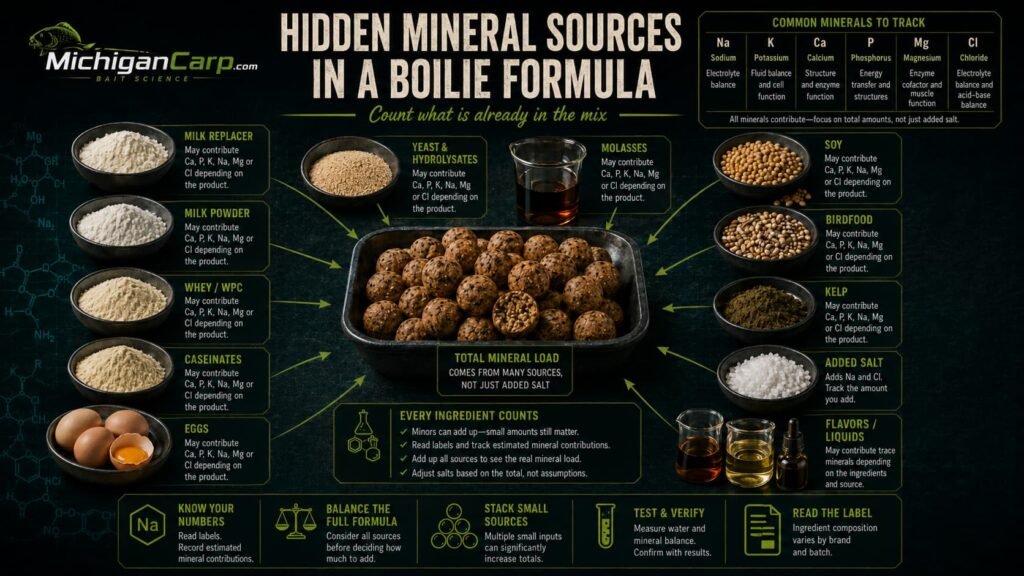
Most boilies already contain minerals before any salt is deliberately added. Milk replacer, milk powders, caseinates, eggs, yeast, hydrolysates, soy, birdfood, molasses, grains and nut meals can all contribute sodium, potassium, calcium, phosphorus, magnesium, chloride or other ash-forming minerals.
The practical question is therefore not simply whether a recipe should contain salt.
The better question is what the existing ingredients already contribute and whether an additional mineral ingredient has one clearly defined job.
Fine food-grade sodium chloride can balance a sweet milk-and-nut bait, support a savory yeast-and-liver profile or give prepared particles a controlled salty edge. Kelp can add a darker seaweed identity along with a variable mineral fraction. A specifically selected calcium, potassium or magnesium salt can alter the formula in a different way.
Those ingredients are not interchangeable.
Sodium chloride does not perform the same job as potassium chloride, calcium carbonate, calcium lactate, sodium citrate, dicalcium phosphate, potassium sorbate or sodium benzoate merely because every product is described chemically as a salt.
For acids and acid-driven pH changes, read Organic Acids in Carp Bait and How pH Changes Carp Bait Performance.
For soluble feeding-related compounds, use Amino Acids in Carp Bait and Betaine in Carp Bait.
Table of Contents
Quick Start: 7 Rules for Salt and Minerals in Carp Bait
- Count the salt and minerals already supplied by the ingredients.
- Use fine food-grade sodium chloride when the required job is simply controlled saltiness.
- Do not pay extra for sea salt, Himalayan salt or an electrolyte blend without a defined formulation reason.
- Do not assign one universal dosage to kelp, mineral premixes or individual mineral salts.
- Start a new salt test at a low measured level and change no other major variable.
- Do not assume salt will dissolve clearly in every glug, remain PVA-compatible or preserve wet bait.
- Judge the complete cooked, dried and immersed bait—not the ingredient name or the dry powder alone.
| Application | Controlled starting direction | Main caution |
|---|---|---|
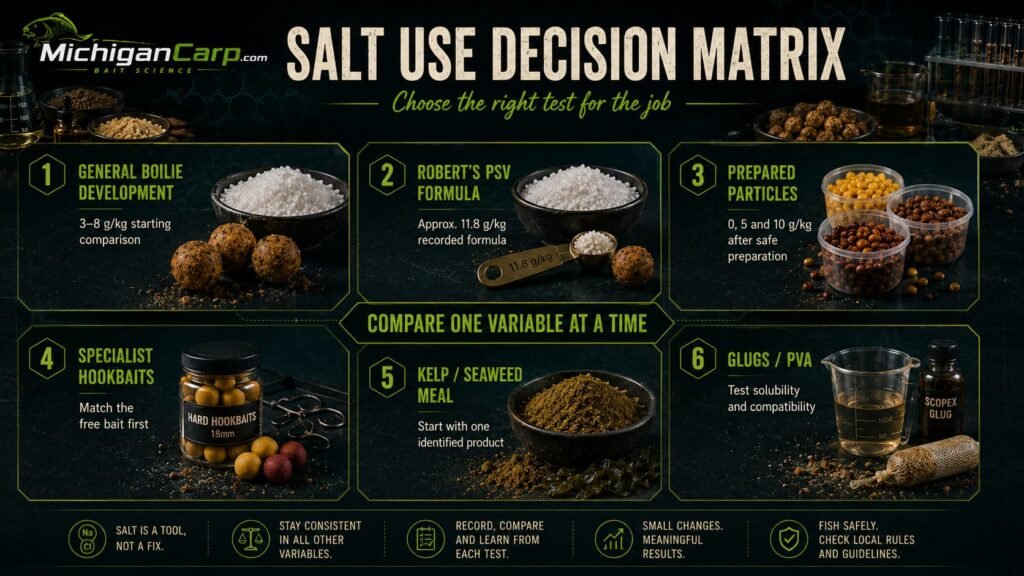
| General boilie development | Compare 3–8 g fine salt per 1 kg dry mix | This is a development range, not a proven optimum |
| Robert’s recorded Plum–Scopex–Vanilla formula | 12 g in 1,019 g dry mix, equal to approximately 11.8 g/kg | A formula-specific field record—not a universal milk-bait rate |
| Prepared particles | Compare 0, 5 and 10 g per 1 kg after soaking, cooking and cooling | Salt does not make improperly prepared particles safe |
| Specialist hookbait | Begin at the matching free-bait level before testing a higher level | Higher salt can change texture, water uptake and presentation |
| Kelp or seaweed meal | Begin with 5–10 g/kg using one identified product | Ash, iodine, salt, texture and odor vary among products |
| Trace-mineral premix | No universal bait rate | Composition and species-specific concentration must be known |
| Glug or spray | Test solubility, sediment, nozzle function and PVA compatibility | Do not assume salt dissolves in a PG- or glycerin-heavy liquid |
The commonly quoted 3–8 g/kg range equals only 0.3–0.8% of the dry mix. Once eggs and other liquids are included, salt represents a still smaller percentage of the complete uncooked paste.
That may be enough to change the bait’s balance. It is not enough to justify a shelf-life claim.
What Salt and Minerals Can—and Cannot—Tell Us About Carp
Sodium, chloride, potassium, calcium, phosphorus, magnesium and several trace elements have genuine biological functions in fish.
They contribute to skeletal structure, osmotic regulation, acid–base balance, nerve function, muscle activity, enzymes and wider metabolism.
The Food and Agriculture Organization discusses these roles in The Minerals in Fish Nutrition and Essential Nutrients: Minerals.
Freshwater fish can obtain some minerals directly from the surrounding water, while other mineral requirements depend more heavily on diet. The balance differs among minerals, species and water chemistry.
That nutritional evidence concerns fish physiology and complete diets. It does not demonstrate that scattering extra trace minerals around a hookbait will cause a wild carp to feed.
Can carp detect sodium chloride?
Carp possess sensitive chemical-detection systems.
An electrophysiological study of common carp reported neural responses when external facial chemoreceptors were stimulated with sodium chloride and other chemicals. Sodium chloride and acetic acid produced stronger responses than sucrose and quinine hydrochloride in that experimental system.
See Taste Responses in the Superior Secondary Gustatory Nucleus of the Carp.
This supports the narrow conclusion that sodium chloride is chemically detectable to carp.
It does not demonstrate:
- an optimum salt level for boilies;
- that stronger sodium-chloride stimulation produces more feeding;
- that sea salt is better than table salt;
- that mineral premixes are attractive;
- that a salty hookbait will outperform the same bait without salt;
- that salt caused a particular capture.
Detection, investigation, oral acceptance and sustained feeding are separate questions.
That distinction is explained further in Carp Feeding Attractants Explained.
Minerals matter biologically, and sodium chloride can be detected. Neither fact proves that more mineral material creates better angling bait.
Salt, Mineral Salts and Electrolytes Are Not the Same Ingredient
In ordinary bait-making language, salt normally means sodium chloride.
An electrolyte is a substance that forms ions when dissolved in a suitable solvent such as water. Sodium chloride is therefore already an electrolyte source because it separates into sodium and chloride ions.
Calling a product an electrolyte blend does not automatically make it more useful than accurately measured salt.
| Ingredient | Main ions or components | Likely formulation effect |
|---|---|---|
| Sodium chloride | Sodium and chloride | Salty taste, ionic contribution and readily water-soluble mineral material |
| Potassium chloride | Potassium and chloride | Potassium source with a different and potentially harsher sensory profile |
| Magnesium chloride | Magnesium and chloride | Highly mineral ingredient that can become bitter or hygroscopic depending on form |
| Calcium chloride | Calcium and chloride | Can influence protein behavior and firmness; not ordinary table salt |
| Calcium lactate | Calcium and lactate | Combines calcium with an organic-acid anion |
| Sodium citrate | Sodium and citrate | Can influence acidity and buffering differently from sodium chloride |
| Calcium carbonate | Calcium and carbonate | Alkaline mineral material that can change pH and texture |
| Dicalcium phosphate | Calcium and phosphate | Mineral and buffering contribution used in formulated feeds |
| Potassium sorbate | Potassium and sorbate | Preservation ingredient rather than a general electrolyte supplement |
| Sodium benzoate | Sodium and benzoate | pH-dependent preservation ingredient rather than ordinary bait salt |
The second half of the salt matters
Adding sodium chloride is not chemically equivalent to adding sodium citrate or sodium benzoate. Each supplies sodium, but the chloride, citrate and benzoate portions have different functions.
The same principle applies to calcium chloride, calcium lactate, calcium carbonate and dicalcium phosphate.
A mineral name should never be separated from its complete chemical form.
Salt and pH
Ordinary sodium chloride is not an organic acid and should not be used as the main pH-adjusting ingredient.
Other mineral salts can raise, lower or buffer pH depending on their chemical form and the surrounding formula.
Milk proteins, phosphates, calcium salts, caseinates and other mineral-rich ingredients can also resist a pH change produced by an acid. This buffering is one reason why the same citric-acid addition does not create the same final pH in every boilie recipe.
The acid system belongs in Organic Acids in Carp Bait. Preservation salts belong in Potassium Sorbate, Sodium Benzoate and Citric Acid in Shelf-Life Boilies.
Sea Salt, Table Salt, Himalayan Salt, Kelp and Mineral Premixes
Plain sodium chloride
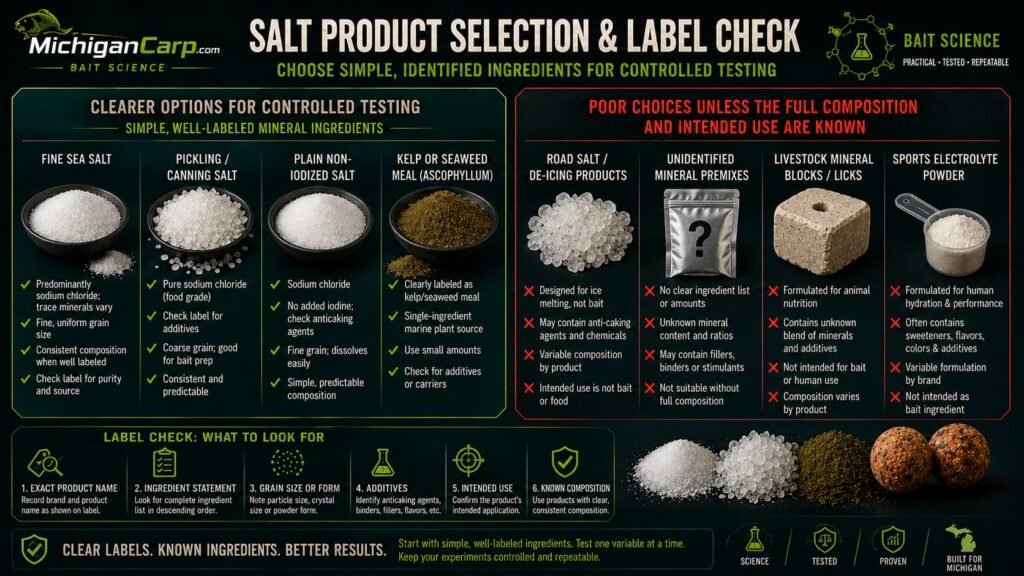
For controlled bait formulation, the most useful salt is normally a fine, clean food-grade sodium chloride product.
Suitable practical choices include:
- fine food-grade sea salt;
- plain non-iodized table salt;
- pickling or canning salt;
- food-grade kosher salt weighed in grams rather than measured by volume.
Fine crystals distribute more evenly through a dry mix than large rock-salt pieces.
Sea salt versus table salt
Both products are predominantly sodium chloride.
Sea salt may contain small amounts of other minerals, but the trace fraction does not establish superior attraction, nutrition or underwater performance.
The more important practical differences are grain size, moisture, purity, additives, price and batch consistency.
Sea salt is a perfectly good bait ingredient. It is not automatically a more technical one.
Iodized salt
US regulations define iodized salt as food salt with permitted iodide added. Anticaking agents may also be declared on the label.
See 21 CFR §100.155: Salt and Iodized Salt.
Iodized salt is not automatically unusable at normal bait levels. Plain non-iodized or pickling salt is simply easier when the aim is to control one ingredient with minimal additional variables.
Himalayan and specialty salts
Pink Himalayan salt and other specialty salts obtain color from small amounts of additional minerals or impurities.
They can be weighed and used like another sodium-chloride source, but their appearance should not be mistaken for evidence of greater bait performance.
Kelp and seaweed meal
Kelp is not simply salt.
It can contribute ash, sodium, potassium, magnesium, iodine, alginate-type material, color, texture and a recognizable seaweed odor.
FAO feed-composition material shows that kelp meal can contain a high and variable ash fraction. That variability is why a new kelp product should be assessed by its own specification rather than treated as a standardized mineral powder.
Use kelp because the darker vegetal–marine identity fits the bait—not because every milk, nut or birdfood boilie needs additional iodine or trace minerals.
A practical first comparison is:
| One-kilogram dry batch | Kelp level | Question |
|---|---|---|
| Control | 0 g | What does the original bait provide? |
| Low test | 5 g | Does kelp add useful identity without dominating? |
| Higher test | 10 g | Does the additional color, ash and odor improve or overload the bait? |
Twenty grams per kilogram may be workable with some products and bait styles, but it should be reached through testing rather than treated as the automatic starting level.
Trace-mineral and livestock premixes
A trace-mineral premix is normally formulated for a specified animal, complete diet and feeding rate.
It may contain concentrated copper, selenium, iodine, zinc, manganese, cobalt or other compounds. A rate intended for cattle, poultry, horses or pigs cannot be transferred blindly into recreational carp bait.
This article does not give a universal gram rate for trace-mineral premixes.
Do not grind an unidentified livestock mineral block into bait. Avoid medicated products and any product whose guaranteed analysis cannot be interpreted confidently.
Sports electrolyte powders
Human hydration powders may contain acids, flavors, colors, sweeteners, vitamins, caffeine, anticaking agents and proprietary blends in addition to minerals.
They can therefore change far more than the mineral content of the bait.
Plain salt or one identified mineral ingredient provides a cleaner experiment.
Count the Minerals Already Present in the Formula
A milk, nut, cereal and birdfood boilie can already contain a substantial mineral background before additional salt, kelp or premix is added.
| Ingredient group | Possible mineral information to check | Practical implication |
|---|---|---|
| Milk replacer | Ash, salt, sodium, calcium, phosphorus and guaranteed mineral levels | A formulated replacer may already contain added minerals and sodium-bearing ingredients |
| Skimmed or whole milk powder | Calcium, phosphorus, potassium, sodium and ash | Dairy material is not mineral-free filler |
| Caseinates | Sodium or calcium associated with the caseinate | Sodium caseinate and calcium caseinate are not mineral equivalents |
| WPC and whey products | Ash, sodium, potassium, calcium and phosphorus | Mineral composition varies with processing |
| Eggs | Sodium, phosphorus, potassium and other minerals | The complete wet phase contributes to the finished formula |
| Yeast and hydrolysates | Natural ash and any salt added during manufacture | Some savory products already taste salty |
| Molasses | Potassium and ash | It contributes more than sugar and color |
| Soy, grains and birdfood | Potassium, phosphorus, magnesium and variable ash | The cereal and plant section contributes to the mineral total |
| Kelp or seaweed meal | Ash, sodium, iodine and other declared minerals | The product may change color, odor and mineral load simultaneously |
| Commercial flavor or liquid food | Carrier, sodium-bearing ingredients and preservatives | Small liquid additions may still introduce mineral salts |
Not every supplier provides a complete mineral analysis. That uncertainty should be acknowledged rather than filled with a guessed value.
Calculate the deliberate salt addition
Added salt percentage of dry mix = salt weight ÷ dry-mix weight × 100
For pure sodium chloride, approximately 39.3% of the weight is sodium and 60.7% is chloride.
| Salt added to 1 kg dry mix | Dry-mix percentage | Approximate sodium supplied | Approximate chloride supplied |
|---|---|---|---|
| 3 g | 0.30% | 1.18 g | 1.82 g |
| 6 g | 0.60% | 2.36 g | 3.64 g |
| 8 g | 0.80% | 3.15 g | 4.85 g |
| 12 g | 1.20% | 4.72 g | 7.28 g |
| 15 g | 1.50% | 5.90 g | 9.10 g |
This table shows the deliberately added sodium chloride. It does not include sodium or chloride already present in milk replacer, caseinate, yeast products, hydrolysates, flavors or other ingredients.
It also uses the dry mix as the denominator. The percentage of the complete paste will be lower after eggs and other liquids are included.
Count the mineral ingredients already in the bait before adding a mineral story to the bait.
Salt in Boilies and Robert’s Milk-Nut Baits
Fine salt is normally added to the complete dry blend so that it is distributed throughout the paste.
For many new boilie formulas, a useful development comparison is 3–8 g per kilogram of dry mix.
That range should not be confused with a biological requirement or proven carp-preference threshold. It is a manageable formulation range that allows the bait maker to compare low and moderate additions without beginning with an extreme salt level.
Robert’s Plum–Scopex–Vanilla record
The recorded Plum, Scopex and Vanilla development formula contains 12 g of sea salt in 1,019 g of dry ingredients.
That equals:
12 ÷ 1,019 × 1,000 = approximately 11.8 g salt per kilogram of dry mix
The level is higher than the general 3–8 g starting range, but it belongs to a specific established formula containing cereals, full-fat soy, birdfood, tiger-nut flour, several dairy ingredients, yeast, molasses powder, liver, fenugreek and a sweet fruit-and-cream flavor system.
It should be preserved as part of that formula’s development record rather than rewritten to match a general table.
It should also not become the automatic salt level for every milk-and-nut boilie.
The complete formula and capture record belong in Plum Scopex Vanilla Boilie: Development and Michigan Results.
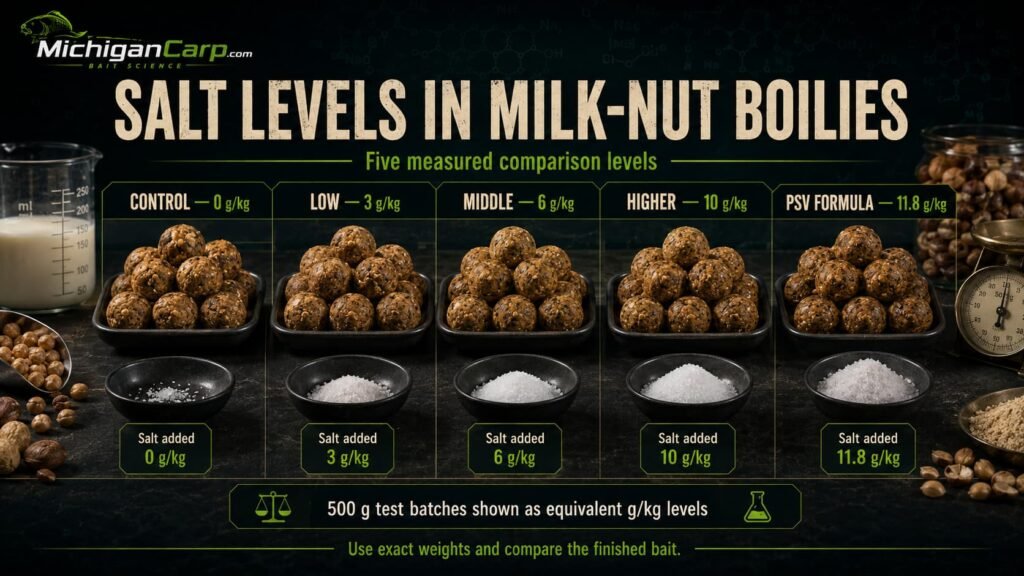
Controlled 500 g salt comparison
| 500 g dry batch | Fine salt | Equivalent per kilogram | Purpose |
|---|---|---|---|
| Control | 0 g | 0 g/kg | Shows the formula without deliberate salt |
| Low | 1.5 g | 3 g/kg | Tests a light balancing effect |
| Middle | 3 g | 6 g/kg | Tests a moderate general level |
| Higher | 5 g | 10 g/kg | Tests whether the extra salt improves or overloads the finished bait |
| PSV-equivalent test | 5.89 g | 11.78 g/kg | Replicates the recorded Plum formula’s salt proportion only |
Use the PSV-equivalent level only when reproducing or deliberately testing that salt proportion. It should not be added as an extra fifth batch without a clear reason.
Paste and cooking effects
Salt changes the ionic environment of the wet paste and can influence interactions among water, proteins and starches.
At low levels the change may be difficult to see. At higher levels it may alter paste firmness, stickiness, extrusion, surface drying or water uptake.
There is no responsible rule that salt always strengthens a boilie or always makes it more soluble. The result depends on the complete formula and process.
Record:
- salt product and exact weight;
- dry-mix weight;
- egg and complete wet-phase weight;
- paste resting time;
- amount of dry mix accepted;
- extrusion and rolling behavior;
- cooking time;
- drying conditions;
- water uptake and physical breakdown.
Do not taste raw paste containing uncooked egg. The finished bait may also contain feed or bait ingredients that were not sold for human consumption, so sensory descriptions should not be treated as human-food tasting instructions.
Use How to Test Boilies Before Fishing for the complete physical testing method.
Particles, Packbait, Hookbaits, Coatings, Liquids and PVA
Prepared particles
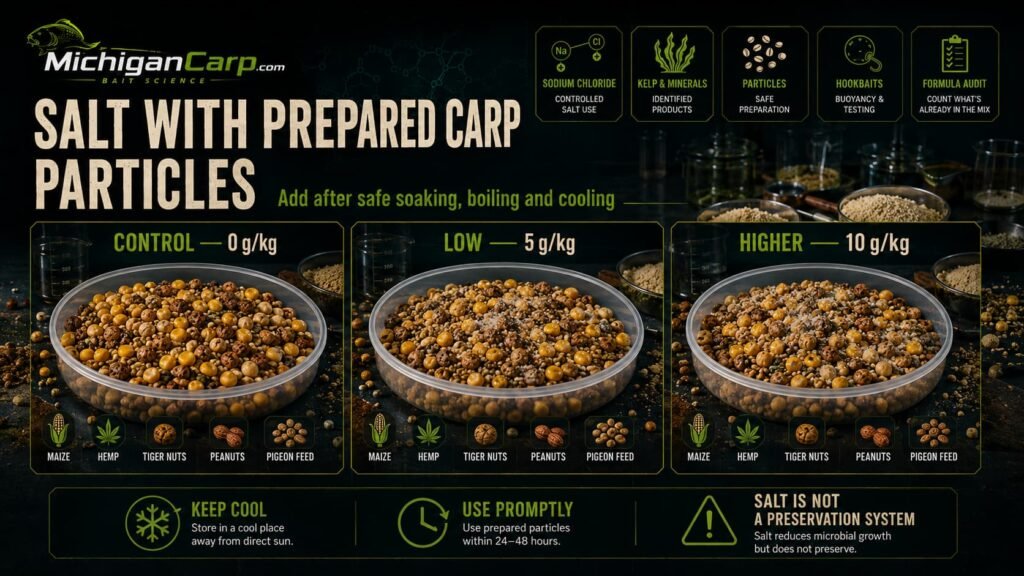
Salt can be tested with maize, tiger nuts, hemp, pigeon feed, peanuts and mixed particles—but only after the particle has been prepared correctly.
Soaking, boiling, cooling and clean storage come first.
A simple same-session comparison is:
| Prepared particle sample | Fine salt | Purpose |
|---|---|---|
| 1 kg control | 0 g | Shows the untreated cooked particle |
| 1 kg low test | 5 g | Tests a light salt addition |
| 1 kg higher test | 10 g | Tests whether the stronger treatment improves or dominates the particle liquid |
Add the salt after the particles have cooled unless the salt is intentionally part of a recorded cooking comparison.
Keep treated particles cool and use them promptly. Salt at these levels is a finishing ingredient—not a validated preservation process.
For safe preparation, read How to Prepare Particles for Carp Fishing.
Packbait and method mix
Salt can be mixed through oats, panko, boilie crumb, maize meal and other dry carriers.
A practical first test is 3–6 g per kilogram of dry packbait carrier.
The packbait must still perform its mechanical job:
- bind during casting;
- reach the intended area intact;
- release at the planned rate;
- leave an appropriate feed patch around the hookbait.
Do not add enough wet salty liquid to destroy the pack’s breakdown behavior.
Use Packbait for Carp Fishing for the full mechanical framework.
Hookbaits
A matching hardened bottom bait, wafter or pop-up should normally begin with the same salt proportion as the free bait.
A stronger hookbait can then be tested deliberately rather than assumed to be better.
Additional salt can affect:
- paste structure;
- drying;
- water uptake;
- surface texture;
- mass;
- wafter and pop-up balance;
- attachment durability.
Test the finished bait with the exact hook, swivel, screw, ring and putty after the full intended soak.
The manufacture of specialist hookbaits belongs in How to Make Wafters and Pop-Ups From a Boilie Base Mix.
Food-based powder coating
A food-based powder coating is easier to control than rolling a damp hookbait directly in straight salt.
| Milk-nut coating ingredient | Amount |
|---|---|
| Fine matching boilie crumb | 45 g |
| Hydrolyzed whey powder or matching milk powder | 20 g |
| Tiger-nut flour | 15 g |
| Brewer’s yeast | 10 g |
| Identified kelp meal | 5 g |
| Fine food-grade salt | 5 g |
| Total | 100 g |
The salt represents 5% of the dust—not 5% of the entire hookbait.
Apply only enough suitable liquid to make a thin coating adhere. Record how much coating the bait gains and retest its texture and buoyancy.
The full finished-hookbait treatment system belongs in Hookbait Conditioners for Carp: Glugs, Sprays, Soaks and Buoyancy Control.

Glugs, sprays and soaks
Sodium chloride dissolves readily in water, but it should not be assumed to dissolve clearly in every propylene-glycol- or glycerin-heavy bait liquid.
PubChem lists approximately one gram of sodium chloride as soluble in ten milliliters of glycerol, which is substantially less convenient than its solubility in water. Propylene-glycol-rich mixtures require their own bench test.
A salty liquid can therefore remain cloudy, form sediment or recrystallize during storage. Crystals may block a fine spray nozzle and create uneven application.
Before using a salt-containing treatment:
- Prepare a small sample of the exact final liquid.
- Record the salt weight and total liquid weight or volume.
- Observe whether the salt dissolves or remains suspended.
- Leave it for at least twenty-four hours and check for recrystallization.
- Test the actual spray nozzle when a spray is intended.
- Apply it to sacrificial hookbaits and measure physical change.
- Test the final treatment against the exact PVA product.
A water-containing treatment may dissolve salt more easily but can increase spoilage risk and may damage PVA. Make small quantities, keep them cool and treat them as short-life prepared bait unless the complete product has been validated.
PVA
Dry salt does not automatically destroy dry PVA, but the complete mixture, humidity and storage time still matter.
Water-rich particle liquor, liquid yeast, CSL, aqueous flavors or an incompletely dissolved salty spray may weaken PVA before casting.
- Load the final mixture exactly as it will be fished.
- Wait longer than the expected preparation and casting time.
- Check for sticking, pinholes, stretching and loss of strength.
- Repeat after the treated bait or mix has stood for several hours.
PVA compatibility belongs to the finished mixture—not to the reputation of one ingredient.
Salt, Texture, Leakage, pH and Preservation
Texture and hydration
Salt can influence the way proteins, starches and water interact, but the effect depends on concentration and the complete bait matrix.
A cereal-heavy paste, milk-protein paste, fishmeal bait and cork-dust pop-up may react differently to the same salt percentage.
Do not add salt to repair a paste before identifying whether the real problem is egg weight, liquid load, particle size, binder balance, fat, resting time or cooking.
For wider diagnosis, use Boilie Problems: Real Causes and Practical Fixes.
Underwater release
Sodium and chloride ions can move into surrounding water once water enters the bait and reaches the dissolved salt.
The release rate still depends on bait diameter, porosity, cooking, drying, cracks, soluble ingredients and water penetration.
A pile of dry salt beside a boilie does not model release from salt trapped inside a cooked protein-and-starch matrix.
The full mechanism belongs in Carp Bait Solubility and Leakage.
Salt is not the main pH tool
Ordinary sodium chloride should not be expected to acidify a boilie.
Carbonates, citrates, phosphates, lactates and acid salts can behave differently. Their effect must be assessed through the complete formula rather than assumed from the cation alone.
Normal bait salt does not establish shelf life
Six grams of salt in one kilogram of dry mix is only 0.6% of that dry mix before eggs and other liquids are added.
That is not comparable with a heavily salted preserved food.
Salt may contribute slightly to total dissolved solids and water binding, but dependable storage still depends on:
- water activity;
- finished-bait pH;
- antimicrobial formulation;
- ingredient freshness and hygiene;
- cooking and drying consistency;
- packaging;
- storage temperature;
- fat oxidation;
- retained-sample testing.
The FDA explains that water activity concerns the moisture available for microbial growth and chemical reactions—not merely how hard or dry a product feels.
See FDA: Water Activity in Foods.
The complete shelf-life framework belongs in Water Activity in Boilies: Moisture, Mold and Shelf-Life Control and Potassium Sorbate, Sodium Benzoate and Citric Acid in Shelf-Life Boilies.
For normal freezer bait, use How to Store Homemade Boilies.
A boilie containing a little salt is still a moist egg-based bait—not a validated salted preserve.
A Controlled Salt and Mineral Test Plan
Salt is easy to test because it can be weighed accurately and changed without rebuilding the complete ingredient system.
Step 1: Select one exact product
Choose one fine salt product and record:
- brand and exact product;
- food or feed grade;
- iodized or non-iodized status;
- anticaking agents where declared;
- lot or purchase date;
- grain size;
- moisture or clumping.
Do not compare sea salt, kelp and potassium chloride in one experiment. That changes several variables at once.
Step 2: Make matched batches
| 500 g dry batch | Salt amount | Equivalent level |
|---|---|---|
| Control | 0 g | 0 g/kg |
| Low | 1.5 g | 3 g/kg |
| Middle | 3 g | 6 g/kg |
| Higher | 5 g | 10 g/kg |
Use the same dry mix, shell-free egg weight, liquids, flavors, diameter, cooking method and drying conditions.
Step 3: Record production behavior
- paste weight;
- dry mix accepted;
- rested paste consistency;
- extrusion pressure;
- rolling quality;
- surface cracking;
- cooking behavior;
- twenty-four-hour dried weight;
- final intended storage condition.
Step 4: Test in water
Use equal numbers and weights of each bait in separate containers holding the same volume and temperature of water.
Assess at one, six, twelve and twenty-four hours where those intervals match the intended fishing.
- water uptake;
- swelling;
- surface softness;
- internal texture;
- cracking;
- physical breakdown;
- visible sediment;
- wafter or pop-up balance;
- attachment strength.
A water test can compare physical behavior. It cannot prove carp preference.
Step 5: Conduct repeated field comparisons
Rotate the salt levels between comparable rod positions and repeat the comparison across several sessions.
Record:
- venue and date;
- water temperature;
- position and depth;
- hookbait version;
- surrounding feed;
- baiting quantity;
- soak time;
- bites and captures.
One capture supports continued testing. It does not establish that the salt level caused the result.
Buying and Handling Salt and Mineral Ingredients
For ordinary sodium-chloride work, buy a food-grade product with a clear ingredient statement.
Pickling salt is a useful grocery-store option because it is normally fine, simple and easy to distribute. Fine sea salt and plain non-iodized table salt work equally well when weighed accurately.
| Product | Check before use |
|---|---|
| Food-grade salt | Ingredient statement, iodized status, anticaking agents and grain size |
| Kelp or seaweed meal | Species or product identity, ash, iodine where available, sodium, contaminants, odor and batch consistency |
| Milk-mineral product | Calcium, phosphorus, sodium, ash, carrier and intended application |
| Individual mineral salt | Exact chemical form, hydration state, purity, solubility and supplier use |
| Trace-mineral premix | Guaranteed analysis, intended species, complete-feed inclusion and medication status |
| Electrolyte blend | Every mineral, acid, sweetener, flavor, vitamin and stimulant on the label |
Avoid:
- road and de-icing salt;
- pool salt without a suitable food/feed specification;
- water-softener products;
- industrial salt with unknown additives;
- medicated livestock minerals;
- unidentified mineral blocks;
- premixes with an unreadable or incomplete guaranteed analysis;
- products transferred into unmarked containers.
Store hygroscopic or easily contaminated materials tightly closed and dry. Label every secondary container with the exact product name and date opened.
Do not assume that “natural,” “marine,” “electrolyte” or “trace mineral” establishes suitability for carp bait.
Common Salt and Mineral Mistakes
| Mistake | Why it matters | Better practice |
|---|---|---|
| Calling minerals automatic attractors | Physiological need and chemical detection do not prove feeding preference | Use attraction language only when supported by controlled evidence |
| Assuming sea salt is superior | Sea and table salts are both predominantly sodium chloride | Select by purity, grain size, consistency and price |
| Using a livestock premix by the teaspoon | Trace elements may be highly concentrated or species-specific | Use no premix without a complete guaranteed analysis |
| Ignoring minerals already in the recipe | Milk replacer, caseinates, yeast and other ingredients may already contribute minerals | Audit the complete formula first |
| Using salt as a pH adjuster | Sodium chloride is not an organic acid | Use a measured acid or buffer system for a defined pH purpose |
| Assuming salt dissolves in every glug | PG- and glycerin-heavy liquids may retain crystals or sediment | Perform a twenty-four-hour solubility and nozzle test |
| Automatically doubling salt in hookbaits | More salt can alter texture, mass and buoyancy | Begin with the matching free-bait proportion |
| Using salt to make particles safe | Salt does not replace soaking and cooking | Prepare particles safely before finishing them |
| Claiming shelf life from normal salt levels | Microbial stability depends on the complete system | Measure pH and water activity and use retained samples |
| Changing salt, kelp and electrolyte powder together | The result cannot be attributed to one variable | Test one identified ingredient at a time |
| Using seasonal salt rules without testing | Water temperature does not create one universal salt requirement | Adjust feed quantity, texture and overall bait system before assuming the salt must change |
My Practical View
I use salt as a balancing ingredient—not as the central attraction claim for the bait.
For a new boilie, 3–8 g of fine salt per kilogram of dry mix provides a sensible development range.
My recorded Plum, Scopex and Vanilla formula uses the equivalent of approximately 11.8 g/kg. That formula has a real development and field history, so I would not reduce its salt merely to make it fit a general table.
I would also not copy that higher level into every milk-and-nut recipe.
For prepared particles, 5–10 g/kg is enough for a useful same-session comparison after the particles have been soaked, boiled and cooled properly.
I see kelp as an optional food-identity ingredient rather than a required mineral supplement. Five to ten grams per kilogram is a useful first comparison when the product fits the bait.
I do not see a reason to add a generic trace-mineral premix to a varied milk, nut, seed and birdfood bait without a precise formulation question and a complete product analysis.
I also would not automatically change the salt because the water becomes cold or warm. Seasonal bait adjustment involves feeding level, location, texture, oil, solubility, bait size and the carp’s activity—not one salt slider.
My practical rules are:
- Use a simple salt product first.
- Weigh it rather than measuring spoons by volume.
- Count the minerals already present.
- Keep sea-salt marketing separate from sodium-chloride chemistry.
- Use kelp only when its complete identity fits the bait.
- Avoid unidentified livestock and electrolyte blends.
- Do not assume salt dissolves in every liquid.
- Do not use salt as proof of preservation.
- Keep a salt-free or established control.
- Allow repeated field evidence to accumulate before making attraction claims.
Use salt to balance the bait. Use mineral ingredients only when their exact form solves a defined formulation problem.
FAQ
Can carp detect salt?
Common carp have chemical-detection systems that respond to sodium chloride. Detection does not prove that a stronger salt level creates greater feeding or more captures.
How much salt should I use in boilies?
A practical development comparison is 3–8 g of fine salt per kilogram of dry mix. Keep an untreated or established control and test the finished bait.
Is 12 g of salt per kilogram too much?
Not necessarily, but it is above the general starting range. Robert’s established Plum formula uses approximately 11.8 g/kg as part of a specific complete recipe. That does not make 12 g/kg universal.
Is sea salt better than table salt?
Not automatically. Both are predominantly sodium chloride. Purity, grain size, additives, consistency and price are more useful selection criteria.
Can iodized salt be used?
Yes, at ordinary bait levels it is not automatically unsuitable. Plain non-iodized or pickling salt provides a simpler controlled ingredient.
Is Himalayan salt better for carp?
There is no good reason to assume so. It is primarily sodium chloride with small amounts of additional mineral material that provide its color.
Should every boilie contain kelp?
No. Kelp can provide color, seaweed character, ash and minerals, but it should fit the bait’s intended identity. Begin with one identified product at 5–10 g/kg when testing it.
Are electrolyte powders good carp-bait additives?
They are rarely the cleanest first choice. Many contain flavors, acids, sweeteners, colors, vitamins or stimulants. Plain salt or one identified mineral ingredient creates a better-controlled test.
How much trace-mineral premix should I add?
There is no responsible universal rate. The amount depends on the complete guaranteed analysis, intended species, complete-feed rate and every mineral already present in the bait.
Can salt preserve homemade boilies?
Normal bait levels do not establish dependable shelf life. Water activity, pH, antimicrobials, drying, hygiene, packaging, temperature and retained samples remain necessary.
Can salt be added to particles?
Yes. Compare 0, 5 and 10 g/kg after safe soaking, boiling and cooling. Keep treated particles cool and use them promptly.
Can salt be used in hookbait glugs?
Yes, but test the exact liquid. Sodium chloride may not remain clearly dissolved in PG- or glycerin-heavy formulations and can recrystallize or block spray nozzles.
Is dry salt PVA-safe?
Dry salt does not automatically melt PVA, but moisture, humidity and the complete mixture matter. Test the finished bag or stick for longer than the expected loading time.
Should I use more salt in warm water?
Not automatically. Seasonal changes affect the complete feeding and baiting system. Test salt independently rather than assigning one universal cold- or warm-water rate.
Next Steps
- Organic Acids in Carp Bait — separate sodium chloride from acid and pH adjustment.
- How pH Changes Carp Bait Performance — understand pH measurement and buffering.
- Potassium Sorbate, Sodium Benzoate and Citric Acid in Shelf-Life Boilies — understand preservation salts and acids.
- Water Activity in Boilies: Moisture, Mold and Shelf-Life Control — validate storage rather than relying on salt.
- Milk Replacer for Carp Bait: How to Read the Label — identify declared minerals in formulated milk replacers.
- Plum Scopex Vanilla Boilie: Development and Michigan Results — see the recorded 12 g salt inclusion in its complete formula.
- Hookbait Conditioners for Carp: Glugs, Sprays, Soaks and Buoyancy Control — formulate finished-hookbait treatments.
- Milk Powders in Boilie Making — understand the dairy ingredients already contributing minerals.
- Milk Proteins in Carp Bait — understand milk-protein and mineral interactions.
- Amino Acids in Carp Bait — separate amino-acid signals from mineral ions.
- Carp Bait Solubility and Leakage — understand how dissolved material leaves the bait.
- How to Prepare Particles for Carp Fishing — prepare particles safely before salt finishing.
- How to Store Homemade Boilies — manage freezer bait and short-life treatments.
- Packbait for Carp Fishing — keep breakdown mechanics ahead of additives.
- Bait Science — explore formulation, processing and finished-bait behavior.
- Boilie School — follow the structured boilie-making route.