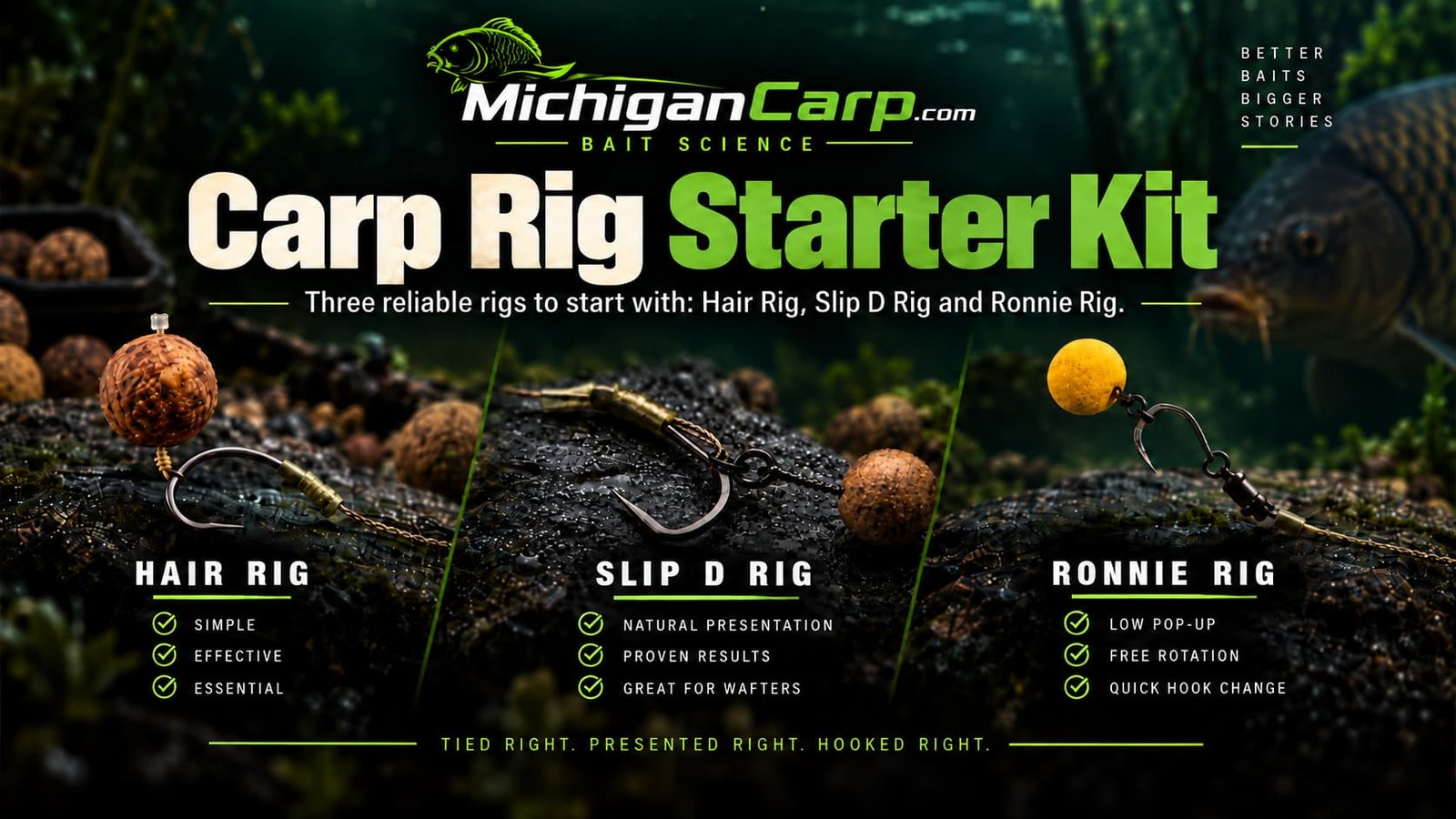
This carp rig starter kit gives Michigan anglers three dependable presentations to learn first: the Hair Rig, Slip D Rig and Ronnie / Spinner Rig. Together they cover simple bottom baits, balanced hookbaits and low pop-ups without filling your rig wallet with unnecessary variations.
My three starting choices are the Hair Rig, Slip D Rig and Ronnie / Spinner Rig.
Together they teach the most useful fundamentals: hair length, hook exposure, bait balance, hooklink stiffness, bait movement, pop-up counterbalancing, lakebed choice and safe lead-system selection.
The aim is not to prove that these are the only three carp rigs worth using. They are not. The aim is to give a beginner a small system that is easy to understand, easy to test and broad enough to fish most normal Michigan situations without filling a rig wallet with presentations you barely know how to use.
Once you understand these three, the MichiganCarp Rig Guide and Complete Michigan Carp Rig Guide will make much more sense because you will already understand the basic jobs that more specialized rigs are trying to perform.
Table of Contents
Carp Rig Starter Kit: The Three Rigs to Learn First
| Rig | Main job | Best starting hookbait | Best starting bottom |
|---|---|---|---|
| Hair Rig | Simple bottom-bait presentation | Bottom boilie, maize, tiger nut, corn | Clean sand, clay, gravel or firm silt |
| Slip D Rig | Balanced-bait presentation | Wafter or critically balanced boilie | Clean ground to light/firm silt |
| Ronnie / Spinner Rig | Low pop-up presentation | Pop-up | Clean ground, firm silt or light debris |
If you can tie only one rig properly, learn the Hair Rig first.
When you understand how bait size, hair length, hook size and hooklink length interact, add the Slip D and learn how a balanced hookbait changes the presentation.
Then add the Ronnie / Spinner so you understand how to present a buoyant hookbait close to the bottom.
Those three lessons cover far more practical ground than learning ten rig names without understanding why any of them work.
Why Start With Only Three Rigs?
Beginners often assume that experienced carp anglers catch more fish because they use more complicated rigs.
Usually the more important difference is that experienced anglers understand when a presentation is suitable, can tie it consistently and can recognize when the lakebed or hookbait requires something different.
A simple starter system lets you learn:
- how much hook gape needs to remain exposed;
- how hair length changes bait-to-hook separation;
- how coated and supple hooklinks behave;
- how a wafter should balance;
- how a pop-up should be counterbalanced;
- how the lead affects the way a rig settles;
- how different lakebeds change presentation;
- how to test a rig before casting;
- when strength and fish control matter more than finesse.
These skills transfer to almost every more advanced rig you will ever use.
The rig itself is only the hook section. The complete fishing system also includes the mainline, leader, lead arrangement, hooklink, hookbait, casting method, lakebed and your ability to land the carp safely.
That is why I would rather see a beginner use three simple rigs well than carry twenty presentations copied from photographs.
Rig 1: Hair Rig — Learn Bottom-Bait Fishing First
The Hair Rig is where I would start.
Its basic idea is simple: the hookbait sits on a short extension behind the hook instead of being mounted directly on the hook. That leaves the point and gape exposed while allowing the bait to move separately.
It teaches almost every fundamental a new carp angler needs.
What the Hair Rig teaches you
With a Hair Rig, you quickly learn that rig performance is affected by the relationship between hook size, bait diameter, hair length and hooklink material.
A boilie jammed tight against the hook bend can restrict movement and reduce usable gape. A very long hair can become untidy or allow the bait to wrap around the hook. A blunt hook ruins the rig regardless of how neat the knot looks.
That feedback makes the Hair Rig an excellent learning tool.
Best hookbaits
The Hair Rig works particularly well with:
- bottom-bait boilies;
- maize;
- sweetcorn;
- tiger nuts;
- peanuts where legal and properly prepared;
- snowman-style combinations;
- some wafters when the balance is appropriate.
Best lakebeds
Start on ground you understand: firm sand, clay, gravel or firm silt.
It can also work on more complicated bottoms, but a beginner learns more when the rig can be seen and tested on a straightforward spot first.
Practical starting setup
| Component | Starting point |
|---|---|
| Hook | Strong size 4 or 6 wide-gape or similar proven carp pattern |
| Hooklink | 20–25 lb semi-stiff coated braid |
| Length | About 8–10 inches |
| Hair gap | Roughly 5–10 mm with a normal 15–18 mm bait |
| Hookbait | Bottom bait or particle presentation |
| Lead system | Properly configured lead clip or inline on known clean ground |
These measurements are starting points, not rules. The actual bait and hook should be examined together.
Korda also treats simple knotless-knot style rigs as an appropriate beginner foundation in its beginner carp-rig guide.
Rig 2: Slip D Rig — Learn Balanced-Bait Presentation
Once you are comfortable with the Hair Rig, I would add the Slip D Rig for Carp Fishing.
The Slip D introduces a very useful new idea: the hookbait attachment can move along a supple braided D behind the hook rather than remaining fixed on a conventional hair.
That makes it an excellent second rig because it teaches you how bait movement and balance can be adjusted without making the entire hooklink complicated.
Why I prefer it as the second starter rig
The older version of this Starter Kit offered a choice between the KD and Blowback Rig.
Both remain useful rigs, and both still belong in the wider Bottom-Bait Rigs guide.
But for a structured beginner progression, I prefer one definite second rig rather than asking the angler to choose between two different mechanics before they have learned either.
The Slip D gives a clear second lesson: balanced hookbait + mobile bait attachment + controlled coated hooklink.
Best hookbaits
The Slip D is particularly useful with:
- wafters;
- critically balanced boilies;
- trimmed bottom baits;
- standard bottom baits where extra bait movement is useful.
It can be adapted for a low pop-up, but that is not the reason I would teach it here.
Best lakebeds
Use it first over clean ground or light, firm silt where you can trust the hookbait to settle properly.
If the lead is burying deeply into soft silt or the hook is disappearing into heavy weed or debris, change the complete presentation rather than expecting a different D size to solve the problem.
Practical starting setup
| Component | Starting point |
|---|---|
| Hook | Strong size 4 or 6 curve/hybrid hook |
| Hooklink | 20–25 lb semi-stiff coated braid |
| Length | About 6–9 inches |
| Bait attachment | Micro ring swivel or bait-screw swivel |
| Hookbait | Wafter or critically balanced bait |
| Lakebed | Clean to lightly silty |
The important lesson is not memorizing those numbers. It is lowering the completed rig into water and watching what the actual hookbait does.
A correctly balanced wafter should not automatically lift the whole hook into the water column. For many situations I want the hook on the bottom while the bait behaves lighter than an ordinary boilie.
For an external tying reference, see Korda: How to Tie the Slip D Rig.
Rig 3: Ronnie / Spinner Rig — Learn Low Pop-Up Fishing
The third rig is the Ronnie / Spinner Rig.
This introduces a different presentation: a low pop-up mounted on a hook that can rotate on a spinner swivel.
The advantage of teaching the Ronnie third is that by this point you should already understand hook exposure, bait balance and hooklink behavior. You can therefore concentrate on learning pop-up height, counterbalancing, boom stiffness and spinner components.
Where the Ronnie belongs
I would start with it over:
- clean gravel;
- sand;
- clay;
- firm silt;
- light natural debris where the hookbait can still sit correctly.
I would not teach a beginner that the Ronnie automatically solves deep chod, dense weed or very soft debris.
Those situations may require a different lead arrangement, a more forgiving hooklink or a true chod-style presentation. The Silt, Weed and Chod-Style Rig Guide covers that decision.
Practical starting setup
| Component | Starting point |
|---|---|
| Hook | Strong size 4 compatible hook |
| Hook connection | Proper spinner swivel |
| Bait attachment | Hook ring swivel or bait-screw arrangement |
| Boom | Semi-stiff coated braid or compatible stiff boom material |
| Length | About 5–8 inches as a starting range |
| Hookbait | Low pop-up |
| Bottom | Clean ground, firm silt or light debris |
Always test the finished pop-up and counterbalance in water. The hookbait should settle the way you intended rather than lifting the complete hook section uncontrollably.
Korda’s Spinner Rig tying guide provides another manufacturer reference for the basic swivel-and-hook construction.
Choose the Rig From the Hookbait and Lakebed
| Fishing situation | Starter choice | Reason |
|---|---|---|
| Bottom boilie, maize, corn or tiger nut on clean ground | Hair Rig | Simple, easy to inspect and very dependable |
| Wafter on clean ground or light silt | Slip D Rig | Mobile bait attachment and controlled balanced-bait presentation |
| Low pop-up on clean ground or firm silt | Ronnie / Spinner | Dedicated low pop-up with rotational hook movement |
| Deep soft silt | Do not force one of the three | Reconsider hooklink length, lead system and specialist presentation |
| Dense weed or heavy debris | Do not choose by rig name alone | Find presentable water and build the entire system around fish safety |
| Timber, rock or zebra-mussel snags | Strengthen the system first | Landing control matters more than sophisticated hook mechanics |
The most important habit a beginner can develop is to stop asking, “What is the best rig?” and start asking:
What am I presenting, what am I presenting it over, and can I land the fish safely from there?
The Minimal Carp Rig Tackle Kit
You do not need every hook pattern and terminal-tackle gadget sold by the carp industry.
A sensible starter collection is enough to build, test and repair the three core rigs:
- strong hooks in sizes 4 and 6;
- optional strong size 2 hooks for genuinely larger baits or demanding conditions;
- 20–25 lb semi-stiff coated braid;
- supple braid;
- a suitable stiff boom material;
- spinner swivels;
- quick-change swivels;
- micro ring swivels or bait-screw swivels;
- hook ring swivels;
- hook beads;
- short kickers;
- anti-tangle sleeves;
- rig putty;
- bait floss and boilie stops;
- baiting needle and bait drill;
- sharp scissors;
- coating stripper;
- rig puller or another safe way to pull-test knots;
- a rig wallet or board.
The water may eventually justify stronger or more specialized materials. Buy them when the conditions give you a reason.
Hook Size for Michigan Carp
I do not believe beginners should automatically start with tiny hooks.
A size 4 or 6 strong carp hook covers a large amount of normal fishing. The exact size depends on the actual pattern because manufacturers size hooks differently.
The bait should leave enough usable gape for the hook to penetrate.
A size 6 may suit a smaller 12–15 mm hookbait on relatively clean ground. A size 4 is an excellent general choice for many 15–20 mm presentations and gives additional gape and metal. A strong size 2 can be entirely reasonable with large 20–24 mm baits or demanding wild-water fishing when the hook, bait and tackle system remain proportionate.
Use Carp Hooks Explained before buying five variations of the same pattern.
Hooklink Strength and Length
For general Michigan lake fishing, 20–25 lb coated braid is a useful starting range for the Hair and Slip D.
That is not a maximum and it is not a universal rule.
Weed, timber, rough rock, zebra mussels, current and larger fish may justify significantly stronger tackle. The complete system has to match the water.
Hooklink length should also be treated as a presentation adjustment rather than a fixed number:
| Situation | General direction |
|---|---|
| Very clean firm bottom | Shorter, controlled hooklink can work well |
| General mixed clean ground | About 7–10 inches is a useful starting area |
| Firm/light silt | Slightly longer may help the hookbait settle naturally |
| Very soft/deep silt | Do not rely on hooklink length alone; reconsider lead arrangement and rig family |
Lead Systems: Learn One Safe System First
The lead system matters just as much as the hook rig.
For most beginners, I would learn a correctly configured lead clip before collecting several systems.
A lead clip is versatile for mixed bottoms and can be configured so that the lead can release when the situation requires it. Inline leads are neat on genuinely clean ground. Helicopter-style systems become particularly useful when the lead is entering softer silt or when the hooklink needs greater freedom to settle.
The complete comparison is in Carp Lead Systems for Michigan: Lead Clip vs Inline vs Helicopter.
Whatever system you use, assemble the real mainline, leader, lead and hooklink and test how the parts behave if something breaks.
How to Test Every Rig Before Casting
A rig is not ready simply because the knot looks neat.
Before casting, check:
- the hook point is perfect;
- the hookbait does not mask the point or gape;
- all knots and crimped connections pass a firm pull test;
- bait screws, stops and swivels are secure;
- the hooklink cannot easily wrap around the lead;
- the wafter or pop-up balances as intended;
- the lead system releases or separates as intended;
- the complete rig settles correctly when lowered into shallow water.
A thirty-second water test often tells you more than repeatedly changing rig components at the bank.
Michigan Conditions That Change the Starter Setup
Zebra mussels and sharp rock
Abrasive water can damage leaders, hooklinks and main line quickly. Check the last several feet regularly rather than assuming strong material is still undamaged.
For the complete safety approach, read Carp Fishing Line and Leaders for Michigan.
Weed
Light weed around a clean presentation is very different from casting directly into dense weed.
Scale up the hook, hooklink, mainline and landing plan when necessary. Do not fish a spot simply because a sophisticated rig can technically be cast into it.
Timber and submerged branches
If a carp can reach timber before you can control it, the problem is not solved by changing from a Hair Rig to a Slip D.
Move the presentation, strengthen the system or do not fish the spot.
Large wild fish
Michigan public-water carp can expose weak knots, worn hooks and under-strength tackle very quickly.
I would rather use a strong, proportionate hook and hooklink than deliberately fish light tackle for appearance.
Boat traffic and moving water
Boat traffic, waves and current can change line angles and move leads after the cast.
Use enough lead for the conditions, position rods sensibly and consider whether the rig will still be fishing correctly after the water moves it.
What Not to Buy Yet
When you are new to carp rigs, buying more components can make learning slower rather than faster.
I would hold off on:
- multiple nearly identical hook patterns;
- specialist rig tools for presentations you do not yet understand;
- large collections of swivels without knowing their purpose;
- several different stiff hooklink materials at once;
- advanced chod hardware before you understand helicopter safety;
- rigs selected because they look clever rather than because they solve a real problem.
Start simple and add equipment when your fishing creates a reason for it.
When Should You Add a Fourth Rig?
Add another rig when one of the first three repeatedly fails to solve a specific presentation problem.
Examples:
- Choose the KD Rig when you specifically want its balanced-bait geometry and high hair exit.
- Choose the Blowback Rig when you want the bait attachment to move directly along the hook shank.
- Choose the Multi Rig when fast hook changes and pop-up presentation become useful.
- Choose the Combi Rig for Carp Fishing when a defined stiff-boom/supple-hook-section combination solves a presentation problem.
- Move into Silt, Weed and Chod-Style Rigs when the bottom is too soft or obstructed for your normal presentations.
The fourth rig should solve a problem you can describe. If you cannot explain what it adds, you probably do not need it yet.
My Practical Starter Rig Wallet
If I were setting up a simple rig wallet for a Michigan session, I would rather have multiple correctly tied examples of three presentations than one example of twelve different rigs.
| Rig | Practical number ready | Why |
|---|---|---|
| Hair Rig | 4 | Main bottom-bait workhorse and easy replacement after damage |
| Slip D Rig | 4 | Main balanced-bait/wafter option |
| Ronnie / Spinner | 3 | Low pop-up option with spare hook sections available |
I would also carry spare hooks, hooklink materials, spinner swivels, bait attachments, kickers, putty and the correct components for the chosen lead system.
Those quantities are not rules. The principle is more important: carry enough proven replacements to keep fishing after a hook point is damaged or a hooklink is abraded.
Common Beginner Rig Mistakes
Changing rigs after every quiet period
A lack of bites is often a location, timing or fish-presence issue rather than proof that the hook rig is wrong.
Using the rig name instead of reading the lakebed
No rig label can turn dense weed, deep debris or unsafe snags into good presentation.
Using hookbaits that do not match the rig
A Ronnie with a poorly balanced pop-up or a Slip D with a wildly over-buoyant “wafter” is not the presentation you think it is.
Ignoring hook sharpness
A perfect knot tied to a damaged point is still a poor rig.
Fishing too light around hazards
The hooklink is only one part of the system. Mainline, leader, knots, lead release and rod position all need to be strong enough for the swim.
Buying complexity before learning basics
Learn why the Hair, Slip D and Ronnie behave differently before adding more rigs.
Rig Safety Comes Before Rig Fashion
The safest rig is not the one with the cleverest hook mechanics.
It is the complete system that lets you hook, control and land a carp while minimizing what the fish would be left towing if the main line failed.
Before fishing near weed, timber, rock or mussels, ask:
- Can I control the fish before it reaches the hazard?
- Is the mainline strong enough?
- Is the leader appropriate and abrasion resistant?
- Can the lead release or the terminal system separate correctly?
- Will beads and components pass the leader knot if the safety design requires it?
- Can I actually net the fish from this bank?
Read Carp Fishing Line and Leaders for Michigan, Carp Lead Systems for Michigan and Carp Fish Care and Safety as part of the same system.
FAQ
What is the best first carp rig to learn?
The Hair Rig. It is simple enough to tie repeatedly and teaches hookbait spacing, hook exposure, knotless-knot construction and basic bottom-bait presentation.
What should my second carp rig be?
I would learn the Slip D next. It introduces a mobile D and balanced-bait presentation without requiring an entirely different lead system.
What should my first pop-up rig be?
The Ronnie / Spinner Rig is a good starting pop-up presentation when used over a suitable clean or lightly silty lakebed and tested with the actual pop-up before casting.
Do I need a KD Rig and Blowback Rig immediately?
No. Both are useful rigs, but neither is required to start. Add them after you understand the basic Hair and balanced-bait presentations.
Can the Ronnie Rig be used over heavy weed?
Do not assume so. A Ronnie can work around light debris or low weed where the complete rig can settle cleanly, but dense weed requires a safer whole-system decision and may justify a different presentation entirely.
What hook size should a beginner use for carp?
A strong size 4 or 6 covers a large amount of normal carp fishing. Larger size 2–4 hooks can be justified with large hookbaits or demanding wild-water conditions. Match the hook to the bait, gape and fishing situation.
How strong should my hooklink be?
Twenty to twenty-five pound coated braid is a useful general starting range, but weed, snags, current, rocks and zebra mussels may require stronger tackle. Do not choose breaking strain independently from the rest of the setup.
How many rigs should I carry?
Carry enough proven replacements for the rigs you actually use. Several well-tied Hair, Slip D and Ronnie rigs are more useful to a beginner than a wallet filled with unrelated experiments.
Do expensive rig components catch more carp?
Not automatically. Sharp hooks, reliable hooklinks, correct bait balance and safe lead systems matter more than owning every specialist component.
When should I move beyond this starter kit?
When you encounter a repeated situation the three rigs do not solve cleanly. Deep silt, heavy weed, unusual hookbaits, very long-range casting or rapid hook replacement are legitimate reasons to add specialist presentations.
Next Steps
Once you understand the three starter routes, use these guides to build outward without duplicating rigs unnecessarily:
- Carp Rig Guide for Michigan — choose the correct rig family before looking at individual builds.
- Hair Rig for Carp Fishing — master the basic bottom-bait presentation.
- Slip D Rig for Carp Fishing — learn the balanced-bait stage next.
- Ronnie / Spinner Rig — learn a dependable low pop-up presentation.
- Bottom-Bait Rigs — compare Hair, KD, Blowback and related bottom-bait options.
- Pop-Up Rigs — compare Ronnie, Multi and other buoyant-hookbait presentations.
- Silt, Weed and Chod-Style Rigs — move into specialist presentations when the bottom requires them.
- Carp Hooks Explained — understand pattern, gape, point and hook size.
- Carp Lead Systems for Michigan — match the hook rig to a safe lead arrangement.
- Complete Michigan Carp Rig Guide — use the full reference once the starter system makes sense.
The goal is not to graduate from simple rigs as quickly as possible. The goal is to understand why each presentation works, recognize when it is suitable and tie it well enough that you can trust it after the cast.
Three rigs learned properly will catch more carp than a tackle box full of presentations you do not understand.