Pop-up rigs for carp are not interchangeable. A Ronnie / Spinner, Multi Rig, Hinged Stiff Rig and Chod Rig may all present a buoyant hookbait, but they solve different problems.
The correct choice depends on how high you want the hookbait to sit, how clean or awkward the lakebed is, how the hooklink needs to settle and which lead system makes sense for that spot.
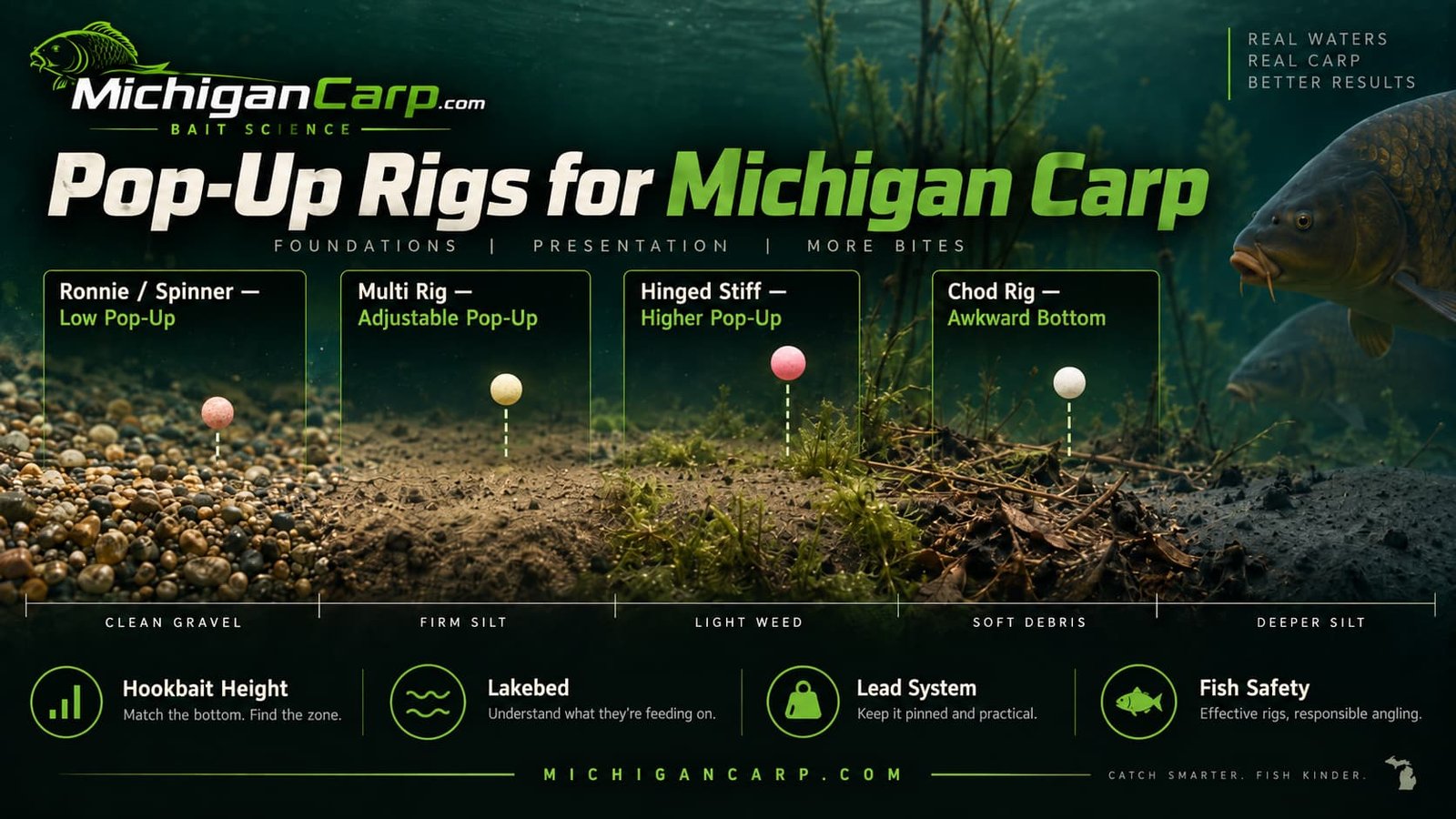
For Michigan carp fishing, I would divide the main pop-up families into four jobs:
Ronnie / Spinner → low pop-up on reasonably clean ground.
Multi Rig → versatile D-style pop-up with fast hook changes.
Hinged Stiff Rig → more defined and usually higher pop-up presentation.
Chod Rig → specialist short stiff presentation for genuinely awkward soft or littered bottoms.
That distinction matters because simply switching from a bottom bait to a pop-up does not automatically make a poor lakebed fishable.
If you are still choosing between all rig families, begin with the MichiganCarp Rig Guide. For the complete comparison across bottom rigs, balanced baits, pop-ups and Zigs, use the Complete Michigan Carp Rig Guide.
Table of Contents
Quick Start: The Four Main Pop-Up Rig Families
| Rig | Main job | Hookbait position | Best starting lakebed |
|---|---|---|---|
| Ronnie / Spinner | Controlled low pop-up | Low, close to bottom | Clean ground, firm silt, light debris |
| Multi Rig | Quick-change D-style pop-up | Low to moderate depending setup | Clean to mixed ground and light silt |
| Hinged Stiff | Defined higher pop-up | Higher, deliberate presentation | Known ground, light silt and debris |
| Chod Rig | Specialist awkward-bottom presentation | Short stiff pop-up section | Soft silt, leaf litter and awkward debris |
If I wanted one pop-up rig to learn first, I would start with the Ronnie / Spinner.
Then I would add the Multi Rig when fast hook replacement or its D-style mechanics give me a reason.
The Hinged Stiff and Chod should come later because their value is easier to understand once you already know how an ordinary low pop-up behaves.
When Should You Use a Pop-Up?
A pop-up is useful when lifting the hookbait above the lakebed solves a real presentation problem.
That may include:
- light debris that could mask a bottom bait;
- firm or shallow silt where you want a slower-settling presentation;
- dying weed or low weed remnants;
- a deliberately visible hookbait over a feeding area;
- a situation where hookbait height itself is part of the presentation;
- very soft or littered ground that requires a specialist Chod-style approach.
But do not use a pop-up simply because the bottom is not perfectly clean.
Carp naturally feed in silt. A bottom bait or wafter on a Hair, Slip D, Blowback or Combi can remain completely effective over firm or shallow silt.
The useful question is:
Will lifting this hookbait improve presentation, or am I using a pop-up because I do not understand the bottom?
Use Reading the Bottom for Carp before assuming a different rig will solve an uncertain swim.
Ronnie / Spinner Rig: The Low Pop-Up Starting Point
The Ronnie / Spinner Rig is where I would start when learning pop-up fishing.
It uses a hook mounted directly on a spinner swivel, normally with a small ring swivel or bait screw moving on the hook shank and a kicker closing the swivel connection.
The main practical advantage is that the hook can rotate freely and be replaced without rebuilding the whole boom.
Where the Ronnie is strongest
The Ronnie is most comfortable over:
- clean sand;
- gravel;
- clay;
- firm silt;
- light debris;
- low sparse weed where the hook can still sit cleanly.
The modern MichiganCarp Ronnie guide treats it as a precise low pop-up tool, not an answer to every bad lakebed.
That is the right way to think about it.
When I would choose something else
If the bottom contains deep soft debris, thick leaf litter or weed heavy enough to bury the boom and mask the hook, moving to a higher or more forgiving specialist presentation makes more sense.
A Ronnie can reset after minor disturbance, but no rig is guaranteed to repair itself after landing badly in heavy weed or debris.
Multi Rig: Quick Hook Changes and D-Style Mechanics
The Multi Rig creates its hook connection and bait D from the same large hooklink loop.
That gives it a different mechanical character from the Ronnie.
The major practical advantages are:
- fast hook changes;
- a movable D behind the hook;
- few metal components at the hook;
- good pop-up and balanced-hookbait versatility;
- the ability to alter the hookbait position by changing the D and counterbalance.
The Multi is particularly useful for anglers who want a reusable boom and fast hook replacement without using a spinner swivel.
Multi vs Ronnie
The Ronnie places the hook on a spinner swivel and normally creates a low pop-up presentation.
The Multi attaches the hook through the hooklink loop itself.
Neither is automatically better.
Choose the Ronnie when you want its swivel-mounted low pop-up mechanics. Choose the Multi when the large-loop D and rapid hook replacement better suit the hookbait and lakebed.
Hinged Stiff Rig: A More Defined Pop-Up
The Hinged Stiff Rig uses two distinct sections:
a short stiff Chod-style hook section and a longer boom.
This creates a more deliberate separation between the hook section and lakebed than an ordinary low Ronnie.
It becomes useful when I want:
- a clearly defined pop-up height;
- a stiff hook section that retains its shape;
- a separate boom controlling how the rig sits away from the lead;
- more height than a standard low pop-up;
- a presentation over known light silt or debris.
The Hinged Stiff is not simply a longer Ronnie and it is not the same as a Chod Rig.
The separate boom is a major part of its identity.
Chod Rig: Specialist Presentation for Awkward Bottoms
The Chod Rig is the specialist option in this group.
It uses a short stiff hook section on a helicopter-style leader arrangement rather than a conventional full-length hooklink extending directly from the lead.
That makes it useful when the lakebed is soft or littered enough that a normal hooklink becomes difficult to trust.
Where I would consider the Chod
- deep or very soft silt;
- leaf litter;
- soft natural debris;
- scattered bottom material that can bury a conventional hooklink;
- known awkward areas where the Chod arrangement has a genuine presentation advantage.
Where I would not automatically use it
Do not treat the Chod as a licence to cast blindly into dense weed.
Heavy weed is still a presentation and fish-control problem.
If you cannot land the carp safely from the area, changing rig names does not solve the problem.
Use the Silt, Weed and Chod-Style Rig Guide for the full awkward-bottom decision process.
Where Slip D and Combi Rigs Fit
The older version of this page treated the Slip D and Combi as two of the main pop-up rigs.
I would no longer organize the site that way.
Slip D Rig
The Slip D Rig can certainly be adapted to present a low buoyant bait.
But its strongest role in the MichiganCarp system is as a balanced-bait and wafter rig.
Its supple D and permanently tied hook give it a distinct job that sits naturally with bottom and balanced-bait presentations.
Combi Rig
The Combi Rig can also be adapted for different hookbait buoyancies.
Its defining feature, however, is not “pop-up rig.”
It is the combination of a stiff boom and short supple hook section.
That places it more naturally in the bottom/balanced family.
This separation makes the rig section easier to understand and prevents the same two rigs being presented as primary choices in both the Bottom-Bait and Pop-Up hubs.
Choose the Pop-Up Rig From the Lakebed
| Lakebed | First rigs to consider | Key question |
|---|---|---|
| Clean sand / gravel / clay | Ronnie or Multi | Do you actually need a pop-up rather than a simpler bottom bait? |
| Firm / light silt | Ronnie, Multi or Hinged Stiff | How high do you want the hookbait to sit? |
| Light debris | Ronnie or Hinged Stiff | Will the hook remain exposed after settling? |
| Deep soft silt | Chod or another correctly configured helicopter presentation | How deeply is the lead penetrating? |
| Leaf litter / awkward soft debris | Chod or Hinged Stiff depending severity | Does the full hooklink need to remain clear? |
| Heavy weed | Do not choose by rig name alone | Can you present and land the fish safely? |
Choose the Rig From Pop-Up Height
Pop-up height changes how the presentation behaves.
Very low
A low Ronnie can give you a buoyant hookbait without making it look dramatically elevated.
Low to moderate
The Multi gives more scope to adjust hookbait position through D size, counterbalance and hooklink arrangement.
More deliberate height
The Hinged Stiff is designed around a clear, defined stiff hook section above a boom.
Awkward-bottom clearance
The Chod is less about choosing an arbitrary high hookbait and more about keeping a short stiff hook section fishing effectively above soft or littered bottom.
Do not make hookbait height extreme simply because a bait floats.
Use the lowest practical height that solves the presentation problem you actually have.
Lead Systems for Pop-Up Rigs
The pop-up rig and lead arrangement should be chosen together.
Lead clip
A correctly configured lead clip works well with Ronnie, Multi and Hinged Stiff presentations over reasonably clean or mixed ground.
Inline lead
Inline systems are most comfortable on clean ground where the lead can settle without dragging the presentation deeply into silt.
Helicopter arrangement
A helicopter system becomes particularly useful when the lead is entering softer bottom and the hooklink needs greater freedom to settle independently.
It is fundamental to genuine Chod-style fishing and can also suit other stiff or pop-up presentations when the conditions justify it.
Do not treat a helicopter setup as an automatic “safe option” simply because the bottom is uncertain. It must still be assembled so beads, stops and leader components behave correctly if the main line fails.
Read the complete Carp Lead Systems for Michigan guide before changing systems purely to accommodate a pop-up.
Hooks and Hookbait Balance
A pop-up presentation depends heavily on the relationship between hook weight and hookbait buoyancy.
The same 15 mm pop-up can behave very differently with a heavy size 2 hook and a lighter size 6.
Always test the completed rig rather than assuming the label on the bait tells you how it will behave.
Look for:
- a hookbait that sinks under control when counterbalanced;
- an exposed point and useful gape;
- a bait attachment that moves as intended;
- a hook section that does not roll or collapse incorrectly;
- a presentation that still behaves properly after the bait has absorbed water.
For hook geometry, use Carp Hooks Explained.
Michigan Conditions That Change Pop-Up Rig Choice
Zebra mussels and rock
These mainly change the durability requirements of the complete tackle system.
Check hook points and line abrasion rather than assuming a pop-up automatically protects the hook.
Cabbage weed and milfoil
Look for edges, holes and low areas before deciding which pop-up rig to cast.
A clean patch beside weed is often more useful than an elaborate rig buried directly inside it.
Soft inland-lake silt
Find out whether the silt is a shallow coating over firm ground or a deep layer that swallows the lead.
Those are very different rig problems.
Leaf litter and dying weed
This is where presentation height becomes genuinely useful.
A Hinged Stiff or Chod can provide more separation than a standard low Ronnie when debris is substantial enough to justify it.
Large wild-water carp
Do not downsize hooks and hooklinks simply because the rig is a pop-up presentation.
Strength should still match the fish, hookbait, weed, snags and landing situation.
Pop-Ups Do Not Replace Watercraft
One of the easiest mistakes is using a buoyant bait to avoid learning what is on the bottom.
A pop-up sitting perfectly over an empty area is still an empty swim.
Before changing rig:
find the carp, identify the route or feeding area, understand the depth and bottom, then choose the presentation.
Use How to Find Carp in Lakes and Best Depth for Carp Fishing before blaming a quiet session on hookbait height.
Common Pop-Up Rig Mistakes
Using the Ronnie everywhere
The Ronnie is versatile, but that does not make it the best answer to deep silt, heavy weed and thick debris.
Fishing the pop-up too high
More height is not automatically more effective.
Use enough clearance to solve the presentation problem.
Over-counterbalancing
A large lump of putty can make an otherwise delicate presentation behave unnaturally.
Use only as much weight as required to achieve the intended sink rate.
Ignoring the lead system
A perfectly balanced pop-up can still be ruined if the lead buries and drags the boom into debris.
Using a Chod Rig because the bottom is unknown
Unknown bottom should encourage investigation, not automatic Chod use.
Assuming bright hookbaits are mandatory
A pop-up describes buoyancy, not color.
Bright, washed-out, food-based and subtle hookbaits can all have a role.
Ignoring fish-control risk
No pop-up rig makes timber, heavy weed or other serious snags safe to fish.
My Practical MichiganCarp Pop-Up System
I would keep the progression simple.
Learn the Ronnie first.
Use it to understand low pop-up balance, spinner components, boom length and how a buoyant bait behaves over reasonably clean ground.
Add the Multi when you want a different D-style presentation and very fast hook changes.
Add the Hinged Stiff when the hookbait genuinely needs a more defined height and a separate stiff hook section.
Add the Chod only when the lakebed is awkward enough to justify a specialist helicopter presentation.
Meanwhile, do not forget the bottom and balanced rigs.
If a wafter on a Slip D presents perfectly, there is no prize for replacing it with a pop-up.
Use a pop-up because the presentation benefits from buoyancy—not because pop-up rigs look more advanced.
FAQ
What is the best pop-up rig for beginners?
The Ronnie / Spinner is the best starting point in this system because it teaches low pop-up balance, hook rotation, boom control and quick hook replacement without requiring a specialist lakebed.
What is the best pop-up rig for firm silt?
A Ronnie or Multi is a good first choice. A Hinged Stiff can make sense when you deliberately want more hookbait height. First confirm the silt is firm enough that the lead and boom are not being buried excessively.
What is the best pop-up rig for deep silt?
A Chod-style helicopter presentation becomes more relevant when the silt is genuinely deep and soft. The lead system is as important as the hook rig because lead penetration determines how the whole presentation settles.
What is the best pop-up rig for weed?
There is no single answer. Light weed around a clean spot may still suit a Ronnie or Multi. Heavy weed requires a safe landing plan and a presentable area before rig choice becomes useful.
Is the Multi Rig better than the Ronnie?
No. They use different hook-attachment systems and solve slightly different problems. The Ronnie uses a spinner swivel and normally fishes as a low pop-up. The Multi uses a loop that forms both the hook connection and the D.
Is the Slip D a pop-up rig?
It can present a low buoyant bait, but its strongest role in the MichiganCarp system is with wafters and critically balanced hookbaits. It now belongs primarily with the balanced/bottom-bait family.
Is the Combi Rig a pop-up rig?
It can be adapted to pop-ups, but the defining feature is its stiff-boom and supple-hook-section construction. It therefore belongs primarily in the bottom/balanced-rig family rather than as one of the four main pop-up rigs.
What is the difference between a Hinged Stiff Rig and Chod Rig?
The Hinged Stiff has a separate boom below its stiff hook section. A Chod Rig uses a short stiff hook section that moves on a helicopter-style leader arrangement. They solve different presentation problems.
How high should a pop-up sit?
High enough to solve the problem and no higher than necessary. A Ronnie normally sits low. Hinged and Chod-style presentations can create greater separation when the bottom requires it.
Do pop-ups need to be brightly colored?
No. Buoyancy and color are separate decisions. Bright pop-ups can be useful, but subtle or food-based colors can work equally well when they fit the fishing situation.
Next Steps
Use the guide that matches the exact pop-up job:
- Ronnie / Spinner Rig — low pop-up over clean ground, firm silt and light debris.
- Multi Rig — quick hook changes and D-style pop-up mechanics.
- Hinged Stiff Rig — a more defined higher pop-up presentation.
- Chod Rig — specialist presentation for soft silt, litter and awkward debris.
- Silt, Weed and Chod-Style Rigs — choose rigs when the lakebed itself is the problem.
- Bottom-Bait Rigs — go back to simpler presentations when the bottom does not require a pop-up.
- Carp Rig Starter Kit — learn Hair, Slip D and Ronnie as the basic three-rig system.
- Complete Michigan Carp Rig Guide — compare all major rig families.
- Carp Lead Systems for Michigan — match the pop-up rig to the correct lead arrangement.
- Carp Hooks Explained — choose hooks that suit stiff rigs, spinner rigs and pop-up mechanics.
For manufacturer tying references, Korda’s rig library also provides useful examples of the Spinner Rig and related modern pop-up systems.
The important lesson is not to collect more pop-up rigs. It is to understand what each family changes—hookbait height, hook movement, boom behavior and lakebed tolerance—and choose the simplest safe presentation that solves the real problem.
Latest Pop-Up Rig Articles
Read the latest MichiganCarp pop-up rig guides below, then choose the individual tutorial that matches the lakebed and hookbait situation you are actually facing.