

Raw vs processed ingredients in carp bait is not a simple argument between natural and artificial.
Raw ingredients are not automatically better. Processed ingredients are not automatically worse. The useful question is whether the ingredient has been treated in a way that improves its job inside the finished bait.
A raw ingredient may bring natural character, texture, oil, starch, fiber or simple structure. It may also be unfinished, hard to digest, unsafe as a particle, weak in leakage, inconsistent, or awkward in a boilie mix.
A processed ingredient may be cooked, toasted, micronized, fermented, hydrolyzed, extracted, spray-dried, concentrated or refined. That processing may improve safety, digestibility, solubility, texture, consistency and food signal. It may also go too far and strip away useful character, damage nutrients, create poor value or produce an ingredient that sounds more technical than it really performs.
Do not buy the romance of raw. Do not buy the marketing of processed. Buy the function.
For Michigan carp fishing, this matters because many of us build bait from feed ingredients, milk powders, nut meals, birdfoods, seed meals, particles, yeasts, liquids and homemade boilies. A good bait does not need to be complicated, but every ingredient should have a reason to be there.
This article owns the broad decision: how to think about raw and processed ingredients. Practical preparation methods belong in How to Process Carp Bait Ingredients Properly. Specific ingredient problems belong in Anti-Nutritional Factors in Carp Bait Ingredients. The digestion side belongs in Carp Bait Digestibility.
For wider feed-processing context, see FAO Farm-Made Aquafeeds and FAO Effects of Processing on the Nutritional Value of Feeds.
Table of Contents
Quick Start: Raw vs Processed Ingredients in Carp Bait
Raw vs processed ingredients in carp bait should be judged by practical bait function, not label preference.
| Question | Better bait-making answer |
|---|---|
| Is raw better? | Only when the raw or simple ingredient performs its job well without extra treatment. |
| Is processed worse? | No. Good processing can improve safety, digestibility, solubility, leakage, texture and consistency. |
| Can processing damage ingredients? | Yes. Excessive heat, over-refinement, poor drying and poor storage can reduce value. |
| Do particles need processing? | Yes. Dry grains and pulses are raw materials, not finished carp bait. |
| Is raw soy a good bait ingredient? | Usually not compared with properly heat-treated or toasted soy products. |
| Are hydrolysates useful because they are processed? | Yes, when the processing creates soluble food fractions that suit the bait’s job. |
| Should every ingredient be processed? | No. Some ingredients are mainly structural and work fine in simple form. |
The best working rule is simple:
Ask what has been done to the ingredient, what that changed, and whether that change helps the finished bait.
What Raw Really Means in Carp Bait
In bait-making language, raw usually means an ingredient has received little treatment beyond cleaning, drying, grinding, crushing or bagging.
That does not mean it is untouched by human processing. A flour has already been milled. A dried seed has already been harvested and dried. A bagged feed ingredient has already been cleaned, stored and transported.
In practical terms, raw or simple ingredients may include:
- dry maize, wheat, hemp and mixed particles;
- raw or untreated seed meals;
- untreated legume flours;
- basic cereal flours;
- simple birdfood ingredients;
- crude feed by-products;
- whole seeds and cracked grains;
- basic nut meals and seed meals.
Some of these can be useful. Others need preparation before they become safe, digestible or functional.
Where raw or simple ingredients can work
Raw or simple ingredients can be valuable when they perform a limited job.
Semolina, maize meal, wheat flour and similar cereal ingredients can help a bait roll, bind and cook. Some birdfood ingredients add texture and openness. Some spices and low-level support powders add background profile without needing advanced treatment.
The mistake is asking a crude ingredient to do a job it is not ready to do.
A raw ingredient used for structure is one thing. A raw ingredient expected to carry digestibility, soluble leakage and nutritional quality is another.
Where raw ingredients become a problem
Raw ingredients become risky when they are difficult to digest, physically too hard, high in anti-nutritional factors, unsafe unless cooked, inconsistent, rancid, poorly stored or mostly cheap bulk with little useful bait function.
This is especially important with legumes, untreated soy, dry particles, poorly handled nut meals and crude feed materials.
The fact that something looks natural does not prove that it behaves well in water or inside a carp.
What Processing Really Means
Processing is not one thing. It covers many different treatments.
| Processing method | What it can change | Carp-bait relevance |
|---|---|---|
| Soaking | Hydration, swelling and softening | Essential for many particles before cooking |
| Boiling or cooking | Softening, starch change, safety and texture | Turns dry particles into usable bait and sets boilies |
| Toasting or heat treatment | Flavor, enzyme activity, anti-nutritional factors and digestibility | Important for soy and some plant meals |
| Micronizing or flaking | Physical structure and starch availability | Can make grains easier to hydrate and use |
| Fermentation | Acids, aroma, solubility and food character | Useful when controlled, risky when spoiled |
| Hydrolysis | Protein breakdown into smaller soluble fractions | Creates active food-signal ingredients |
| Autolysis | Yeast breakdown and soluble savory compounds | Useful in yeast extracts and autolysed yeast products |
| Refinement | Purity, consistency and specific function | Important in milk proteins, caseins and WPC products |
| Spray drying | Liquid converted into powder | Used for milk powders, yeasts and flavor carriers |
| Over-processing | Heat damage, loss of character or poor value | Can make an ingredient less useful despite a technical label |
The right question is not whether processing happened. It is whether the processing improved the ingredient for the bait you are making.
Good Processing vs Bad Processing
Good processing makes an ingredient more useful. Bad processing makes it worse, more expensive for no reason or harder to interpret.
| Good processing can improve | Bad processing can cause |
|---|---|
| Safety | Heat damage or poor storage stability |
| Digestibility | Reduced protein quality when overheated |
| Solubility and leakage | Loss of useful volatile or soluble character |
| Texture and rolling behavior | Rubbery, dense or lifeless bait structure |
| Consistency between batches | Over-refined ingredients with little bait character |
| Food signal | Expensive ingredients that do not earn their place |
| Ease of use | Technical confusion and false precision |
Processing is useful only when it improves the ingredient’s actual job.
A hydrolysate is useful because it has been broken down into more active soluble fractions. A toasted soy product is useful because heat treatment changes the raw soy problem. A cooked particle is useful because the grain has been hydrated and softened. A refined milk protein is useful because it has a clearer function than a random dairy powder.
But a powdered ingredient is not better just because it has a technical name.
Raw vs Processed by Ingredient Type
[IMAGE PLACEMENT: RAW VS PROCESSED BY INGREDIENT TYPE — raw_vs_processed_bait_ingredients.png]
Alt text: Raw vs processed ingredients in carp bait by ingredient type comparing soy, particles, milk ingredients, yeast, proteins and grains or cereals.
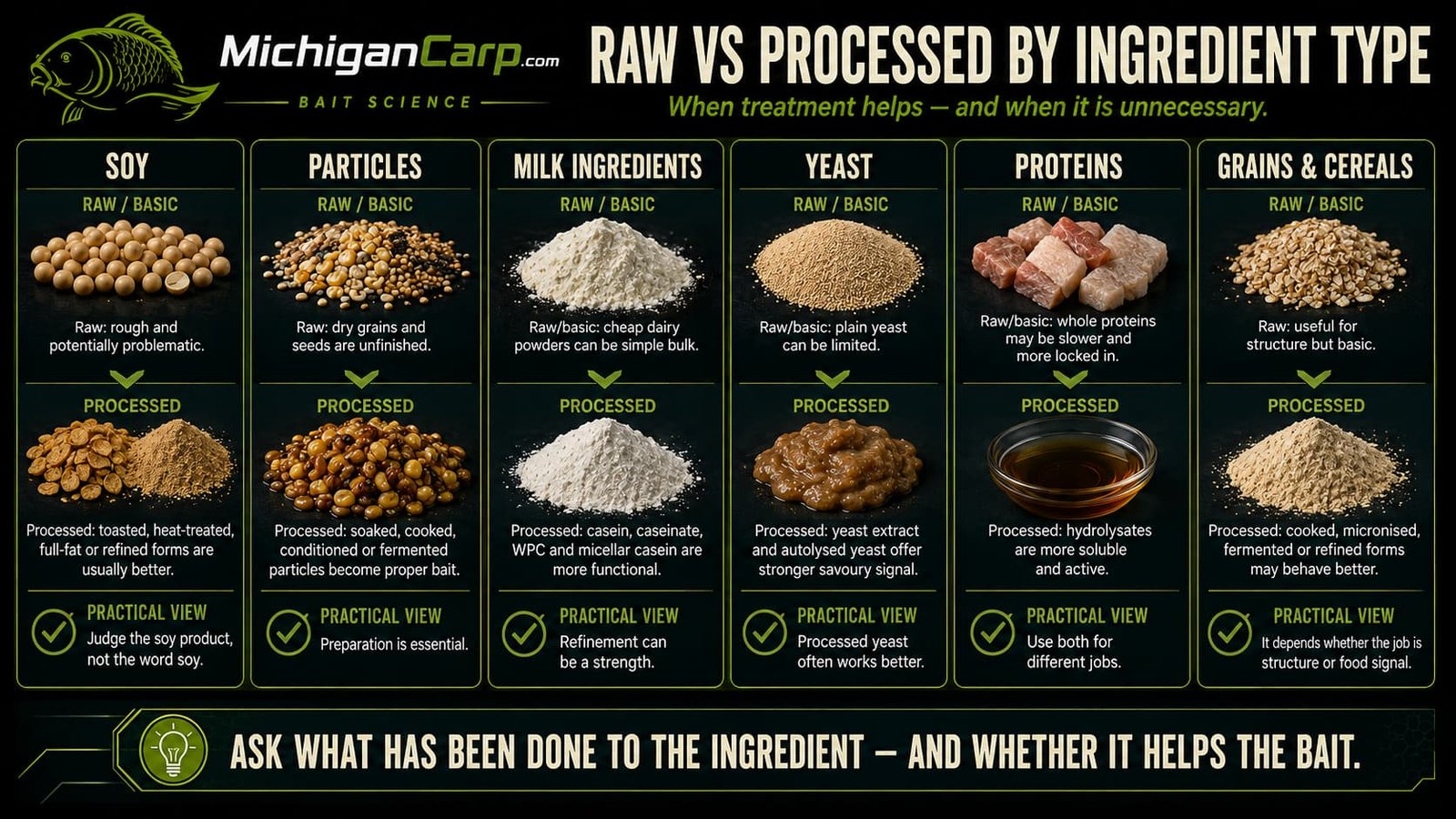
Different ingredients need different decisions. Raw vs processed ingredients in carp bait cannot be judged as one single category.
| Ingredient group | Raw or basic version | Processed version | Best practical view |
|---|---|---|---|
| Soy | Can be rough, less digestible and affected by anti-nutritional factors | Toasted, heat-treated, full-fat or refined soy products | Judge the specific soy product, not the word soy |
| Particles | Dry grains and seeds are unfinished | Soaked, cooked, conditioned or fermented particles | Preparation is essential before feeding |
| Milk ingredients | Cheap dairy powders may be simple bulk | Casein, caseinate, WPC and micellar casein are more functional | Refinement can be a strength |
| Yeast | Plain brewer’s yeast can be useful but limited | Yeast extract and autolysed yeast offer stronger soluble savory signal | Processed yeast often performs a clearer job |
| Proteins | Whole proteins may be slower and more locked in | Hydrolysates are more soluble and active | Use whole and hydrolyzed forms for different jobs |
| Grains and cereals | Useful for structure but often basic | Cooked, micronized, fermented or refined forms may behave better | Depends whether the job is structure or food signal |
| Nut and seed meals | Can bring natural oil and food texture | Defatted, toasted, stabilized or finely milled meals may be more predictable | Watch fat, freshness and rancidity |
| Finished boilies | Freshly made bait may be soft and active | Boiled, dried, frozen, rehydrated or conditioned bait behaves differently | Your own processing changes the bait too |
Soy Is the Clearest Example
Soy shows why raw-versus-processed thinking matters.
Soy can be a useful carp-bait ingredient. Full-fat soy, toasted soy flour and soybean meal can bring protein, fat, binding and practical food value. But raw soy and properly processed soy are not the same thing.
Raw soybeans contain trypsin inhibitors and other factors that can interfere with protein digestion. Feed references commonly treat heat processing as important for improving soybean meal and reducing trypsin-inhibitor problems. See Feedipedia: Soybean and FAO Effects of Processing on the Nutritional Value of Feeds.
That does not mean every soy product is automatically good. Overheated or poor-quality soy is still a poor choice. The correct decision is product-specific.
Do not ask whether soy is good or bad. Ask which soy product it is, how it was processed and what job it performs in the bait.
For the detailed anti-nutritional discussion, use Anti-Nutritional Factors in Carp Bait Ingredients.
Particles Are the Bank-Side Example
Particles make the subject easy to understand.
A sack of dry maize is not finished bait. Dry hempseed is not the same as soaked and cooked hemp. Dry chickpeas, beans, wheat, maples or pigeon feed are not ready just because carp might eventually eat plant material in nature.
Proper particle preparation changes the ingredient physically and practically.
| Particle stage | What it means | Practical bait value |
|---|---|---|
| Dry raw particle | Hard, unfinished material | Not suitable for direct feeding |
| Soaked particle | Hydrated and swollen | Part way toward safe preparation |
| Cooked particle | Softened and physically changed | Usable bait when correctly prepared |
| Rested particle | Allowed to absorb cooking liquor and condition | Often more consistent and food-like |
| Controlled fermented particle | Acidic, active and aromatic when managed properly | Useful, but not proof of safety by smell alone |
| Spoiled particle | Rotten, moldy or contaminated | Discard |
The point is not that particles are complicated. The point is that processing turns dry feed material into bait.
For the full preparation method, use How to Prepare Particles for Carp Fishing.
Milk Proteins Show Why Refinement Can Be Useful
Some anglers hear “processed” and assume inferior. Milk proteins prove why that is wrong.
Casein, sodium caseinate, calcium caseinate, micellar casein, whey protein concentrate and milk replacers are all processed in some way. That processing is often what gives them value.
A refined milk protein may offer clearer protein concentration, better structure, more predictable behavior or a more specific role than a cheap generic dairy powder.
| Milk ingredient | Why processing matters | Bait-making view |
|---|---|---|
| Skimmed milk powder | Dried dairy ingredient with lactose and milk solids | Useful, but not the same as concentrated milk protein |
| WPC80 | Concentrated whey protein | More targeted protein support than ordinary whey powder |
| Casein | Separated milk protein | Useful for structure, density and specialist hookbait work |
| Caseinate | Modified casein salt | Different behavior from acid or rennet casein |
| Milk replacer | Blended dairy/feed product | Must be judged by its label, not by the word milk |
| Cream powder | Dairy-fat and cream character | Useful for profile but must fit the fat budget |
For the practical dairy comparison, read Milk Powders in Boilie Making. For label decisions, use Milk Replacer for Carp Bait: How to Read the Label.
Hydrolysates, Yeasts and Fermented Ingredients
Hydrolysates, yeast extracts and controlled fermented ingredients are processed by design.
That is the point.
They are not trying to act like raw meals. They are included because processing has changed their behavior in water and in the finished bait.
| Processed food-signal ingredient | What processing may provide | Main caution |
|---|---|---|
| Liver hydrolysate | Smaller soluble protein fractions and strong savory signal | Can dominate a bait if overused |
| Yeast extract | Soluble savory compounds and nucleotides | Strong taste; use with purpose |
| Autolysed yeast | Partially broken-down yeast material | Products vary greatly |
| Fermented grain liquid | Acids, aroma and transformed food character | Controlled fermentation is not the same as spoilage |
| CSL-style liquid | Soluble grain and fermentation-derived food signal | Quality and composition vary |
| Whey hydrolysate | More soluble dairy-protein fractions | Not needed in every milk bait |
These ingredients are useful when they have a defined role. They become clutter when several are added at once without a purpose.
For the full protein-breakdown subject, use The Science of Proteins, Peptides and Hydrolysates in Carp Bait. For fermented liquids, use What Fermented Bait Liquids Really Do.
Digestibility: Processing Can Help, But It Is Not Magic
Digestibility is one of the strongest reasons to care about processing.
An ingredient can look good on a nutrition label but still be less useful if its nutrients are physically locked up, protected by anti-nutritional factors, poorly hydrated, too fibrous, too coarse or damaged by bad processing.
Processing can improve digestibility by:
- softening hard structures;
- reducing some heat-sensitive anti-nutritional factors;
- opening starches or proteins to water and enzymes;
- improving hydration;
- breaking proteins into smaller fractions;
- making particles physically easier to process;
- improving consistency between batches.
But processing and digestibility are not identical subjects. A processed ingredient may still be poorly digestible. A raw or simple ingredient may still perform well when used for structure rather than serious nutrition.
For the complete digestion discussion, read Carp Bait Digestibility.
Solubility and Leakage: Processing Changes Release
Carp do not respond only to what is inside the bait. They respond to what leaves the bait and reaches their sensory system.
Processing can change release in several ways:
- hydrolysis can create smaller soluble fractions;
- fermentation can create acids and transformed food compounds;
- cooking can alter starches and proteins;
- fine grinding can increase exposed surface area;
- drying can slow water entry;
- excessive heating can make a bait denser or less active;
- oil-heavy processing can reduce water access if poorly balanced.
This is why a processed food liquid can sometimes create a stronger signal than a much larger amount of crude meal.
It is also why a heavily cooked, over-dried boilie can become physically durable but slower to open.
For the complete release mechanism, read Carp Bait Solubility and Leakage. For cooking effects, use What Boiling Does to Carp Bait: Heat, Steaming, Leakage and Structure.
Feed-Grade vs Bait-Grade Ingredients
Feed-grade ingredients are not automatically poor. Many are useful in carp bait when chosen carefully.
Bait-grade ingredients are not automatically superior either. Some are excellent. Some are ordinary ingredients repackaged with better marketing.
The same rule applies:
Do not buy the category. Buy the function, freshness, consistency and result.
| Label | What it may mean | What to check |
|---|---|---|
| Feed-grade | Made for animal-feed use or livestock economics | Freshness, analysis, storage, grind, fat level and suitability |
| Food-grade | Made for human food use | Still needs to fit the bait’s job |
| Bait-grade | Sold for bait-making | May be useful, but still judge function and value |
| Technical ingredient | More specialized or concentrated | Use level, safety, solubility and whether it is needed |
| Natural ingredient | May be less refined or more recognizable | Digestibility, freshness, preparation and performance |
A cheap feed ingredient can be excellent. A premium bait ingredient can be unnecessary. The finished bait does not care about the marketing label.
How This Affects Homemade Boilie Design
Raw vs processed ingredients in carp bait becomes most useful when building a boilie base mix.
A boilie is not a pile of attractive powders. It is a cooked matrix. Ingredients must hydrate, bind, roll, cook, dry, leak, soften, resist handling and suit the fishing situation.
| Bait job | Raw or simple ingredients may be enough when | Processed ingredients may help when |
|---|---|---|
| Structure | The ingredient rolls, binds or opens the mix reliably | You need better texture, consistency or cooked behavior |
| Nutrition | The ingredient is already suitable and used modestly | Digestibility, protein quality or anti-nutritional factors matter |
| Leakage | The ingredient is not expected to signal quickly | You need soluble food cues and faster release |
| Flavor profile | The ingredient provides background character | Fermentation, roasting or extraction creates a clearer note |
| Hookbait durability | The bait only needs moderate strength | Albumen, casein or refined binders are needed for specialist function |
| Cold-water use | The bait is used lightly and supported by soluble material | Small active ingredients may outperform heavy crude bulk |
For complete base-mix architecture, read How to Formulate a Milk, Nut and Birdfood Boilie Base Mix.
When Processing Goes Too Far
Processing can improve bait ingredients, but it can also damage them.
Processing may go too far when an ingredient becomes:
- overheated;
- oxidized;
- stripped of useful food character;
- too refined for the job;
- too expensive for the benefit;
- physically dense and slow to release;
- marketed with technical language but little practical effect;
- less consistent after poor storage.
This is not just something that happens before you buy an ingredient. You can over-process bait at home.
Over-boiling, excessive drying, repeated freezing and thawing, heavy glugging, too much oil and poor storage can all change a good ingredient system into a poorer finished bait.
For post-production effects, use What Freezing, Drying and Rehydration Really Do to Bait. For treatment mistakes, use How to Prepare Boilies for Carp Fishing: Glugs, Soaks and Hookbait Conditioning.
Cold Water, Warm Water and Ingredient Choice
Water temperature changes how much processing matters.
| Situation | Ingredient direction | Main risk |
|---|---|---|
| Cold water | Small amounts of soluble, digestible, processed food-signal ingredients | Heavy crude bulk that does not release enough signal |
| Cool spring water | Prepared particles, crumb, yeast liquids, hydrolysates and restrained hookbait treatment | Overfeeding before carp are feeding strongly |
| Warm water | More room for prepared grains, particles, seed meals and larger feed beds | Nuisance fish, sour bait, soft bait and poor storage |
| Fall water | More emphasis on real food value and digestible bait | Using crude filler instead of a proper food package |
| Long public-water sessions | Prepared particles plus boilie crumb and controlled hookbaits | Weak bait that fails before the session develops |
A processed ingredient may be especially useful when the bait needs to leak quickly, work in cold water or deliver a clear food signal at low inclusion.
A simple ingredient may be perfectly fine when the bait needs structure, bulk, texture or slow background feeding.
Michigan Notes
Michigan carp waters often contain a lot of natural food: snails, mussels, weedbed invertebrates, crayfish, insect larvae, silt food and natural plant material.
That does not mean a bait must be raw to look believable.
It means the bait must make practical sense.
- Properly prepared particles usually beat dry crude grains.
- Heat-treated plant proteins usually beat raw problematic versions.
- Good milk and yeast ingredients often beat random decorative powders.
- Hydrolysates and fermented liquids work best when they have one clear job.
- Natural-food waters reward bait that behaves like food, not just bait that smells loud.
- A simple, well-prepared bait is usually better than a romantic pile of unfinished raw ingredients.
My own preference is to combine practical ingredients with controlled processing: prepared particles, balanced boilie structure, milk and nut food value, restrained soluble support and hookbaits that survive the session.
Common Mistakes With Raw and Processed Ingredients
| Mistake | Why it causes problems | Better practice |
|---|---|---|
| Assuming raw means better | Raw may simply mean unfinished or less useful | Judge function and preparation |
| Assuming processed means artificial or inferior | Many good bait ingredients work because they are processed | Ask what the processing improved |
| Using dry particles as bait | They are not safely prepared | Soak, cook and condition properly |
| Using crude raw soy | Raw soy has known nutritional problems | Use properly treated soy products |
| Buying by bait-grade labels | Marketing does not prove function | Compare analysis, freshness and performance |
| Adding too many processed liquids | The bait becomes confused or over-wet | Use one main signal and supporting liquids only when needed |
| Ignoring fat freshness | Nut and seed meals can oxidize | Store cool, rotate stock and smell/check before use |
| Overcooking finished bait | Can create a hard skin and slower leakage | Fix paste design before cooking longer |
| Confusing fermentation with spoilage | Sour, moldy or rotten bait is not automatically attractive | Control pH, smell, hygiene and storage |
| Copying livestock logic directly into carp bait | Carp bait has different practical jobs than a complete ration | Translate feed science cautiously into bait function |
Simple Ingredient Decision Test
Before adding any ingredient, run it through this test.
- What is it? Identify the exact ingredient, not just the category.
- What has been done to it? Raw, toasted, cooked, hydrolyzed, fermented, refined or blended?
- What job does it perform? Structure, nutrition, leakage, texture, fat, sweetness, flavor, mineral or preservation support?
- Does processing help that job? If yes, the processed version may be better.
- Does processing harm that job? If yes, a simpler version may be better.
- What is the inclusion level? A useful ingredient can still be too high.
- What does it do to the finished bait? Check paste, rolling, cooking, drying, leakage and storage.
- Can it be replaced easily? Ingredients that are hard to source should justify their place.
This is how bait makers avoid both raw-food romance and technical-ingredient clutter.
My Practical View
I do not build carp bait by asking whether every ingredient is raw, natural, processed or technical.
I ask what each ingredient does.
Semolina, maize and birdfood can provide useful physical structure without needing to become scientific. Properly treated soy makes more sense than crude raw soy. Milk proteins are useful partly because they have been refined into more specific ingredients. Hydrolysates and yeast extracts are useful because processing has made them more soluble and active.
Particles are the simplest lesson. Dry maize is feed material. Properly soaked, cooked and conditioned maize is bait.
The same thinking applies to boilies.
A bait made from raw-sounding ingredients can still be poor if those ingredients are hard, stale, crude, poorly prepared or doing no clear job. A bait made from processed ingredients can be excellent if those ingredients improve structure, digestibility, leakage and consistency.
Raw vs processed ingredients in carp bait should be a formulation question, not a belief system.
For my own Michigan fishing, I want ingredients that roll, cook, dry, leak, store and fish properly. Some of those ingredients are simple. Some are processed. The finished bait decides whether they earned their place.
FAQ
Are raw ingredients better for carp bait?
No. Some raw or simple ingredients are useful, especially for structure and texture, but raw does not automatically mean safe, digestible, attractive or functional.
Are processed ingredients bad for carp bait?
No. Many useful bait ingredients are processed. Toasted soy, prepared particles, hydrolysates, yeast extracts, casein and whey protein products all rely on processing to improve their function.
What is the best way to compare raw vs processed ingredients in carp bait?
Compare the exact ingredient, the type of processing, the inclusion level and the job it performs in the finished bait. Do not judge by the words raw or processed alone.
Is raw soy good for carp bait?
Raw soy is usually less sensible than properly heat-treated or toasted soy products. The issue is not whether soy is good or bad; it is which soy product is being used and how it has been processed.
Do particles count as processed bait?
Yes. Once maize, hemp, wheat, pigeon feed or other particles have been soaked, cooked, rested or fermented, they have been processed into bait.
Are hydrolysates too processed?
Not by default. Hydrolysates are useful because processing breaks proteins into smaller, more soluble fractions. They should still be used with purpose rather than added automatically.
Are refined milk proteins better than cheap dairy powders?
Often, yes, when the bait needs specific protein, structure or consistency. Cheap dairy powders can still be useful, but they are not the same as casein, caseinate, WPC80 or micellar casein.
Can processing damage bait ingredients?
Yes. Too much heat, poor drying, oxidation, over-refinement or poor storage can reduce ingredient value.
Should I avoid feed-grade ingredients?
No. Some feed-grade ingredients are excellent in carp bait. Judge freshness, quality, consistency, fat level, analysis and function rather than the label alone.
Does processing always improve digestibility?
No. Good processing can improve digestibility, but poor processing can damage ingredients. Digestibility depends on the ingredient, treatment, inclusion level and finished bait.
Are natural ingredients always better on wild waters?
No. Natural-food waters reward bait that behaves like food. That may include simple ingredients, but also properly processed particles, milk proteins, yeasts and hydrolysates.
What is the main lesson for homemade boilies?
Use simple ingredients where they perform simple jobs, and processed ingredients where processing improves safety, digestibility, leakage, texture or consistency.
Next Steps
- How to Process Carp Bait Ingredients Properly — move from ingredient decisions into grinding, sieving, cooking, drying and preparation.
- Anti-Nutritional Factors in Carp Bait Ingredients — understand phytate, trypsin inhibitors, lectins, tannins and plant-ingredient limitations.
- Do Enzymes and Phytase Really Improve Carp Bait? — separate real enzyme logic from bait-making hype.
- What Boiling Does to Carp Bait: Heat, Steaming, Leakage and Structure — understand how your own processing changes finished boilies.
- Carp Bait Digestibility — understand usable nutrition rather than label protein alone.
- Carp Bait Solubility and Leakage — understand water entry, outward movement and food-signal release.
- The Science of Proteins, Peptides and Hydrolysates in Carp Bait — understand hydrolysis and soluble protein fractions.
- Milk Powders in Boilie Making — compare dairy powders and refined milk ingredients.
- Milk Replacer for Carp Bait: How to Read the Label — judge milk replacer by its actual label.
- How to Formulate a Milk, Nut and Birdfood Boilie Base Mix — apply raw-versus-processed decisions inside a complete base mix.
- Bait Science — browse the technical bait library.
- Boilie School — follow the structured boilie-making route.