

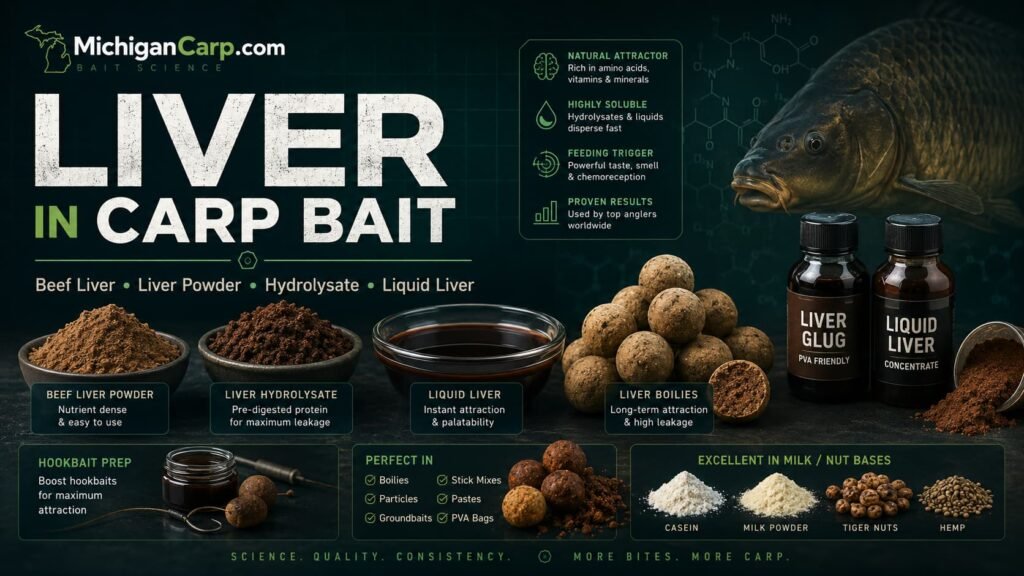
Liver hydrolysate for carp bait showing beef liver liquid liver boilies soluble food signals hydrolysate protein breakdown and carp bait ingredients
Liver hydrolysate for carp bait is often described as a powerful liquid attractor.
That is true, but it is also incomplete.
The important word is not just liver.
It is hydrolysate.
A liver hydrolysate is not simply liver flavor. It is a liver-based food ingredient that has been broken down into smaller soluble fractions. Depending on the product, that may include peptides, amino acids, savory compounds, liver extractives and soluble animal-food signals that can move out of bait more readily than ordinary dry liver powder.
That is why liver hydrolysate can be useful in:
BOILIES.
GLUGS.
HOOKBAITS.
PASTES.
POWDER COATINGS.
PACKBAIT.
METHOD MIX.
PARTICLE FINISHING LIQUIDS.
SHORT-SESSION BAIT PREP.
MILK/NUT AND CREAM-STYLE BAITS.
For MichiganCarp bait work, I especially like beef liver hydrolysate because it adds a strong savory food signal without automatically turning a milk/nut bait into a fishmeal bait.
That matters.
A good milk, nut, cream or tiger nut boilie does not always need fishmeal identity. Sometimes it needs a controlled savory edge that sits underneath the dairy, nut and birdfood structure. Beef liver hydrolysate can do that very well when used carefully.
This article explains how to use liver hydrolysate for carp bait, including beef liver hydrolysate, liquid liver, liver hydrolysate powder, ordinary liver powder, boilies, glugs, hookbait conditioners, powder coatings, packbait, particles, cold-water use, warm-water use, USA sourcing and practical inclusion ranges.
For the broader hydrolysate guide, read How to Use Hydrolysates in Carp Bait.
For boilie liquids and additive basics, use Boilie Liquids and Additives.
For practical boilie preparation before fishing, read How to Prepare Boilies for Carp Fishing.
For milk/nut bait design, read How to Formulate a Milk, Nut and Birdfood Boilie Base Mix.
The simple rule is:
LIVER HYDROLYSATE IS A SOLUBLE SAVORY FOOD-SIGNAL TOOL.
USE IT TO SUPPORT GOOD BAIT, NOT TO BURY IT.
Table of Contents
Quick Start: How to Use Liver Hydrolysate
Use this table first.
| Use | Best Form | Starting Level | Main Benefit | Main Warning |
|---|---|---|---|---|
| Boilie liquid phase | Liquid beef liver hydrolysate | 10–30 ml/kg dry mix | Built-in soluble savory signal | Count it as part of the liquid system |
| Boilie dry mix | Liver hydrolysate powder | 5–20 g/kg dry mix | Controlled dry inclusion | Too much can become harsh |
| Freezer bait glug | Liquid liver hydrolysate | 10–40 ml/kg boilies | Fast outer food signal | Do not drown soft bait |
| Hookbait conditioner | Liquid hydrolysate in PG/glycerin carrier | Light coating | Strong hookbait identity | Test wafters and pop-ups |
| Powder coating | Liver hydrolysate powder or beef liver powder | 10–25% of dust blend | Fast savory skin | Do not overcoat |
| Packbait / method | Liver powder, liver hydrolysate, liquid liver | Small addition | Adds food signal to carrier bait | Do not make mix wet or sour |
| Particles | Liquid liver after cooking | Low-level finishing liquid | Savory soluble trail | Safe particle prep comes first |
| Cold water | Light liver hydrolysate, liver dust | Low end of range | Signal without heavy feed | Avoid heavy oil and overfeeding |
| Warm water | Liver glug, liver hookbait, liver packbait | Moderate range | Stronger food bait support | Watch spoilage and heat |
Most mistakes come from using liver hydrolysate like a magic additive.
It is not magic.
It is a strong ingredient that needs control.
The best starting point is:
Start low.
Test in water.
Increase only if the bait still feels balanced.
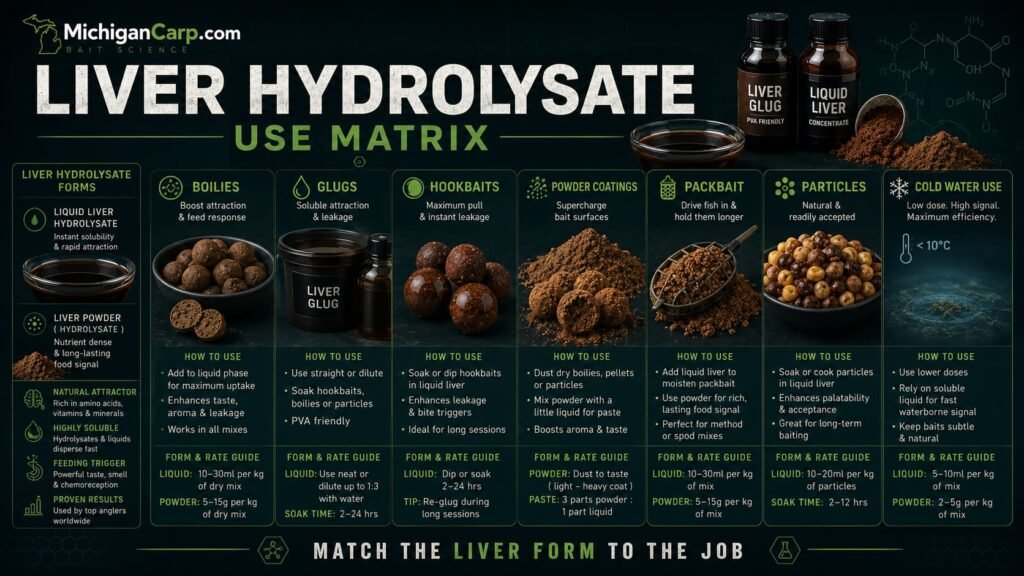
What Is Liver Hydrolysate?
Liver hydrolysate is liver protein that has been broken down into smaller fractions.
A true protein hydrolysate is normally produced by hydrolysis, often using enzymes or controlled processing, to break larger proteins into smaller peptides and amino-acid-containing fractions. Reviews of protein hydrolysates describe enzymatic hydrolysis as a method that converts proteins into bioactive peptides and smaller soluble components. Review of Fish Protein Hydrolysates.
For carp bait, the practical point is simple:
A hydrolysate is usually more soluble and more active than ordinary liver meal or liver powder.
That does not automatically make it better in every situation.
It means it behaves differently.
Liver Powder
Liver powder is usually dried liver ground into powder.
It can be very useful, but it is not necessarily a true hydrolysate.
Liver Hydrolysate Powder
Liver hydrolysate powder is liver that has been broken down and then dried into powder.
It is usually more soluble and stronger than ordinary liver powder.
Liquid Liver Hydrolysate
Liquid liver hydrolysate is a liquid liver product made from hydrolyzed liver material.
It can be very useful in glugs, liquid phases and hookbait conditioners.
Homemade Liver Liquid
Blended or cooked beef liver liquid can be useful, but it is not automatically a true hydrolysate.
If you blend fresh beef liver with water, cook it and strain it, you have made a homemade liver liquid or extract-style bait liquid, not a guaranteed hydrolysate.
That distinction matters because bait claims should be honest.
Why Liver Hydrolysate Works in Carp Bait
Carp are aquatic feeders. They do not respond to bait the way humans respond to smell in air.
They investigate chemical signals in water.
Aquaculture feed research supports the broad idea that soluble feed attractants can influence feeding response. A University of Florida feed-attractant review discusses amino acids, nucleotides, betaine-type compounds and organic acids as feed-attractant classes used in aquaculture nutrition. University of Florida Feed Attractants Review.
Protein hydrolysate research also supports the idea that low-molecular-weight peptides and free amino acids can improve feed attractiveness and palatability in aquatic feeds. Palatability of Protein Hydrolysates from Industrial Byproducts.
That does not prove every liver glug catches more carp.
It supports the practical bait-making logic behind using liver hydrolysate as a soluble savory food-signal ingredient.
Liver hydrolysate can contribute:
- savory depth;
- soluble food signal;
- peptide/amino background;
- liver character;
- hookbait identity;
- glug value;
- powder coating strength;
- short-session attraction;
- milk/nut contrast;
- fishmeal bait support.
The honest conclusion is:
liver hydrolysate can help when it improves the bait’s food signal, leakage and identity.
It can hurt when it makes bait too strong, too soft, too bitter or badly balanced.
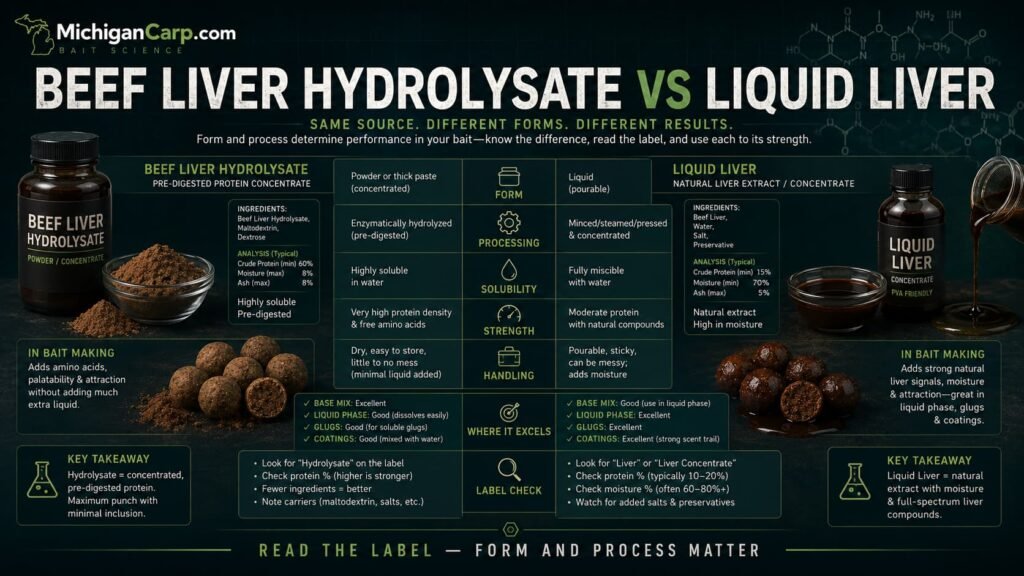
Beef Liver Hydrolysate vs Liquid Liver
These two are often confused.
They may overlap, but they are not automatically the same.
Beef Liver Hydrolysate
Beef liver hydrolysate should be liver-derived material that has been hydrolyzed.
It may be sold as:
- liquid beef liver hydrolysate;
- powdered beef liver hydrolysate;
- beef liver digest;
- hydrolyzed beef liver;
- liver protein hydrolysate;
- liver extract hydrolysate.
Liquid Liver
Liquid liver is a broader term.
It may be:
- true liquid liver hydrolysate;
- liver extract;
- liver digest;
- liver-flavored bait liquid;
- liver mixed with molasses;
- liver mixed with yeast;
- liver mixed with fish solubles;
- liver in glycerin;
- liver in propylene glycol;
- liver in water-based carrier;
- commercial “liquid liver” with several ingredients.
Practical Difference
The term liquid liver tells you the form.
The term hydrolysate tells you something about processing.
A liquid liver product may be excellent, but you still need to read the label.
Look for:
- liver source;
- beef, poultry or mixed animal source;
- hydrolyzed, digest, extract or flavor;
- water content;
- salt level;
- carrier liquid;
- preservative system;
- protein content;
- storage instructions;
- smell and freshness.
If the label is vague, start low.
Why I Prefer Beef Liver for Milk/Nut Baits
For MichiganCarp-style milk/nut baits, beef liver is my preferred liver direction.
The reason is identity.
A milk/nut bait may already contain:
- tiger nut flour;
- peanut protein;
- peanut meal;
- milk powder;
- WPC80;
- casein;
- birdfood;
- cream powder;
- yeast;
- sweet or fruit flavor support.
That bait does not always need fishmeal.
It often needs a savory animal-food note underneath the dairy and nut profile.
Beef liver hydrolysate can provide that without dragging the bait into a strong marine direction.
That makes it useful in:
- milk/nut boilies;
- tiger nut boilies;
- peanut boilies;
- cream baits;
- plum/cream baits;
- maple/vanilla/butter baits;
- birdfood baits;
- hard hookbaits;
- powder coatings;
- packbait;
- method mix.
The key is restraint.
A milk/nut bait with a controlled beef liver edge can still feel creamy, nutty and edible.
A milk/nut bait overloaded with liver can lose its identity.
Liver Hydrolysate vs Liver Powder
Liver powder and liver hydrolysate are both useful.
They do different jobs.
Liver Powder
Liver powder is good for:
- base mixes;
- hookbait mixes;
- packbait;
- method mix;
- powder coatings;
- PVA stick mixes;
- boilie crumb blends.
It adds liver character and dry food value, but it may not be as soluble as a true hydrolysate.
Liver Hydrolysate
Liver hydrolysate is good for:
- liquid phase;
- glugs;
- hookbait conditioners;
- short-session bait prep;
- soluble powder coatings;
- cold-water traps;
- stronger hookbait identity.
It usually gives a more immediate soluble liver signal.
Which Should You Use?
Use liver powder when you want a controlled dry ingredient.
Use liver hydrolysate when you want a stronger soluble signal.
Use both only when the bait needs it.
Do not automatically stack liver powder, liver hydrolysate, liquid liver and liver extract all at high levels.
That is how bait becomes harsh.
Liquid Liver Hydrolysate vs Powdered Liver Hydrolysate
Both forms are useful.
Liquid Liver Hydrolysate
Best for:
- boilie liquid phase;
- glugs;
- hookbait conditioners;
- sprays if thin enough;
- packbait liquids;
- particle finishing liquids;
- paste wraps.
Main risk:
- too much moisture;
- softer bait;
- shorter storage life;
- souring if mishandled;
- PVA problems if water-based.
Powdered Liver Hydrolysate
Best for:
- dry base mix;
- hookbait mix;
- powder coatings;
- PVA stick mixes;
- packbait dry blend;
- boilie crumb;
- cold-water dusting.
Main risk:
- bitterness;
- harshness;
- clumping;
- over-strong surface signal.
Practical Rule
Use liquid when you want coating and movement.
Use powder when you want control and dry signal.
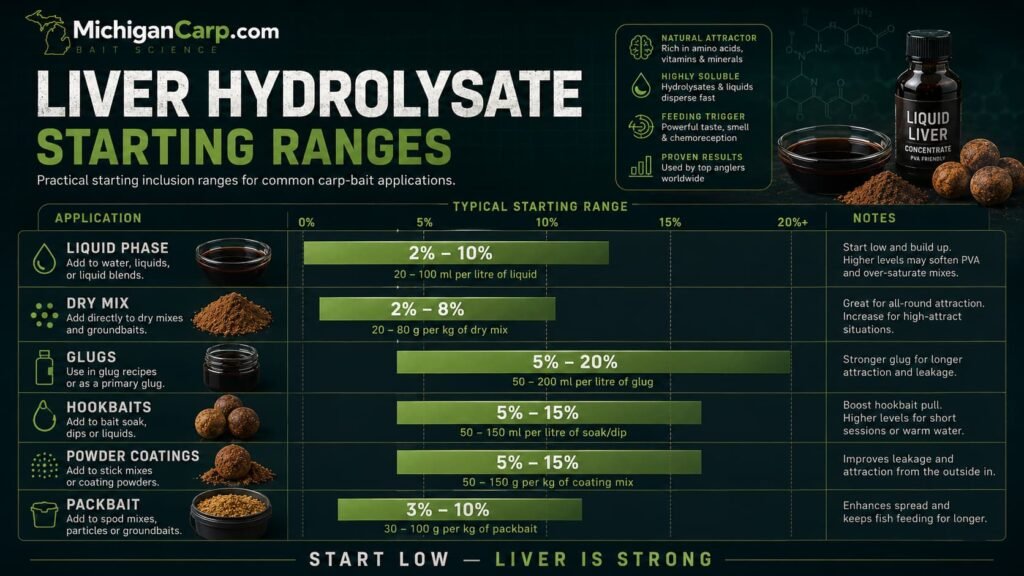
How Much Liver Hydrolysate Should You Use?
Start lower than you think.
Liver hydrolysate is strong.
Dry Mix Starting Points
| Ingredient | Starting Range per 1 kg dry mix |
|---|---|
| Ordinary beef liver powder | 5–25 g |
| Liver hydrolysate powder | 5–20 g |
| Strong liver extract powder | 2–10 g |
| Hookbait liver powder level | 15–40 g |
| Liver plus yeast blend | 10–40 g total |
Liquid Phase Starting Points
| Liquid Product | Starting Range per 1 kg dry mix |
|---|---|
| Beef liver hydrolysate | 10–30 ml |
| Liquid liver | 10–40 ml |
| Homemade beef liver liquid | 20–60 ml for freezer bait only |
| Concentrated liver extract | 2–10 g dissolved into liquids |
Glugging Starting Points
| Use | Starting Amount |
|---|---|
| Light glug | 10–25 ml per 1 kg boilies |
| Moderate glug | 25–50 ml per 1 kg boilies |
| Heavy soak | 50–100 ml per 1 kg hard bait |
| Hookbait conditioner | Light coating only |
Powder Coating Starting Points
| Use | Starting Amount |
|---|---|
| Light dusting | 5–15 g per 1 kg boilies |
| Strong dusting | 15–30 g per 1 kg boilies |
| Hookbait dusting | Use sparingly |
| Packbait add-on | 10–30 g per kg dry carrier |
These are starting points, not laws.
If the bait smells harsh or tastes bitter, reduce the level.
Liver Hydrolysate in Boilies
Liver hydrolysate can be used directly in boilies.
It can go into:
- the dry base mix;
- the liquid phase;
- hookbait paste;
- corkball paste;
- freezer bait;
- shelf-life bait if properly formulated and tested.
In the Dry Mix
Use powder liver hydrolysate when you want controlled inclusion.
Good starting level:
5–20 g per 1 kg dry mix
For ordinary beef liver powder:
5–25 g per 1 kg dry mix
For strong hookbait mixes:
15–40 g per 1 kg hookbait mix
In the Liquid Phase
Use liquid liver hydrolysate when you want more leakage and soluble movement.
Good starting level:
10–30 ml per 1 kg dry mix
Count it as liquid.
Do not add it on top of an already wet recipe without reducing something else.
In Freezer Baits
Freezer baits are the easiest place to use liver hydrolysate because long room-temperature storage is not the goal.
Use liver hydrolysate:
- in the base mix;
- in the liquid phase;
- as a post-thaw glug;
- as a powder coating;
- in boilie crumb;
- in hookbait prep.
In Shelf-Life Baits
Shelf-life bait is more complicated.
Liver hydrolysate can add moisture and biological richness.
Use dry hydrolysate powders, stable carriers and proper preservation testing.
Do not assume wet liver-treated bait is shelf-stable.
For storage rules, read How to Store Homemade Boilies.
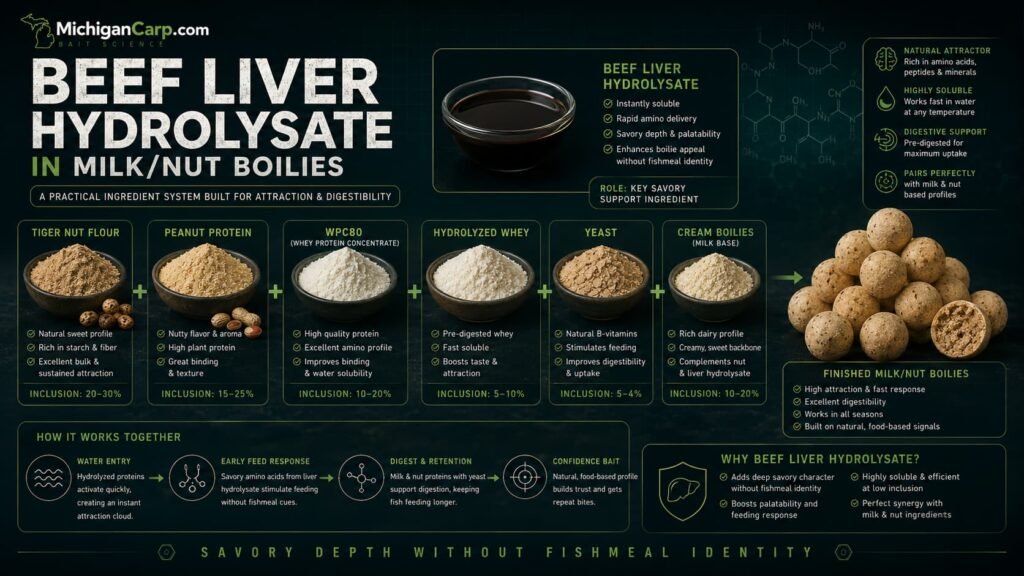
Liver Hydrolysate in Milk/Nut Boilies
This is one of the best uses for beef liver hydrolysate.
Milk/nut boilies often have excellent food value but can benefit from a deeper savory layer.
Good Ingredients to Pair With Beef Liver Hydrolysate
Use beef liver hydrolysate with:
- hydrolyzed whey;
- WPC80;
- skimmed milk powder;
- Nido or whole milk powder;
- tiger nut flour;
- peanut protein;
- peanut meal;
- birdfood;
- brewer’s yeast;
- yeast extract;
- betaine;
- light molasses;
- maple or vanilla support.
Practical Milk/Nut Liver Package
For 1 kg dry mix:
10 g beef liver powder or liver hydrolysate powder
15 g hydrolyzed whey powder
10 g brewer’s yeast or yeast extract
5 g betaine
Total:
40 g
This is a strong soluble support package.
Do not add it blindly to an already complete recipe.
Balance it against the rest of the bait.
Liquid Phase Option
For 1 kg dry mix:
15–25 ml beef liver hydrolysate
10–20 ml liquid yeast
10–20 ml tiger nut extract
This fits a milk/nut bait better than a heavy fish hydrolysate direction.
What to Avoid
Avoid:
- too much liver;
- too much oil;
- too much syrup;
- liver plus heavy fish hydrolysate unless intended;
- burying the cream/nut identity;
- making the bait smell like straight meat.
Liver Hydrolysate in Fishmeal Boilies
Liver hydrolysate also works in fishmeal bait.
In fishmeal boilies, it supports an existing savory animal-food profile.
Good Combinations
Use liver hydrolysate with:
- fishmeal;
- predigested fishmeal;
- fish protein hydrolysate;
- krill;
- squid;
- yeast extract;
- spices;
- betaine;
- marine oils used carefully.
Starting Direction
For 1 kg dry mix:
10–30 g liver powder
5–20 g liver hydrolysate powder
10–30 ml liquid liver hydrolysate
Do not use all of those at maximum levels together.
Warning
Fishmeal plus liver hydrolysate plus fish hydrolysate plus yeast extract can become too strong quickly.
Strong bait is not always better bait.
The bait still has to be eaten.
Liver Hydrolysate in Hookbaits
Hookbaits are one of the best places to use liver hydrolysate.
A hookbait can be slightly stronger than the free bait because it has a different job.
Best Hookbait Uses
Use liver hydrolysate in:
- hard bottom bait hookbaits;
- corkball paste;
- paste wraps;
- hookbait dips;
- hookbait sprays;
- powder coatings;
- long-soak bottom baits;
- cold-water singles.
Bottom Bait Hookbaits
Bottom bait hookbaits can handle more liver hydrolysate than wafters or pop-ups.
Starting levels:
15–40 g liver powder per 1 kg hookbait mix
or:
10–30 ml liquid liver hydrolysate per 1 kg hookbait mix
Wafters
Use caution.
Liquid liver can change balance.
Use:
- light spray;
- short dip;
- powder coating;
- controlled conditioner.
Always test with the actual hook.
Pop-Ups
Use even more caution.
Heavy soaking can reduce buoyancy.
Use:
- spray;
- brief dip;
- light coating;
- low inclusion in the original mix.
A pop-up still has to pop up.
Beef Liver Hookbait Conditioner
This is a practical hookbait conditioner for hard bottom baits, bait-screw hookbaits and durable milk/nut hookbaits.
Use food-grade ingredients only.
Glycerin is listed in federal regulations as generally recognized as safe when used according to good manufacturing practice, and propylene glycol is also listed under federal food regulations for specified food uses. For bait making, the practical point is simple: use food-grade glycerin and food-grade propylene glycol, not automotive or industrial products. eCFR Glycerin and eCFR Propylene Glycol.
250 ml Beef Liver Hookbait Conditioner
90 ml food-grade propylene glycol
60 ml food-grade glycerin
40 ml tiger nut extract or matching bait liquid
30 ml beef liver hydrolysate or liquid liver
20 ml liquid yeast or hydrolyzed whey liquid
10 ml molasses or maple syrup
Total:
250 ml
How to Use
- Put hookbaits in a small tub.
- Add a small amount of conditioner.
- Shake until lightly coated.
- Let the bait absorb.
- Add more only if the bait needs it.
- Test in water before fishing.
Warning
Do not drown wafters or pop-ups in this conditioner unless you have tested buoyancy.
This conditioner is best for:
- hard bottom bait hookbaits;
- long-soak hookbaits;
- bait-screw hookbaits;
- milk/nut hookbaits;
- cold-water singles used carefully.
Liver Hydrolysate Glugs and Soaks
Liver hydrolysate works very well in glugs and soaks.
But it is easy to overdo.
A good glug coats and supports the bait.
It does not turn the bait into a wet, sour, liver-heavy mess.
Light Liver Hydrolysate Glug for 1 kg Boilies
15 ml beef liver hydrolysate
15 ml liquid yeast
10 ml tiger nut extract
10 ml food-grade glycerin or propylene glycol
Total:
50 ml
Use for thawed freezer bait, air-dried boilies or short-session bait prep.
Milk/Nut Beef Liver Glug
20 ml tiger nut extract
15 ml liquid yeast
10 ml beef liver hydrolysate
10 ml hydrolyzed whey liquid
5 ml molasses or maple syrup
Total:
60 ml
Use for 1 kg of milk/nut boilies.
Strong Savory Liver Glug
25 ml liquid liver hydrolysate
15 ml fish hydrolysate
15 ml liquid yeast
10 ml food-grade glycerin or propylene glycol
Total:
65 ml
Use only when the bait profile suits a strong savory direction.
Glug Warning
If liquid is pooling in the bottom of the tub and the boilies are already soft, you have used too much.
Start lower.
Shake the bait.
Let it absorb.
Add more only if needed.
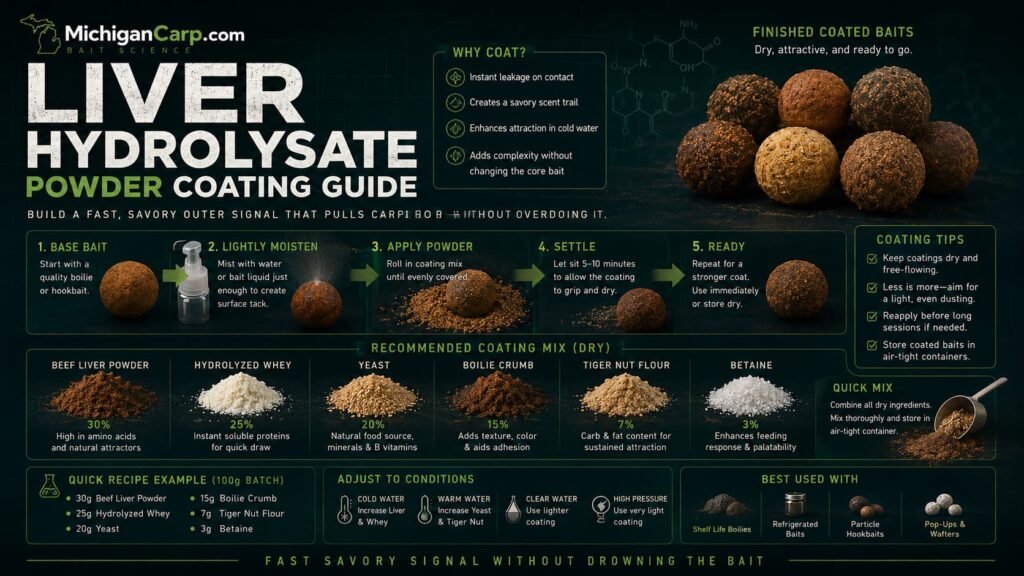
Liver Hydrolysate Powder Coatings
Powder coatings are one of the best ways to use liver hydrolysate.
They add a fast outer signal without drowning the bait.
100 g Milk/Nut Liver Hydrolysate Dust
30 g hydrolyzed whey powder
20 g fine boilie crumb
20 g beef liver powder or liver hydrolysate powder
15 g skimmed milk powder
10 g tiger nut flour
5 g betaine
Total:
100 g
100 g Savory Liver Dust
30 g fine boilie crumb
25 g beef liver powder or liver hydrolysate powder
20 g brewer’s yeast
15 g hydrolyzed whey or fish hydrolysate powder
5 g betaine
5 g garlic powder or spice powder
Total:
100 g
How to Use a Liver Powder Coating
- Lightly spray or dampen boilies.
- Add a small amount of dust.
- Shake gently.
- Let the coating settle.
- Repeat only if needed.
- Use soon or keep cool depending on moisture.
Best Uses
Use liver dust for:
- cold water;
- short sessions;
- hookbait coatings;
- PVA stick mixes;
- milk/nut boilies;
- packbait;
- method mix;
- small high-signal traps.
Homemade Beef Liver Liquid
Fresh beef liver is easy to find in the USA.
It can be used to make a practical homemade liver liquid for freezer bait, packbait, method mix or same-session glugs.
But be honest about what it is.
A homemade blended liver liquid is not automatically a true hydrolysate.
Simple Homemade Beef Liver Liquid
250 g fresh beef liver
250 ml water
10 g salt
10 g molasses
optional: 10–20 ml liquid yeast
Method
- Cut the liver into small pieces.
- Blend with the water.
- Warm gently until cooked through.
- Do not burn it.
- Cool.
- Blend again if needed.
- Strain through fine mesh.
- Use immediately or freeze in small portions.
How to Use It
Use homemade beef liver liquid in:
- freezer bait liquid phase;
- same-day glugs;
- packbait;
- method mix;
- particle finishing liquid;
- paste wraps.
Storage Warning
Homemade beef liver liquid is perishable.
Keep it refrigerated short-term or freeze it in small portions.
Do not leave it warm in a bait bucket, garage or truck.
Do not treat it like a commercial preserved bait liquid.
Liver Hydrolysate in Packbait and Method Mix
Liver hydrolysate fits extremely well in packbait and method mix.
This is especially useful when fishing boilies alongside packbait.
Many anglers fish packbait with particles but miss the chance to make it support their boilie hookbait.
Best Liver Packbait Ingredients
Use:
- beef liver powder;
- liver hydrolysate powder;
- liquid liver hydrolysate;
- brewer’s yeast;
- hydrolyzed whey;
- fine boilie crumb;
- tiger nut flour;
- peanut powder;
- milk powder;
- molasses;
- liquid yeast.
100 g Liver Packbait Add-On
35 g fine boilie crumb
20 g beef liver powder or liver hydrolysate powder
20 g brewer’s yeast
15 g hydrolyzed whey or skimmed milk powder
10 g tiger nut flour
Total:
100 g
Add this to dry packbait or method mix.
Same-Session Liver Liquid Add-On
20 ml liquid yeast
10 ml beef liver hydrolysate
10 ml molasses
Total:
40 ml
Add to the wetting liquid.
Warning
Do not make packbait too wet or sticky.
It still has to bind, cast, sink and break down properly.
For the full packbait system, read Packbait for Carp Fishing.
Liver Hydrolysate With Particles
Liver hydrolysate can be used with particles, but safe particle preparation comes first.
Do not use liver liquid to cover poor preparation.
Add liver hydrolysate after particles are properly soaked, boiled and cooled.
With Maize or Corn
Good options:
- liquid yeast;
- small beef liver hydrolysate addition;
- molasses;
- hydrolyzed whey if fishing milk/nut boilies;
- boilie crumb.
With Tiger Nuts
Good options:
- tiger nut extract;
- beef liver hydrolysate at low level;
- liquid yeast;
- molasses;
- milk/nut boilie crumb.
With Hemp
Good options:
- liver powder;
- liquid yeast;
- savory hydrolysate;
- light hemp oil only if conditions suit.
Practical Rule
Use liver hydrolysate as a finishing liquid or short-term soak.
Do not use it instead of proper soaking and boiling.
For particle safety, read How to Prepare Particles for Carp Fishing and Particles for Carp Fishing.
Liver Hydrolysate in Cold Water
Liver hydrolysate can be useful in cold water because it provides signal without needing much feed.
But the level should usually be low.
Cold-water bait should often be:
- smaller;
- more soluble;
- lower in oil;
- used in lower quantity;
- easy to investigate;
- not too heavy.
Best Cold-Water Liver Hydrolysate Use
Use:
- light liver spray;
- liver powder dust;
- small beef liver hydrolysate glug;
- liver plus hydrolyzed whey;
- liver plus yeast;
- crumb around the hookbait;
- low-feed PVA traps.
Cold-Water Starting Levels
Liquid:
5–20 ml per 1 kg bait
Powder:
5–15 g per 1 kg dry mix
Dust:
light coating only
Avoid
Avoid:
- heavy oil glugs;
- huge baiting quantities;
- strong sour liver liquids;
- greasy bait;
- hard bait that leaks too slowly.
In cold water, liver hydrolysate should be precise.
Liver Hydrolysate in Warm Water
Warm water gives you more room to use liver hydrolysate.
When carp are feeding properly, stronger savory food bait can work well.
Best Warm-Water Uses
Use:
- liver in base mix;
- liver glugs;
- beef liver hookbaits;
- liver dust;
- liver packbait;
- liver plus yeast;
- liver plus fish hydrolysate for fishmeal baits;
- liver plus milk/nut for non-marine baits.
Warm-Water Starting Levels
Liquid:
15–40 ml per 1 kg bait
Powder:
10–30 g per 1 kg dry mix
Glug:
25–60 ml per 1 kg boilies
Warning
Warm weather also increases spoilage risk.
Do not leave liver-treated bait baking in a hot truck, sealed bucket or sunny swim.
Keep prepared bait cool and use it sensibly.
Liver Hydrolysate and PVA
Many liquid liver hydrolysates are water-based.
That means they may melt PVA.
Safer PVA Options
Use:
- dry liver powder;
- liver hydrolysate powder;
- powder coating;
- dry PVA stick mix;
- PG-heavy hookbait conditioner;
- glycerin-heavy conditioner;
- dry boilie crumb with liver dust.
Riskier PVA Options
Be careful with:
- liquid liver;
- homemade liver liquid;
- water-thinned liver extract;
- liquid yeast plus liver;
- particle juices with liver;
- wet glugged boilies.
Simple PVA Test
- Put a small amount of liquid in a cup.
- Add a scrap of PVA mesh or bag.
- Wait 5–10 minutes.
- Watch for melting or weakening.
- Test the finished mix, not only the liquid.
Do not trust claims.
Test your own PVA.
Liver Hydrolysate and Storage
Liver hydrolysate can improve bait, but it can also make storage more difficult.
This is especially true with water-based liquids.
Freezer Bait
Freezer bait is the easiest place to use liver hydrolysate.
Use it in:
- liquid phase;
- post-thaw glug;
- powder coating;
- hookbait prep;
- packbait liquid.
Keep bait cool and use sensible session portions.
Shelf-Life Bait
Shelf-life bait is more complicated.
Use liver hydrolysate carefully because it may add moisture, soluble nutrients and storage risk.
Safer shelf-life use:
- dry liver hydrolysate powder;
- low-level inclusion;
- stable carrier liquids;
- proper preservative system;
- proper drying;
- storage testing.
Riskier shelf-life use:
- homemade liver liquid;
- water-based liquid liver;
- heavy wet glugs;
- post-boil liver soaks;
- warm storage.
Practical Rule
If you add water-rich liver hydrolysate after boiling, treat the bait as prepared bait for use, not long-term shelf-life bait.
For storage details, use How to Store Homemade Boilies.
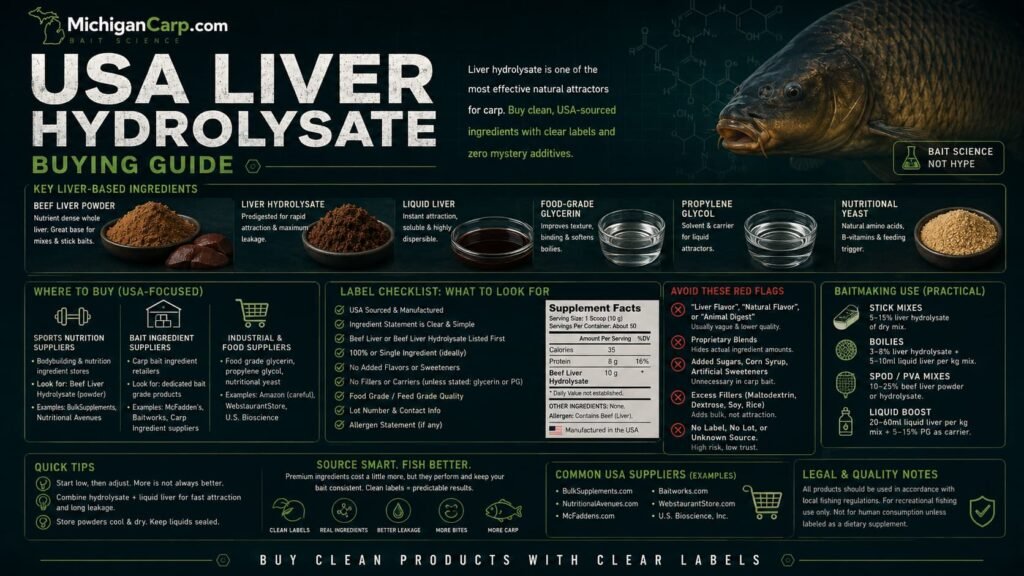
USA Buying Guide for Liver Hydrolysate
USA bait makers do not need to chase every UK bait additive.
There are practical options here.
Look For
Useful USA sources include:
- beef liver hydrolysate;
- beef liver powder;
- desiccated beef liver powder;
- freeze-dried beef liver powder;
- liquid liver hydrolysate;
- liver digest from reputable feed or pet suppliers;
- clean beef liver supplement powder;
- fresh beef liver from grocery or butcher counters;
- food-grade glycerin;
- food-grade propylene glycol;
- brewer’s yeast;
- yeast extract;
- hydrolyzed whey.
Read the Label
Check:
- beef, poultry or mixed liver source;
- hydrolyzed, digest, extract or powder;
- added salt;
- fillers;
- anti-caking agents;
- preservatives;
- flavorings;
- sweeteners;
- protein level;
- moisture level;
- storage guidance;
- food-grade or feed-grade suitability.
Beef Liver Supplement Powders
Some USA beef liver powders are sold as human supplements.
They can work if the label is clean.
But they may be expensive.
Bulk powder is usually more practical for bait making.
Fresh Beef Liver
Fresh beef liver is easy to find in many USA grocery stores.
It is useful for:
- homemade liver liquid;
- freezer bait experiments;
- same-session packbait liquids;
- short-term glugs.
It is not shelf-stable.
Freeze what you do not use.
Avoid
Avoid:
- rancid liver powder;
- mystery animal digest;
- medicated feed products;
- products with unclear labels;
- old liquid liver stored warm;
- fragrance oils;
- heavily flavored supplement blends;
- industrial chemicals;
- anything not suitable around water or bait.
Use clean products with clear labels.
Common Liver Hydrolysate Mistakes
Mistake 1: Using Too Much
Liver hydrolysate is strong.
More is not automatically better.
Mistake 2: Treating Liquid Liver as Magic
Liquid liver only helps if it fits the bait and the session.
Mistake 3: Confusing Liver Powder With Hydrolysate
Liver powder and liver hydrolysate are not the same thing.
Mistake 4: Drowning Free Bait
Free bait should still be edible and balanced.
Mistake 5: Drowning Wafters and Pop-Ups
Liquid liver can change buoyancy.
Test before fishing.
Mistake 6: Ignoring Storage Risk
Water-rich liver products can spoil or sour if stored badly.
Mistake 7: Ignoring PVA
Many liquid liver products are not PVA-safe.
Mistake 8: Making Milk/Nut Bait Too Meaty
Beef liver should support the bait, not bury the cream and nut identity.
Mistake 9: Using Old or Rancid Products
Bad liver products ruin bait quickly.
Mistake 10: Not Testing in Water
Always soak test new liver levels before trusting them.
Simple Liver Hydrolysate Test Plan
Before committing to a full batch, test small.
Step 1: Choose One Product
Pick one:
- beef liver hydrolysate liquid;
- liver hydrolysate powder;
- ordinary beef liver powder;
- homemade beef liver liquid.
Step 2: Make Three Levels
For a 1 kg dry mix equivalent:
Low: 5–10 g powder or 10 ml liquid
Medium: 15–20 g powder or 20–30 ml liquid
High: 30–40 g powder or 40–60 ml liquid
Step 3: Keep Everything Else the Same
Do not change flavor, sweetener, hydrolysate, boil time and drying time all at once.
Step 4: Boil, Dry and Soak Test
Check after:
- 1 hour;
- 6 hours;
- 12 hours;
- 24 hours.
Step 5: Judge Properly
Look for:
- smell;
- leakage;
- bitterness;
- softness;
- texture;
- cracking;
- hookbait durability;
- buoyancy if relevant;
- storage behavior;
- fish response.
Step 6: Record the Result
Write down:
- product name;
- supplier;
- level used;
- bait recipe;
- boil time;
- drying time;
- soak test result;
- fishing result.
Good bait development needs notes.
My Practical View
Liver hydrolysate is one of the most useful savory bait tools available to a home boilie maker.
But it should be used with discipline.
For MichiganCarp-style bait, I especially like beef liver hydrolysate because it supports milk/nut and cream bait without forcing the bait into a fishmeal direction.
That makes it useful in:
- milk/nut boilies;
- tiger nut boilies;
- peanut baits;
- birdfood baits;
- hookbait conditioners;
- powder coatings;
- packbait;
- method mixes;
- short-session traps.
I would not use it heavily in everything.
I would use it as a controlled savory layer.
The biggest mistake is treating liver hydrolysate like a magic glug.
It is not magic.
It is a strong soluble food-signal ingredient.
The final rule is:
USE LIVER HYDROLYSATE FOR DEPTH.
USE BEEF LIVER WHEN YOU WANT SAVORY NON-MARINE SUPPORT.
START LOW.
TEST IN WATER.
DO NOT OVERPOWER GOOD BAIT.
FAQ
Is liver hydrolysate good for carp bait?
Yes. Liver hydrolysate can be very useful in carp bait because it adds a soluble savory food signal that works well in boilies, glugs, hookbaits, powders, packbait and method mix.
Is beef liver hydrolysate good for carp bait?
Yes. Beef liver hydrolysate is especially useful when you want a savory animal-food signal without turning the bait into a fishmeal bait.
What is the difference between liver powder and liver hydrolysate?
Liver powder is dried liver ground into powder. Liver hydrolysate has been broken down into smaller soluble fractions, so it is usually stronger and more active in water.
Is liquid liver the same as liver hydrolysate?
Not always. Liquid liver may be a true hydrolysate, but it may also be liver extract, liver digest, liver flavor or a blended commercial bait liquid. Read the label.
How much liver hydrolysate should I use in boilies?
A practical starting point is 5–20 g of liver hydrolysate powder per 1 kg dry mix or 10–30 ml of liquid liver hydrolysate per 1 kg dry mix.
How much liquid liver should I use as a glug?
Start with 10–25 ml per 1 kg of boilies for a light glug. Use 25–50 ml only when the bait is dry enough to absorb it.
Can you use too much liver hydrolysate?
Yes. Too much liver hydrolysate can make bait harsh, bitter, sour, sticky, soft or overpowering.
Does liver hydrolysate work in milk/nut boilies?
Yes. Beef liver hydrolysate works very well in milk/nut boilies when used as a supporting savory layer.
Does liver hydrolysate work in fishmeal boilies?
Yes. Liver hydrolysate works well in fishmeal boilies, but it can become too strong if combined with high levels of fish hydrolysate, yeast extract and marine products.
Can liver hydrolysate be used in hookbaits?
Yes. Hookbaits are one of the best places to use liver hydrolysate, especially in hard bottom bait hookbaits, conditioners, sprays, dips and powder coatings.
Can liver hydrolysate be used in packbait?
Yes. Liver hydrolysate, beef liver powder and liquid liver can all work well in packbait and method mix when used carefully.
Can liver hydrolysate be used with particles?
Yes, but add it after particles have been safely soaked, boiled and cooled. Use it as a finishing liquid or short-term soak.
Is liver hydrolysate PVA-safe?
Many liquid liver hydrolysates are water-based and may melt PVA. Test every liquid with your own PVA before using it.
Can I make homemade liver hydrolysate?
You can make homemade beef liver liquid, but it is not automatically a true hydrolysate unless the proteins are actually hydrolyzed. Treat homemade liver liquid as perishable.
What is the biggest mistake with liver hydrolysate?
The biggest mistake is using too much without a clear purpose.
Next Steps
Use these supporting guides next:
- How to Use Hydrolysates in Carp Bait
- What Hydrolysates Really Do in Carp Bait
- Boilie Liquids and Additives
- How to Prepare Boilies for Carp Fishing
- How to Store Homemade Boilies
- Milk Powders in Boilie Making
- Milk Proteins in Carp Bait
- How to Formulate a Milk, Nut and Birdfood Boilie Base Mix
- Nut Boilie Base Mix Recipes
- Packbait for Carp Fishing
- Particles for Carp Fishing
- The Bait Shed
- Boilie School
- Michigan Carp Guide Library