

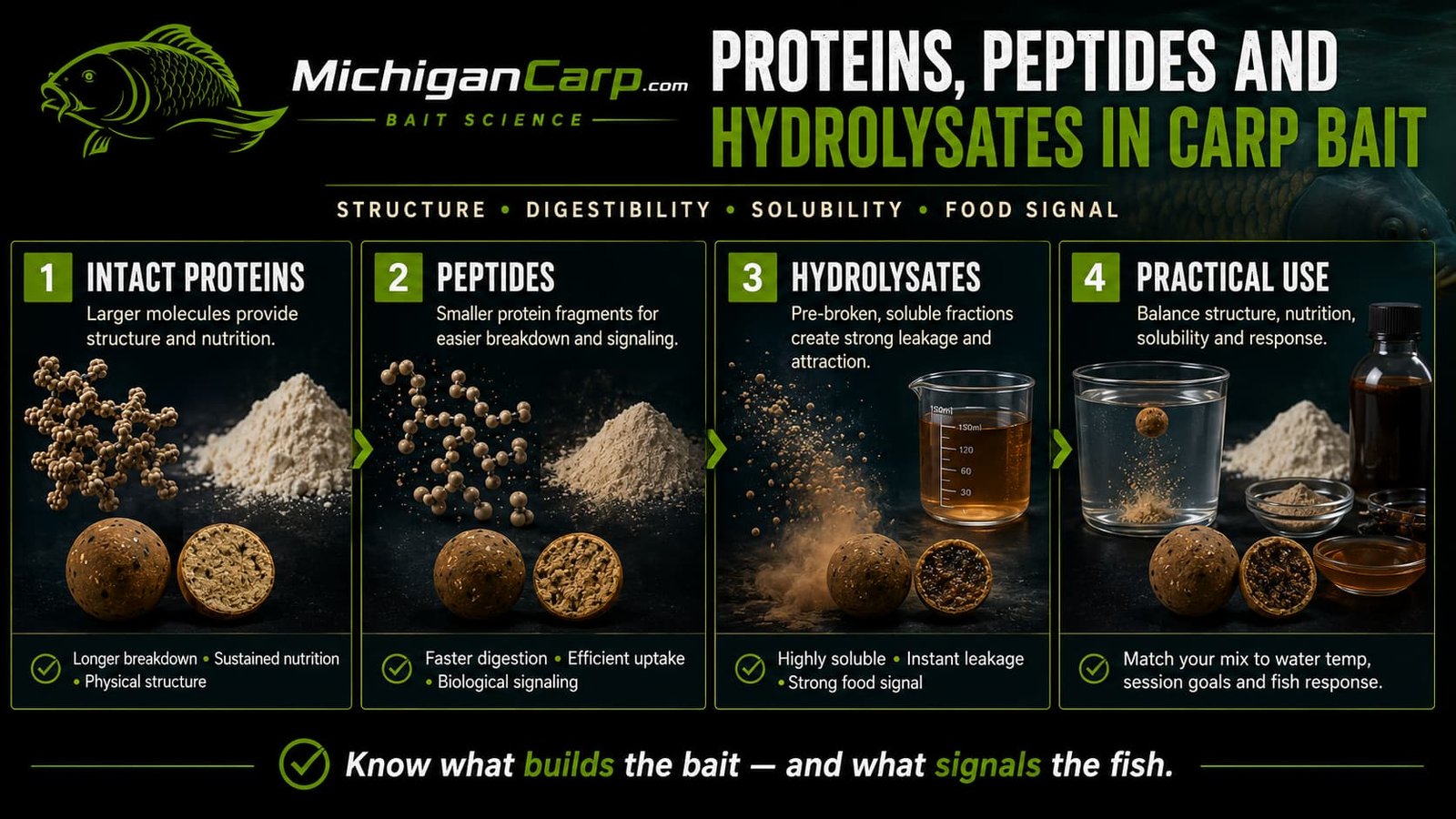
Proteins, peptides and hydrolysates in carp bait are often discussed as though they are different grades of the same thing.
They are not.
An intact protein, a peptide-rich ingredient, a protein hydrolysate and a free amino acid can all belong in bait science, but they do not automatically perform the same job. Some help build the food value and structure of the bait. Some contribute smaller soluble fractions. Some are more relevant to local chemical signal. Some are better used in crumb, paste, hookbait treatment or short-session traps than as the backbone of a full baiting campaign.
The useful model is not “which one is best?”
The useful model is:
What does this protein form do inside the complete bait?
A bait can contain a high crude-protein percentage and still release very little soluble food signal quickly. Another bait can release a strong local signal while providing less long-term food value. A serious bait does not need to choose between nutrition and signal. It needs to balance both.
The simplest protein continuum is:
Intact protein → larger peptides → smaller peptides → free amino acids
A protein hydrolysate can contain material from several points along that continuum. Its character depends on the starting material, hydrolysis method, processing time, pH, temperature, degree of hydrolysis, filtration and concentration. That is why the word hydrolysate by itself does not tell you exactly what is in the bottle or powder.
This article is the broad protein-form guide. For the more specific hydrolysate article, use What Hydrolysates Really Do in Carp Bait. For the free-amino-acid evidence discussion, use Do Carp Detect Free Amino Acids the Way Anglers Think?. For digestion and usable nutrition, use Carp Bait Digestibility.
For external technical context, see Enzymatic Fish Protein Hydrolysates in Finfish Aquaculture, Effects of Protein-, Peptide- and Free Amino Acid-Based Diets in Fish Nutrition and the USGS amino-acid response study in carp species.
Table of Contents
Quick Start: Proteins, Peptides and Hydrolysates in Carp Bait
Proteins, peptides and hydrolysates in carp bait should be judged by function, not by technical wording.
| Protein form | What it is | Main bait role | Main mistake |
|---|---|---|---|
| Intact protein | Larger protein structure | Food value, structure, digestion after eating | Judging only by crude-protein percentage |
| Peptides | Shorter chains of amino acids | Product-dependent protein-derived fractions | Treating all peptides as identical |
| Hydrolysates | Protein material broken into mixed fractions | Soluble food fraction, liquids, crumb, paste and hookbait treatment | Assuming every hydrolysate behaves the same |
| Free amino acids | Individual amino acids not bound in chains | Sensory and formulation roles | Assuming more always means better |
The main rule is simple:
Do not rank protein forms from worst to best. Give each one the right job.
The Protein Continuum
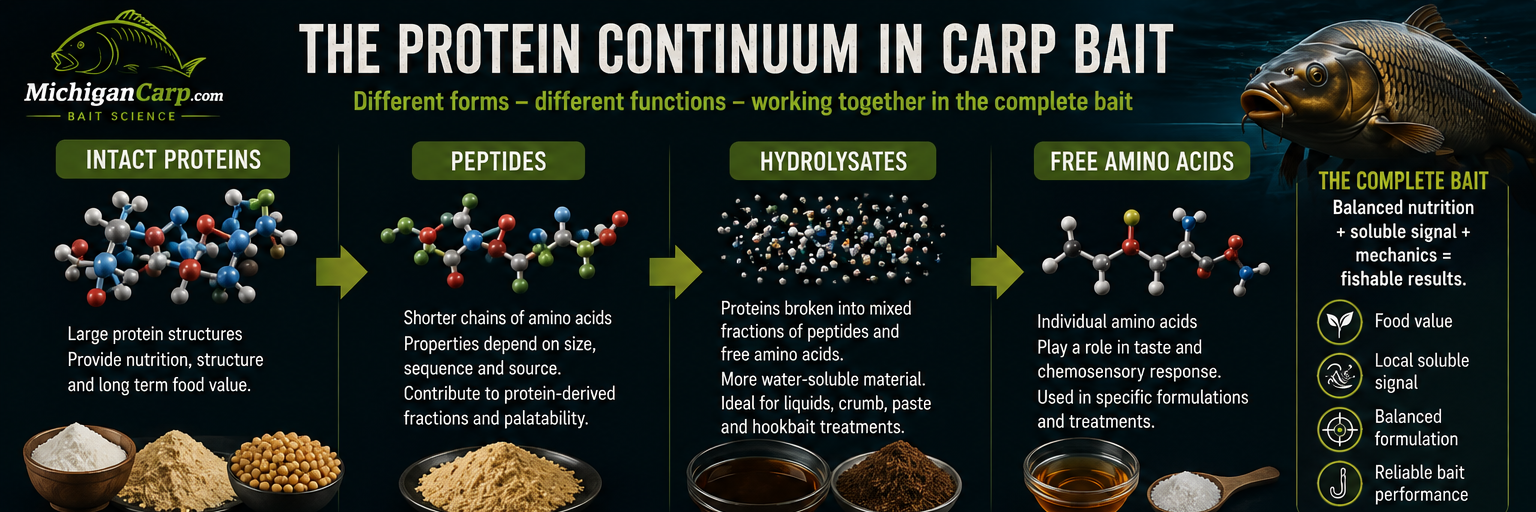
The word continuum is more useful than ladder.
A ladder can accidentally suggest that intact proteins are basic, peptides are better and free amino acids are the most advanced form. That is not how bait design works. The progression is about molecular size, processing and bait function, not automatic quality.
Intact proteins can provide structure, food value and amino-acid supply after digestion. Peptides are shorter protein-derived chains, but their properties depend on size, sequence, charge, hydrophobicity and source material. Hydrolysates are mixed products made by breaking protein into smaller fractions. Free amino acids are individual compounds that belong mainly in sensory and targeted-formulation discussions.
A good bait may use more than one part of this system. The mistake is asking one form to do every job.
For example, a milk-nut boilie may use casein, WPC, egg protein or milk powders to build the food and structure. It may then use a small amount of yeast extract, liver hydrolysate or whey hydrolysate to support local signal or treated crumb. Those are different jobs inside one bait system.
Intact Proteins Build the Food Package
Intact protein ingredients are the backbone of many serious food baits. They can contribute nutritional value, paste behaviour, binding, firmness, density, water life and post-digestion amino-acid supply.
Examples include casein, whey protein concentrate, egg proteins, fishmeal, processed soy proteins, pea protein, liver powder and selected animal or marine meals. For MichiganCarp.com, the non-marine milk, nut and seed direction often leans heavily on milk proteins, nut meals, seed meals, cereal structure and yeast-derived support rather than traditional fishmeal dependence.
The important warning is that protein percentage alone is not bait quality.
A bait can show a high crude-protein number and still be poorly balanced, too dense, awkward to roll, weak in short-term leakage, expensive, low in usable energy or unsuitable for the session. A specification number does not tell you how the bait hydrates, cooks, dries, softens, leaks or fishes.
| Protein decision | Better question |
|---|---|
| High crude protein | Is the protein digestible, balanced and useful in this bait? |
| Milk protein | Is it being used for structure, food value, solubility or profile? |
| Plant protein | Is it properly processed and used at a sensible level? |
| Animal or marine protein | Does the profile fit the bait and water? |
| Protein blend | Does the full mix roll, cook, dry, leak and fish properly? |
This connects directly with Carp Bait Digestibility, How to Formulate a Milk, Nut and Birdfood Boilie Base Mix and Anti Nutritional Factors in Carp Bait Ingredients.
Peptides Are Product-Dependent
Peptides are chains of amino acids shorter than intact proteins. That definition is simple, but peptide behaviour is not.
A peptide’s properties can depend on chain length, amino-acid sequence, molecular weight, charge, hydrophobicity and the source protein. That means the word peptide should not be used as a magic bait term.
Some peptide-rich fractions may be more water-compatible than the original protein. Some may contribute taste or biological activity in certain systems. Some may be part of a useful hydrolysate. But that does not mean every peptide in every hydrolysate is a proven carp feeding stimulant.
The more honest bait-making view is:
Peptide-rich ingredients can add protein-derived complexity, but their value depends on the actual product and processing history.
This is why two hydrolysates made from the same broad source can still behave differently. Degree of hydrolysis, processing method, filtration, concentration and carrier all matter.
What a Protein Hydrolysate Really Is
A protein hydrolysate is produced when peptide bonds within protein material are broken. The finished product may contain residual larger protein fragments, larger peptides, medium peptides, short peptides, dipeptides, tripeptides and free amino acids.
Hydrolysis can change molecular-weight distribution, taste, bitterness, solubility, viscosity, smell and water behaviour. But those changes are product-specific.
That is why I would avoid the simple claim that hydrolysates always leak faster than proteins. Many hydrolysates can provide more water-compatible fractions than the original intact protein, but the final bait still controls how that material reaches the water.
Concentration, carrier, bait structure, drying, cooking, oil level, powder loading, skin formation and water access all affect the result.
The ingredient cannot be separated from the bait carrying it.
| Hydrolysate variable | Why it matters |
|---|---|
| Starting material | Liver, fish, whey, shellfish and plant proteins have different profiles |
| Hydrolysis method | Enzymatic, acid, heat-assisted or other processing routes create different products |
| Degree of hydrolysis | Changes the balance of larger fragments, peptides and free amino acids |
| Filtration | Can shift the molecular-weight distribution |
| Concentration | Affects strength, solids, dosage and cost |
| Carrier | Changes how the product behaves in bait |
For the narrower specialist guide, use What Hydrolysates Really Do in Carp Bait.
Hydrolysate Is a Category, Not One Ingredient
This is the most important practical point.
Liver hydrolysate, fish protein hydrolysate, whey protein hydrolysate, shellfish hydrolysate and plant protein hydrolysate can all be called hydrolysates. That does not make them interchangeable.
They can differ in amino-acid composition, peptide-size distribution, smell, taste, salt content, solids, mineral content, viscosity and bait compatibility. Two fish hydrolysates can differ from one another. Two liver products can differ from one another. A liquid and powder version can behave differently even when the label sounds similar.
The correct question is not:
Is hydrolysate good?
The better question is:
Which hydrolysate, made from what, processed how, and used where?
Whole Proteins and Hydrolysates Work Better Together
Whole proteins and hydrolysates should not be treated as competing bait philosophies.
Whole proteins can build the food package. Hydrolysates can support the soluble fraction, local food signal, crumb treatment, paste, pellet treatment or selected hookbait conditioning.
The mistake is trying to replace the entire bait with a strong liquid.
A practical boilie can use intact protein ingredients for nutrition, structure and repeat feeding while using smaller amounts of hydrolysate, yeast extract or other soluble food ingredients to support the bait’s water activity. That is much stronger than building a recipe around an impressive bottle and hoping everything else follows.
| Bait job | Whole protein role | Hydrolysate role |
|---|---|---|
| Food bait | Builds nutritional base and structure | Supports local soluble food signal |
| Short-session trap | Provides recognisable food material | Boosts crumb, chop or hookbait treatment |
| Hookbait | Provides texture, durability and food profile | Adds surface or internal treatment if mechanics survive |
| Campaign bait | Controls food quality and repeat feeding | Used selectively, not as bulk economy |
Where Free Amino Acids Fit
Free amino acids are individual amino acids not bound into a protein or peptide chain. They belong mainly in discussions about chemosensory detection, taste, specific feeding responses and targeted formulation.
They do not replace whole proteins, energy sources, structural ingredients or balanced bait design.
The phrase “contains amino acids” is too vague to mean much by itself. Different amino acids can produce different responses. Concentration matters. Mixture composition matters. Water movement and bait release matter.
Free amino acids are important, but they are not magic dust.
For the full evidence-based article, use Do Carp Detect Free Amino Acids the Way Anglers Think?. For the direct comparison with protein nutrition, use Free Amino Acids vs Intact Proteins in Carp Bait.
The Main Hydrolysate Families
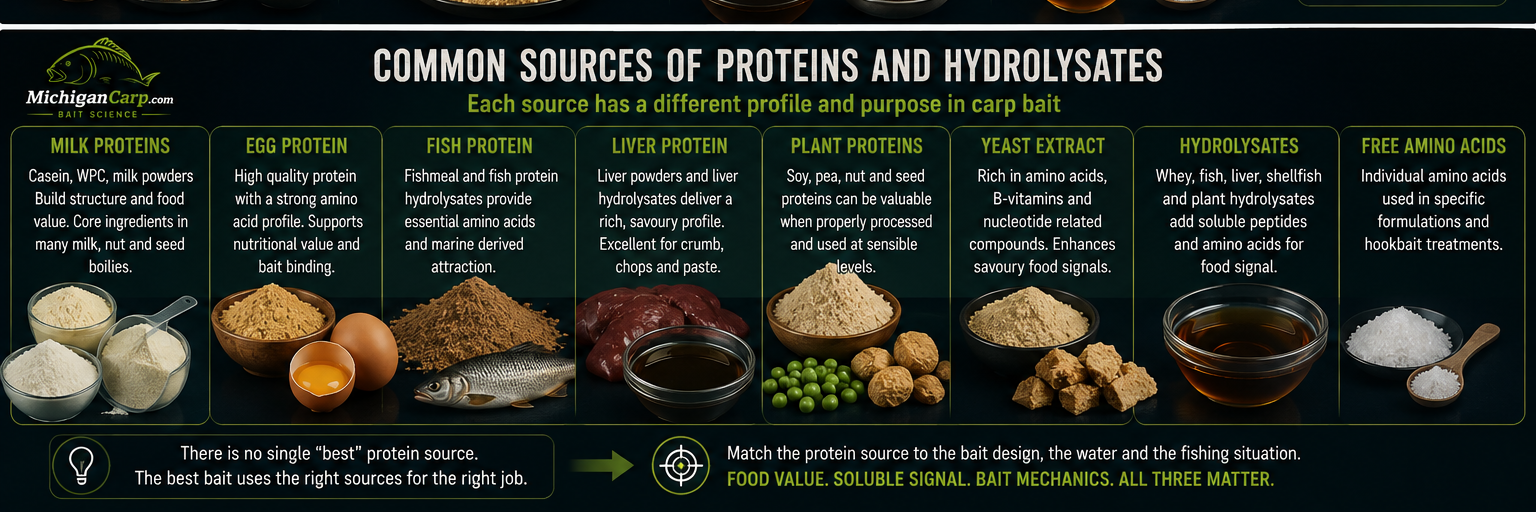
Hydrolysates are best judged by source and purpose.
Liver hydrolysate can provide a dark, savoury, animal-protein-derived profile. I like the logic of liver hydrolysate most in crumb, chopped boilies, paste, pellets, small traps and selected hookbait treatment. For homemade versions, beef liver remains my preferred starting point when I want a deeper, darker and richer profile, while chicken liver remains a practical alternative.
Fish protein hydrolysates fit naturally into fishmeal baits, pellet systems, savoury baits and marine profiles. I would use them where the profile fits the wider bait rather than adding them automatically to every formulation.
Shellfish hydrolysates can make sense in marine, mollusk-oriented or strong savoury bait profiles, but the presence of snails, mussels or shellfish-type natural food in a water does not prove that any shellfish liquid will automatically catch carp. The finished product still has to be judged on its own properties.
Whey protein hydrolysate can fit naturally into dairy-protein, milk and nut, or non-marine boilie systems. It should not be treated as a replacement for casein, WPC or milk powder because the roles are different. Intact milk proteins can build structure and food value, while a whey hydrolysate is more likely to be used as a smaller soluble-support fraction.
Plant protein hydrolysates may be useful in some feed and bait contexts, but the exact plant source, anti-nutritional background, taste, solubility and processing quality matter. Do not assume a plant hydrolysate is automatically clean, attractive or digestible just because it is hydrolyzed.
Where Yeast Extract Fits
Yeast extract deserves its own category.
It should not be casually bundled with every protein hydrolysate. Yeast extract is derived from yeast cells and may contain soluble yeast material, amino compounds, savoury compounds and nucleotide-related fractions depending on production method.
That makes it useful in many bait systems, especially milk baits, nut baits, cereal baits, birdfoods, crumb, paste and hookbait treatments.
The reason I separate it is simple: yeast extract can support a bait’s savoury food signal without pretending to be the same thing as liver hydrolysate, fish hydrolysate or whey hydrolysate.
For the yeast side of the bait-science library, use Yeast in Boilies and Nucleotides in Carp Bait.
Protein Choices in Milk, Nut and Seed Baits
Milk and nut baits are a good example of why this subject matters.
A non-marine milk, nut and seed boilie might use casein for structure and food value, WPC for dairy protein support, skimmed milk or milk replacer for broader dairy character, nut meals for energy and profile, birdfood for texture, and yeast extract or a low-level hydrolysate for extra soluble food character.
None of those ingredients needs to do every job.
That is the advantage of a layered formulation. The base mix builds the bait. The liquid or soluble fraction supports the bait. The hookbait treatment fine-tunes the local presentation.
For Robert’s milk-nut direction, I would keep hydrolysates controlled rather than dominant. A small amount of liver hydrolysate, whey hydrolysate or yeast-derived material can add useful depth, but it should not erase the clean milk, nut and birdfood structure that makes the bait different from a conventional fishmeal formula.
For the full base-mix article, use How to Formulate a Milk, Nut and Birdfood Boilie Base Mix. For dairy-ingredient choices, use Milk Powders in Boilie Making and Milk Replacer for Carp Bait: How to Read the Label.
Hookbait Logic and Freebait Logic
The hookbait and the free offerings do not need identical protein systems.
Freebait may need to provide food value, repeat feeding, consistency, practical cost and reliable water behaviour. A large baiting program built mainly around expensive hydrolysates makes little sense to me.
Hookbaits and the rig area can justify more targeted treatment because the quantity is smaller. Hydrolysate treatment, yeast extract, active crumb, paste wrap or soluble outer coating may all make sense when they help the immediate presentation.
The key is still mechanics.
A treatment that ruins hardness, buoyancy, balance, hookbait durability or rig behaviour is not an improvement. This is especially important with wafters, pop-ups, long sessions, nuisance fish and crayfish pressure.
For practical hookbait handling, use How to Prepare Boilies for Carp Fishing: Glugs, Soaks and Hookbait Conditioning and How to Make Wafters and Pop-Ups From a Boilie Base Mix.
Why Crumb and Chops Work So Well
Crumb and chopped boilies are one of the strongest practical uses for protein-derived liquids.
Breaking bait into smaller pieces increases exposed surface area. Water has more direct contact with the bait, shorter pathways into the material and more exposed edges. A suitable hydrolysate, yeast extract or food liquid can then distribute through crumb, chops or crushed pellets more effectively than it can escape from the middle of a hard, over-dried whole boilie.
This does not mean crumb creates impossible long-range attraction. It means a small amount of bait can create a more active local feeding area.
That is useful for short sessions, cool water, mobile fishing, small traps, travel-route fishing and rig-area enhancement.
For the physical mechanism, use Why Surface Area Matters in Carp Bait. For release behaviour, use Carp Bait Solubility and Leakage.
Short Sessions, Long Campaigns and Water Temperature
The role of proteins, peptides and hydrolysates changes with the fishing job.
On short sessions, I may put more emphasis on crumb, chops, small pellet traps, selected hydrolysate treatment, yeast extract and treated hookbaits. The aim is to make a small amount of bait work clearly without overfeeding.
On longer campaigns, I put more emphasis on food quality, intact protein sources, digestibility, energy balance, repeat feeding, consistency and economical baiting. Hydrolysates can still support the system, but they do not need to become the system.
In cold water, the biggest risk is often too much bait and too much complexity. A smaller amount of digestible bait with active crumb or targeted hookbait treatment can make more sense than a heavy feed bed.
In warmer water and longer sessions, real food value becomes more important because fish may eat more. The signal package should support the food, not replace it.
A Practical Layered Protein System
I think of protein-based bait design in four layers.
| Layer | What it does | Examples |
|---|---|---|
| Food backbone | Builds nutrition, structure and repeat feeding value | Milk proteins, egg, processed plant proteins, quality meals |
| Peptide or hydrolyzed support | Adds product-dependent smaller protein-derived fractions | Whey hydrolysate, liver hydrolysate, fish hydrolysate |
| Local soluble fraction | Supports crumb, chops, paste, pellets or hookbait treatment | Hydrolysates, yeast extract, CSL-style liquids, soluble food liquids |
| Presentation layer | Keeps the bait fishable and mechanically reliable | Texture, hardness, buoyancy, water life, rig balance |
The final layer matters more than people think. A brilliant protein system can still make a poor bait if it will not roll, cook, dry, cast, resist nuisance species or present correctly.
Technical ingredients must still produce practical fishing bait.
Michigan Notes
Protein, peptide and hydrolysate thinking fits Michigan carp fishing because many of our waters are large natural systems with abundant food sources such as weedbed invertebrates, mollusks, silt food, seeds, insect larvae and crayfish.
That does not mean every bait must imitate one natural food exactly. It means the bait must communicate locally while remaining worth eating repeatedly.
For spring and short sessions, I tend to emphasize bait form, crumb, chops and controlled hookbait treatment. For warmer feeding periods and longer sessions, I care more about food quality, digestibility, consistent baiting and a sensible protein-energy system.
On big waters, I do not want a bait that is only loud. I want a bait that can create local interest and still make sense when carp return and feed again.
Common Mistakes
| Mistake | Why it causes problems | Better practice |
|---|---|---|
| Chasing crude protein percentage | A high number does not prove digestibility, attraction or bait quality | Judge the complete formula |
| Treating peptides as one ingredient | Peptide size and chemistry differ | Judge the actual product |
| Assuming every hydrolysate leaks fast | Bait structure and product type control release | Test the finished bait in water |
| Using hydrolysates everywhere | Can become wasteful in bulk feed | Use them where they have a clear job |
| Treating every hydrolysate as equal | Source, process, concentration and carrier differ | Compare the label, product and result |
| Confusing yeast extract with hydrolysate | Yeast products have their own ingredient logic | Keep ingredient categories clear |
| Assuming free amino acids replace protein | Signal and nutrition are different jobs | Build both intentionally |
| Ignoring bait texture | Good chemistry can still make poor boilies | Protect rolling, cooking, drying and hookbait mechanics |
| Ignoring session type | A short spring session and a long summer campaign need different emphasis | Match the protein system to the fishing job |
Simple Rules for Protein-Based Bait Design
Use intact proteins to build the food package. Use peptide-rich ingredients only when the actual product justifies its role. Use hydrolysates with a clear purpose. Do not assume every hydrolysate behaves the same way. Do not confuse free amino acids with complete nutrition. Keep yeast products in their correct category. Match the soluble fraction to the session. Protect hookbait mechanics.
Most importantly, build the whole bait — not an impressive ingredient list.
My Practical View
Proteins, peptides, hydrolysates and free amino acids belong in the same conversation, but they are not interchangeable.
Whole proteins build food value and structure. Peptides are shorter protein-derived chains with properties that depend on their actual size and chemistry. Hydrolysates are mixtures created by protein breakdown. Free amino acids are individual compounds with their own sensory and formulation roles.
The best carp bait does not need to chase one extreme.
For my own bait thinking, I prefer real food underneath, a sensible soluble fraction where needed, and targeted stronger treatments only where they earn their place.
Do not ask whether protein or hydrolysate is better. Ask what the complete bait needs each protein form to do.
FAQ
What is the difference between a protein and a hydrolysate?
An intact protein contains larger protein structures. A protein hydrolysate is produced by breaking peptide bonds and may contain protein fragments, peptides and free amino acids.
Are peptides the same as free amino acids?
No. Peptides are chains containing two or more amino-acid residues. Free amino acids are individual amino acids not bound into peptide chains.
Are hydrolysates more soluble than whole proteins?
They can be, because hydrolysis can reduce molecular size and alter properties, but the result depends on the original protein, degree of hydrolysis, processing conditions and finished bait structure.
Are hydrolysates better than whole proteins?
No. They perform different jobs. Whole proteins can provide food value and structure, while hydrolysates can contribute smaller protein-derived fractions and targeted liquid applications.
Do I need hydrolysates in every carp bait?
No. Hydrolysates are optional tools. Use them when the formulation or fishing situation gives them a clear job.
Is liver hydrolysate good for carp bait?
It can be useful in crumb, chopped boilies, pellets, paste and targeted hookbait treatment. For homemade liver work, beef liver is my preferred starting point when I want a darker and richer profile.
Which hydrolysate suits a milk or nut bait?
Whey protein hydrolysate can fit a dairy-protein system. Yeast extract can add savoury depth. Low-level liver hydrolysate can provide a darker background layer. They are different ingredients with different roles.
Should hookbaits contain more hydrolysate than freebait?
They can. A small hookbait or crumb trap can justify more concentrated treatment than a large bulk baiting program, provided the treatment does not damage bait mechanics.
Is yeast extract a protein hydrolysate?
Not automatically. Yeast extracts and yeast hydrolysate products can be produced through different processes and should be judged by their actual production method and composition.
Do free amino acids replace protein in carp bait?
No. Free amino acids may have sensory and formulation roles, but they do not replace complete protein, energy, structure or balanced bait design.
Next Steps
- Carp Bait Digestibility — understand usable nutrition rather than crude-protein numbers.
- Carp Bait Solubility and Leakage — understand how bait releases food signals into water.
- What Hydrolysates Really Do in Carp Bait — go deeper into hydrolysate function and practical use.
- Do Enzymes and Phytase Really Improve Carp Bait? — separate active enzyme treatment from finished hydrolysates.
- Do Carp Detect Free Amino Acids the Way Anglers Think? — handle amino-acid attraction claims carefully.
- Free Amino Acids vs Intact Proteins in Carp Bait — compare signal and nutrition directly.
- How to Formulate a Milk, Nut and Birdfood Boilie Base Mix — apply protein-form decisions inside a working boilie formula.
- How to Prepare Boilies for Carp Fishing: Glugs, Soaks and Hookbait Conditioning — use protein-derived liquids without ruining the bait.
- Bait Science — browse the technical bait library.