
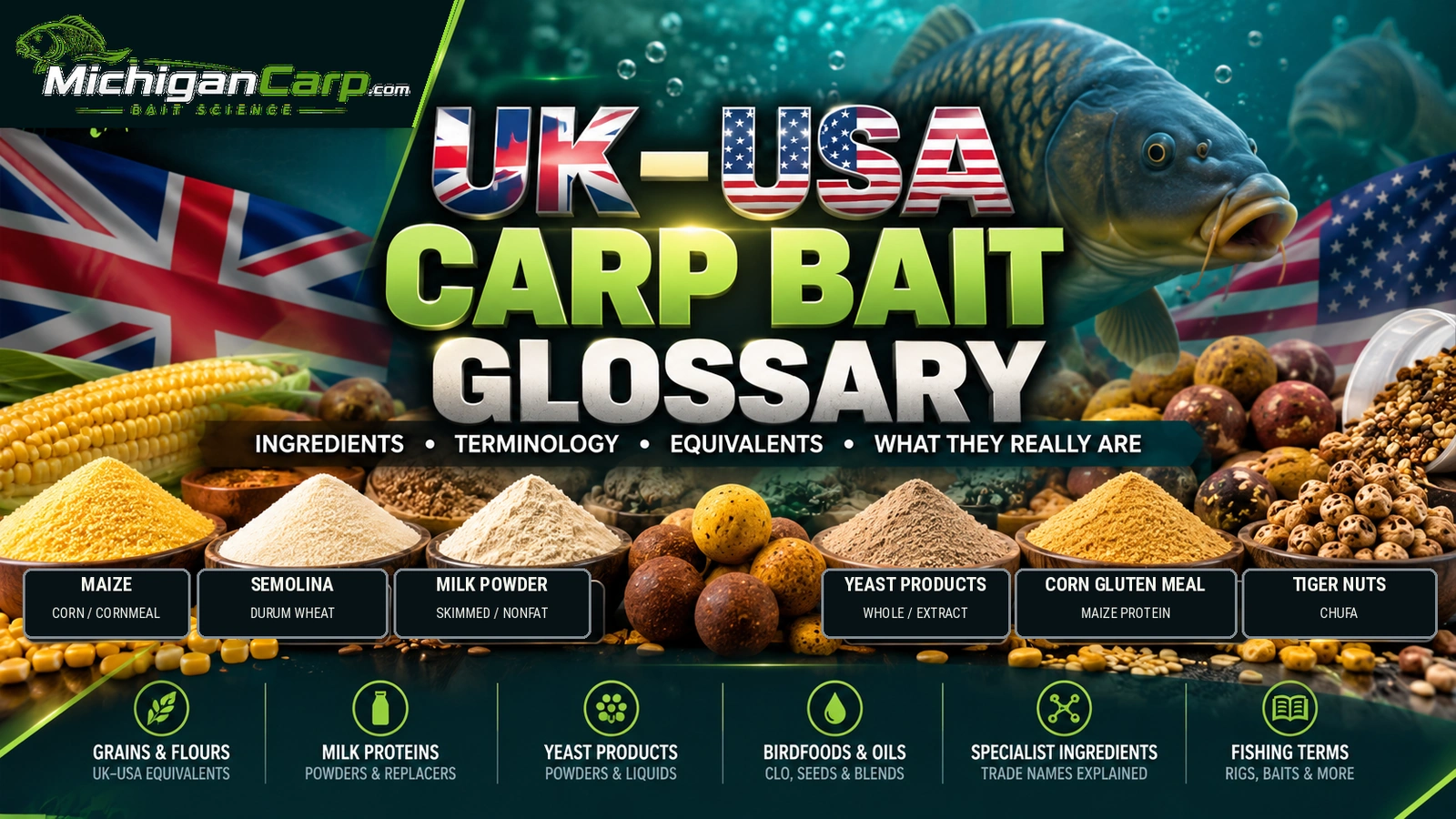
Making your own carp bait should not involve guessing what an ingredient is called in another country.
Yet American anglers following British boilie recipes regularly encounter unfamiliar terms: maize flour, soya flour, skimmed milk powder, gram flour, CLO, Brocacel, birdfood, milk replacers and specialist yeast products.
British anglers reading American recipes may encounter deer corn, chufa, cornmeal, cornstarch, nonfat dry milk, garbanzo flour and packbait.
Some products are effectively the same. Others have similar names but very different compositions.
The biggest mistakes often happen when two ingredients sound interchangeable but aren’t.
This UK–USA carp bait glossary is designed to help anglers understand the terminology, identify equivalent products and avoid expensive ingredient mistakes.
It also explains commonly encountered trade names. A specialist carp-bait label may describe a genuine, useful ingredient, but the name alone does not establish that it performs better than a correctly specified alternative.
Our approach is straightforward:
Know what the ingredient is. Understand what processing has changed. Decide what it contributes to the finished bait.
If you’re making your first boilies, begin with the Beginner Boilie Journey.
For the functions of different ingredients, read Boilie School BS-02: Boilie Ingredients Explained.
Table of Contents
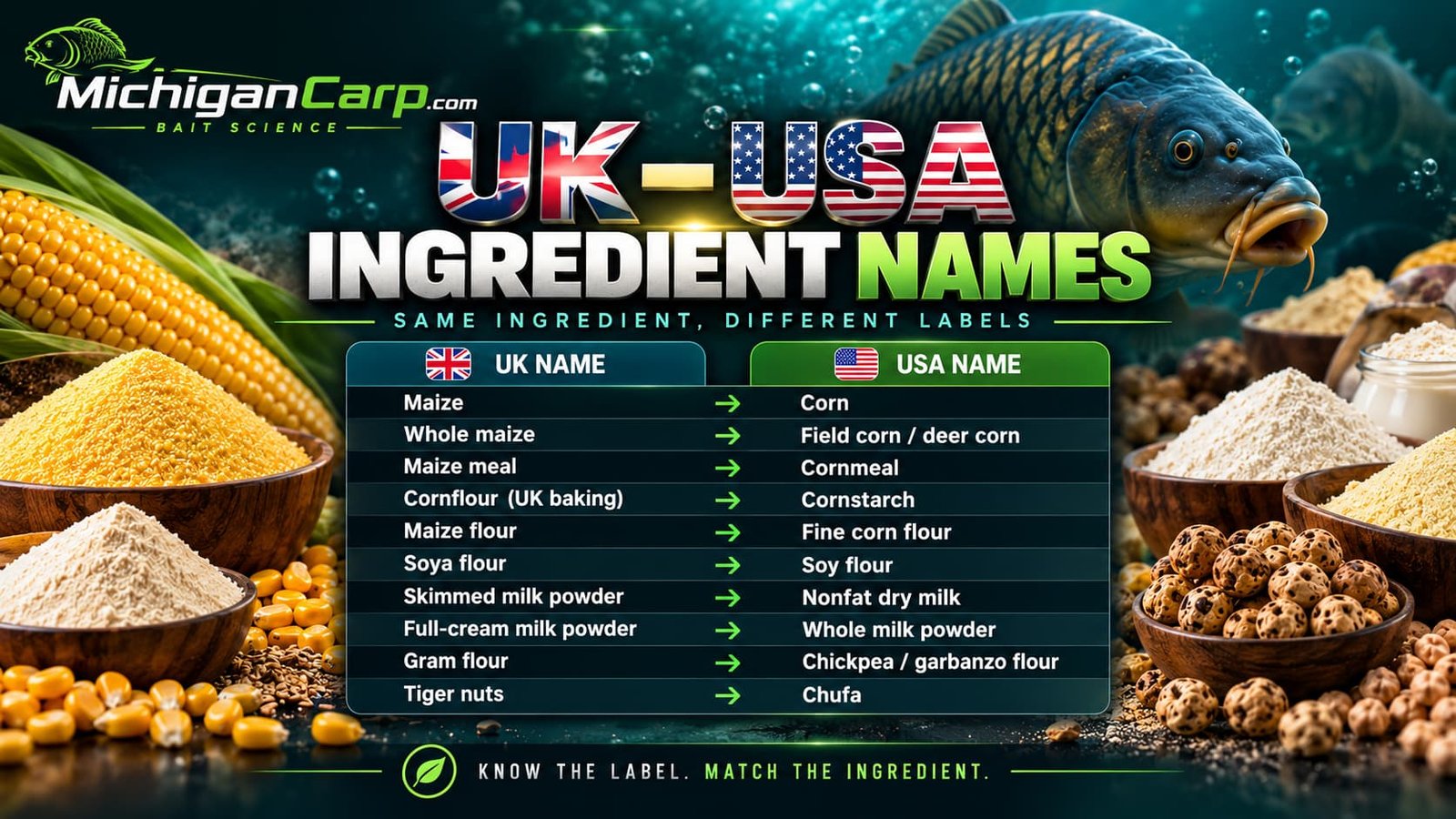
Quick Start: Common UK–USA Carp Bait Terms
| British term | American equivalent or related name |
|---|---|
| Maize | Corn |
| Whole maize | Field corn, deer corn |
| Maize meal | Cornmeal |
| Cornflour, in UK baking | Cornstarch |
| Maize flour | Finely ground corn flour |
| Soya flour | Soy flour |
| Skimmed milk powder | Nonfat dry milk |
| Full-cream milk powder | Whole milk powder, if genuinely dairy-based |
| Gram flour | Chickpea or garbanzo flour |
| Egg albumen | Dried egg white |
| Wheatgerm | Wheat germ |
| Maize gluten meal | Corn gluten meal |
| Tiger nuts | Chufa, sometimes chuffa |
| Glycerine | Glycerin |
| Flavours | Flavors |
| Groundbait | Groundbait; sometimes related to chum or packbait |
| Hooklink | Hooklength; sometimes a short leader |
| Birdfood | Specialist prepared birdfood, not necessarily birdseed |
This table is a starting point, not permission to substitute everything automatically.
Some equivalent names refer to the same basic material, while others identify broad ingredient categories containing several different products.
Always check the composition, processing method, fat content, protein level and physical form.
Flours, Maize and Structural Ingredients
Maize, cornmeal and corn flour
Maize is the familiar British term for corn, especially in traditional carp-bait recipes.
In America, corn is the everyday name, although maize is still used in agriculture and scientific literature.
Several products need distinguishing.
Maize meal / cornmeal: Ground dried corn, sold in fine, medium and coarse grades.
Maize flour / corn flour: Finely ground corn, often containing more of the original grain components than isolated starch.
Whole maize / whole field corn: Mature, dried corn kernels used in agriculture and animal feeding.
Cracked corn: Dried corn broken into smaller pieces, commonly sold as poultry or animal feed.
These ingredients differ in hydration, particle size and their effects on a boilie mix.
Fine corn flour may blend relatively smoothly into paste. Coarse cornmeal adds more texture and can alter rolling and binding.
For a more detailed comparison, see Flours, Grains and Meals for Carp Boilies.
Deer corn
Deer corn is an important American name for whole dried field corn, often sold in large bags for wildlife feeding.
It can be a practical source of whole maize where the product is untreated, sound and suitable for the intended purpose.
However, deer corn is not the same as canned sweet corn, and it isn’t ready-to-use carp bait simply because it comes in a feed bag.
Dried corn must be properly prepared before use as a particle bait.
Reject mouldy, damaged, suspect or chemically treated grain. Seed corn intended for planting may carry chemical treatments and must not be mistaken for ordinary feed corn.
The size of the bag and the low price do not replace checking product quality.
Cornflour versus cornstarch
This is one of the most important differences in the glossary.
In British cooking, cornflour usually means cornstarch.
In American terminology, corn flour usually means finely ground corn.
Those are different ingredients.
Cornstarch consists predominantly of refined starch. Finely ground whole corn contains other grain components, including some protein, fat and fibre.
Both may affect boilie texture, but they cannot automatically be exchanged gram-for-gram.
If a British boilie recipe calls for maize flour, an American angler should generally look for ground corn flour rather than cornstarch.
If a British baking recipe calls for cornflour as a thickener, American cornstarch is normally the equivalent.
Check the ingredient description rather than relying solely on the product name.
Polenta
Polenta is commonly sold as dry, medium- or coarse-ground maize.
In practical bait making, plain dry polenta may provide a similar cereal component to appropriately ground cornmeal.
However, polenta also describes the finished cooked dish.
Products labelled instant polenta, precooked polenta or ready-to-eat polenta may behave differently from ordinary dry maize meal.
Check the ingredients, particle size and whether the grain has been precooked.
A fine boilie mix may not behave identically when coarse polenta is substituted for fine maize flour.
Grits and masa harina
These American ingredients can cause confusion when British recipes are converted.
Grits generally refers to ground corn products, often relatively coarse. Some are produced from hominy, and processing varies.
Masa harina is corn flour made from nixtamalized maize. The corn has undergone alkaline processing, typically involving calcium hydroxide.
Masa harina is not simply ordinary maize flour with a Spanish name.
Nixtamalization changes the properties of the grain, including its hydration and handling behaviour.
Neither product is automatically unsuitable for bait making, but both should be treated as ingredients requiring their own small-batch testing.
Semolina and farina
Semolina is one of the most familiar structural ingredients in British boilie making.
It is traditionally produced from durum wheat and contributes to paste structure, rolling and the firmness of cooked boilies.
American stores may also sell farina, including wheat breakfast cereals.
Farina is related to semolina but is not necessarily made from the same wheat or processed to the same specification.
It can sometimes be tested as a substitute, but differences in grind, hydration and protein behaviour may alter the finished bait.
Where a recipe has been developed specifically around semolina, use genuine semolina when possible.
Soya flour and soy flour
Soya and soy are simply British and American forms of the name.
The more important distinction is the product itself.
Soy ingredients may be sold as:
- Full-fat soy flour.
- Defatted soy flour or meal.
- Toasted or heat-treated soy flour.
- Soy protein concentrate.
- Soy protein isolate.
- Textured soy ingredients.
These have different protein concentrations, fat contents and physical properties.
Full-fat flour introduces more oil than defatted flour. Concentrated soy proteins behave differently from ordinary flour.
Processing matters particularly with soybeans. Raw or insufficiently treated soybean ingredients can contain active antinutritional factors, including trypsin inhibitors.
A brief boil of finished boilies should not automatically be assumed to provide adequate processing of raw soybean flour.
See Raw vs Processed Ingredients in Carp Bait.
Gram flour, chickpea flour and garbanzo flour
British and Indian recipes often use gram flour or besan.
American grocery stores commonly use the terms chickpea flour or garbanzo bean flour.
These are closely related ingredient descriptions, although the chickpea variety, degree of dehulling and grind size can vary.
Gram flour contributes plant protein, starch and structural properties.
It is not ordinary wheat flour, and the word gram does not refer to a measurement of weight.
Wheatgerm, wheat bran and vital wheat gluten
These are three different wheat-derived ingredients.
Wheatgerm / wheat germ: The germ portion of wheat. It contains oils and nutrients and needs sensible storage because its fat fraction can deteriorate.
Wheat bran: The fibrous outer portion of the grain. It contributes texture and fibre but isn’t a direct replacement for wheat flour.
Vital wheat gluten: A concentrated wheat-protein product with strong elastic and binding properties.
Vital wheat gluten behaves very differently from wheat germ or wheat bran.
Maize Gluten Meal, Corn Gluten Meal and Commercial Ingredient Names
Maize gluten meal versus corn gluten meal
Maize gluten meal (UK) and corn gluten meal (USA) are names for the same broad class of protein-rich maize-processing ingredient.
Corn gluten meal is produced during maize wet-milling, when starch and other fractions are separated.
Feed products commonly contain approximately 60% or more crude protein, although specifications vary.
It is used in livestock, pet-food and aquaculture feeds and can also be incorporated into carp-bait formulations.
Corn gluten meal has an amino-acid profile different from milk protein, soy protein and fishmeal. High crude protein alone does not make proteins nutritionally interchangeable.
It may also contribute colour and affect paste characteristics.
Corn gluten meal versus corn gluten feed
These are not the same product.
Corn gluten meal is the more protein-concentrated ingredient.
Corn gluten feed contains a different combination of maize-processing fractions, including bran and steeping-related material.
Corn gluten feed typically contains far less crude protein than corn gluten meal.
Confusing them can substantially change the nutritional composition of a boilie base mix.
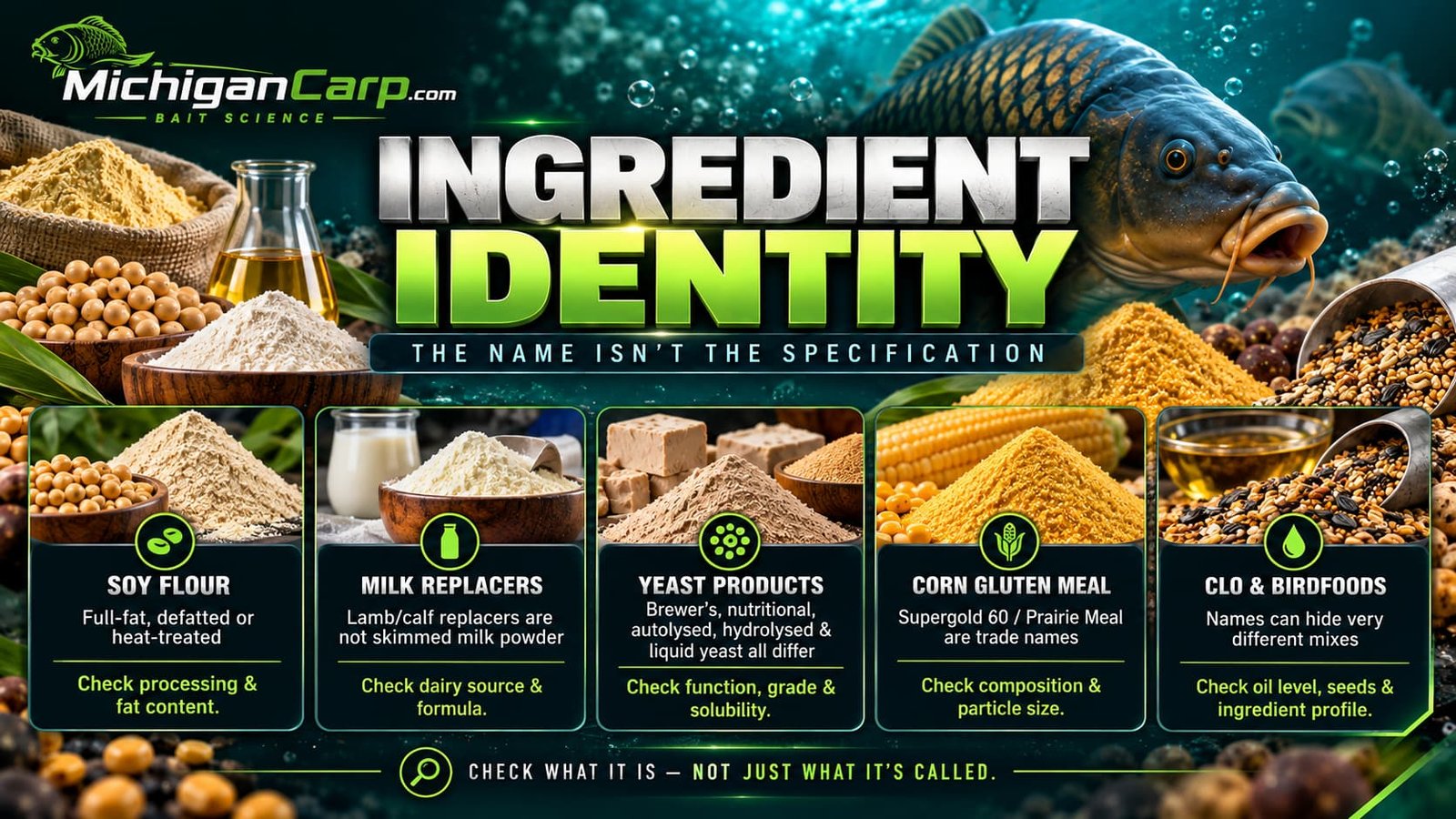
Supergold 60 and Prairie Meal
British carp-bait catalogues sometimes use names such as Supergold 60 or Prairie Meal for maize-derived protein ingredients.
Prairie meal is also a recognized feed-industry name associated with corn gluten meal.
However, a trade name should never be treated as a complete ingredient specification.
Check the manufacturer’s declaration of protein, fat, starch, moisture, processing and product identity.
A specialist carp-bait product may offer convenient pack sizes, consistent grading or additional quality control. Those can be legitimate reasons to purchase it.
They do not, by themselves, prove that the ingredient attracts more carp than a suitably specified alternative.
Corn gluten meal versus vital wheat gluten
Despite containing the word gluten, corn gluten meal is not equivalent to vital wheat gluten.
Vital wheat gluten is known for its elastic binding properties when hydrated.
Corn gluten meal does not form the same elastic network.
Replacing wheat gluten with corn gluten meal can therefore change the physical structure of a boilie considerably.
Tiger Nuts, Birdfoods and Prepared Particles
Tiger nuts, chufa and chuffa
Tiger nuts are familiar to British carp anglers but can be confusing to American readers.
In the United States, tiger nuts may be sold as chufa, occasionally spelled chuffa.
Wildlife-food-plot suppliers also use the phrase chufa seed.
Botanically, tiger nuts are not nuts or true seeds. They are underground tubers of Cyperus esculentus.
This distinction matters when purchasing the ingredient.
Chufa planting material may not have been prepared or marketed for use as fishing bait. Check for chemical treatments and other suitability issues.
For carp fishing, tiger nuts can be used as appropriately prepared whole particles or processed into flour.
Tiger-nut flour is not interchangeable with almond flour, peanut flour or ordinary nut meal.
Birdfood versus birdseed
This is one of the most frequently misunderstood terms in British boilie making.
Birdfood, in a British bait recipe, may mean a specially manufactured bird-rearing food or a prepared mixture containing cereals, seeds, egg products, oils and other components.
Birdseed in the United States usually means a seed mixture sold for feeding wild or captive birds.
Those products can have very different compositions.
Replacing a British birdfood ingredient with an arbitrary bag of American wild-bird seed may change the binding, texture, oil content and nutritional profile of the bait.
The correct approach is to examine what the original birdfood actually contains.
CLO — Cod Liver Oil
CLO stands for Cod Liver Oil, but in traditional British boilie making it also identifies a prepared birdfood ingredient containing cod liver oil.
This is an important distinction.
Haith’s CLO is a dry birdfood-based product containing cereals and other ingredients alongside cod liver oil.
It is not simply a bag of powdered pure cod liver oil.
CLO-style birdfoods can provide texture, cereal material, oils and other components, but different manufacturers’ formulations may vary.
Do not substitute pure liquid cod liver oil for a dry CLO birdfood at the same weight.
Sluis CLO, Nectarblend and prepared birdfoods
Sluis CLO and Nectarblend are names associated with prepared birdfood products used in carp-bait making.
These are blends rather than single raw materials.
Their actual composition matters more than the familiar name.
In the American market, a prepared bird-rearing food with a comparable ingredient profile may sometimes be more appropriate than ordinary wild-bird seed.
For the full explanation, see Birdfood for Carp Boilies: CLO, Nectarblend and Seed Blends.
Hempseed and hemp hearts
British anglers commonly use whole hempseed as a cooked particle.
American grocery stores often sell hemp hearts, meaning hulled hempseed kernels.
These products differ in physical form and texture.
Hulled hemp is not identical to whole hempseed prepared as a particle. Both may have uses in bait making, but they should be evaluated separately.
Milk Powders, Milk Replacers and Dairy Proteins
Skimmed milk powder and nonfat dry milk
British skimmed milk powder broadly corresponds to American nonfat dry milk.
Both provide milk solids with most milk fat removed.
They contribute milk proteins, lactose and minerals.
However, product specifications and processing can differ, particularly between instant and non-instant grades.
They are useful general dairy ingredients but should not be mistaken for concentrated casein or whey protein isolate.
Full-cream milk powder and whole milk powder
British recipes may call for full-cream milk powder.
The closest general American equivalent is whole milk powder.
Genuine whole milk powder contains the natural milk components, including substantial milk fat.
But there’s an important complication.
Some products sold to bait makers under names such as full-fat milk powder are actually fat-filled dairy powders, combining whey-derived ingredients with added vegetable fats.
These are not nutritionally equivalent to ordinary whole milk powder.
A fat-filled whey product may contain considerably less protein and more fat than genuine whole milk powder.
Neither product is automatically unsuitable for carp bait. They simply have different compositions.
Always read the actual specification rather than assuming the product name guarantees pure whole milk solids.
Lamb milk replacer and Lamlac
Lamb milk replacer is a formulated livestock-feed product intended to replace or supplement milk for young lambs.
Lamlac is a commercial name associated with lamb milk-replacer products.
Formulations may contain whey proteins, other dairy ingredients, fats, vitamins, minerals and additional components.
Protein and fat levels vary considerably.
Lamb milk replacer is not the same as skimmed milk powder, whole milk powder, casein or WPC80.
Its suitability for any bait formulation depends on the exact product.
Never use medicated milk replacer in carp bait.
Also check the intended use, full ingredient declaration, freshness and any treatments or warnings. A non-medicated label alone does not establish suitability for introduction into a fishery.
Calf milk replacer and CalfLac
Calf milk replacer is formulated for young cattle.
CalfLac is a commercial product name encountered in British bait-making and animal-feed circles.
Calf milk replacers can contain milk-derived proteins, added fats, lactose, minerals, vitamins and other feed ingredients.
Some products use alternative protein sources, including processed plant proteins.
Two products both described as calf milk replacers may have very different nutritional specifications.
For bait formulation, compare their actual composition rather than treating all replacers as a single ingredient.
The front of the bag is not enough. Check the complete feed label.
For a detailed explanation, read Milk Replacer for Carp Bait: How to Read the Label.
Whey powder, WPC35, WPC80 and WPI
Whey ingredients are sold in several forms.
Ordinary whey powder: Contains whey proteins alongside substantial lactose and minerals.
Whey protein concentrate (WPC35): A whey concentrate commonly containing around 35% protein.
Whey protein concentrate (WPC80): A higher-protein concentrate commonly containing approximately 80% protein.
Whey protein isolate (WPI): A more highly refined whey protein ingredient, generally containing very high protein levels with comparatively little lactose and fat.
These are not gram-for-gram substitutes.
Replacing WPC80 with ordinary whey powder can substantially reduce the protein contribution and increase the lactose fraction.
Casein, caseinate and micellar casein
Casein is a major milk-protein family.
Common bait-making products include acid casein, rennet casein, micellar casein, sodium caseinate and calcium caseinate.
These differ in manufacture, dispersion, functional properties and their behaviour in bait paste.
Sodium caseinate generally disperses more readily in water than many traditional casein powders.
A caseinate is not automatically interchangeable with acid casein merely because both are milk proteins.
See Milk Powders in Boilie Making for the wider dairy comparison.
Egg albumen and dried egg white
British bait makers commonly use the term egg albumen.
In American ingredient catalogues, it may be sold as dried egg white powder.
Egg albumen is not the same as whole egg powder.
It contains concentrated egg-white proteins and can contribute to binding and cooked-bait structure.
Using whole egg powder instead changes the fat and protein composition.
Fishmeal, Hydrolysates and Processed Feed Ingredients
Fishmeal and LT fishmeal
Fishmeal is a broad category of processed fish-derived meals.
Products differ in species, freshness, fat, ash, protein quality and manufacturing method.
British bait catalogues often use the term LT fishmeal, meaning low-temperature-processed fishmeal.
Low-temperature processing is intended to protect aspects of ingredient quality, but the term alone does not establish a standardized composition or superior carp attraction.
Always compare actual specifications.
Fish protein hydrolysate
A fish protein hydrolysate has undergone processing that breaks some proteins into smaller peptides and related soluble fractions.
A hydrolysate is not simply finely ground fishmeal.
The degree of hydrolysis, raw material and processing method determine the final composition.
Concentrated powdered hydrolysates should not be assumed equivalent to diluted liquid products.
CPSP90
CPSP90 is a trade name associated with a specialist fish protein hydrolysate.
It is not a generic name for every soluble fish protein.
When evaluating products sold under specialist trade names, check the exact grade, composition and manufacturer’s specification.
A product may offer valuable processing characteristics without proving exceptional carp-catching performance.
Micronized grains
British bait catalogues frequently list micronized maize, wheat, barley or peas.
Micronizing involves a controlled heat-treatment process, often associated with infrared heating, followed by suitable processing.
The aim is to change physical or nutritional properties, including starch behaviour.
Micronized maize isn’t simply another name for raw cornmeal.
Whether it improves a particular bait depends on the ingredient’s actual specification and intended role.
Yeast Products: What Are You Actually Buying?
Yeast is one of the most useful—and most confusing—ingredient families in carp-bait making.
Brewer’s yeast, nutritional yeast, autolysed yeast, hydrolysed yeast, yeast extract, yeast cultures and liquid yeast formulations are frequently discussed as though they were interchangeable.
They are not.
The differences involve both what material is present and what processing has been applied.
This glossary provides the essential distinctions. For the detailed bait-science explanation, read Yeast and Fermented Additives in Carp Bait.
Brewer’s yeast
Brewer’s yeast is commonly derived from Saccharomyces cerevisiae associated with brewing.
For bait making it is usually supplied as an inactivated, dried product.
It can provide protein, amino acids, B vitamins, minerals and yeast cell-wall components.
The exact nutritional composition varies with the source and manufacturing process.
Brewer’s yeast is a useful general-purpose ingredient, but its presence does not automatically establish strong attractant properties.
Nutritional yeast
Nutritional yeast is generally inactivated yeast sold as a human food ingredient.
It is relatively easy to obtain in America.
Some products are fortified with added vitamins, while others are unfortified.
Its broad nutritional role may overlap with brewer’s yeast, but the ingredients, processing and final composition should be checked.
Autolysed yeast
Autolysed is the British spelling; autolyzed is the common American spelling.
Autolysis involves the controlled breakdown of yeast cells through enzymes naturally present in the yeast.
This can change the balance of intact cell material and soluble components.
An autolysed yeast product may contain both soluble and insoluble fractions.
It should not automatically be treated as identical to pure yeast extract.
Hydrolysed yeast
Hydrolysed yeast has undergone a process intended to break down yeast components.
Depending on the process, hydrolysis may produce smaller peptides and more readily soluble material.
However, the word hydrolysed does not identify one standardized product.
Different manufacturers may produce very different fractions.
Yeast extract
Yeast extract is a processed ingredient derived from yeast cells.
Commercial manufacturing generally involves cell disruption and separation of soluble components from much of the insoluble material.
Depending on the product, yeast extract may contain amino acids, peptides, glutamate, nucleotides and other soluble compounds.
It is different from simply adding ordinary brewer’s yeast to water.
A concentrated yeast extract may contribute a different sensory and soluble profile from whole dried yeast.
But that does not establish that it catches more carp.
Yeast cell-wall products
Some specialist yeast ingredients concentrate cell-wall fractions, including beta-glucans and mannans.
These materials have attracted interest in animal nutrition, especially for digestive and immune-related applications.
They are not equivalent to ordinary brewer’s yeast or a concentrated savoury yeast extract.
Claims relating to gut health or livestock performance should not be treated as evidence of immediate wild-carp attraction.
Brocacel
Brocacel is a commercial deactivated yeast culture produced from Saccharomyces cerevisiae.
Its manufacturer describes a purpose-produced yeast product containing protein, yeast-cell components, nucleotides, glutamate-related material and vitamins.
It is not simply a branded yeast extract.
Its underlying biological source overlaps with ordinary brewer’s yeast, although production conditions and composition differ.
Brocacel may be a legitimate specialist feed ingredient.
However, its trade name and nutritional composition do not establish that it produces a stronger feeding response in wild carp than a properly selected brewer’s yeast.
Springer Reveal
Springer Reveal is a range of human-food-grade yeast-derived ingredients produced by Biospringer, not one single standardized powder.
The range includes dried inactive yeasts, autolysed dried yeasts and yeast extracts.
Some grades also contain additional ingredients.
Therefore, the words Springer Reveal alone are insufficient to determine composition or a sensible inclusion level.
The exact grade or product code must be identified.
It is particularly important not to substitute a concentrated yeast extract for an ordinary inactive dried yeast at the same weight.
Celmanax Liquid
CELMANAX Liquid is a formulated yeast-derived animal-nutrition product, not simply liquid brewer’s yeast.
An ARM & HAMMER manufacturer’s technical sheet identifies hydrolyzed yeast, yeast extract, yeast culture, acetic acid, xanthan gum and colour as ingredients.
The sheet specifies a minimum crude-protein content of 6% and a maximum moisture content of 82%.
The mixture is therefore very different from a dry yeast powder or a pure concentrated yeast extract.
The manufacturer’s animal-feeding rates are not carp-bait inclusion recommendations.
Its use in a fishing bait would require separate consideration of the exact product, its intended application, composition and suitability. There is no established optimal Celmanax inclusion rate for recreational carp boilies.
Liquid yeast products
There is no single standard composition for products marketed to anglers as liquid yeast.
A product may contain diluted yeast extract, autolysed yeast, hydrolysed yeast, fermentation material, suspended yeast solids or a mixture with other liquid carriers.
Two products can share the label liquid yeast while having very different concentrations and compositions.
Before comparing products, check:
- Whether the material is whole yeast, extract, hydrolysate or a blend.
- The water or moisture content.
- Protein and soluble-solids information, where supplied.
- Preservatives, acids, salt and other additions.
- Whether it is intended for food, feed or another use.
- Appropriate storage and stability information.
Do not use a universal millilitre-per-kilogram rule for every liquid yeast product.
Yeast spreads: Marmite and Vegemite
Marmite and Vegemite are yeast-extract-based food spreads.
They are not simply pure yeast extract.
They contain additional ingredients, including substantial salt and other flavouring or nutritional components depending on the formulation.
They can be considered as formulated food ingredients, but they are not directly interchangeable with dry brewer’s yeast or a standardized yeast extract concentrate.
CSL — Corn Steep Liquor
CSL is an especially important term to clarify.
CSL stands for corn steep liquor. It is not yeast extract.
It originates from the maize wet-milling process and contains a mixture of soluble corn-derived materials and fermentation-related components.
Commercial CSL products differ in concentration and composition.
Angling liquids marketed as CSL may also contain additional ingredients.
CSL and yeast extract can both contribute soluble material, but they have different origins and compositions.
Yeast product comparison
| Product | Main identity | Key caution |
|---|---|---|
| Brewer’s yeast | Usually dried inactive whole yeast | Grade and composition vary |
| Nutritional yeast | Food-grade inactive yeast | May be vitamin-fortified |
| Autolysed yeast | Enzyme-broken-down yeast | May retain insoluble material |
| Hydrolysed yeast | Processed yeast fractions | Degree of hydrolysis varies |
| Yeast extract | Concentrated soluble yeast components | Not equivalent to whole yeast |
| Brocacel | Deactivated yeast culture | Not proven a superior carp attractant |
| Springer Reveal | Family of different yeast grades | Exact product code required |
| Celmanax Liquid | Formulated yeast-derived feed liquid | Not ordinary liquid yeast |
| Marmite | Yeast-extract-based spread | Contains other ingredients and salt |
| CSL | Corn-derived processing liquid | Not a yeast product |
The important lesson is straightforward:
Different processing can create genuinely different ingredients. Different branding alone does not prove better bait performance.
Other Liquids, Sweeteners and Additives
Glycerine and glycerin
These are alternative spellings for glycerol.
Glycerin is used in food processing and bait making as a humectant and liquid carrier.
However, product purity matters. Do not assume that every industrial or cosmetic-grade product is appropriate for bait preparation.
Propylene glycol
Propylene glycol is a separate compound from glycerin.
It may be used as a solvent, carrier and humectant in appropriate applications.
It is not chemically identical to glycerin, and its physical properties differ.
Use clearly identified material suitable for the intended application.
Molasses and black treacle
Molasses is familiar in both countries.
British anglers may also encounter black treacle.
These dark syrups can have similar practical uses, but their composition and consistency vary.
Blackstrap molasses is not necessarily equivalent to ordinary molasses or black treacle.
Golden syrup and corn syrup
Golden syrup is familiar in British baking, while corn syrup is widely available in America.
They are both carbohydrate syrups but may have different sugar profiles, flavour and viscosity.
Neither should be assumed identical to high-fructose corn syrup.
Flavours and flavors
This is principally a spelling difference.
However, different flavour products can have very different strengths and carriers.
Water-soluble, oil-based, alcohol-based and emulsified flavours may behave differently in a bait.
The name of the flavour is not enough to establish its composition or effectiveness.
For the wider discussion, see Carp Bait Flavours: The Science, the Myths and What Really Matters.
Fishing, Feeding and Rig Terminology
Swim
In British carp fishing, a swim is the fishing position or area an angler occupies.
American anglers often refer to the fishing spot, location or bank position.
It does not mean a designated swimming area.
Bank fishing and shore fishing
British anglers commonly use bank fishing.
American anglers may use shore fishing or bank fishing.
Both describe fishing from land rather than from a boat.
Groundbait, chum and packbait
These terms overlap, but they aren’t identical.
Groundbait: A mixture introduced to attract or hold fish in an area. It may be loose, formed into balls or used with feeders.
Chum: A broad American term for bait material introduced to attract fish.
Packbait: A mixture commonly used in American carp fishing, designed to be packed around suitable tackle and then break down in water.
Packbait may serve a similar purpose to some groundbaits, but its binding and breakdown behaviour can differ.
Particles
In carp fishing, particles usually means properly prepared grains, seeds, pulses and similar individual food items.
Examples include maize, hempseed and tiger nuts.
Preparation requirements differ. Never assume that all dry feed grains or seeds are safe and ready to introduce without treatment.
Free offerings, freebies and hookbaits
Free offerings or freebies: Bait introduced without a hook.
Hookbait: The bait presented on the rig, including boilies, particles, wafters and pop-ups.
A boilie can be used successfully as a hookbait without introducing large quantities of loose boilies.
The role of a hookbait is not necessarily the same as that of the wider feeding bait.
Boilie stringer and PVA bag
A boilie stringer is a short arrangement of boilies attached using water-soluble PVA string or tape.
A PVA bag contains bait around or near the rig, depending on the setup.
Both can introduce a limited quantity of bait close to the hookbait.
Bottom bait, pop-up and wafter
Bottom bait: A bait designed to rest on the lakebed.
Pop-up: A buoyant hookbait that can suspend a presentation above the bottom.
Wafter: A hookbait whose buoyancy helps counterbalance the weight of the hook and rig.
A wafter doesn’t necessarily float on its own. Its behaviour must be checked with the intended hook and presentation.
Hooklink, hooklength and leader
A British hooklink is the rig section connecting the hook to the rest of the tackle.
Hooklength is another related term.
In American terminology, leader is sometimes used more broadly.
Specialist carp anglers distinguish hooklinks from shock leaders, abrasion leaders and other leader systems because they serve different purposes.
Do not assume they are interchangeable.
Hair rig
A hair rig presents the bait on a short attachment extending from the hook.
It is a standard technique in modern carp fishing, familiar to British anglers and increasingly used in the United States.
Chod rig, Ronnie rig and spinner rig
These are specialist British-origin carp-rig names commonly encountered in advanced rig discussions.
Chod rig: A specialized presentation using a short, stiff hook section, commonly for certain difficult-bottom or pop-up situations.
Ronnie rig / spinner rig: Related presentations designed around a rotating hook arrangement, commonly used with pop-ups.
Specific components and safe construction matter more than the trade or nickname applied to a rig.
For detailed explanations, use the MichiganCarp.com Rigs guides rather than relying on terminology alone.
British Carp-Bait Trade Names: What They Actually Mean
Trade names can be useful shortcuts for experienced bait makers, but they can also conceal important differences.
| Name | Ingredient category | What to check |
|---|---|---|
| Sluis CLO / Haith’s CLO | Prepared birdfood containing cod liver oil | Full composition, oil content |
| Nectarblend | Prepared birdfood blend | Cereal, seed and other ingredients |
| Supergold 60 | Maize protein ingredient | Corn gluten meal specification |
| Prairie Meal | Common feed name for corn gluten meal | Actual protein and product grade |
| Lamlac | Lamb milk replacer product | Protein, fat, medication, additives |
| CalfLac | Calf milk replacer product | Exact formulation and label |
| Brocacel | Deactivated yeast culture | Manufacturer specification |
| Springer Reveal | Range of yeast-derived food ingredients | Exact grade and product code |
| Celmanax Liquid | Formulated yeast-derived animal-feed liquid | Full ingredient statement |
| CPSP90 | Specialist fish protein hydrolysate | Exact grade and composition |
These names should help identify what a recipe author intended.
They should not automatically become recommendations to buy a particular brand.
A measurable specification is more useful than an impressive product description.
Measurements and UK–USA Recipe Conversions
Weight-based measurements make boilie recipes easier to reproduce.
| Measurement | Approximate equivalent |
|---|---|
| 1 kilogram | 1,000 grams |
| 1 pound | 454 grams |
| 1 ounce by weight | 28.35 grams |
| 1 US fluid ounce | 29.57 millilitres |
| 1 imperial fluid ounce | 28.41 millilitres |
| 1 US cup | 237 millilitres |
| 1 US gallon | 3.79 litres |
| 1 imperial gallon | 4.55 litres |
| 10°C | 50°F |
| 20°C | 68°F |
| 100°C | 212°F |
American cups measure volume, not weight.
A cup of cornmeal, a cup of milk powder and a cup of semolina may have different weights.
For consistent boilie formulations, measure dry ingredients in grams and record the liquid ingredients carefully.
Common Ingredient Substitution Mistakes
| Original ingredient | Common mistake | Better approach |
|---|---|---|
| Maize flour | Buying cornstarch | Use actual ground corn flour |
| Deer corn | Assuming it is ready-to-feed sweet corn | Check the feed and prepare properly |
| Fine maize meal | Buying coarse grits | Match the grind |
| Semolina | Assuming every farina product is identical | Check wheat type and texture |
| Full-fat soya flour | Buying raw or unidentified soy flour | Verify processing and fat content |
| Corn gluten meal | Buying corn gluten feed | Check protein specification |
| Vital wheat gluten | Substituting corn gluten meal | Recognize their different binding roles |
| Tiger nuts | Buying treated chufa planting material | Verify untreated, suitable tubers |
| CLO birdfood | Buying pure cod liver oil | Distinguish dry blend from liquid oil |
| Full-cream milk powder | Buying fat-filled whey without checking | Read the composition |
| WPC80 | Replacing it with ordinary whey powder | Compare actual protein concentration |
| Lamb or calf milk replacer | Assuming all products are equivalent | Read the complete feed tag |
| Egg albumen | Buying whole egg powder | Use dried egg white |
| Brocacel | Assuming it is yeast extract | Identify the yeast type |
| Springer Reveal | Assuming every grade is the same | Find the product code |
| Celmanax Liquid | Treating it as plain liquid brewer’s yeast | Read the complete specification |
| CSL | Calling it yeast extract | Recognize its corn-processing origin |
A substitute may still work even when it is not identical.
The sensible approach is to understand the differences, decide whether they matter in the intended formulation and test a small batch.
Buying Carp-Bait Ingredients in the United States
One of the advantages of making homemade boilies is that many basic ingredients are widely available.
For first-time bait makers, ordinary grocery stores are often enough.
Examples include semolina, cornmeal, flour, oats, nonfat dry milk, eggs, honey and molasses.
International grocery stores may offer gram flour, rice flour, semolina and other cereals.
Health-food and baking suppliers may stock wheat germ, dried egg white and specialist flours.
Feed stores can provide access to agricultural materials, but additional care is required.
Agricultural or livestock products may differ from food-grade materials in their intended use, handling, chemical treatments, contaminants and labelling.
Before using an ingredient, identify it properly and check that it is appropriate for introduction into the fishing environment.
Never use chemically treated planting seed or medicated livestock feed as carp bait.
Specialist ingredients such as refined milk proteins, hydrolysates and standardized yeast extracts may require dedicated suppliers.
And there’s an important purchasing lesson.
A larger bag is not automatically a bargain when shipping, storage, freshness and the quantity actually needed are considered.
For a beginner, four easily sourced ingredients may be more valuable than twelve expensive ones.
For experienced bait makers, specialist ingredients may be justified when they provide a clearly understood function.
Frequently Asked Questions
Is British cornflour the same as American corn flour?
No. British cornflour generally means American cornstarch, whereas American corn flour generally refers to finely ground corn.
What is deer corn called in Britain?
The closest everyday carp-fishing term is whole maize or field maize. Product quality and preparation must still be checked.
Are tiger nuts and chufa the same thing?
Yes. Chufa is another common name for the tiger-nut plant and its tubers. Products sold as chufa seed may actually be planting tubers.
What does CLO mean in carp bait?
CLO stands for Cod Liver Oil. In British boilie making, it also refers to a prepared dry birdfood blend containing cod liver oil, not simply the pure oil itself.
Is Supergold 60 different from corn gluten meal?
Supergold 60 is a specialist commercial maize-protein product. Corn gluten meal is the underlying feed-ingredient class. Compare actual specifications rather than assuming the branded product is automatically superior.
Can I use calf milk replacer in boilies?
A clearly identified, suitable non-medicated product may be considered as a formulation ingredient. Its complete composition and fat contribution must be evaluated. Never use medicated milk replacer.
Is whole milk powder the same as full-fat milk powder?
Not always. Genuine whole milk powder is a dairy product containing milk fat. Some products marketed as full-fat milk powder are fat-filled whey blends with added vegetable oils.
Is Brocacel the same as brewer’s yeast?
Both are yeast-derived ingredients, but Brocacel is a purpose-produced deactivated yeast culture. The differences should be assessed from the manufacturer’s specification rather than the brand name alone.
Is Springer Reveal a yeast extract?
Some Springer Reveal grades are yeast extracts, while others are dried inactive or autolysed yeast products. The exact product code is necessary.
Is Celmanax Liquid simply liquid yeast?
No. It is a formulated yeast-derived animal-feed liquid containing several yeast fractions and other ingredients.
Is CSL a yeast product?
No. CSL stands for corn steep liquor and originates from maize processing.
Do expensive specialist ingredients catch more carp?
Not necessarily. Some specialist ingredients offer genuine differences in composition, refinement or consistency. Those properties do not automatically prove better feeding response or greater catches.
Does a beginner need specialist additives to make boilies?
No. A beginner can learn to make workable boilies using a simple, understandable base mix.
The first objective should be to produce a bait that mixes, rolls, cooks, dries, stores and behaves predictably in water.
Next Steps: From Ingredient Names to Better Bait Making
This glossary is designed to help anglers identify ingredients correctly.
It does not replace the detailed science, formulation and manufacturing guides.
Continue with:
- Beginner Boilie Journey — start making your own boilies with confidence.
- Boilie School BS-02: Boilie Ingredients Explained — understand ingredient functions.
- Flours, Grains and Meals for Carp Boilies — compare grains, cereals and structural ingredients.
- Birdfood for Carp Boilies — understand CLO, prepared birdfoods and seed blends.
- Milk Powders in Boilie Making — compare dairy ingredients.
- Milk Replacer for Carp Bait — learn to read livestock feed labels.
- Raw vs Processed Ingredients in Carp Bait — understand what processing actually changes.
- Yeast and Fermented Additives in Carp Bait — explore whole yeast, autolysis, extracts, liquids and CSL.
- Homemade Yeast Extract for Carp Bait — understand homemade yeast autolysates and their limitations.
- Boilie School BS-05: Making Boilies Step by Step — turn ingredients into a finished bait.
- Michigan Carp Guide Library — find the full collection of guides.
Technical Reference Sources
For readers who want to examine ingredient specifications and manufacturing descriptions:
- Feedipedia — Corn Gluten Meal
- Haith’s — CLO (Cod Liver Oil)
- Biospringer — Springer Reveal
- E.F.S. Holland — Brocacel
- ARM & HAMMER Animal Nutrition — Celmanax Liquid Technical Sheet
These references help establish product identity and composition. They do not constitute independent evidence that any named ingredient improves wild-carp catch rates.
Whether you’re following a British recipe in Michigan or an American recipe in Britain, the principle remains the same:
Know your bait. Understand your ingredients. Fish with confidence.