

Boilie ingredients explained
Boilie ingredients explained properly are not a list of magic powders.
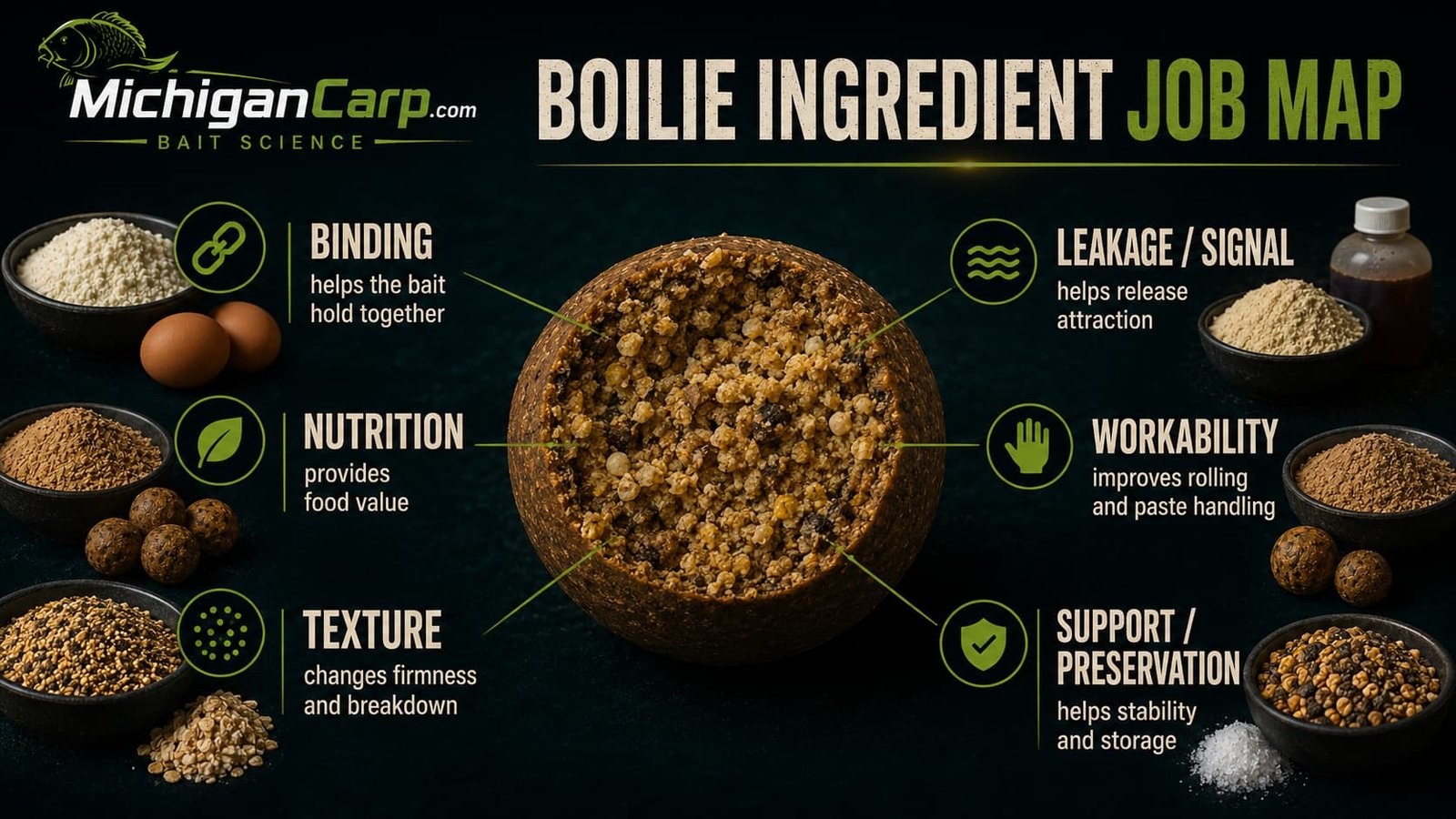
A boilie recipe is a set of jobs. Some ingredients help the bait roll. Some bind it. Some provide protein. Some bring fat. Some create texture. Some dissolve or disperse into the water. Some control hardness, drying, leakage, cost, storage or repeatability.
That is why beginners get confused. They see recipes full of fishmeal, milk powder, semolina, birdfood, tiger nut flour, yeast, hydrolysate, oils, flavours and sweeteners, then assume every ingredient is there because it is a secret attractor.
Most of the time, that is the wrong way to look at bait.
A good boilie ingredient earns its place because it performs a job inside the complete formula.
Boilie School BS-02 explains those jobs. This is not a recipe page and it is not the full bait-science library. It is the ingredient-role lesson that sits between BS-01: Boilie Basics and BS-03: Boilie Base Mix Families.
For finished practical formulas, use Nut Boilie Base Mix Recipes. For section-based formulation, use How to Formulate a Milk, Nut and Birdfood Boilie Base Mix. For reading commercial ingredient labels, use How to Read Carp Bait Ingredient Labels.
Boilie School navigation: Previous Lesson: BS-01 — Boilie Basics | Back to Boilie School Hub | Next Lesson: BS-03 — Boilie Base Mix Families.
For external technical background, see FAO: Feed Ingredients and Fertilizers for Farmed Aquatic Animals, National Academies: Nutrient Requirements of Fish and Shrimp, OpenStax: The Dissolution Process and USDA FoodData Central.
Table of Contents
Quick Start: Think in Ingredient Jobs
The first rule of boilie ingredients is simple:
Do not ask “Is this ingredient good?” first. Ask “What job is this ingredient doing?”
Most ingredients perform more than one job, but every ingredient should have a reason for being in the mix.
| Ingredient job | What it means | Typical examples |
|---|---|---|
| Structure | Helps the bait roll, cook, dry and stay intact | Semolina, maize meal, wheat flour, rice flour, some birdfoods |
| Binding | Holds paste and finished bait together | Eggs, albumen, gluten, some milk proteins, semolina |
| Protein | Adds food value and amino-acid-containing material | Fishmeal, milk proteins, soy, pea protein, peanut protein, egg |
| Texture | Changes openness, mouthfeel and physical behaviour | Birdfood, seed meals, wheatgerm, crushed particles, nut meals |
| Soluble signal | Helps material leave the bait and enter the water | Hydrolysates, yeast extract, salts, sugars, soluble milk fractions |
| Fat and energy | Adds richness, energy and lipid character | Eggs, nuts, seeds, fishmeal, full-fat soy, cream powder, oils |
| Palatability | Supports taste, acceptance and feeding confidence | Yeast, liver, sweeteners, salts, acids, flavours, food liquids |
| Practicality | Controls cost, sourcing, storage and repeatability | Reliable staple ingredients, local products, consistent suppliers |
The Base Mix Is the Foundation
The base mix is the dry ingredient system. It controls most of the bait’s structure, density, nutritional direction, water behaviour, texture, rolling quality, cost and repeatability.
Liquids and flavours matter, but they cannot rescue a poor base mix.
| Base-mix problem | Likely result | Better thinking |
|---|---|---|
| Too little structure | Cracking, splitting, collapsing or soft bait | Add structural support before adding more liquids |
| Too much hard protein | Dense, slow, difficult paste | Balance protein with texture and rollability |
| Too many solubles | Sticky paste, weak hookbaits or fast breakdown | Use solubles deliberately, not endlessly |
| Too much fat | Greasy paste, slow drying or rancidity risk | Count fat from nuts, seeds, eggs, dairy and oils together |
| Too many ingredients | Confused signal and poor repeatability | Build fewer ingredients with clearer jobs |
Good bait starts with a balanced dry foundation. BS-02 teaches ingredient roles. BS-03: Boilie Base Mix Families explains how those roles combine into marine, birdfood, milk, nut, seed and hybrid bait styles.
Structural Ingredients and Binders
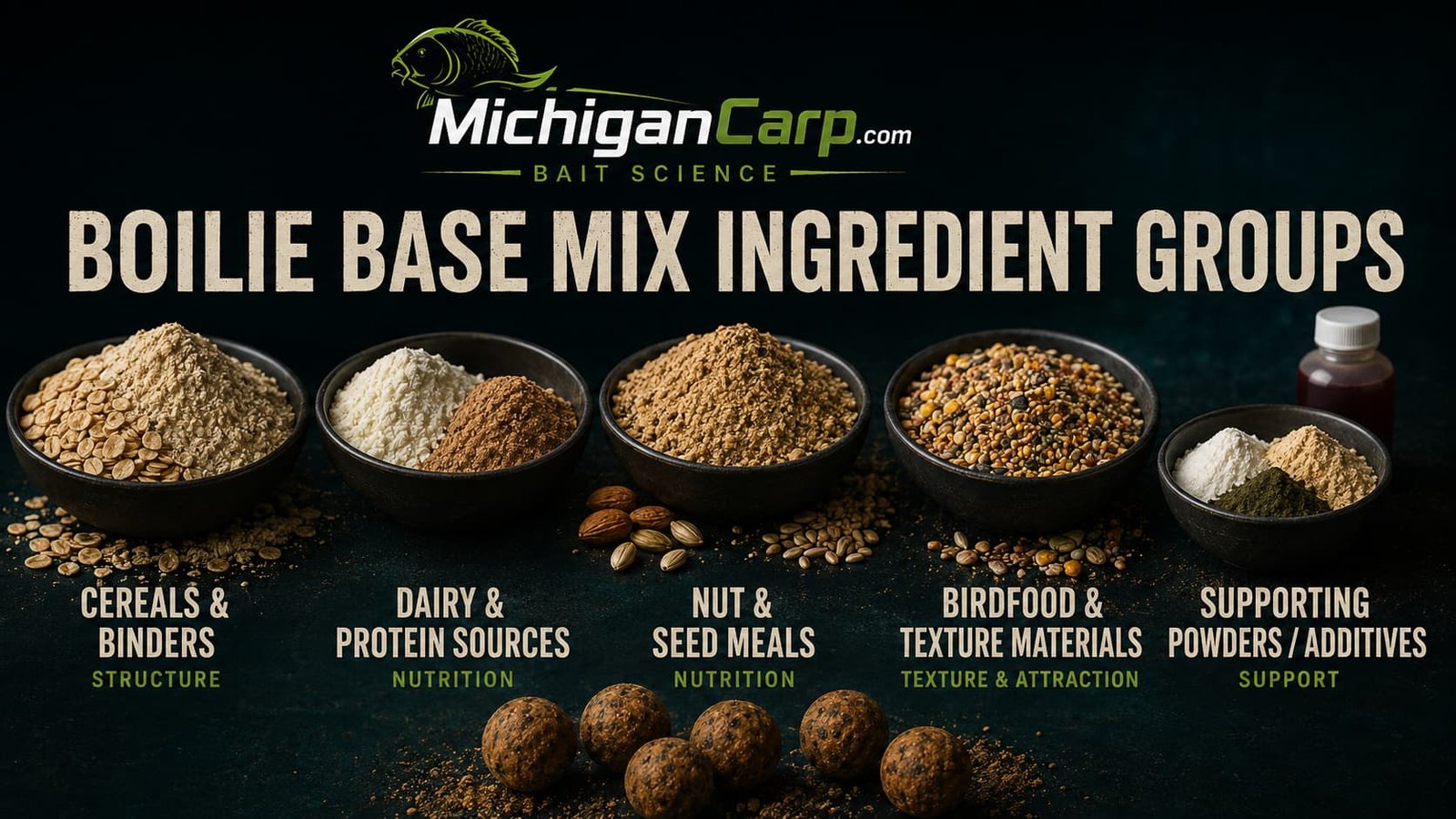
Structural ingredients are the chassis of the boilie. They help the bait form paste, extrude, roll, cook, dry, store and survive normal fishing use.
They are not glamorous, but without structure the bait fails.
| Ingredient group | Main role | Practical note |
|---|---|---|
| Semolina | Rollability, firmness and cost control | A classic structural tool, not a magic attractor |
| Maize flour / corn meal | Structure, carbohydrate and firming | Useful in simple and complex baits |
| Wheat flour / gluten | Binding, elasticity and paste strength | Too much can make bait heavy or doughy |
| Rice flour | Fine structure and lightness | Can help dry handling in some formulas |
| Wheatgerm | Texture, mild fat and food value | Useful, but still part of the total dry mix |
| Egg albumen | Firming and hookbait durability | Useful in hookbaits, but too much can over-harden bait |
| Eggs | Binding, water, protein, fat and cooking structure | Part of the liquid phase, not just moisture |
For the wet-phase side, use Boilie Liquids and Additives. For the practical cooking step, use How to Boil and Dry Boilies Properly.
Protein Ingredients: Food Value and Function
Protein ingredients are often treated as the heart of a bait, but protein is not just a headline percentage.
Different proteins behave differently. A bait does not become better simply because the crude-protein number is higher. Protein source, digestibility, processing, amino-acid contribution, solubility, fat level, cost and physical effect all matter.
| Protein group | What it can contribute | Common beginner mistake |
|---|---|---|
| Marine proteins | Savoury profile, protein, minerals, fats and soluble fractions depending on product | Assuming fishmeal automatically means premium bait |
| Milk proteins | Dairy profile, protein, binding, structure and variable solubility | Assuming all milk powders behave the same |
| Egg protein | Binding, nutrition and heat-set structure | Forgetting that eggs add fat and water too |
| Vegetable proteins | Protein, structure, cost control, binding and texture | Treating all plant proteins as filler |
| Hydrolysates | Smaller protein fractions and soluble food signal depending on product | Using too many before understanding one |
Marine baits still need structure, controlled fat, sensible liquids and proper baiting. Milk baits still need rollability and cost control. Plant proteins still need correct processing and balance.
For deeper protein detail, use Proteins, Peptides and Hydrolysates in Carp Bait, Carp Bait Digestibility and Anti-Nutritional Factors in Carp Bait Ingredients.
Milk, Nut, Seed and Birdfood Ingredients
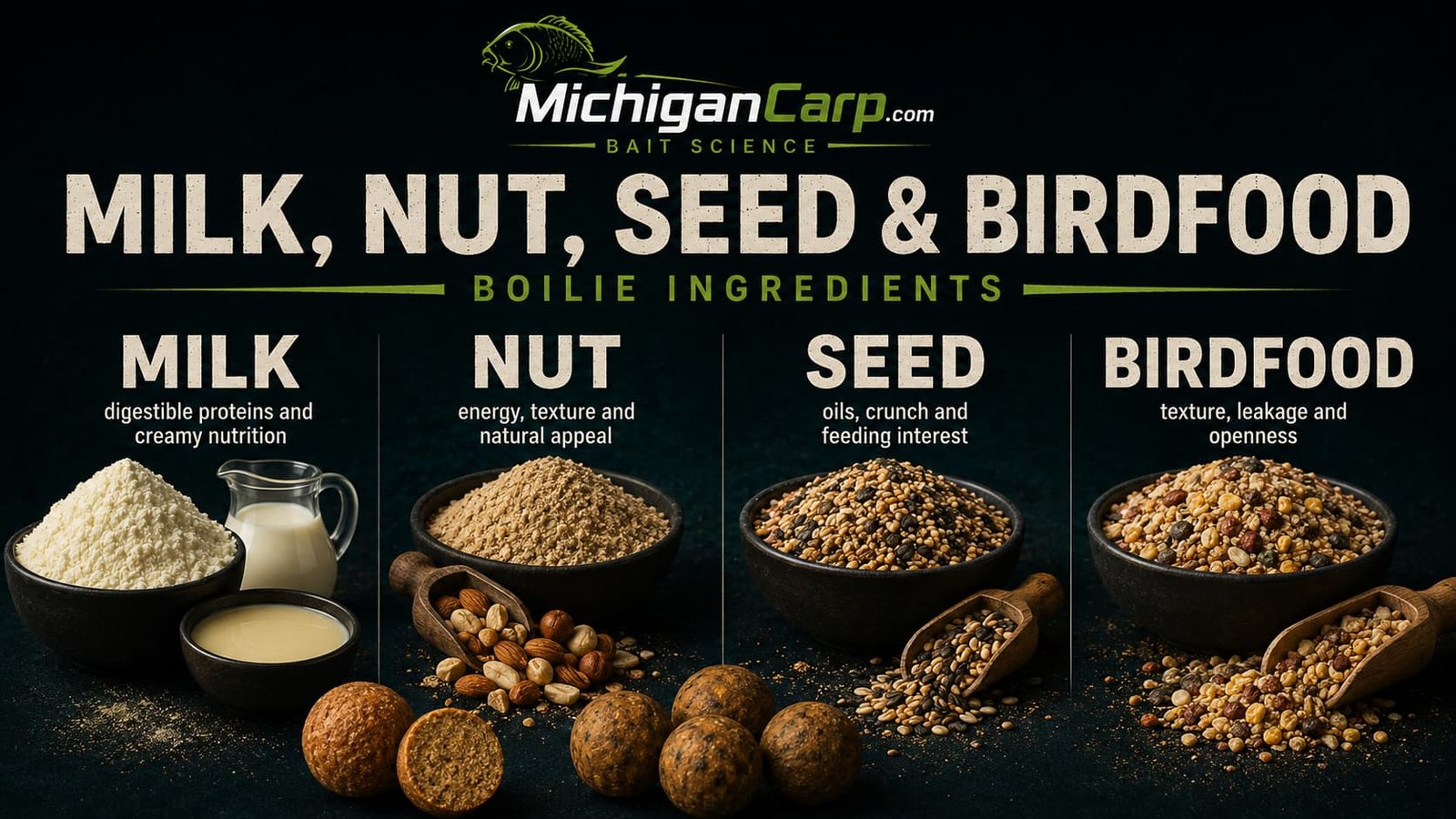
Milk, nut, seed and birdfood ingredients are central to the MichiganCarp.com bait direction because they allow strong non-marine food-bait design without relying on fishmeal as the default answer.
But these categories need careful thinking. None of them are single standardized ingredients.
| Ingredient family | Useful roles | Watch for |
|---|---|---|
| Milk powders | Protein, lactose, dairy profile, structure, creaminess and binding | Different milk products behave very differently |
| Nut meals and flours | Food value, fat, flavour, texture and compatibility with particles | High fat, cost, rancidity and heavy paste |
| Seed meals | Texture, fat, food value and natural-particle profile | Coarseness, oil level and storage freshness |
| Birdfoods | Texture, openness, cereal character, seed material and mouthfeel | Assuming birdfood automatically means leakage |
| Cereal ingredients | Structure, carbohydrate, rolling, energy and cost control | Using them as empty bulk instead of functional structure |
A good milk/nut/seed bait is not made by stacking every rich ingredient at once. Tiger nut flour, peanut, almond, coconut, hemp, cream powder, milk replacer and egg all affect fat, texture, drying and storage.
For this bait family, use How to Formulate a Milk, Nut and Birdfood Boilie Base Mix, How to Balance Fat in Boilies, Milk Replacer for Carp Bait and Raw vs Processed Ingredients in Carp Bait.
Solubles, Hydrolysates and Water Signal
Soluble ingredients help bait communicate in water. They may dissolve, disperse or leave the bait more readily than heavier insoluble material.
Useful soluble or semi-soluble bait materials can include hydrolysates, yeast extracts, milk solubles, sugars, salts, acids, minerals, sweeteners, fermented liquids and soluble fractions from food ingredients.
But solubility does not automatically mean attraction. A compound may dissolve without being useful, and visible clouding is not the same as proven feeding response.
| Soluble group | Main role | Practical warning |
|---|---|---|
| Hydrolysates | Protein-derived soluble food signal | Start with one main hydrolysate and learn its effect |
| Yeast extract | Savoury soluble profile and palatability support | Not the same as CSL or fish hydrolysate |
| Fermented liquids | Food-like liquid character | Product identity and stability matter |
| Sugars and sweeteners | Taste support and soluble background | Sweetness is not a full bait strategy |
| Salts and acids | Taste, pH support and ionic background | Small controlled use is usually enough |
Too many solubles can create sticky paste, weak hookbaits, poor drying, fast breakdown and confused bait logic.
For the deeper release side, use Carp Bait Solubility and Leakage, Why Some Carp Baits Leak Faster Than Others, Solubility vs Nutrition in Carp Bait and How to Use Hydrolysates in Carp Bait.
Fats, Oils and Energy
Fat matters because it affects richness, energy, mouthfeel, texture, storage, oxidation risk, water behaviour and seasonal suitability.
But bottled oil is optional. A bait may already contain plenty of fat before any extra oil is added.
| Fat source | What to remember |
|---|---|
| Eggs | Add fat as well as water, protein and binding |
| Nut meals | Can make bait rich, attractive and heavy if overused |
| Seeds | Can add useful texture and oil, but freshness matters |
| Fishmeal | Fat level depends heavily on product |
| Full-fat soy | Not the same as defatted soy flour |
| Cream powder / milk replacer | Can add meaningful fat and storage risk |
| Added oils | Use only when the bait actually needs them |
The beginner mistake is adding oil automatically because a recipe mentions it. Instead, ask whether the water is warm enough, whether the bait is already rich, whether oil supports the bait family, and whether it will affect rolling, drying or storage.
For the full guide, use How to Balance Fat in Boilies.
Liquids, Flavours, Sweeteners and Additives
Liquids and additives should support the bait, not replace the bait.
A poor base mix with strong flavour is still a poor base mix. A confused stack of liquids does not automatically become advanced bait.
| Liquid or additive type | Useful role | Beginner warning |
|---|---|---|
| Eggs | Main wet binder and cooking structure | Count them as part of the formula, not just moisture |
| Food liquids | Liquid nutrition, taste and soluble support | Use by job, not by smell alone |
| Flavours | Define fruit, cream, nut, spice or savoury profile | Flavour is not the bait |
| Sweeteners | Taste support and profile shaping | Do not build syrup dough and call it advanced bait |
| Betaine / amino blends | Specialist support when used carefully | Do not turn the first bait into a chemistry cabinet |
| Preservatives | Shelf-life support when correctly designed | Not needed for simple freezer bait |
For liquid-phase design, use Boilie Liquids and Additives. For flavours, use How to Flavor Boilies Properly. For sweeteners, use Sweeteners for Boilies and Sugars, Sweeteners and Carbohydrates in Carp Bait.
For shelf-life bait, use Potassium Sorbate, Sodium Benzoate and Citric Acid in Shelf-Life Boilies and Water Activity in Boilies. Do not assume one preservative makes bait safe forever.
Ingredient Form and Freshness Matter
The same ingredient name can hide very different products.
| Do not blindly swap | Why it matters |
|---|---|
| Whole peanut vs defatted peanut flour | Fat, protein, texture and storage change |
| Full-fat soy vs defatted soy flour | Fat level and paste behaviour change |
| Skim milk powder vs WPC80 | Protein, lactose, solubility and structure change |
| Casein vs caseinate | Solubility, binding and texture change |
| Whole hemp vs ground hemp | Surface area, oil exposure and freshness change |
| Liquid hydrolysate vs powder hydrolysate | Moisture, dose, handling and storage change |
Freshness also matters, especially with oily ingredients such as hemp, peanut, almond, fishmeal, full-fat soy, sunflower, sesame, oils, cream powders and milk replacers.
Stale or rancid ingredients are not improved by flavour. Store ingredients cool, dry, sealed, away from unnecessary heat and air, and in quantities you can actually use.
For ingredient handling, use How to Process Carp Bait Ingredients and Raw vs Processed Ingredients in Carp Bait.
How to Build a Beginner Ingredient List
A beginner does not need a shed full of powders.
A good first boilie ingredient list can be simple:
| Part of the bait | Beginner target |
|---|---|
| Structural base | One or two reliable rolling ingredients |
| Main protein direction | Marine, milk, nut, plant or hybrid |
| Texture ingredient | Birdfood, seed meal, wheatgerm or coarse food material |
| Soluble or savoury support | One controlled hydrolysate, yeast product or food liquid |
| Wet phase | Eggs plus measured liquids |
| Flavour direction | One simple flavour profile if needed |
| Taste support | Small salt or sweetener support where appropriate |
That is enough to learn mixing, paste feel, rolling, cooking, drying, water behaviour and fishing response.
Do not make the first bait a chemistry cabinet.
A Simple Ingredient Job Checklist
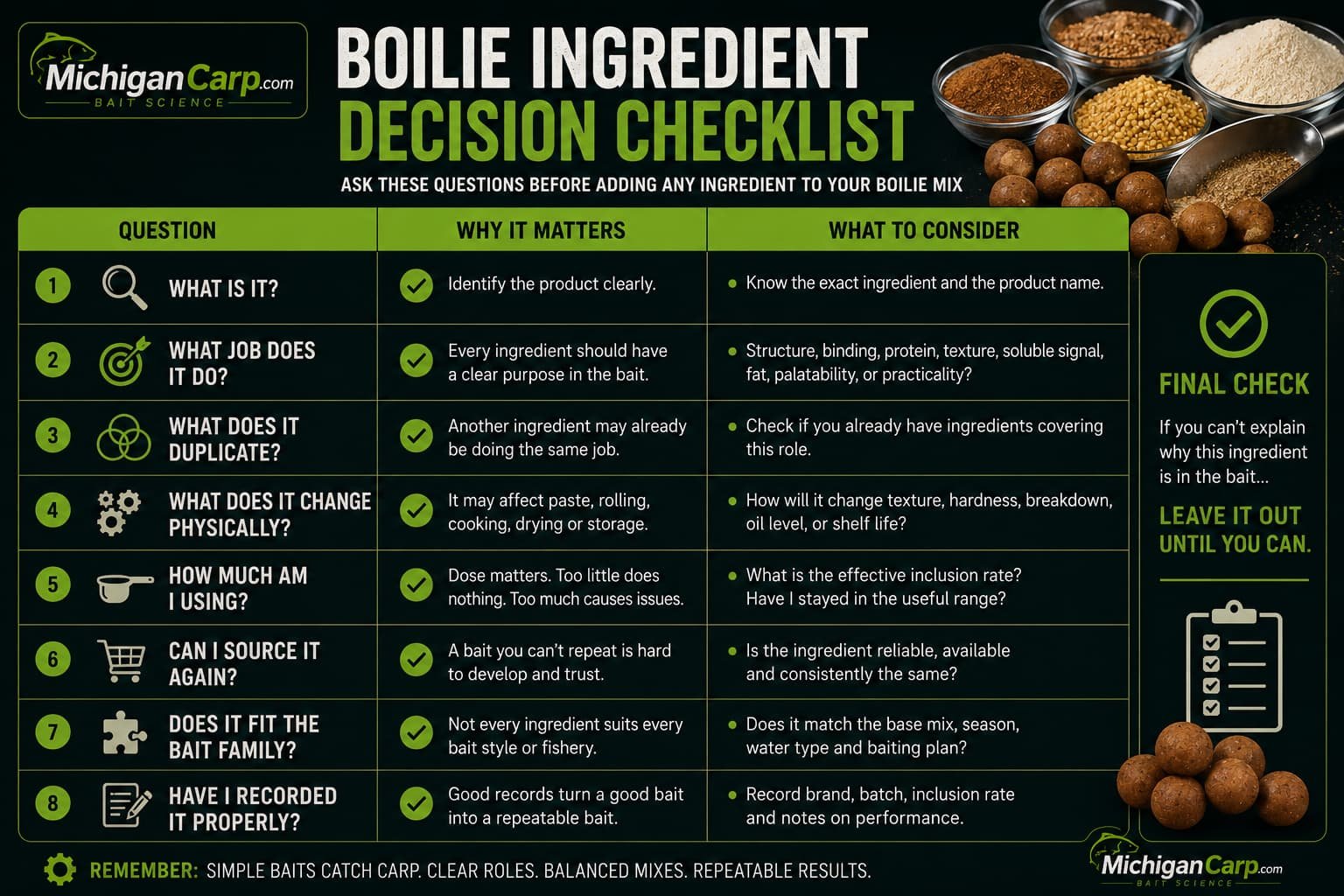
Before adding an ingredient, ask these questions.
| Question | Why it matters |
|---|---|
| What is it? | Identify the product clearly |
| What job does it do? | Structure, protein, soluble signal, fat, texture, binding, taste or preservation |
| What does it duplicate? | Another ingredient may already do the same job |
| What does it change physically? | It may affect paste, rolling, cooking, drying or storage |
| How much am I using? | Dose matters and should be recorded |
| Can I source it again? | A bait you cannot repeat is hard to develop |
| Does it fit the bait family? | Marine, birdfood, milk/nut, seed, particle-style or hybrid |
Michigan Notes
My Michigan bait thinking is practical.
Many of our waters are large, public, lightly understood for carp, rich in natural food and affected by weed, depth, boat traffic, current, weather and seasonal fish movement.
That means I care about ingredients that help me build bait I can repeat. I do not need every powder to be exotic. I need the bait to roll cleanly, fish properly, store safely, work beside particles, support multi-day sessions, match the season and be affordable enough to use.
For many Michigan anglers, the best first improvement is not buying more additives. It is understanding the job of the ingredients already in the mix.
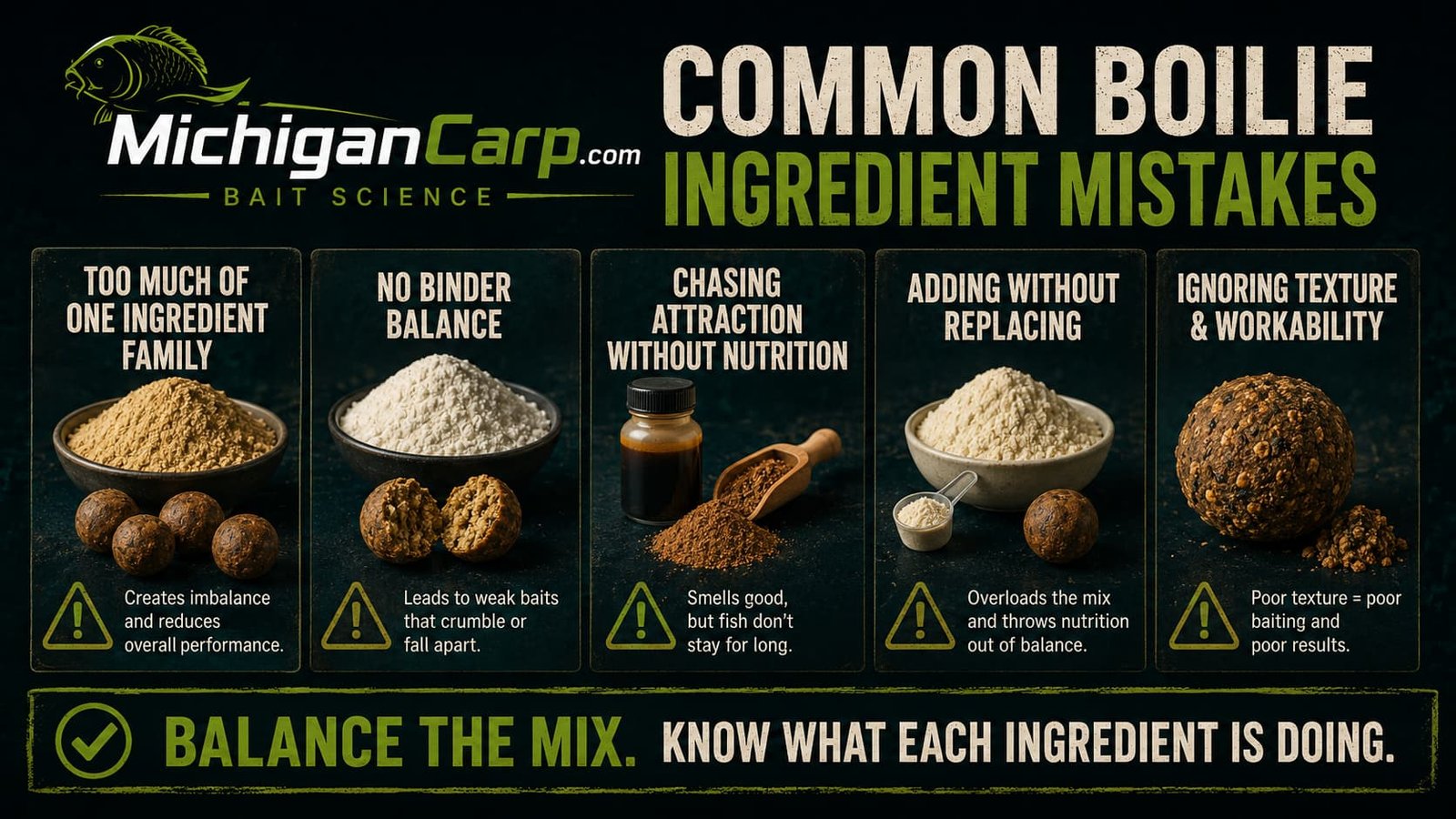
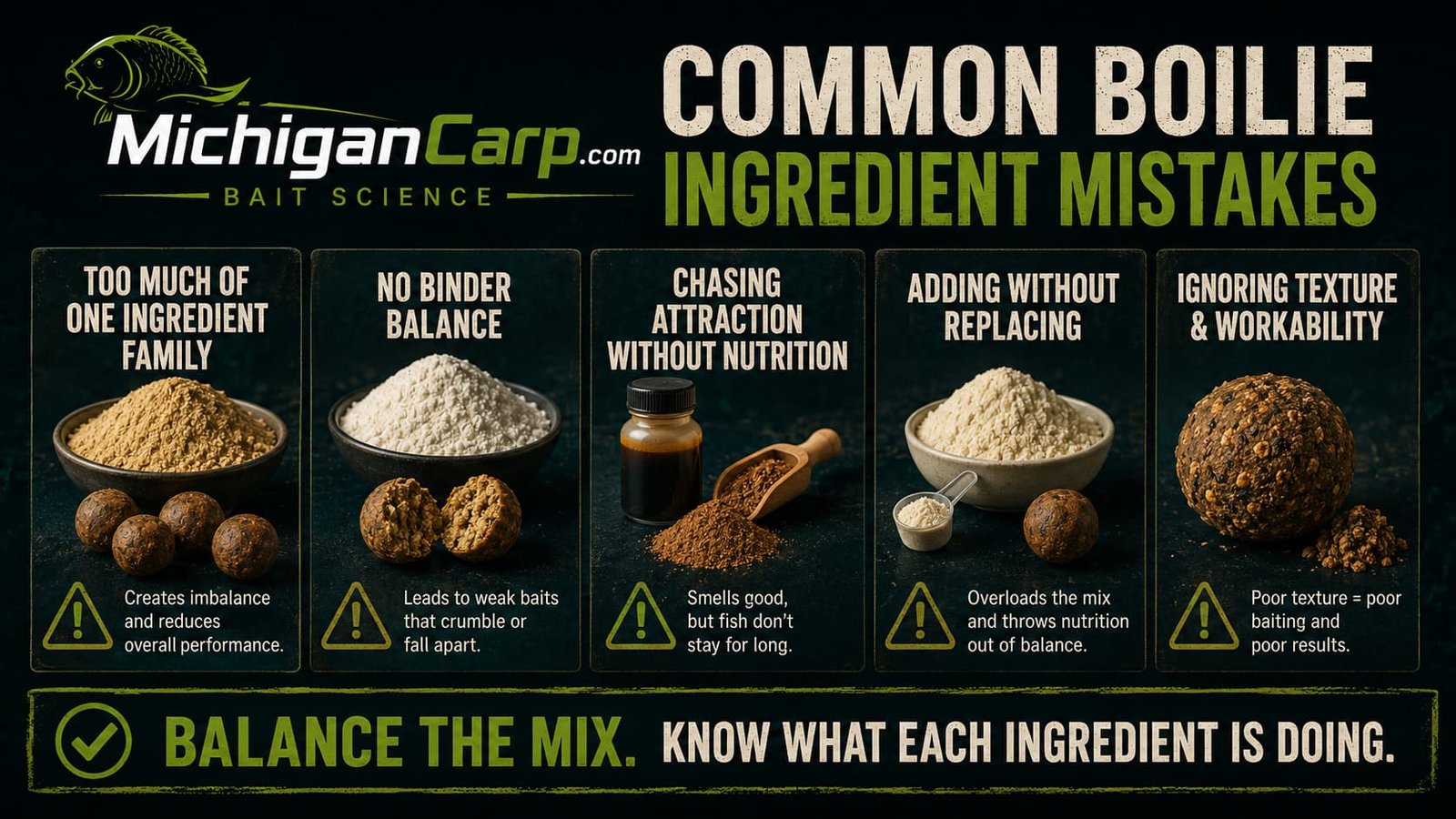
Common Boilie Ingredient Mistakes
| Mistake | Why it causes problems | Better practice |
|---|---|---|
| Adding ingredients because they sound good | The formula becomes cluttered and hard to repeat | Give every ingredient a clear job |
| Confusing protein percentage with bait quality | Protein number alone does not measure complete bait value | Consider digestibility, energy, structure and palatability |
| Using too many solubles | Can create sticky, weak or unstable bait | Use controlled leakage, not maximum leakage |
| Adding oil without counting existing fat | Nuts, seeds, eggs, soy and dairy may already contain plenty | Count the complete fat system |
| Thinking milk powders are all the same | Skim milk, WPC, casein and cream powder behave differently | Choose by function and label |
| Treating birdfood as one ingredient | Birdfood products vary widely | Choose the product by texture, structure and bait family |
| Ignoring product form | Whole, ground, defatted, hydrolyzed and extracted products differ | Do not swap blindly |
| Building the first bait too complicated | Complex bait makes learning harder | Start simple and repeatable |
| Not recording supplier details | You may not be able to repeat the bait | Record exact products and sources |
My Practical View
Good boilie making starts when you stop asking whether an ingredient is famous and start asking what it does.
Semolina has a job. Fishmeal has a job. Milk powder has a job. Birdfood has a job. Tiger nut flour has a job. Hydrolysate has a job. Oil has a job only when the bait actually needs it.
The best bait makers are not the ones who use the longest ingredient list. They are the ones who understand why each ingredient is there.
That is the point of BS-02.
If you cannot explain why an ingredient is in the bait, leave it out until you can.
That one rule will make your homemade boilies better immediately.
FAQ
What are the main ingredients in boilies?
Most boilies contain structural ingredients, protein sources, binders, texture ingredients, soluble signals, fats, liquids and small additives such as salt, sweeteners or flavours.
What is the most important boilie ingredient?
There is no single most important ingredient. A good bait needs balance between structure, food value, leakage, palatability, rollability and practical use.
Is semolina just filler in boilies?
No. Semolina is mainly a structural ingredient. It helps with rolling, firmness and consistency. That makes it useful even if it is not a major attractor.
Are fishmeals always better than vegetable proteins?
No. Fishmeals can be excellent, but vegetable proteins can also help with structure, cost control, protein and texture when used properly.
Are milk proteins good in carp bait?
Yes, but different milk ingredients behave differently. WPC, casein, caseinate, skim milk powder, cream powder and milk replacer are not interchangeable.
What do hydrolysates do in boilies?
Hydrolysates can provide smaller protein-derived fractions and soluble food signal depending on product. They are useful, but not magic.
Do boilies need oils?
No. Oil is optional. Count the fat already present in eggs, nuts, seeds, soy, dairy and fishmeal before adding bottled oil.
What does birdfood do in boilies?
Birdfood can add texture, cereal character, seed material, openness and moderate food value. The exact result depends on the product.
Are carbohydrates filler?
Not automatically. Cereal and carbohydrate ingredients can help structure, energy, rollability, cooking behaviour and cost control.
Should beginners use lots of additives?
No. Beginners should start with a simple bait they can understand and repeat. Additives should be added only when they have a clear job.
What makes a bait leak attraction?
Soluble ingredients, liquids, texture, cooking, drying and bait structure all affect water behaviour. Controlled leakage is better than unstable bait.
Can I swap one ingredient for another?
Only if you understand the difference. Whole, ground, defatted, hydrolyzed and extracted ingredients may behave very differently.
Are preservatives needed in homemade boilies?
Not for simple freezer bait. Shelf-life bait requires deliberate preservation design and should not be guessed.
How should I choose ingredients for my first boilie?
Choose one structural base, one main protein direction, one texture ingredient, one soluble or savoury signal, eggs and a simple flavour or support note if needed.
What is the biggest ingredient mistake?
The biggest mistake is adding ingredients because they sound impressive instead of because they perform a clear job in the formula.
Next Steps
- Previous Lesson: BS-01 — Boilie Basics
- Next Lesson: BS-03 — Boilie Base Mix Families
- Boilie Liquids and Additives
- Boilie School BS-05: Making Boilies Step by Step
- Boilie School BS-06: Using Boilies on the Bank
- Back to Boilie School Hub
- How to Formulate a Milk, Nut and Birdfood Boilie Base Mix — turn ingredient roles into a working formula.
- How to Read Carp Bait Ingredient Labels — understand product labels before buying ingredients.
- Proteins, Peptides and Hydrolysates in Carp Bait — understand protein form and soluble fractions.
- Carp Bait Digestibility — understand usable food value.
- Anti-Nutritional Factors in Carp Bait Ingredients — understand limitations in plant-heavy mixes.
- Raw vs Processed Ingredients in Carp Bait — understand how processing changes ingredient behaviour.
- How to Process Carp Bait Ingredients — grind, sieve, cook and prepare ingredients properly.
- Bait Science — browse the full technical bait library.