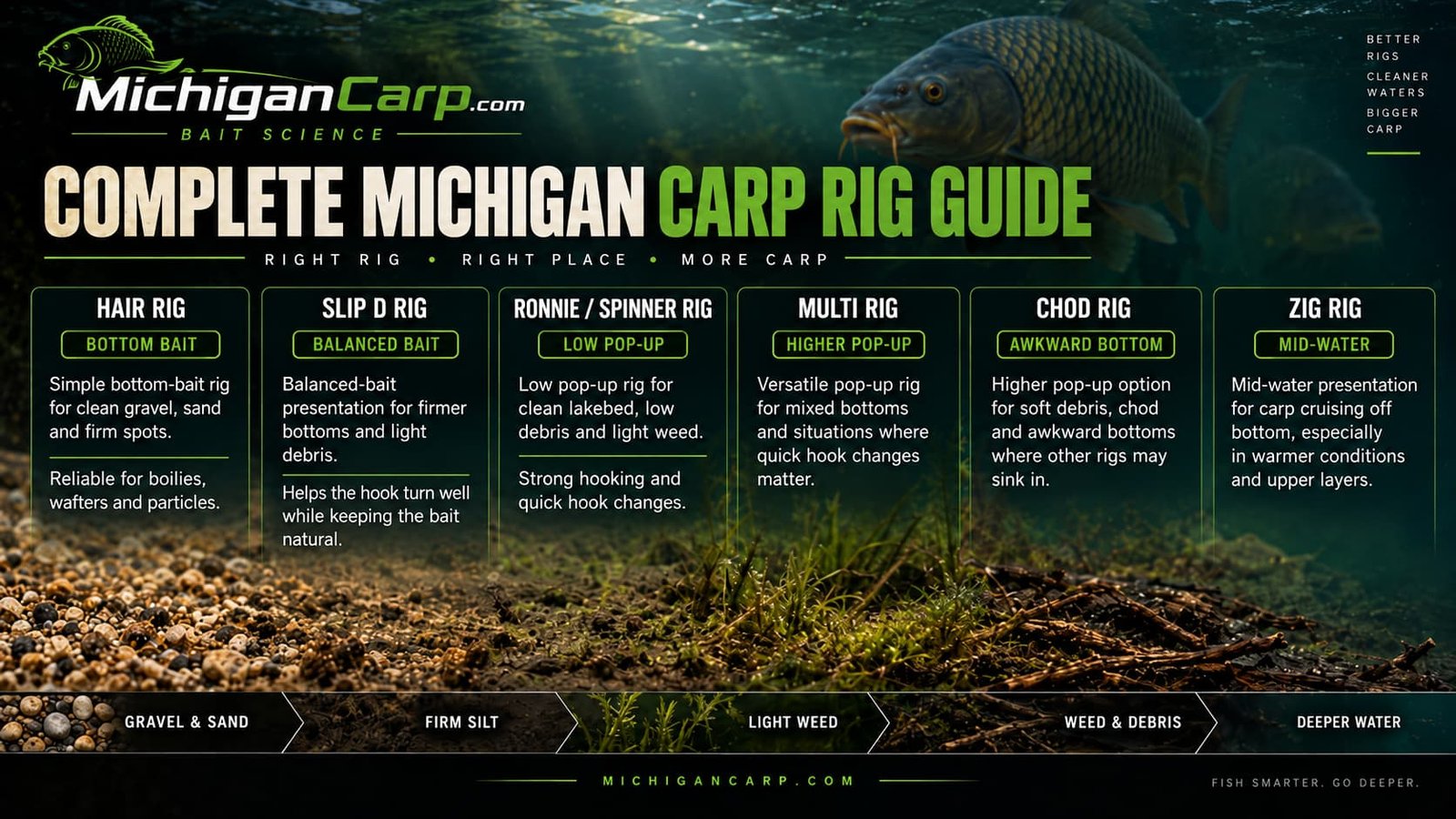
This complete carp rig guide is the MichiganCarp.com master reference for choosing the right presentation before you open an individual tying tutorial.
The purpose is not to persuade you that one rig is better than every other rig. It is to answer a more useful question:
What presentation gives me the best chance of putting a sharp hook and suitable hookbait on this particular lakebed safely?
Michigan carp fishing can involve clean sand, gravel, clay, mussels, soft silt, dying weed, cabbage weed, timber, rock, river current and large public-water carp. No single rig handles all of those conditions equally well.
The safest way to choose is to work in order:
hookbait → lakebed → lead system → hooklink → hook → fish-control risk.
If you are completely new to modern carp rigs, begin with the Carp Rig Starter Kit. It teaches three core presentations first: Hair Rig, Slip D and Ronnie / Spinner.
If you already understand those basics, use this page as the full comparison reference. The MichiganCarp Rig Hub remains the main navigation page for the whole rig section.
Table of Contents
Quick Start: Choose the Rig by the Job
| Situation | Good first choices | Main reason |
|---|---|---|
| Simple sinking boilie, corn, tiger nut or maize on clean ground | Hair Rig | Simple, exposed hook and easy presentation check |
| Bottom bait or wafter with more bait movement | Blowback or Slip D | Mobile bait attachment without abandoning a bottom-oriented presentation |
| Balanced wafter on clean ground or light silt | Slip D | Supple mobile D with controlled coated hooklink |
| Two-material anti-tangle presentation | Combi Rig | Stiff boom plus short supple hook section |
| Low pop-up over clean ground, firm silt or light debris | Ronnie / Spinner | Controlled low pop-up and easy hook replacement |
| Pop-up with fast hook changes and adjustable D-style presentation | Multi Rig | Large loop forms both hook connection and movable D |
| Higher pop-up over known ground or light silt | Hinged Stiff Rig | Defined stiff hook section above a separate boom |
| Soft silt, leaf litter or awkward debris | Chod Rig | Short stiff hook section works on a helicopter-style system |
| Carp clearly using mid-water rather than the bottom | Zig Rig | Presents the hookbait at the depth the fish are actually using |
This carp rig guide works best when you start with the job the presentation needs to perform, then refine the choice around hookbait, lakebed and lead system.
A Hair Rig can carry a wafter. A Multi can carry more than a pop-up. A Slip D can be adjusted for different bait types. But assigning each rig a primary job makes the whole system much easier to understand.
Start With the Lakebed, Not the Rig Name
A rig can be mechanically perfect on your tackle table and still fish badly once it reaches the bottom.
The first job is therefore to understand the spot itself.
Use Reading the Bottom for Carp when you need the full process for interpreting substrate, weed, depth changes, drag-back feel and structure.
Clean sand, clay and firm gravel
This is where simple rigs shine.
Hair, KD, Blowback, Slip D, Combi, Ronnie and Multi can all be made to present well because the bottom is not trying to bury or mask the hook.
Do not add complexity simply because the lakebed allows it.
If a sinking boilie on a Hair Rig gives you exactly the presentation you want, use it.
Hard gravel, rock and mussels
The rig may present very cleanly, but tackle durability becomes more important.
Check hook points after casts and fish. Inspect hooklinks, leaders and the final section of main line for abrasion.
Beaked or protected points can sometimes retain sharpness better on rough substrate, but the exact hook pattern still has to suit the presentation.
For hook geometry, read Carp Hooks Explained.
Firm or light silt
Do not automatically abandon bottom baits because the lead picks up a little silt.
A Hair Rig, Blowback, Slip D or Combi can still fish extremely well if the hookbait remains visible and the lead is not dragging the complete hooklink deeply into the substrate.
Wafters can make the presentation settle more gently.
A Ronnie or Multi becomes useful when you specifically want a pop-up.
Deep soft silt
This is where the complete lead system matters as much as the hook rig.
A lead can bury deeply and pull an otherwise good presentation into the bottom.
Rather than simply adding several inches to the hooklink, consider how the lead, leader, hooklink and hookbait will settle as one system.
A correctly configured helicopter arrangement and a suitable Chod-style or hinged presentation may make more sense.
Light weed and dying weed
Do not treat every strand of weed as a reason to use a Chod Rig.
Find out whether you can identify a small clean area, low weed, a weed edge or a hole.
A Ronnie, Multi or carefully balanced Slip D may be enough when the weed is sparse and the hook can remain exposed.
Heavy weed
Heavy weed is primarily a fish-control and presentation problem, not a rig-selection problem.
No hooklink design makes an unsafe swim safe.
Ask whether you can land a hooked carp before casting. If the answer is doubtful, move the rig rather than trying to solve the problem with more tackle.
The dedicated Silt, Weed and Chod-Style Rig Guide covers awkward bottoms in more detail.
Leaf litter and debris
Soft debris can mask a point without looking dramatic from the bank.
Low pop-ups, Hinged Stiff or Chod-style presentations can help when the bottom is sufficiently messy to justify them.
Again, the objective is not “fish a pop-up because debris exists.” The objective is to keep the hook and bait fishing cleanly.
The Core Bottom and Balanced-Bait Rigs
Hair Rig
The Hair Rig remains the foundation.
The bait sits on a hair rather than directly on the hook, leaving the point and gape exposed.
Use it when you want the simplest reliable presentation for:
- bottom-bait boilies;
- maize and sweetcorn;
- tiger nuts;
- snowman hookbaits;
- some wafters;
- method or PVA-bag adaptations.
It is the best starting point because every later rig still depends on the same fundamentals: sharp hook, exposed gape, sensible bait-to-hook proportion and a hooklink that lands cleanly.
Blowback Rig
The Blowback Rig develops the Hair Rig by allowing a small rig ring connected to the hair to travel along the hook shank.
Its job is controlled hookbait movement while retaining a conventional hooklink and knotless-knot foundation.
Use it primarily for:
- bottom baits;
- wafters;
- snowman presentations;
- clean to lightly silty ground.
KD Rig
The KD Rig changes where the hair exits the knotless knot.
That creates a different bait-to-hook relationship and is best understood as a specialist balanced-bait variation rather than a completely separate rig universe.
It makes most sense when the hookbait is light enough for the intended geometry to work.
Slip D Rig
The Slip D Rig forms a supple D from the stripped hooklink itself.
A bait swivel or ring moves along that D, giving the hookbait more freedom while the hook remains permanently tied to the hooklink.
For Michigan fishing, I particularly like its role with:
- wafters;
- critically balanced boilies;
- trimmed bottom baits;
- clean ground;
- firm to light silt.
It belongs more naturally in the balanced/bottom-bait family than as a primary pop-up rig.
Combi Rig
The Combi Rig combines two hooklink behaviours.
A stiff mono or fluorocarbon boom helps provide separation and anti-tangle control, while a short supple braided section near the hook gives the hook and bait freedom to move.
Use it when that two-material behaviour solves a genuine presentation problem rather than simply because the rig looks technical.
The Main Pop-Up Rigs
Ronnie / Spinner Rig
The Ronnie / Spinner Rig is the primary low pop-up rig in this system.
The hook rotates on a spinner swivel and can be replaced without rebuilding the complete boom.
I consider it strongest over:
- clean sand or gravel;
- firm silt;
- light debris;
- low weed where the complete presentation can still settle cleanly.
It is not a licence to cast into deep chod or dense weed and assume the pop-up will fix everything.
Multi Rig
The Multi Rig forms a movable D and hook connection from one large loop in the hooklink.
Its major advantages are:
- quick hook changes;
- few metal components;
- adjustable D-style presentation;
- good pop-up and balanced-hookbait versatility.
The loop, hook eye, D and counterbalance still have to work together correctly.
Hinged Stiff Rig
The Hinged Stiff Rig uses two distinct sections: a short stiff hook section and a longer boom.
That makes it useful when you deliberately want a more defined pop-up presentation than a low Ronnie.
It belongs between ordinary low pop-up fishing and true Chod-style work.
Chod Rig
The Chod Rig is a specialist short stiff hook section designed to work on a helicopter-style leader arrangement.
Its value appears when the bottom is soft, littered or awkward enough that a conventional hooklink becomes difficult to trust.
Use it because the lakebed requires it—not because it is fashionable.
Zig Rig: When the Carp Are Not on the Bottom
The Zig Rig solves a completely different problem.
Every bottom rig in this guide becomes irrelevant if the fish are spending their feeding or cruising period several feet above the lakebed.
A Zig suspends the hookbait at a chosen depth in the water column.
It becomes worth considering when:
- carp are visibly cruising;
- fish repeatedly show in the upper layers;
- hot weather concentrates activity away from the bottom;
- bottom rods remain quiet despite clear carp presence;
- depth and light suggest fish are using a specific layer.
That makes Zig fishing an important part of a genuinely complete rig system rather than an exotic extra.
Special Systems and Hookbait Presentations
Not everything anglers call a “rig” is really a separate hook-rig family.
This distinction helps prevent unnecessary duplication.
Method Feeder
The Method Feeder Rig is better thought of as a complete feeding and terminal-tackle system.
A short hooklink sits beside or within a compact mass of feed around a weighted feeder.
It is particularly useful where you want precise hookbait-and-feed placement on relatively clean ground.
Snowman hookbait presentation
The Snowman presentation is not a separate rig family.
It is a bottom bait topped by a smaller buoyant bait to alter visual profile and effective weight.
You can use a snowman on a Hair Rig, Blowback, KD or another compatible presentation.
Solid PVA bag
Solid PVA Bag Rig for Carp should also be understood mainly as a delivery system.
A very short supple hooklink and hookbait are packed with dry feed and the lead inside a dissolving bag, creating a compact anti-tangle parcel.
The dedicated modern MichiganCarp Solid PVA Bag article is still to be rebuilt, so this guide does not duplicate that future tutorial.
360 Rig
I do not consider the 360 a core MichiganCarp recommendation that requires another full individual tying article.
The useful question is how it differs from the modern Ronnie/Spinner concept.
That comparison already belongs in Spinner Rig vs Ronnie Rig vs 360 Rig.
Carp Rig Guide: Master Rig Comparison
Use this section of the carp rig guide as a quick reference before opening the individual tying tutorials.
| Rig | Primary job | Hookbait | Starting lakebed/zone |
|---|---|---|---|
| Hair | Simple bottom presentation | Bottom bait / particles | Clean to firm silt |
| Blowback | Moving bait attachment on hook shank | Bottom bait / wafter | Clean to light silt |
| KD | Balanced-bait geometry | Wafter / balanced bait | Clean ground |
| Slip D | Mobile braided D | Wafter / balanced bait | Clean to light silt |
| Combi | Stiff boom plus supple hook section | Bottom bait / wafter | Clean to light silt |
| Ronnie / Spinner | Low rotating pop-up | Pop-up | Clean, firm silt, light debris |
| Multi | Quick-change D presentation | Pop-up / balanced bait | Clean to light/mixed ground |
| Hinged Stiff | Defined higher pop-up | Pop-up | Known ground, light silt/debris |
| Chod | Short stiff specialist presentation | Buoyant pop-up | Soft silt / litter / awkward debris |
| Zig | Mid-water presentation | Foam / buoyant hookbait | Water column |
Match the Lead System to the Rig and Bottom
A common mistake is to choose the hook rig first and treat the lead as an unrelated weight.
The lead determines how the whole presentation enters and settles on the bottom.
Lead clip
A correctly configured lead clip is a versatile general system.
It works particularly well on clean and mixed ground where you want a conventional hooklink and the ability to configure lead release appropriately for the swim.
Inline lead
Inline systems provide a compact connection between lead and hooklink.
They suit genuinely clean ground, method-feeder setups and many solid-PVA-bag applications.
They are less forgiving when a heavy lead punches deeply into soft silt.
Helicopter system
A correctly constructed helicopter arrangement allows the hooklink to rotate around the leader and gives more freedom to settle independently of a lead that penetrates softer ground.
It is particularly relevant to Chod-style work and useful in other soft-bottom situations when configured safely.
For the full comparison, use Carp Lead Systems for Michigan.
Main Line, Leaders and Hooklink Strength
There is no single breaking strain that is “the Michigan setup.”
The correct strength depends on:
- fish size;
- weed;
- timber and snags;
- rock and mussels;
- casting distance;
- current;
- boat traffic;
- leader arrangement;
- the amount of pressure required to land the fish safely.
For ordinary open-water carp fishing, many anglers can use relatively conventional tackle. Rough water may require substantially stronger main line, leader and hooklink.
Do not increase only the hooklink while leaving a weaker or abrasion-damaged main line above it.
Think about the complete chain.
Use Line and Leaders when building the system around the hook rig.
Michigan Conditions That Change Rig Choice
Zebra mussels and sharp rock
The primary issue is abrasion and hook-point damage.
Inspect line and leader frequently. Check the hook after retrieving over rough substrate.
Timber and stumps
Do not confuse a stronger rig with a safer swim.
If a fish can reach submerged timber before you can stop it, reposition the rig or do not fish that exact line.
Large weed beds
Look for edges, holes, lanes and clean patches before deciding that you need a specialist weed rig.
Rig choice starts after you identify a fishable presentation area.
Current
Moving water can shift leads, bow line and alter how the rig sits after the cast.
Use enough lead to maintain the intended position, then make sure the hooklink and lead arrangement remain compatible with the flow.
Large wild-water carp
Rig finesse has to be balanced against fish control.
A strong size 2 or 4 hook and heavier hooklink can be entirely appropriate when bait size, snags and the rest of the tackle justify them.
The aim is not to fish heavy for its own sake. It is to avoid deliberately under-strength tackle where a hooked carp cannot be controlled safely.
Choose the Rig by Hookbait
| Hookbait | Best places to start |
|---|---|
| Maize / corn / tiger nut | Hair Rig |
| Sinking boilie | Hair, Blowback, Combi |
| Wafter | Slip D, Blowback, Multi |
| Snowman | Hair, Blowback, KD |
| Low pop-up | Ronnie / Spinner, Multi |
| Higher defined pop-up | Hinged Stiff |
| Buoyant bait over soft debris | Chod |
| Mid-water buoyant hookbait | Zig Rig |
Common Rig-Choice Mistakes
Choosing a favourite rig before checking the bottom
A rig cannot solve a lakebed it is unsuited to.
Assuming every bit of silt needs a pop-up
Carp naturally feed in silt. Firm or shallow silt can still be excellent bottom-bait territory.
Assuming a Chod Rig makes heavy weed safe
Presentation and fish extraction still have to be possible.
Using the Ronnie for every pop-up problem
The Ronnie is excellent, but a low pop-up over clean ground is a different job from a high presentation over debris.
Treating hooklink length as the only silt adjustment
The lead system, lead penetration, hookbait buoyancy and way the hooklink settles matter too.
Copying hook sizes without considering bait size
The useful question is whether enough gape remains exposed and whether the hook is strong enough for the water.
Changing rigs when there are no carp present
No hook mechanic compensates for poor location.
Use How to Find Carp in Lakes before spending a quiet session repeatedly rebuilding rigs.
My Practical MichiganCarp Rig System
I do not approach a session with the intention of using the most advanced rig I can tie.
The purpose of this carp rig guide is not to make every angler carry every rig.
I start with the simplest presentation that gives me confidence on the spot.
If I am fishing a firm clean area with a normal bottom bait, the Hair Rig is difficult to justify replacing just for the sake of complexity.
If I want a balanced bait and more bait movement, the Slip D or Blowback becomes more attractive.
If I want a two-material hooklink that resists tangling and still gives movement at the hook, I look at the Combi.
If I deliberately want a low pop-up, I look at the Ronnie.
If fast hook changes and D-style mechanics are useful, I consider the Multi.
If I want a more defined, higher pop-up presentation, I move toward the Hinged Stiff.
If the bottom is genuinely soft, littered or awkward enough to require a specialized short stiff section, I consider the Chod.
And if the carp are clearly not feeding on the lakebed, I stop arguing about bottom rigs and consider the Zig.
A useful carp rig guide should help you eliminate unsuitable presentations as quickly as it helps you choose one.
The best rig is the simplest safe presentation that solves the actual problem in front of you.
Rig Safety Before the Cast
Before every cast, check the complete system rather than only the hook.
- Is the hook point perfect?
- Does the hookbait leave enough usable gape?
- Have all knots and connections been pull-tested?
- Is the hooklink free from abrasion?
- Will the lead system behave as intended if something fails?
- Can any required beads or components pass the leader connection?
- Can the fish be controlled and landed safely from that swim?
- Does the finished rig actually settle correctly in water?
Rig safety is part of fish care, not a separate subject.
Use the MichiganCarp Fish Care and Safety guide for the full landing, handling and release system.
Fishing regulations can change, so anglers should also check the current Michigan DNR Fishing Regulations for the water and fishing method being used.
FAQ
What is the best carp rig for beginners?
The Hair Rig is the best starting point for most anglers because it teaches bait spacing, hook exposure, hooklink length and the knotless knot without unnecessary components. After that, add a Slip D for balanced baits and a Ronnie / Spinner for low pop-ups.
What is the best carp rig for bottom baits?
Start with a Hair Rig. Blowback, KD, Slip D and Combi presentations become useful when a particular bait movement, balance or hooklink behaviour gives you a reason to use them.
What is the best carp rig for wafters?
The Slip D is an excellent first choice. Blowback and Multi rigs are also useful depending on the hookbait, bottom and mechanics you want.
What is the best carp rig for pop-ups?
For a low pop-up over clean ground, firm silt or light debris, the Ronnie / Spinner is a strong first choice. Multi, Hinged Stiff and Chod rigs solve different pop-up jobs.
What is the best rig for deep silt?
Do not answer that question from hook-rig name alone. First consider how deeply the lead penetrates and whether the hookbait will remain clear. A helicopter-style system combined with a suitable pop-up presentation may be more appropriate than a conventional short bottom-bait rig.
What rig should I use in weed?
First find a presentation area you can fish and land carp from safely. Light weed can often be handled with ordinary balanced or low pop-up rigs. Dense weed is a fish-control problem and cannot be solved simply by choosing a Chod Rig.
Is the Ronnie Rig the same as the Spinner Rig?
In modern carp fishing, Ronnie Rig and Spinner Rig are commonly used for essentially the same swivel-mounted rotating-hook presentation. The 360 Rig is a different design.
Is the Snowman a separate rig?
No. It is primarily a hookbait presentation: a sinking bait topped with a smaller buoyant bait. It can be used on several compatible bottom-bait rigs.
Do I need a different rig for large carp?
Not necessarily. Large carp require a dependable hook, hooklink and complete tackle system, but a correctly tied Hair Rig can still be perfectly suitable. Scale strength according to the water, bait, hazards and control required rather than fish size alone.
How many carp rigs do I really need?
Far fewer than the number of named rigs available. Master a simple bottom-bait rig, balanced-bait presentation and pop-up rig first. Add specialist presentations only when they solve a specific problem.
Next Steps
Use this guide as the decision page, then move into the article that matches the exact job:
- Carp Rig Guide for Michigan — main rig hub and navigation.
- Carp Rig Starter Kit — Hair, Slip D and Ronnie as the three-rig beginner route.
- Bottom-Bait Rigs — compare Hair, KD, Blowback, Slip D and Combi-style presentations.
- Pop-Up Rigs — compare the main pop-up families.
- Silt, Weed and Chod-Style Rigs — choose presentations for softer and more awkward ground.
- Hair Rig for Carp Fishing — simple bottom-bait foundation.
- Slip D Rig for Carp Fishing — balanced baits and mobile D mechanics.
- Combi Rig for Carp Fishing — stiff boom plus supple hook section.
- Ronnie / Spinner Rig — low pop-up presentation.
- Multi Rig for Carp Fishing — quick-change loop and D system.
- Hinged Stiff Rig — defined higher pop-up presentation.
- Chod Rig for Carp Fishing — specialized soft-silt and debris presentation.
- Zig Rig for Michigan Carp — when the fish are using the water column instead of the lakebed.
- Carp Lead Systems for Michigan — match the hook rig to the lead arrangement.
- Carp Hooks Explained — choose hook pattern, gape, point and size.
- Reading the Bottom for Carp — understand the substrate before choosing the rig.
You do not need every rig in this guide in your tackle box.
You need enough understanding to recognize the problem, choose the simplest safe presentation that solves it and tie that rig well enough that you can trust it after the cast.