

When choosing carp fishing rods Michigan anglers need to think about casting distance, weed, snags, line control and the total casting load rather than fish size alone.
That distinction matters.
A 20 lb carp on clean sand does not create the same tackle problem as the same fish heading toward cabbage weed, flooded timber, zebra mussels or riprap. Likewise, a 13 ft distance rod may be useful on a wide open bank but awkward in a wooded campground swim, from a boat or when the fish are feeding only 40 yards out.
For most Michigan carp fishing, rod choice comes down to five questions:
- how far you really need to cast;
- how much your complete casting load weighs;
- how much weed, rock or snag risk is present;
- how much line and fish control you need;
- how much room you have to cast and land the fish.
The objective is not maximum rod power.
It is enough power for control without sacrificing the cushioning, accuracy and fish-playing ability that help you land carp safely.
For the wider tackle system, start with Carp Gear for Michigan. Match the rod with Carp Fishing Reels for Michigan and Carp Fishing Line and Leaders for Michigan.
Table of Contents
Quick Start: Carp Fishing Rods Michigan Guide
For most anglers wanting one dependable Michigan setup, my starting point is:
12 ft • around 3.25 lb test curve • progressive action
That combination gives enough authority for larger public waters, moderate weed, normal leads, many packbait and PVA applications and stronger line without becoming a specialist distance rod.
Use this as the starting guide:
| Michigan Fishing Situation | Practical Starting Point | Main Reason |
|---|---|---|
| Clean lakes, modest range | 12 ft, 2.75–3 lb | Forgiving and enjoyable |
| General Michigan carp fishing | 12 ft, 3.25 lb | Strong all-round balance |
| Weed and heavier casting loads | 12 ft, 3.25–3.5 lb | More backbone and casting authority |
| Tight banks and boat work | 9–10 ft, 3–3.5 lb | Better close-range handling |
| Channels and moving water | 12–13 ft, 3.25–3.75 lb | Line control and heavier leads |
| Big open water / genuine distance | 12 ft 6 in–13 ft, around 3.5 lb | Casting leverage and line pick-up |
| Serious snag fishing | 10–12 ft, stronger progressive rod | Direct pressure and control |
These are starting ranges, not universal specifications.
Rod action, blank design and the manufacturer’s intended casting range matter alongside test curve.
A well-designed 3.25 lb rod can be a much better heavy-water fishing tool than a poor 3.5 lb rod.
What a Carp Rod Actually Has to Do
A carp rod is primarily a casting and pressure-control tool.
It has four important jobs.
Cast the Complete Load
The rod does not cast only the lead.
It may be casting:
- lead;
- hooklink;
- hookbait;
- PVA bag;
- method feeder;
- packbait;
- tubing or leader components.
A 3 oz sinker plus a large loaded PVA bag is a very different proposition from a bare 3 oz lead.
This is especially relevant in North American carp fishing because method feeders, packbait and relatively heavy baited presentations are common.
For the dedicated bait system, see Packbait for Carp Fishing.
Control Line
Rod length and power influence how efficiently you can pick up line, alter the line angle and steer a fish.
That becomes important around:
- weed;
- riprap;
- mussels;
- bridge edges;
- stumps;
- flooded timber;
- channel ledges.
Cushion the Hook Hold
Power without forgiveness is not automatically useful.
A carp lunging under the rod tip can place enormous short-duration pressure on the hook hold.
The rod, drag and line should absorb those changes rather than transferring every shock directly to the hook.
Land the Fish Safely
Fish care starts before the carp reaches the mat.
A rod too weak for a dangerous swim can contribute to break-offs.
A rod used too aggressively can contribute to hook damage.
The correct setup gives enough control to prevent avoidable problems while retaining enough cushioning to play the carp cleanly.
Once the fish reaches the bank, use Carp Fish Care and Safety and Landing Gear for Carp Fishing.
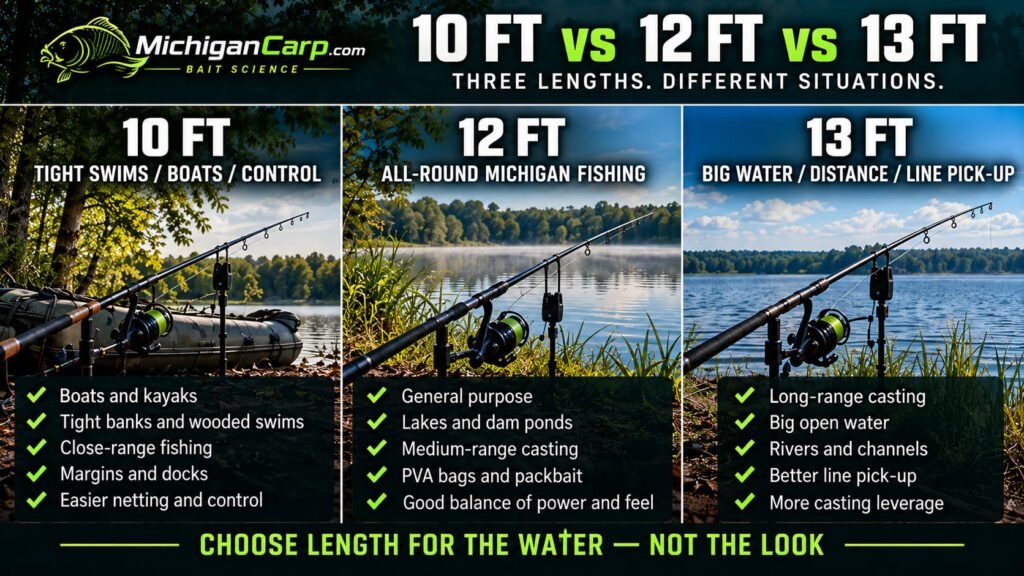
Carp Rod Length: 10 ft vs 12 ft vs 13 ft
Rod length is a practical choice, not a measure of how serious the angler is.
The three main useful groups are:
9–10 ft compact rods
12 ft all-round rods
12 ft 6 in–13 ft longer-range rods
9–10 ft Carp Rods
Short carp rods deserve far more respect than they sometimes receive.
They are particularly useful for:
- boats;
- kayaks;
- tight campground banks;
- wooded swims;
- short-range fishing;
- margins;
- docks;
- snag fishing;
- mobile sessions.
At close range, the shorter lever can make the rod easier to control.
Netting can also be easier because there is less rod behind you and less tip length extending beyond the fish.
The main compromise is casting leverage and long-range line pick-up.
If your fishing regularly takes place at 60–100 yards from an open shoreline, a compact rod is unlikely to be your only rod system.
12 ft Carp Rods
Twelve feet remains the most useful general bank-fishing length.
It works because it sits between the extremes.
A good 12 ft rod can handle:
- normal lake casting;
- medium-range fishing;
- many PVA bags;
- packbait;
- weed edges;
- public-bank fishing;
- channels;
- moderate distance;
- normal netting situations.
For an angler buying a first serious set of dedicated carp rods, 12 ft remains my default recommendation.
For carp fishing rods Michigan conditions usually favor a versatile 12 ft progressive rod unless the venue creates a specific reason to go shorter, longer or more powerful.
12 ft 6 in and 13 ft Carp Rods
Longer rods start to make sense when the water gives you a genuine reason for them.
That reason might be:
- long-range casting;
- large open banks;
- long line pick-up;
- wide rivers;
- difficult current;
- distance fishing with larger reels.
A longer rod gives additional leverage.
What it does not guarantee is additional casting distance.
Casting technique, line diameter, reel spool, rod action, lead weight, timing and aerodynamics all matter.
A 13 ft rod is also more awkward around trees, bivvies, campground banks, boats and tight netting situations.
Do not buy one simply because you fish a large lake.
A big lake can still have carp feeding thirty yards from the bank.
Test Curve Explained
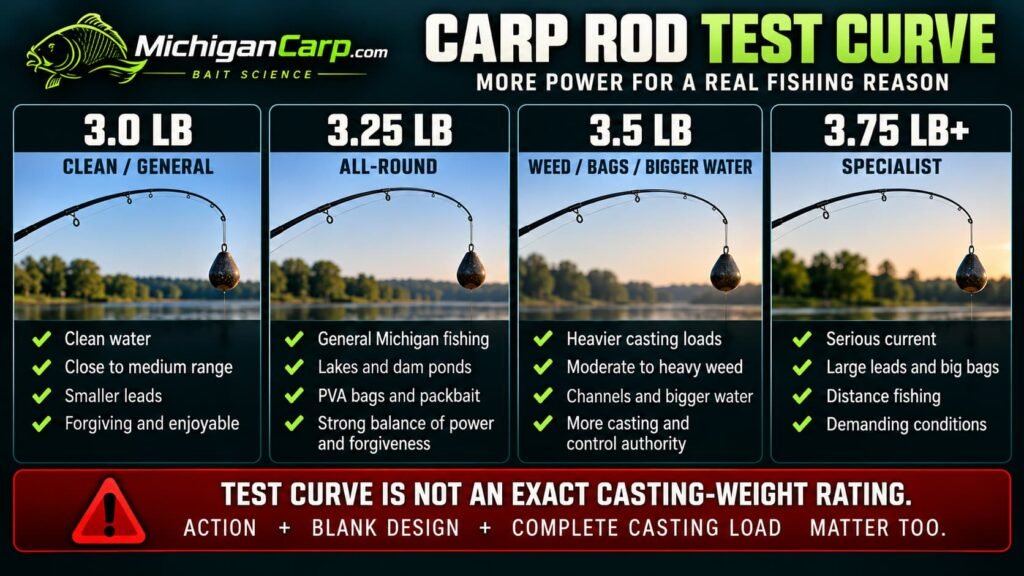
Test curve is a useful indication of rod power, but it is commonly misunderstood.
It is not an exact casting-weight rating.
Two rods carrying the same test-curve figure can feel completely different because blank taper, materials, recovery and action differ.
That is why I would never buy a rod using the test-curve number alone.
The general progression looks like this:
| Test Curve | Typical Role | Main Consideration |
|---|---|---|
| 2.75 lb | Clean water, close/medium range | Softer and forgiving |
| 3.0 lb | General clean-water fishing | Useful lighter all-rounder |
| 3.25 lb | Broad Michigan all-round role | Strong balance of power and forgiveness |
| 3.5 lb | Weed, bags, channels, bigger water | More casting and control authority |
| 3.75 lb+ | Current, specialist distance or demanding loads | More specialized |
The manufacturer’s stated casting recommendations should always take priority over a homemade conversion from test curve.
For a technical industry explanation of rod length and test curve, see Korda’s Rod Length and Test Curve Guide.
2.75–3 lb
This range can be excellent on relatively clean lakes.
It gives good cushioning and enjoyable fish playing and handles ordinary leads at sensible ranges.
It becomes less suitable when heavy weed, large PVA bags, strong current or demanding distance work becomes normal.
3.25 lb
For mixed Michigan fishing, this is the range I would look at first.
It offers enough backbone for:
- moderate weed;
- larger leads;
- normal bag work;
- stronger mono;
- bigger public waters;
- reasonable distance fishing.
Yet a good progressive 3.25 lb rod can remain forgiving under the tip.
3.5 lb
This starts to make more sense when the tackle has to do harder work.
Typical reasons include:
- heavier PVA bags;
- large packbait casts;
- stronger wind;
- weed;
- channels;
- bigger leads;
- longer distances;
- stronger mainline.
It is not automatically better.
For short-range carp on clean bottom, a powerful 3.5 lb rod can feel unnecessarily stiff.
3.75 lb and Above
This is specialist territory.
It may make sense for:
- serious current;
- particularly heavy leads;
- demanding distance work;
- severe weed or snag situations;
- some boat or compact heavy-duty setups.
If you cannot explain exactly why you need the extra power, you probably do not need it.
Rod Action Matters as Much as Test Curve
Test curve tells only part of the story.
Rod action describes how the blank bends and transfers power.
Through Action
A through-action rod bends deeply through much of the blank.
Advantages include:
- excellent cushioning;
- enjoyable close-range fish playing;
- forgiving hook-hold protection.
It is less suited to demanding distance work and situations where fast recovery and strong fish control dominate.
Progressive Action
A progressive rod offers softer initial compression but develops stronger resistance deeper into the blank.
For general Michigan carp fishing, this is my preferred compromise.
It can provide:
- casting control;
- sufficient backbone;
- good fish-playing feel;
- useful reserve power.
Faster Distance-Style Action
A faster rod tends to recover more quickly and concentrates greater casting power into the blank.
That can help with:
- distance;
- heavier leads;
- PVA bags;
- open water.
The trade-off is usually less forgiveness at close range.
Drag setup becomes especially important.
For most anglers who are not specifically distance specialists, I would favor progressive rather than extremely fast.
Casting Load: Lead, PVA, Method Feeder and Packbait
This is where rod-buying advice often becomes unrealistic.
The rod casts the entire payload.
Suppose you start with a 3 oz lead.
Add:
- a loaded solid PVA bag;
- bait;
- rig components.
The rod may now be casting considerably more than the lead number printed on the packet suggests.
The same applies to a loaded method feeder.
Packbait can add substantial weight.
That means an angler who regularly casts large baited loads may benefit from a stronger blank even when the actual fishing distance is modest.
Never assume that a test curve automatically tells you the safe casting limit.
Follow the manufacturer’s recommendations for the specific rod.
If a load feels uncontrolled, stop increasing it.
Overloading a rod can reduce accuracy, increase crack-offs and damage tackle.
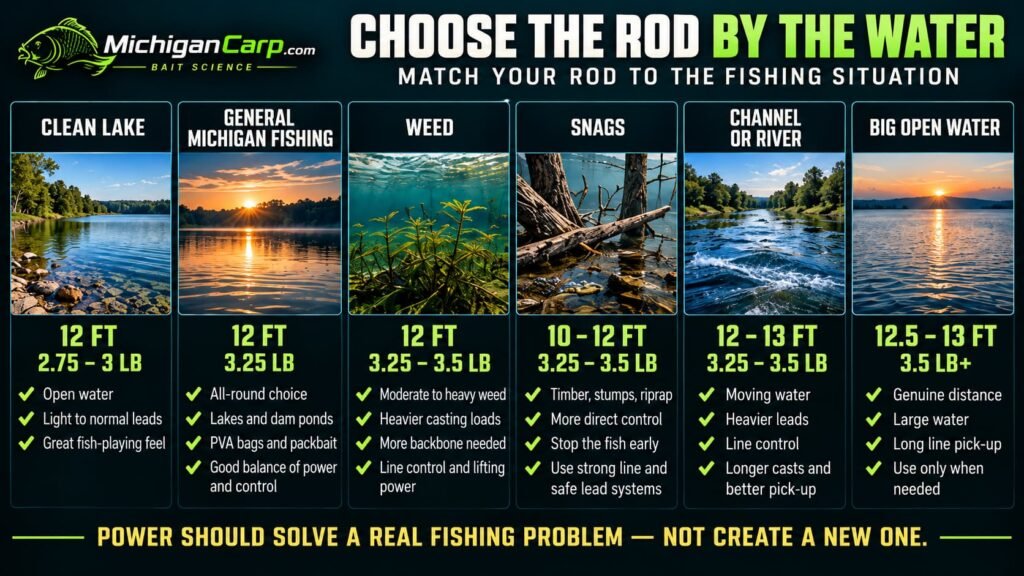
Match the Rod to the Water
This is more useful than asking what rod is best for carp generally.
Clean Inland Lakes
On open, relatively snag-free water, there is little reason to over-tackle.
A typical useful starting point is:
12 ft • 3 lb • progressive action
A 2.75 lb rod can also be enjoyable where casting loads and ranges remain modest.
The advantage is cushioning.
You can play carp without needing excessive pressure.
Weed
Weed increases the need for control.
A carp reaching dense cabbage or other submerged vegetation can quickly turn a normal fight into a line-angle problem.
For moderate weed, I prefer:
12 ft • around 3.25 lb
For heavier weed or larger casting loads:
12 ft • around 3.5 lb
But power alone does not solve weed fishing.
The rod must be matched with suitable line, hook strength, leader arrangement and a fish-safe lead system.
Use Carp Fishing Line and Leaders for Michigan for that part of the setup.
Stumps, Timber and Serious Snags
Snag fishing requires judgement before tackle.
A more powerful rod can help turn a fish.
It cannot make an impossible swim safe.
For controlled snag edges, a strong progressive rod around 10–12 ft can offer more direct control than a long distance rod.
But ask:
- Can I stop the fish?
- Can I change the line angle?
- Can I land it safely?
- What happens if the line breaks?
- Will the lead release safely?
If the realistic outcome of a take is a carp buried in unrecoverable timber, changing the fishing position is better than simply buying a stronger rod.
Rock, Riprap and Zebra Mussels
Abrasion is the main problem here.
The rod’s job is to change the line angle and gain control before line is repeatedly dragged over sharp material.
A progressive 12 ft rod around 3.25–3.5 lb can be useful, but line and leader choice matter more than simply increasing rod power.
Inspect line frequently.
Rivers and Channels
Moving water adds continuous load.
You may also need heavier leads to hold position.
A useful starting range is:
12–13 ft • 3.25–3.5 lb
Stronger current or specialist casting may justify more.
Again, the complete casting load matters.
Big Michigan Lakes
A large lake does not automatically require a distance rod.
That point is important.
Carp can use:
- margins;
- weed edges;
- bay mouths;
- shallow flats;
- points;
- channel edges;
- near-bank drop-offs.
Start with location.
Use Watercraft and Conditions for Michigan Carp Fishing before assuming the fish are at maximum range.
If the carp really are using distant water and the bank allows proper casting, then 12 ft 6 in or 13 ft rods become logical.
Boats and Tight Banks
This is where 9–10 ft rods excel.
A short rod can be easier for:
- netting;
- steering;
- lifting line;
- close boat work;
- wooded banks;
- campground swims.
If you place rigs from a boat rather than casting long distance, much of the reason for owning a 13 ft rod disappears.
Rod, Reel and Line Should Work as One System
A carp rod should never be selected independently of the reel and line.
A heavy 13 ft rod paired with a small reel can feel poorly balanced.
A compact 10 ft rod paired with an enormous distance reel may be unnecessarily cumbersome.
For general 12 ft fishing, medium-large freespool or carp-style reels are usually a logical match.
For longer distance rods, a larger spool can improve balance and line handling.
For compact rods and boat work, a more compact reel often makes the setup easier to use.
The reel’s drag is especially important.
A powerful rod plus a sticky drag is a bad combination.
Use Carp Fishing Reels for Michigan for the full reel system.
Strong Line Does Not Mean You Need the Stiffest Rod
Another common mistake is assuming that heavy mainline requires the most powerful rod available.
That is not how I would build the system.
Mainline strength should reflect:
- abrasion;
- weed;
- snags;
- casting requirements;
- fish safety.
Rod power should reflect:
- casting load;
- fish control;
- range;
- line angle.
These factors overlap, but they are not identical.
Heavy line around mussels may be necessary because of abrasion even when casting range is modest.
Likewise, a powerful casting rod may be used with relatively modest line on clean open water.
Match the complete system rather than pairing specifications simply because their numbers look similar.
Carp Rods vs Catfish Rods
You do not need a dedicated European-style carp rod to catch a carp.
Many North American anglers start with catfish rods, and that can be perfectly sensible.
A capable catfish rod can:
- cast a bait;
- handle strong line;
- land large carp.
The reasons to move toward specialist carp rods are refinement rather than magic.
Dedicated carp rods are generally designed around:
- repeated lead casting;
- static bank fishing;
- fixed-spool reels;
- bite alarms;
- long fights;
- hair-rig presentations;
- multiple-rod setups.
A good carp rod may therefore provide better casting feel, balance and fish-playing action.
My advice to a beginner is simple:
Use capable tackle first. Upgrade once your fishing tells you what you actually need.
Do You Need Three Matching Carp Rods?
Not necessarily, although matching rods make life easier.
A matched set gives you:
- consistent casting;
- consistent feel;
- identical line angles;
- interchangeable sections in some cases;
- simpler transport and setup.
For someone building a dedicated carp setup, I would normally buy two matching rods first rather than immediately buying three specialist rods.
Learn what your venues demand.
You may later decide you need:
- a third identical all-round rod;
- a short boat rod;
- a heavy weed rod;
- a distance rod.
There is little benefit in buying specialist tackle before the fishing creates the problem it is supposed to solve.
Used Carp Rod Buying Checks
Used carp rods can offer excellent value.
Inspect them carefully.
Guides
Look for:
- cracked inserts;
- grooves;
- corrosion;
- loose guide feet;
- damaged tip rings.
A useful simple check is to pass cotton gently around the guide surface. A damaged insert may catch fibers.
Joints
Assemble every section.
Check for:
- excessive looseness;
- twisting;
- clicking;
- damaged spigots or ferrules.
Blank
Look for:
- crushing;
- deep scratches;
- impact marks;
- repairs;
- unusual soft spots.
Cosmetic marks are one thing.
Structural damage is another.
Reel Seat and Handle
Check that the reel seat holds firmly and that handles have not become loose.
A bargain rod that damages line or fails under load is not a bargain.
What I Would Buy First for Michigan Carp Fishing
For someone starting serious Michigan carp fishing, my default recommendation would be:
two matching 12 ft, 3.25 lb progressive-action carp rods
Why?
Because they cover a broad range of realistic fishing:
- lakes;
- dam ponds;
- campground banks;
- moderate weed;
- packbait;
- PVA;
- boilies;
- tiger nuts;
- normal distance;
- reasonably heavy mono.
If the fishing is almost entirely clean and close range:
12 ft, 3 lb is a very good alternative.
If heavy weed, solid bags or bigger water are already normal:
12 ft, 3.5 lb may be justified.
If much of the fishing is from boats or tight banks:
consider 10 ft rods before automatically moving upward in length.
If true distance is repeatedly required:
then consider 12 ft 6 in or 13 ft rods.
The key phrase is repeatedly required.
Do not buy a distance rod for one swim you might fish someday.
My Own Practical Michigan Rod Choice
For my own fishing, my rod choice has moved toward the more powerful end because of the water I fish.
Much of my fishing involves large wild lakes and dam ponds, heavier line, long sessions, weed, stronger casting loads and carp that may have to be controlled before they reach trouble.
I currently use 13 ft, 3.5 lb test-curve rods.
That does not mean I would recommend that specification as the universal Michigan carp rod.
It reflects my fishing.
On cleaner water at shorter range, I would happily use less rod.
That is really the central lesson of this entire guide:
the rod specification should describe the problem you fish—not the carp angler you want to look like.
Common Carp Rod Mistakes
Buying Too Much Rod
A heavy distance rod is unnecessary if your normal fishing is short range on open water.
Buying Too Little Rod
A soft clean-water rod can become a liability around heavy weed, strong current or large casting loads.
Using Test Curve as a Casting-Weight Formula
Test curve is not an exact casting rating. Follow the manufacturer’s recommendations.
Ignoring the Complete Casting Load
Lead plus feeder, bag or packbait can weigh considerably more than the lead alone.
Assuming Bigger Water Means Longer Rods
Location determines casting distance.
Lake acreage does not.
Ignoring Rod Action
Two rods with the same test curve may fish completely differently.
Ignoring Reel Balance
The rod, reel and line form one working system.
Treating Stronger Tackle as Permission to Fish Unsafe Snags
No rod makes an unrecoverable snag safe.
Spending on Rods Before Fish Care
A premium rod is less important than a proper net, mat or cradle, sling, forceps and fish-safe rig system.
Practical Michigan Rod Recommendations
If you want the short version:
Clean water / normal leads:
12 ft • around 3 lb • progressive
General Michigan fishing:
12 ft • around 3.25 lb • progressive
Weed / bigger bags / heavier work:
12 ft • around 3.5 lb • progressive to faster progressive
Boats / tight banks:
9–10 ft • suitable power for the hazards
Big open water / genuine distance:
12 ft 6 in–13 ft • around 3.5 lb where justified
Serious current or specialized heavy work:
3.5–3.75 lb+ only when the actual job demands it
If I had to choose one general specification without knowing anything else about the venue:
12 ft • 3.25 lb • progressive action
It will not be perfect everywhere.
But it will be useful almost everywhere.
FAQ
What is the best carp rod for Michigan?
For general Michigan carp fishing, a 12 ft progressive-action rod around 3.25 lb test curve is a strong all-round starting point. Clean-water anglers may prefer 3 lb, while weed, bags and heavier water can justify 3.5 lb.
Is a 10 ft carp rod too short?
No. A 10 ft rod can be excellent for boats, tight banks, wooded swims, margins and close-range fishing. It sacrifices some casting leverage and long-range line pick-up.
Do I need a 13 ft carp rod for large Michigan lakes?
Not automatically. A 13 ft rod becomes useful when the carp’s actual location requires longer casts or additional line control. Large lakes can still produce excellent close-range fishing.
What does carp rod test curve mean?
Test curve is an indication of rod power. It is not an exact casting-weight rating and does not describe rod action, recovery or blank quality by itself.
Is a 3.5 lb carp rod too powerful?
Not when weed, heavier bags, channels, larger leads or distance work justify it. It can be unnecessarily stiff for clean, close-range fishing.
Is a 3 lb rod powerful enough for carp?
Yes. A well-designed 3 lb rod is an excellent choice for clean to moderately difficult water with normal leads and short-to-medium range fishing.
What rod should I use for heavy weed?
A progressive 12 ft rod around 3.25–3.5 lb is a practical starting range. Heavy weed also requires appropriate line, hooks, lead safety and a realistic landing plan.
Can I use a catfish rod for carp?
Yes. A suitable catfish rod can catch carp perfectly well. Dedicated carp rods become useful when you want more refined casting, balance and fish-playing characteristics for static carp fishing.
What rod should I use for PVA bags or packbait?
The answer depends on the complete loaded weight. Moderate loads may suit a 3.25 lb rod, while heavier bags or longer casting can justify 3.5 lb. Always follow the specific rod manufacturer’s casting guidance.
Should I buy two or three carp rods first?
Two matching all-round rods are a sensible first purchase. Add a third or specialist rod after your normal fishing shows that you need one.
Are expensive carp rods necessary?
No. Blank action, guide quality, reliability and suitability for your fishing matter more than price. Premium rods become more worthwhile once you know exactly what characteristics you want.
Next Steps
Build the rod into a complete tackle system rather than choosing it in isolation.
Use Carp Fishing Reels for Michigan to match reel size, freespool system, drag and line capacity.
Use Carp Fishing Line and Leaders for Michigan for mono, braid, abrasion and leader selection.
Use the Michigan Carp Rig Guide to make sure the terminal system remains safe.
Use Carp Gear for Michigan for the complete equipment route.
And before worrying about another rod upgrade, make sure the essential fish-care equipment in Carp Fish Care and Safety and Landing Gear for Carp Fishing is already covered.
The practical rule remains:
BUY ENOUGH ROD FOR THE WATER.
DO NOT BUY MORE ROD THAN THE WATER REQUIRES.