

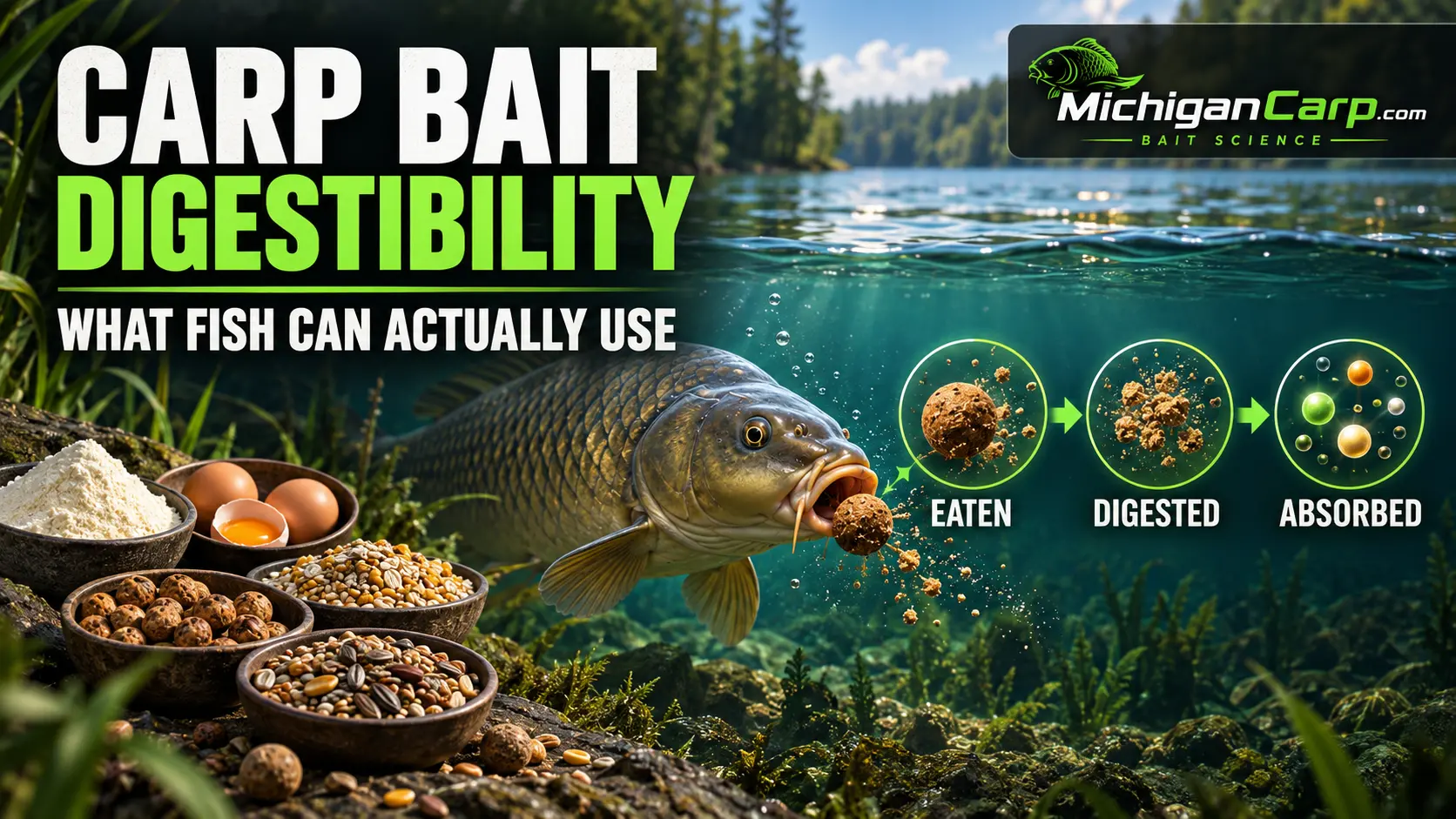
Carp bait digestibility is not about how soft a boilie feels, how strongly it smells, or how quickly it clouds the water. It is about what happens after a carp eats it: how effectively the fish can break down, absorb and use the nutrients in that food.
That distinction matters because several common bait claims confuse very different properties.
A soft bait is not automatically digestible.
A hard bait is not automatically indigestible.
A high-protein bait is not automatically a better food.
A highly soluble ingredient can create a strong signal without providing a balanced meal.
And words such as natural, raw, fermented, hydrolyzed, premium and pre-digested tell us very little unless we know what was processed, how it was processed, and what job the ingredient performs in the finished bait.
This guide explains what carp bait digestibility really means, how it differs from softness and solubility, what controls nutrient use, and how I apply the subject to homemade boilies and longer sessions on Michigan waters.
For the digestive-anatomy side, read Why Carp Have No Stomach and What It Really Means for Bait. For the difference between attraction and food value, use Solubility vs Nutrition in Carp Bait.
Table of Contents
Quick Answer
Carp bait digestibility describes how effectively a carp can use nutrients from bait after eating it.
The main points are:
- nutrient percentage and nutrient availability are not the same thing;
- proteins, fats, carbohydrates and minerals from one ingredient may not be used equally well;
- ingredient identity and processing matter more than marketing language;
- plant ingredients can be valuable when the product and inclusion level are sensible;
- anti-nutritional factors matter most when the ingredient is poorly processed, used heavily, or forms a large part of a repeated feeding program;
- softness affects physical bait behavior, not nutritional digestibility directly;
- solubility affects what can leave a bait in water, not necessarily what the fish can use after eating it;
- water temperature changes feeding behavior and total food intake, but it does not turn every balanced food bait into an indigestible lump;
- a coherent blend of ingredients usually makes more sense than chasing one supposedly perfect protein source.
The practical rule is simple:
Judge the whole bait by ingredient quality, processing, balance and intended use—not by one crude-protein number or fashionable additive.
What Carp Bait Digestibility Actually Means
In feed science, digestibility is estimated by comparing what an animal consumes with what remains unabsorbed and is excreted. Results are commonly expressed as apparent digestibility coefficients for dry matter, protein, lipid, energy or individual nutrients.
Home bait makers cannot calculate a meaningful digestibility figure by looking at a recipe on paper. We normally do not have controlled diets, representative fish, measured intake, collected waste or laboratory analysis.
That does not make the idea useless. It means we should use it honestly.
For carp bait, digestibility is a way of asking:
- Can the fish process this ingredient efficiently?
- Are the nutrients in a usable form?
- Does processing improve the ingredient or damage it?
- Does the amino-acid pattern complement the rest of the mix?
- Is too much fiber or indigestible bulk diluting the bait?
- Is the fat level appropriate once all ingredients are counted?
- Does the formula suit the amount I intend to feed?
Two ingredients can each show 50 percent crude protein on a specification sheet and still contribute very different amounts of usable nutrition.
The same applies to energy, fats, minerals and individual amino acids. A label is useful, but it is not the finished answer.
Crude Analysis Is Only the Starting Point
Crude protein estimates the nitrogen-containing material in an ingredient. It does not tell us:
- how well that protein is digested;
- whether the amino-acid profile is balanced;
- whether important amino acids are available;
- whether heat or storage has damaged the ingredient;
- whether anti-nutritional compounds interfere with its use;
- or how the ingredient behaves beside everything else in the bait.
This is why I prefer to formulate around function and balance rather than chase the highest protein percentage possible.
For the wider protein picture, read Proteins, Peptides and Hydrolysates in Carp Bait.
Digestibility Is Not Softness, Solubility or Protein Percentage
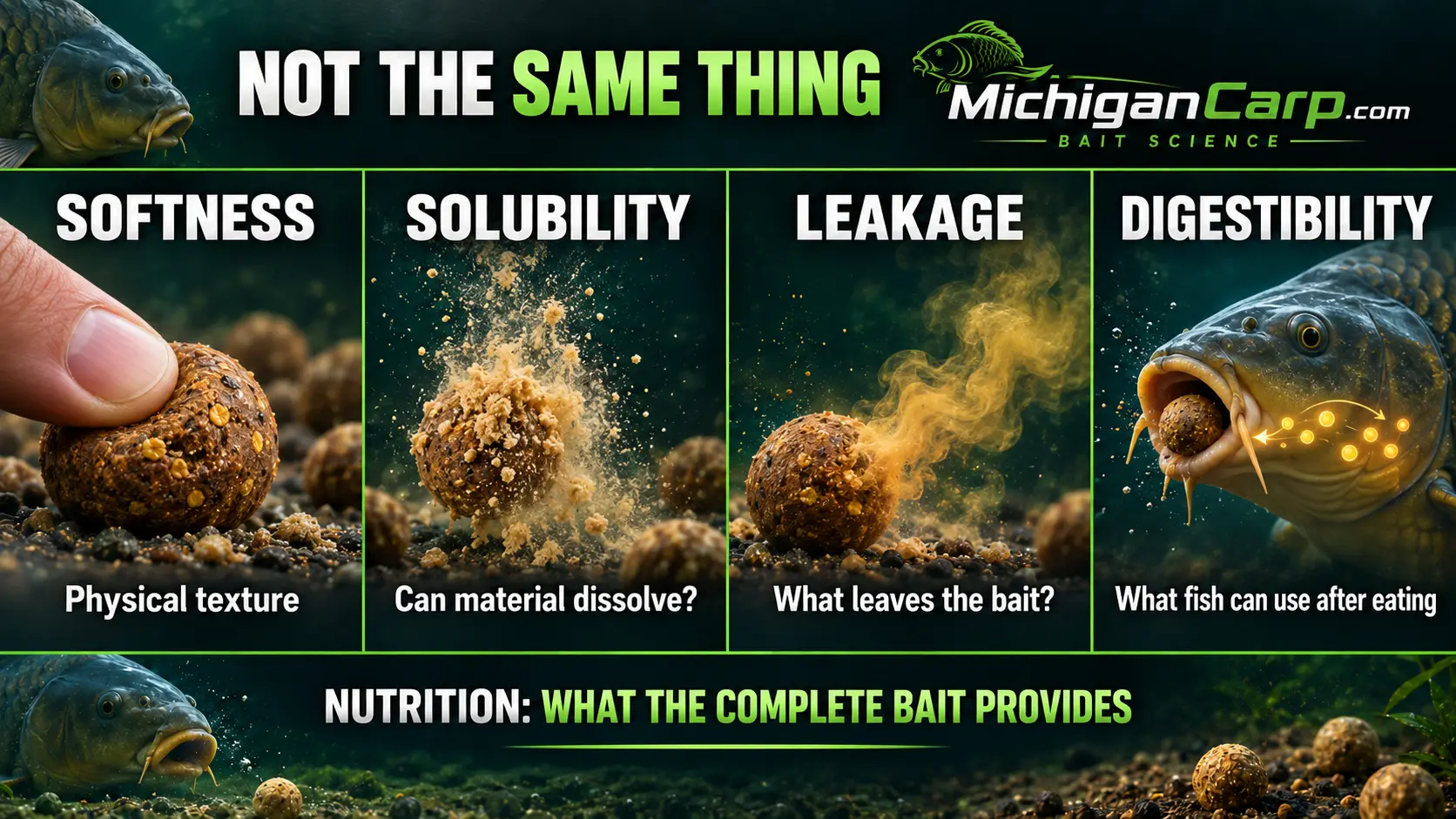
These properties are regularly mixed together, but each answers a different question.
| Property | The Useful Question |
|---|---|
| Softness | How easily does the finished bait compress, hydrate or break apart? |
| Solubility | Can a particular substance dissolve in water? |
| Leakage | What actually leaves the finished bait and enters the surrounding water? |
| Digestibility | How effectively can consumed nutrients be digested and absorbed? |
| Nutrition | What useful food value does the complete bait provide? |
Softness Is a Physical Property
A soft boilie may hydrate quickly, shed particles and break down sooner. Those qualities can help water enter the bait and can improve the release of soluble material.
They do not prove that the ingredients are nutritionally digestible.
A hard hookbait can still contain useful food ingredients. Its outer structure may simply have been designed to survive casting, nuisance fish, crayfish, zebra mussels or a long soak.
The real problem comes when a free bait is made unnecessarily dense, dry and resistant, then fed in quantity as though hardness were a sign of quality.
Solubility Happens Before Eating; Digestibility Happens After
A soluble liquid, sugar, salt, free amino acid or small peptide may move into the water and help create a food signal. That does not make it a complete food.
An intact milk or plant protein may release slowly but still contribute useful nutrition after the bait is eaten.
The strongest bait systems combine both jobs:
- enough accessible signal to help the fish find and investigate the food;
- enough usable nutrition to make the bait worth eating.
Read Carp Bait Solubility and Leakage for the physical release side.
High Protein Is Not the Same as High Food Value
Protein percentage matters, but only within a complete formula. Protein quality, amino-acid balance, energy, fat, minerals, ingredient processing and feeding level all affect the real nutritional picture.
A bait can also be so expensive, rich or difficult to roll that it is impractical to use properly. A slightly lower-protein bait built from sound ingredients and fed consistently can be the better fishing bait.
How Carp Process Food
Common carp are agastric fish: they do not have the true acidic stomach stage found in many other animals and fish species.
That does not mean they are unable to deal with firm or varied foods. Carp naturally consume a broad mixture of insects, larvae, mollusks, seeds, plant material, detritus and other available foods.
Before swallowing, harder food can be crushed by the pharyngeal teeth at the back of the throat. Digestion and nutrient absorption then continue through the intestinal system with enzymes that act on proteins, carbohydrates and fats.
The wrong conclusion is:
Carp have no stomach, so every bait must be soft and almost dissolved before it is eaten.
The better conclusion is:
Because carp lack a strongly acidic stomach stage, ingredient selection, preparation, nutrient availability and the balance of the complete bait deserve careful thought.
That still does not let us predict the exact digestibility of a homemade boilie from its recipe. It simply gives us a sounder basis for choosing ingredients and avoiding exaggerated claims.
What Controls Digestibility in a Finished Bait
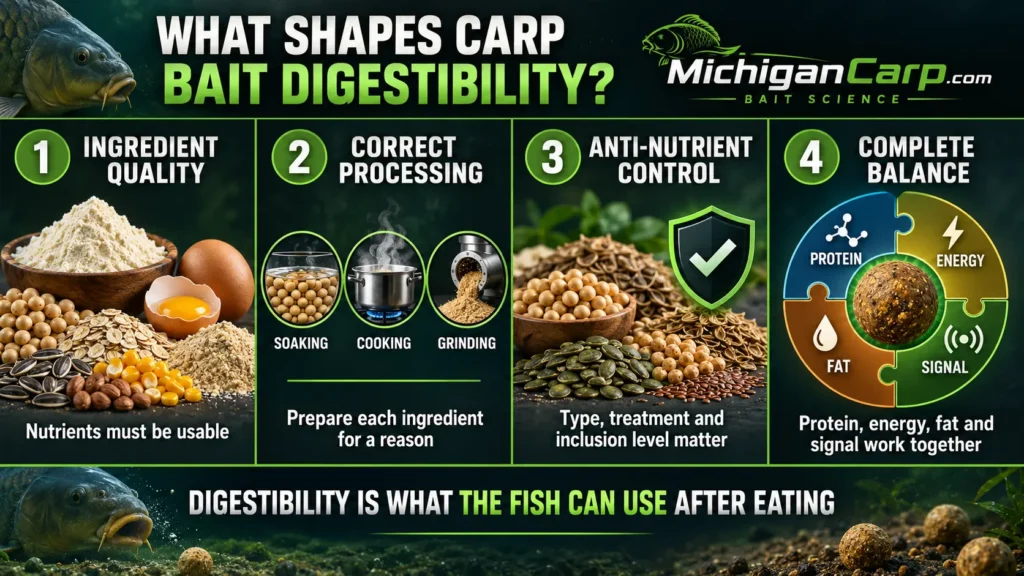
Four connected areas matter most.
1. Ingredient Identity and Quality
The exact ingredient matters more than its broad category.
“Soy” might mean raw ground soybeans, properly heat-treated full-fat soy, defatted soybean meal, soy protein concentrate or a textured food product. Those materials are not interchangeable.
“Milk powder” might mean nonfat dry milk, whole milk powder, whey powder, whey protein concentrate, milk protein concentrate or casein. Again, they do not perform the same job.
Before judging an ingredient, I want to know:
- what it actually is;
- how it was produced;
- its protein, fat, carbohydrate and fiber levels;
- whether it has been heat-treated or otherwise processed;
- how fresh it is;
- and why it belongs in the recipe.
2. Processing With a Clear Purpose
Processing can improve access to nutrients, make a hard material safer, change starch behavior, reduce selected anti-nutritional factors, increase surface area or create smaller protein fractions.
It can also damage ingredients when heat, moisture, fermentation or storage is poorly controlled.
The useful question is never simply, Is processed better than raw?
It is:
What problem is this particular process solving in this particular ingredient?
3. Anti-Nutritional Factors and Inclusion Level
Some plant materials contain compounds that can reduce protein digestion, bind minerals or otherwise lower nutrient use. Examples include protease inhibitors, phytate, tannins, lectins and saponins.
Their importance depends on:
- the ingredient;
- the form in which it was purchased;
- the processing already applied;
- the amount used;
- and the rest of the diet.
This is not a reason to reject plant ingredients. It is a reason to use identifiable, properly processed products at sensible levels.
4. The Balance of the Complete Bait
Carp do not eat ingredients from a spreadsheet. They eat the finished bait.
Protein, amino acids, energy, fats, minerals, texture and food signal have to work together. A formula built around one impressive ingredient can still be poorly balanced, too fatty, too fibrous, too hard, too expensive or too weak in water.
Blending usually makes more sense than extremes:
- one protein source can improve nutritional quality;
- another can help structure;
- cereals can contribute usable energy and handling;
- birdfoods can open texture;
- nuts and seeds can add identity and natural fats;
- yeast and hydrolysates can strengthen food-related signal;
- egg can bind, heat-set and add nutrition.
The goal is not to fit every possible ingredient into one recipe. It is to give each ingredient a clear job.
Digestibility of Protein, Carbohydrate, Fat and Fiber
Digestibility does not apply to protein alone. A useful bait needs an appropriate nutrient and energy system.
Protein and Amino-Acid Availability
Protein sources differ in digestibility, amino-acid pattern, processing history, solubility, heat sensitivity, anti-nutritional load and cost.
A blend of complementary proteins is often more practical than relying on one expensive source. Milk proteins, egg, processed soy, wheat proteins, yeast, nut meals and seed meals can all have roles when selected for a reason.
Free amino acids and small peptides should be considered separately from intact dietary proteins. They can contribute soluble feeding-related signals, but adding a few amino acids does not correct a poorly designed nutritional base.
Milk Proteins
Milk-derived ingredients can provide useful protein and functional effects, but “milk protein” is not one ingredient.
Casein, caseinate, whey protein concentrate, hydrolyzed whey, nonfat dry milk and whole milk powder differ in:
- protein concentration;
- solubility and dispersibility;
- heat-setting behavior;
- hardness and binding;
- flavor and creaminess;
- and cost.
Large amounts of expensive dairy powder do not automatically improve a bait. I use each one for a defined job and judge it inside the complete milk, nut and birdfood system.
For the detailed breakdown, read Milk Proteins in Carp Bait: Digestibility, Solubility and Food Value.
Plant Proteins
Plant proteins are neither automatically excellent nor automatically cheap filler.
Properly processed full-fat soy, soybean meal, selected cereal proteins and other plant meals can help build a balanced, economical bait. Raw or poorly identified agricultural material is a different proposition.
I look at processing, fiber, fat, amino-acid contribution, anti-nutritional factors and inclusion level before deciding whether a plant ingredient fits the mix.
Read Anti-Nutritional Factors in Carp Bait Ingredients for the deeper explanation.
Carbohydrates and Starch
The word carbohydrate covers simple sugars, starches and several fiber fractions. They do not behave identically.
Cereal ingredients can provide energy, binding, rolling quality, structure and sensible cost. Heat and moisture can change the availability and physical behavior of starch, but the result depends on the cereal and the process.
Semolina, maize meal, rice flour, wheat flour and bran should not be treated as nutritional synonyms simply because they are all cereal ingredients.
For the wider subject, read Sugars, Sweeteners and Carbohydrates in Carp Bait.
Fat and Total Bait Richness
Fat supplies concentrated energy and essential fatty acids, but more is not automatically better.
The total fat system includes what is already present in:
- eggs;
- nuts and nut meals;
- seeds and birdfoods;
- full-fat soy;
- milk powders;
- pellets;
- and any bottled oil.
That is why I count built-in fat before adding oil. A nut-heavy mix may already contain all the lipid it needs.
The full calculation method is covered in How to Balance Fat in Boilies.
Fiber
Fiber is not automatically bad. Modest amounts can influence texture, structure and breakdown.
The problem is excessive low-value bulk. High fiber can dilute nutrient and energy density, especially when a cheap ingredient dominates the formula.
The right question is not, Does this ingredient contain fiber?
It is:
What is it contributing, and is the inclusion level justified?
Processing, Anti-Nutrients, Enzymes and Hydrolysates
These subjects are connected, but they should not be collapsed into one vague idea called pre-digestion.
Ingredient Processing
Soaking, cooking, heat treatment, extrusion, grinding, fermentation, hydrolysis and enzyme treatment do different jobs.
Examples include:
- soaking and cooking dry particles so they are properly prepared before feeding;
- buying heat-treated full-fat soy instead of using raw ground beans;
- grinding a hard ingredient to increase surface area and improve mixing;
- using a hydrolyzed product that already contains smaller protein fractions;
- fermenting a defined ingredient under controlled conditions rather than allowing a mixture to spoil.
Read How to Process Ingredients for Carp Bait and Raw vs Processed Ingredients in Carp Bait before adding an extra process simply because it sounds advanced.
Boiling the Finished Boilie
Ingredient processing and finished-bait cooking are separate questions.
Boiling or steaming a boilie changes its outer structure, starches, proteins, water access, firmness and durability. Time and bait diameter matter: a 24 mm boilie needs a different cooking decision from a 14 mm bait.
That does not mean boiling automatically destroys nutrition or makes the bait indigestible. It means excessive cooking and drying can create a dense bait that admits water and releases signal more slowly than intended.
The target is enough heat setting for the bait’s job—not the hardest boilie that can be produced.
Read What Boiling Does to Carp Bait for the full explanation.
Enzymes
Adding an enzyme powder to a finished mix does not automatically create a pre-digested bait.
An enzyme needs:
- a suitable substrate;
- enough moisture;
- a workable temperature;
- an appropriate pH;
- sufficient reaction time;
- and a process that occurs before later heat stops the activity.
Phytase, protease and amylase do not perform the same job. Each should be used only when the target ingredient and preparation method justify it.
Read Enzymes in Carp Bait: Phytase, Protease and Pre-Digestion.
Hydrolysates
Hydrolysates contain proteins broken into smaller fractions to varying degrees. Depending on the product, that can include larger peptides, smaller peptides, free amino acids, salts and other food-derived material.
They can be useful for soluble signal, palatability, crumb treatments, hookbait liquids or a modest contribution to the bait’s protein system.
They are not a substitute for the dry nutritional backbone of a feeding bait.
Read How to Use Hydrolysates in Carp Bait.
Fermentation
Fermentation can change an ingredient, but fermented does not automatically mean more digestible.
The result depends on the starting material, microorganisms, moisture, temperature, pH, hygiene and time. Controlled fermentation may be useful. Uncontrolled spoilage is not bait development.
For the practical distinction, read Fermented Carp Bait and Food Signals.
Water Temperature, Bait Quantity and Session Length
Water temperature matters because carp are ectothermic. Their movement, feeding frequency, total intake and the length of feeding windows change as conditions change.
But the statement cold water makes bait indigestible is too crude. Experimental digestibility results can vary by diet and nutrient, while the angler’s larger practical problem is often that the fish are moving less, feeding for shorter periods or consuming less food.
That makes bait quantity at least as important as chasing a special cold-water ingredient.
What I Change in Cool Water
In cooler conditions I normally favor:
- lower total feed;
- accurate placement;
- smaller or chopped free baits when useful;
- a controlled soluble signal;
- ingredients with clear functions;
- less unnecessary added oil;
- and a willingness to wait for evidence before adding more bait.
I do not automatically replace a balanced food bait with soft sugary mush. I change the quantity, concentration and speed of communication first.
Hookbait, Short Session or Feeding Campaign?
Digestibility matters in context.
A single durable hookbait used over a small PVA bag is not the same nutritional event as several pounds of bait fed during a three- to five-day session. The more bait carp may consume, and the more often an area is prebaited, the more important ingredient quality, fat level, nutrient balance and processing become.
This is particularly relevant on large Michigan waters. A practical system may combine:
- properly prepared particles for volume and variety;
- a consistent, balanced boilie;
- crumb and chops for quicker local release;
- and a more concentrated hookbait or small PVA presentation near selected rigs.
Not every free bait has to be an expensive premium boilie. It does need to be safe, coherent and suitable for the amount being fed.
Seasonal Use in Michigan
Spring: Find the fish first, begin with restraint, and use a useful local signal without assuming that more bait will create a feeding spell.
Summer: During sustained summer feeding, a broader food package becomes more valuable. Protein quality, energy, natural fats and consistent baiting can work together.
Fall: Follow actual water temperature and fish behavior rather than the calendar. Keep food value while reducing quantity as feeding windows shorten.
Very cold conditions: Prioritize location, small amounts, controlled signal and minimal waste.
Four Practical Digestibility-Led Bait Systems
1. Short Cool-Water Session
- one dependable hookbait;
- a small PVA bag, crumb or a few chops;
- modest soluble food-signal support;
- low total feed.
Priority: Communicate locally without overfeeding.
2. Three- to Five-Day Big-Water Session
- properly prepared particles;
- balanced boilies;
- crumb or chops near selected rods;
- baiting adjusted to signs, takes and recasts;
- enough economical feed to use the system consistently.
Priority: Combine real food value with controllable attraction.
3. Non-Marine Milk, Nut and Birdfood Bait
- cereals for energy, rolling and structure;
- milk proteins selected by function rather than prestige;
- processed soy or another complementary plant protein;
- nut and seed ingredients used with their natural fat counted;
- birdfood for texture and ingredient diversity;
- yeast, hydrolysate or other food-signal support at sensible levels.
Priority: Build a coherent food bait without stacking expensive powders or unnecessary oil.
For formulation, read How to Formulate a Milk, Nut and Birdfood Boilie Base Mix.
4. Repeated Prebaiting or Long-Term Feeding
- consistent ingredients from identifiable sources;
- complementary proteins;
- sensible protein-to-energy balance;
- controlled fat and fiber;
- properly processed plant materials;
- repeatable production and storage;
- a cost that allows the bait to be used as intended.
Priority: Dependable food quality, consistency and sensible economics.
Common Mistakes
Confusing Softness With Digestibility
Softness changes physical bait behavior. It does not directly measure nutrient use.
Confusing Leakage With Food Value
A strong cloud or fast flavor release can attract attention without providing balanced nutrition.
Chasing Crude Protein
A high number does not guarantee good amino-acid availability, sensible energy balance or suitable ingredient quality.
Treating All Plant Ingredients as Cheap Filler
The exact product, processing and inclusion level matter. Properly processed plant ingredients can be valuable.
Treating All Milk Powders as Interchangeable
Casein, whey protein concentrate, whole milk powder and hydrolyzed whey perform different jobs.
Ignoring Built-In Fat
Egg, nuts, seeds, full-fat soy and milk powders all contribute before bottled oil is added.
Assuming Every Cold-Water Problem Is Digestibility
Location, feeding windows and excessive bait quantity are often the larger issues.
Believing Fermentation Fixes Poor Ingredients
Fermentation is a controlled process, not a magic label.
Adding Enzymes Without a Process Plan
An enzyme only helps when it has the correct substrate and conditions in which to work.
Overcooking and Overdrying Free Bait
Durability matters, but a dense shell and very low moisture can slow water entry and signal release beyond what the session requires.
My Practical View
After more than 50 years of carp fishing in the UK and Michigan, I do not think the best bait is the one with the longest ingredient list or highest protein figure.
I want a bait that rolls and cooks reliably, survives the fishing situation, begins communicating in water, provides useful food after it is eaten, and is economical enough to use properly.
On a short cool-water trip, location and restraint come first.
On a three- to five-day session, I want consistent food, manageable cost and the ability to adjust the feeding level without changing the whole bait system.
In a non-marine milk, nut and birdfood bait, that normally means blending ingredients rather than building the recipe around one expensive dairy powder. Cereals provide energy and mechanics. Processed soy and milk proteins contribute complementary protein. Nuts, seeds and egg add natural fats. Birdfoods help texture. Yeast, hydrolysates and selected soluble ingredients help the bait communicate.
Every part has a job.
The final rule is:
Build a bait that makes sense before it is eaten, while it is being eaten, and after it has been eaten.
FAQ
What Does Carp Bait Digestibility Mean?
It means how effectively a carp can break down, absorb and use nutrients from bait after eating it.
Is a Soft Boilie More Digestible?
Not automatically. Softness affects hydration, breakdown and water entry. Nutrient digestibility depends mainly on the ingredients, processing and complete formulation.
Is Soluble Bait the Same as Digestible Bait?
No. Solubility describes whether material can dissolve in water. Digestibility describes nutrient use after consumption.
Do Carp Have a Stomach?
Common carp do not have a true acidic stomach. Food is mechanically processed by the pharyngeal teeth, then digested and absorbed through the intestinal system.
Are Plant Proteins Bad for Carp Bait?
No. Properly processed soy, cereal proteins and other plant ingredients can be useful. The exact product, anti-nutritional factors, fiber and inclusion level all matter.
Are Milk Proteins Digestible?
Milk proteins can provide useful nutrition, but different dairy ingredients have different protein, solubility and structural properties. They should be selected by function rather than added indiscriminately.
Does Cold Water Make Boilies Indigestible?
No. Temperature affects carp physiology and feeding behavior, but the practical response is usually to improve location, reduce unnecessary feed, control oil and use an appropriate signal—not assume every normal food ingredient has become indigestible.
Does Boiling Make a Boilie Less Digestible?
Boiling changes proteins, starches and physical structure. Excessive cooking can create an unnecessarily dense bait, but ordinary heat setting should not be described as automatically destroying digestibility.
Do Hydrolysates Make Bait Pre-Digested?
Hydrolysates contain protein broken into smaller fractions and can add soluble food-related material. They do not pre-digest the rest of the recipe or replace a balanced dry base.
Are Enzymes Worth Using in Homemade Boilies?
Only when the enzyme, target ingredient, moisture, temperature, pH and reaction time make sense together. Adding enzyme powder without a defined treatment process is unlikely to achieve what the label implies.
Continue Learning
Use these guides to go deeper into digestion, nutrient availability, ingredient processing and practical bait design:
- Why Carp Have No Stomach and What It Really Means for Bait
- Proteins, Peptides and Hydrolysates in Carp Bait
- Solubility vs Nutrition in Carp Bait
- Carp Bait Solubility and Leakage
- How to Balance Fat in Boilies
- Raw vs Processed Ingredients in Carp Bait
- How to Process Ingredients for Carp Bait
- Anti-Nutritional Factors in Carp Bait Ingredients
- Enzymes in Carp Bait: Phytase, Protease and Pre-Digestion
- What Boiling Does to Carp Bait
- Milk Proteins in Carp Bait
- How to Use Hydrolysates in Carp Bait
- Sugars, Sweeteners and Carbohydrates in Carp Bait
- Bait Science
For the underlying feed-science background, see the FAO material on carp nutritional requirements and digestive physiology and fish-feed digestibility and digestive anatomy.