

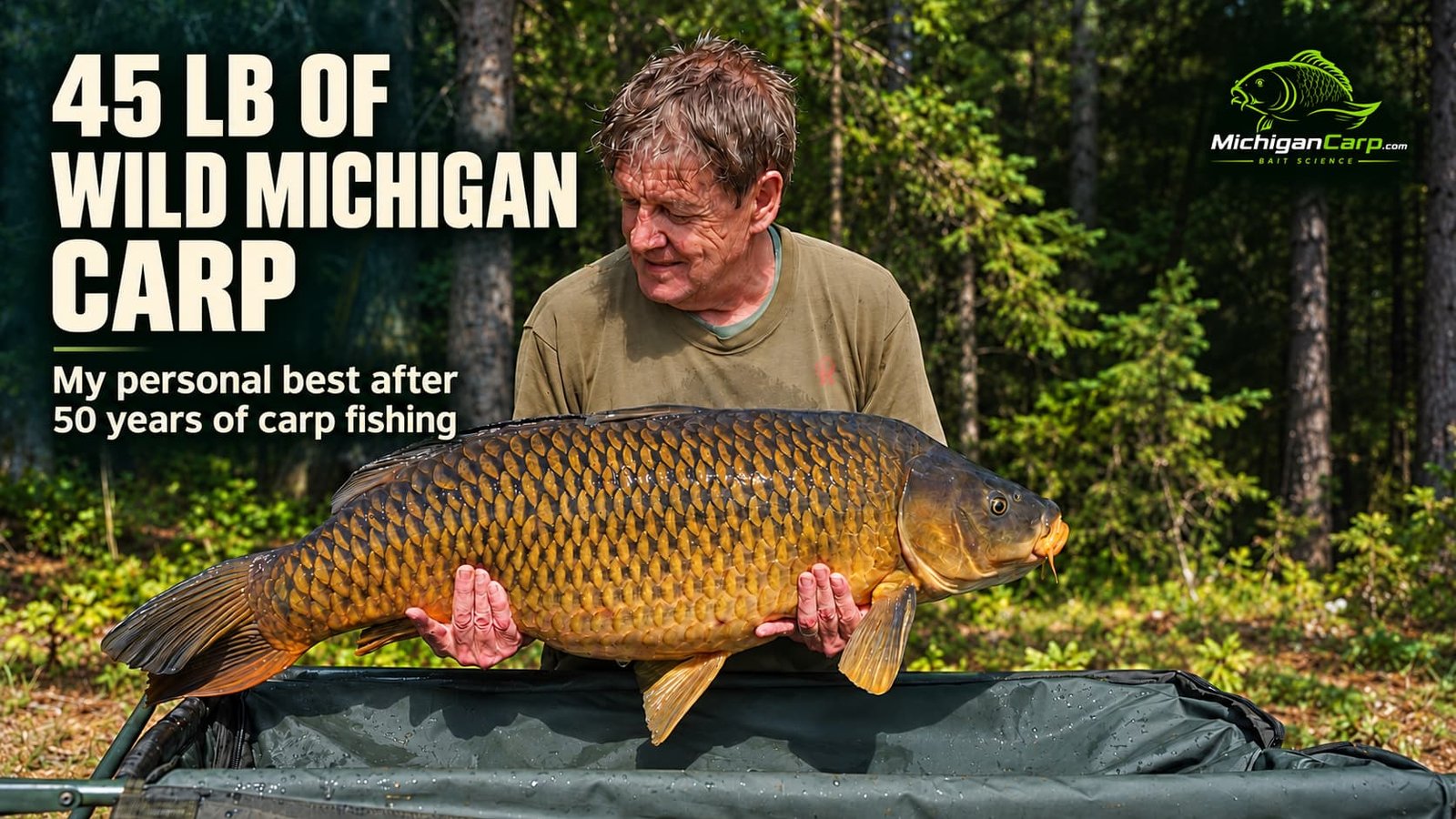
I have had plenty of sessions where I have packed up wondering what I could have done differently. This late-September Michigan common carp session was one I would happily have carried on fishing. A new personal best, a bait I had made myself, and a friend alongside me catching a remarkable fish of his own—it was a week that reminded me why I still love doing this.
Over several days on a large Michigan water I landed 22 wild common carp, including fish of 37 lb 8 oz, 37 lb 5 oz, 30 lb, 29 lb 12 oz and 27 lb 12 oz, but the fish that defined the trip was a new personal best common of exactly 45 lb.
What made the capture especially satisfying was that it came on a homemade Plum/Scopex Milk-Nut boilie, a bait I had already developed a great deal of confidence in before the trip. By the time the session was over, that bait had accounted for fish from small doubles all the way to the 45-pounder and had worked as a single bottom bait, with paste, as a double 24 mm presentation and as part of a snowman.
There was plenty to think about along the way: busy spells with several rods going, quiet water that was still producing fish, changes of hookbait and the familiar business of keeping everything organised over several days on the bank. But the part I will remember longest is looking at the scales and seeing a weight that had meant something to me since my earliest years of carp fishing.
Table of Contents
Returning to a Difficult Water
This was not one of those trips where I arrived knowing I was almost certain to catch. I had fished the area before and had blanked there, so I knew from experience that it could be difficult. That was part of the attraction.
The swim itself also demanded some work. The bank was steep, which made moving equipment an exercise in its own right. Anyone who fishes multi-day sessions knows how quickly the amount of gear builds up once you add a bivvy, bedchair, food, cooking equipment, bait, landing equipment, photography gear, spare clothing, batteries, tackle and all the other things that make a long session comfortable and practical.
Over the years I have learned to be much more sensible about this side of fishing. Good preparation and the right equipment make a huge difference, and so does pacing yourself. There is very little benefit in exhausting yourself during setup and then trying to fish effectively for the next four days.
Most of my fishing was at around 60 yards or more. The lakebed was far from uniform. There were areas of weed and I found a couple of snags during the session, so presentation mattered and fish could not simply be allowed to take line indefinitely once hooked.
After getting the camp organised, I introduced roughly five gallons of corn into the general fishing area. My opening rod setup deliberately gave the fish several different options. One rod carried a single plum boilie, another started with a tiger nut presentation, while the third used a plum bottom bait topped with an orange pop-up to form a snowman.
For a while, very little happened.
I saw one possible fish show away from the main area and later heard what sounded like a large fish crash somewhere farther out. The water looked good, but there was nothing to suggest that I was about to experience the kind of session that eventually unfolded.
Rather than constantly recasting and changing everything, I left the boilie rods alone. There was no reason yet to lose confidence in them.
During the first evening, the left-hand rod ripped off and after a solid fight I slipped the net under a beautiful 37 lb 8 oz wild common. It had taken the single Plum/Scopex Milk-Nut boilie.
That fish immediately changed the feel of the session. I did not need it to convince me that the boilie worked. The bait had already accounted for multiple good wild carp elsewhere, including fish approaching 30 lb, and I had arrived with plenty of confidence in it. But a 37 lb 8 oz common from a difficult water was further evidence that the bait was capable of doing exactly what I hoped it could do.
More importantly, that first fish made me feel there was a real possibility of something much bigger.
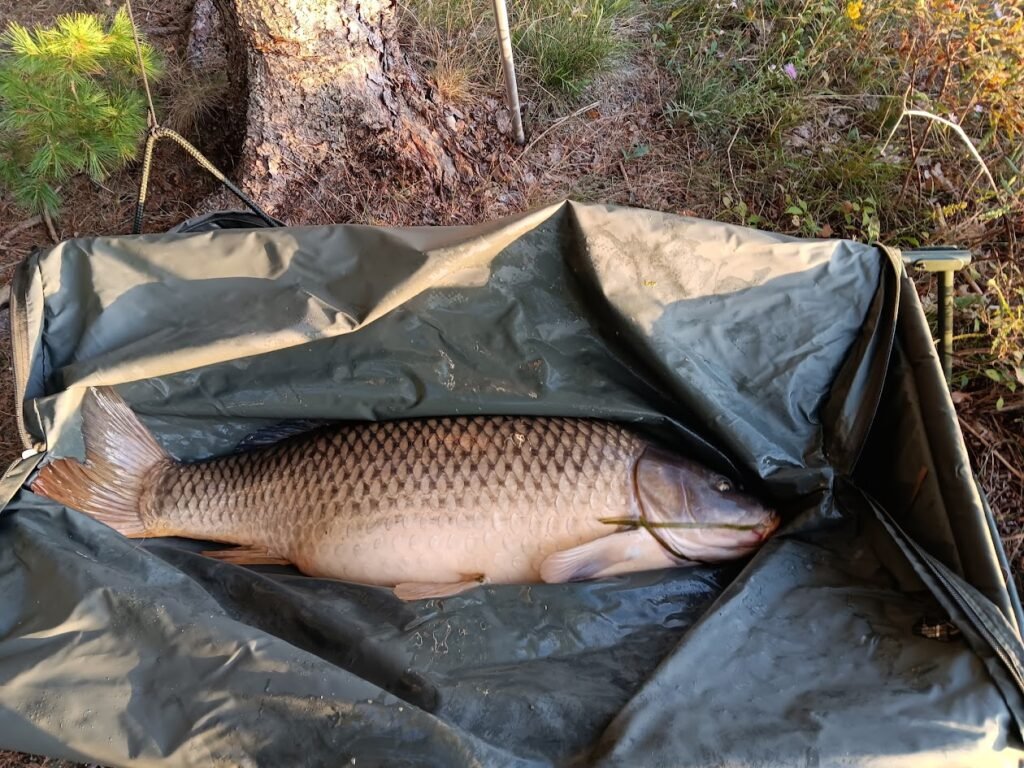
Later that evening another smaller common of around 10–12 lb came to the same plum bait. As darkness settled, the lake also became noticeably more active. Carp began crashing around the broader area, including near the baited zone, and there was far more activity than I had seen on previous visits earlier in the year.
Even so, I eventually brought the rods in and went to sleep.
That may sound strange when fish are active, but this was a multi-day session and I wanted to remain effective throughout it. There is a tendency in carp fishing to think that serious fishing means keeping rods out every possible minute, but I do not believe that anymore. If exhaustion starts affecting your ability to move safely, handle fish properly, photograph them carefully or make good decisions, getting some sleep can be the better angling decision.
As it turned out, I was going to need that rest.
The Day Everything Came Together
Tuesday started later than I had originally intended because I was tired from the travelling, boating gear into the swim and getting everything established. During the early morning I could hear carp crashing around the area while I was still resting, which was frustrating in one sense, but I also knew I had several days ahead of me.
Once I did begin fishing properly, the whole character of the session changed. I had considered moving immediately to three boilie rods with different presentations, but instead I kept much of the existing setup intact and began making smaller changes. One of those was the addition of a matching Plum Milk-Nut paste.
I wrapped a thin layer of paste around a single 24 mm plum boilie and put it back into the productive area. That rod soon produced a 17 lb 10 oz common. Shortly afterwards I missed another run on the same presentation.
At that point I changed another rod to a double 24 mm plum presentation and placed it close to the successful single-plum rod. My thinking was simple: there were clearly good wild carp in the area, so perhaps a larger mouthful might offer some degree of selectivity.
The next spell of fishing became hectic.
The single plum and paste rod went first, producing a 24 lb 7 oz common. While I was dealing with that fish, the adjacent rod ripped off as well. That one had the two 24 mm plum boilies and resulted in a 19 lb 10 oz common.
At one point, all three rods were involved in action within minutes of each other.
That was the closest the session came to becoming frantic. Fortunately, it was not like that all day. There was generally enough time between spells to land fish, get photographs, rebait, reset the rods properly and settle everything down again, but for a period it felt as if the swim had suddenly switched on completely.
Then the left-hand rod ripped off again.
This was the take I will remember longest. Almost immediately, I knew the fish was different.
After the initial surge it developed what I can only describe as the swagger that big wild carp often have. It was not necessarily charging around continuously. Instead, it felt immensely solid. I could apply pressure and move it, but only so far. There was a sense that the fish would give ground only when it decided to.
When you have played enough big carp, that feeling becomes familiar. Every bit of line gained feels as though it has to be negotiated.
There was weed in the area and a couple of known snags, so I had to maintain enough pressure to control the fish without becoming impatient and trying to bully it unnecessarily. Big carp have a way of punishing that sort of mistake.
Eventually I got it close.
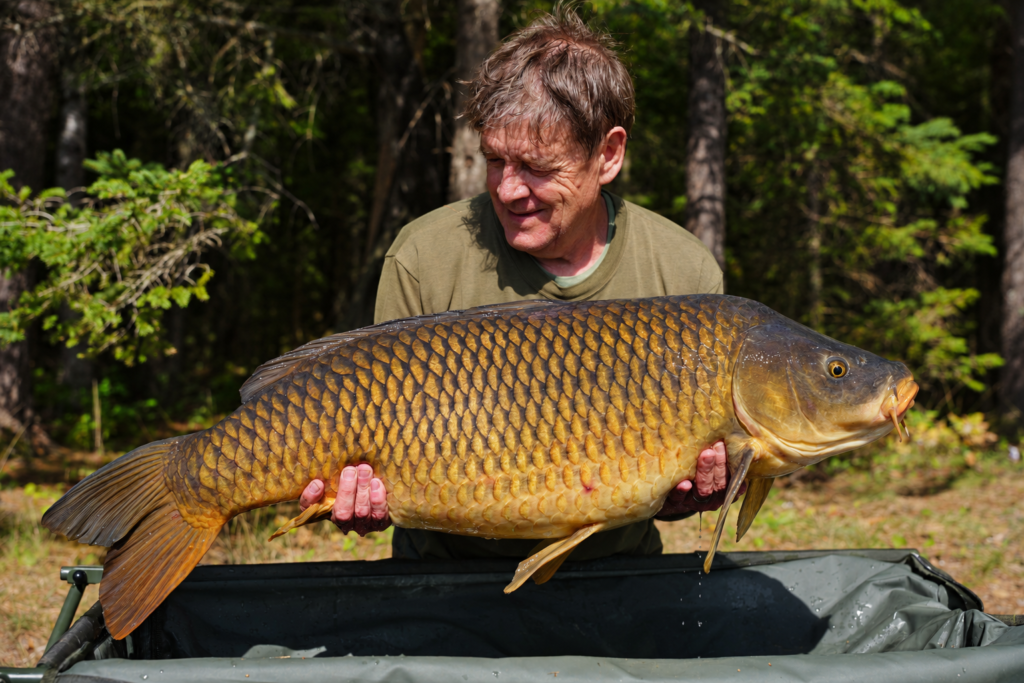
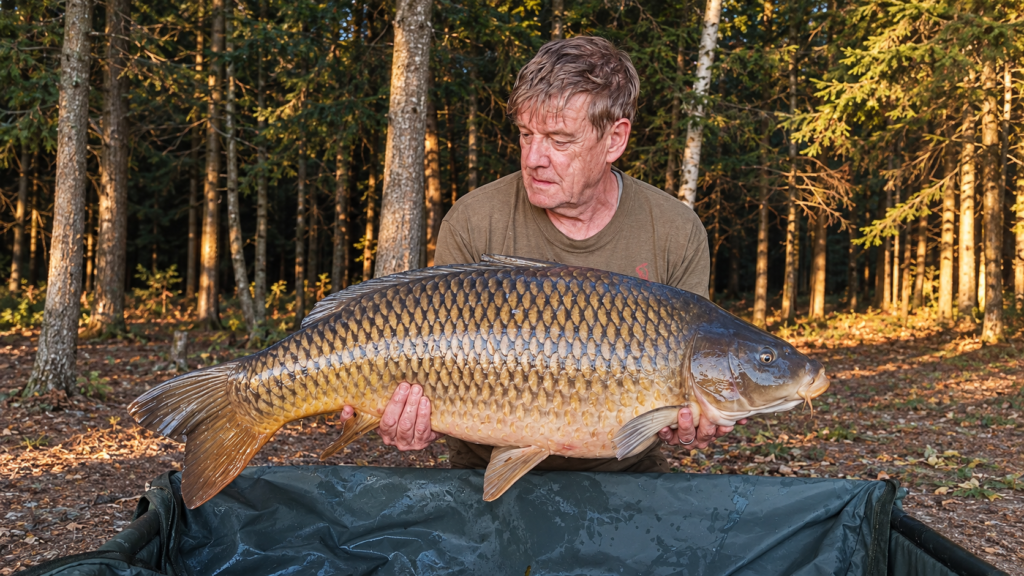
When the fish finally rolled over the net cord and I saw it properly, I was confident that it was well over 40 lb.
On the scales it settled at exactly 45 lb.
I was absolutely delighted.
Why 45 lb Meant More Than a Personal Best
I had previously caught three carp just over 40 lb, so I already knew the pleasure of getting a forty into the net. But this fish took my personal best to exactly 45 lb, and that particular weight meant something to me that went back much further than those previous captures—to my earliest years of carp fishing in Britain.
During my early years of carp fishing in the UK, the British record stood at 44 lb. Richard Walker’s famous common had set a benchmark that remained in place through those formative years when I was learning the sport.
As a young carp angler, a fish of that size was almost mythical. It was the sort of weight you read about in fishing magazines, talked about with other anglers and measured every other big carp against.
A 40-pounder was not simply a big carp. A fish in the mid-40s belonged to an entirely different world.
So all these years later, to look down and see the scales settle at 45 lb carried a significance that went beyond simply beating my previous personal best.
In some ways it felt as though I had crossed a line that had been fixed in my mind since my earliest years of carp fishing. All those years later, here I was in Michigan with a wild common heavier than the fish that had once seemed almost beyond reach.
And I had caught it on my own bait: a single 24 mm Plum/Scopex Milk-Nut boilie with a matching paste wrap. That mattered to me. There is a particular satisfaction in catching on something you have developed and made yourself, especially when the fish on the end is the biggest common you have ever landed.
I had already believed I had something special in that bait. The earlier 37 lb 8 oz common had reinforced that belief. Looking at the 45, I had every reason to feel pleased with the work that had gone into it.
The most interesting thing was that, even after landing a new personal best, I still felt there might be a bigger fish somewhere in the area.
That may sound greedy, but I did not mean it that way. I was completely satisfied with the 45. What I felt was simply that the quality of fish using the water suggested that another exceptional carp could easily be present.
The 37 had already shown up, now a 45 had appeared, and there were large fish crashing at times. There was no obvious reason to assume I had just landed the biggest fish in the water.
That feeling stayed with me for the rest of the session.
The Plum Boilie Kept Doing the Business
The 45 would have made the trip on its own, but the fishing did not stop there. The plum bait kept producing, and there were some very good wild carp among the fish that followed.
During the same broad period I landed another carp of around 20 lb, followed by fish of 27 lb 12 oz, 29 lb 12 oz and 30 lb, plus another smaller common.
The 27 lb 12 oz fish came on a plum boilie topped with an orange pop-up as a snowman. Others came on single plum bottom baits and paste-wrapped presentations.
What pleased me was that I could use the plum boilie in several different ways and still catch. It worked as a plain bottom bait, with paste, doubled up and as part of a snowman. I could adjust the presentation without feeling that I needed to abandon a bait I trusted.
The boilie was doing the business, and I was in no hurry to change it.
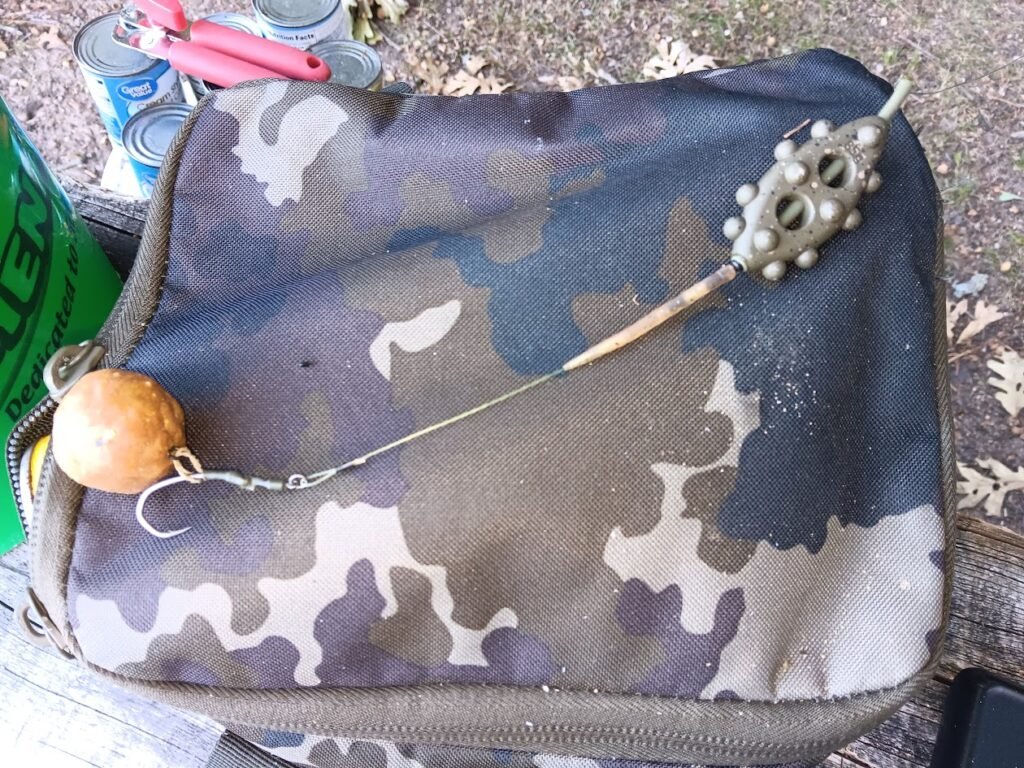
For the formulation principles behind this style of bait, see How to Formulate a Milk, Nut and Birdfood Boilie Base Mix.
By mid-to-late afternoon I introduced another large quantity of bait, roughly five gallons of mixed particle made up of pigeon seed, hemp, corn and tiger nuts.
By then, the fish had been in the area for hours and I had been catching them throughout the day. I wanted to give them a reason to keep visiting. That felt a very different decision from arriving at a quiet swim and putting in bucket after bucket without a sign of a carp.
After that major introduction, however, I became much more conservative. I did not continue pouring in another bucket every few hours.
The swim had already received plenty of food, and fish were continuing to visit the area. There comes a point where more bait may simply give them more opportunities to feed without encountering a hookbait.
That balance—feeding enough to hold carp without overfeeding them—became one of the more useful practical lessons of the trip.
Another Big Wild Common and Another Double Take
Wednesday brought another fish that would have been a highlight on almost any trip. After a quieter period, the single 24 mm plum with paste went again, producing a wild common of 37 lb 5 oz.
During the fight, another rod ripped off. I managed to deal with the 37 and then land the second carp, which was around 15 lb. Both had taken single plum boilies with paste. It was another of those spells where everything seemed to need doing at once.
There were definite feeding spells when several carp seemed to be using the same general area. Once those spells developed, staying organised became a job in itself: dealing with the takes, handling the fish carefully and getting everything ready to fish again.
This is where good preparation mattered. The photographs from a successful session rarely show the less glamorous side of it.
They do not show repeated journeys up and down a steep bank, wet landing nets, mats, rebaiting, rig checks, charging camera batteries, organising self-timers, cooking meals, drying equipment or packing everything away again.
A productive multi-day session can be physically demanding, but I did not finish this trip exhausted. I had prepared well, used the right gear and paced myself. When I felt I needed proper sleep, I brought the rods in.
I have learned to be more sensible about that side of fishing. I want to enjoy the whole trip, including the days after the first busy evening.
What the Surface Was Telling Me—and What It Wasn’t
Over the next several days, the surface gave me very different impressions of what was happening. At times the lake seemed alive, with carp crashing in different areas. At others it appeared almost completely dead.
Yet the rods did not always agree with what my eyes were telling me.
Some of the best periods of fishing happened when almost nothing was showing. During Tuesday’s remarkable spell, I was catching quality wild carp despite seeing very little meaningful surface activity.
That is easy to forget on large waters. A carp rolling over the bait gives confidence, and a big fish crashing nearby makes you feel that the swim is alive. When nothing happens on the surface, it is easy to start wondering whether the carp have moved away. I am no different; I like seeing something to reassure me that I am in the right place.
This session was a strong reminder that they may simply be feeding below the surface without advertising their presence.
A quiet lake is not necessarily an empty lake.
That lesson became especially important on Wednesday and Thursday, when surface activity varied dramatically but fish continued to be caught.
The feeding windows also changed from day to day. There was no simple pattern where bites came only at dawn, dusk or during darkness. I caught fish in the morning, around midday, during the afternoon and into the evening.
My fishing partner David added another piece to the puzzle.
He caught three 30 lb-class commons during one nighttime spell between roughly 1:00 and 3:00 AM.
Then he caught an exceptional fish of his own.
A 45 lb 8 oz wild common.
Sharing the Session With David
I have fished with David for a number of years, so seeing him land a wild carp of that calibre made the session even better.
His 45 lb 8 oz wild common came on a 16 mm orange wafter, which was interesting in itself because it contrasted sharply with the large 24 mm food baits I had been using for most of my own fishing.
I was delighted for him. When somebody you have shared fishing with for years catches a fish like that, you enjoy the moment almost as much as if you had caught it yourself.
I helped him organise the photographs, and David insisted that I get into some of the pictures as well. We put the camera on self-timer and took several shots with both of us in the frame holding the fish.
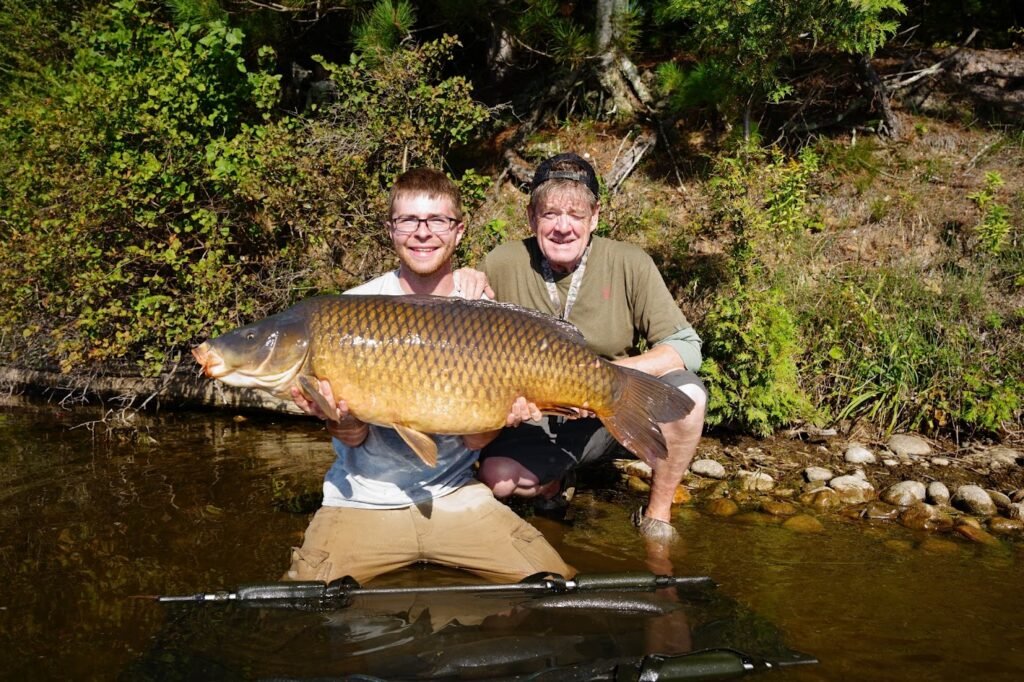
Those may end up being some of the most important photographs from the whole session. It was David’s fish, and being invited into the pictures made them a record of something we had shared. After years of fishing together, that means a great deal.
When I look back at those photographs, I will remember who was there as well as what the fish weighed.
David’s capture also gave me something to think about with my own rods. A 45 lb 8 oz wild carp had happily picked up a relatively small 16 mm orange wafter. With a fish like that in front of me, I could hardly dismiss a smaller hookbait just because I was hoping for another big common.
Later in my own session, when I wanted to experiment on one rod without disturbing two proven plum presentations, I switched the third rod to a smaller bright bait—a 14 mm orange wafter topped with a 10 mm orange dumbbell pop-up.
That setup produced a 23 lb 14 oz common and generated several additional takes, including two fish that were lost.
One of those lost fish felt particularly good.
On the final morning, the same orange setup produced another 23 lb 6 oz common that fought far harder than its weight suggested.
I was still completely happy with the plum boilie, and two rods remained on it. Keeping the third available for an experiment gave me something else to work with while my main approach continued catching. That suited me far better than changing all three rods just because another presentation had produced a good fish.
Two 24 mm Boilies Were Still No Obstacle
My experiment with two 24 mm plum boilies gave me another useful reminder. I had hoped that the larger mouthful might discourage some of the smaller fish while the better carp were feeding in the area.
It caught carp, but one was around 18 lb, and it had no apparent difficulty taking the double bait. The earlier 19 lb 10 oz common had managed it too.
It was a useful reminder of just how capable carp are of handling large food items.
A double 24 mm bait may look enormous when you hold it in your hand, but to the mouth of an adult common carp it is not necessarily a serious obstacle.
I would therefore be cautious about describing large hookbaits as true big-fish selectors.
They can certainly have tactical value, and they may reduce interference in some situations, but this session showed very clearly that modest-sized carp are still capable of taking them.
The Final Evening and Morning
The last evening was much quieter. The water was completely flat calm and the lake felt almost motionless. There were one or two occasional fish crashing, but nothing resembling the activity seen earlier in the week.
I rebaited all three rods and settled into the bivvy.
Two rods carried 24 mm plum boilies with paste wraps, while the third remained on the smaller orange wafter and pop-up combination.
The rods stayed out while I decided whether the final night was likely to produce anything worthwhile.
For most of the night, very little happened. There were a few beeps, but no proper runs. By the early morning I had begun thinking about breaking camp and preparing to leave.
Before daylight, however, the middle rod finally went. The fish felt good but found a snag. I gave it time, hoping it might work itself free, but eventually it was lost. Even in a session like this, those are the chances that stay in your mind.
Soon afterwards the left-hand rod produced a 21 lb common on another single plum boilie.
At that point I was gradually dismantling camp while continuing to fish. There was still time for one more.
The orange wafter rod went and, after an unexpectedly hard fight, I landed a 23 lb 6 oz common.
It was a fitting last fish.
By the time the session finished, I had landed 22 wild carp, with David’s catches separate from that total.
Among them were the 45 lb personal best, two 37s, a 30, a 29 lb 12 oz fish, a 27 lb 12 oz fish and a string of twenties.
For a swim where I had blanked on previous visits, I could hardly have asked for more.
What This Michigan Common Carp Session Taught Me
I went home with considerably more confidence in the Plum/Scopex Milk-Nut boilie than I had arrived with—and I had arrived with plenty. The first 37 lb 8 oz common was a tremendous start, the 45 made it a special trip, and the fish that followed kept giving me reasons to leave the plum bait on the rods.
It caught small carp, twenties, thirties and a 45. It produced in the morning, afternoon and evening, and it worked plain, paste wrapped, doubled and as part of a snowman. As an angler making and using his own bait, that is exactly the kind of performance I hope for.
For my fishing, it is now one of the best carp baits I have personally used.
And because I know exactly what went into it and why, I can continue refining it rather than simply buying another bag and hoping for the same result.
I also want to spend more time with the matching paste. The boilie was already catching before I introduced it, and my feeling is that the paste added an extra layer of attraction around a bait the carp were already happy to eat.
That is something I want to test properly in future by fishing identical plum boilies side by side, one plain and one with paste, over comparable areas.
The session also reminded me not to over-interpret surface activity.
Fish showing can be useful information, but lack of surface activity does not prove the carp are absent.
Likewise, big hookbaits do not automatically mean big fish, and small wafters should never be dismissed simply because you are targeting larger carp.
Most of all, I left with the confidence that comes from catching on something repeatedly. When I put that plum boilie out now, I can picture the fish it has already caught. That is a good feeling to take into the next session.
Michigan Notes
Late September can be a fascinating period for wild carp fishing in Michigan. During this session the reported water temperature was approximately 62–64°F, even though overnight air temperatures were considerably cooler.
That difference is worth remembering when you are sitting in chilly autumn air wondering what the fish are doing. It certainly did not feel as though the cooler nights had put an end to their appetite.
The weather itself was remarkably calm for much of the trip. There were periods when the lake was completely glass-flat and the sky was clear.
I pay attention to wind, fronts and changes in the weather, but I was hardly going to complain about calm conditions while the rods were going. On this trip, the fish gave me plenty of reason to stay where I was and keep doing what was working.
For anglers targeting Michigan common carp on larger wild waters, one of the clearest lessons from this session was not to rely too heavily on surface activity.
FAQ
What bait caught the 45 lb wild common?
The fish was caught on a single 24 mm homemade Plum/Scopex Milk-Nut boilie with a matching paste wrap.
Had the bait caught good fish before this session?
Yes. The same basic Plum Milk-Nut boilie had already produced multiple carp approaching 30 lb before this trip, which is why I arrived with considerable confidence in it.
Did the paste make the difference?
The boilie was already catching before the paste was introduced, so I would not credit the paste with making the bait successful. My current view is that it acted as an additional attraction and leakage layer around an already proven boilie.
Did two 24 mm boilies select bigger carp?
Not reliably. One fish of around 18 lb readily took the double 24 mm presentation.
Did smaller wafters catch big fish?
Yes. David’s 45 lb 8 oz wild common came on a 16 mm orange wafter, while my smaller orange wafter/pop-up combination also produced several takes and two landed twenties.
Was surface activity a reliable indication of feeding?
No. Some of the most productive periods occurred when very little was showing on the surface.
How far out were the rods?
Most of the fishing was at approximately 60 yards or more.
Was the lakebed clean?
No. Weed was present in parts of the swim and I identified several snaggy areas during the session.
How many wild carp were landed?
I landed 22 wild carp during the session.
What was your largest fish?
A 45 lb wild common, which became my new personal best.
Leaving Content, With a Reason to Return
I left the session content. That is probably the best word for it.
I had caught a new personal best, landed 22 wild carp, shared the trip with a friend who caught a 45 lb 8 oz wild common of his own, and proved to myself that the homemade Plum Milk-Nut boilie could produce exactly the calibre of fish I had hoped for.
The trip also seemed to pass remarkably quickly. That is usually a sign that you have been completely absorbed in what you are doing.
I have blanked in this area before and I know how difficult it can be, which made this session even more satisfying.
But I also left with a feeling of unfinished business.
The 45 lb wild common was a landmark fish for me, especially because it crossed a weight that had seemed almost mythical during my early years of carp fishing in Britain.
Yet after seeing the quality of fish that moved through the area during this session, I do not believe 45 lb necessarily represents the limit. And I now believe I have a bait capable of catching whatever eventually comes along.
That is enough reason to go back.