

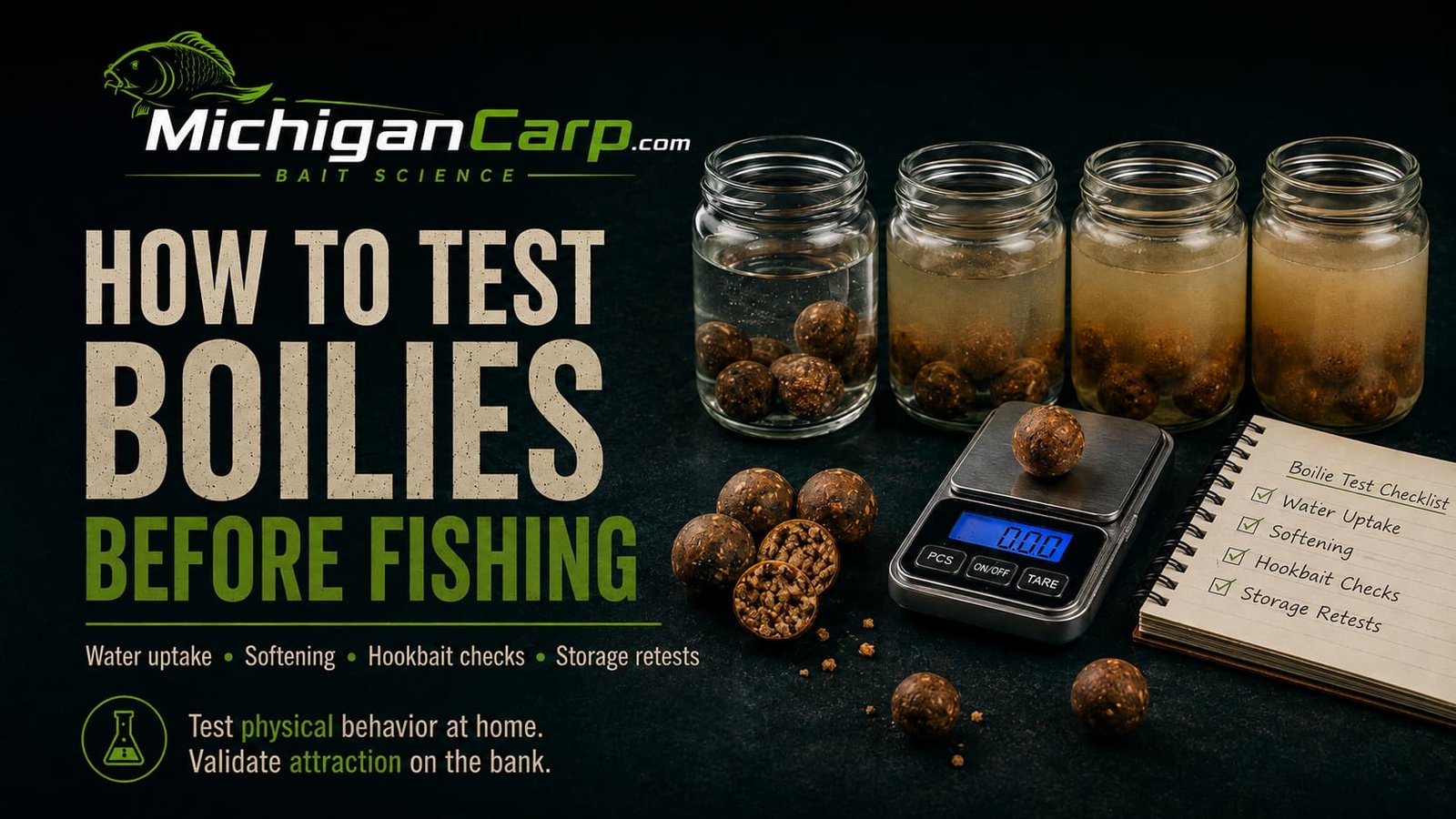
Learning how to test boilies before fishing is one of the most useful habits a homemade bait maker can develop.
A simple home test can show whether a boilie takes on water, softens, swells, cracks, erodes, releases crumb or visible particles, survives the intended soak time, remains attached to the rig and changes after freezing, drying or conditioning.
What it cannot prove is whether carp will prefer that bait.
Test physical behaviour at home. Test carp response at the lake. Do not confuse the two.
The best home test is a controlled comparison rather than a demonstration. Instead of asking, “Does this boilie look active in water?” ask, “How does this bait behave compared with another sample when I keep the important conditions the same?”
For the underlying release mechanisms, use The Science of Carp Bait Solubility and Leakage and Why Some Carp Baits Leak Faster Than Others. For whole boilies, chops, crumb, dust and paste, use Why Surface Area Matters in Carp Bait.
For useful external background on dissolution and the difference between physical bait release and feeding response, see OpenStax: The Dissolution Process and UF/IFAS: A Review of Feed Attractants as a Guide for Aquaculture Operations.
Table of Contents
Quick Start: How to Test Boilies Before Fishing
Use several samples and keep the test conditions as consistent as practical.
| Test | What it can show | What it cannot prove |
|---|---|---|
| Dry inspection | Cracking, size consistency and surface defects | Carp preference |
| Cut test | Internal structure, voids and wet centres | Exact chemical release |
| Water uptake | Relative hydration | That maximum uptake is best |
| Softening test | Surface and core texture changes | Attraction |
| Breakdown test | Crumb loss, erosion and splitting | That faster breakdown catches more carp |
| Visible release | Clouding, particles and oil droplets | Long-range attraction |
| Hookbait test | Attachment, durability and buoyancy | That fish will find the rig |
| Storage retest | Changes after freezing, drying or conditioning | Storage safety by itself |
Every useful test should answer a specific question.
What a Home Boilie Test Can and Cannot Tell You
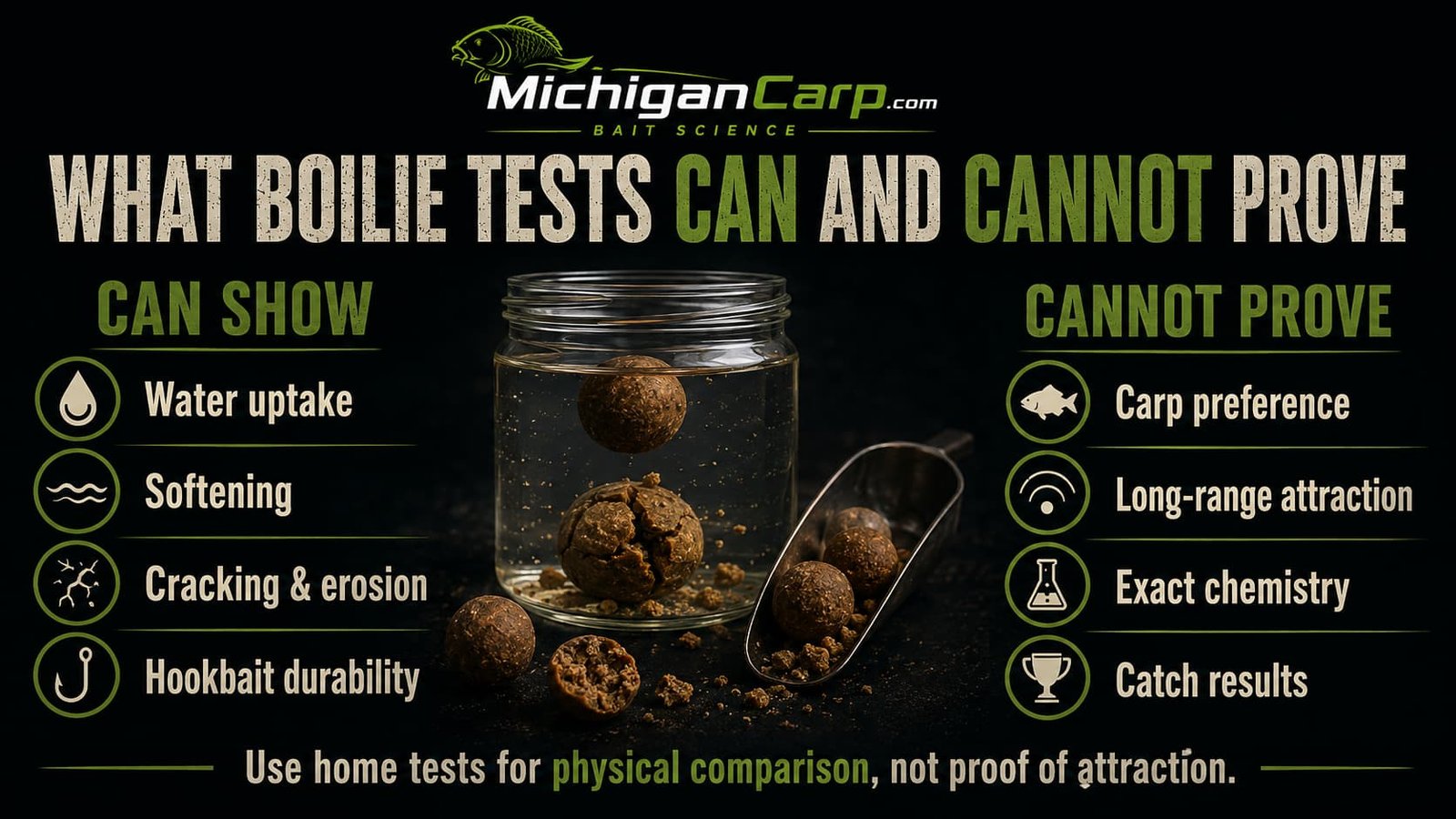
A home water test is valuable when treated as a physical comparison.
It can show whether one bait hydrates faster than another, whether longer drying increased hardness, whether a different boil time changed structure, whether a glug altered surface texture and whether a hookbait survives the intended fishing period.
It cannot prove carp preference, long-range attraction, exactly which dissolved compounds are leaving the bait or whether visible clouding represents a meaningful feeding signal.
A spectacular-looking jar test can still be scientifically weak. A boring controlled comparison can be much more useful.
Build a Simple Boilie Testing Kit
You do not need laboratory equipment. A useful home kit can contain identical jars or tubs, a digital kitchen scale, timer, labels, paper towels, sharp knife, notebook or spreadsheet and the actual hooks and rigs you fish.
If one boilie is too light for your scale to show small changes reliably, weigh several identical boilies together.
Start With Dry Inspection and Cut Tests
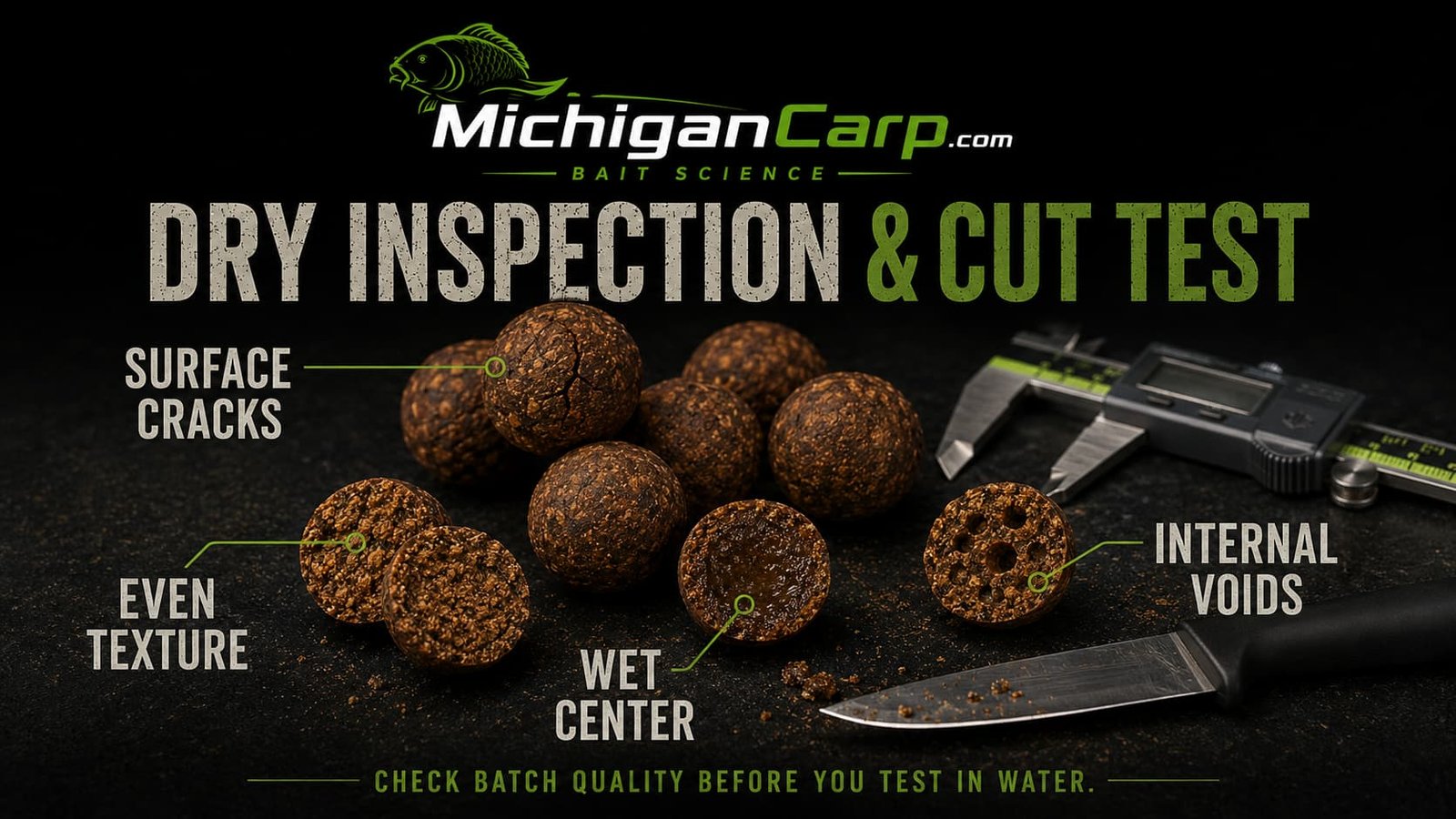
Before putting anything in water, inspect the finished bait for major size differences, cracks, flat spots, rough surfaces, excessive oil, deformation and inconsistent hardness.
Then cut several boilies through the centre. The cut test can reveal hollow centres, air pockets, uneven coarse ingredients, unusually wet centres, cracking through the core and inconsistent internal structure.
One unusual boilie does not condemn the batch. Test several.
For judging drying condition specifically, use How to Tell When Boilies Are Dry Enough.
Set Up a Controlled Water Test
Try to keep container size, water volume, water source, starting temperature, bait diameter, bait count or weight and observation times consistent.
Label every sample clearly. For example: 90-second boil, 120-second boil and 150-second boil; or 12-hour dry, 24-hour dry and 48-hour dry.
Do not change boil time, drying time, flavor and liquid treatment simultaneously and then claim one variable caused the difference.
Choose Test Times That Match the Session
Test duration should reflect the fishing question.
| Bait job | Useful test times |
|---|---|
| Short-session free bait | 30 minutes, 1 hour, 2 hours, 4 hours |
| General session bait | 1 hour, 4 hours, 8 hours, 12 hours |
| Overnight hookbait | 1 hour, 6 hours, 12 hours, 24 hours |
| Specialist long-life hookbait | 12 hours, 24 hours, 48 hours |
The test should match the job.
Measure Water Uptake Without Overcomplicating It
A simple procedure is to weigh several dry boilies, record the starting mass, soak them for a fixed period, blot their surfaces consistently and reweigh them immediately.
Water uptake % = ((wet weight − starting weight) ÷ starting weight) × 100
If five boilies weigh 50 g dry and 57 g after soaking, the group has gained approximately 14% mass under those test conditions.
That does not mean 14% is automatically better than 8% or 20%. The useful result depends on the bait’s job.
Record Softening, Erosion and Breakdown Separately
Softening means the boilie becomes easier to compress or cut while remaining intact.
Erosion means material gradually leaves the surface.
Cracking means fractures form through the skin or deeper structure.
Collapse means the bait loses enough structure to break apart.
Swelling means the bait increases in dimensions as it hydrates.
Do not simply record “bait broke down.” Record what actually happened.
Interpret Visible Clouding Carefully
Clouding can come from fine flour, starch, colour, suspended particles, milk powder, soluble solids, emulsified oil, glug or surface dust.
Visible clouding tells you material has moved into the water. It does not identify every dissolved compound and does not prove attraction.
A bait can also release dissolved material that you cannot see.
For the wider release mechanism use The Science of Carp Bait Solubility and Leakage.
Compare Whole Boilies, Chops and Crumb
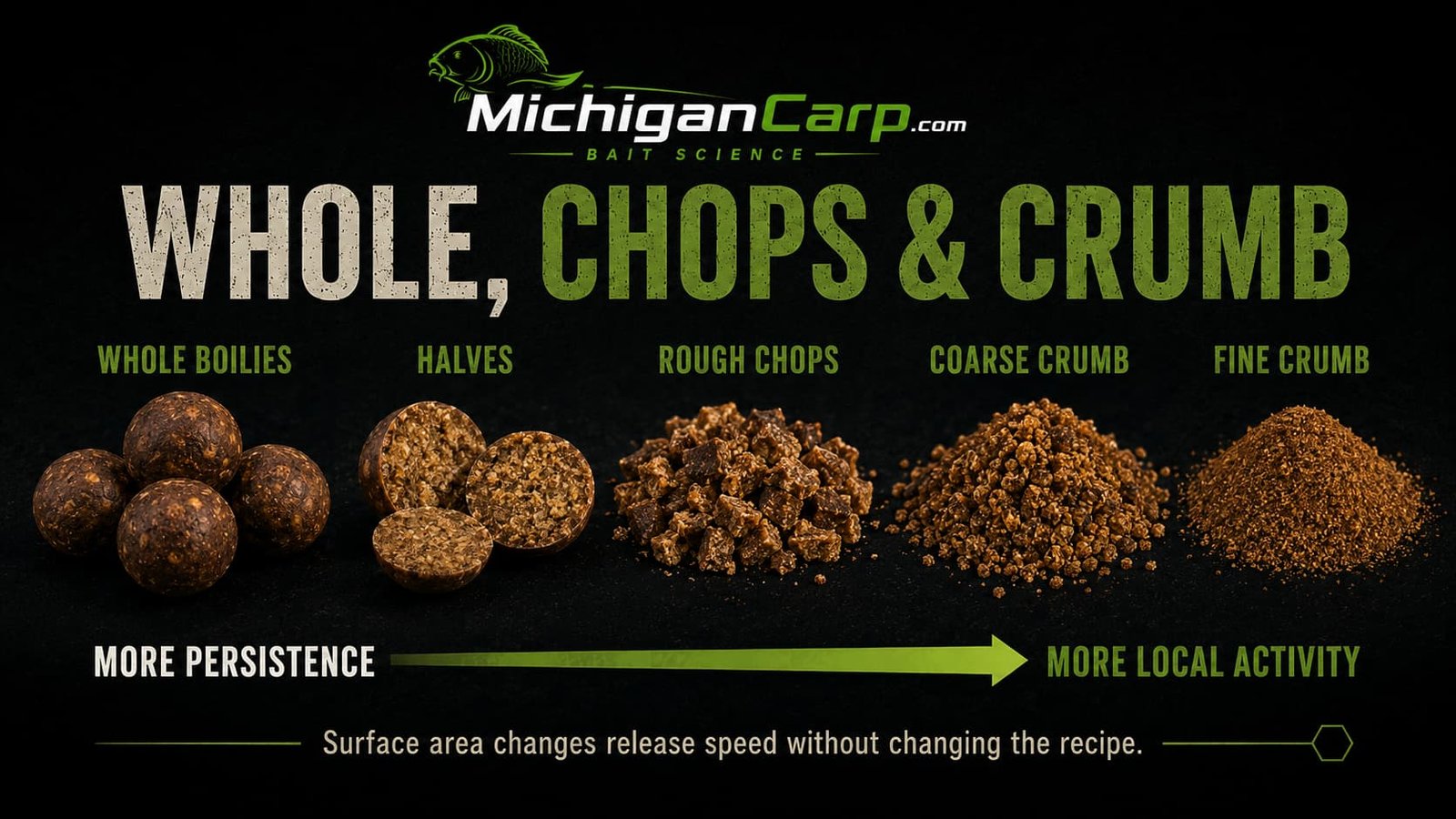
A whole 24 mm boilie behaves differently from the same bait chopped into quarters. Crumb behaves differently again because much more surface area is exposed to the water.
A simple comparison can use equal bait weights of whole boilies, halves, quarters, coarse crumb and fine crumb.
For the full explanation use Why Surface Area Matters in Carp Bait.
Test Cooking, Drying and Glugging One Variable at a Time
Testing boil time
Use the same paste, diameter and drying conditions and change only the cooking duration. Then compare hardness, cracking, water uptake, softening, erosion and long-soak durability.
For the production process use How to Boil and Dry Boilies Properly.
Testing drying time
Use boilies from the same batch and compare samples dried for different periods, such as 12, 24 and 48 hours.
For deciding when the bait is actually dry enough use How to Tell When Boilies Are Dry Enough.
Testing glugs and conditioners
Keep an untreated control from the same batch and compare it with lightly and heavily conditioned samples.
Record changes in mass, surface texture, softness, swelling, breakdown, smell and attachment strength.
For treatment methods use How to Prepare Boilies for Carp Fishing: Glugs, Soaks and Hookbait Conditioning.
Test Hookbaits on the Actual Rig
A hookbait is not properly tested simply because it survived in a jar.
Check hair attachment, bait-screw hold, stop security, cracking around drilled holes, buoyancy, balance, sink rate, pop-up height and wafter behaviour after soaking.
Wafters
A wafter should be tested with the actual hook. Changing hook size can alter the presentation substantially.
Pop-ups
Test buoyancy after the intended fishing duration. A pop-up that works when fresh may lose lift after prolonged soaking or heavy liquid treatment.
Bottom hookbaits
Check whether the hair hole or bait screw remains secure after the intended soak.
The specialist formulation work belongs in How to Make Wafters and Pop-Ups From a Boilie Base Mix, which remains unlinked until publication.
Retest Bait After Storage
A bait that tested well when freshly made may change after freezing, extended drying, glugging or long conditioning.
Retest older frozen batches, heavily conditioned hookbaits and bait that has been dried much longer than normal before relying on it for an important session.
For storage use How to Store Homemade Boilies. For deliberate shelf-life preservation use Potassium Sorbate, Sodium Benzoate and Citric Acid in Shelf-Life Boilies.
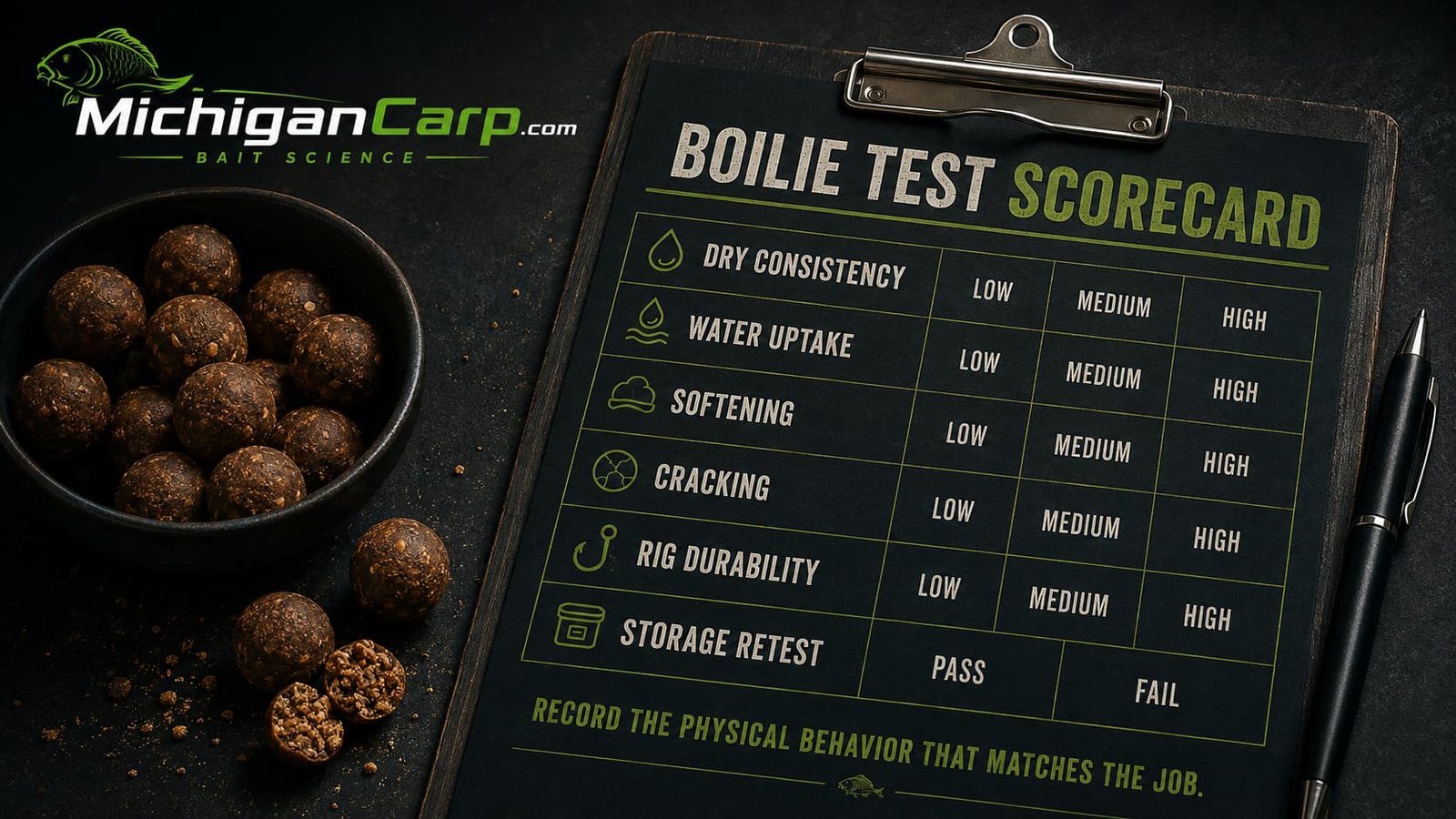
Use a Simple Boilie Test Scorecard
| Test | Score 1–5 | Notes |
|---|---|---|
| Rolling consistency | ||
| Surface condition | ||
| Internal structure | ||
| Water uptake | ||
| Controlled softening | ||
| Cracking resistance | ||
| Erosion/release | ||
| Long-soak durability | ||
| Hookbait attachment | ||
| Buoyancy/balance | ||
| Performance after storage |
Do not turn the total score into false precision. The notes matter as much as the number, and free bait and hookbait have different jobs.
Four Useful Boilie Test Programs
Test 1 — New base mix
Check rolling, cooking, drying, internal structure and one-, six- and 12-hour soak behaviour before making a large batch.
Test 2 — Boil-time comparison
Take one paste and divide it into several cooking groups, for example 60, 90 and 120 seconds. Dry them identically and compare them in water.
Test 3 — Drying comparison
Cook one batch identically and test groups after 12, 24 and 48 hours of drying.
Test 4 — Hookbait durability
Test the actual hookbait on the intended rig at one, six, 12 and 24 hours and record attachment, hardness, cracking, balance and buoyancy.
Michigan Seasonal Testing Notes
Michigan water temperatures change greatly through the fishing season, so a room-temperature jar should not always be treated as a perfect representation of the lake.
Spring
If you are developing bait for April or early May, include cooler-water tests rather than relying only on warm indoor conditions.
Summer
Warmer water can change hydration and softening rates, so long-session hookbaits deserve testing under conditions reasonably close to those expected on the bank.
Fall
Late-season sessions often involve cooler water and long overnight soak times, making hookbait durability worth checking.
Large boilies
I often fish 20–24 mm boilies. A 24 mm bait has a longer path from surface to centre than a small bait, so test the diameter you actually intend to fish.
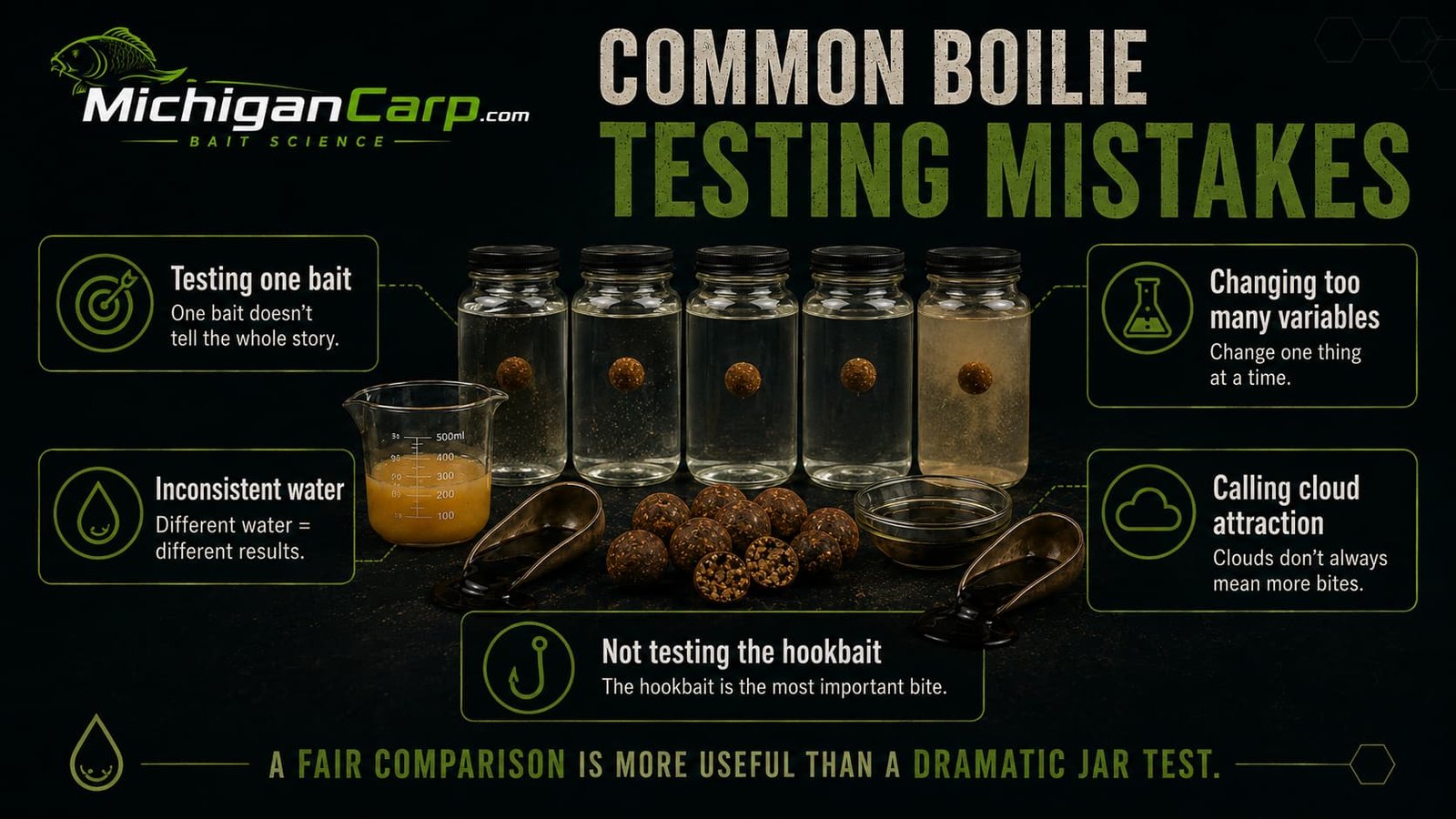
Common Boilie Testing Mistakes
| Mistake | Why it weakens the test | Better approach |
|---|---|---|
| Testing one boilie | One sample may not represent the batch | Test several |
| Changing many variables | You cannot identify the cause | Change one major factor |
| Different containers or water volumes | Weakens comparison | Standardize conditions |
| Calling clouding attraction | Visible material is not proof of feeding response | Call it visible release |
| Maximum uptake = best | More water is not always desirable | Match the bait to its job |
| Ignoring hookbait mechanics | Misses rig failures | Test on the actual rig |
| Ignoring stored bait | Storage can change behaviour | Retest |
| Testing 24 hours for a three-hour session | The test does not match the question | Match test duration to fishing |
Simple Rules for Testing Boilies Before Fishing
- Ask a clear question.
- Use several boilies.
- Keep the important conditions consistent.
- Change one main variable at a time.
- Record what actually happened.
- Separate hydration, softening, erosion, cracking and collapse.
- Test hookbaits on the actual rig.
- Match test duration to fishing duration.
- Retest after important storage or conditioning changes.
Use home tests for physical comparison—not as proof of attraction.
My Practical View
For my own bait development, I would rather run ten simple repeatable comparisons than one impressive-looking demonstration.
I want to know whether the batch rolled consistently, whether the boil time set it correctly, whether drying made it too hard, whether it softens as intended, whether the free bait remains usable and whether the hookbait stays attached and presents correctly.
Those are useful questions.
Whether carp actually accept the bait is then tested where it matters—during real fishing.
Ask a question. Control the comparison. Measure what you can. Record what you observe. Then validate the finished bait on fish.
FAQ
How long should I test boilies in water?
Match the test to the intended fishing period. Short-session bait may only need checks through four hours, while overnight hookbaits may justify 12- or 24-hour testing.
How many boilies should I test?
Use several samples from different parts of the batch. One boilie cannot show whether the batch is consistent.
Can a bucket test prove that carp like a bait?
No. It can compare physical behaviour, but carp preference must be assessed through fishing or controlled feeding work.
Does cloudy water mean a boilie is attractive?
No. It shows visible material entering the water. It does not by itself prove chemical attraction or feeding response.
How do I measure water uptake?
Weigh the bait before soaking, soak it for a fixed period, blot consistently and reweigh it. Compare samples using the same method.
Should a good boilie become soft?
It can. The correct degree of softening depends on the bait’s job. Free bait and long-life hookbait do not need identical durability.
Should glugged boilies be tested separately?
Yes. Compare treated bait against untreated bait from the same batch because conditioning can change weight, softness and durability.
How should I test a wafter?
Test it using the actual hook and rig, then repeat the check after the intended soak time.
Should frozen boilies be retested?
Yes, particularly after long storage or before an important session.
What is the most important boilie-testing rule?
Use controlled comparisons to answer specific questions. Do not treat a home water test as proof that carp prefer the bait.
Next Steps
- The Science of Carp Bait Solubility and Leakage — understand water entry, dissolution, diffusion and release.
- Why Some Carp Baits Leak Faster Than Others — identify factors that alter release rate.
- Why Surface Area Matters in Carp Bait — compare whole boilies, chops, crumb, dust and paste.
- How to Boil and Dry Boilies Properly — control cooking and drying before testing.
- How to Tell When Boilies Are Dry Enough — assess drying condition using practical checks.
- How to Store Homemade Boilies — manage freezer bait and stored test batches.
- How to Prepare Boilies for Carp Fishing: Glugs, Soaks and Hookbait Conditioning — test post-production treatments.
- How to Make Wafters and Pop-Ups From a Boilie Base Mix — specialist hookbait formulation; keep unlinked until publication.
- Potassium Sorbate, Sodium Benzoate and Citric Acid in Shelf-Life Boilies — preservation and storage logic.
- Bait Science — return to the technical bait library.