

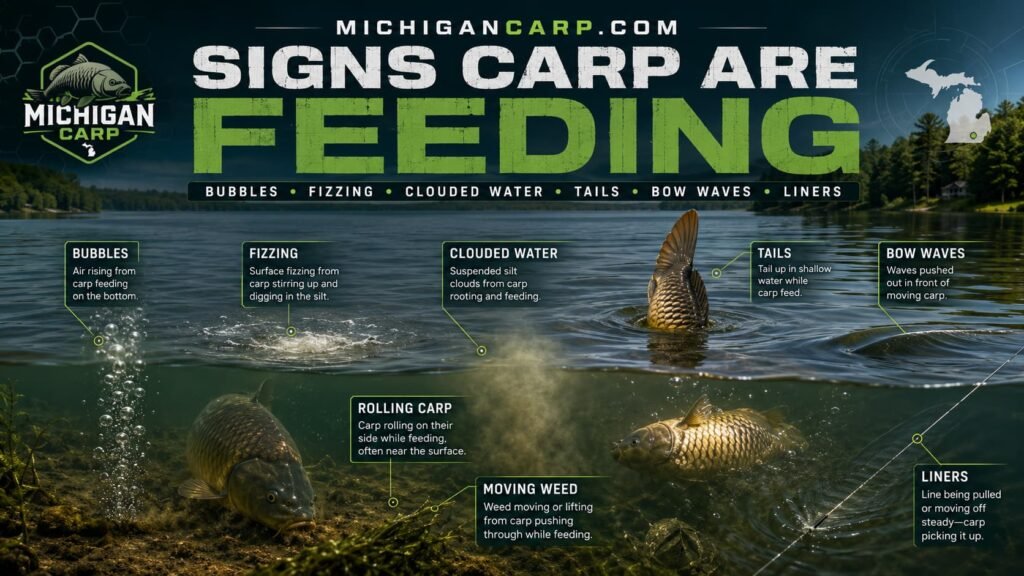
The signs carp are feeding can be obvious, subtle, or easy to misread.
Sometimes carp give themselves away clearly. You see tails waving in shallow water, a line of bubbles creeping across soft silt, or a cloudy plume spreading along a reed edge. Other times, all you get is one short liner, a distant roll, or a patch of weed moving against the wind.
That is what makes sign reading so important.
Carp are not always visible, especially in Michigan lakes where water clarity, weed growth, silt, wind, boat traffic, depth and low-light movement can hide what is really happening. A lake can look dead at noon and come alive at dawn. A shallow bay can show nothing for hours, then suddenly reveal tails, bubbles and mud trails in a short feeding window. A big-water point can produce no obvious feeding signs at all, but repeated evening liners may show carp are using the route every day.
The key is not reacting to every splash.
The key is learning which signs actually matter.
A single bubble might be bottom gas. A rolling carp might be moving, not feeding. A patch of clouded water might be carp, ducks, turtles, boat wash or wind pushing against shallow silt. But when bubbles, clouded water, liners, rolling fish and movement all repeat in the same area, at the same time, over the right bottom, the lake is giving you useful information.
This article explains the main signs carp are feeding, including bubbles, fizzing, clouded water, tails, bow waves, rolling carp, liners, moving weed, reed movement, mud trails, surface slicks, bird clues and false feeding signs. More importantly, it explains how to respond without ruining the opportunity.
For the broader location process, read How to Find Carp in Lakes.
For food-rich habitat, read How to Find Natural Carp Feeding Areas in Michigan Lakes.
For large-water strategy, readAdvanced Big-Lake Carp Tactics for Michigan Waters
For bait choice after you find activity, read Best Carp Bait for Michigan Lakes.
The simple rule is this:
One sign is interesting. Repeated signs are important. Repeated signs in the right location are worth fishing.
Table of Contents
Quick Start: The Main Signs Carp Are Feeding
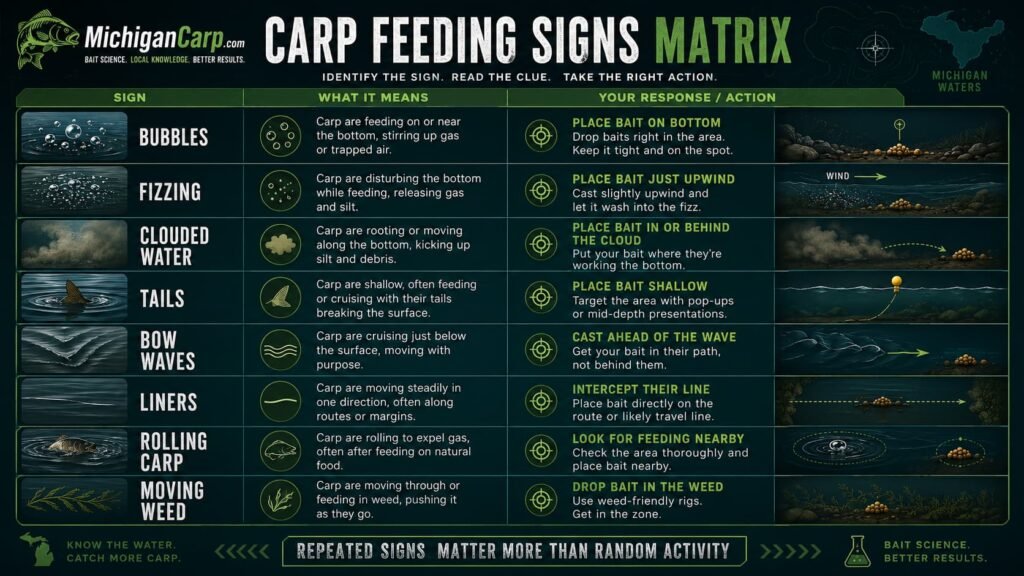
Use this table as the quick decision guide.
| Sign | What It Often Means | Stronger Evidence | Best Response |
|---|---|---|---|
| Bubbles | Carp feeding, bottom gas, turtles or other fish | Moving bubbles, repeated patches, clouded water nearby | Watch first, then cast quietly near the edge |
| Fizzing | Carp disturbing soft bottom, silt or insect-rich areas | Fine bubbles creeping across one area | Use light bait and balanced presentation |
| Clouded water | Carp rooting in silt, clay, marl or shallow margins | Cloud moves, grows or repeats near food | Fish the clean edge or route |
| Tails up | Carp feeding head-down in shallow water | Repeated tailing in the same area | Stay low and avoid casting on top of fish |
| Bow waves | Carp cruising, feeding shallow or spooking | Slow waves along weed, reeds or margins | Intercept the route quietly |
| Rolling carp | Carp present, moving or comfortable | Repeated rolling over a feature or route | Watch before baiting heavily |
| Liners | Carp moving through your lines | Repeated knocks at similar times | Adjust bait position or line angle |
| Moving weed | Carp, turtles, wind or other fish | Weed moves against wind with bubbles nearby | Fish holes, lanes and edges |
| Reed movement | Fish close to cover | Repeated knocking or parting reeds | Fish quietly with strong tackle |
| Mud trails | Carp disturbing shallow bottom | Trail moves with bubbles, tails or bow waves | Place bait ahead of movement |
| Surface slicks | Fish activity, oil, algae or wind shadows | Repeated slicks over known food | Use as supporting evidence only |
| Bird clues | Food activity, insects, baitfish or shallow disturbance | Bird activity matches carp signs | Combine with other signs |
A sign becomes more valuable when it repeats.
A bubble trail over soft silt at dawn means more than one random bubble at midday. A liner followed by rolling fish means more than a single bleep on a windy afternoon. Tails, clouded water and bubbles in the same shallow bay are stronger than any one of those signs alone.
Why Feeding Signs Matter
Feeding signs matter because they turn a guess into a decision.
Without signs, you are relying on map work, watercraft, bait confidence and past experience. Those things matter, but visible activity can shorten the search. A single sign will not always tell you exactly where to cast, but repeated signs can show whether carp are feeding, traveling, holding, visiting a margin, using a weedline, or simply passing through a swim without stopping.
That distinction is important.
A feeding area is where carp stop and search for food. A travel route is where they pass between safety water and feeding water. A holding area is where fish may sit, roll, cruise or stage before moving elsewhere. The mistake is treating all three the same.
A rolling fish in open water may tell you carp are present, but not feeding. A line of bubbles along a reed edge may show fish are actually rooting. A series of liners down the same rod at dusk may reveal that your line is crossing the route, even if your bait is not quite on the spot.
This is especially important on large Michigan waters. Carp may not stay in front of you for long. They can move from deep water into a shallow bay, feed for a short window, then disappear when boats start running. They may roll over open water, but feed later along the weed edge. They may give liners on a point without ever dropping onto your bait because your rigs are close to the route but not on the feeding spot.
That is why sign reading has to be connected to location.
A patch of bubbles over soft silt means something different from bubbles trapped in rotting weed. A rolling carp over a bay mouth means something different from one rolling randomly in open water. Clouded water along a reed edge means something different from a dirty shoreline after boat wash.
The best sign reading asks four questions:
What did I see?
Where did I see it?
Did it repeat?
What should I do next without spooking the fish?
That last question matters most. Many anglers see signs and immediately ruin the opportunity by casting too hard, baiting too heavily, standing too close to the water, or moving rods too quickly. A feeding sign should make you more careful, not more frantic.
Bubbles and Fizzing
Bubbles are one of the classic signs carp are feeding, but they are also one of the easiest signs to misread.
Carp can create bubbles when they disturb soft bottom, root in silt, blow into sediment, feed around weed stems, or sift through natural food. On the right bottom, a moving patch of bubbles can be a strong carp sign.
But not every bubble is a carp.
Bubbles can also come from rotting weed, decaying leaves, bottom gas, turtles, other fish, insects, trapped air or wave disturbance. Some lakes produce random bottom bubbles all day. Casting at every bubble is a quick way to turn observation into confusion.
The best carp bubbles usually have movement and pattern. They creep across a feeding area. They appear in small clusters. They repeat in the same zone. They may be linked with clouded water, tails, liners, moving weed or rolling fish. They often show over soft silt, weed edges, shallow bays, reed lines or food-rich flats.
Weak bubble evidence looks different. One bubble rising from the same place every few minutes is not enough. Random bubbles spread all over a shallow bay are not enough. Bubbles that never move, never repeat in a pattern and never connect to any other sign should be treated carefully.
Fizzing is stronger evidence than the odd bubble.
Fizzing usually looks like a patch of fine bubbles rising from a disturbed area of bottom. It often appears when carp are feeding with their heads down over soft silt, insect-rich bottom, bloodworm-type areas, decaying natural food or the base of weed.
Good fizzing has life to it. It shifts slowly. It follows a line. It appears near clouded water. It creeps across a soft-bottom patch or along a weed edge. It may stop, restart, and move again as fish feed.
That kind of fizzing is worth attention.
Still, it is not foolproof. Rotting weed, gas pockets, leaves, wave pressure, turtles and other fish can create fizzing. If it rises from exactly the same place for a long time and never moves, it may be gas. If it moves across a natural feeding area and lines up with other signs, it becomes much more useful.
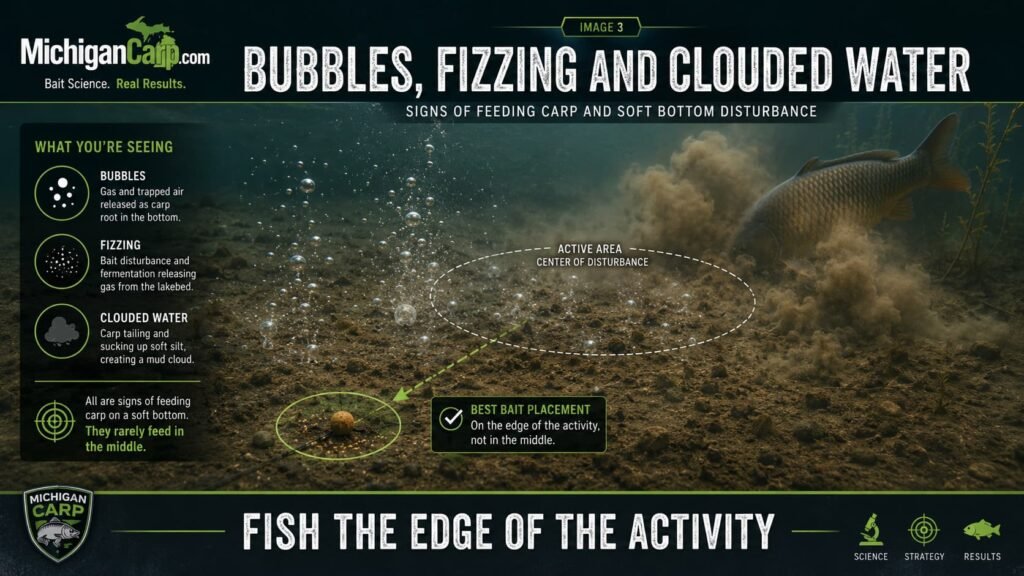
When you see bubbles or fizzing, do not automatically cast on top of them. First, watch. Decide whether the activity is moving, whether it is over a likely feeding area, and whether the fish are shallow enough to spook.
Often the best cast is not into the center of the bubbling. It is on the edge, slightly ahead of the direction of movement, or on the nearest clean presentation spot. A balanced hookbait, wafter, small boilie, small PVA bag, light particle trap or dusted hookbait can work well.
Heavy baiting is rarely the first move. Carp that are already feeding do not always need much extra bait, and throwing bait directly onto them can stop the activity.
Clouded Water and Mud Trails
Clouded water is one of the most useful signs carp are feeding in shallow water.
Carp can cloud the water when they root in silt, clay, marl, shallow mud, weed bases, reed margins or hard/soft transitions. In many Michigan lakes, especially shallow bays and dam ponds, clouding can be easier to see than the fish themselves.
Strong clouded-water signs usually appear suddenly, move, grow, clear and return, or show alongside bubbles, tails, bow waves or reed movement. A cloudy patch that forms along a reed edge at dawn, then moves slowly across a soft-bottom corner, is a very different clue from a shoreline muddied by wind.
False clouding is common. Boat wash, ducks, geese, turtles, dogs, swimmers, waves, rain runoff, shoreline erosion and inflows can all cloud water. The key is whether the cloud behaves like feeding activity. Does it move with purpose? Does it repeat? Does it appear near food-rich habitat? Does it connect to other carp signs?
When you see clouded water, do not always cast into the middle of it. Carp may be actively rooting there, and a lead landing in the center can spook them. Often the better cast is to the clean edge, the route leading into the cloud, the firmer bottom nearby, or the place the fish seem to be heading.
Mud trails are closely related. They show that something has disturbed the bottom and moved through the area. In soft silt, clay, marl or shallow margins, a moving mud trail can be a very good carp sign, especially when linked to tails, bubbles or bow waves.
The best response is usually to fish ahead of the movement or on the edge of the trail. Casting directly into the fish’s path can spook them, especially in shallow, calm water.
The color of the cloud can also tell you something. A pale cloud may suggest clay, marl or fine sediment. A dark brown cloud may suggest soft silt. A cloud that appears around weed stems may suggest fish working the base of the plants. Each bottom type needs a slightly different presentation.
For a deeper guide to bottom types and natural food, use How to Find Natural Carp Feeding Areas in Michigan Lakes.
Tails and Bow Waves
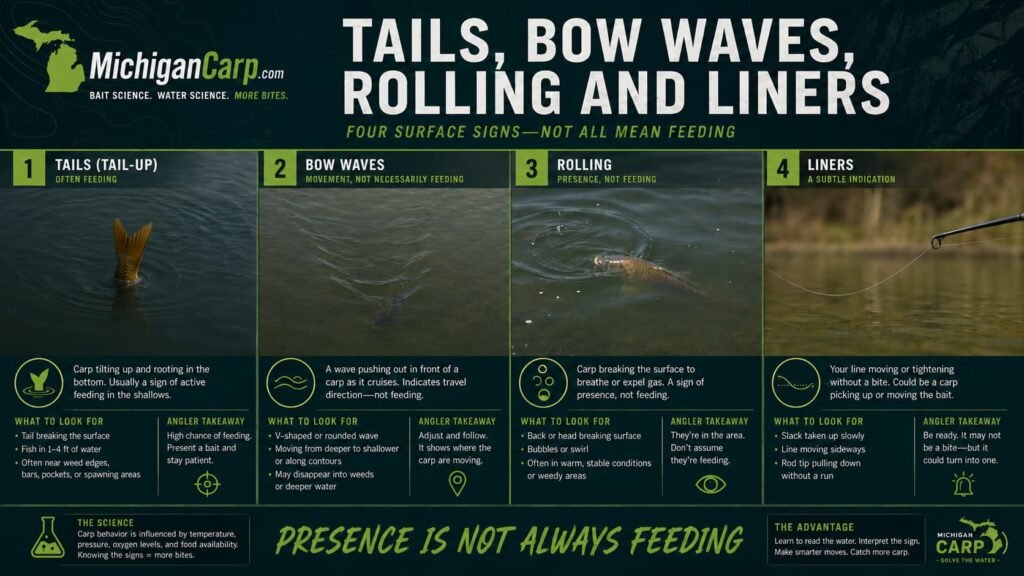
A carp with its tail up is one of the clearest signs you will ever see.
Tailing usually means the carp is head-down, feeding or investigating bottom food in shallow water. It may be rooting through silt, picking around weed, browsing snail-rich edges, working a reed line, or feeding on a shallow flat.
Tailing carp are exciting because they confirm two things at once: carp are present, and at least one fish is down on the bottom. That is stronger than seeing a carp cruise past near the surface.
But tailing carp are also easy to spook.
Shallow fish are sensitive to vibration, shadows, casting splash and bank movement. The worst response is to rush forward, stand on the skyline and cast directly onto the fish. A better response is to stay low, watch the direction of movement, and place a bait where the fish is likely to feed next.
Sometimes that means casting beyond the fish and drawing the rig back carefully. Sometimes it means placing a bait ahead of the route. Sometimes it means waiting until the fish moves off the exact spot before casting. In very shallow water, waiting can be the best fishing decision you make.
Bow waves need similar care.
A bow wave shows fish moving through shallow water, but it does not always mean the same thing. A slow bow wave moving along a reed edge, weedline or shallow margin can be a useful carp sign. It may show fish cruising confidently, feeding lightly, or moving between food and safety. A sudden bow wave charging away from the bank usually means the fish has been spooked.
The difference is speed and behavior.
Confident bow waves are often slow, deliberate and repeated. They may follow a weed edge, pass through a reed gap, cross a shallow flat, or move toward clouded water. Spooked bow waves are sudden, fast and usually move away from you.
When you see bow waves, do not chase them. Try to understand the route. Where did the fish come from? Where is it heading? Is it following a margin, a weed edge, a bay mouth, or a shallow-to-deep transition?
A bow wave is often a route sign more than a feeding spot. The best bait may be ahead of the fish, along the path it keeps using, rather than behind it where it has already passed.
Rolling Carp and Liners
Rolling carp are useful, but they are often misunderstood.
A carp rolling shows that carp are present. That alone has value. But rolling does not always mean feeding. Carp may roll when they are moving, adjusting depth, cruising, gathering, spawning, staging before feeding, or simply comfortable in the area.
The most useful rolling is repeated and connected to a feature.
If several fish roll over a bay mouth at dawn, that may show a route. If fish roll along a point every evening, they may be using the edge. If carp roll over a known gravel or mussel area at dusk, they may be visiting a feeding zone. If one fish rolls once in open water and disappears, that is much weaker evidence.
Do not automatically cast to the exact roll. Ask what is under it. Ask whether the fish are moving or feeding. Ask whether they are likely to travel from that spot to a nearby bay, weedline, point or shelf.
On big lakes, rolling fish often reveal zones rather than exact spots. A roll at range can show the direction of movement, the depth band fish are using, or the general area worth watching. It does not always mean you should fire bait at the splash.
Liners are just as important, and many anglers waste them.
Liners are line bites caused by fish touching or swimming through your line. They may show as single bleeps, slow lifts, short drops, twitchy bobbin movement, repeated knocks or false indications that never develop into a run.
A liner can show that carp are in the area, even if they are not feeding on your bait. That is valuable information.
One liner can be random. Repeated liners at the same time, from the same direction, are much more important. They may mean carp are moving through your swim. They may mean your line crosses a route. They may mean fish are above your bait, close to your bait, or feeding nearby but not exactly where the rig is placed. They may also show that your line angle is too intrusive.
Do not instantly recast after one liner. If liners repeat, think before acting. You might move one rod slightly closer to the route, place another on the feeding edge, slacken or sink the line where appropriate, reduce bait, or fish a single hookbait where the fish are crossing.
A liner is not a failed bite.
It is the fish telling you something.
For big-water interpretation, read Advanced Big-Lake Carp Tactics for Michigan Waters
Weed, Reeds and Margin Movement
Weed and reeds can reveal carp before you ever see a fish.
Carp feeding or moving through weed can make stems shake, part, pulse or move against the wind. Reed movement can show fish tight to cover, feeding at the base of stems, or using a margin route.
These signs are strongest in calm conditions. If a patch of weed moves against the wind, moves in pulses, or moves at the same time bubbles appear nearby, it deserves attention. Reed movement is stronger when it happens low at the base, repeats in one area, or is followed by clouding, bubbles or bow waves.
But weed and reeds can also be moved by wind, current, turtles, ducks, panfish, waves or floating debris. The sign becomes useful when it joins a pattern.
Do not cast blindly into thick weed or tight reeds unless you can present safely and land the fish. The better spots are usually holes, lanes, outside edges, inside turns, reed gaps and the route leading away from cover.
Use strong tackle, safe lead systems and realistic fish-landing judgment. A carp hooked in heavy weed or reeds needs to be landed safely. If the tackle, swim or angle is not suitable, do not fish that exact spot.
Reed and weed signs are often strongest at dawn, dusk, night or during quiet periods when boat pressure has dropped. A weedline that looks lifeless at midday may become active after the lake settles.
Surface Slicks, Flat Spots and Bird Clues
Surface slicks and flat spots are weaker signs, but they can still help.
A flat spot may appear when fish activity changes the surface, when oilier food rises, or when wind and surface film create a calmer patch. It can also come from algae, pollen, boat slicks, decomposing vegetation, bait oils or natural lake scum.
A flat spot by itself is not proof. A flat spot over a known feeding area, with bubbles or rolling fish nearby, is more interesting.
Bird activity can also help you read the water. Gulls, terns, ducks, herons and other birds may reveal insects, baitfish, weed life, shallow food or wind-driven activity. Birds do not prove carp are feeding, but they can point you toward food-rich areas.
Birds can also reveal a problem. If ducks, geese or swans are clearing bait, adjust baiting, timing or location. Do not feed birds and do not create a bird problem while trying to catch carp.
On some public Michigan waters, bird activity, boat traffic and carp activity all overlap around campgrounds, shallow bays and weedy shorelines. That does not mean you should fish blindly. It means the area deserves observation.
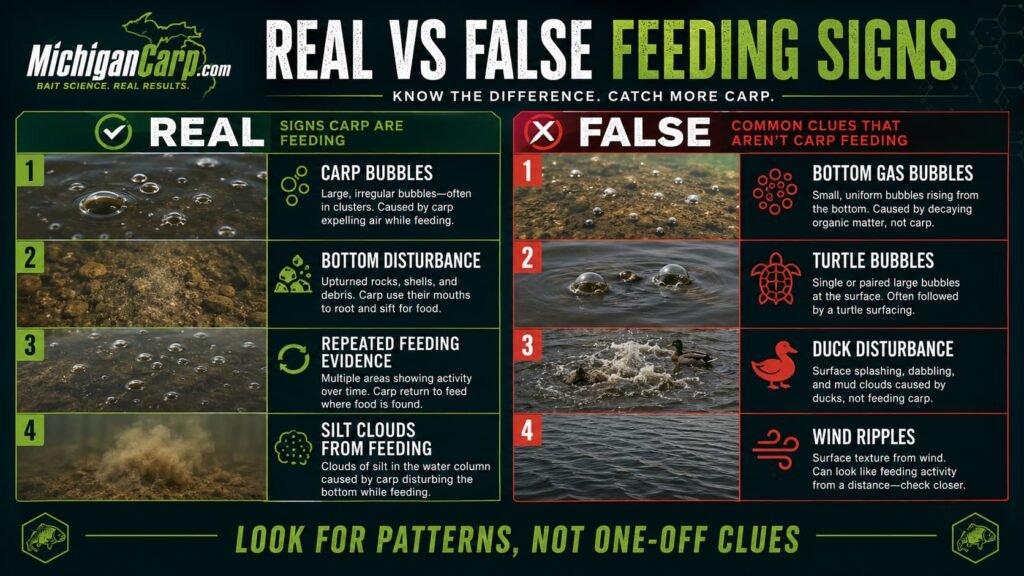
Real Feeding Signs vs False Clues
Good sign reading depends on knowing what not to trust.
False or weak signs include turtle bubbles, gas from rotting weed, ducks stirring silt, baitfish dimpling, gar rolling, frogs moving reeds, muskrats, boat wash, wind ripples, leaves releasing trapped gas, insect hatches and algae slicks.
The way to separate real signs from false clues is to look for connection.
Does the sign repeat? Does it move like a fish? Is it near natural food? Does it happen at a feeding time? Is it linked to bottom type? Did it produce liners, rolling fish, clouding, tails or bites?
The best confirmation is when several signs line up.
Slow bubbles plus clouded water plus reed movement is strong.
Repeated liners plus evening rolling along a point is useful.
Tails plus a mud trail in a shallow bay with weed and warm wind is worth fishing.
One random splash is not enough.
Patterns are what matter.
How Bottom Type Changes the Signs
The same carp activity looks different over different bottoms.
Over soft silt, signs may be obvious. Bubbles, fizzing, clouded water, mud trails and tails can all appear when carp root through insect-rich sediment. This is where balanced hookbaits, wafters, light crumb, small PVA bags and careful presentation can be important.
On gravel, mussels or hard clay, signs may be more subtle. Carp may not cloud the water heavily. Instead, you may notice rolling fish, liners, repeated shows, shell fragments, or activity along hard/soft transitions. Boilies, tiger nuts, hard hookbaits, wafters and small amounts of crumb often suit these areas.
In weed, visible signs may be disguised. Moving stems, small bubbles, shaking weed tops, bow waves and activity around holes or lanes can all matter. The challenge is presentation and landing fish safely. The thickest weed is not always the best place to cast; edges and clear holes are usually more practical.
On clay or marl, clouding can look pale, milky or tan. Carp moving through these areas may leave obvious trails in shallow water. The edge of the cloud is often better than the center, especially if fish are actively disturbing the bottom.
Understanding bottom type stops you misreading signs. It also helps you choose the right rig and bait.
How Season, Weather and Pressure Change Feeding Signs
Feeding signs change through the year.
In spring, signs often appear in shallow warming areas. Look for bow waves, tails, clouded dark-bottom bays, bubbling in soft silt, reed movement and rolling fish after several warm days. Spring signs can be brief, and carp may visit shallow water for warmth before they are ready to feed heavily.
In summer, signs often shift around boat pressure and oxygen. Dawn, dusk and night become more important. Weed movement, evening liners, shallow bubbles after boat traffic drops, and signs on windward banks can all matter. A lake that looks dead at noon may be very different after sunset.
In fall, feeding signs can become stronger but more specific. Weed dieback edges, mussel beds, deeper bay mouths, windward points and hard/soft transitions can produce repeated activity. Fall carp may feed confidently, but location still matters.
In cold water, signs are often subtle. A few slow bubbles, a small clouded patch, one short feeding window, or gentle liners near deeper stable water may be all you see. Cold-water sign reading requires patience.
Weather also changes what you can see. Calm weather makes tiny signs easier to read, but carp may be more cautious. Wind can hide signs but also create feeding. Rain can activate inflows and shallow areas, but heavy runoff can confuse clouded-water clues. Boat pressure can stop visible signs during the day and push carp into weed, deeper water or nighttime routes.
A lack of signs at the wrong time does not prove a lack of carp.
It may only prove you are watching during the wrong window.
For seasonal location detail, read Michigan Carp Fishing Seasons.
How to React Without Ruining the Chance
Seeing signs is only half the skill. Reacting correctly is the other half.
Cast when signs are repeated, the fish are not too shallow to spook, the bottom allows presentation, and you can place the bait quietly. Wait when carp are close in, shallow, moving toward you, or feeding in clear calm water where one bad cast will clear the swim.
Move only when the evidence justifies it. Repeated signs out of range, a clear wind shift, visible fish activity on another bank, or repeated liners showing a route away from your bait are all reasons to adjust. Moving because you are bored is not watercraft.
Bait lightly when fish are already feeding, when water is cold, when the spot is small, when carp are shallow, or when you are still learning the pattern. Increase bait only when carp stay in the area, bites happen, bait is being eaten, and nuisance fish or birds are not clearing everything first.
The best anglers do not overreact. They let the signs tell them what kind of opportunity they have.
A feeding spot needs careful bait placement.
A travel route needs accuracy and restraint.
A holding area may need time.
A shallow tailing fish may need no extra bait at all.
Matching Bait and Presentation to Feeding Signs
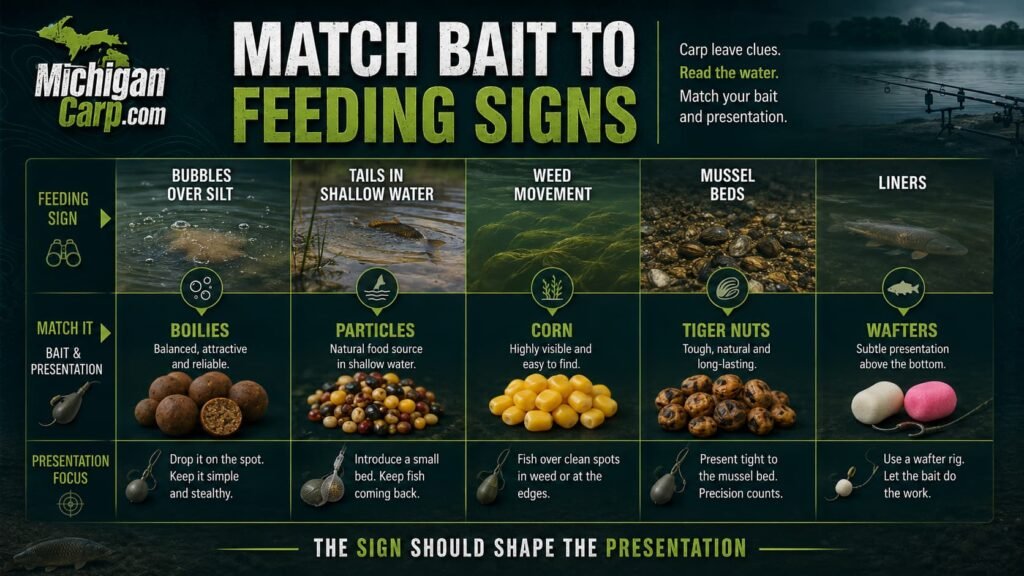
The sign should influence the bait and presentation.
Bubbles and fizzing over silt usually call for careful presentation. Wafters, balanced hookbaits, small boilies, light crumb, soluble dusted hookbaits and small PVA bags can work well. Heavy baiting should wait until fish confirm they are staying.
Tails in shallow water usually call for stealth. Corn, maize, tiger nuts, small boilies and light particles are good options, but the cast and bank movement matter more than the bait.
Hard-bottom signs around mussels, gravel or clay often suit boilies, tiger nuts, hard hookbaits, wafters and small crumb. These areas may not show dramatic surface activity, so repeated rolling, liners and timing become important.
Weed movement usually calls for fishing the holes, lanes and edges. Tiger nuts, nut boilies, maize, balanced hookbaits and small PVA sticks can all work, but tackle strength and fish safety must come first.
Liners without bites usually mean the fish are close, but something is not quite right. Move one rod slightly, reduce bait, fish a route, change the line angle or place a bait where the fish are crossing.
For bait selection, read Best Carp Bait for Michigan Lakes, Boilies vs Corn vs Particles for Carp, Particles for Carp Fishing and Packbait for Carp Fishing.
A Simple Sign-Reading System for Bank Anglers
From the bank, you need to slow down.
Do not walk straight to the water and start casting. Stop back from the edge, stay low if the water is shallow, and watch. The margins may tell you more in five quiet minutes than a marker lead will tell you after ten splashy casts.
Look close before looking far. Check reed edges, weed holes, shallow margins, clouded water, tails, bow waves and moving stems. Many anglers miss carp close in because they are obsessed with distance.
Then scan the wider zone. Look at bay mouths, points, windward edges, drop-offs, bird activity and boat pressure. Try to work out whether the signs show a feeding spot, a route, or fish simply passing through.
With three rods, do not cast all three to the same guess. Fish one visible feeding sign, one travel route and one safety edge. If one rod gets liners, one gets bites and one does nothing, the lake is teaching you how the carp are using the zone.
Practical Example: Reading a Feeding Bay
Imagine a shallow Michigan bay with soft silt at the back, cabbage weed on one side, reeds along the margin and a deeper route leading out toward the main lake.
At first light, you see small bubbles near the weed edge. Ten minutes later, a clouded patch appears near the reeds. Then one slow bow wave leaves the back of the bay. A few minutes later, the reeds knock twice in the same corner.
That is not one random sign.
That is a pattern.
A sensible approach would be to place one balanced hookbait near the soft silt edge, one tiger nut or maize bait near the weed/reed route, and one small boilie trap near the deeper exit route. Bait lightly, stay quiet, and avoid casting directly into the clouded water.
The signs tell you how to fish the swim.
Practical Example: Liners With No Bites
Now imagine a big-lake point.
One rod is on a hard spot, one is on the side of the point, and one is deeper at the base. At dusk, the middle rod gives three single bleeps and the bobbin lifts slightly twice, but no run develops.
The same thing happens the next evening at the same time.
That is not failure.
That may be the route.
A good adjustment would be to move one rod slightly closer to the suspected line of movement, reduce bait on that rod, fish a single hookbait or small PVA stick, and watch for rolling fish, bubbles or further liners along the point.
Repeated liners are one of the most useful clues in carp fishing if you treat them as information.
Common Mistakes When Reading Carp Signs
The biggest mistake is reacting to one random sign instead of waiting for a pattern.
Casting at every bubble, chasing every roll, dumping bait after one splash, or moving swims every thirty minutes usually creates more disturbance than results. Good sign reading is calm. It takes in the sign, the location, the timing, the bottom and the likely route before changing anything.
Another common mistake is confusing presence with feeding. A rolling carp shows carp are present. It does not automatically show they are eating. A liner shows carp are in the area. It does not mean they are on the bait. A bow wave shows movement. It may be feeding, cruising or spooking.
The third mistake is ignoring bottom type. Bubbles over productive silt mean something different from bubbles in rotting weed. Clouded clay means something different from duck-stirred mud. Moving weed beside a snail-rich edge means something different from weed moving in wind.
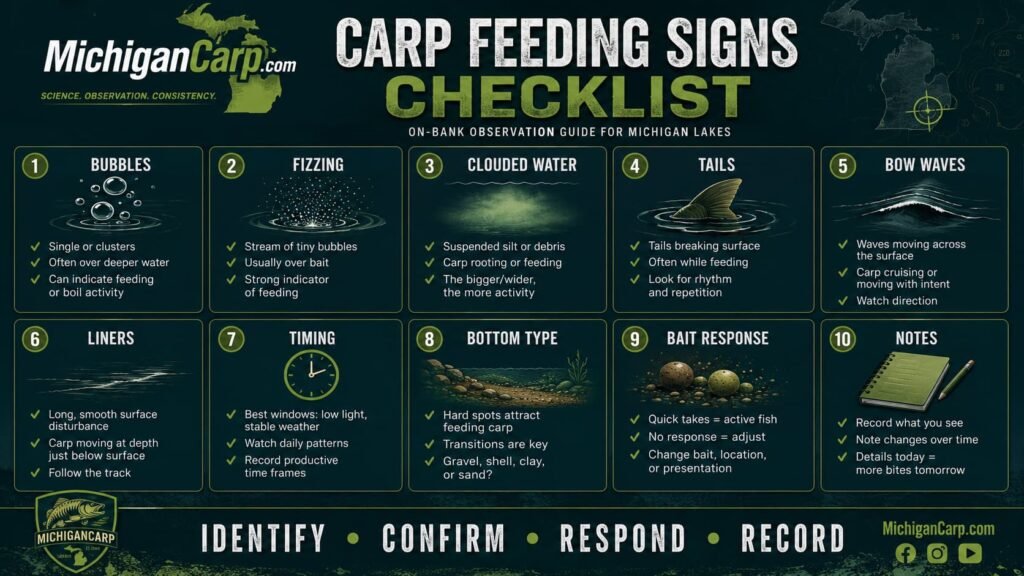
The final mistake is not keeping notes. Feeding signs often repeat by wind direction, season, time of day, water temperature and boat pressure. If you record those patterns, you start building your own lake knowledge instead of starting from scratch every session.
My Practical View
I would rather see one repeated feeding sign in the right area than ten random splashes in open water.
For Michigan carp fishing, the strongest signs are usually connected to habitat. Bubbles over soft silt mean more if the area holds natural food. Tails in a shallow bay mean more if the bay has weed, warmth and a route out. Liners mean more if they happen at the same time each evening. Clouded water means more if it appears along a reed edge or clean silt pocket. Rolling fish mean more when they repeat over a bay mouth, point or depth change.
The mistake is treating every sign the same.
A feeding sign is only useful when you understand the location behind it.
The final rule is simple:
Watch first. Look for patterns. Fish the edge of feeding activity. Bait lightly until the carp confirm the spot. Let the signs tell you what to do next.
FAQ
What are the main signs carp are feeding?
The main signs carp are feeding include bubbles, fizzing, clouded water, tails up, bow waves, rolling carp, liners, moving weed, reed movement and mud trails.
Are bubbles a sign of carp feeding?
Bubbles can be a sign of carp feeding, especially when they move slowly, repeat in one area, appear with clouded water or follow a line across soft bottom. Random bubbles can also be bottom gas, turtles or rotting vegetation.
What does carp fizzing look like?
Carp fizzing usually looks like fine bubbles rising from a patch of disturbed bottom. It is strongest when the bubbles move slowly across a soft-bottom feeding area.
Does clouded water mean carp are feeding?
Clouded water can mean carp are feeding, especially in shallow silt, clay, marl or reed edges. It can also come from wind, ducks, turtles, waves or boat wash.
What does it mean when carp tail up?
Tails up usually mean carp are head-down in shallow water, feeding or investigating bottom food.
Are bow waves a good carp sign?
Bow waves can be a good carp sign if they are slow and repeated near food or cover. Fast bow waves usually mean spooked fish.
Does rolling mean carp are feeding?
Rolling shows carp are present, but not always feeding. Repeated rolling over a feature, route or baited area is more useful than one random roll.
What are liners in carp fishing?
Liners are line bites caused by carp touching or swimming through your line. They often show carp are moving through the swim.
What should I do if I get liners but no bites?
Repeated liners may mean carp are crossing your line or feeding nearby. Move one bait onto the route or feeding edge, reduce disturbance and consider changing the line angle.
Is moving weed a sign of carp?
Moving weed can be a sign of carp, especially when it moves against wind or in pulses and is linked to bubbles, bow waves or reed movement.
Should I cast directly at feeding carp?
Not always. In shallow or clear water, casting directly on feeding carp can spook them. Often it is better to fish the edge, route or next clean spot ahead of the fish.
Should I bait heavily when I see feeding signs?
Not immediately. Start with light baiting unless carp are clearly feeding hard, staying in the area and accepting bait.
How do I know if feeding signs are real?
Real feeding signs usually repeat, move naturally, connect to food-rich habitat and appear with other evidence such as bubbles, clouding, liners, tails or fish movement.
Do carp feeding signs change by season?
Yes. Spring signs are often shallow and brief, summer signs often appear at dawn, dusk or night, fall signs may last longer, and cold-water signs can be very subtle.
What is the biggest mistake when reading carp signs?
The biggest mistake is reacting to one random sign instead of looking for repeated patterns connected to food, routes, bottom type and timing.
Next Steps
Use these supporting guides next:
How to Find Natural Carp Feeding Areas in Michigan Lakes
Advanced Big Lake Carp Tactics for Michigan Waters
Best Carp Bait for Michigan Lakes
Boilies vs Corn vs Particles for Carp