

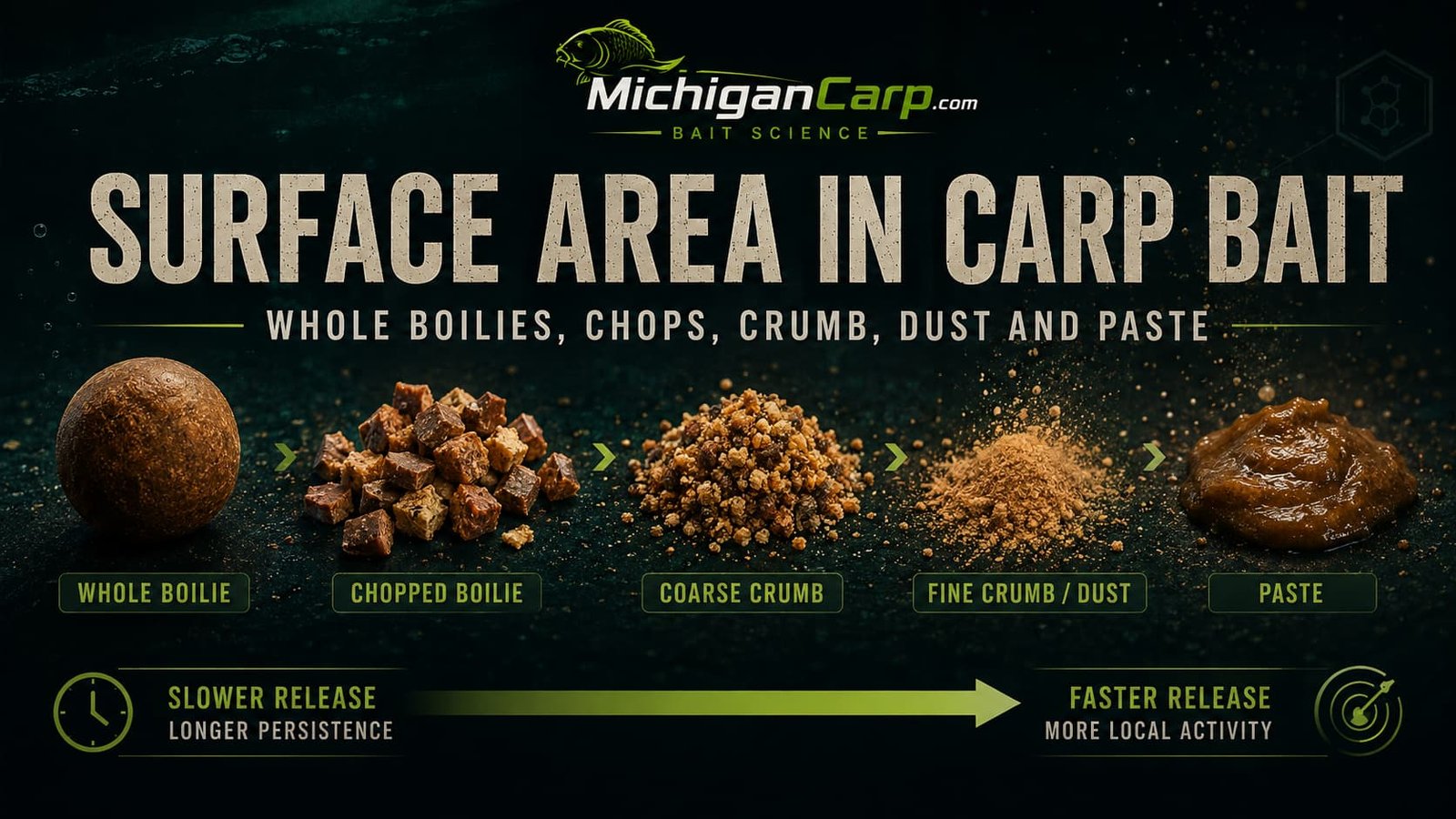
Surface area in carp bait is one of the simplest practical bait-science ideas, but it is often explained too simply.
The usual advice is that more surface area means more leakage. That is directionally useful, but it is not the full story.
A whole boilie, a small boilie, a halved boilie, chopped boilie, crumb, dust and paste can all come from the same recipe and still behave very differently underwater. The reason is not only that one version has more outside surface touching the water.
Changing bait format also changes how much internal structure is exposed, how quickly water reaches soluble material, how far dissolved material must travel, how many physical particles are released, and how long recognisable food remains in the swim.
Surface area controls timing. It helps decide how quickly, how locally and for how long the bait system communicates with the water.
This article owns the bait-format side of the subject: whole boilies, smaller boilies, chops, crumb, dust, paste, pellets, prepared particles and mixed-format feeding.
For the core release mechanism, read Carp Bait Solubility and Leakage. For the practical controls that make one finished boilie leak faster than another, read Why Some Carp Baits Leak Faster Than Others. For testing bait formats at home, use How to Test Boilies Before Fishing.
This guide also connects with How to Use Hydrolysates in Carp Bait, How to Prepare Boilies for Carp Fishing, Packbait for Carp Fishing, How to Process Carp Bait Ingredients and the main Bait Science hub.
For external technical background, see OpenStax: The Dissolution Process, OpenStax: Factors Affecting Reaction Rates and OpenStax: Mathematical Formulas.
Table of Contents
Quick Start: Surface Area in Carp Bait
Surface area in carp bait changes how much bait-water contact is available and how much internal bait structure is exposed.
More surface area usually creates more opportunity for water contact and faster local activity, but it does not create solubility by itself. A ground ingredient can expose more surface, but an insoluble fraction does not become chemically soluble just because it has been crushed.
| Bait format | Surface-area effect | Best practical use |
|---|---|---|
| Large whole boilies | Lowest exposed surface per unit of mass | Durability, selectivity, longer sessions and nuisance resistance |
| Smaller whole boilies | More external surface per unit of mass | More individual food items and faster activity without losing cooked structure |
| Halves | Expose internal bait structure | Simple way to increase release without making full crumb |
| Chops | Create irregular exposed surfaces | Intermediate activity, food presence and rig-area feeding |
| Coarse crumb | High exposed area with recognisable food particles | Short sessions, sticks, method, packbait and active patches |
| Fine crumb or dust | Very high exposed area and fast dispersion | Fast local signal, coatings and small traps |
| Paste | Maximum water access if used thinly | Hookbait wraps, lead wraps and short-session traps |
The simplest rule is:
Use surface area to control bait timing, not as a replacement for good ingredients, good location or correct bait quantity.
Surface Area Is Contact Between Bait and Water
A bait interacts with water through surfaces, cracks, cut faces, pores, exposed ingredients and any structure that water can actually reach.
At that bait-water boundary, water can wet the surface, enter accessible cracks, hydrate parts of the matrix, dissolve suitable compounds, loosen fine particles, soften the structure and carry material into the surrounding water.
This does not mean everything leaving bait is dissolved. Some material may be truly dissolved. Some may be fine suspended particles, crumb, dust, fragments, oil droplets or colloidal material. Those processes all matter, but they are not chemically identical.
| What happens at the surface | What it means in bait terms |
|---|---|
| Water wets the bait | The release process begins at accessible surfaces |
| Soluble material dissolves | Salt, sugars, organic acids, amino acids and some hydrolysate fractions can enter the water phase |
| Fine particles disperse | Crumb, dust, seed meal and method particles can cloud or spread locally |
| Structure softens | The bait may expose new surfaces over time |
| Fragments separate | Physical food pieces may remain in the swim |
A bait can stay physically intact while still releasing dissolved material. A bait can also cloud the water heavily while releasing mostly physical particles. Surface area helps both processes, but it does not make them the same thing.
Surface Area Does Not Create Solubility
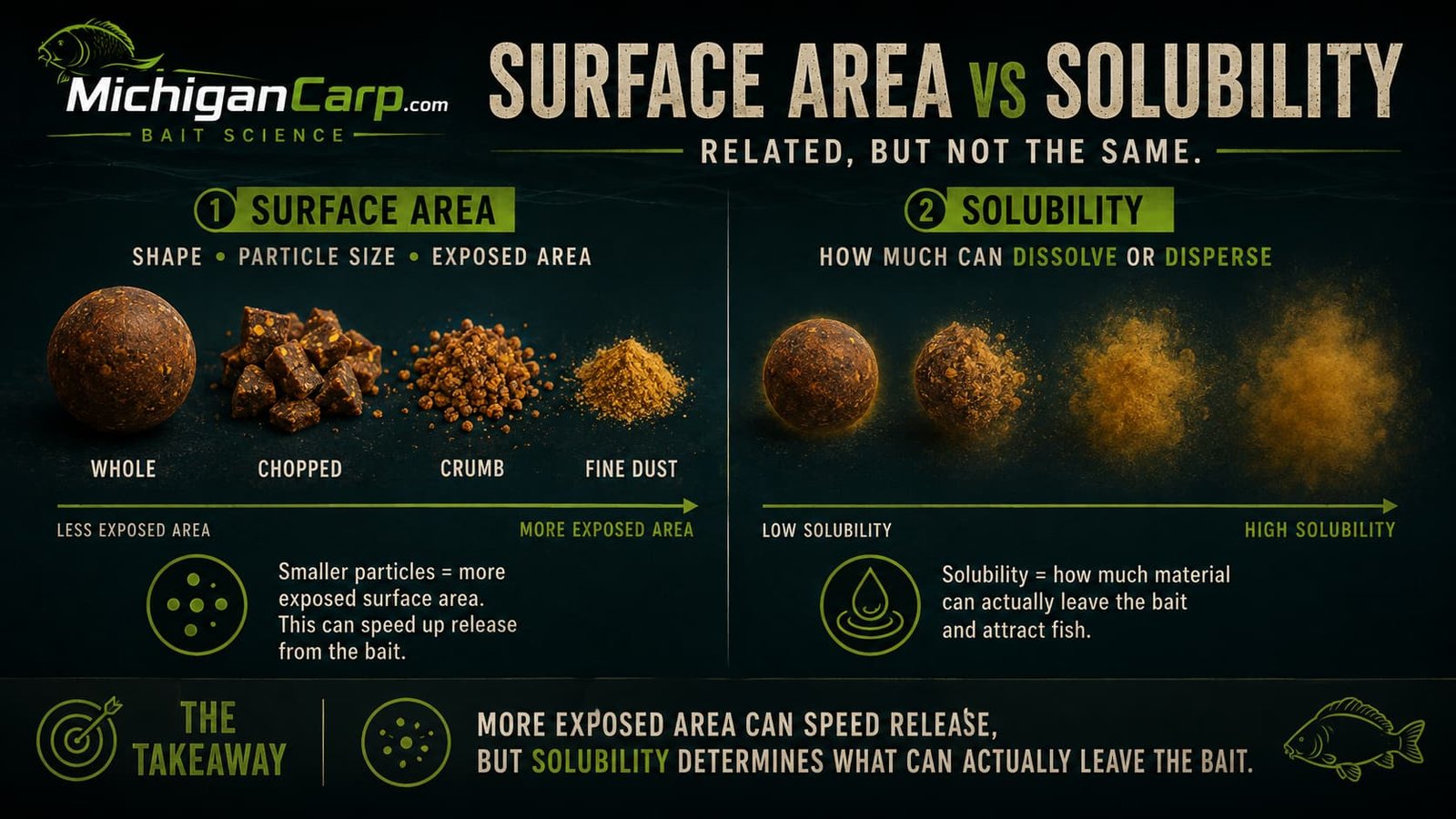
This is the biggest misunderstanding in the subject.
Grinding, chopping or crumbing bait can expose more material to water. That can speed up the release of fractions that are already soluble or dispersible. It can also make physical particles spread faster.
But surface area does not change the chemistry of the ingredient.
An insoluble structural fraction does not become soluble because it has been ground finer. A fatty ingredient does not suddenly behave like salt. A dense protein structure does not become a free amino acid because it has been crushed.
| Question | What it really asks |
|---|---|
| Is it soluble? | Can that compound or fraction enter solution under the conditions present? |
| Is it exposed? | Can water reach enough of the material? |
| Can it leave? | Can dissolved or dispersed material move away from the bait? |
| Does it still fish? | Does the bait remain useful for the session? |
Good bait design considers all four questions.
For the deeper release explanation, use Carp Bait Solubility and Leakage. For hydrolysate application in crumb, coatings and liquids, use How to Use Hydrolysates in Carp Bait.
Whole Boilies, Smaller Boilies, Chops and Crumb
The most practical way to use surface area is to think in bait formats.
A whole boilie keeps its complete cooked structure. It usually releases more slowly than the same bait cut into pieces, but slow does not mean inactive. Whole boilies are useful when you need durability, selectivity, longer bottom time, nuisance resistance or recognisable food remaining in the swim.
Smaller whole boilies keep the cooked outer structure but increase external surface area per unit of bait mass. They also create more individual food items for the same total bait weight. This can be useful when you want more activity without turning the bait into crumb.
Halves and chops expose the interior. This is important because the inside of a boilie may not behave exactly like the cooked outer surface. Cutting gives water direct access to material that would otherwise be buried inside the bait.
Crumb creates many small surfaces and short travel distances. Fine crumb works quickly but can disperse fast and leave little substantial food behind. Coarse crumb gives more physical food presence while still increasing water contact.
Paste removes much of the cooked-bait structure from the equation, but recipe still matters. A thin paste wrap around a hookbait behaves differently from a large dense ball of paste.
| Format | Speed tendency | Food persistence | Best use |
|---|---|---|---|
| Whole boilie | Slowest | Highest | Longer sessions, selectivity, hookbait durability |
| Smaller whole boilie | Moderate | Good | More items and more surface without full breakdown |
| Halves/chops | Moderate to fast | Moderate | Rig-area feeding, intermediate release, mixed beds |
| Coarse crumb | Fast | Moderate | Short sessions, method, packbait, PVA sticks |
| Fine crumb/dust | Very fast | Low | Coatings, quick traps, surface activity |
| Paste | Fast and recipe-dependent | Variable | Wraps, short windows, close-range attraction |
The mistake is asking one format to do every job. A mixed-format baiting approach is often stronger.
The 10 mm vs 24 mm Example
The most useful math idea is surface area relative to bait mass.
For ideal spheres of the same density, surface area increases with the square of radius, while volume increases with the cube. That means large spheres contain proportionally more material inside compared with the surface available to water.
In bait terms, for the same total mass of identical mix, many 10 mm boilies provide about 2.4 times as much external surface area as 24 mm boilies.
That does not mean the 10 mm bait leaks exactly 2.4 times faster. Real bait is affected by cooking, drying, matrix structure, solubility, porosity, water movement and ingredient chemistry.
But it does show why size changes more than mouthful size.
| Bait size decision | What changes | Practical result |
|---|---|---|
| Larger boilies | Lower surface area per unit mass and longer internal distance | More persistence, selectivity and slower timing |
| Smaller boilies | Higher surface area per unit mass and more individual items | More activity and more feeding movements |
| Mixed sizes | More than one timing profile | Useful when you want activity and food persistence together |
This is one reason I like mixed formats around selected rigs rather than relying on only one bait size.
Why Chops Are So Useful
Chopped boilies are one of the most useful practical tools in carp bait.
They sit between whole boilies and crumb. They expose internal bait structure without turning the entire feed into dust. They provide recognisable food pieces while still increasing water contact and local activity.
Chops also let you control how far you push the bait toward fast release. Halves, quarters, rough chops, coarse crumb and fine crumb all behave differently even when they come from the same original boilie.
| Chop style | Release effect | Best use |
|---|---|---|
| Halves | Simple internal exposure | Faster than whole bait while retaining size |
| Quarters | More exposed structure and more pieces | Rig-area feeding and short sessions |
| Rough chops | Irregular surfaces and mixed timing | Natural-looking food pieces and varied release |
| Coarse crumb | High activity with some food presence | Method, packbait, PVA and compact traps |
| Fine crumb | Fastest local activity | Coatings, dusting and small high-signal zones |
For many sessions, chops are a better answer than simply making the whole bait softer. You can keep the hookbait durable and increase activity with the freebait format.
Crumb, Dust and Paste
Crumb is not one single bait format.
Coarse crumb, mixed crumb, fine crumb and flour-like dust all behave differently. Coarse crumb creates exposed food pieces with more persistence. Fine crumb hydrates and disperses quickly. Dust can create rapid surface activity but may move away fast in current, wind movement or tow.
That is why I prefer mixed crumb in many situations. A mixture of fine and coarse fractions can create an early signal while still leaving some physical food behind.
Paste is even more water-accessible, especially when used as a thin wrap or small local trap. But paste is still controlled by recipe, moisture, binder level, oil content, particle size and thickness.
| Format | Strength | Risk |
|---|---|---|
| Coarse crumb | Fast activity with food pieces | Can still overfeed if used heavily |
| Fine crumb | Rapid hydration and dispersion | Can disappear from the spot quickly |
| Dust | Immediate surface signal and coating use | Little lasting food value |
| Paste wrap | Very active local presentation | May lack durability |
| Paste ball | Strong local food signal | Can be nuisance-prone or too soft |
This is especially important in cold water and short sessions. More surface area can help a small amount of bait work harder, but it should not be used as an excuse to put in too much feed.
For glugs, soaks, powders and hookbait conditioning, use How to Prepare Boilies for Carp Fishing.
Pellets, Particles, Method Mix and Packbait
Surface area also matters outside boilies.
Pellet behaviour is affected by diameter, but size is not the whole story. Compression, extrusion, binder system, oil level, porosity, ingredient quality and water temperature can all change how a pellet softens and breaks down. A 4 mm pellet is not automatically fast and a 12 mm pellet is not automatically slow.
Prepared particles also change when they are cracked, crushed, ground or blended. Whole maize, cracked maize, coarse blended maize and maize paste are different physical presentations. The whole fraction provides recognisable food. The ground fraction spreads flavour, texture, particles and local activity.
This is why packbait and method mixes work well when they combine structure and surface area. A good packbait is not just dust. It needs to bind, cast or mold, reach the bottom, break down properly and leave useful food around the rig.
| Bait type | Surface-area lesson | Practical use |
|---|---|---|
| Small pellets | More exposed surface, but structure still matters | Fast traps when actual breakdown supports it |
| Larger pellets | More persistence if structure allows | Longer activity and larger food items |
| Whole particles | Lower exposed internal area | Food persistence and feeding confidence |
| Crushed particles | More exposed internal material | Method, packbait and quick local activity |
| Packbait | High contact area carried in a binding system | Rig-area feeding and North American carp tactics |
For practical carrier-bait systems, use Packbait for Carp Fishing. For particle preparation, use How to Prepare Particles for Carp Fishing.
Mixed Formats Create a Release Ladder
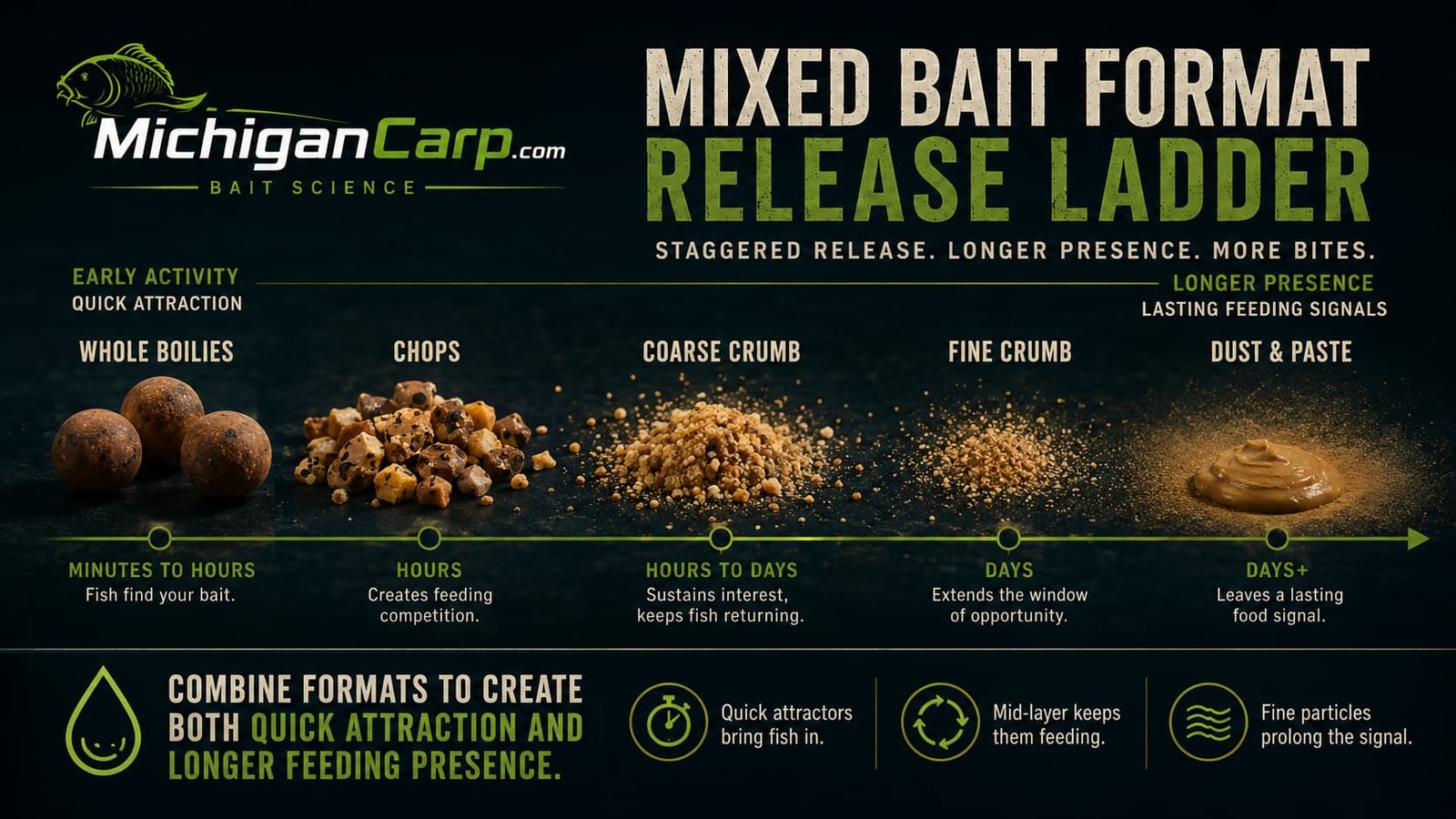
The best practical use of surface area is often a mixed-format release ladder.
Instead of asking one bait to work at one speed, you can use several formats together. Fine crumb gives early activity. Coarse crumb gives exposed food particles. Chops provide intermediate release and recognisable food. Smaller boilies add more external surface while staying intact. Larger boilies provide longer food presence.
| Format | Main timing role | Why it helps |
|---|---|---|
| Fine crumb/dust | Very early | Gets the rig area working quickly |
| Coarse crumb | Early to intermediate | Adds surface area and small food pieces |
| Chops | Intermediate | Exposes interior while leaving recognisable bait |
| Small boilies | Intermediate to sustained | More items and more surface than large baits |
| Large boilies | Sustained | Maintains food presence and selectivity |
This approach is especially useful for longer sessions, big-water fishing, dam ponds, channels and pressured public water where you may want both immediate activity and food that remains meaningful later.
It also lets you separate hookbait mechanics from swim activity. The hookbait can stay durable while the surrounding bait creates faster release.
Short Sessions, Long Sessions and Moving Water
Surface area should match the session.
On short sessions, I want some part of the bait system working quickly. That may mean crumb, chops, paste, smaller boilies, powder coatings or a small PVA/stick mix. But a short session does not mean turning everything into dust. A little physical food can still help hold carp long enough to make a mistake.
On longer sessions, I prefer a wider timing range. Whole boilies, chops, coarse crumb, particles and localized faster treatments can all work together. This prevents the swim from burning out quickly while still giving early activity around selected rigs.
Moving water changes the decision because very fine material may travel away from the rig faster. In current, channel flow, wind undertow or dam-pond movement, I want to think about where fine material goes, whether food remains on the bottom, and how the rig sits relative to the transport path.
| Situation | Surface-area approach |
|---|---|
| Short cold-water session | Small amount of crumb, chops or paste close to a durable hookbait |
| Overnight session | Mixed chops, whole bait and moderate crumb |
| Three-day natural-lake session | Layered bait: particles, whole boilies, chops and rig-area activity |
| Moving water | Use fine material carefully and keep enough substantial food on the spot |
| Big-water exploration | Avoid committing everything to one release speed while learning fish movement |
For Michigan fishing, that usually means using surface area carefully rather than magically. Location, timing and bait quantity still matter more than simply increasing exposed area.
How to Test Surface Area at Home
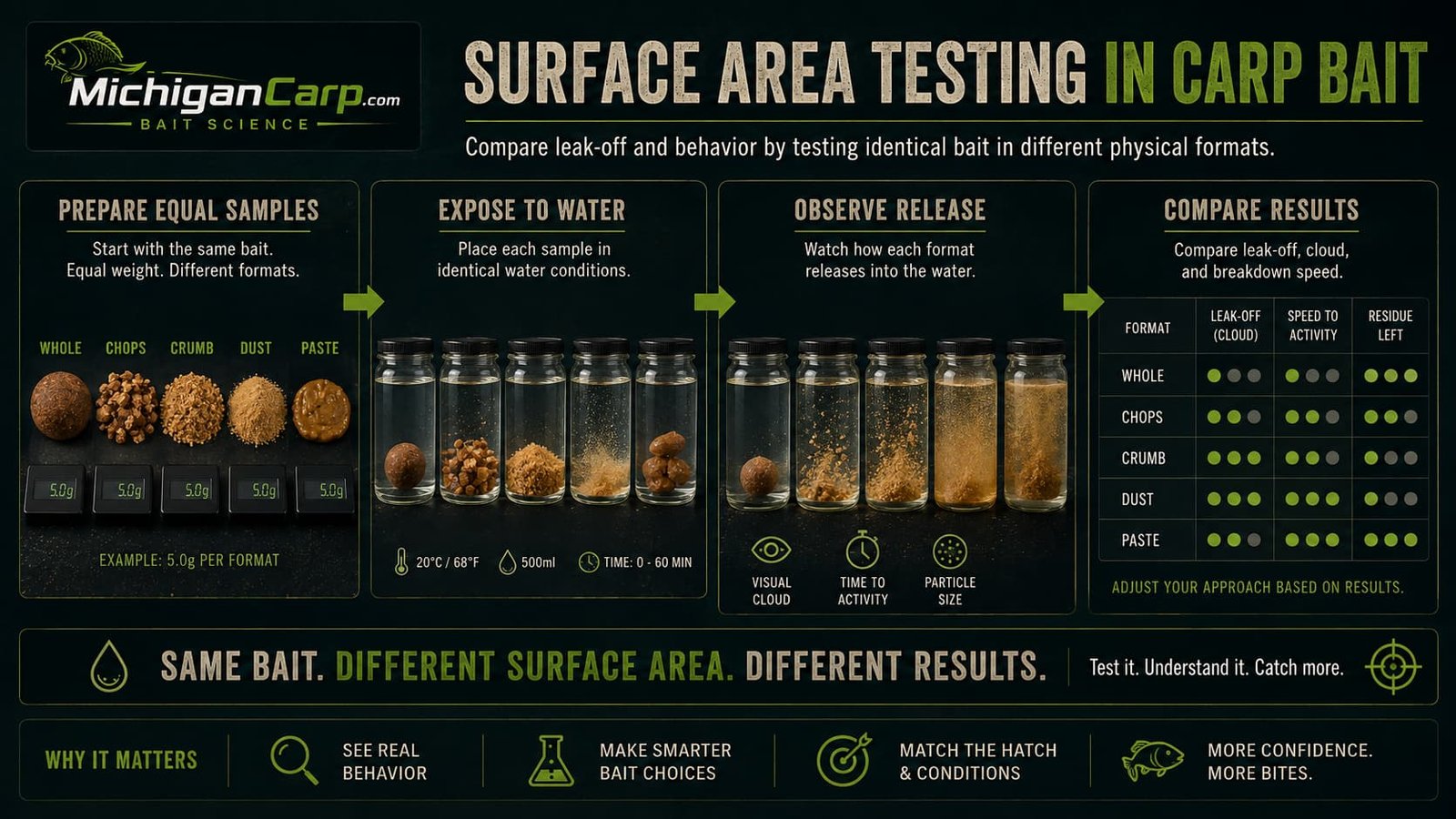
This subject is easy to test comparatively.
Take one batch of identical boilies and divide it into whole boilies, halves, rough chops, coarse crumb and fine crumb. Use equal dry weights, equal water volumes, identical containers and the same water temperature.
Observe the samples at fixed times, such as 30 minutes, 1 hour, 3 hours, 6 hours and 24 hours.
| Observation | What it shows |
|---|---|
| Surface softening | How quickly water affects the outer structure |
| Visible particle release | How much physical material disperses |
| Clouding | Visual activity, not complete dissolved chemistry |
| Fragmentation | How quickly the bait loses physical structure |
| Remaining food | Whether useful bait is still present later |
| Hookbait durability | Whether the rig bait still fishes correctly |
The test will not measure every dissolved compound, but it will show how changing format changes physical bait behaviour.
Do not simply choose the cloudiest jar. A good baiting system may need early activity, intermediate food and longer persistence.
Common Surface-Area Mistakes
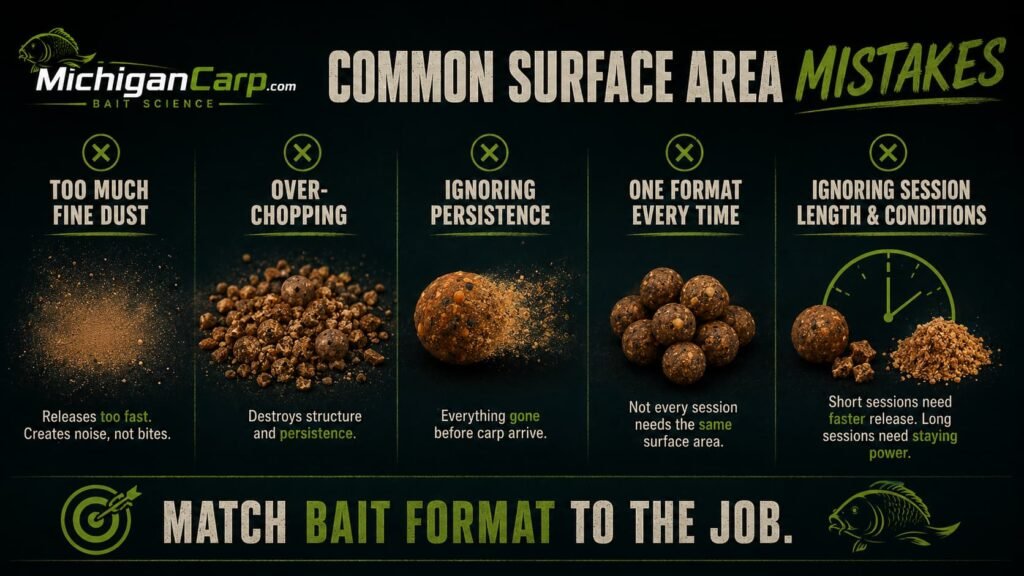
| Mistake | Why it causes problems | Better practice |
|---|---|---|
| Thinking more surface area is always better | Fast release is only useful when it suits the job | Match format to session length |
| Turning everything into fine dust | It may disperse fast and leave little food behind | Use mixed crumb sizes |
| Confusing clouding with solubility | Visible particles are not the same as dissolved signal | Record physical and dissolved behaviour separately |
| Assuming small pellets are always fast | Pellet structure, oil and binder matter too | Test actual breakdown |
| Ignoring the cut interior | Chops expose internal structure, not just extra sides | Use chops deliberately |
| Using only one release speed | One format may not cover the whole session | Build a release ladder |
| Forgetting hookbait mechanics | The hookbait still has to fish correctly | Keep hookbait durability where needed |
| Replacing location with bait format | No bait format works where carp are absent | Find fish first, then tune bait |
Simple Rules for Surface Area in Carp Bait
Think in surface area per unit of bait, not diameter alone. Remember that cutting exposes internal structure as well as creating extra area. Do not confuse faster dissolution with greater chemical solubility. Separate dissolved signal from visible particle clouding.
Use crumb size deliberately rather than turning everything into powder. Judge pellets by actual structure and breakdown, not diameter alone. Use smaller whole bait when you want more external area without losing cooked structure. Use chops when you want a middle ground between whole boilies and crumb.
Most importantly, layer bait formats when the session requires more than one timescale.
My Practical View
Surface area matters because it changes bait timing.
It controls how much bait-water contact is available, how much internal material is exposed, how quickly a small baited area becomes active and how long recognisable food remains in the swim.
But surface area is not a magic attraction setting. It works alongside ingredient solubility, matrix structure, cooking, drying, water movement, fish location and session length.
For short sessions, I like using crumb, chops, powder coatings, paste or small bait quantities to create useful local activity without overfeeding. For longer sessions, I prefer a release ladder with whole bait, chops, coarse crumb and particles so the swim has both early activity and food that remains meaningful later.
For my own Michigan fishing, I rarely want every bait item doing the same job. A durable hookbait can fish properly while the surrounding bait creates faster activity.
Surface area is a control tool. Use it to decide how quickly, how locally and for how long the bait system should work.
FAQ
Why does surface area matter in carp bait?
Surface area matters because it changes how much bait-water contact is available. More exposed surface can increase water contact, expose internal bait structure and speed local release, but the result still depends on ingredients and bait structure.
Do smaller boilies release signal faster?
For the same total bait mass and identical recipe, smaller boilies provide more combined external surface area than larger boilies. Actual release still depends on cooking, drying, matrix structure, porosity and ingredient solubility.
Why do chopped boilies behave differently?
Chopped boilies expose internal bait structure directly to water. That changes both exposed area and the distance some soluble material must travel before leaving the bait.
Does grinding bait make it more soluble?
No. Grinding increases exposed area and may speed the release of soluble or dispersible fractions, but it does not make chemically insoluble material soluble.
Is crumb better than whole boilies?
Not universally. Crumb is useful for rapid local activity, while whole boilies provide more physical persistence. The best choice depends on session length, fish activity and baiting strategy.
Is fine crumb better than coarse crumb?
No. Fine crumb works faster and disperses more easily. Coarse crumb retains more physical food. A mixed crumb often gives a better balance.
Does paste always release faster than a boilie?
Paste usually gives easier water access because it has not been cooked into the same durable structure, but its behaviour still depends on recipe, moisture level, binders, oil content and thickness.
Are small pellets always faster than large pellets?
No. Pellet size matters, but compression, ingredients, binders, oil level, porosity and processing can also change breakdown and release.
Should I mix whole boilies, chops and crumb?
Often yes. Mixed formats can create different release times in one feeding area, with early activity from crumb, intermediate release from chops and persistence from whole bait.
Does higher surface area attract carp from farther away?
Not automatically. Higher exposed area can increase local release, but transport depends on water movement, the compounds involved, bait quantity and whether carp are close enough to encounter the signal.
Next Steps
- Carp Bait Solubility and Leakage — understand the core water-entry and release mechanism.
- Why Some Carp Baits Leak Faster Than Others — understand the practical controls behind leakage rate.
- How to Test Boilies Before Fishing — compare whole bait, chops, crumb and treated bait fairly.
- How to Use Hydrolysates in Carp Bait — use hydrolysates in crumb, glugs, powders and hookbait treatments.
- How to Prepare Boilies for Carp Fishing — apply glugs, soaks, sprays and powder coatings without ruining bait mechanics.
- Packbait for Carp Fishing — build carrier bait with the right surface area, binding and breakdown.
- How to Prepare Particles for Carp Fishing — prepare particles safely before crushing, blending or adding to carrier bait.
- How to Process Carp Bait Ingredients — understand grinding, sieving, soaking, cooking and drying decisions.
- Bait Science — browse the technical bait library.