
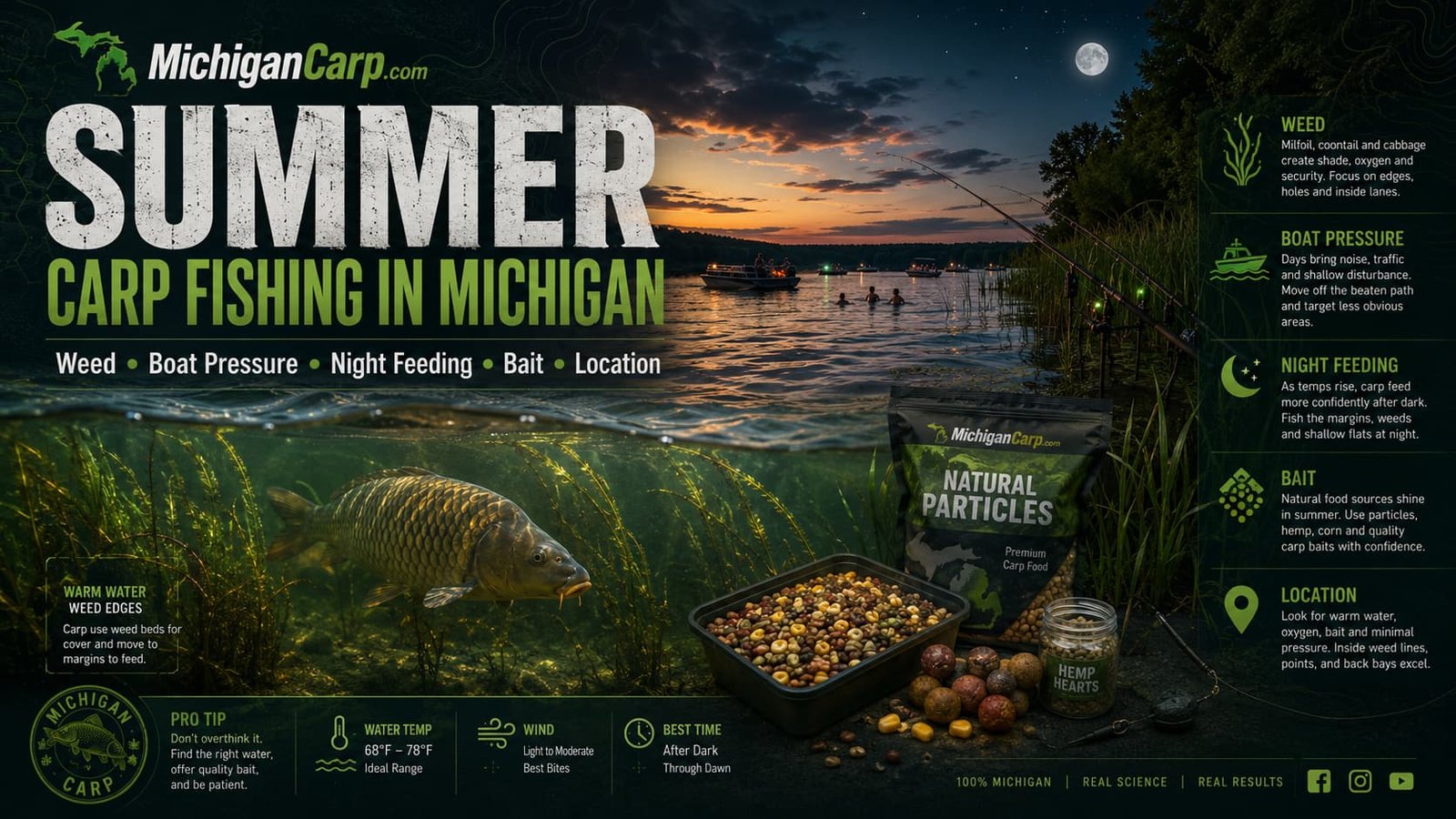
Summer carp fishing in Michigan can be excellent, but it is often misunderstood.
A lot of anglers assume summer should be easy because the water is warm, carp are active, weed is growing, natural food is abundant and fish are feeding more than they were in early spring. That can be true. Summer can produce some of the most reliable carp fishing of the year.
But summer also creates problems.
Boat traffic increases. Swimmers, jet skis, kayaks, paddleboards, dogs, campgrounds and shoreline activity can push carp away from obvious daytime areas. Weed beds thicken. Nuisance fish become more active. Turtles and birds can become a problem. Warm water can reduce comfort in shallow areas during some parts of the day. A swim that looked perfect in May can feel lifeless in July if you fish it at the wrong time.
That is the real summer lesson.
Summer carp are often feeding, but not always where daytime anglers expect them to be.
The best summer fishing usually comes from understanding weed, oxygen, shade, wind, boat pressure, low-light movement, night feeding, bait control and how carp use quiet areas when the lake is busy.
This guide explains summer carp fishing in Michigan, including early summer after spawning, high-summer weed growth, boat pressure, night fishing, dawn and dusk feeding windows, wind direction, shallow bays, deeper routes, no-wake areas, campground banks, particles, packbait, tiger nuts, maize, boilies and how much bait to use in warm water.
For the full year-round seasonal framework, read Michigan Carp Fishing Seasons.
For the broader location process, read How to Find Carp in Lakes.
For big-water location, read Finding Carp in Big Michigan Lakes.
For reading visible carp activity, read Signs Carp Are Feeding.
For bait choice by venue and season, read Best Carp Bait for Michigan Lakes.
The simple summer rule is this:
Do not judge a summer carp lake at midday. Find the weed, watch the pressure, fish the quiet windows and match bait to real feeding activity.
Table of Contents
Quick Start: Summer Carp Fishing in Michigan
Use this table as the quick summer strategy guide.
| Summer Situation | Where to Look | Feeding Pattern | Best Bait Approach | Biggest Mistake |
|---|---|---|---|---|
| Early summer after spawning | Weed edges, bays, reed lines, points, mussel areas | Feeding improves as fish recover and natural food builds | Particles, tiger nuts, maize, boilies, light packbait | Assuming all fish recover at the same time |
| Busy summer days | Weed cover, deeper routes, quiet corners, no-wake zones | Carp may avoid obvious pressure | Accurate baiting, tougher hookbaits, selective spots | Fishing noisy midday shallows |
| Dawn and dusk | Bay mouths, margins, weedlines, reed edges, travel routes | Short but reliable feeding windows | Corn, maize, tiger nuts, boilies, small packbait traps | Arriving too late or leaving too early |
| Night fishing | Quiet bays, weed edges, campground margins, points, routes | Carp often move closer and feed more confidently | Particles, packbait, boilies, tiger nuts, controlled baiting | Overcasting past fish that moved close |
| Weed-heavy lakes | Holes, lanes, outside edges, inside turns, clear patches | Carp feed around natural food and cover | Strong tackle, safe rigs, tiger nuts, boilies, maize | Casting into unfishable thick weed |
| Hot stable weather | Oxygenated areas, windward banks, shade, deeper access | Feeding can become time-specific | Feed only where carp stay | Fishing stale water from habit |
| Windy summer conditions | Windward food banks, points, bay mouths, colored water | Wind can improve food, oxygen and confidence | Wider but controlled baiting if signs confirm | Fishing wind with no habitat |
| Late summer | Deeper edges, weed dieback starts, pressure-free zones | Variable, often strongest low light | Tight baiting, boilies, tiger nuts, particles | Fishing early-summer patterns too long |
Summer rewards anglers who adjust.
A shallow bay can be excellent at dawn and dead by noon. A campground bank can be useless during the day and productive after dark. A weedline can look impossible until you find the clean lane that carp use every evening.
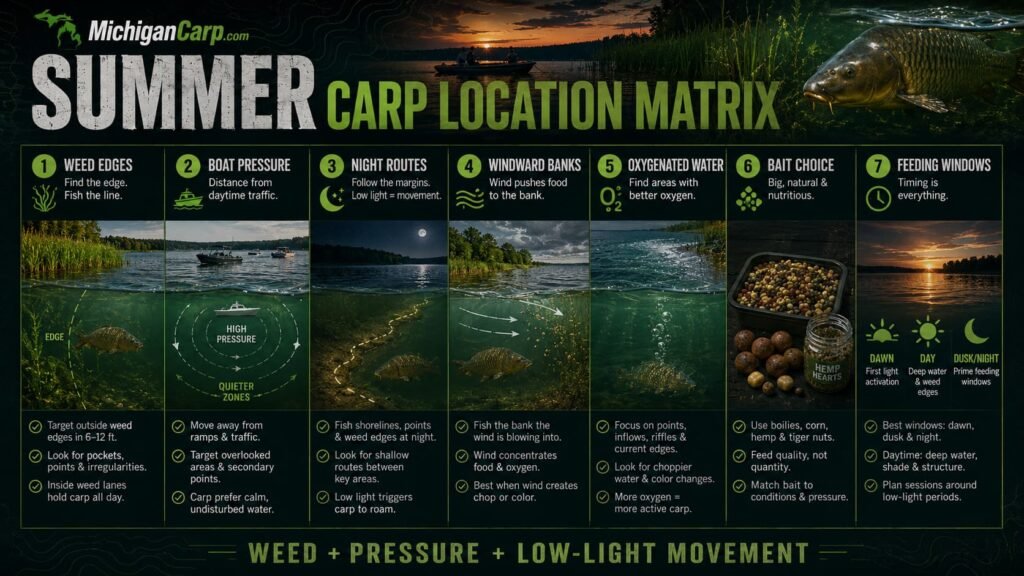
Why Summer Carp Fishing Is Different
Summer is not simply “warm water carp fishing.”
By summer, the whole lake has changed. Weed beds are thicker. Natural food is more abundant. Carp may have recovered from spawning. Small fish are active. Turtles are active. Birds are active. Human pressure is much higher on many Michigan lakes. The carp have more food available, more cover available and more reasons to shift their movement around pressure.
That means summer carp can feed strongly without being obvious.
In spring, a warming shallow bay can pull fish in because warmth is scarce. In summer, warmth is everywhere. Carp are not forced to use one shallow corner simply because it warms first. They can choose areas based on food, oxygen, safety, shade, pressure and timing.
This is why summer can feel confusing. The fish may be in the lake in good numbers. They may be feeding every day. But they may feed at 5:30 AM, 9:00 PM or midnight rather than at 2:00 PM when the lake is full of boats.
The best summer carp fishing starts by asking better questions:
Where is the food now?
Where is the pressure lowest?
Where can carp feed safely after the lake quiets down?
Where is weed helping the carp rather than just blocking the rig?
Where can I land fish safely if I hook one in warm water and heavy weed?
Summer carp fishing is active, but it requires more watercraft than many anglers expect.
Early Summer After Spawning
Early summer often begins with a transition out of spawning behavior.
Some carp recover quickly and begin feeding. Others may be slower. Not all fish spawn at exactly the same time, and not every part of a lake warms or recovers at the same speed. That means early summer can produce excellent feeding, but it can also feel patchy for a while.
The first reliable areas are usually close to where carp already wanted to be in late spring: shallow bays, reed edges, early weed, soft silt, bay mouths, points and nearby routes. The difference is that natural food is now increasing quickly. Weed growth is stronger. Snails, insects, larvae and small aquatic life become more important. Carp begin to use these areas not just for warmth or spawning movement, but for real feeding.
Look for signs that feeding has replaced spawning behavior. Slow bubbles, clouded water, liners on routes, fish rolling over food areas, and carp showing at dawn or dusk are more useful than noisy shallow crashing. If fish are still thrashing and chasing in shallow reeds, do not assume they are feeding.
Early summer baiting can be more confident than early spring, but it still needs evidence. Particles, maize, tiger nuts, small boilies, crumb and light packbait can all work well. If carp are clearly feeding and staying in the area, you can build bait gradually. If signs are brief or fish are only passing through, fish tighter traps and avoid spreading bait too widely.
A good early summer setup is one rod on the food, one on the route, and one on the safer edge. That might mean a weedline, a bay mouth and a slightly deeper shelf. Let the rods tell you whether carp are feeding in the shallow zone, moving along the edge, or holding off.
For the spring-to-summer transition, read Spring Carp Fishing in Michigan.
Weed Beds: The Main Summer Feature
Weed is one of the most important summer features in Michigan carp fishing.
It can hold snails, insects, larvae, shade, oxygen, cover and patrol routes. It can also make fishing difficult, hide carp activity, bury rigs, collect drifting debris and make landing fish harder. Summer carp often use weed, but the thickest weed is not automatically the best place to cast.
The most useful parts of weed beds are usually the fishable edges.
Outside edges are important because they connect open water to cover. Inside edges can be good where carp move between shallow feeding areas and sheltered pockets. Holes and lanes are valuable because they allow clean presentation. Weed points can act like underwater features, guiding carp movement. Clear patches inside weed can become repeated feeding spots if carp feel safe there.
Good weed fishing starts with finding where a bait can actually fish.
A rig buried in thick weed is not a presentation. A bait dragged into stems by wave action is not a presentation. A hooklink wrapped around weed is not a presentation. You need a clean enough spot, a safe enough angle and tackle strong enough to land the fish.
This is where tiger nuts, maize, boilies and balanced hookbaits can all work. Tiger nuts are durable and useful around weed. Boilies can help when smaller fish are a problem. Maize can be excellent if carp are feeding confidently. Small PVA sticks can help settle a rig and keep a small amount of attraction around the hookbait.
Do not ignore weed movement. A patch of weed moving against the wind, pulsing in calm water or moving with bubbles nearby can reveal carp. Reed knocks, bow waves along weed edges and clouding in clear holes are also strong clues.
For natural food and weed interpretation, read How to Find Natural Carp Feeding Areas in Michigan Lakes.
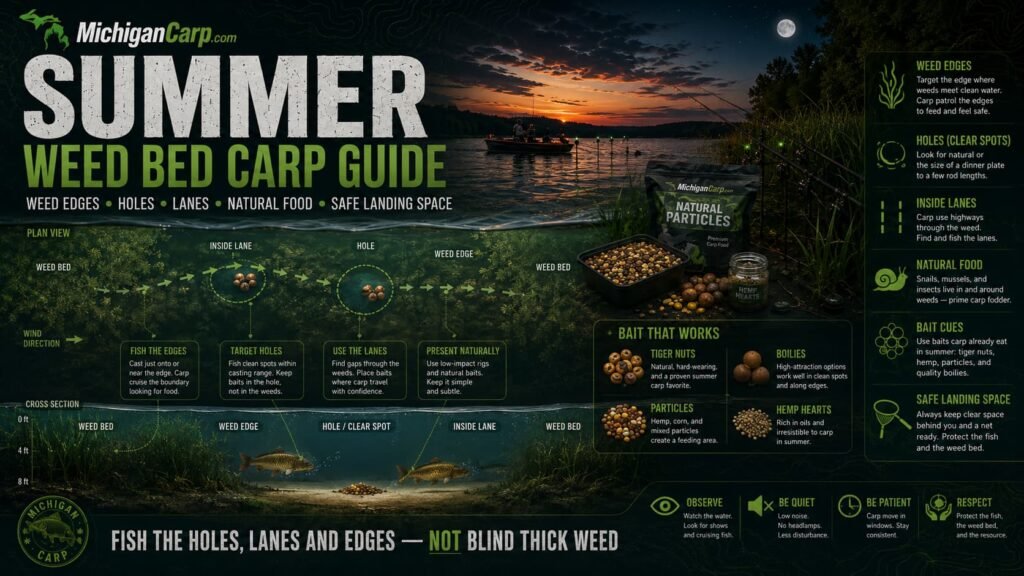
Boat Pressure and Summer Lake Traffic
Boat pressure is one of the biggest summer carp fishing factors in Michigan.
Many of the best public waters become busy once summer arrives. Boats, jet skis, swimmers, paddleboards, kayaks, dogs, campground activity, shoreline noise and repeated disturbance can change carp behavior. The fish may not leave the lake, but they may stop using the obvious daytime areas.
This is why a lake can look perfect and still fish poorly during the middle of a busy summer day.
Carp often respond by using cover, depth, quiet corners, weed, no-wake areas, less disturbed banks and low-light feeding windows. They may move into shallow water before the boat traffic starts, drop back during the day, then return after dark.
Do not assume boat pressure ruins a lake. It often changes the timing.
A campground bank may be too disturbed during the day but productive after dark. A shallow bay may be hammered by swimmers at noon but visited by carp at first light. A point beside a boat lane may not fish well during traffic, but the quieter side of the point may become a route after sunset.
Before planning a summer session, check access, boating rules and local restrictions. Official Michigan boating information is available through Michigan DNR Boating.
The practical summer pressure rule is simple:
When the lake gets busy, carp often change routes before they stop feeding.
Fish the quieter route, the edge of the pressure, or the window after the pressure fades.
Dawn, Dusk and Night Feeding
Low light is one of the most important summer advantages.
In summer, carp often become easier to locate and catch before the lake wakes up and after it quiets down. Dawn, dusk and night reduce boat pressure, reduce shoreline disturbance and allow fish to move closer to margins, weed edges, shallow bays and campground banks.
Night fishing can be especially powerful on warm-water venues. Carp that hold off during the day may move into the baited area after dark. Shallow margins that are too exposed during daylight can become safe feeding zones. Weed edges that look quiet in the afternoon may produce liners, bubbles and bites at night.
But night fishing should still be structured.
Do not simply cast farther because it is dark. Summer carp often move closer at night, not farther. A margin route, bay mouth, weed edge, reed line or near-bank shelf can be better than a long cast into open water. This is especially true around campgrounds, channels and public banks where food, cover and quiet nighttime movement overlap.
Arrive early enough to understand the swim in daylight. Find the weed, the clear spots, the safe landing area, the line angles and the likely routes before dark. Then fish accurately and avoid unnecessary recasting.
Good night baits include particles, maize, tiger nuts, boilies, crumb and packbait. Packbait can be excellent where the bottom is clean enough and nuisance fish are manageable. Boilies and tiger nuts can be useful when you want a more durable hookbait through the night.
For reading low-light signs, read Signs Carp Are Feeding.
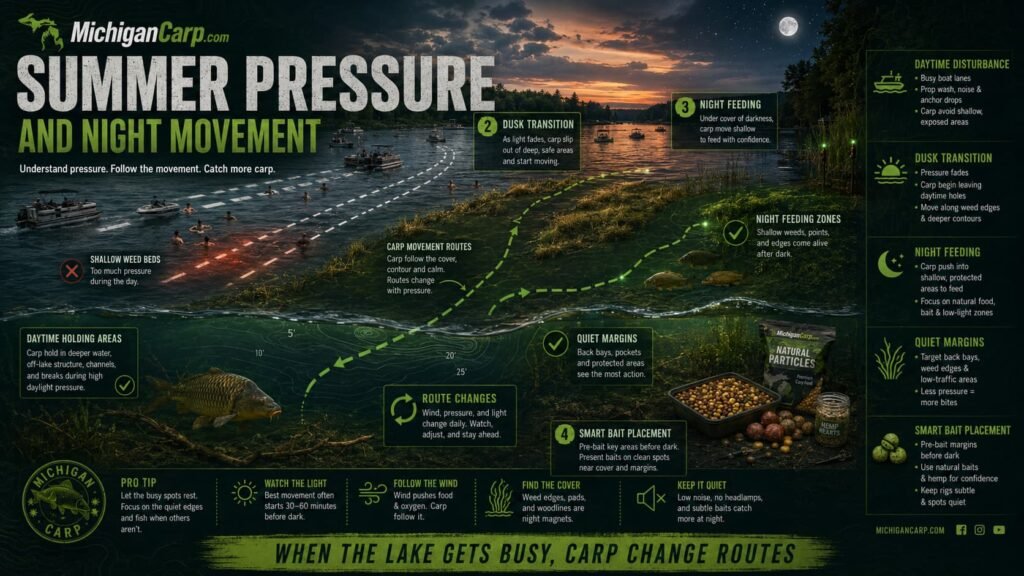
Wind, Oxygen and Warm-Water Comfort
Summer wind can be very useful, but only if it improves the water.
A steady wind can push food, color, oxygenated water and surface life into a bank. It can make carp feel safer and less exposed. It can also concentrate floating debris, insects and suspended material around points, bays and weed edges.
But wind alone is not enough.
A windward bank with weed, silt, mussels, reeds or a bay mouth is interesting. A windward bank of sterile sand may still be poor. A strong wind pushing floating weed, heavy chop or unfishable debris into the swim may make presentation worse rather than better.
Summer oxygen is also part of the picture. Warm water, heavy weed, algae, calm conditions and low overnight oxygen can affect fish comfort. Carp are hardy fish, but they still respond to water quality and comfort. Wind, inflows, current, shade, deeper water and healthy weed edges can all influence where fish feel comfortable.
In hot stable weather, the best areas are often not the hottest shallow corners. Instead, look for a combination of food and comfort: windward weedlines, deeper bay mouths, shaded margins, oxygenated inflows, points with moving water, or routes from deeper water into feeding areas.
In summer, carp location is not just about finding warm water. Once Michigan lakes get hot, dissolved oxygen and carp fishing become closely connected. Wind ripple, healthy weed edges, inflows, shade, depth and low-light periods can all make one area more comfortable than another. A shallow bay may look perfect, but if it is hot, still, full of dying weed and showing no fish activity, carp may feed better on a wind-rippled edge, near moving water, or during a dawn, dusk or night bite window. In warm weather, always ask whether the swim gives carp oxygen, food, safety and confidence before adding more bait.
A warm summer wind after stable conditions can switch on a bank. A flat, bright, hot day with heavy boat traffic may push fish into cover or night feeding. A thunderstorm or weather change can briefly improve activity, but it can also make conditions unsafe. Do not fish exposed banks during lightning or unsafe weather.
For official forecasts, wind and storm information, use NOAA / National Weather Service.
Shallow Bays vs Deeper Routes in Summer
Summer carp use both shallow and deeper water.
The mistake is assuming one is always better.
Shallow bays can be excellent in summer, especially at dawn, dusk, night, during warm wind, or where weed and natural food are present. Carp may feed in silt, reeds, weed holes, insect-rich margins and soft-bottom corners. But shallow bays can also become heavily pressured, too disturbed, too bright or too warm during the day.
Deeper routes become important when shallow water is under pressure or when fish need comfort. A bay mouth, old channel, drop-off, point, shelf or deeper weed edge can act as the connection between daytime holding and low-light feeding. Sometimes the best summer bite comes not from the back of the bay, but from the route carp use to enter and leave it.
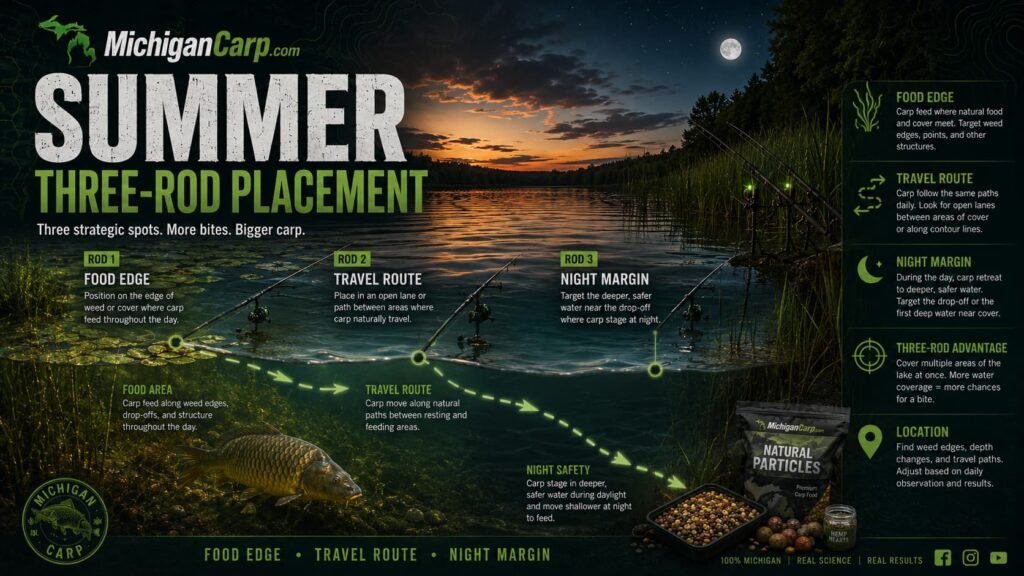
A good summer three-rod layout often tests both ideas.
One rod can fish the shallow feeding edge. One can fish the bay mouth or weed route. One can fish the deeper safety edge. If the shallow rod works only at night, the route rod gives liners at dusk, and the deeper rod produces during the day, you have learned the lake’s timing.
On big lakes, this matters even more. Summer carp may use long routes between basins, bays, weed beds and safe water. The best bank is rarely random. It is usually a bank that reaches one of those routes.
For large-water strategy, read Finding Carp in Big Michigan Lakes.
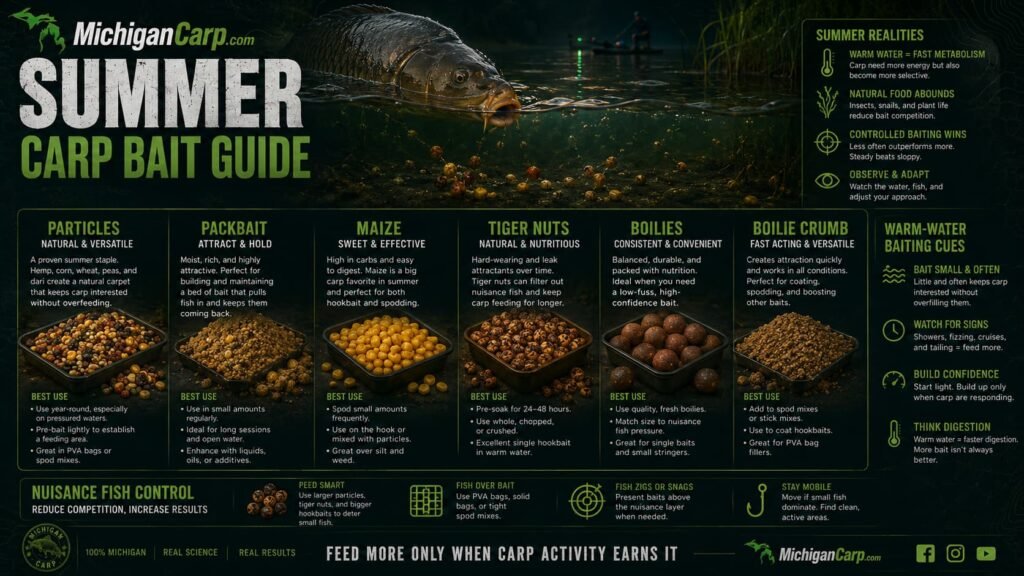
Best Summer Carp Baits in Michigan
Summer gives you more bait options than early spring, but that does not mean every bait should be used heavily.
Particles are very effective when carp are feeding confidently. Maize, hemp, pigeon seed, prepared peanuts where legal and safe, and mixed particles can hold fish in an area. They can be especially useful during multi-day sessions, on clean bottom, around weed edges and in warm water where carp are active.
Corn and maize remain simple and effective. Canned corn is easy, visible and quick. Prepared maize is tougher and better suited to longer sessions or nuisance fish. Both can work in shallow bays, margins, packbait, particle mixes and light baiting.
Tiger nuts are valuable in summer because they are durable, selective and useful around weed, silt edges and nuisance fish. They are not a high-volume feed for every situation, but they are excellent as hookbaits and controlled feed. They must be prepared safely. For safe preparation, read Tiger Nuts for Carp Fishing.
Boilies can be very useful in summer, especially where you want a more selective bait, a stronger hookbait, or a food signal that can be repeated over several sessions. Nut, milk, birdfood and balanced food-bait approaches all have a place. In warm water, boilie crumb can also be useful as part of a packbait or method-style attraction.
Packbait is a strong summer tool when used properly. It can create a localized attraction around the hookbait and work well with corn, maize, crumb, particles and boilies. It is especially useful when carp are present and feeding, but you want to keep the attraction tight.
For bait decisions, read Boilies vs Corn vs Particles for Carp, Particles for Carp Fishing and Packbait for Carp Fishing.
How Much Bait to Use in Summer
Summer can support more bait than spring, but only in the right place.
Warm water, active carp and longer feeding windows can make heavier baiting effective. A group of carp feeding confidently over particles, packbait and boilie crumb can clear bait quickly. During multi-day sessions, controlled prebaiting or repeated top-ups can work very well.
But summer also has more bait thieves.
Small fish, turtles, ducks, geese, crayfish and other wildlife can remove bait before carp settle. If you assume all missing bait was eaten by carp, you can badly misread the swim.
The right bait amount depends on evidence.
If you see repeated bubbles, liners, clouding, rolling fish and bites, you can build the swim. If bait is disappearing but carp signs are absent, tighten up. If birds are clearing bait, change timing or bait style. If nuisance fish are destroying small particles, use tougher hookbaits, boilies, tiger nuts or more selective baiting.
For short summer sessions, start with a tight trap. A small amount of packbait, crumb, particles or chopped boilie around the hookbait is often better than spreading bait widely.
For overnight sessions, baiting can be more confident, especially if carp move in after dark. But avoid dumping everything at the start. Fish the first few hours, read the activity, then top up based on signs.
For multi-day sessions, feed according to response. If carp are visiting regularly, small repeated top-ups are often better than one huge bait dump. If they are not visiting, bait is not the solution. Location is.
The practical summer baiting rule is:
Summer allows more bait, but carp activity must earn it.
Nuisance Fish, Turtles and Birds
Summer is when nuisance pressure becomes part of bait strategy.
Small fish can peck soft baits, strip corn, scatter packbait and create false indications. Turtles can damage hookbaits and create confusing movement. Birds can clear shallow baited areas. Crayfish may attack boilies and particles depending on the water.
This does not mean you should avoid baiting. It means you need to know what is eating your bait.
If you get constant small taps and no carp signs, nuisance fish may be the issue. If hookbaits come back damaged or missing repeatedly, turtles or crayfish may be involved. If ducks and geese are working the spot, your feed may be gone before carp arrive.
Tougher hookbaits help. Boilies, tiger nuts, harder maize, balanced hookbaits, mesh-wrapped baits where legal and suitable, and more selective presentation can all reduce bait loss. Feeding later, baiting deeper, avoiding obvious bird areas and using tighter baiting can also help.
Do not feed birds intentionally. It creates problems for you, the fishery and other anglers.
Summer carp fishing is not just about feeding more. It is about feeding smarter.
Summer Rod Placement
A good summer rod layout should test feeding, movement and safety.
Do not cast all rods to the same spot unless the swim is already proven.
On a weed-heavy lake, one rod might fish a clear hole, one the outside weed edge and one the deeper route away from the weed. On a busy lake, one rod might fish the quiet margin after dark, one the bay mouth, and one a deeper daytime route. On a point, one rod might fish the windward side, one the tip or shelf, and one the downwind or deeper side.
This is how you learn the summer pattern.
If one rod gets repeated liners at dusk, that may be the travel route. If another rod produces bites after midnight, that may be the feeding zone. If the shallow rod only works at dawn, you know the window is short.
Summer carp often move by time of day. Your rod placement should reflect that.
A simple summer three-rod system is:
Rod one: food edge.
Rod two: travel route.
Rod three: safe water or night margin.
That is better than three rods thrown into the middle of a bay because it looked good in daylight.
Summer Session Plan
A good summer session starts by thinking about timing.
If you arrive at midday on a busy lake, do not judge the whole venue by what you see in the first hour. Watch boat lanes, swimmer areas, weed edges, shade, wind direction and quiet corners. Think about where carp will move when the pressure drops.
If possible, arrive with enough daylight to scout properly. Find clean spots in weed. Check the margin. Work out safe landing areas. Identify where you can fish at night without guessing. Look for bubbles, clouded water, rolling fish, moving weed, reed movement and liners.
Start with controlled baiting. Fish one rod on the best food feature, one on the route, and one on the area likely to come alive after dark. Do not overfeed before the lake gives you a reason.
As dusk arrives, pay attention. Summer carp often reveal themselves during the transition. Liners, rolling fish, bubbling, moving weed and margin activity can all appear quickly. Adjust one rod at a time rather than tearing the whole swim apart.
Through the night, keep disturbance low. Avoid unnecessary recasting. Keep lines sensible. Top up only if activity justifies it. Be ready for fish to move closer than they did during the day.
At dawn, watch again. The early morning window can be as important as the night itself. After the sun rises and pressure returns, decide whether the swim is still worth fishing or whether the fish have shifted back to cover or deeper routes.
Common Summer Carp Fishing Mistakes
The first summer mistake is fishing obvious daytime water and assuming the lake is poor.
Many summer waters only show their real carp pattern at dawn, dusk or night. If you fish only the busiest part of the day, you may miss the feeding window completely.
The second mistake is ignoring boat pressure. Carp do not always leave pressured lakes, but they do change how they use them. The quiet side of a point, a weed edge, a no-wake area, a bay mouth or a nighttime margin can be far better than the most comfortable daytime swim.
The third mistake is fishing thick weed without proper presentation. Carp may be in the weed, but your rig still has to fish. Find the lanes, holes and edges.
The fourth mistake is feeding too much without knowing what is eating the bait. In summer, missing bait does not always mean carp. Small fish, turtles, birds and crayfish may be clearing you out.
The fifth mistake is overcasting at night. Carp may move closer after dark. Long casting past the fish is common.
The sixth mistake is failing to adapt from spring. Summer is not just warmer spring fishing. Weed, pressure, oxygen, nuisance fish and night movement change the whole pattern.
My Practical View
For summer carp fishing in Michigan, I want to know what the lake does after the people leave.
Daytime observations still matter, but I am often thinking ahead to the evening, night and first-light window. Where will carp move when boat pressure drops? Which weed edge gives them food and safety? Which margin becomes safe after dark? Which point or bay mouth creates a route?
I like weed in summer, but only if I can fish it properly. I like particles and packbait, but only if carp are present and nuisance fish are not stealing the swim. I like boilies and tiger nuts when I need tougher, more selective hookbaits. I like windward banks when the wind is pushing into useful habitat, not when it is just making casting harder.
The most important summer adjustment is timing.
A lake can look dead at midday and produce at midnight. A swim can be noisy and useless during the day, then become a feeding area after dark. A shallow bay can be empty when boats are running and active at first light.
The final rule is simple:
In summer, fish the weed, respect the pressure, watch the low-light windows, and let carp activity decide how much bait the swim deserves.
FAQ
Is summer good for carp fishing in Michigan?
Yes. Summer can be excellent for carp fishing in Michigan, but timing and location matter. Dawn, dusk and night often fish better than busy midday periods on pressured lakes.
Where do carp go in summer?
Summer carp often use weed edges, shallow bays, points, mussel areas, deeper routes, shaded margins, windward banks, quiet corners and nighttime feeding areas.
Do carp feed at night in summer?
Yes. Night feeding can be very important in summer, especially on busy lakes where boat pressure, swimmers and shoreline activity reduce daytime confidence.
How does boat pressure affect summer carp fishing?
Boat pressure can push carp away from obvious shallow areas during the day. They may move into weed, deeper water, quiet bays, no-wake zones or feed more confidently after dark.
Are weed beds good for summer carp?
Yes. Weed beds can hold snails, insects, cover and oxygen. The best spots are usually clear holes, lanes, outside edges and routes around the weed rather than the thickest weed.
What bait should I use for summer carp in Michigan?
Good summer carp baits include particles, maize, corn, tiger nuts, boilies, boilie crumb and packbait. Match bait choice to weed, nuisance fish, bottom type and carp activity.
Is packbait good in summer?
Yes. Packbait can be very effective in summer when carp are present and feeding, especially when you want tight attraction around the hookbait.
Are tiger nuts good in summer?
Tiger nuts can be excellent in summer because they are durable, selective and useful around weed, nuisance fish and longer sessions. They must be prepared safely.
How much bait should I use in summer?
Summer can support more bait than spring, but only where carp are feeding. Start controlled and increase when signs, liners, bites or bait response confirm carp activity.
Should I fish shallow or deep in summer?
Fish both intelligently. Shallow areas can be excellent at dawn, dusk and night. Deeper routes, bay mouths and weed edges may be better during busy or hot daytime periods.
Does wind matter in summer?
Yes. Wind can move food, color and oxygen into a bank, but it matters most when it pushes into useful habitat such as weed, reeds, silt, mussels or a bay mouth.
What is the best time of day for summer carp fishing?
Dawn, dusk and night are often the best summer windows, especially on public lakes with heavy boat traffic.
Why do I see carp in summer but not catch them?
Visible carp may be cruising, using a route, avoiding pressure or feeding at a different time. Look for repeated feeding signs, liners, bubbles and low-light patterns rather than random sightings.
What is the biggest summer carp fishing mistake?
The biggest mistake is judging a summer lake during the busiest part of the day and ignoring weed, boat pressure, night movement and low-light feeding windows.
Next Steps
Use these supporting guides next:
Spring Carp Fishing in Michigan
Winter Carp Fishing in Michigan
Finding Carp in Big Michigan Lakes
How to Find Natural Carp Feeding Areas in Michigan Lakes
Best Carp Bait for Michigan Lakes
Boilies vs Corn vs Particles for Carp