

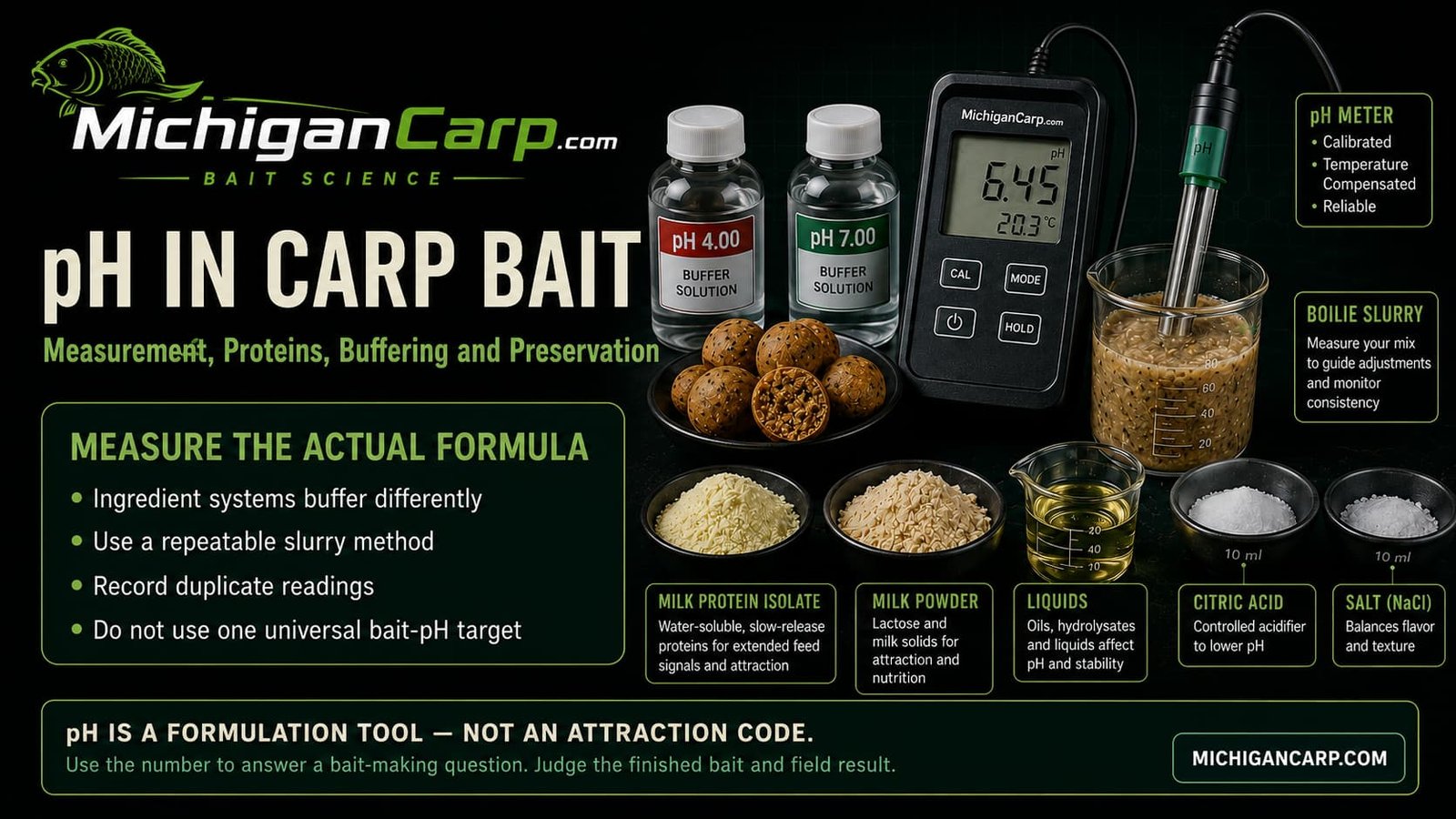
How pH changes carp bait matters because it can change how proteins, minerals, acids, liquids and preservatives behave.
It can help explain why a milk-rich liquid thickens, why two recipes respond differently to the same amount of citric acid, why a preservative system needs an acidic environment or why a fermented liquid changes over time.
What pH cannot provide is one magic attraction number for every boilie, particle, glug or hookbait.
A Plum milk-and-nut boilie, fermented particle liquid, cereal bait and preserved hookbait can produce different pH readings for legitimate reasons. Forcing all of them toward one supposedly perfect value would ignore their ingredients, processing and intended jobs.
Use pH to understand and control the bait—not to manufacture an attraction story around one number.
This page owns pH measurement and interpretation. Acid selection belongs in Organic Acids in Carp Bait. Mineral ingredients and buffering sources belong in Salt and Minerals in Carp Bait.
For the physical movement of soluble material from a finished boilie, use Carp Bait Solubility and Leakage.
Table of Contents
Quick Start: 7 Rules for pH in Carp Bait
- There is no universal ideal pH for every carp bait.
- Measure liquids directly, but use a repeatable slurry method for solid boilies.
- Calibrate the meter with fresh pH 4.00 and pH 7.00 buffers before comparative testing.
- Expect eggs, dairy proteins, phosphates, caseinates and minerals to resist pH change.
- Do not assume lower pH automatically improves attraction, solubility or leakage.
- Do not treat a low reading as proof of fermentation safety or shelf stability.
- Change one acid, alkaline ingredient or mineral variable at a time and compare the finished bait.
| Question | What pH can help show | What pH cannot prove |
|---|---|---|
| Did an acid change the formula? | A repeatable slurry test can show the direction and approximate size of the change | That carp will prefer the lower-pH bait |
| Is an antimicrobial system being acid-supported? | Whether the bait is within the intended working region for the preservative formulation | That the finished bait has a validated shelf life |
| Did fermentation change over time? | A developing trend when the same method is repeated | That the liquid is safe, stable or attractive |
| Did a protein-rich paste become unstable? | Whether changing acidity may help explain aggregation or thickening | That purified-protein solubility predicts complete-boilie leakage |
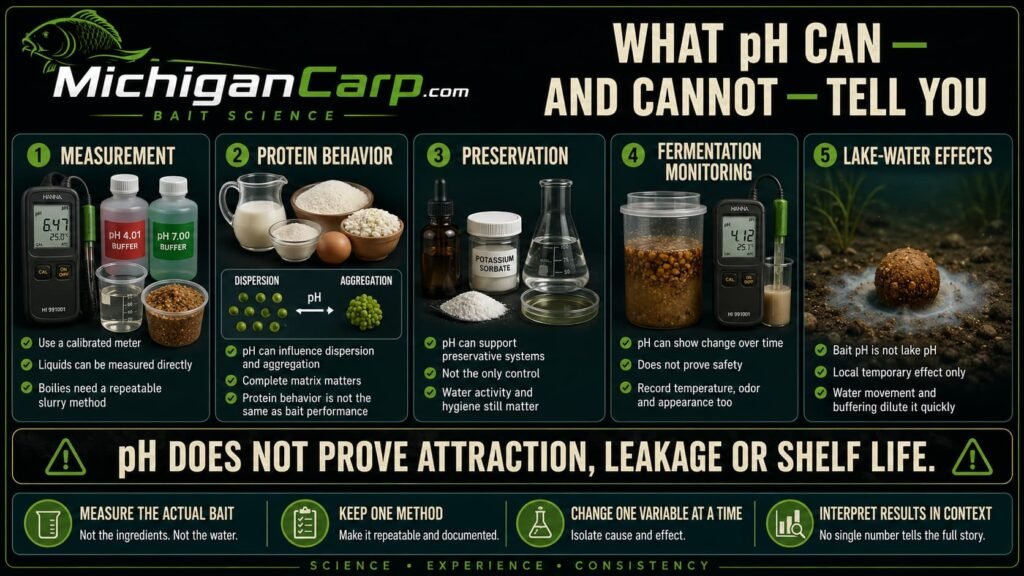
| Will bait change the lake pH? | A bait can create a small temporary local chemical difference | That one boilie changes the pH of the wider swim |
What pH Actually Measures
pH describes hydrogen-ion activity in a water-containing system.
The familiar practical scale is:
- below pH 7: acidic;
- around pH 7: neutral under ordinary reference conditions;
- above pH 7: basic or alkaline.
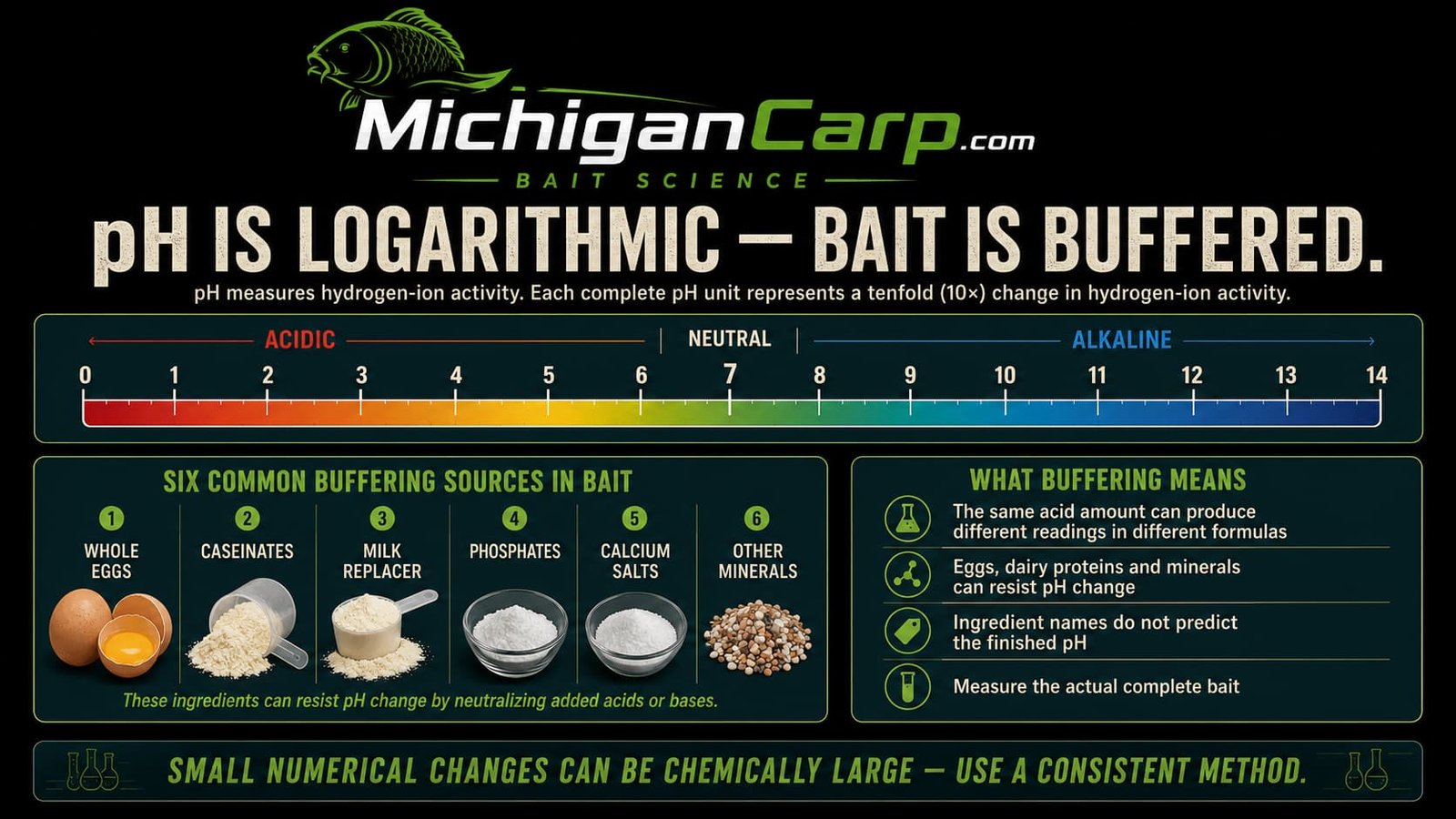
The scale is logarithmic. A change of one whole pH unit represents a tenfold change in hydrogen-ion activity.
Moving from pH 7 to pH 6 is therefore not comparable to moving from 70°F to 69°F. The numbers are one unit apart, but the chemical relationship is tenfold.
The formal measurement principle is explained in the NIST report on pH standards.
pH applies to the water-containing phase
A liquid can normally be measured directly when the electrode is suitable and the sample has been mixed properly.
A dried boilie is different. Its ingredients are held inside a cooked matrix containing proteins, starches, fats, minerals and variable moisture.
Pressing a strip against the outside of a wet boilie does not provide a dependable measurement of the complete bait. For comparisons between batches, the bait should be ground or finely cut and mixed with a controlled amount of water.
pH is not total acidity
Two samples can have similar pH readings while containing different acids, different total quantities of acid and different buffering systems.
A simple citric-acid solution, food vinegar and a fermented grain liquid may share a similar reading while remaining chemically and nutritionally different ingredients.
pH describes the measured hydrogen-ion environment. It does not identify the complete flavor or feeding signal.
How to Measure Liquids and Boilies Consistently
A pH result is useful only when the meter, sample and procedure are controlled.
Choosing and maintaining a meter
A digital meter is normally more useful than paper strips for dark, cloudy or particle-rich bait samples.
Look for two-point calibration, a maintainable electrode, suitable storage solution, appropriate resolution and temperature compensation or temperature recording.
Paper strips can provide rough screening in a clear liquid, but molasses, fermented corn, hydrolysates and colored flavor systems can obscure the strip.
Calibrating the meter
- Allow the meter, buffers and samples to reach a reasonably similar temperature.
- Inspect and rinse the electrode according to the manufacturer’s instructions.
- Calibrate with fresh pH 7.00 buffer.
- Complete the second calibration point with fresh pH 4.00 buffer.
- Rinse between solutions without aggressively wiping the sensing surface.
- Check the meter against a buffer again when readings appear unstable or implausible.
FDA inspection guidance similarly emphasizes meter standardization with pH 7 and pH 4 reference solutions. See FDA guidance on pH-meter standardization.
Measuring a bait liquid
- Mix the liquid thoroughly without whipping excessive air into it.
- Pour enough into a clean container to cover the sensing area properly.
- Insert the rinsed electrode and follow the meter manufacturer’s method.
- Wait for the reading to stabilize.
- Record temperature, date, recipe version and measurement time.
- Rinse the electrode before testing the next sample.
Do not measure only the clear surface of a liquid containing settled particles or fermentation material unless that surface layer is deliberately the subject of the test.
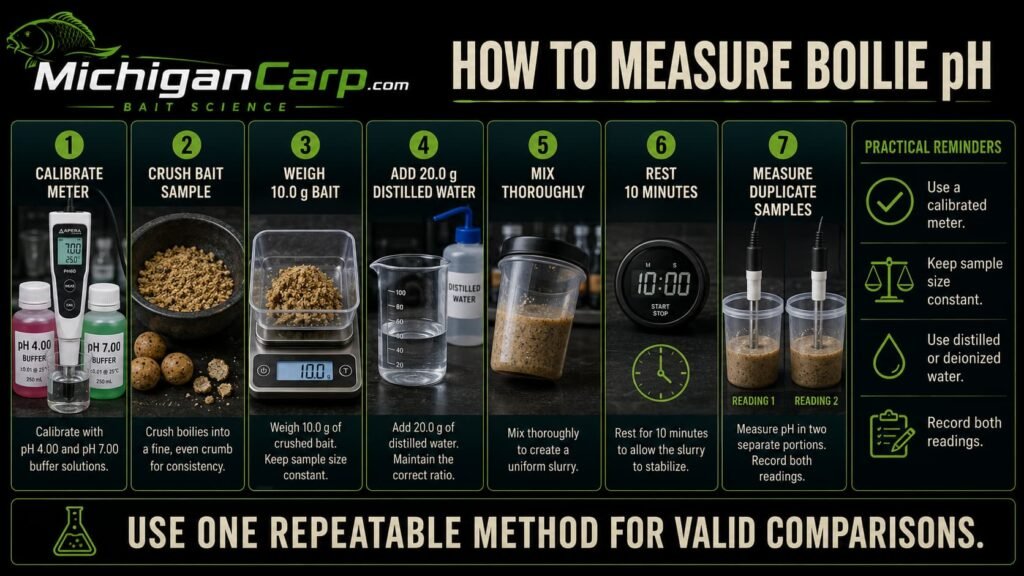
MichiganCarp comparative boilie-slurry method
The following bench method is intended for repeatable internal comparisons between homemade bait batches:
- Calibrate the meter with fresh pH 4.00 and pH 7.00 buffers.
- Select representative boilies from the batch.
- Grind or finely cut the bait into a reasonably uniform sample.
- Weigh 10.0 g of bait into a clean container.
- Add 20.0 g of distilled or deionized water.
- Mix thoroughly, cover and rest for ten minutes.
- Mix again and insert the rinsed electrode.
- Record the stabilized reading and sample temperature.
- Prepare a second independent 10 g sample and repeat the test.
- Record both readings rather than selecting only the preferred number.
This is a comparative MichiganCarp bench method. It is not a regulatory equilibrium-pH determination and does not validate room-temperature shelf life.
| Record | Example entry |
|---|---|
| Recipe version | PSV control or PSV citric test |
| Bait condition | Twenty-four-hour dried, frozen–thawed or seven-day dried |
| Bait weight | 10.0 g |
| Water weight | 20.0 g distilled water |
| Resting time | 10 minutes |
| Sample temperature | Record actual temperature |
| Reading one | Record stabilized result |
| Reading two | Record independent duplicate |
Buffering: Why the Same Acid Produces Different Results
A bait formula can resist a change in pH. This resistance is called buffering.
Ingredients that can contribute to the buffering environment include whole eggs, caseins, caseinates, milk powders, WPC, phosphates, calcium and magnesium salts, citrate salts, hydrolysates, yeast products and carbonates.
Two recipes can receive the same amount of citric acid and still produce different readings.
A milk-rich formula containing caseinates, phosphates and calcium may resist acidification more strongly than a simpler cereal formula. Egg weight, water content and ingredient brands can also alter the result.
Do not calculate finished pH from acid weight alone
A recipe should not claim that one gram of citric acid always produces one exact final pH.
The reliable method is to make the actual batch, follow one measurement procedure and record what happened.
Mineral form matters
Sodium chloride is not an acid and should not be expected to lower pH in the way citric acid does.
Sodium citrate, calcium carbonate, calcium lactate and dicalcium phosphate behave differently despite each being described chemically as a salt.
Use Salt and Minerals in Carp Bait for the wider mineral comparison.
How pH Changes Protein Behavior
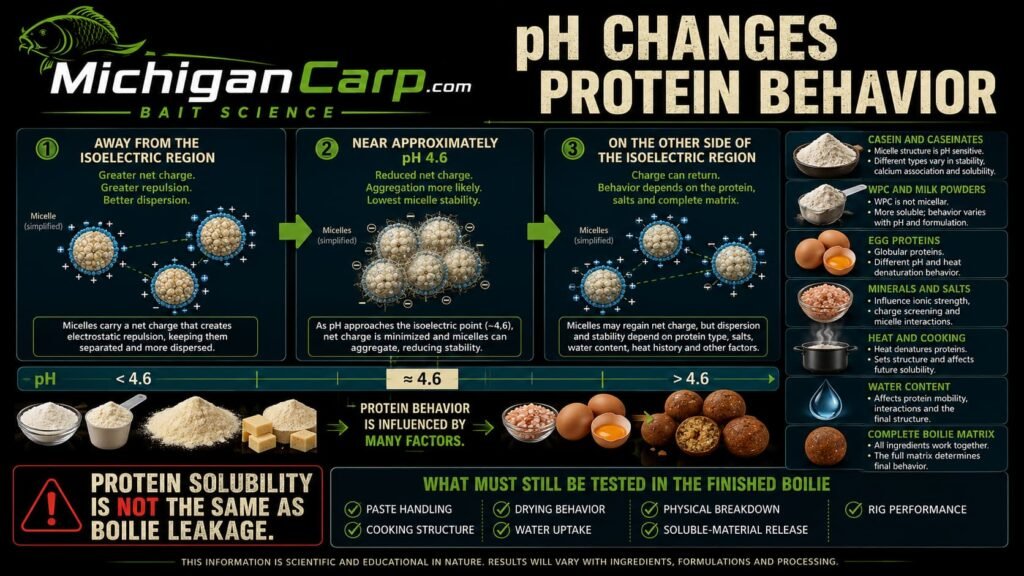
Proteins carry electrical charges that change as pH changes.
Each protein has an isoelectric region where its net charge approaches zero. Near that region, electrostatic repulsion is reduced and many proteins become more likely to aggregate or precipitate.
Moving away from that region can increase dispersion or solubility in some systems, but the direction and scale depend on the exact protein, mineral environment, heat treatment and concentration.
Casein and acidification
Casein micelles lose stability as milk is acidified toward approximately pH 4.6.
Research on acidified milk confirms that casein distribution and solubility change as the system approaches its isoelectric region. See Effect of Temperature and pH on Casein Solubility.
This does not mean a cooked boilie becomes more attractive or leaks faster at pH 4.6.
It means that directly acidifying a casein-rich liquid phase can alter aggregation, paste structure and cooked texture.
Different dairy proteins behave differently
Sodium caseinate, calcium caseinate, micellar casein, acid casein, rennet casein, WPC80 and milk replacer should not be treated as one ingredient.
They differ in processing, mineral form, solubility, fat, lactose and their response to acid and heat.
For ingredient-level detail, read Milk Proteins in Carp Bait and Milk Powders in Boilie Making.
Heat and the complete boilie matrix
Egg proteins coagulate during cooking. Whey proteins can denature and aggregate. Starches gelatinize, minerals influence protein interactions and drying changes water distribution.
The finished boilie is therefore not equivalent to an uncooked liquid phase or purified protein dissolved in laboratory water.
Protein chemistry can explain a change in paste or texture. It cannot, by itself, predict the leakage or field performance of the finished boilie.
pH, Leakage and Attraction Are Different Questions
Changing pH can alter the charge, dispersion or aggregation of some bait ingredients.
That does not mean lowering pH automatically makes a boilie release soluble material faster.
Release from a finished bait also depends on water penetration, ingredient solubility, diameter, particle size, porosity, egg structure, cooking time, drying, fat content, water temperature and post-production treatment.
A tightly bound, heavily cooked and extensively dried bait may remain slow even when its slurry pH is comparatively low.
A more open bait containing soluble yeast, lactose, hydrolysate or crumb can release material effectively without an extreme pH.
The full physical framework belongs in Carp Bait Solubility and Leakage.
Lower pH is not automatically more attractive
Carp can detect and evaluate dissolved chemicals, but an acid-specific taste response is not the same as attraction to a pH number.
Controlled carp research comparing carboxylic acids found that acceptance differed among acids and was not predicted in common carp simply by the pH of the pellets.
See Taste Responses of Carp Fishes to Carboxylic Acids.
Citric acid, lactic acid, vinegar and butyric-style products should therefore be evaluated as identified ingredients—not as interchangeable ways of producing low pH.
For detection, investigation and sustained feeding, use Carp Feeding Attractants Explained.
pH in Fermentation and Shelf-Life Bait
Fermentation monitoring
Microbial fermentation can produce organic acids and lower the pH of a wet grain or particle system.
Recording the starting value and repeated readings can show that the batch is changing.
It does not prove that desirable microorganisms caused the change or that the material is safe and suitable for bait.
Fermentation records should also include starting ingredients, preparation, time, temperature, odor, gas production, surface appearance, container condition and subsequent storage.
A low reading does not convert spoiled or contaminated material into suitable bait.
Potassium sorbate and sodium benzoate
The antimicrobial performance of sorbate and benzoate systems is pH-dependent because the proportions of their active chemical forms change with pH.
That makes pH a genuine formulation issue in Robert’s combined potassium-sorbate, sodium-benzoate and citric-acid system.
It does not make pH the only control.
A shelf-life claim still depends on actual preservative percentages, finished-bait pH, water activity, hygiene, cooking, drying, packaging, temperature and retained-sample testing.
The FDA defines water activity as the moisture available to support microbial growth and chemical reactions. It is separate from pH. See FDA: Water Activity in Foods.
The complete preservation system belongs in Potassium Sorbate, Sodium Benzoate and Citric Acid in Shelf-Life Boilies. Moisture availability belongs in Water Activity in Boilies: Moisture, Mold and Shelf-Life Control.
Do not use pH 4.6 as a boilie shelf-life target
The familiar pH 4.6 threshold comes from US acidified and low-acid canned-food regulation.
It is not a universal target that validates an egg-based homemade boilie, glug or hookbait conditioner.
Measure pH because the preservative system depends on it—but never use pH alone as proof of shelf life.
Bait pH Versus Michigan Water pH
The pH measured in a boilie slurry is not the same as the pH of the lake surrounding the bait.
Michigan waters include hard-water lakes, marl systems, stained northern lakes, rivers, reservoirs, weedy shallows and Great Lakes-connected waters. Their alkalinity, geology, biological activity and water movement differ.
Water pH can also move through the day.
Photosynthesis removes carbon dioxide and can raise pH during daylight. Respiration returns carbon dioxide and can lower it overnight. See USGS: Photosynthesis, Respiration and pH.

A boilie cannot change the whole swim
A bait may create a small temporary local difference as water enters it and dissolved compounds move out.
The surrounding volume of water, alkalinity, current, wave action and diffusion begin diluting that difference immediately.
It is more realistic to discuss local release of identified compounds than to describe a persistent acidic or alkaline cloud across a swim.
Keep the fishing questions in priority order
Lake pH and alkalinity can help explain why an ingredient behaves differently between waters, but they should not replace the more immediate questions:
- Are carp present?
- Are they feeding?
- Is oxygen adequate?
- Is the bait where carp naturally travel?
- Is the feeding quantity suitable?
- Is the hookbait fishing correctly?
A Controlled pH Test for Homemade Boilies
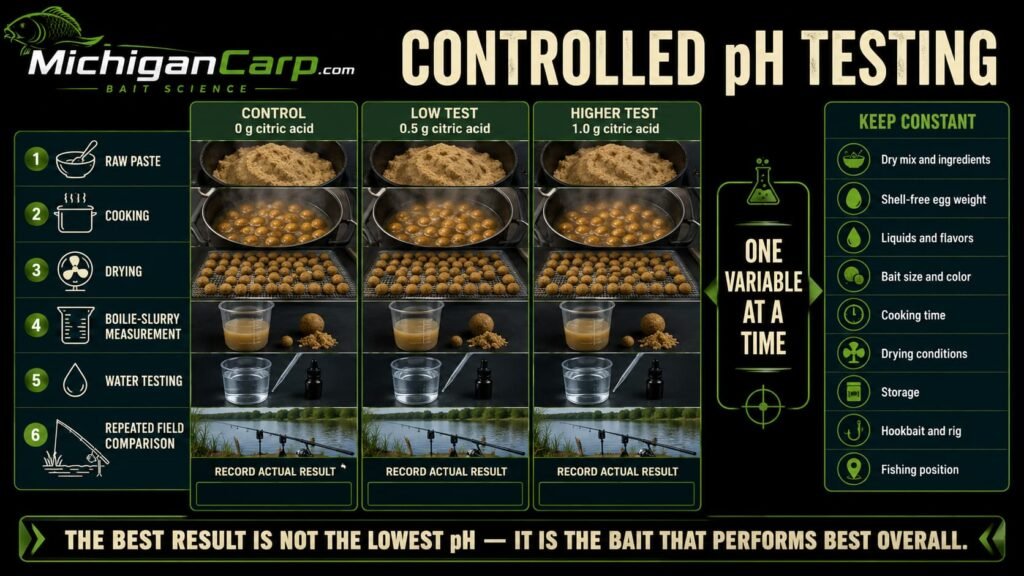
A useful pH test changes one identified variable while keeping the rest of the bait as consistent as practical.
Example citric-acid comparison
| 500 g dry-mix batch | Citric acid | Purpose |
|---|---|---|
| Control | 0 g | Shows the established formula without additional acid |
| Low test | 0.5 g | Tests a modest pH and flavor adjustment |
| Higher test | 1.0 g | Shows whether the stronger addition improves or disrupts the bait |
These are practical comparison levels equivalent to 0, 1 and 2 g/kg. They are not scientifically established optimum amounts for wild carp.
Keep the dry mix, shell-free egg weight, supporting liquids, flavor, bait diameter, cooking, drying, storage and hookbait presentation unchanged.
What to record
- Measure and record the liquid-phase pH where appropriate.
- Record raw-paste handling after the normal resting period.
- Cook every batch identically.
- Measure comparative slurry pH after the same drying period.
- Repeat after freezing and thawing when the bait will be stored frozen.
- Compare one-, six-, twelve- and twenty-four-hour water behavior.
- Record texture, swelling, cracking and physical breakdown.
- Retest wafters and pop-ups on the exact rig.
- Repeat field comparisons across more than one session.
Use How to Test Boilies Before Fishing for the wider physical testing process.
Interpreting the result
A lower reading may be useful when it supports the intended flavor, processing or preservation purpose.
It is not an improvement when the paste rolls worse, dairy proteins aggregate, the bait becomes harsh or the control performs equally well.
The best pH result is not the lowest number. It is the result that improves the complete bait without creating a larger problem.
Common pH Mistakes
| Mistake | Why it causes problems | Better practice |
|---|---|---|
| Chasing one ideal bait pH | Different bait systems have different ingredients and purposes | Define what the pH change is intended to improve |
| Pressing a strip against a boilie | The result represents an uncontrolled wet surface | Use a calibrated meter and consistent ground-bait slurry |
| Measuring without calibration | Meter drift can make small differences meaningless | Use fresh pH 4.00 and 7.00 buffers |
| Assuming equal acid weights create equal pH | Protein and mineral buffering differ among recipes | Measure the actual complete bait |
| Using acid to repair poor leakage | Structure, cooking and drying may be the real limitations | Test physical architecture first |
| Equating acidity with attraction | Acid identity and food composition matter beyond the pH number | Keep an untreated control and compare field results |
| Calling a fermentation safe because pH fell | pH does not identify microorganisms or contamination | Use full records and reject suspect material |
| Using pH 4.6 as a shelf-life guarantee | The threshold comes from a different regulated food context | Control water activity, antimicrobials, hygiene and retained samples |
| Changing acid, flavor and liquids together | The result cannot be attributed to one variable | Change one controlled factor at a time |
| Assuming bait changes the whole swim | Lake volume, buffering and movement dilute local effects | Describe the local temporary effect realistically |
My Practical View
I see pH as a diagnostic and formulation tool.
I do not see it as a secret carp-attraction setting.
In a freezer boilie, I would first examine the ingredients, paste structure, cooking, drying and physical leakage. I would add an acid only when it supports a defined flavor or processing question.
In my Plum, Scopex and Vanilla milk-nut bait, I would keep the established version as the control and test citric or malic acid separately rather than assuming every fruit flavor needs extra acidity.
In shelf-life development, pH becomes more important because the sorbate-and-benzoate system depends on an appropriately controlled acidic environment.
Even there, I would not claim a storage period without water-activity measurements and retained samples.
With fermented corn or particle liquid, a meter can show whether the batch is changing. It cannot replace judgment about preparation, smell, contamination, temperature and storage.
On Michigan waters, I would not attempt to match every boilie to one lake-pH reading. Daily biological changes, depth, wind, current and alkalinity make that approach too simplistic.
Measure pH to answer a bait-making question—not simply to collect a technical-looking number.
FAQ
Does pH matter in carp bait?
Yes. It can affect protein behavior, paste, fermentation records and pH-dependent preservative systems. It is a formulation factor rather than a guaranteed feeding trigger.
What is the best pH for carp bait?
There is no universal best value. The useful pH depends on the ingredients, bait type, processing method and whether the purpose is flavor, monitoring or preservation.
Is acidic bait better for carp?
Not automatically. Carp responses can differ among individual acids, and the pH number does not describe the complete bait.
How should I measure the pH of a boilie?
Grind a representative sample and use a repeatable slurry method. MichiganCarp uses 10.0 g bait with 20.0 g distilled or deionized water, a ten-minute rest and duplicate readings from a calibrated meter.
Can I press a pH strip against a wet boilie?
That can provide a rough uncontrolled surface indication, but it is not a dependable way to compare complete solid baits. Dark colors and particles can also obscure the strip.
Which calibration buffers should I use?
For normal acidic bait work, use fresh pH 7.00 and pH 4.00 buffers according to the meter manufacturer’s instructions.
Does pH change casein behavior?
Yes. Casein micelles lose stability as the system approaches their isoelectric region near pH 4.6. The finished-boilie response still depends on minerals, other proteins, egg, heat and water content.
Does lower pH make boilies leak faster?
Not automatically. Leakage depends on the complete bait structure, water penetration, soluble ingredients, particle size, cooking, drying, fat and temperature.
Can pH prove a fermented liquid is safe?
No. It can show that the batch changed, but it does not identify the microorganisms, contamination or storage suitability.
Does pH affect potassium sorbate and sodium benzoate?
Yes. Their antimicrobial performance is pH-dependent, which is why pH must be controlled in a properly designed preservation system.
Does pH below 4.6 make homemade boilies shelf-stable?
No. Shelf stability also depends on water activity, preservative levels, hygiene, drying, packaging, temperature and retained-sample testing.
Can one boilie change the pH of a swim?
No. It may create a small temporary local chemical difference, but the surrounding water volume, alkalinity and movement dilute it rapidly.
Next Steps
- Organic Acids in Carp Bait — select citric, malic, lactic, acetic and specialist acids for defined jobs.
- Salt and Minerals in Carp Bait — understand buffering ingredients and mineral salts.
- Carp Bait Solubility and Leakage — separate pH from physical release.
- Milk Proteins in Carp Bait — compare dairy proteins affected by pH and heat.
- Carp Feeding Attractants Explained — separate chemical detection from sustained feeding.
- How to Test Boilies Before Fishing — compare physical performance alongside pH.
- Potassium Sorbate, Sodium Benzoate and Citric Acid in Shelf-Life Boilies — build the pH-dependent antimicrobial system.
- Water Activity in Boilies: Moisture, Mold and Shelf-Life Control — measure microbial moisture availability separately from pH.
- Bait Science — explore formulation, chemistry and finished-bait behavior.
- Boilie School — follow the structured boilie-making route.