
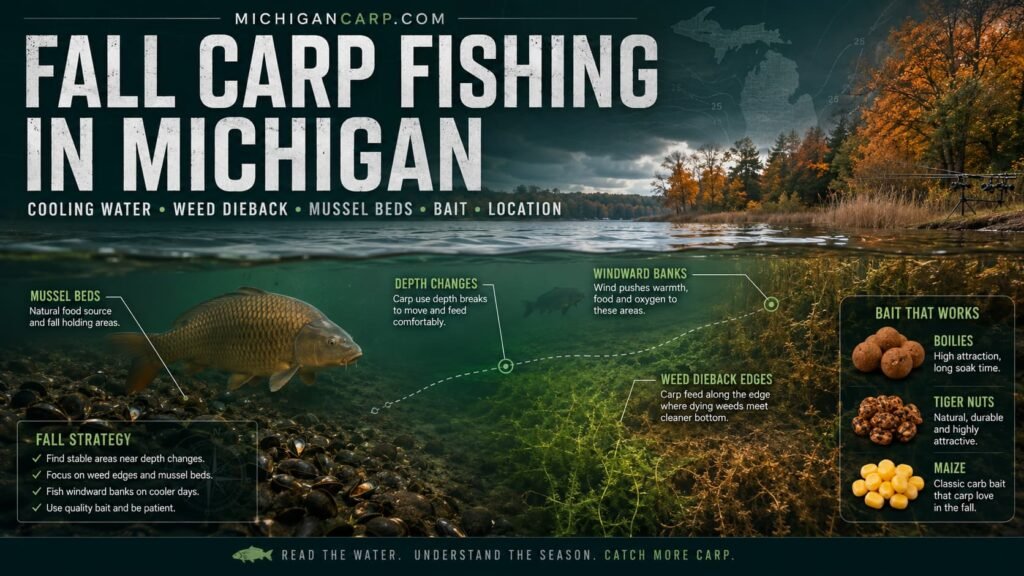
Fall carp fishing in Michigan can be one of the best periods of the year.
The lakes are quieter. Boat pressure drops. Weed begins to change. Natural food becomes more concentrated. Carp often feed strongly before winter, and some of the best fish in a water can become more catchable when the right location, bait and weather window line up.
But fall carp fishing is not just summer fishing with cooler air.
The whole lake starts to reorganize.
Some shallow bays that were alive in summer begin to fade. Thick weed starts dying back. Remaining green weed becomes more important. Mussel beds, hard spots, silt edges, deeper bay mouths, windward banks and routes toward stable water can all become better. Feeding can be strong, but it becomes more location-specific as the season progresses.
That is the real fall lesson.
Fall carp may feed hard, but they do not feed everywhere.
The best fall fishing comes from finding the areas that still offer food, comfort and a route to safer water as temperatures change.
This guide explains fall carp fishing in Michigan, including early fall, late fall, cooling water, weed dieback, remaining green weed, mussel beds, hard/soft transitions, wind direction, deeper bay mouths, fall boilies, tiger nuts, maize, particles, crumb, baiting amounts, feeding signs and practical session planning.
For the full year-round seasonal framework, read Michigan Carp Fishing Seasons.
For the broader location process, read How to Find Carp in Lakes.
For natural food zones, read How to Find Natural Carp Feeding Areas in Michigan Lakes.
For reading visible activity, read Signs Carp Are Feeding.
For bait choice by venue and season, read Best Carp Bait for Michigan Lakes.
The simple fall rule is this:
Follow the food, watch the cooling trend, fish routes near stable water, and build bait only where carp prove they are feeding.
Table of Contents
Quick Start: Fall Carp Fishing in Michigan
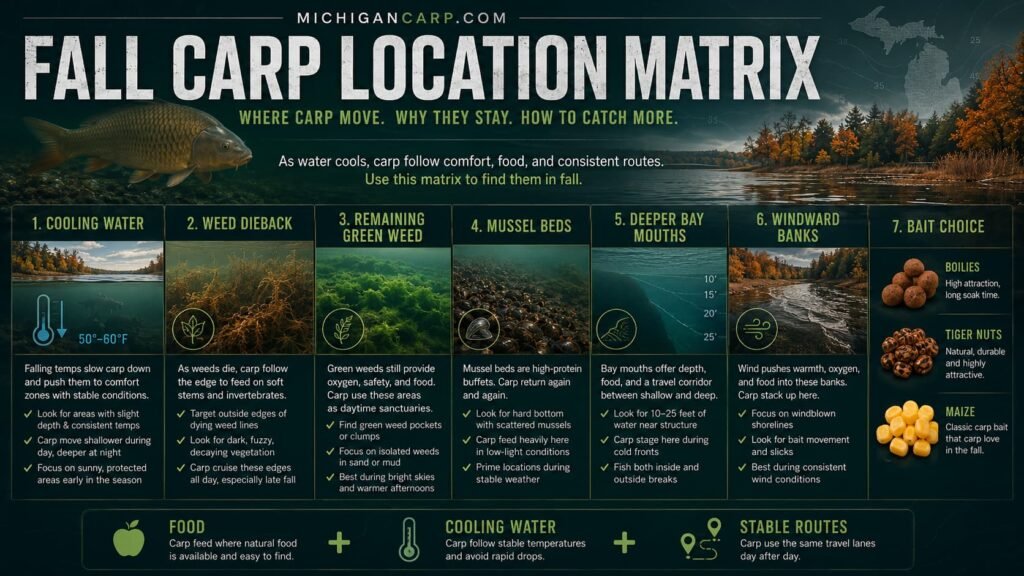
Use this table as the quick fall strategy guide.
| Fall Situation | Where to Look | Feeding Pattern | Best Bait Approach | Biggest Mistake |
|---|---|---|---|---|
| Early fall | Weed edges, bays, points, mussels, night routes | Often still similar to late summer | Boilies, particles, tiger nuts, maize, controlled packbait | Abandoning summer patterns too early |
| Cooling water | Windward food banks, deeper bay mouths, hard/soft transitions | Feeding can be strong but more focused | Boilies, maize, tiger nuts, crumb, moderate baiting | Fishing random shallow water |
| Weed dieback | Remaining green weed, outside edges, clear holes, dying weed edges | Carp search remaining food and cleaner areas | Strong hookbaits, boilies, tiger nuts, light particles | Fishing rotten weed blindly |
| Mussel beds | Hard spots, gravel, shell, riprap, hard/soft edges | Strong fall feeding potential | Boilies, tiger nuts, wafters, crumb | Ignoring abrasion and presentation |
| Windward fall banks | Banks where wind pushes into food and comfortable water | Can switch on quickly | Moderate baiting if signs confirm fish | Fishing wind with no habitat |
| Late fall | Deeper routes, stable water, bay mouths, old channels, soft silt pockets | Shorter but serious feeding windows | Smaller amounts, higher accuracy, quality hookbaits | Feeding like it is still September |
| Cold snap | Deeper safety edges, stable areas, softer bottom near routes | Feeding slows or shortens | Tight baiting, small PVA, singles | Moving constantly or overbaiting |
| Mild fall spell | Shallows near food, windward bays, remaining weed | Carp may move back onto food | Controlled bait increase if signs appear | Missing short weather windows |
Fall rewards anglers who adjust.
A lake may fish like summer in early September and like cold water by late November. The best approach is to read the conditions, not just the date.
Why Fall Carp Fishing Is Different
Fall changes the lake in stages.
In early fall, many waters still carry strong summer patterns. Weed is still present. Carp may still use night routes, shallow bays, weed edges and areas affected by boat pressure. But as days shorten and water cools, the pattern starts to change.
Boat pressure usually drops, which can make some areas easier to fish. Carp may use banks that were disturbed all summer. Campground margins, public access banks, points and shallow bays can become quieter. That gives carp more confidence, but it does not automatically make every swim good.
Natural food also changes.
Some weed starts to break down. Some weed remains green and useful. Mussel beds, shell areas, gravel, silt edges and soft-bottom feeding zones can become more important. Carp may not spread themselves evenly through the lake. They often concentrate around the food and routes that still make sense.
This is why fall can be so productive. Carp may feed hard, but they also become more predictable if you understand the transition.
A good fall swim usually gives carp three things:
food
comfortable water
a route toward safety
That might be a mussel bed near a bay mouth. It might be remaining green weed beside deeper water. It might be a windward point with hard bottom and soft silt nearby. It might be an old channel edge that connects shallow feeding water to deeper stable water.
The goal is not to fish every attractive-looking fall bank.
The goal is to find the bank that still has food and a reason for carp to visit.
Early Fall: Do Not Leave Summer Too Quickly
Early fall can still fish like summer.
The days may be shorter, the nights cooler and the lake quieter, but carp may continue using many of the same areas they used in August. Weed edges, shallow bays, bay mouths, points, mussel areas, campground margins and low-light routes can all remain productive.
The mistake is changing too drastically too soon.
If carp are still feeding on summer weedlines, keep fishing them. If night movement is still strong, do not abandon it just because the calendar says fall. If particles, packbait and maize are still producing, there is no reason to stop using them.
What changes is how closely you need to watch the trend.
Early fall nights begin cooling the lake. Weed starts changing. Boat pressure drops. Carp may start extending feeding windows during the day, especially during mild weather or cloud cover. A bank that only worked at night in July may start producing in the evening or even late afternoon as fall develops.
This is a good time to keep notes. Write down wind, water feel, weed condition, bite times, signs and which rods are producing. Early fall patterns can carry into mid-fall, but they can also change quickly after a cold snap.
In early fall, use summer knowledge but stay alert for fall movement.
Cooling Water and Fall Feeding Windows
Cooling water is the central fall trigger.
Carp do not stop feeding just because temperatures drop. In many cases, fall cooling can improve feeding, especially after the heat, algae, heavy boat pressure and inconsistent summer conditions begin to fade.
The important point is pace.
A gradual cooling trend can produce excellent fishing. A sudden hard cold front can shorten feeding windows and push fish toward more stable water. A mild spell after colder weather can briefly switch fish back onto shallow food or windward banks.
Fall carp often feed in defined windows. Those windows may be longer than winter but shorter and more specific than summer. A spot may produce for two hours and then go quiet. A windward bank may come alive after several hours of wind. A deeper bay mouth may produce at dusk when carp move from safe water toward food.
This makes timing important.
In early fall, dawn, dusk and night can still be strong. In mid-fall, afternoon warming and wind can become more useful. In late fall, shorter windows near stable water may matter most.
The best fall anglers do not just ask where carp are.
They ask when that location becomes useful.
A mussel bed may fish when the wind hits it. A bay mouth may fish when carp move in or out. A remaining weed edge may fish in the warmest part of the day. A deeper route may fish after a cold night.
Fall location and timing belong together.
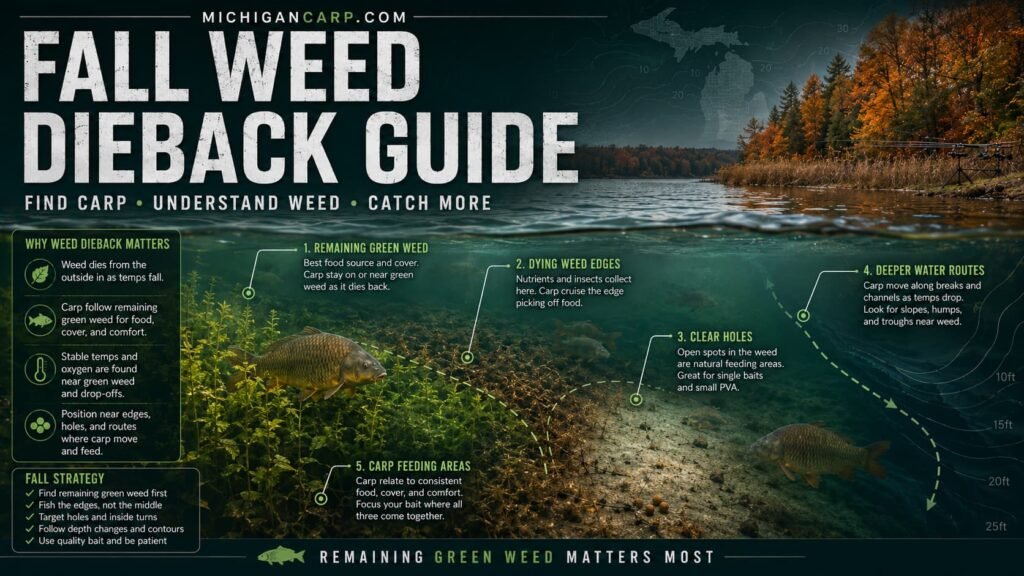
Weed Dieback and Remaining Green Weed
Weed is one of the biggest fall changes.
In summer, thick weed can provide food, cover, oxygen and patrol routes. In fall, some weed begins to die, collapse or decay. That can change where carp feed and how they move.
Dying weed is not automatically bad. Edges of dying weed can still hold food. Breaking weed can expose insects, snails and clean patches. Carp may search around changing weed beds because food becomes easier to access.
But rotten weed can also be poor. It can smell bad, bury rigs, reduce presentation quality, collect debris and make water less comfortable in some areas. Fishing directly into decaying weed without knowing what is happening is a mistake.
Remaining green weed is often more important.
A patch of healthy weed near deeper water can become a fall hotspot. The outside edge may hold snails and insects. Clear holes can offer presentation. The route between remaining weed and deeper safety water can be very productive.
The best fall weed areas usually have:
remaining green weed
clear fishable holes
an outside edge
nearby depth
signs of carp activity
a safe landing angle
Do not cast blindly into the thickest weed because it looks “carpy.” Find where a bait can actually fish and where a hooked carp can be landed safely.
Mussel Beds, Gravel and Hard Spots
Fall is a strong time to pay attention to mussel beds, gravel, shell, riprap and hard-bottom areas.
Hard areas can give carp clean feeding zones and durable natural food sources. Mussel beds and shell areas can be especially important on Michigan waters where carp regularly browse hard bottom, gravel/silt transitions and rocky edges.
The best hard spots are rarely isolated.
They become much better when connected to other features: weed, silt, a point, a bay mouth, a windward bank, an old channel, or deeper water. A mussel bed beside a travel route is stronger than a random hard patch in open water.
Look for shell fragments on the bank, crunch through the lead, visible hard patches, gravel points, riprap, clay shelves and hard/soft transitions. If you are using a boat, sonar or underwater camera, pay attention to where hard bottom meets silt or weed.
Presentation matters. Sharp shells, zebra mussels and rough bottom can damage line, hooklinks and leaders. Use abrasion-resistant tackle where needed, and check rigs regularly.
Bait choice also changes on hard spots. Boilies, tiger nuts, wafters, maize and crumb all work well. Boilies can be especially useful because they are easy to present, selective and repeatable. Tiger nuts are durable and suit hard-bottom feeding. Crumb can create attraction without overfeeding.
For tiger nut preparation and hookbait use, read Tiger Nuts for Carp Fishing.
Windward Banks in Fall
Wind can be powerful in fall.
A steady fall wind can push food, color, surface warmth and oxygen into a bank. It can make carp feel safer and concentrate activity along points, weed edges, bay mouths and hard-bottom areas.
But wind is not enough by itself.
A windward bank only becomes interesting if it pushes into useful habitat. Wind hitting a bay with soft silt, remaining weed, mussels or a deeper route is worth attention. Wind pounding a sterile sand bank may not be worth much. Wind that makes presentation unsafe or impossible is not helpful.
The type of wind matters too.
A mild wind after stable weather can switch on a bank. A cold wind after a sharp front may push fish away from exposed shallows. A strong wind can improve confidence but also create drift, floating weed and presentation problems. In fall, wind direction should always be judged against water temperature, bottom type and access to safer water.
A good fall windward-bank setup often includes one bait on the main food edge, one on the route into the wind-affected area and one slightly deeper or more sheltered. That lets you test whether carp are feeding right in the wind, traveling beside it, or holding just off it.
For official wind and weather forecasts, use NOAA / National Weather Service.
Deeper Bay Mouths, Points and Routes to Stable Water
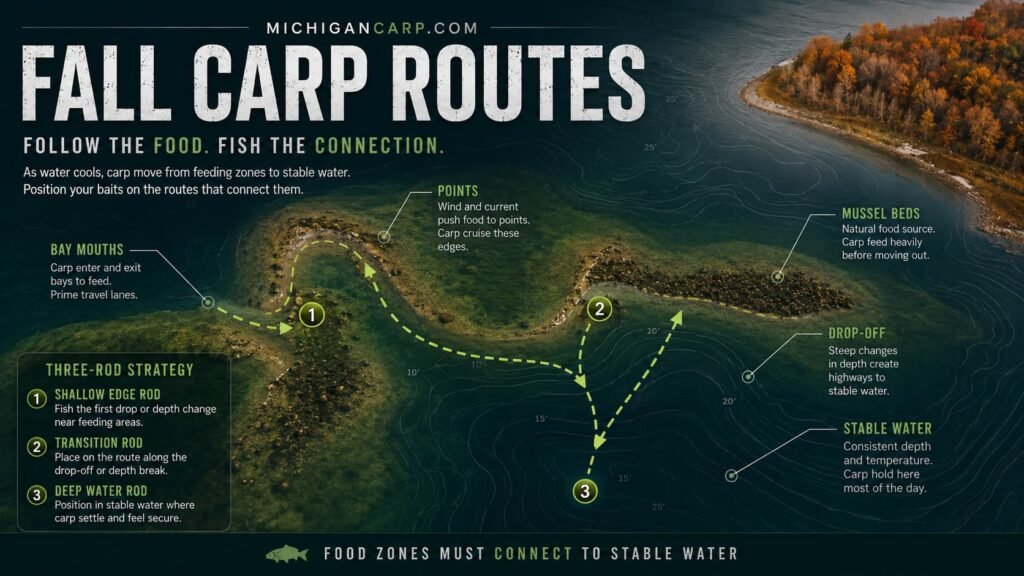
As fall progresses, routes become more important.
Carp may still feed shallow, but they often want easy access to stable water. Bay mouths, points, shelves, drop-offs, old channels, basin edges and deeper weedlines can all become key features.
A bay mouth can be better than the back of the bay because it connects shallow food with deeper safety water. A point can be useful because carp naturally travel around it. A drop-off can hold fish that are not fully committed to feeding shallow. An old channel can act as a route toward winter areas.
This is where fall carp fishing becomes more precise.
Instead of fishing the most obvious shallow spot, ask how carp would enter and leave the feeding area. Where would they hold after a cold night? Where would they move during a mild afternoon? Where would they feed before dropping back?
A strong fall swim often gives access to:
one food zone
one route
one deeper or more stable edge
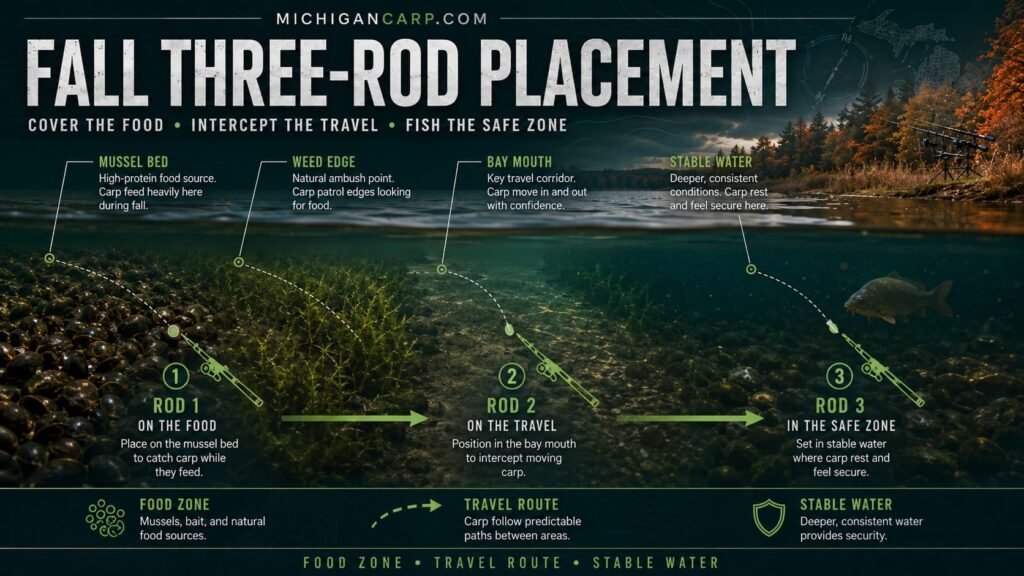
With three rods, that might mean one bait on a mussel bed, one on a hard/soft transition and one on the deeper route. Or one on remaining weed, one on the bay mouth and one on the point leading out.
For big-water route selection, read Finding Carp in Big Michigan Lakes.
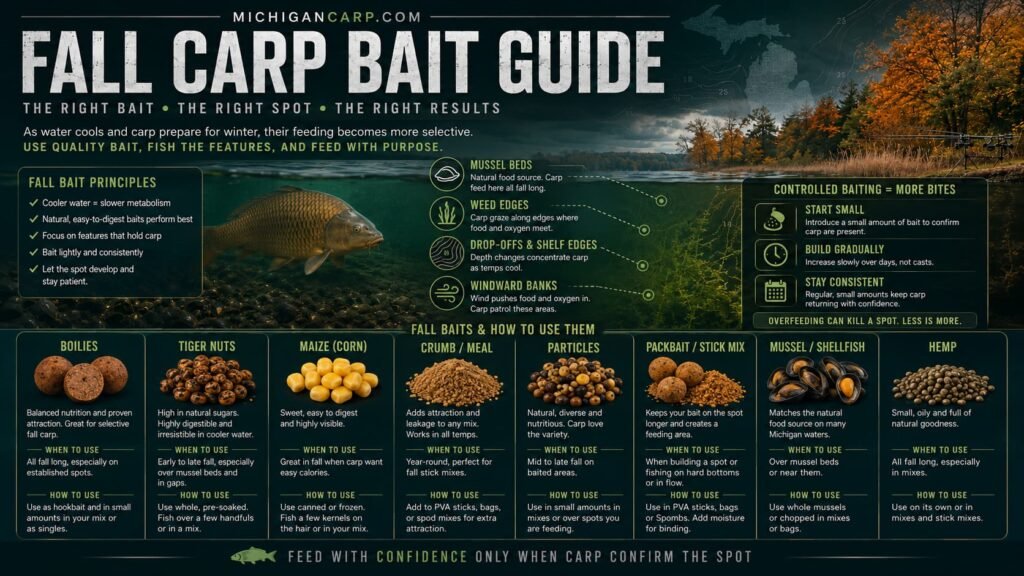
Best Fall Carp Baits in Michigan
Fall can be a very good bait season.
Carp may be willing to feed hard when conditions are right, especially before the water gets genuinely cold. But bait choice should still follow location and feeding confidence.
Boilies are often strong in fall. They are selective, consistent and useful on hard spots, mussel beds, points, bay mouths and routes. Chopped boilies and crumb can help create attraction without overfeeding. Milk/nut, birdfood, nut-based and balanced food-bait approaches can all work when carp are feeding properly.
Tiger nuts are also useful. They are durable, selective and effective around weed edges, hard spots, silt transitions and nuisance fish. They are not a bait to throw everywhere in huge amounts, but they are excellent as a controlled feed and hookbait.
Maize and corn remain effective, especially during early fall and mild spells. Prepared maize is tougher and better for longer sessions. Canned corn is quick, visible and useful for light traps.
Particles can still work well in fall, but the amount should be controlled as water cools. Early fall can support more particle feeding than late fall. As windows shorten, tighter baiting becomes more important.
Packbait can be effective when carp are present and feeding, especially if you want attraction around the hookbait without spreading bait too far. In cooler fall conditions, smaller packbait applications can be better than large balls of feed.
For bait comparison, read Boilies vs Corn vs Particles for Carp.
For boilie and bait choice by venue, read Best Carp Bait for Michigan Lakes.
How Much Bait to Use in Fall
Fall baiting can be excellent, but it needs to change as the water changes.
In early fall, carp may still clear bait confidently. If you find a feeding group on a weed edge, mussel bed, bay mouth or point, moderate baiting can work well. Particles, crumb, boilies and tiger nuts can all hold fish if they are actively feeding.
In mid-fall, controlled baiting becomes more important. Fish may still feed hard, but the windows can be more defined. A steady top-up after activity may be better than dumping bait at the start.
In late fall, accuracy matters more than volume. Smaller amounts of higher-confidence bait are usually better. A few boilies, some crumb, a small PVA stick, maize, tiger nuts or a tight particle trap can outfish a heavy bed of bait.
The key is evidence.
If bites, liners, bubbles and bait response show carp are feeding, build slowly. If the swim is quiet, do not assume more bait will fix it. Fall fish may be close but not feeding, or they may be using a different route.
A simple fall baiting rule is:
Feed enough to hold feeding carp, but not enough to bury a short window.
Fall Signs Carp Are Feeding
Fall feeding signs can be more subtle than summer, but they are often more meaningful.
Bubbles near mussel beds, silt edges, remaining weed or bay mouths are important. Clouded water on a cool, calm afternoon can show fish rooting in shallow or medium-depth food. Rolling fish over a point or route may reveal movement. Repeated liners at dusk can show carp traveling between feeding and safety water.
Weed signs also matter. Moving stems, cloudy holes, bubbles on the edge of remaining green weed and reed movement can all show fish are still using cover.
In fall, the timing of signs is important. A few signs during the warmest part of the day may be more useful than dawn activity after a cold night. A windward bank may show signs only after the wind has pushed for several hours. A deeper bay mouth may show liners at dusk as fish move out or back.
Do not ignore small signs.
One repeated bubble patch in the right fall location may be more important than a dramatic roll in the wrong place.
For sign reading, use Signs Carp Are Feeding.
Fall Session Plan
A good fall session starts with choosing the right phase of fall.
Early fall sessions can still be run like late summer with adjustments. Watch weed, boat pressure and low-light movement, but be ready for more daytime activity as pressure drops.
Mid-fall sessions should focus more strongly on food and routes. Mussel beds, windward banks, remaining weed, hard/soft transitions, bay mouths and points become important.
Late fall sessions should be more precise. Look for stable water, deeper routes, softer bottom, old channels, bay mouths and food close to safety.
Before fishing, check the weather trend. A mild spell after cold weather can be excellent. A hard front may shorten the window. Wind direction should be judged by what it pushes into, not just where it blows.
When you arrive, watch before baiting heavily. Look for bubbles, liners, rolling fish, clouding, moving weed and bird activity. Feel the bottom if needed. Do not assume last month’s swim is still right.
A good three-rod fall layout is:
one rod on food
one rod on the route
one rod on stable water
That might mean a mussel bed, a hard/soft transition and a deeper bay mouth. Or remaining green weed, a point and the drop-off behind it.
Let the first few hours teach you. If one rod gets liners, adjust one bait toward the route. If signs appear shallow during a mild afternoon, move one rod carefully. If activity fades after dark in late fall, avoid unnecessary recasting and let the best spots work.
Common Fall Carp Fishing Mistakes
The first fall mistake is fishing summer patterns too long.
A shallow weed edge that produced in August may still work in September, but by late fall the fish may be using deeper routes, remaining green weed or bay mouths instead.
The second mistake is abandoning summer knowledge too early. Early fall can still fish like summer. Do not leave productive weed edges and night routes until conditions actually change.
The third mistake is ignoring weed condition. Healthy remaining weed can be excellent. Rotten dying weed can be poor. Learn the difference.
The fourth mistake is missing mussel beds and hard/soft transitions. Fall carp often use these areas, especially when they connect to routes and depth.
The fifth mistake is overbaiting late fall. Carp may still feed, but the window can be shorter. Too much bait can reduce your chances.
The sixth mistake is not adjusting to wind. Fall wind can switch on a bank, but only when it pushes into useful habitat.
The final mistake is failing to use quieter fall conditions. With less boat pressure, some public banks and daytime windows become better than they were in summer.
My Practical View
Fall is one of my favorite Michigan carp periods because the fishing becomes more honest.
The lake is quieter. The obvious summer pressure drops. The fish still need food, but they start using the lake more selectively. This rewards watercraft.
I want food, but I also want access to stable water. Mussel beds, remaining green weed, hard/soft transitions, windward banks, bay mouths and points all interest me. I am especially interested when several of those features meet in one fishable area.
I also like fall for boilies and tiger nuts. They are selective, repeatable and fit well around hard spots, mussel beds and routes. But I still do not feed blindly. Early fall may take more bait. Late fall usually needs more accuracy.
The final rule is simple:
In fall, follow the remaining food, respect the cooling water, fish routes near stability, and let carp activity decide how much bait the swim deserves.
FAQ
Is fall good for carp fishing in Michigan?
Yes. Fall can be one of the best times for carp fishing in Michigan because boat pressure drops, carp often feed before winter, and food-rich areas become more important.
Where do carp go in fall?
Fall carp often use remaining green weed, mussel beds, hard/soft transitions, windward banks, deeper bay mouths, points, old channels and routes toward more stable water.
What is the best fall carp bait?
Good fall carp baits include boilies, tiger nuts, maize, corn, crumb, controlled particles and small packbait traps. Boilies and tiger nuts can be especially useful around hard spots and mussel beds.
Are boilies good for fall carp?
Yes. Boilies can be very effective in fall, especially on hard spots, mussel beds, points, bay mouths and repeatable feeding routes.
Are tiger nuts good in fall?
Yes. Tiger nuts are durable and selective, making them useful around weed edges, hard spots, silt transitions and nuisance fish.
How much bait should I use in fall?
Use more bait only when carp are clearly feeding. Early fall can support moderate baiting, while late fall usually needs tighter, more accurate feeding.
Do carp feed after the water cools?
Yes. Carp can feed well as water cools, especially during stable or mild conditions. Feeding windows may become shorter and more location-specific.
Are weed beds good in fall?
Remaining green weed can be excellent. Rotten or collapsing weed can be poor. Fish clear holes, edges and routes near healthy remaining weed.
Are mussel beds good for fall carp?
Yes. Mussel beds, shell areas and hard/soft transitions can be strong fall feeding locations, especially when connected to depth or travel routes.
Does wind matter in fall carp fishing?
Yes. A mild wind pushing into food-rich habitat can switch on a fall bank. Cold wind or wind hitting poor habitat is less useful.
What time of day is best for fall carp?
Early fall may still produce at dawn, dusk and night. Mid and late fall may also produce during the warmest part of the day, especially after mild weather or wind.
Should I fish shallow or deep in fall?
Fish the connection between food and stable water. Early fall can still produce shallow, while late fall often rewards bay mouths, depth changes and routes toward deeper water.
Why did my summer carp spot stop working in fall?
The weed, food, temperature and pressure may have changed. Carp may have shifted to remaining green weed, mussel beds, deeper routes or more stable water.
What is the biggest fall carp fishing mistake?
The biggest mistake is fishing old summer habits without reading cooling water, weed dieback, food location and routes toward stable water.
Next Steps
Use these supporting guides next:
Spring Carp Fishing in Michigan
Summer Carp Fishing in Michigan
Winter Carp Fishing in Michigan
Finding Carp in Big Michigan Lakes
How to Find Natural Carp Feeding Areas in Michigan Lakes
Best Carp Bait for Michigan Lakes
Boilies vs Corn vs Particles for Carp