

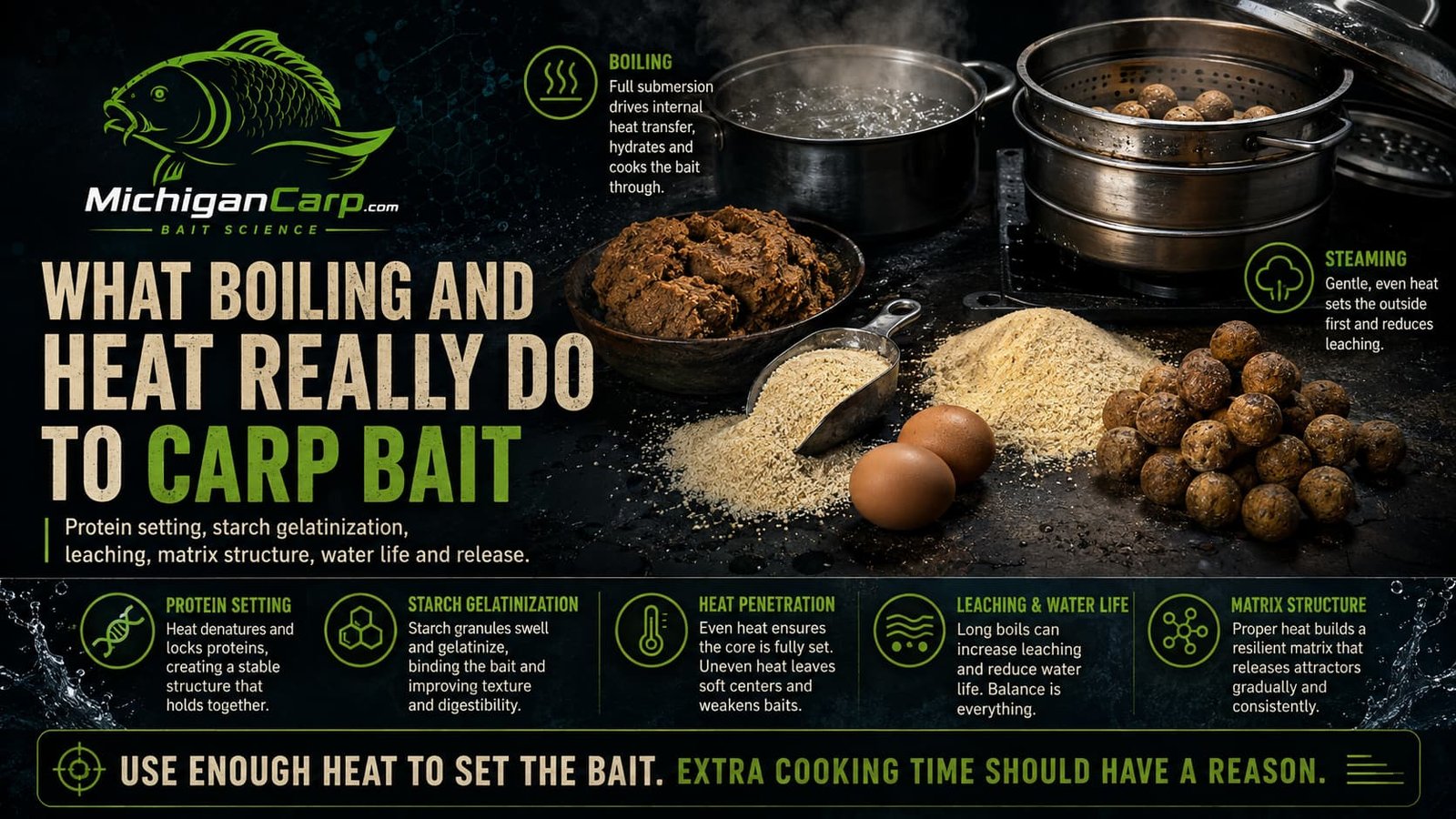
What boiling does to carp bait is more complicated than simply making a boilie hard. Boiling, steaming and other heat treatments change bait through heat transfer, water contact, protein setting, starch gelatinization, leaching, volatile loss and matrix formation.
That does not mean boiling is bad. Without controlled cooking, many boilie recipes would remain soft paste rather than practical fishing bait. The problem is not heat itself. The problem is using heat without understanding what it is doing.
Boiling can help a bait hold shape, survive casting, resist nuisance fish and stay intact long enough to do its job. It can also move soluble material into the cooking water, reduce some volatile aroma, inactivate heat-sensitive enzymes and change the way the finished bait later takes on water.
Steaming can reduce direct leaching because the bait is not submerged in a large pan of water, but steaming is not chemically neutral. Steam still heats proteins, changes starches, sets structure and affects heat-sensitive ingredients. It is a different cooking path, not a magic way to avoid bait chemistry.
This article explains the technical side. For the practical step-by-step process, use How to Boil and Dry Boilies Properly. For ingredient processing before bait making, use Raw vs Processed Ingredients in Carp Bait and How to Process Carp Bait Ingredients Properly.
Use enough heat to set the bait for the job. Extra cooking time should always have a reason.
Table of Contents
Quick Answer: What Boiling Does to Carp Bait
Boiling is a combined heat, water and structure-setting process. The outside of the boilie heats first, water contacts the surface, heat moves inward and the bait begins changing from paste into a cooked matrix.
During that process, proteins can denature and aggregate, starches can hydrate and gelatinize, egg proteins help set the structure, soluble ingredients can move into the cooking water and the finished bait becomes physically different from the raw paste.
| Cooking effect | What happens | Practical result |
|---|---|---|
| Heat penetration | The surface heats before the core | Diameter and recipe density affect cooking time |
| Protein setting | Egg, milk and plant proteins change structure | The bait becomes firmer and more cohesive |
| Starch gelatinization | Starch absorbs water and swells when conditions allow | Binding, texture and water behavior change |
| Leaching | Soluble compounds can move into cooking water | Some attraction may be lost from the finished bait |
| Volatile loss | Some aroma compounds may evaporate or change | The flavor profile may become softer or different |
| Matrix formation | Proteins, starches, fibers, fats and particles set together | Water life, leakage and durability are controlled by the complete bait |
A short boil is not automatically better. A long boil is not automatically worse. The correct cooking process depends on bait diameter, recipe density, egg level, milk-protein content, starch level, particle size, intended water life and whether the bait is a free offering, hookbait or special treatment bait.
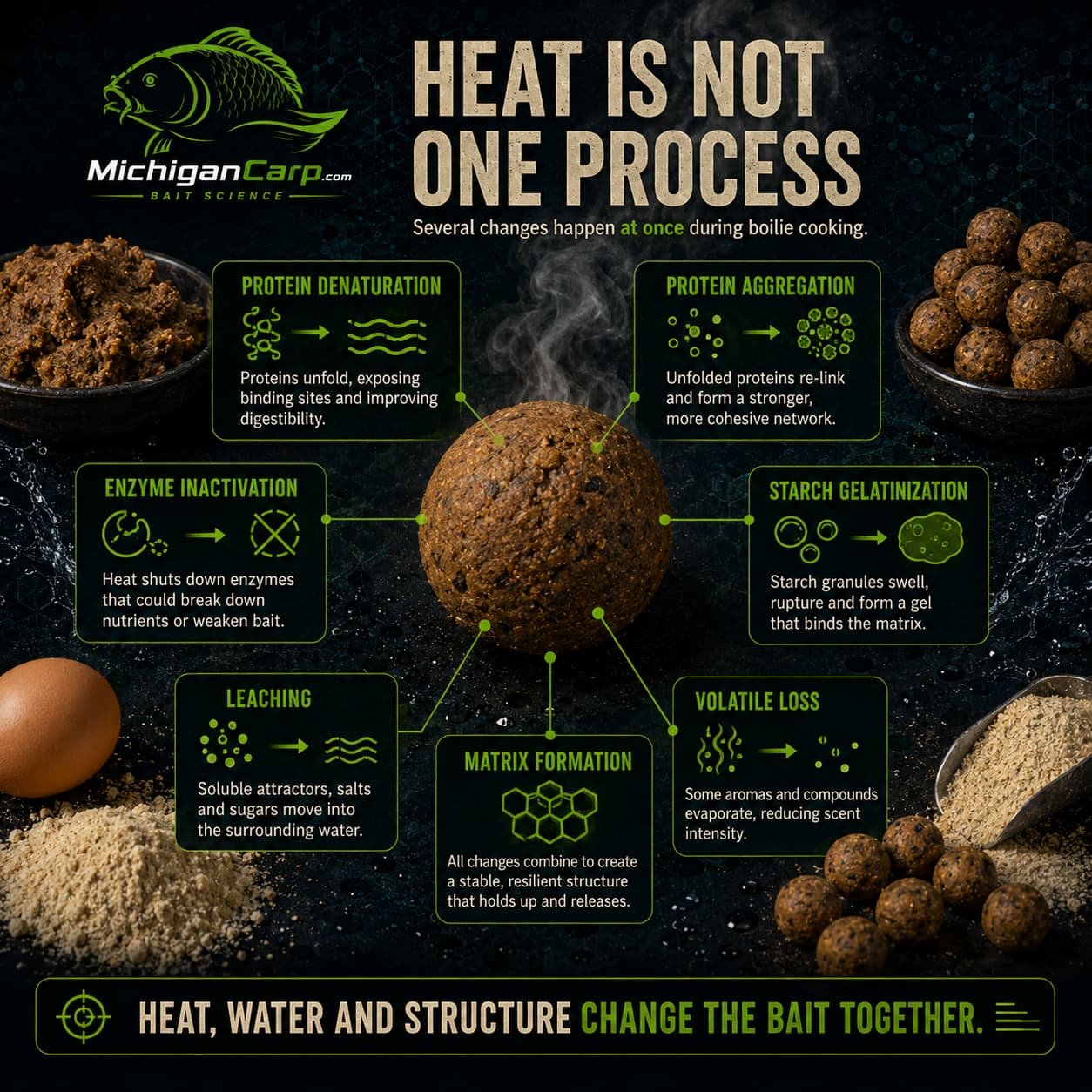
Heat Is Not One Process
One of the biggest mistakes in bait discussion is talking about heat as though it performs one single action. It does not. Heat changes different ingredients in different ways, and those changes happen at the same time.
Egg proteins, casein, whey proteins, soy proteins, wheat gluten, starches, sugars, enzymes, flavors, oils and hydrolysates do not all respond identically. Some changes are useful. Some are unavoidable. Some are only a problem when the wrong ingredient is placed in the wrong part of the process.
That is why the better question is not, “Is heat good or bad?” The better question is, “What job is this heating step performing, and what trade-off am I accepting?”
| Process | What changes | Why bait makers should care |
|---|---|---|
| Protein denaturation | Folded protein structures unfold or rearrange | Can help set the bait but may also change solubility |
| Protein aggregation | Proteins interact and form larger networks | Influences firmness, toughness and water movement |
| Starch gelatinization | Starch hydrates, swells and loses granular structure | Improves binding and changes texture |
| Enzyme inactivation | Enzyme structure and activity may be reduced | Matters if the ingredient was added for active enzyme work |
| Leaching | Soluble material moves into surrounding water | Reduces what remains inside the finished bait |
| Volatile loss | Some aroma compounds leave the bait more easily | Can alter flavor and aroma strength |
| Matrix formation | Proteins, starches, fibers and particles form a cooked structure | Controls hardness, water life and release behavior |
Ingredient Processing and Finished-Bait Cooking Are Different
Ingredient processing and finished-bait cooking are often mixed together in bait discussions, but they are different questions.
Processing an ingredient before it enters the bait may reduce anti-nutritional factors, gelatinize starch, improve digestibility, alter texture or make a raw material safer and more useful. Examples include heat-treated soy, cooked particles, toasted cereals, fermented materials, pre-gelatinized starches and hydrolyzed protein products.
Cooking the finished boilie has a different job. It sets the complete paste into a usable bait. It helps stabilize shape, produces mechanical strength, controls water life and makes the bait practical to cast, fish and store.
A soybean ingredient may benefit from proper industrial heat treatment before you buy it. That does not mean a finished boilie containing soy needs excessive boiling. Likewise, boiling a finished bait for an extra minute is not the same thing as properly processing a raw ingredient before formulation.
For the anti-nutritional factor side, read Anti-Nutritional Factors in Carp Bait Ingredients. For enzyme use, read Enzymes in Carp Bait: Phytase and Pre-Digestion Explained.
What Happens When a Boilie Enters Hot Water?
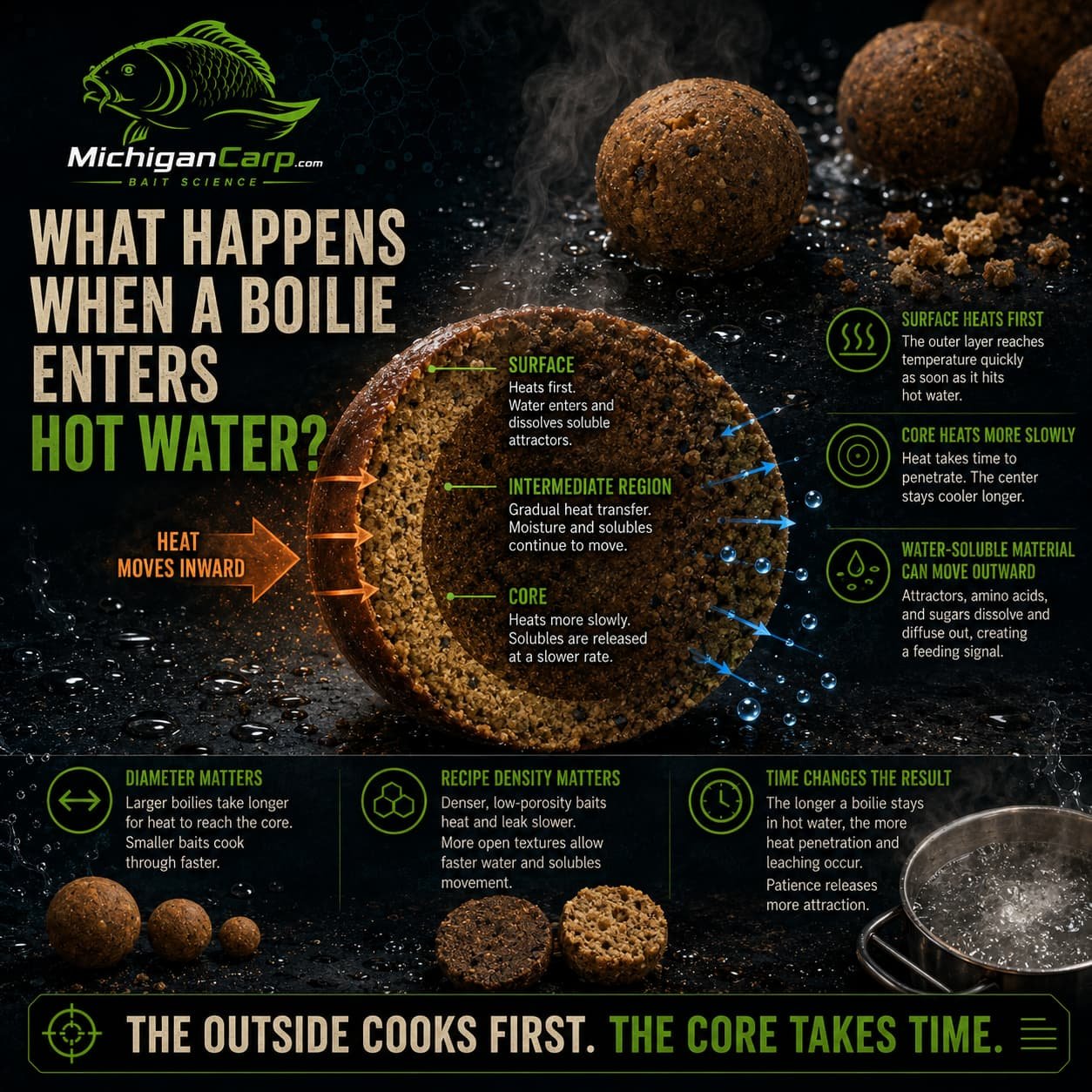
A boilie does not instantly become the same temperature all the way through. The outside enters hot water first. The surface heats quickly, begins changing first and has the longest contact with the cooking water. The center heats more slowly.
This creates three practical zones: the surface, the intermediate region and the core. The surface may firm quickly and lose some soluble material. The intermediate region changes as heat and water move inward. The core may lag behind, especially in larger or denser baits.
This is why diameter matters. A 24 mm milk-protein bait is not cooked in the same way as a 12 mm open birdfood bait. The larger bait has more distance between the surface and the center. A dense bait with a tight matrix heats and hydrates differently from an open-textured bait with more coarse particles.
Batch size also matters. A crowded pan can drop water temperature and reduce even cooking. A rolling boil with smaller batches gives a more repeatable process than overloading the pan and guessing.
What Heat Does to Egg Proteins
Eggs are central to traditional boilie construction because they are not just liquid. They bring water, protein, yolk fat, phospholipids, emulsifying properties and heat-set structure.
When the bait is cooked, egg proteins help transform paste into a cohesive boilie. That setting process is one of the main reasons a boiled bait behaves differently from a paste ball made from the same ingredients.
This does not mean every bait needs the longest possible boil. Once the bait is set for the intended use, additional cooking may give more firmness, but it may also increase leaching, reduce surface activity and change the way the finished bait hydrates.
For egg use in the liquid phase, connect this article with Boilie Liquids and Additives.
What Heat Does to Milk Proteins
Milk-protein baits need careful language because skim milk powder, WPC80, whey powder, casein, caseinates and milk replacer do not behave as one identical ingredient group.
Heating can change protein structure, solubility, aggregation and interaction with the rest of the bait matrix. That does not mean heat “destroys milk protein.” Denatured protein is still protein. The practical question is how the cooking process changes structure, water movement, softness, hardness and later release.
Whey proteins, caseins and milk powders also sit inside a complete bait containing egg, cereal starches, fats, minerals, acids, sweeteners, yeast, nut meals and birdfood. Their behavior depends on the whole system, not just the ingredient name.
For the deeper dairy route, read Milk Powders in Boilie Making, Milk Proteins in Carp Bait and Milk Caseins for Boilie Making.
What Heat Does to Starches
Starch behavior is one of the main reasons heat can improve some bait ingredients. In the presence of enough water and heat, starch granules can hydrate, swell and gelatinize. This changes binding, texture, water holding and physical structure.
That matters in semolina, wheat flour, maize meal, rice flour and other cereal ingredients. It also matters in manufactured birdfoods and seed-cereal blends, depending on how they were processed before you bought them.
Gelatinization is not an identical switch in every bait. Different starch sources respond differently. Water availability matters. Protein, fat, fiber, particle size and acids in the bait can all affect how the starch system behaves.
This is why one universal boil time makes little sense. A bait containing a high proportion of cereal starch may respond differently from a dense milk-protein bait with less available water.
Leaching: Cooking Loss Is Not the Same as Heat Damage
Leaching is one of the most important practical effects of boiling. When bait is submerged in hot water, water-soluble material can move from the bait into the cooking water.
This can include some salts, sugars, organic acids, small soluble food compounds, free amino acids, small peptide fractions and water-soluble flavor components. The material is not necessarily destroyed. Some of it may simply leave the bait and enter the cooking water.
This distinction matters. An ingredient can remain chemically stable at cooking temperature while still losing part of its soluble fraction through water contact. That is cooking loss, not always chemical destruction.
The amount lost depends on surface area, porosity, soluble concentration, cooking time, water volume, water movement, bait size and the density of the cooked matrix.
For the deeper transport science, read The Science of Carp Bait Solubility and Leakage and Why Some Carp Baits Leak Faster Than Others.
Boiling vs Steaming: The Real Difference
The boiling vs steaming debate is often exaggerated. Boiling is sometimes blamed for destroying attraction, while steaming is sometimes treated as if it preserves everything. Neither view is accurate.
Both methods cook the bait. Both transfer heat. Both change proteins, starches and the bait matrix. The real difference is how heat and external water interact with the bait.
What boiling does
Boiling fully submerges the bait in hot water. This gives strong, direct heat transfer and helps cook the bait through. It also gives the greatest contact between the bait and the surrounding water.
That direct contact can increase leaching of water-soluble material. The more soluble the ingredient, the more open the bait and the longer the boil, the more important this becomes. Boiling is efficient and repeatable, but the cooking water becomes part of the process.
Boiling is useful when you want fast heat penetration, strong setting, predictable batch production and a bait that is easy to produce consistently. It is also the simplest method for most home bait makers.
What steaming does
Steaming surrounds the bait with hot vapor and condensed moisture rather than submerging it in a large volume of water. This usually reduces direct leaching into a pan of water because the bait is not sitting in boiling water.
However, steaming still heats the bait. Proteins can still denature. Starches can still gelatinize where heat and moisture are sufficient. Enzymes may still lose activity. Volatile compounds can still change. The bait matrix still sets.
Steaming may produce a smoother skin and can be useful for baits where you want less direct leaching and a more controlled surface set. But it may need more time to achieve comparable internal heating, especially with larger or denser boilies.
When boiling is the better choice
Boiling is often the better choice when speed, simplicity and repeatability matter. It is practical for general free baits, larger production batches and baits where the liquid phase and soluble materials have already been designed with cooking loss in mind.
For many everyday milk, nut, birdfood and particle-supported boilies, a controlled short boil followed by proper drying is still a very practical method.
When steaming may be useful
Steaming may be useful when the recipe contains a higher proportion of soluble ingredients, hydrolysates, sweet liquids or surface-active materials that you want to retain inside the bait as much as possible during cooking.
It may also be useful for specialist hookbaits, wafters, pop-ups or small batches where a slower process is acceptable and the goal is controlled setting rather than fast production.
The practical trade-off
Boiling is direct, fast and simple, but increases contact with external water. Steaming reduces direct water contact, but still applies heat and may require more time. Neither method is automatically superior. The right method depends on the bait and the job.
| Question | Boiling | Steaming |
|---|---|---|
| Heat transfer | Fast and direct | Gentler and often slower |
| Water contact | Full submersion | Steam and condensed moisture |
| Leaching risk | Higher for soluble materials | Usually lower direct leaching |
| Surface setting | Fast surface contact with hot water | Often smoother and more gradual |
| Internal cooking | Efficient when batches are controlled | May need more time for dense baits |
| Best use | General boilies and repeatable production | Specialist baits, reduced leaching, careful small batches |
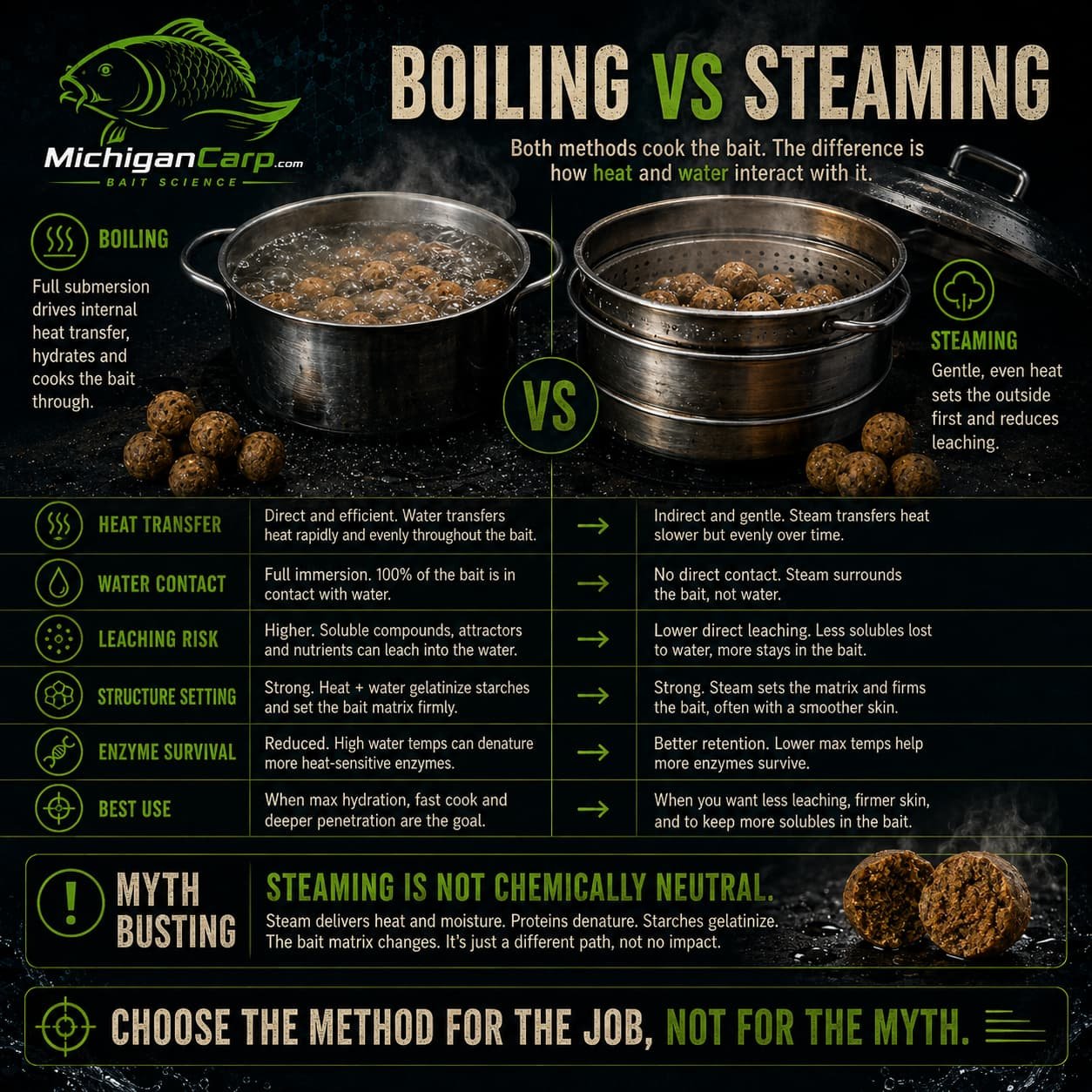
Choose boiling or steaming for the job, not for the myth.
Does Boiling Create an Impermeable Skin?
A cooked outer layer is not the same as an impermeable seal. Boiled bait can remain physically intact while still taking on water, softening, leaking dissolved material and releasing particles.
Cooking can make the surface firmer and more resistant to water movement, but that is a rate change, not an absolute barrier. Water can still enter. Soluble material can still dissolve. The release pathway may simply become slower or more controlled.
This matters because some anglers judge bait only by skin hardness. A very hard skin may help with nuisance resistance, casting strength or water life, but it does not automatically mean better bait. It may also slow hydration and delay release.
The practical wording I prefer is this: cooking changes resistance to water entry and movement. It does not necessarily create a sealed shell.
Heat-Sensitive Ingredients Need a Process Plan
Some ingredients belong in the base mix. Some may be better used after cooking. Others may need pre-treatment before the finished bait is made. The point is not to protect every ingredient from heat. The point is to place each ingredient where it does its best work.
Enzymes
Enzymes are proteins that catalyze specific reactions. A useful enzyme system needs the correct substrate, moisture, temperature, pH and time. Normal boilie cooking may reduce enzyme activity, although exact heat stability depends on the enzyme and formulation.
If enzyme activity is the reason you bought the product, do not blindly assume it survives a normal cooking process. Ingredient pre-treatment, uncooked paste applications, method mixes or controlled post-cooking treatments may be more logical.
Hydrolysates
Hydrolysates are often described too loosely. A hydrolysate may contain larger peptides, smaller peptides, free amino acids, salts and other food-derived compounds. Boiling does not make all of that disappear.
The bigger practical issue is often leaching and matrix retention. Some soluble fractions may move into cooking water, and the cooked bait matrix can control how easily retained material later releases in the lake.
A split strategy often makes sense: use some food liquid or hydrolysate inside the bait for background food character, then use targeted post-boil treatment where fast outer signal matters. For the deeper protein-fraction guide, read Proteins, Peptides and Hydrolysates in Carp Bait.
Fermented liquids and yeast products
Fermented liquids can contain acids, soluble grain compounds, yeast-derived material, microbial metabolites and sometimes living microorganisms. Those components do not all respond to heat the same way.
If the goal is live microbial activity, cooking is obviously a problem. If the goal is a food-derived liquid containing acids and soluble fermentation products, the issue becomes more about leaching, retention and final bait placement.
For this wider route, read Fermented and Food-Signal Baits for Carp.
Flavors and volatile compounds
Some aromatic compounds are volatile and can leave the bait more readily under heat. Others may be more stable or retained by the bait matrix. Water solubility, fat solubility, concentration, carrier and cooking method all matter.
This is why doubling flavor to “replace what boiling removes” is not a clean technical solution. It may overpower the bait, distort the profile or fail to solve the real problem. Keep How to Flavor Boilies Properly bold and unlinked until that article is finalized.
Sugars, Sweeteners, Oils and Vitamins Under Heat
Sugars, sweeteners, oils and vitamins should not be treated as one category. They have different chemical behavior and different jobs in bait.
Some sugars and sweet soluble materials can move into cooking water. Reducing sugars may participate in heat-related reactions under suitable conditions, although ordinary short, wet boilie cooking should not be casually equated with dry roasting or baking.
Oils behave differently from water-soluble compounds. They do not dissolve into cooking water like salts or sugars, but heat, oxygen exposure, ingredient freshness and total lipid level still matter. Oil should not be used as a substitute for soluble food signal.
Vitamins vary greatly in heat stability and water solubility. The question “does boiling destroy vitamins?” is too broad. It depends on the vitamin, chemical form, time, temperature, oxygen exposure, water contact and surrounding food matrix.
Use these supporting guides where relevant: Sugars, Sweeteners and Carbohydrates in Carp Bait, Oils, Fats and Energy in Carp Bait, How to Balance Fat in Boilies and Vitamins for Carp.
Bait Size, Recipe and Time Must Be Considered Together
There is no perfect universal cooking time for every boilie. A small open bait, a dense milk-protein bait, a high-egg hookbait and a coarse birdfood bait do not all need the same treatment.
The most important variables are diameter, recipe density, egg content, starch content, protein system, particle size, water content, cooking method and desired water life.
Smaller baits heat through faster. Larger baits need more time for the core to reach the same level of change. Dense baits may resist water movement and heat penetration. Coarse baits may allow faster water access but can also become physically weaker if the structure is not designed properly.
Hookbaits may justify more durability than free offerings. Free bait may benefit from being more open and active. Crumb and chopped boilies can provide faster surface area even when whole baits are more durable.
Boiling and Digestibility Are Not the Same as Hardness
Cooking can influence digestibility, but hardness alone does not measure digestibility. This is an important distinction.
A bait can become harder because proteins and starches set into a stronger matrix. That does not automatically tell you how much of the protein, lipid or carbohydrate a carp can use. Mechanical hardness, water entry, solubility, digestion and nutrient value are related, but they are not the same measurement.
Moderate processing can improve some ingredients by changing starch availability or reducing selected raw-ingredient problems. Excessive or unsuitable processing can reduce the value of other ingredients or make the bait unnecessarily slow for the fishing situation.
For the broader nutrient-use article, read Carp Bait Digestibility.
Paste, Lightly Set Boilies and Hard Boilies
Paste and boilies should not be treated as rivals. They are different bait forms with different jobs.
| Bait form | Main strength | Main limitation |
|---|---|---|
| Paste | Fast water access and high activity | Limited durability and casting strength |
| Lightly set boilie | Balance of durability and activity | Requires controlled production and drying |
| Hard durable boilie | Long water life and nuisance resistance | May hydrate and release more slowly |
| Post-treated hookbait | Durable center with active outer zone | Can become over-treated if liquid absorption is ignored |
A practical bait system can use all of these. For example, a session may use durable hookbaits, whole boilies, chopped boilies, crumb, paste and a targeted liquid around the rig. Every bait in the swim does not have to be cooked to the same hardness.
For bait-form effects, read Why Surface Area Matters in Carp Bait.
Post-Boil Treatment: Useful but Not Magic
Post-boil treatment is useful because it lets you place selected ingredients on or near the outside of an already cooked bait. That can be valuable when the ingredient’s main job is rapid outer signal, hookbait conditioning, powder coating or controlled rehydration.
However, pouring more liquid onto bait is not automatically better. A good post-boil treatment should answer five questions: what am I adding, why does it belong outside the bait, how much can the bait absorb, will it alter hardness or buoyancy, and does it improve the rig-zone signal or simply make the bucket smell stronger?
This is especially important for wafters and pop-ups, where liquid uptake can alter buoyancy. It also matters for hard hookbaits, where repeated soaking can soften the surface or create a sticky outer layer.
For liquid selection, use When to Use Each Type of Carp Bait Liquid. For carrier behavior, use Propylene Glycol vs Glycerin in Carp Bait.
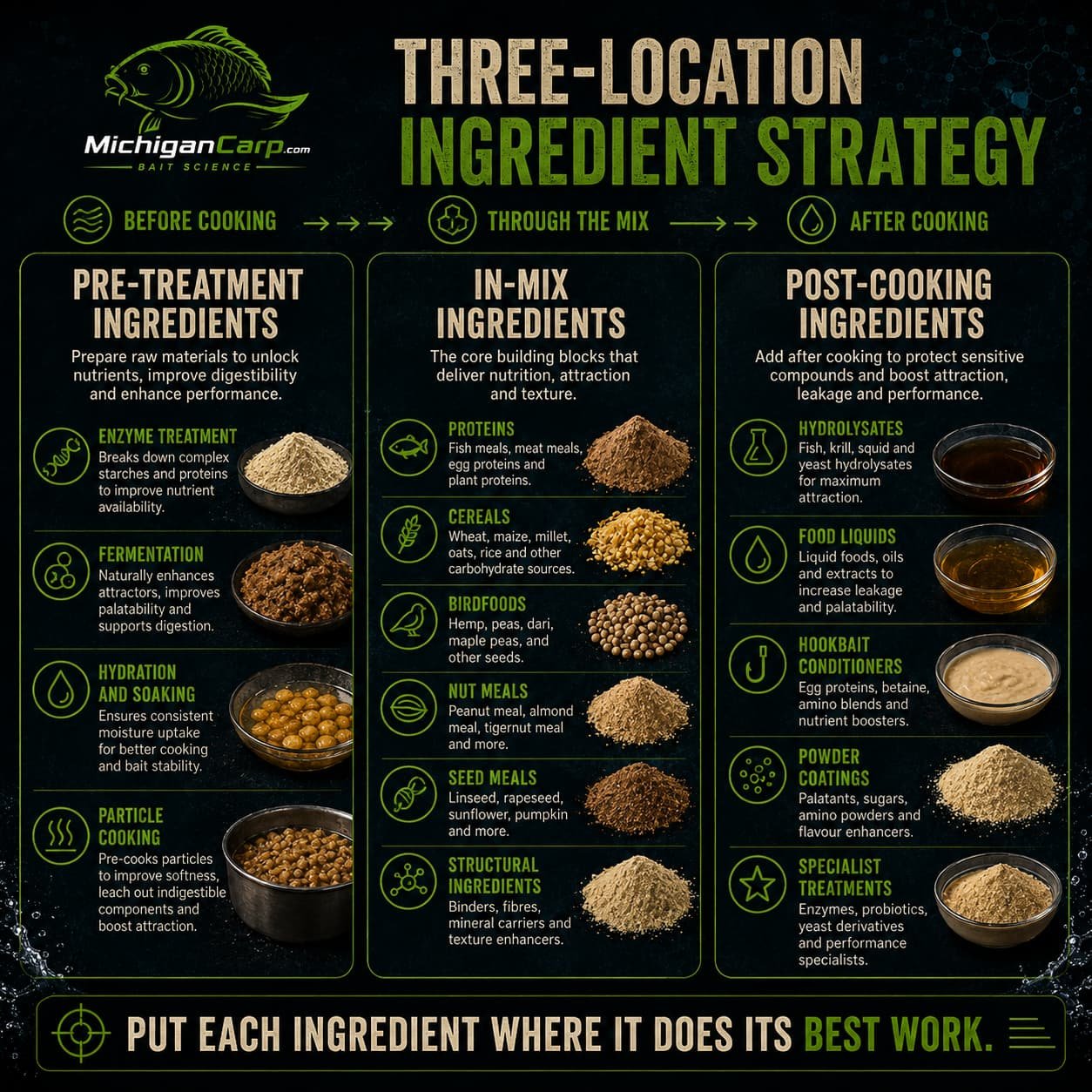
The Three-Location Ingredient Strategy
A cleaner way to design homemade bait is to decide where each ingredient belongs in the process. Not every ingredient has to go through the same heat treatment.
I think of this as a three-location strategy: before cooking, through the mix and after cooking.
| Location | Best fit | Examples |
|---|---|---|
| Pre-treatment | Ingredients that need work before the finished bait is cooked | Particle cooking, soaking, fermentation, enzyme treatment, hydration |
| In the mix | Core ingredients that build nutrition, structure and bait identity | Egg, milk proteins, cereals, birdfood, nut meals, seed meals, structural flours |
| Post-cooking | Ingredients used for outer signal, coating or heat avoidance | Selected hydrolysates, food liquids, hookbait conditioners, powders, specialist treatments |
This approach prevents a common mistake: forcing every attractive ingredient into the dry mix and then wondering whether boiling damaged it. Some ingredients are meant to build the bait. Some are better used to treat the finished bait.
How to Test Heat Effects at Home
You do not need a laboratory to learn useful things about your own bait. You need controlled comparisons.
Make one paste and change only one process variable. For example, compare a short boil against a longer boil, boiling against steaming, one-day drying against several-day drying, or untreated bait against post-treated bait.
Then test equal weights under identical conditions. Use the same water temperature, same container, same bait size and same observation times. Record what happens after one hour, four hours and overnight.
Useful observations include surface texture, cracking, swelling, water uptake, visible particle release, softening, hardness, clouding, aroma, breakdown and whether a rigged hookbait remains usable.
Visible clouding does not measure every dissolved compound, but it can still help compare two versions of the same bait. The value is not pretending a jar test is a laboratory analysis. The value is seeing which version behaves more like the bait you intended to build.
For the complete testing sequence, use How to Test Boilies Before Fishing.
Michigan Notes
On Michigan waters, I do not want heat treatment to become more complicated than the fishing demands. Big natural lakes, dam ponds, river channels, weedbeds, mussel areas, short feeding windows and multi-day sessions all create different bait requirements.
For short spring sessions, I often want enough durability for the rig to work, but I do not automatically want maximum hardness. Crumb, chops, paste, small amounts of liquid and a lightly active boilie can sometimes be more useful than a rock-hard free bait.
For multi-day lake sessions, durability matters more. Even then, I would still separate hookbait durability, free-bait activity and local rig-zone signal. Every bait in the swim does not need to be identical.
Where crayfish or nuisance fish are a problem, harder hookbaits may be justified. That still does not mean every free boilie needs to be processed to the same extreme.
On larger waters, practicality and cost matter. I would rather use a coherent feeding system and place concentrated post-treatment where it adds value than overprocess every pound of bait simply because harder feels safer.
Common Mistakes
Thinking all heat damage is the same
Protein denaturation, enzyme inactivation, leaching, volatile loss and matrix hardening are different processes. Treating them as one thing leads to bad bait decisions.
Using one boil time for every bait
Diameter, recipe density, egg level, starch level, particle size and desired water life all affect the correct process.
Assuming steaming changes nothing
Steaming reduces direct submersion but still heats and transforms the bait. It is not chemically neutral.
Calling every cooked skin a seal
Cooked bait can still hydrate and release material. Processing changes resistance and rate, not necessarily absolute permeability.
Adding enzymes without a process plan
Ask which enzyme, which substrate, what temperature, what pH, what moisture level and when the reaction is supposed to happen.
Assuming every liquid belongs inside the boilie
Some liquids may make sense inside the bait. Others may work better as post-boil treatments, hookbait conditioners, powder-coating activators or rig-zone liquids.
Cooking for reassurance rather than function
A very hard bait can feel dependable in the hand while being unnecessarily slow for the fishing situation.
Simple Rules for Boiling, Steaming and Heat
- Separate ingredient processing from finished-bait cooking.
- Remember that boiling is heat plus direct water contact.
- Use steaming to reduce direct leaching, not to avoid heat chemistry.
- Use enough heat to set the bait for its job.
- Do not treat all proteins, starches, enzymes and liquids as heat-equivalent.
- Separate chemical damage from soluble loss into cooking water.
- Match cooking to bait diameter, recipe density and water-life needs.
- Use post-boil treatments for a clear reason.
- Test one process variable at a time.
- Do not make every bait harder than the fishing requires.
My Practical View
For me, boilie cooking is not a ritual. It is a formulation tool.
I want enough heat to create a bait that rolls, cooks, dries, casts and fishes properly. I do not want extra processing simply because a harder bait feels safer in the hand.
With milk, nut and birdfood baits, I am especially careful about this. The bait already contains proteins, starches, fats, sugars, soluble materials and texture ingredients that all respond differently to heat and water. A good process should support the bait’s design rather than fight it.
Sometimes boiling is the right answer. Sometimes steaming is useful. Sometimes the best answer is a durable hookbait, more active free bait and a post-boil treatment close to the rig.
The goal is not to prove that one method is always superior. The goal is to understand what the method is doing.
Set the bait enough to perform its job. Do not apply extra heat just because harder feels safer.
FAQ
Does boiling destroy carp bait attraction?
No. Boiling changes the bait, but it does not automatically destroy attraction. Some soluble material may leach into cooking water, some volatile compounds may change and the matrix may release differently, but the result depends on recipe, time, method and bait design.
Does boiling destroy protein?
No. Heat can denature and aggregate proteins, but denaturation does not mean the protein disappears. The practical issue is how heating changes solubility, structure, water movement and digestibility within the finished bait.
Does boiling gelatinize starch?
Heat and water can gelatinize starch, but the extent depends on starch source, available water, temperature history and the complete bait matrix.
Is steaming better than boiling for boilies?
Not always. Steaming can reduce direct leaching because the bait is not submerged, but it still heats and changes the bait. Boiling is faster and simpler. Steaming is useful when reduced water contact is more important than speed.
Does steaming preserve all attractors?
No. Steaming reduces direct contact with cooking water, but heat still affects proteins, starches, enzymes, volatile compounds and the bait matrix. It is not a no-change method.
Are hydrolysates ruined by boiling?
Not necessarily. Hydrolysates contain different peptide and amino fractions. Some soluble material may leach into cooking water, but that is not the same as saying the ingredient disappears or is completely destroyed.
Does a longer boil create a sealed skin?
Not literally. Longer cooking can firm the outside and slow water movement, but cooked bait can still hydrate, soften and release dissolved or dispersed material.
Should delicate ingredients be added after cooking?
Sometimes. Post-cooking use makes sense when the ingredient’s main job is rapid outer signal, heat avoidance, hookbait conditioning or powder coating. Other ingredients still belong inside the bait.
Is a harder boilie more digestible or less digestible?
Hardness alone does not measure digestibility. Physical hardness, water entry, solubility and nutrient digestibility are different properties.
What is the best rule for boilie cooking?
Use enough processing to produce the durability, shape and water life required for the fishing situation. Additional heat exposure should have a reason.
Next Steps
Use this article as the heat-treatment foundation, then continue with the related MichiganCarp guides that match the next decision:
- How to Boil and Dry Boilies Properly — practical cooking, drying and handling.
- How to Test Boilies Before Fishing — water testing and process comparison.
- Raw vs Processed Ingredients in Carp Bait — ingredient preparation before bait making.
- Anti-Nutritional Factors in Carp Bait Ingredients — plant ingredient limitations and processing logic.
- The Science of Carp Bait Solubility and Leakage — water movement, diffusion and release behavior.
- Proteins, Peptides and Hydrolysates in Carp Bait — protein fractions and soluble food signals.
- Boilie School — the complete boilie-making learning route.