

Carp fishing reels for Michigan should be chosen for the way you actually fish, not because one reel style looks more serious than another.
For many carp anglers, the choice eventually becomes big pit vs Baitrunner.
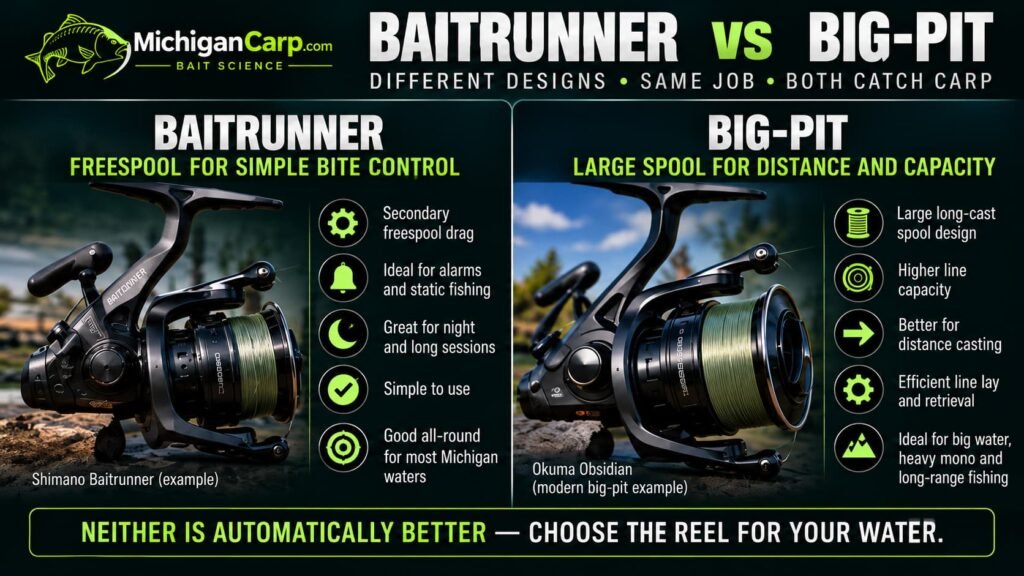
A Baitrunner-style reel is built around convenient bite management. A secondary adjustable drag allows a carp to take line while the rod remains on the alarms, then the reel switches back to the preset fighting drag when you engage it.
A conventional big-pit reel approaches the problem differently. It normally uses a larger long-cast spool, high line capacity and a front drag designed to move quickly between loose take pressure and the pressure required to fight the fish.
Neither system is automatically better.
On a Michigan campground lake with carp feeding 40 yards out, a huge big-pit reel may offer very little advantage.
On a large exposed lake where you are fishing heavier mono at greater range, line capacity, spool geometry and efficient line retrieval can become much more important.
The right reel should match:
- the rod;
- the mainline;
- the distance;
- the amount of weed or snag risk;
- the way you manage a take;
- the amount of line you genuinely need.
For the wider tackle system, start with Carp Fishing Gear for Michigan. Match the reel to Carp Fishing Rods for Michigan and Carp Fishing Line and Leaders for Michigan.
The practical rule is simple:
Choose the reel for the fishing problem—not for the reel category.
Table of Contents
Quick Start: Big Pit vs Baitrunner
For most Michigan anglers, I would start here:
| Fishing Situation | Reel Direction | Main Reason |
|---|---|---|
| First dedicated carp setup | Baitrunner / baitfeeder | Simple bite management |
| Normal inland lakes | Medium-large freespool reel | Practical and well balanced |
| Night and multi-rod sessions | Baitrunner / baitfeeder | Convenient secondary drag |
| Moderate weed | Larger freespool or compact big-pit | More capacity and control |
| Heavy mono | Larger spool | Better usable line capacity |
| Big open water | Big-pit / long-cast reel | Capacity and line management |
| Genuine distance fishing | Big-pit | Long-cast spool design |
| Boats and short rods | Medium reel | Better balance |
| Serious snag fishing | Strong reel with excellent drag | Immediate controlled pressure |
For conventional alarms-and-banksticks carp fishing, a good Baitrunner-style reel remains extremely convenient.
When distance, large spool capacity, heavier mono and long-range retrieval become regular requirements, the case for a big-pit becomes much stronger.
Baitrunner vs Big-Pit: What Is the Actual Difference?
There is an important distinction that is often missed.
Baitrunner and big-pit are not exact opposites.
They describe different parts of reel design.
A Baitrunner-style reel is defined mainly by the way it manages a take.
A big-pit reel is defined mainly by its spool, capacity and long-cast format.
It is therefore possible for some reels to combine characteristics of both.
Baitrunner-Style Reel
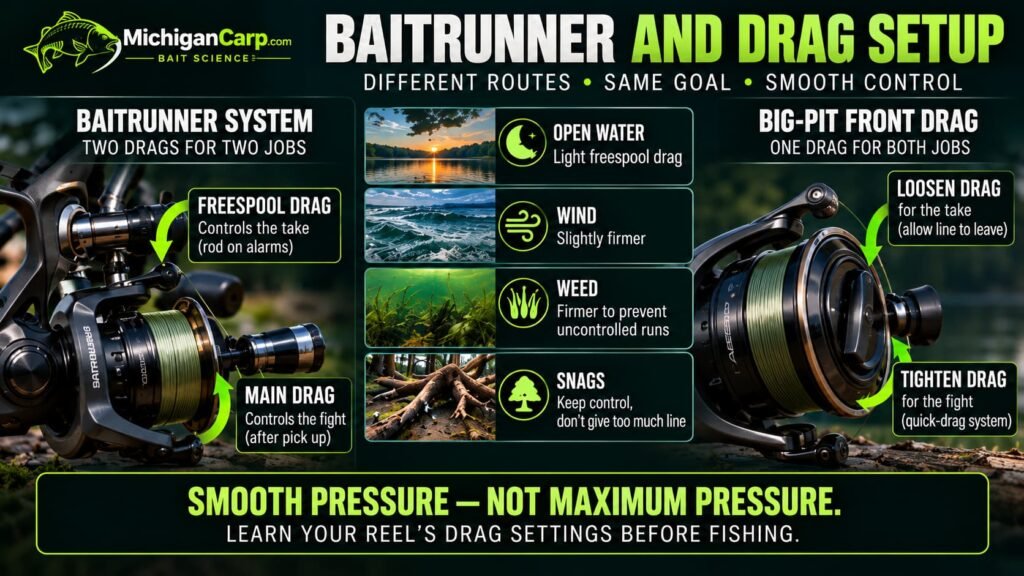
A Baitrunner, baitfeeder or freespool reel has two drag systems.
The normal fighting drag is set for playing the carp.
A second adjustable drag allows line to leave the spool much more easily while the rod is sitting on the alarms.
The sequence is:
CAST → SET MAIN DRAG → ENGAGE FREESPOOL → WAIT FOR TAKE → PICK UP → ENGAGE MAIN DRAG
When a carp takes line, the bail arm remains closed.
You pick up the rod and normally turn the handle or disengage the freespool lever.
The reel then returns to the fighting drag you already set.
That is the main attraction.
Conventional Big-Pit Reel
Most conventional big-pit reels do not use that separate secondary drag.
Instead, they normally use one front-drag system.
For the take, that drag is loosened sufficiently for line to leave the spool.
When you pick up the rod, you tighten the drag to the fighting pressure you want.
With a modern quick-drag or fast-drag system, that can take only a relatively small turn of the drag knob.
The sequence becomes:
CAST → LOOSEN DRAG → WAIT FOR TAKE → PICK UP → TIGHTEN DRAG → PLAY FISH
Both approaches work.
They simply require different habits.
Side-by-Side Comparison
| Feature | Baitrunner / Freespool | Conventional Big-Pit |
|---|---|---|
| Take control | Separate secondary drag | Main/front drag |
| Fighting drag | Can remain preset | Usually adjusted after pickup |
| Spool format | Medium to large | Usually large long-cast spool |
| Line capacity | Moderate to high | Usually high |
| Static alarm fishing | Extremely convenient | Requires front-drag routine |
| Distance emphasis | Moderate to good | Strong |
| Heavy mono | Model dependent | Often very good |
| Compact setups | Often easier | Can become bulky |
| Big-water role | Larger models work well | Natural strength |
| Learning curve | Very straightforward | Quick-drag routine requires familiarity |
The lesson is not to become trapped by the labels.
Look at what the reel actually does.
How a Baitrunner Reel Works
Shimano made the Baitrunner name famous, but the underlying freespool principle is now used under several names.
Other manufacturers may call it:
- baitfeeder;
- bite-and-run;
- live liner;
- freespool.
The names vary.
The principle is similar.
A lever or switch activates a secondary adjustable drag.
With that system engaged, a carp can pull line from the reel without immediately encountering the normal fighting-drag pressure.
When the reel is engaged, the primary fighting drag takes over.
Shimano still offers current Baitrunner models, including the Shimano Baitrunner D.
Okuma uses its own Baitfeeder system. The Okuma Ceymar Baitfeeder A uses an adjustable secondary drag and automatically switches back to the primary drag when the reel is engaged.
Why the System Suits Carp Fishing
A large part of modern carp fishing involves a bait sitting on the bottom while the rod remains stationary.
You may be using:
- bite alarms;
- bobbins;
- banksticks;
- a rod pod;
- boilies;
- particles;
- packbait;
- PVA.
The freespool system fits that fishing naturally.
Set the fighting drag.
Engage the secondary drag.
The reel is ready.
When the alarm sounds, there is no need to find the correct fighting-drag position from scratch.
Adjust the Freespool to the Swim
The secondary drag does not always need the same setting.
In calm open water it can normally be fairly light.
In strong wind or undertow, slightly more resistance may stop line constantly leaving the spool.
Around weed or nearby hazards, I do not want a carp taking large amounts of uncontrolled line before I reach the rod.
The useful rule is:
Light enough for the take. Firm enough for the swim.
What Is a Big-Pit Reel?
A big-pit reel is essentially a large fixed-spool reel designed around line capacity and long-range line management.
Typical characteristics include:
- large-diameter spool;
- longer spool stroke;
- high line capacity;
- controlled oscillation;
- precise line lay;
- strong line retrieval;
- fast or quick front drag.
These characteristics can help line leave the spool efficiently during the cast.
They also make it easier to accommodate thicker mono without losing useful capacity.
That matters in Michigan because heavy line can be justified by:
- zebra mussels;
- riprap;
- weed;
- stumps;
- rock;
- larger public waters.
A current example is the Daiwa Emblem 45 SCW QD, which uses a 45 mm long-cast spool, Slow Cross Wrap line lay and a quick-drag system.
That is classic big-pit thinking.
Why Big-Pits Suit Larger Waters
At genuine range, several things become more important.
You may need:
- more line;
- thicker line;
- efficient line release;
- fast line retrieval;
- good line lay;
- better balance with a longer distance rod.
A big-pit reel can provide all of these.
Why You May Not Need One
A 12000-size reel does not automatically catch carp better than an 8000-size Baitrunner.
If most of your fishing is:
- 30–70 yards;
- compact banks;
- close weed edges;
- small lakes;
- boats;
- short rods;
then the extra spool and body size may bring little practical advantage.
Okuma Obsidian: A Modern Big-Pit Example
The Okuma Obsidian is especially relevant to this guide because I own three of them.
That gives me both reel formats in my own tackle rather than leaving this as a theoretical comparison.
The Okuma Obsidian is not a Baitrunner-style reel.
It does not use a separate secondary baitfeeding drag.
Instead, it follows the modern long-cast big-pit approach.
Okuma’s published specification for the OSD12000-35AY includes:
- 35 mm spool stroke;
- super-slow oscillation;
- worm-shaft transmission;
- fast progressive carbon-fiber drag;
- 520 g reel weight;
- 103 cm line retrieval per handle turn;
- capacity of 600 m of 0.35 mm mono;
- additional spool and capacity reducers.
From a practical carp-fishing perspective, those features place the Obsidian firmly in modern lightweight big-pit / long-cast territory.
The major contrast with a classic Baitrunner is not simply size.
It is how you manage the take.
With a Baitrunner-style reel:
secondary drag for the take → preset main drag for the fight
With the Obsidian:
loosened front drag for the take → tighten fast front drag for the fight
Neither system is difficult once it becomes habitual.
But they feel different on the bank.
My Practical View: Baitrunner vs Obsidian
This is one area where I do not have to choose between theory and marketing descriptions.
I own both reel styles.
The attraction of a traditional Baitrunner system is its simplicity during static carp fishing.
Once the main fighting drag is where I want it, I can leave that setting alone.
After recasting:
- put the rod on the alarms;
- engage the freespool;
- adjust it for the conditions;
- wait for the take.
When a fish runs, engaging the reel returns me immediately to the fighting drag.
The Obsidian requires a different routine.
There is no separate Baitrunner lever.
Instead, the front drag itself moves between take pressure and fighting pressure.
That gives the reel a cleaner big-pit layout and the advantages of the large long-cast spool.
For traditional alarms-and-banksticks fishing at ordinary ranges, I still see a strong practical advantage in the Baitrunner concept.
For larger water, heavier line and situations where spool capacity and long-cast design matter more, the Obsidian approach makes a lot of sense.
I would not present one as the replacement for the other.
They solve the same basic fishing problem in different ways.
Drag Quality Matters More Than Maximum Drag
Reel specifications often advertise maximum drag pressure.
For carp fishing, that number is rarely the thing I care about most.
I care about:
how smoothly the drag starts.
A carp may pull steadily for several seconds and then suddenly accelerate.
Near the net, it may go from almost stationary to a violent short run.
If the drag sticks and then suddenly releases, the pressure on:
- hook hold;
- mainline;
- hooklink;
- rod tip;
changes abruptly.
A good drag should release progressively.
The useful characteristics are:
- smooth startup;
- predictable adjustment;
- consistent pressure;
- no obvious pulsing or grabbing.
Maximum pressure without smoothness is not an advantage.
Quick Drag vs Baitrunner Drag
A fast front drag and a Baitrunner system are trying to solve the same broad problem in different ways.
Baitrunner
You set:
Freespool drag = take
Main drag = fight
The switch happens mechanically.
Quick Drag
One drag performs both jobs.
You physically move it between:
loose = take
and
firmer = fight
Manufacturers have developed drag systems that make this adjustment much faster than older front-drag reels.
Daiwa, for example, describes the QDM system on its Emblem 45 SCW QD as moving through its drag range in approximately one full turn.
The Obsidian uses what Okuma calls a fast progressive drag.
The exact amount of movement differs by reel.
The important thing is learning yours.
Do not wait for a carp to be taking line at 2:00 a.m. before discovering how far the knob needs to turn.
Set the Reel Before Fishing
Before putting a bait in the water, test the complete setup.
Set the Main Fighting Drag
Thread the line through the rod rings.
Pull against the complete rod rather than directly from the spool.
You want controlled pressure and smooth line release.
The correct drag pressure depends on:
- rod action;
- line;
- hook size and pattern;
- hook hold;
- weed;
- snags;
- range.
There is no useful universal number.
Set the Baitrunner or Take Drag
If using a Baitrunner-style reel, engage the secondary drag and pull line.
Ask:
- Can a carp take line?
- Is the rod secure?
- Will wind pull line constantly?
- Will the fish gain too much line near weed?
Set a Big-Pit Front Drag
If using a quick-drag big-pit, learn the exact position needed for the take.
Then practice tightening it to a sensible fighting pressure.
Do this several times.
It should become automatic.
Reel Size Numbers Can Be Misleading
Reel-size numbers are useful, but they are not standardized.
One company’s 8000 can be physically different from another company’s 8000.
A 12000 reel is not automatically twice the size or capacity of a 6000.
Instead of relying only on the model number, check:
- line capacity;
- line diameter;
- spool size;
- weight;
- retrieve per turn;
- physical dimensions.
As a broad practical guide:
Medium Reels
Often useful for:
- 9–10 ft rods;
- smaller lakes;
- boats;
- lighter general setups.
Medium-Large Reels
Often ideal for:
- 12 ft carp rods;
- general Michigan bank fishing;
- Baitrunner-style systems;
- normal mono.
Large / Long-Cast Reels
Useful for:
- heavier line;
- big water;
- 12 ft 6 in or 13 ft rods;
- longer casts.
Do not choose the reel from the number printed on the box alone.
Line Capacity Matters More Than the Size Number
Michigan carp anglers often have good reason to use relatively strong mono.
The issue is not only breaking strain.
Diameter matters.
A thick abrasion-resistant line takes up much more space than a thin distance mono.
A reel that looks large with 12 or 15 lb line may lose useful capacity rapidly once you spool heavier material.
Always compare reel capacity using actual line diameter.
That is far more useful than comparing only advertised breaking strain.
For the complete system, use Carp Fishing Line and Leaders for Michigan.
Line Lay and Casting
Good line lay helps casting.
If line is stacked unevenly or crosses badly, the spool does not release it as efficiently.
Long-cast reels therefore devote a lot of engineering to oscillation and line placement.
This matters more as distance increases.
At modest fishing ranges, excellent line lay is still useful but usually less important than:
- drag quality;
- capacity;
- reliability.
Do not buy a distance reel because of casting technology if you rarely cast far enough to benefit from it.
Retrieve Rate and Gearing
Line retrieval becomes increasingly important as range increases.
If you repeatedly retrieve rigs from 100 yards or more, a reel that picks up more than a meter of line per handle turn can noticeably reduce effort.
Fast retrieval is also useful for:
- river fishing;
- bringing tackle over weed;
- marker work;
- spodding.
But retrieval speed alone does not determine reel quality.
Gearing should also remain smooth under load.
For ordinary carp fishing, I would rather own a reel with dependable gears and a smooth drag than one that wins a specification comparison for retrieve speed.
Match the Reel to the Water
Reel choice becomes much easier when you start with the venue.
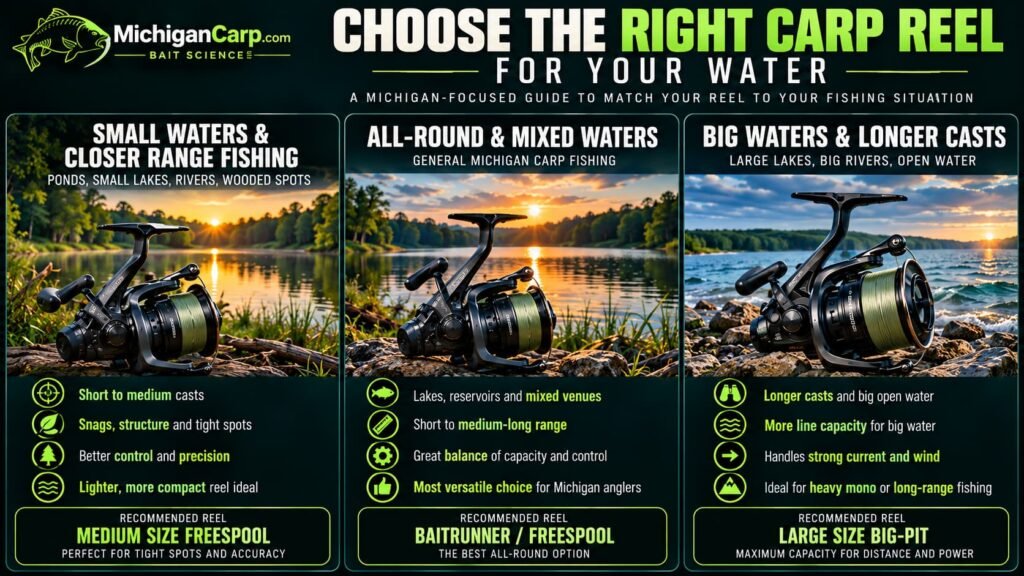
Clean Inland Lake
You normally do not need a giant reel.
A quality medium or medium-large spinning or freespool reel with a smooth drag and enough capacity is more than sufficient.
General Michigan Carp Fishing
This is where the Baitrunner-style reel remains particularly strong.
For conventional rods on alarms with normal casting distances, it offers an excellent balance of:
- convenience;
- capacity;
- control.
Weed
Weed may justify:
- stronger line;
- greater capacity;
- firmer drag management;
- stronger gearing.
A larger Baitrunner or a compact/lightweight big-pit can both work.
The decision comes down to how much capacity and casting performance you need.
Snags and Timber
Drag and gearing become more important than spool cosmetics.
The reel must allow you to apply controlled pressure quickly.
Do not set an extremely loose take drag beside dangerous snags.
And remember:
No reel makes an unsafe snag swim safe.
Use Carp Lead Systems for Michigan and the Complete Michigan Carp Rig Guide to make sure the rest of the system remains safe.
Zebra Mussels, Rock and Riprap
This is mainly an abrasion problem.
A larger spool may become useful because heavier mono requires more capacity.
But the most important job of the reel is to help you maintain control before the fish repeatedly drags the line across the hazard.
Rivers and Channels
Moving water adds constant load.
You may require:
- heavier leads;
- stronger line;
- larger capacity;
- efficient retrieval.
Either a large freespool reel or big-pit can work.
Big Open Water
This is where a big-pit reel starts earning its place.
If you genuinely need:
- high capacity;
- heavy mono;
- long casts;
- rapid long-range retrieval;
the large spool becomes a practical advantage.
But find the carp first.
A 1,000-acre lake does not mean the carp are 150 yards out.
Use Watercraft and Conditions for Michigan Carp Fishing before assuming distance tackle is necessary.
Boats and Tight Banks
A very large reel can make a compact setup cumbersome.
When rigs are being placed rather than cast long range, the advantages of extreme long-cast spool design become less important.
A well-balanced medium reel may be the better tool.
Match the Reel to the Rod
The reel should balance the rod.
9–10 ft Rods
A medium reel usually makes more sense.
A huge long-cast reel can make a short rod unnecessarily front-heavy and cumbersome.
12 ft All-Round Rods
This is the most flexible group.
A 12 ft carp rod can balance well with:
- medium-large Baitrunners;
- baitfeeders;
- compact big-pits;
- lighter full-size big-pits.
12 ft 6 in–13 ft Rods
Longer, more distance-oriented rods tend to suit larger-spool reels.
That is where the combination begins to work as a true long-range system.
For the complete rod decision, use Carp Fishing Rods for Michigan.
Mono vs Braid on Carp Reels
For most conventional Michigan bank fishing, mono remains my default.
It offers:
- useful stretch;
- forgiving fish-playing behavior;
- simple handling;
- predictable knots;
- good abrasion performance when correctly selected.
Braid offers:
- very low stretch;
- thin diameter for strength;
- excellent feedback;
- specialist weed and boat applications.
But braid is less forgiving.
That places more responsibility on:
- rod action;
- drag;
- leader choice;
- hook hold;
- technique.
The fact that a reel can hold braid does not mean braid is automatically the correct mainline.
Spooling a Carp Reel Properly
A good reel can perform badly when filled badly.
The important things are:
- sensible tension;
- even line lay;
- correct fill level;
- no excessive twist;
- a clean spool lip.
Too little line can reduce casting efficiency.
Too much line can create:
- coils;
- loops;
- wind knots.
After respooling, make several controlled casts before fishing seriously.
If the line is jumping from the spool, solve the problem rather than hoping a carp will ignore it.
Using Reels With Bite Alarms
The reel, alarm and indicator should function as one system.
A Baitrunner-style reel naturally suits alarms because the bail remains closed while the secondary drag allows movement.
That gives:
- positive runs;
- drop-back indication;
- liner indication;
- controlled line release.
Big-pit reels work perfectly well with alarms too, but the front drag must be loose enough for the bite without becoming so loose that loops of line spill from the spool.
Test the complete setup.
Do not assume that because the alarm makes a noise, the reel is correctly adjusted.
Do You Need a Dedicated Spod Reel?
Not immediately.
Spodding is hard on reels.
A dedicated spod reel normally benefits from:
- large spool;
- strong gears;
- fast retrieve;
- braid compatibility.
But it is not a beginner priority.
You can catch a great many Michigan carp using:
- packbait;
- PVA;
- particles;
- accurate casting;
- close-range feeding.
Buy a dedicated spod/marker reel when repeated long-range baiting actually becomes part of your fishing.
Buying Used Carp Reels
Used reels can be excellent value.
Older premium reels in good condition can be better purchases than cheap new reels.
Check the following.
Drag
Pull line steadily.
Watch for:
- grabbing;
- pulsing;
- inconsistent resistance.
Baitrunner System
If fitted, test:
- engagement;
- adjustment;
- disengagement;
- return to the main drag.
Spool Lip
Look closely for nicks.
A damaged spool lip can damage line and casting performance.
Line Roller
Make sure it rotates properly.
A damaged or seized roller can cause line wear and twist.
Bail
Check:
- spring pressure;
- alignment;
- closure.
Handle and Gears
Feel for:
- excessive play;
- grinding;
- knocking.
Body
Look for:
- impact damage;
- corrosion;
- evidence of immersion.
A smooth-looking reel can hide expensive problems.
Common Carp Reel Mistakes
Buying a Big-Pit Because It Looks Better
If you do not require capacity or distance, you may simply be adding weight.
Buying Too Little Reel for Heavy Mono
Thicker line can consume capacity quickly.
Comparing Only Reel Size Numbers
Manufacturer sizing is not standardized.
Looking Only at Maximum Drag
Smooth drag startup matters more.
Setting the Baitrunner Too Tight
The carp immediately encounters unnecessary resistance.
Setting It Too Loose Beside Snags
The fish gains distance before you reach the rod.
Locking the Fighting Drag
A sudden lunge can result in line failure or a hook pull.
Forgetting to Reset a Big-Pit Drag
After recasting, make sure the take setting is correct.
Overfilling the Spool
Loops and wind knots follow.
Ignoring the Line Roller
A small damaged part can destroy expensive mainline.
Pairing a Huge Reel With a Small Rod
Balance matters.
Buying Premium Reels Before Fish-Care Equipment
A better reel is not more important than safe landing and handling.
What I Would Recommend for Michigan
If someone asked me for a sensible starting point without knowing the exact venue, I would not immediately recommend a huge big-pit.
For straightforward static fishing on lakes and dam ponds, a quality medium-large Baitrunner-style reel remains a very practical choice.
If the angler already knows the fishing involves:
- large open water;
- heavier mono;
- longer casting;
- strong wind;
- frequent fishing at range;
then I would look much more seriously at a modern big-pit reel.
For boats and compact rods, I would generally move smaller.
For snag fishing, I would prioritize drag, gearing and the complete fish-control system.
And if you already own both systems, use the fishing to decide which one comes out of the bag.
That is more useful than trying to declare a universal winner.
FAQ
Is a Baitrunner better than a big-pit reel for carp?
Not universally. A Baitrunner offers a separate secondary drag that makes static bite management extremely convenient. A big-pit normally offers greater spool capacity and stronger long-range design.
What is the main difference between a Baitrunner and a big-pit reel?
A Baitrunner is mainly defined by its secondary freespool drag system. A big-pit is mainly defined by its large long-cast spool, capacity and line-management design.
Can a big-pit reel have a Baitrunner system?
Yes. The categories can overlap. Baitrunner describes a take-management system, while big-pit describes the broader spool and long-cast reel format.
Do I need a Baitrunner reel for carp?
No. A conventional spinning or big-pit reel can catch carp perfectly well if the drag and take system are managed correctly.
How do you fish a big-pit reel without a Baitrunner?
The normal approach is to loosen the front drag enough to allow the carp to take line, then tighten it to the required fighting pressure after picking up the rod.
Is the Okuma Obsidian a Baitrunner?
No. The Obsidian uses a fast progressive front drag rather than a separate secondary baitfeeding drag.
Is the Okuma Obsidian a big-pit reel?
Its 12000 size, 35 mm stroke, high line capacity, super-slow oscillation and long-cast design place it firmly in modern big-pit / long-cast carp-reel territory.
What reel size should I use for Michigan carp?
There is no universal size because manufacturer numbering differs. For most fishing, use enough reel to hold the required line comfortably and balance the rod.
Are big-pit reels better for big lakes?
They are useful when big lakes require greater line capacity or genuine distance. Lake size alone does not prove you need one.
What is the most important feature of a carp reel?
Smooth, predictable drag performance is one of the most important features.
How tight should a Baitrunner be?
Light enough to allow line to leave the spool during a take, but firm enough that wind, current or nearby hazards do not create uncontrolled line movement.
How tight should a big-pit reel be while waiting for a take?
The front drag should allow the carp to take line without pulling the rod from its supports while avoiding excessive spool looseness or uncontrolled loops.
Should I use mono or braid?
Mono is the safer general starting point for most Michigan bank fishing. Braid is useful in specialist situations but requires more careful drag, leader and fish-playing decisions.
Are older Baitrunner reels still useful?
Yes. Condition matters more than age. Check the drag, gears, line roller, bail and freespool mechanism carefully.
Next Steps
Build the reel into a complete system rather than treating it as an isolated purchase.
Use Carp Fishing Rods for Michigan to match rod length, power and action.
Use Carp Fishing Line and Leaders for Michigan to choose mainline, leader and abrasion protection.
Use the Complete Michigan Carp Rig Guide for the terminal system.
Use Carp Fishing Gear for Michigan for the wider tackle route.
And make sure Carp Fish Care and Safety and Landing Gear for Carp Fishing are already covered before spending heavily on another reel upgrade.
The decision does not need to be complicated:
BAITRUNNER — SIMPLE, DEDICATED TAKE CONTROL.
BIG-PIT — CAPACITY, LINE LAY AND LONG-RANGE DESIGN.
USE THE SYSTEM THAT SOLVES THE PROBLEM IN FRONT OF YOU.