

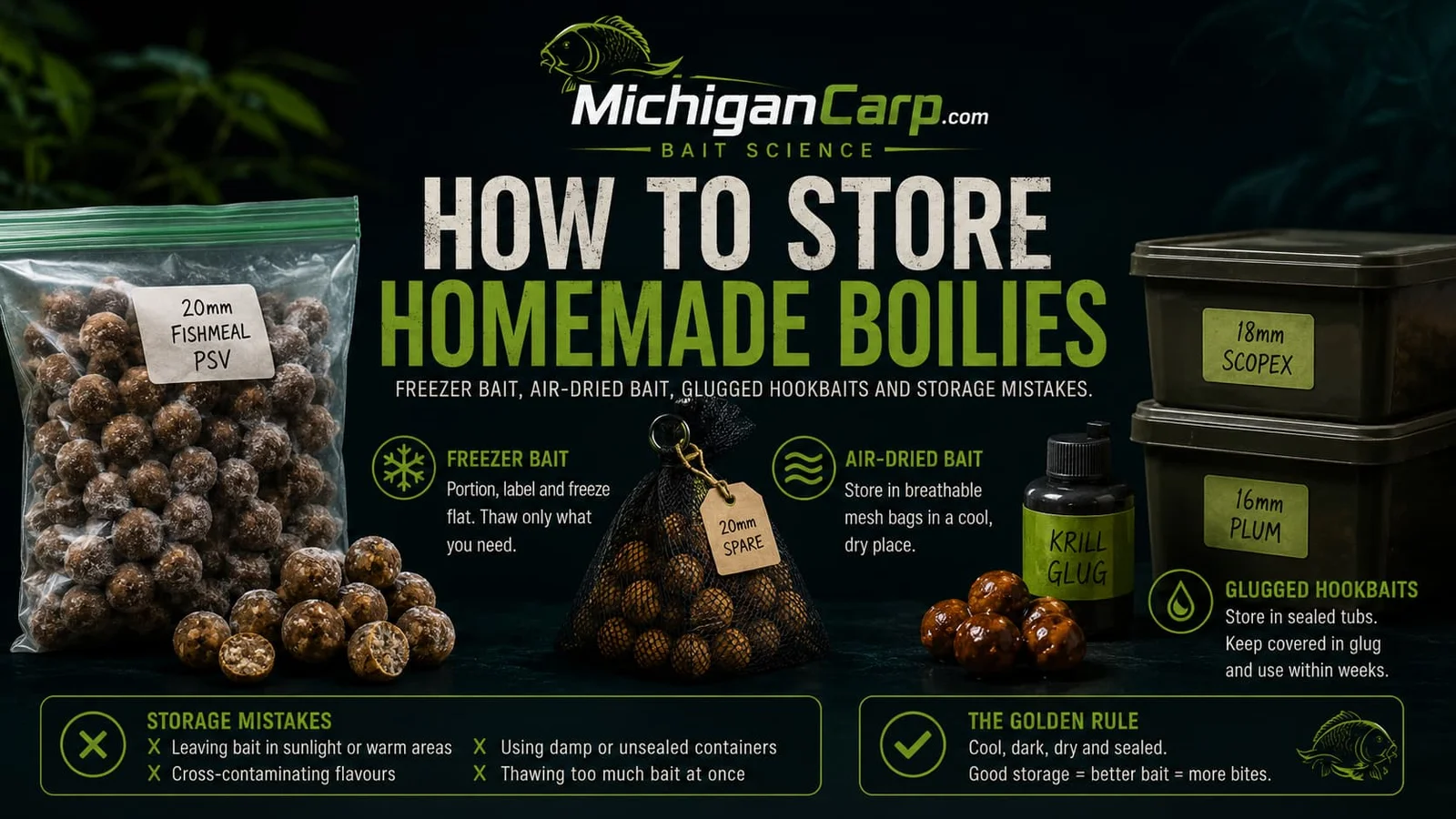
Learning how to store homemade boilies is just as important as learning how to formulate, roll, boil and dry them.
A good bait can still be spoiled after production by being bagged warm, sealed while damp, repeatedly thawed, left in a hot vehicle, over-glugged or simply forgotten in an unsuitable container.
Storage affects:
- freshness;
- texture;
- smell;
- hardness;
- water uptake;
- hookbait durability;
- buoyancy;
- mold risk;
- fat rancidity; and
- how closely the bait still matches the product you originally tested.
For most homemade boilies, the safest default is simple:
Cool them, dry them appropriately, portion them into session-sized bags, label them and freeze them.
This article covers the practical storage workflow after the bait has been made.
For cooking and drying, use How to Boil and Dry Boilies Properly.
For deciding whether bait is sufficiently dry for its intended use, use How to Tell When Boilies Are Dry Enough.
For deliberate shelf-life preservation, use Potassium Sorbate, Sodium Benzoate and Citric Acid in Shelf-Life Boilies.
Table of Contents
Quick Start: How to Store Homemade Boilies
The right storage method depends on the type of bait.
| Bait type | Best default storage | Main risk |
|---|---|---|
| Fresh homemade freezer bait | Cool, dry appropriately, bag, label and freeze | Freezing wet bait or repeated thawing |
| Same-week bait | Refrigerate or keep very cool after drying | Mold or souring if damp |
| Short-term air-dried bait | Mesh bag with airflow and regular checks | Mistaking it for shelf-life bait |
| Deliberate shelf-life bait | Proven preservation and storage system | False confidence in stability |
| Glugged boilies | Small clean tub, cool storage, regular checks | Softening, sweating, souring |
| Hookbaits | Separate labeled tubs | Texture or buoyancy change |
| High-fat milk/nut bait | Freeze unless preservation is validated | Rancidity |
| Active session bait | Small working tub, shaded and used promptly | Heat and contamination |
A useful rule is:
Freezer bait needs cold storage.
Air-dried bait needs airflow.
Preserved bait needs validation.
Glugged bait needs moisture control.
Hookbaits need separate testing.
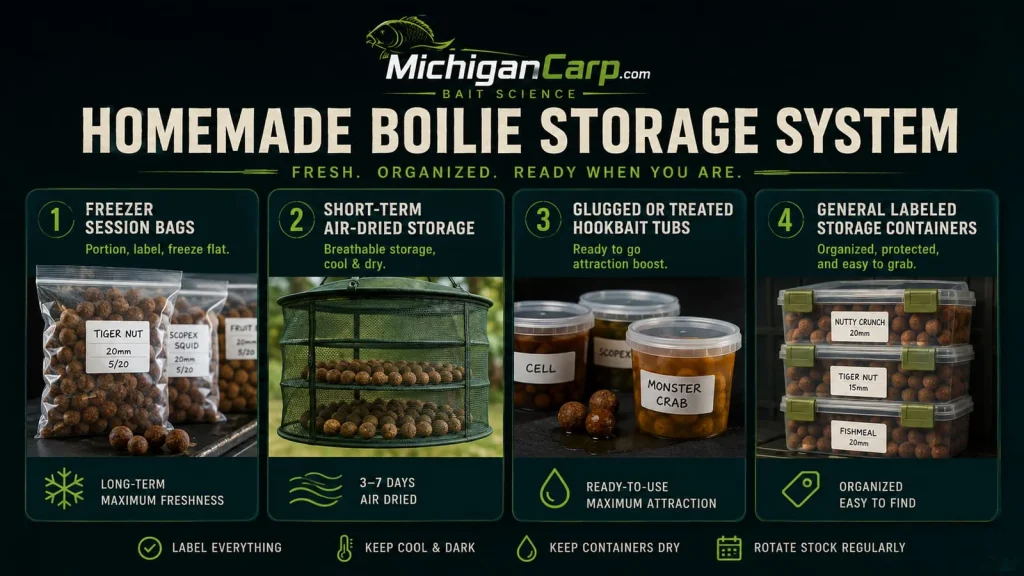
Alt text: Homemade boilie storage system showing freezer bait bags, short-term air-dried boilies, shelf-life tubs, glugged hookbaits, labels and storage warnings.
Freezer Bait vs Shelf-Life Bait
The first decision is whether the bait is intended to be freezer bait or genuine room-temperature shelf-life bait.
They are not the same product.
Freezer bait
Freezer bait relies primarily on cold storage to protect it after production.
For most home bait makers this is the sensible default because it allows you to use food-rich ingredients without pretending the finished bait is stable indefinitely at room temperature.
Typical examples include:
- fresh milk/nut boilies;
- birdfood boilies;
- high-protein food baits;
- nut-heavy mixes;
- fresh yeast-containing bait;
- short-production batches made for specific sessions.
Shelf-life bait
Shelf-life bait is deliberately formulated and processed for longer storage away from a freezer.
That requires more than making the bait hard.
It involves a combination of:
- formulation;
- drying;
- preservation;
- hygiene;
- packaging;
- storage conditions; and
- retained-sample observation.
For MichiganCarp’s preservation system, use Potassium Sorbate, Sodium Benzoate and Citric Acid in Shelf-Life Boilies.
For most home rollers, freezer bait remains the simpler and more conservative option.
Dry Does Not Automatically Mean Preserved
This distinction is important.
A boilie can feel hard and dry on the outside while still containing more moisture internally than you expect.
That is why the useful home question is not:
“Does this boilie feel dry?”
It is:
“Is this bait dry enough for what I intend to do with it?”
For ordinary freezer bait, session bait and hookbaits, practical checks are usually more useful than chasing laboratory numbers.
Use How to Tell When Boilies Are Dry Enough for the full practical method.
The wider food-science concept behind shelf stability is water activity, which describes how much water is available to support microbial growth and chemical reactions. It is not the same thing as simply measuring total moisture. The FDA technical guidance on water activity provides the general scientific background.
For normal homemade freezer bait, however, there is no need to turn every batch into a laboratory project.
Hard does not prove dry, and dry does not prove shelf-stable.
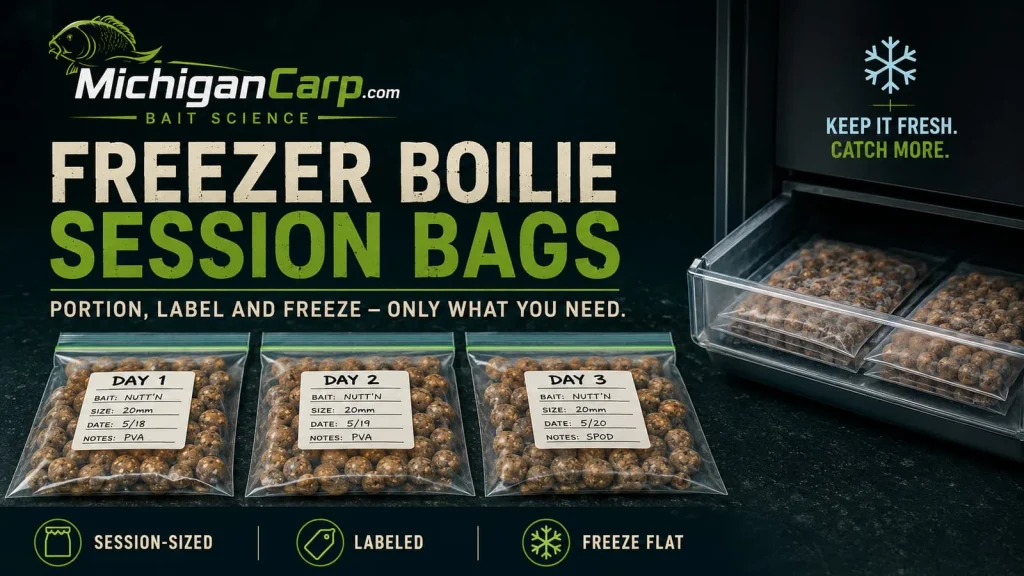
The Best Default Method: Freeze in Session-Sized Bags
For most homemade boilies, this is the storage method I prefer.
- Finish boiling.
- Drain the bait properly.
- Allow it to cool fully.
- Dry it for the intended purpose.
- Check that it is no longer warm or sweating.
- Divide it into useful session quantities.
- Label each bag.
- Freeze.
The advantage of session-sized bags is that you only thaw the bait you need.
That reduces repeated temperature cycling and avoids having one large bag repeatedly opened, warmed and returned to the freezer.
What to write on the label
At minimum, record:
- bait name;
- flavor;
- boilie size;
- production date;
- boil time;
- drying time; and
- any unusual treatment.
For experimental bait, also record the batch version.
How Dry Should Boilies Be Before Freezing?
The bait should be:
- fully cool;
- no longer steaming;
- reasonably surface dry;
- not obviously wet;
- easy to separate; and
- suitable for clean packaging.
For many freezer baits, 12–24 hours of drying is a useful starting point.
But the clock is not the final test.
A small 14 mm cereal/birdfood bait may dry much faster than a dense 24 mm milk-and-nut bait.
Humidity, airflow, fat content and formulation all matter.
That is why How to Tell When Boilies Are Dry Enough should be the practical reference rather than using drying time alone.
How Long Do Freezer Boilies Last?
There is no useful universal expiry date for homemade freezer boilies.
Storage life depends on:
- packaging;
- freezer temperature;
- fat content;
- ingredient freshness;
- air exposure;
- freezer burn;
- how often the bait is thawed; and
- whether it was packed properly in the first place.
As a practical approach, I prefer to use homemade freezer bait while it still smells, feels and fishes like the bait I originally made.
Older bait should be checked rather than trusted automatically.
Inspect:
- smell;
- surface condition;
- freezer burn;
- oiliness;
- texture after thawing; and
- water behavior.
High-fat bait deserves particular attention because it can deteriorate through fat oxidation even without visible mold.
Thawing and Refreezing Boilies
Thaw only what you are likely to use.
Move frozen boilies into a clean container or air-dry bag and allow them to thaw in a cool place.
Do not leave them sitting wet in a sealed plastic bag as condensation develops.
Repeated thawing and refreezing is poor practice because each cycle can alter:
- surface moisture;
- texture;
- cracking;
- clumping; and
- overall bait quality.
If bait has thawed but remained clean, cool and in good condition, use practical judgment rather than automatically throwing it away.
But the better system is still to avoid the problem by freezing in sensible portions.
The USDA explains that freezing slows or stops microbial growth while food remains frozen, rather than sterilizing the product. See USDA FSIS: Freezing and Food Safety for general food-safety background.
How to Store Boilies During a Multi-Day Session
For a three-, four- or five-day carp session, taking one large container of bait and repeatedly opening it in warm weather is not ideal.
A better system is to divide bait by day or by expected use.
For example:
- Day 1 bait;
- Day 2 bait;
- Day 3 bait;
- reserve bait.
Keep the reserve bait as cool as reasonably possible.
Only move a smaller quantity into the active bait bucket or tub.
This is especially useful with rich homemade milk/nut boilies.
Keep the active bait:
- out of direct sun;
- away from vehicle heat;
- protected from rain;
- protected from insects;
- handled with reasonably clean hands or scoops; and
- checked each day.
If bait becomes damp, warm, sticky or sour-smelling, do not simply mix it back into the main reserve.
How to Store Short-Term Air-Dried Boilies
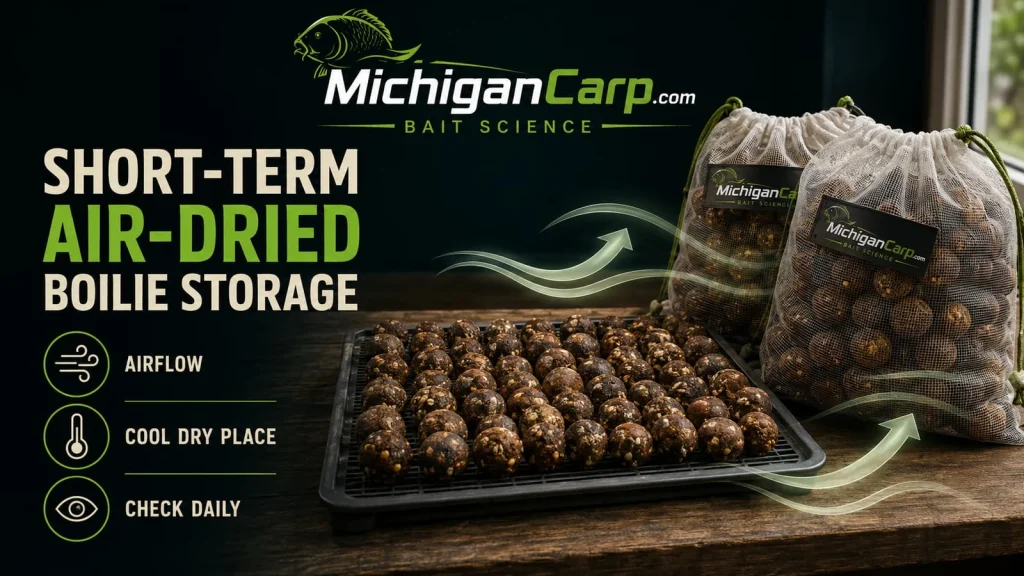
Air drying is useful when you want a tougher bait for travel or a multi-day session.
Use:
- mesh air-dry bags;
- drying racks;
- cool airflow;
- regular turning; and
- daily checks.
Do not pack damp air-dried bait tightly into a sealed container.
Air-dried does not mean immortal
Longer drying may slow some spoilage processes by removing moisture, but it does not automatically turn ordinary freezer bait into a validated shelf-life product.
Air-dried high-fat bait can still become stale or rancid.
For travel bait, think in terms of short-term conditioning and toughness, not indefinite preservation.
How to Store Deliberate Shelf-Life Boilies
A shelf-life system should be treated as a separate formulation project.
Storage discipline still matters even when preservatives are used.
Keep preserved bait:
- cool;
- dry;
- away from sunlight;
- in clean containers;
- clearly labeled;
- protected from temperature extremes; and
- periodically inspected.
Retained samples are useful because they let you compare stored bait against the original batch over time.
My own practical preservation work uses potassium sorbate, sodium benzoate and citric acid as parts of a combined system.
That does not mean adding those ingredients automatically proves a specific shelf life.
For the full preservation framework use Potassium Sorbate, Sodium Benzoate and Citric Acid in Shelf-Life Boilies.
Mold, Souring and Rancidity
These are not all the same storage failure.
Mold
Possible warning signs include:
- fuzzy growth;
- colored patches;
- musty smell;
- condensation;
- damp clumps; and
- obvious surface contamination.
Visible mold is a rejection signal.
Souring
Bad souring can produce:
- unpleasant acidic or rotten odor;
- wet sticky surfaces;
- gas pressure in sealed containers; or
- a fermentation character you did not deliberately create.
Deliberate fermentation is a separate controlled bait-making process. Accidental warm storage is not.
Rancidity
Rancidity involves deterioration of fats.
Possible warning signs include:
- stale nut smell;
- old oil smell;
- paint-like notes;
- bitter or waxy smell; and
- loss of the clean original bait character.
A boilie can be completely mold-free and still smell rancid.
How to Store Milk, Nut and High-Fat Boilies
Milk/nut boilies deserve particular storage attention because many common ingredients contribute substantial fat.
These can include:
- tiger nut flour;
- nut meals;
- full-fat soya;
- whole milk powder;
- Nido;
- cream powder;
- milk replacer;
- coconut products;
- seed meals;
- added oils.
That does not make these ingredients bad.
It simply means the fat system matters.
For my own food-rich milk/nut bait, freezing is the default unless I have deliberately built a separate preservation system.
| Bait type | Best default | Main concern |
|---|---|---|
| Milk/nut freezer bait | Freeze | Moisture and fat deterioration |
| Nut-rich bait | Freeze in small bags | Rancidity |
| Casein-heavy free bait | Freeze | Excessive hardening during long drying |
| Hookbait version | Separate tub | Cracking or over-hardening |
| Preserved version | Controlled shelf-life system | Validation |
For formulation-level fat control use How to Balance Fat in Boilies.
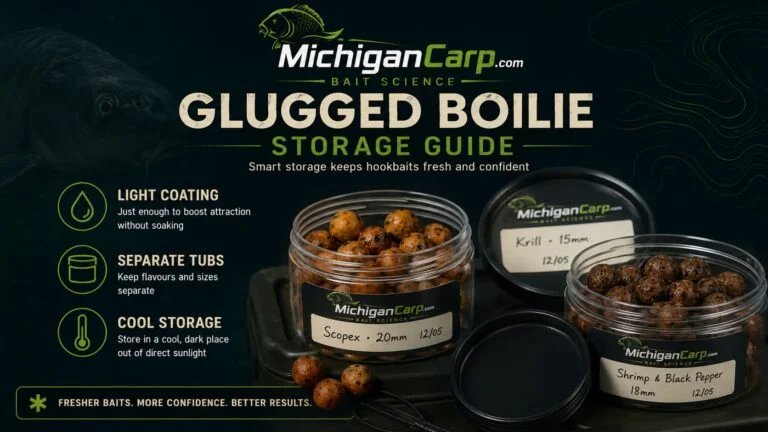
How to Store Glugged Boilies
Adding liquid changes the storage problem.
The more liquid you add, the more closely you should watch:
- softness;
- surface moisture;
- clumping;
- odor;
- souring; and
- mold.
The safest approach is usually:
- Dry the boilies first.
- Treat only the quantity you need.
- Add liquid gradually.
- Shake or turn the bait for even coating.
- Keep it cool.
- Check it regularly.
Do not assume that a liquid containing propylene glycol, glycerin or flavoring automatically makes a bait shelf-stable.
For the treatment process itself, use How to Prepare Boilies for Carp Fishing: Glugs, Soaks and Hookbait Conditioning.
How to Store Hookbaits, Wafters and Pop-Ups
Hookbaits deserve separate storage because their mechanical job is different from free bait.
They need consistent:
- hardness;
- attachment strength;
- shape;
- buoyancy;
- smell; and
- response after soaking.
Store them in clearly labeled tubs.
Bottom-bait hookbaits
Check:
- hair-hole strength;
- bait-screw hold;
- cracking;
- hardness; and
- long-soak durability.
Wafters
Wafter balance can change after drying, storage or liquid conditioning.
Always retest a stored wafter with the actual hook and rig.
Pop-ups
Do not assume an old pop-up still has the same buoyancy it had when freshly made.
Test it for the soak period you intend to fish.
Corkball hookbaits
Check for:
- cracking;
- exposed cork;
- shell separation; and
- buoyancy changes.
The specialist formulas belong in How to Make Wafters and Pop-Ups From a Boilie Base Mix.
That article remains separate from this storage guide.
Buckets, Fridges and Vacuum Sealing
These are useful tools, but none of them repairs poor bait handling.
| Storage method | Good use | Main caution |
|---|---|---|
| Bucket | Dry session bait or stable bait | Do not seal warm or damp bait |
| Fridge | Short-term thawed or treated bait | Does not create shelf stability |
| Vacuum sealing | Freezer portions | Do not treat it as room-temperature preservation |
| Air-dry bag | Travel and short-term toughening | Needs airflow and regular checking |
| Hookbait tub | Specialist hookbaits | Avoid excessive liquid accumulation |
Buckets
Buckets work well when the bait going into them is already in the correct condition.
They are poor drying chambers for warm wet boilies.
Fridges
A refrigerator is useful for short-term bait management.
It slows deterioration but does not magically convert unstable bait into preserved bait.
Vacuum sealing
Vacuum sealing can be useful for freezer bait because it reduces air exposure and helps portioning.
But vacuum sealing damp food-rich bait and leaving it warm is not a substitute for preservation.
Storage for Boilie Crumb and Packbait
Breaking boilies into crumb increases exposed surface area.
That changes how quickly the bait can:
- absorb moisture;
- stale;
- dry;
- oxidize; and
- respond to added liquids.
Fresh moist crumb
Freeze it if you are not using it promptly.
Fully dried crumb
Store in a clean dry container and check high-fat crumb for stale or rancid odor.
Liquid-treated crumb
Once liquid is added, treat it as wet active bait.
Use it promptly or keep it cool.
Packbait
Dry packbait ingredients store best in dry sealed containers.
Once water, milk, syrup, yeast products or other wet ingredients are added, storage time becomes much shorter.
For the wider carrier-bait system use Packbait for Carp Fishing.
Storage Checklist Before Fishing
Stored bait should not be judged by date alone.
Check the bait itself.
| Check | Good sign | Warning sign |
|---|---|---|
| Smell | Clean, recognizable bait aroma | Moldy, rancid, rotten or unpleasant sour smell |
| Surface | Dry/normal for the bait | Sweating, strange film, mold |
| Texture | Appropriate for its intended use | Unexpected softness, brittleness or grease |
| Appearance | Normal color and condition | Fuzzy growth or unusual discoloration |
| Water test | Behaves as expected | Collapses, cracks or changes badly |
| Hookbait test | Stays attached and presents correctly | Screw pulls out or buoyancy changes |
Before an important trip, a quick water test is cheap insurance.
Use How to Test Boilies Before Fishing for the full test procedure.
Common Boilie Storage Mistakes
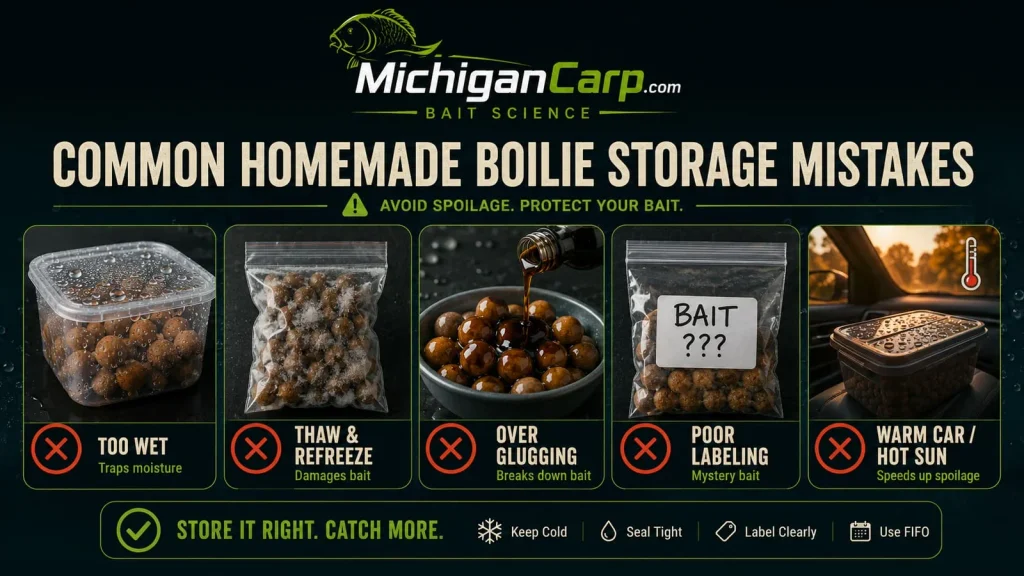
Alt text: Common homemade boilie storage mistakes including bagging bait too wet, freezing warm bait, repeated thawing, hot vehicle storage, over-glugging and unlabeled bags.
| Mistake | Why it causes problems | Better practice |
|---|---|---|
| Bagging bait while warm | Creates condensation | Cool fully first |
| Sealing damp bait | Encourages sweating and mold | Dry appropriately before sealing |
| One giant freezer bag | Encourages repeated thawing | Use session-sized bags |
| Leaving bait in a hot vehicle | Heat accelerates deterioration | Keep it shaded and cool |
| Treating air-dried bait as shelf-life | Drying alone does not prove stability | Freeze or use a proper preservation system |
| Over-glugging | Can soften or destabilize bait | Treat small quantities gradually |
| Ignoring high-fat ingredients | Rancidity can occur without mold | Freeze rich bait and smell-check it |
| Mixing hookbaits with free bait | Different storage needs | Keep hookbaits separate |
| Poor labeling | Makes batch history guesswork | Label every bag |
| Fishing old bait without testing | Stored bait may behave differently | Soak-test it first |
Michigan Notes
For Michigan carp fishing, freezer bait is particularly practical because many sessions are planned in advance and vehicle access often makes coolers, insulated bags or frozen session packs realistic.
On longer camping sessions, I prefer to manage bait in smaller working amounts rather than exposing the entire supply repeatedly.
Fall fishing deserves extra attention.
Cool outside air can make bait feel safe even when it has been sitting in a warm vehicle, truck bed, tent or enclosed storage box during the day.
Likewise, spring bait made in a cool room may dry more slowly than it appears.
For my own milk/nut baits, especially large 24 mm boilies, I would rather freeze properly dried bait than try to force a long room-temperature life simply for convenience.
That keeps the bait closer to the form I originally developed and tested.
My Practical View
For homemade boilies, I prefer a simple hierarchy:
Freeze the main food bait.
Keep hookbaits separately.
Treat only what you need.
Air-dry for a reason, not because it sounds traditional.
Build shelf-life bait deliberately rather than accidentally.
Freezer bait in labeled session bags is difficult to beat for most home bait makers.
It gives you control.
You know what batch you are using, how old it is, how it was processed and how much has been thawed.
Shelf-life bait has a place.
Air-dried bait has a place.
Glugged bait has a place.
But none of those methods should replace basic storage discipline.
Good bait deserves good storage.
FAQ
What is the best way to store homemade boilies?
For most homemade boilies, cool and dry them appropriately, divide them into session-sized bags, label them and freeze them.
Can homemade boilies be frozen?
Yes. Freezing is the normal default for homemade boilies that have not been deliberately formulated and validated as shelf-life bait.
How dry should boilies be before freezing?
They should be fully cool, no longer steaming, reasonably surface dry and suitable for clean packaging. Use the bait’s actual condition rather than drying time alone.
How long should boilies dry before freezing?
Twelve to twenty-four hours is a useful starting range for many freezer baits, but bait size, formulation, humidity and airflow can change this considerably.
Should boilies be frozen in one large bag?
Usually no. Smaller session-sized bags reduce repeated thawing and make bait management easier.
Can boilies be refrozen?
Avoid repeated thawing and refreezing. If bait has thawed cleanly and remained cool, judge its actual condition, but portioning the bait correctly from the start is better.
How long do freezer boilies last?
There is no universal expiry date. Packaging, freezer conditions, formulation and fat content all matter. Inspect older bait for smell, texture, freezer burn and water performance before using it.
Are air-dried boilies shelf-life boilies?
Not automatically. Drying alone does not prove room-temperature stability.
Can boilies go moldy?
Yes. Warm, damp, contaminated or poorly stored bait can mold.
Can boilies go rancid?
Yes. High-fat bait can become rancid even without visible mold.
How should I store glugged boilies?
Start with properly dried bait, add liquid gradually, use clean small containers, keep the bait cool and monitor smell, softness and surface moisture.
Should glugged boilies be refrigerated?
If they contain substantial moisture or water-based treatments and are being held for more than immediate use, refrigeration is a sensible short-term precaution.
How should hookbaits be stored?
Keep them separately in labeled tubs and periodically retest hardness, attachment strength and buoyancy.
Can boilies be stored in buckets?
Yes, once the bait is in the correct condition. Do not seal warm or damp boilies in a bucket.
Can boilies be vacuum sealed?
Yes, particularly for freezer storage. Vacuum sealing is not a substitute for drying, freezing or deliberate preservation.
What is the biggest homemade-boilie storage mistake?
Sealing bait while it is still warm, damp or otherwise unstable.
Next Steps
- How to Boil and Dry Boilies Properly — prepare bait correctly before it enters storage.
- How to Tell When Boilies Are Dry Enough — judge drying condition with practical home checks.
- Potassium Sorbate, Sodium Benzoate and Citric Acid in Shelf-Life Boilies — understand deliberate shelf-life preservation.
- How to Test Boilies Before Fishing — check stored bait before relying on it.
- How to Prepare Boilies for Carp Fishing: Glugs, Soaks and Hookbait Conditioning — manage post-production treatments.
- How to Make Wafters and Pop-Ups From a Boilie Base Mix — specialist hookbait formulation and buoyancy work; keep unlinked until published.
- How to Balance Fat in Boilies — manage fat levels and storage risk in rich mixes.
- How to Formulate a Milk, Nut and Birdfood Boilie Base Mix — build the bait before deciding how to store it.
- Packbait for Carp Fishing — manage dry and wet carrier baits.
- Bait Science — return to the technical bait library.