
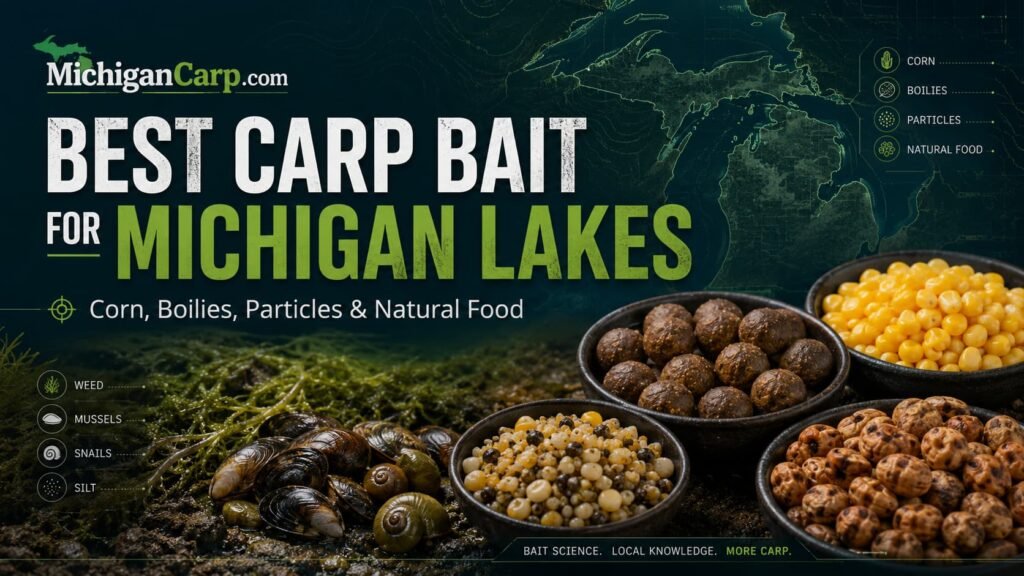
Best carp bait for Michigan lakes depends on the lake, the season and how the carp are feeding.
There is no single bait that wins everywhere.
On one Michigan lake, canned corn may catch quickly because carp are lightly pressured and willing to pick up simple food.
On another lake, boilies may be better because you need a tougher hookbait that survives nuisance fish, turtles or an overnight session.
On a big natural lake or impoundment, prepared particles may help hold carp on a route, shelf, weed edge or silty feeding area.
Natural food matters too.
Michigan carp live around weed, mussels, snails, insect life, silt, reed edges, soft-bottom bays, marinas, channels and shallow warming water. Good bait choice should work with that environment, not ignore it.
This article is about choosing bait for Michigan lakes specifically.
For the broad bait-choice hub, use Carp Bait Guide.
For a direct bait-type comparison, read Boilies vs Corn vs Particles for Carp.
For corn, use Corn for Carp in Michigan.
For particles, use Particles for Carp Fishing.
For boilies, start with Boilie School.
Before fishing any public water, check current rules through Michigan DNR Fishing Regulations. When moving boats, nets, mats, buckets or wet gear between waters, follow Michigan’s clean, drain and dry invasive-species prevention guidance through Michigan Invasive Species: Boaters and Anglers.
The clean answer is:
CORN IS THE BEST SIMPLE CONFIDENCE BAIT.
BOILIES ARE THE BEST CONTROLLED HOOKBAIT AND FOOD-BAIT SYSTEM.
PARTICLES ARE THE BEST FEEDING-AREA BUILDER.
TIGER NUTS ARE THE BEST TOUGH PARTICLE HOOKBAIT.
NATURAL FOOD TELLS YOU WHERE AND HOW TO FISH THEM.
Michigan lake carp fishing rewards bait that matches the water in front of you.
Table of Contents
Quick Start: Best Carp Bait for Michigan Lakes
Use this quick guide before choosing bait.
| Michigan Lake Situation | Best Starting Bait | Why |
|---|---|---|
| Beginner session | Canned corn | Simple, cheap, visible and fast |
| Short evening session | Corn or single boilie | Low feed and quick response |
| Early spring | Corn, small wafter or single boilie | Cold water needs restraint |
| Warming spring margin | Corn with tiny hemp support | Fast test bait with light attraction |
| Summer weed edge | Boilie over hemp, maize or light particles | Controls hookbait over browsing feed |
| Big natural lake | Boilies plus controlled particles | Better holding power and repeatability |
| Shallow weedy lake | Corn, tiger nut or small boilie | Easy placement and less overfeeding |
| Channel or marina | Corn, boilie or tiger nut | Depends on nuisance fish and current |
| Turtles active | Tiger nut or boilie | Tougher hookbait than corn |
| Small nuisance fish active | Boilie, tiger nut or plastic corn support | Better hookbait durability |
| Prebaiting | Boilies or prepared particles | More repeatable food signal |
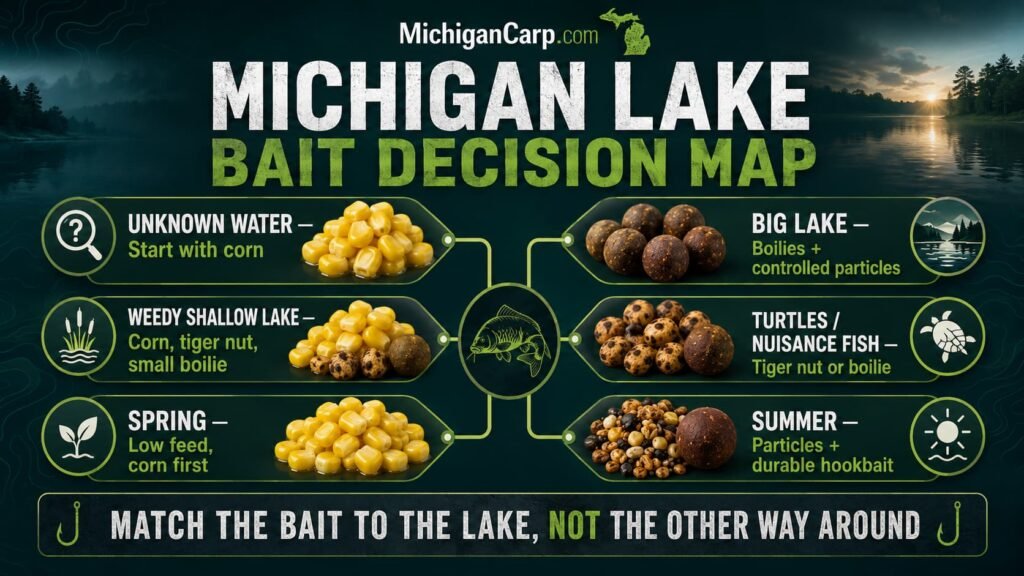
| Unknown water | Corn first | Best low-risk test bait |
| Known big-fish water | Boilie or tiger nut over light feed | More durable and selective |
The best carp bait for Michigan lakes is usually not one bait.
It is the bait that matches the lake type, water temperature, natural food, nuisance fish and session length.
Why Michigan Lakes Need Their Own Bait Thinking
Michigan carp fishing is not the same as fishing small, highly pressured commercial carp waters.
Many Michigan lakes are:
- large;
- public;
- weedy;
- natural-food rich;
- lightly pressured by carp anglers;
- affected by boat traffic;
- shared with swimmers, bass anglers, panfish anglers and recreational boaters;
- full of seasonal changes.
That matters.
Carp in these waters may not need a big bed of bait to feed.
They may already have plenty of natural food.
They may move long distances between resting areas, feeding areas and travel routes.
They may visit shallow water for warmth before feeding heavily.
They may patrol weed edges, reed lines, silt pockets, marinas, channels and current areas.
So bait choice should begin with watercraft.
Ask:
What are these carp probably eating here, and what bait gives me the cleanest chance?
That question is better than asking which bait is famous online.
The Four Main Bait Jobs
On Michigan lakes, bait usually needs to do one of four jobs.
1. Test the Swim
This is where corn is strongest.
When you are not sure carp are present or feeding, corn gives you a quick, simple test.
2. Control the Hookbait
This is where boilies and tiger nuts are strongest.
When nuisance fish, turtles, overnight fishing or longer sessions become a problem, the hookbait needs to stay fishing.
3. Build Feeding Activity
This is where prepared particles are strongest.
When carp are already likely to browse, particles can create a feeding area and keep fish working.
4. Match Natural Feeding
This is where bait choice meets watercraft.
If carp are grubbing in silt, feeding along weed, working mussel areas or patrolling shallow shelves, your bait should fit that behavior.
Good bait choice is not just about attraction.
It is about choosing the right job.
Corn: The Best Simple Michigan Carp Bait
Canned corn is one of the best carp baits for Michigan lakes because it is simple and effective.
It is especially useful when:
- you are new to carp fishing;
- you are testing a new lake;
- carp are showing but not feeding heavily;
- you are fishing a short session;
- the water is cool;
- you want a visible hookbait;
- you want to keep baiting light;
- you do not want complicated preparation.
Corn works well because it is soft, bright, easy to eat and easy to use in tiny amounts.
A few grains around the hookbait can be enough.
A full can is often more than enough for a short session.
For the full corn guide, read Corn for Carp in Michigan.
When Corn Is Not Enough
Corn has weaknesses.
It is not always the best bait.
Corn can become a problem when:
- bluegills or other small fish strip the hookbait;
- turtles are active;
- the rig needs to fish all night;
- carp are feeding at longer range;
- you want a more selective hookbait;
- you are trying to build a multi-day baiting pattern;
- you overfeed because corn is cheap.
Corn is a great question bait.
It asks:
Will a carp pick something up here?
But it is not always the best answer for every session.
When corn gets stripped, switch to plastic corn support, a boilie, a wafter or a tiger nut.
Boilies: The Best Control Bait
Boilies are the best choice when you need more control.
They are useful because you can control:
- size;
- firmness;
- buoyancy;
- flavor;
- leakage;
- nutrition;
- hookbait durability;
- feeding pattern;
- rig compatibility.
Boilies are strong on Michigan lakes when:
- you are fishing overnight;
- you are fishing at distance;
- nuisance fish are active;
- turtles are a problem;
- you want a repeatable food bait;
- you are prebaiting;
- you need a more durable hookbait;
- you want to fish over particles without the hookbait disappearing.
A boilie does not have to mean heavy baiting.
A single boilie over a tiny amount of crumb, corn or hemp can be a controlled low-feed approach.
For boilie foundations, use Boilie Basics.
For fishing boilies, use How to Fish Boilies for Carp.
When Boilies Need Introduction
On some Michigan waters, carp may not see boilies often.
That does not make boilies bad.
It means they may need a sensible introduction.
You can introduce boilies by:
- using a few crushed boilies with corn;
- fishing a boilie tipped with corn;
- feeding small amounts consistently;
- using boilie crumb in a small trap;
- pairing boilies with prepared particles;
- avoiding oversized baits when carp are cautious.
The mistake is throwing a lot of boilies into unknown water and expecting instant results.
Boilies work best when they are used as part of a clear system.
Particles: The Best Feeding-Area Builder
Particles are best when you want carp to browse.
Common particle baits include:
- prepared maize;
- hemp;
- tiger nuts;
- wheat;
- barley;
- pigeon feed;
- maples;
- chickpeas;
- mixed prepared grains and seeds.
Particles are useful on Michigan lakes because carp already spend a lot of time searching natural food areas.
A controlled particle patch can encourage fish to grub, turn, cloud the bottom and stay in one area longer.
Particles are strongest when:
- water is warm enough;
- carp are already in the area;
- the session is long enough;
- you can bait accurately;
- the particles are prepared safely;
- you want to hold fish without relying only on boilies.
For the full particle guide, read Particles for Carp Fishing.
For safe preparation, read How to Prepare Particles for Carp Fishing.
When Particles Are the Wrong Bait
Particles can be excellent, but they are easy to use badly.
Avoid heavy particles when:
- water is cold;
- carp are only cruising;
- the session is short;
- you have not found fish;
- you cannot bait accurately;
- turtles or nuisance fish dominate;
- you are fishing an unknown bottom;
- you are tempted to feed because nothing is happening.
Particles should support feeding.
They should not be used to compensate for poor location.
The biggest mistake is turning every Michigan lake session into a bucket-baiting exercise.
A handful in the right place can beat a gallon in the wrong place.
Tiger Nuts: The Tough Particle Hookbait
Tiger nuts deserve their own mention because they solve a different problem.
They are useful when you want a particle-style hookbait that is tougher than corn.
Tiger nuts are helpful when:
- turtles are active;
- nuisance fish are clearing soft bait;
- you want a durable hair-rig bait;
- you are fishing over maize or hemp;
- you want a hookbait that lasts longer;
- you want more selectivity than loose corn.
Tiger nuts should be prepared correctly.
Do not fish them dry.
Use Tiger Nuts for Carp Fishing for the full guide.
A simple Michigan setup is:
single tiger nut tipped with plastic corn over a small maize and hemp patch.
That gives toughness, visibility and a natural particle connection.
Natural Food: The Missing Bait Clue
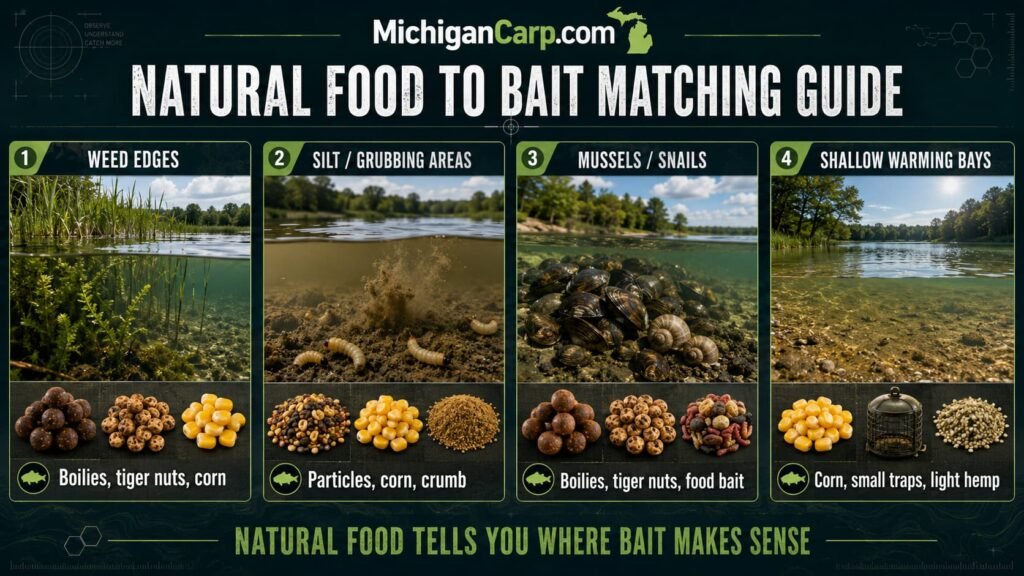
Natural food is one of the biggest clues on Michigan lakes.
Carp feed around:
- weedbeds;
- silt;
- snails;
- mussels;
- insect larvae;
- bloodworm-type food sources;
- crayfish areas;
- reed edges;
- detritus and soft organic bottom;
- windblown food lines;
- shallow warming bays.
This does not mean your bait must exactly copy natural food.
It means bait should fit the feeding behavior.
If carp are grubbing in silt, small particles, corn, crumb and bottom baits can make sense.
If they are moving along a clean weed edge, a boilie or tiger nut can be easier to present.
If they are visiting a shallow bay for warmth but not feeding much, a single corn or small wafter may be better than a pile of feed.
Natural food tells you how much bait to use and where to place it.
Best Bait for Big Michigan Lakes
Big lakes need bait that helps you fish with purpose.
On large waters, carp may travel long routes and feed in specific zones.
Good bait choices include:
- corn to test showing fish;
- boilies for repeatable hookbait control;
- particles for holding fish near a route or feeding area;
- tiger nuts when the hookbait needs to last;
- boilies over light particles for longer sessions.
Big lakes reward accuracy.
Do not spread bait everywhere.
Find likely areas first:
- weed edges;
- shallow shelves near depth;
- silty bays;
- reed margins;
- windward corners;
- channels;
- inflows;
- hard-to-soft bottom transitions.
Then bait carefully.
For location work, use How to Locate Carp Before You Cast and Reading a Lake Like a Carp Angler.
Best Bait for Shallow Weedy Lakes
Shallow weedy lakes can be excellent carp waters, but they punish bad baiting.
Carp may already have plenty of natural food.
They may patrol weed edges, pockets, lanes and soft-bottom areas.
Good bait choices include:
- corn for quick testing;
- small boilies or wafters for controlled presentation;
- tiger nuts where turtles are a problem;
- tiny hemp and corn traps;
- light maize only when feeding is confirmed.
Avoid heavy baiting into thick weed.
Avoid dumping particles where the rig cannot present cleanly.
The bait must be placed where carp can find it and the rig can work.
A small clean spot near weed often beats bait buried in the weed itself.
Best Bait for Channels, Marinas and River Mouths
Channels, marinas and river-mouth areas can fish differently from open lakes.
Carp may move through them, pause in calmer water or feed around edges.
Good bait choices include:
- corn for quick bites;
- boilies for durability;
- tiger nuts where nuisance fish are active;
- small particle traps in slower areas;
- crumb or small feed where current is limited.
Do not overfeed moving water.
Bait can spread, roll or be cleared faster than expected.
In channels, bait placement and rig location matter as much as bait type.
A durable hookbait often helps.
Best Bait for Campground and Public Access Carp
Many Michigan carp sessions happen from public access sites, campgrounds, piers, banks and utility-access areas.
These places need practical bait.
Good bait should be:
- easy to transport;
- clean to use;
- not messy around public areas;
- simple to store;
- safe for fish;
- easy to pack away;
- suitable for short or overnight sessions.
Good public-access bait choices include:
- canned corn;
- prepared maize in small tubs;
- boilies;
- wafters;
- tiger nuts;
- small dry stick mixes;
- crushed boilies;
- small prepared particle bags.
Avoid sloppy bait handling.
Keep bait tubs closed.
Do not leave particles, corn, tins, plastic, line or bait waste on the bank.
Good carp fishing should leave the access cleaner than you found it.
Spring Bait Choices
Spring bait should start small.
Best spring options include:
- corn;
- corn plus plastic corn;
- small wafter;
- single boilie;
- tiny hemp support;
- light maize only when fish are feeding;
- tiger nut when the hookbait needs to last.
Spring carp may move before they feed heavily.
Do not feed like summer just because you see fish.
For spring particles, read Spring Particles for Carp.
For seasonal carp location and timing, use Spring Carp Fishing in Michigan.
Summer Bait Choices
Summer gives you more baiting options, but also more nuisance problems.
Best summer options include:
- corn;
- boilies;
- maize;
- hemp;
- tiger nuts;
- controlled mixed particles;
- boilies over particles;
- tougher hookbaits when turtles are active.
Summer carp may feed harder and move more.
Particles become more useful.
Boilies become stronger for overnight control.
Corn remains excellent, but may be stripped faster.
In summer, the bait question often becomes:
How do I create feeding without losing control of the hookbait?
That is where boilies, tiger nuts and controlled particle use become important.
Fall Bait Choices
Fall can be excellent for carp baiting because fish may feed more confidently before colder weather.
Good fall options include:
- boilies;
- corn;
- maize;
- hemp;
- tiger nuts;
- moderate particle use;
- boilie crumb;
- food-bait approaches.
Fall baiting can support longer sessions, but weather changes still matter.
Cold nights, fronts and dropping temperatures can shorten feeding windows.
Boilies can be strong in fall because they offer a repeatable food signal and durable hookbait.
Particles can work very well when fish are actively feeding.
Corn remains a good quick-response bait.
Cold-Water Bait Choices
Cold water needs restraint.
Good cold-water baits include:
- single corn;
- corn plus plastic corn;
- single boilie;
- small wafter;
- tiny crumb trap;
- very small hemp support;
- minimal maize only when signs justify it.
Avoid large beds of particles.
Avoid feeding because nothing has happened.
In cold water, one good hookbait in the right place is often better than a large baited area.
Warm-Water Bait Choices
Warm water gives you more room to build a swim.
Good warm-water baits include:
- corn;
- boilies;
- maize;
- hemp;
- tiger nuts;
- mixed prepared particles;
- boilies over particles;
- crumb and pellet-style traps where appropriate.
Warm water does not mean careless baiting.
It means you can increase bait when carp confirm they are feeding.
Feed by evidence:
- liners;
- fizzing;
- rolling;
- clouding;
- mud puffs;
- bites;
- fish seen over the area.
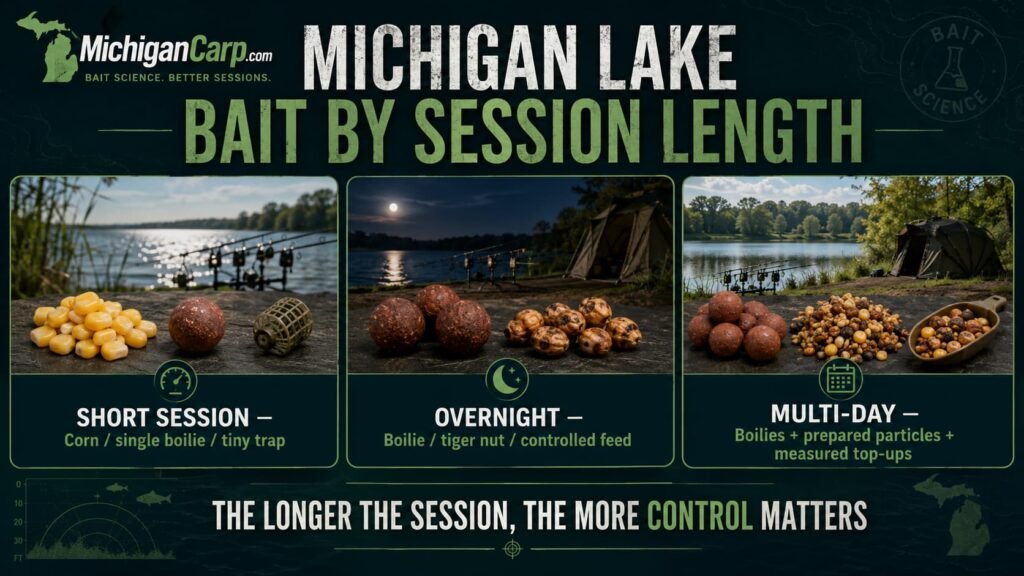
Best Bait for Short Sessions
Short sessions need fast information.
Best choices:
- canned corn;
- corn plus plastic corn;
- single boilie;
- small wafter;
- tiny PVA trap;
- a few grains of corn;
- small boilie crumb trap.
Do not prepare a big bait plan for a two-hour session unless you already know fish are feeding there.
The goal is one clean chance.
Corn is usually the safest starting point.
Best Bait for Overnight Sessions
Overnight sessions need baits that keep fishing.
Good choices:
- boilies;
- tiger nuts;
- corn plus plastic corn;
- boilie over light particles;
- tiger nut over maize and hemp;
- small prepared particle patch;
- wafter over crumb.
Corn can work overnight, but it may not survive nuisance fish.
Boilies and tiger nuts give you better hookbait durability.
A good overnight plan keeps the hookbait fishing while you are not watching it.
Best Bait for Multi-Day Sessions
Multi-day sessions let you build a better bait system.
Good choices:
- boilies for repeatability;
- prepared particles for feeding activity;
- corn for quick response;
- tiger nuts for tough hookbaits;
- boilie crumb for attraction;
- controlled top-ups based on signs.
Do not take more bait just because the session is longer.
Take bait in controlled portions.
Use session-sized particle bags.
Keep wet bait cool.
Keep notes.
A three-day session should help you learn how the swim responds.
It should not become random feeding.
Best Bait for Turtles and Nuisance Fish
Turtles and nuisance fish can change bait choice quickly.
When soft bait gets destroyed, use tougher hookbaits.
Good options include:
- boilies;
- tiger nuts;
- wafters;
- plastic corn with real corn;
- harder maize hookbaits;
- reduced loose corn;
- less bait in the margin.
Do not solve nuisance activity by adding more loose bait.
That usually makes the problem worse.
Use tougher hookbaits and less free food.
Best Bait for Prebaiting Michigan Lakes
Prebaiting can work, but it should be sensible.
Good prebaiting baits include:
- boilies;
- prepared maize;
- hemp;
- controlled mixed particles;
- corn in small amounts;
- tiger nuts in limited amounts.
Boilies are useful because they are repeatable.
Particles are useful because they create browsing.
Corn is useful for fast response, but can be cleared quickly by non-target fish.
Prebaiting should be legal, clean and controlled.
Do not dump bait into public water without a plan.
A good prebaiting approach might be:
- small amounts;
- same spot or same route;
- repeated timing;
- bait matched to season;
- hookbait matched to freebait;
- no waste left behind.
Best Bait for Low-Pressure Michigan Carp
Many Michigan carp are not pressured like carp on busy UK-style venues.
That changes bait.
Low-pressure carp may respond quickly to simple baits.
Good low-pressure options include:
- corn;
- bread where practical and allowed;
- maize;
- hemp;
- simple boilies;
- tiger nuts;
- small natural-looking traps.
Do not assume more complicated bait is better.
On some waters, a simple corn rig in the right place will beat a high-tech bait in the wrong place.
Start simple.
Add complexity only when the problem demands it.
Best Bait for Bigger Michigan Carp
No bait guarantees bigger carp.
But some bait choices can improve control and selectivity.
Better big-fish options often include:
- boilies;
- tiger nuts;
- larger balanced hookbaits;
- boilies over controlled particles;
- maize and hemp with a durable hookbait;
- repeated baiting where practical;
- less loose small bait when nuisance fish dominate.
Bigger carp are still carp.
They eat natural food and simple bait.
But a stronger hookbait and more controlled feeding plan can help avoid wasted time with small nuisance activity.
The key is not just bait size.
It is presentation, location and timing.
Simple Michigan Bait Plans
Plan 1 — First Carp / Unknown Lake
Use:
- canned corn hookbait;
- a few grains of loose corn;
- simple hair rig or corn presentation;
- one rod in a likely margin or travel route.
Goal:
get a bite and learn the water.
Plan 2 — Spring Margin
Use:
- corn or corn plus plastic corn;
- tiny pinch of hemp;
- no heavy feed;
- small wafter or single boilie as backup.
Goal:
test whether visible spring carp are feeding.
Plan 3 — Summer Weed Edge
Use:
- boilie or tiger nut hookbait;
- light maize and hemp;
- small accurate top-ups;
- avoid baiting into thick weed.
Goal:
hold carp near a clean feeding spot.
Plan 4 — Big Lake Overnight
Use:
- boilie hookbait;
- small prepared particle patch;
- tiger nut option if nuisance fish appear;
- corn for a faster test rod.
Goal:
balance attraction with hookbait durability.
Plan 5 — Multi-Day Public-Water Session
Use:
- boilies for repeatable hookbait control;
- prepared particles in session-sized bags;
- corn for quick checks;
- tiger nuts for tough hookbait work;
- top-ups only after signs.
Goal:
build information and avoid random overfeeding.
Common Bait Mistakes on Michigan Lakes
Using Too Much Bait Too Soon
Most Michigan sessions do not need heavy bait at the start.
Treating Every Lake the Same
A shallow weedy lake, big natural lake, channel and impoundment do not fish the same.
Choosing Bait Before Finding Fish
Location should come first.
Fishing Dry or Underprepared Particles
Dry or underprepared particles should not be used.
Feeding Corn Like It Is Free
Corn is cheap, but overfeeding still ruins swims.
Using Boilies Without Introducing Them
Boilies often work better with a clear introduction plan.
Ignoring Natural Food
Natural food tells you where carp are likely to feed and how they may approach bait.
Forgetting Hookbait Durability
A bait that is gone after ten minutes is not fishing.
Fighting Turtles With More Bait
Use tougher hookbaits and less loose feed.
Copying Bait Plans From Different Waters
Michigan carp fishing needs local thinking, not copy-and-paste baiting.
My Practical View
For Michigan lakes, I start with the water before I start with bait.
If I am testing a new spot, I trust corn.
If I need the hookbait to last, I trust boilies or tiger nuts.
If I know carp are feeding and I want to hold them, I trust prepared particles.
If the lake is full of natural food, I do not try to overpower it with bait.
I try to place the right bait where carp already want to be.
That is the real answer.
The best carp bait for Michigan lakes is not the fanciest bait.
It is the bait that does the right job in the right place at the right time.
My rule is:
MATCH THE BAIT TO THE LAKE BEFORE YOU MATCH IT TO YOUR CONFIDENCE.
That keeps bait choice practical.
FAQ
What is the best carp bait for Michigan lakes?
The best carp bait for Michigan lakes depends on the situation. Corn is the best simple confidence bait, boilies are best for control and durability, particles are best for feeding activity, and tiger nuts are useful when you need a tough particle hookbait.
Is corn good for carp in Michigan?
Yes. Canned corn is one of the best beginner and short-session carp baits in Michigan because it is simple, visible, cheap and easy for carp to eat.
Are boilies good for Michigan carp?
Yes. Boilies can be very useful for Michigan carp, especially for overnight sessions, nuisance fish, turtles, prebaiting and more controlled hookbait presentation.
Are particles good for Michigan lakes?
Yes, prepared particles can be excellent on Michigan lakes when carp are feeding and you can bait accurately. They should be prepared safely and used with restraint.
What bait should I use for spring carp in Michigan?
Use small amounts of corn, corn with plastic corn, small wafters, single boilies, tiny hemp support or light maize only when carp are clearly feeding.
What bait should I use for summer carp in Michigan?
Summer allows more options, including corn, boilies, maize, hemp, tiger nuts and controlled particle mixes. Use tougher hookbaits when nuisance fish or turtles are active.
What bait should I use for big Michigan lakes?
For big lakes, use corn to test areas, boilies for control, prepared particles to build feeding activity and tiger nuts when you need hookbait durability.
What bait is best when turtles are active?
Boilies and tiger nuts are usually better than soft corn when turtles are active.
Should I prebait Michigan lakes?
Prebaiting can help when it is legal, clean and controlled. Boilies and prepared particles are usually the most repeatable prebaiting options.
Do I need complicated bait for Michigan carp?
No. Many Michigan carp can be caught on simple bait in the right place. Start simple and add complexity only when the situation demands it.
What bait catches bigger carp in Michigan?
No bait guarantees bigger carp, but boilies, tiger nuts and controlled baiting can help improve hookbait durability and selectivity.
What is the biggest bait mistake on Michigan lakes?
The biggest mistake is choosing bait before finding fish. Location, season and feeding behavior should decide the bait plan.
Next Steps
Use these routes next:
- Carp Bait Guide
- Boilies vs Corn vs Particles for Carp
- Corn for Carp in Michigan
- Particles for Carp Fishing
- How to Prepare Particles for Carp Fishing
- Tiger Nuts for Carp Fishing
- Spring Particles for Carp
- Boilie School
- How to Fish Boilies for Carp
- How to Locate Carp Before You Cast
- Reading a Lake Like a Carp Angler
- Michigan Carp Guide Library