

Carp fishing line and leaders are among the most important parts of a reliable carp-fishing setup. The right choice is not necessarily the line with the highest breaking strain, the thinnest diameter or the longest casting distance. It is the line that gives you sufficient control, withstands the hazards of the water and works safely with the rest of your tackle.
Michigan presents some demanding conditions for carp anglers. A relatively clean inland lake may allow a straightforward monofilament setup, while a large dam pond, rocky channel or snag-filled river can expose that same line to sharp zebra mussels, submerged timber, weed and abrasive stone.
The difference matters. A carp weighing 20 pounds can break an unsuitable line against a mussel-covered rock just as readily as a much larger fish. Conversely, using extremely heavy tackle on clean, open water may introduce unnecessary complications without improving your fishing.
After more than 50 years of carp fishing in the UK and Michigan, I have learned to approach line selection by considering the complete system: mainline, leader, connecting knots, rod, reel, drag, hooklink and lead arrangement.
The guiding principle is simple: choose your line for the conditions between you and the carp, not merely the weight of the fish you hope to catch.
Table of Contents
Choosing the Right Carp Fishing Line
Before deciding between monofilament, braided line and fluorocarbon, examine the water you intend to fish.
Start with the lakebed and surrounding structure. Are you fishing over clean sand, clay or gravel, or does the area contain rocks, zebra mussels, heavy weed or submerged timber? Consider not only where the bait will land but where a hooked carp may run. A clean feeding area is of little advantage if the fish can immediately reach a dangerous snag.
Casting distance also influences the choice. At relatively short ranges, the stretch of conventional monofilament can be a useful advantage. At greater distances, that same stretch may reduce the directness of bite indication and the angler’s contact with the fish.
The rod and reel matter just as much. A powerful carp rod, a smooth drag and an appropriately selected line should work together. Changing to a much stronger or less stretchy line without considering the remaining tackle can make the system less forgiving.
For beginners fishing reasonably clear, open Michigan lakes, good-quality monofilament is usually the most straightforward starting point. There is no need to introduce specialist leaders or complicated connections unless the fishing requires them.
Experienced anglers may choose very different combinations, particularly on difficult waters. The important distinction is that those choices should be responses to identifiable problems rather than equipment recommendations copied without context.
Monofilament, Braid and Fluorocarbon Explained
These three materials are frequently discussed as though one must be superior to the others. In practice, they have different characteristics, and each can be useful in the right circumstances.
Monofilament: The Versatile Starting Point
Monofilament, usually called mono, is most commonly made from nylon. Its greatest practical advantage for general carp fishing is its ability to stretch under load.
That stretch helps absorb sudden changes in pressure when a carp makes a powerful run, changes direction or lunges close to the landing net. Combined with a suitable rod action and properly adjusted reel drag, it creates a relatively forgiving system.
Mono is also widely available, generally economical and familiar to anglers on both sides of the Atlantic. It handles well in many conventional carp reels, and suitable knots are relatively easy to learn and reproduce consistently.
For my general Michigan bank fishing, mono remains the starting point against which I judge other materials.
However, its advantages come with compromises. Greater stretch can make contact with a fish less direct at long range. Monofilament is also usually thicker than braid of a comparable stated breaking strain, which may affect casting distance and reel capacity.
Some mono develops memory, particularly after prolonged storage on the spool, and all line requires inspection for wear, deterioration and abrasion.
Abrasion resistance also varies considerably between products. A line described as abrasion-resistant should not be assumed to withstand every sharp edge simply because the manufacturer makes that claim.
Braided Line: Strength, Sensitivity and Direct Contact
Modern braided fishing lines are generally made from woven synthetic fibres, often ultra-high-molecular-weight polyethylene.
Their defining characteristics are comparatively low stretch and high strength relative to diameter.
The limited stretch allows the angler to feel changes in tension more directly, which can be valuable at distance, in certain weed situations and during specialist boat-supported fishing.
Braid also offers substantial line capacity because relatively strong products can be manufactured in smaller diameters.
Those advantages require a different approach to fish playing.
With less stretch available to absorb a sudden movement, more of the force can reach the rod, reel drag, hook and hook hold. A powerful rod combined with heavy braid and an excessively tight drag can create a particularly unforgiving arrangement.
Abrasion performance is another consideration. Although some braids perform well against vegetation and certain obstacles, fine fibres can be vulnerable when pulled across sharp rock or shell. Performance varies with the line’s construction, diameter and the nature of the contact.
For that reason, I would not automatically choose braided mainline simply because its labelled breaking strain is high.
Braid is useful when its particular advantages solve a fishing problem. It is not an automatic upgrade from monofilament.
Fluorocarbon: Dense, Stiff and Often Useful as a Leader
Fluorocarbon fishing line is generally manufactured from polyvinylidene fluoride (PVDF), a material denser than water and conventional nylon monofilament.
This density can help the final section of line settle near the lakebed. Fluorocarbon also has optical properties that can make it less conspicuous underwater than some alternative materials, although describing it as invisible is misleading.
For carp fishing, I am particularly interested in fluorocarbon as a leader material rather than as a default mainline for filling an entire reel.
Suitable fluorocarbon products can provide useful protection around hard structure. Their stiffness can also help reduce tangling and influence how the terminal section lies on the bottom.
However, that same stiffness makes some products difficult to handle, especially in larger diameters. Heavy fluorocarbon may form bulky knots, and its knot performance requires careful attention.
Not all fluorocarbons have identical abrasion resistance or flexibility. Choosing an appropriate product and testing the actual connection matters more than assuming all fluorocarbon is superior to nylon.
Quick Comparison
| Line type | Practical role and main compromise |
|---|---|
| Monofilament | Forgiving general-purpose mainline with useful stretch; usually thicker than equivalent-strength braid |
| Braid | Thin, strong and low-stretch; excellent contact but less cushioning and variable sharp-edge resistance |
| Fluorocarbon | Dense, relatively discreet and potentially useful for abrasion leaders; can be stiff, costly and difficult to knot |
None of these materials can compensate for a poorly chosen fishing position or a rig that is unsafe after a break-off.
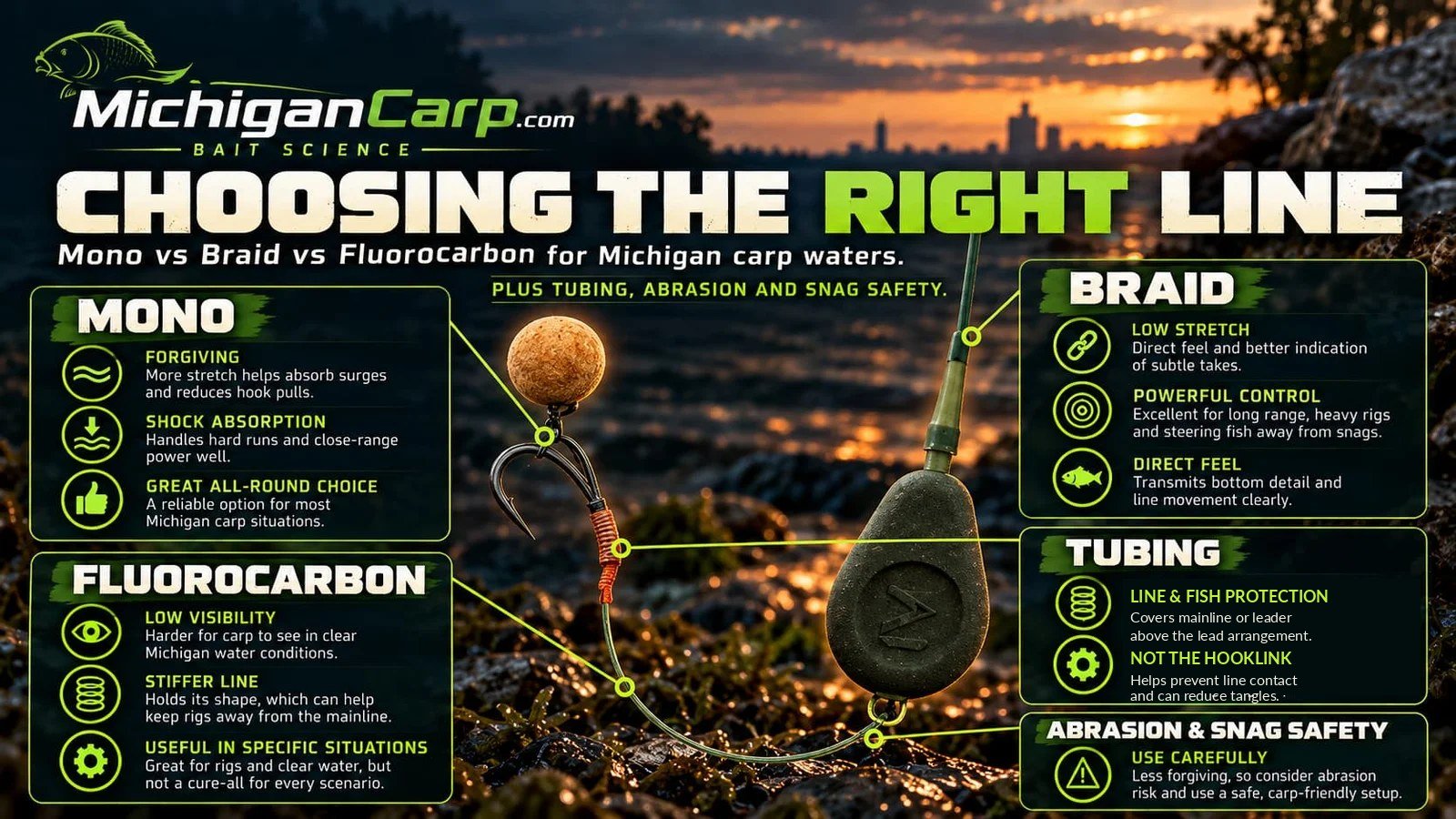
Choosing the Right Carp Line
Mono, braid and fluorocarbon each solve different problems.
Useful stretch absorbs sudden runs. A forgiving, general-purpose mainline.
Low stretch and direct contact. Drag control matters, and sharp-edge resistance varies.
Dense and useful for selected leaders. Stiff, heavy connections need careful testing.
Covers mainline or leader above the lead, not the hooklink. Helps protect fish and the covered line.
Breaking Strain, Diameter and Tackle Balance
One of the most common mistakes in line selection is concentrating on the number printed on the spool.
A line marked 20 lb is not necessarily comparable in every respect with another manufacturer’s 20 lb line. Actual diameter, stretch, abrasion performance, knot strength and handling can all differ.
In Britain, anglers commonly refer to breaking strain. In the United States, the corresponding term is usually pound-test. Both describe a nominal line-strength rating, not a guarantee that every knot or complete rig will withstand that exact load.
Why Diameter Matters
Physical diameter influences several aspects of fishing.
Thicker line generally creates more resistance as it travels through the water and rod guides, although the line’s surface and construction also matter. Thinner line may help with casting distance and reel capacity, but reducing diameter can leave less material to withstand abrasion.
When fishing rough Michigan waters, I often place greater importance on having sufficient diameter and abrasion protection than on gaining a few extra yards of casting distance.
That does not mean thicker line is automatically better. A large-diameter line may still be unsuitable if its material, knots or construction perform poorly against the hazards present.
Match Line Strength to the Whole System
The fishing rod, reel drag, hook and hooklink must be considered alongside the mainline.
A relatively forgiving mono setup can tolerate sudden changes in pressure differently from a low-stretch braided setup. Similarly, an extremely strong leader provides little practical benefit if the adjoining mainline is already damaged.
Knot strength is also important. A poorly tied connection may fail well below the nominal strength of the line.
For general open-water carp fishing, conventional monofilament in the region of 15–20 lb can be a reasonable starting point, as outlined in the Carp Anglers Group beginner’s guide. That is a starting example, not a rule for every Michigan venue.
Rough bottoms, weed, sharp structure and the need for greater fish control may justify substantially different tackle. The decision should follow a realistic assessment of the hazards rather than the expectation of catching a particular size of carp.
Understanding Carp Fishing Leaders
A leader is an additional section of material connected to the mainline, usually to perform a specific job near the terminal tackle or during casting.
Although the term is often used loosely, not all leaders serve the same purpose.
A shock leader absorbs the demanding loads created during casting. An abrasion or snag leader is intended to protect the line from difficult structure. A lead-free woven leader or leadcore section may be used to keep the final part of the setup close to the lakebed.
Understanding those distinctions makes it easier to choose an appropriate arrangement without introducing unnecessary components.
Shock Leaders: Protection During Casting
A shock leader is primarily a casting component.
It becomes relevant when the mainline alone is unsuitable for the forces generated by casting heavy leads, large PVA bags, method feeders or other substantial loads, particularly at greater distance.
The leader must be appropriately rated for the casting load and technique. It must also be long enough for the casting force to be carried by the leader, including sufficient turns around the reel spool at the start of the cast.
This is not a situation in which a short length of heavy line tied near the rig necessarily provides adequate protection.
The connecting knot must also be suitable for the materials involved and able to pass through the rod guides without catching or damaging them.
A shock leader can provide additional abrasion resistance, depending on the material used, but its primary purpose remains casting safety.
Abrasion and Snag Leaders
An abrasion leader addresses a different problem: contact with rough or sharp underwater structure.
Zebra mussels, riprap, submerged rock, timber and concrete can all damage fishing line. In these conditions, a suitably selected heavy monofilament or fluorocarbon leader may provide additional protection.
Heavy mono offers useful diameter and some stretch, making it a practical option where a forgiving but robust final section is desirable.
Fluorocarbon may be useful where its density, stiffness and particular abrasion characteristics suit the situation. However, it should not be treated as universally more abrasion-resistant than every nylon product.
Braided snag leaders have specialist applications, but they also introduce low-stretch behaviour and can perform unpredictably against sharp edges.
Leader length must reflect the hazard. A short abrasion leader will not protect the mainline if a fish can drag that line across several yards of mussel-covered rock.
Equally, simply installing a very long, heavy leader is not necessarily a safe solution. Longer leaders introduce more material and connecting components that may become involved in a break-off.
Sometimes changing the fishing angle, shortening the cast or moving away from the obstruction is the better answer.
Lead-Free Leaders and Leadcore
Lead-free woven leaders and traditional leadcore are often used to provide a heavy, flexible final section that follows the contours of the lakebed.
These materials can be effective, but their safety depends entirely on the complete rig arrangement.
A leader marketed for carp fishing should never be assumed to be safe in every combination of beads, swivels, lead clips or helicopter components.
The crucial question is whether the fish can escape dangerous terminal tackle after the mainline or leader breaks.
This becomes particularly important with helicopter arrangements, where the movement and release of the hooklink swivel depend on the complete assembly.
If the components cannot release as intended, the fish may be left towing a dangerous length of tackle.
Rig Tubing: A Simpler Alternative
Rig tubing, often called anti-tangle tubing, is threaded onto the mainline or an appropriate leader section above the lead arrangement. It is not fitted to the hooklink (the short length carrying the hook). In a typical lead-clip setup, the tubing covers the final section of line leading into the lead clip, while the hooklink attaches separately below the swivel.
Its two important protective roles are to provide a barrier between the carp’s body and the line during a fight, helping reduce the risk of scales or fins being damaged by direct line contact, and to offer some protection to the covered line from rubbing against rough surfaces. Tubing can also help reduce tangles and keep the final part of the setup lying tidily.
That abrasion protection has limits. Tubing is not cut-proof and cannot replace an appropriately selected abrasion leader where sharp zebra mussels, rock or other hazards threaten a longer section of line. It only protects the length it actually covers.
For many relatively clean or moderately difficult waters, correctly fitted tubing over suitable monofilament can be a simpler option than adding a separate leader and another connecting knot. However, tubing does not make an otherwise unsafe lead system safe: the lead, swivel and any other terminal components must still function correctly if the line breaks.
Matching Your Line to Michigan Fishing Conditions
Michigan carp fishing covers an unusually wide range of environments. An arrangement that performs well on a clean inland lake may be poorly suited to a rocky river channel or a dam pond containing submerged timber.
The following situations illustrate how I approach those differences.
Clean Lakes and Open Bottoms
Where the lakebed is relatively clear of obstacles, conventional monofilament is often sufficient.
A properly selected line can be fished straight through to the terminal tackle, with suitable tubing and a correctly assembled lead system where appropriate.
There is little reason to add a heavy abrasion leader unless a specific hazard justifies it.
The important qualification is that an apparently clean water should be assessed properly. Isolated rocks, discarded tackle or submerged branches can still create problems.
Weed Beds and Heavy Vegetation
Weed presents two distinct challenges: controlling the hooked fish and preventing line or terminal tackle from becoming trapped.
Moderate weed may simply justify a stronger or more abrasion-resistant monofilament. Dense vegetation may call for specialist equipment, different casting angles or an alternative fishing position.
Braided line can provide advantages in particular weed situations, but the reduced stretch demands careful drag adjustment and controlled pressure.
An angler should never regard stronger line as permission to fish where a carp cannot realistically be landed.
For the wider location and presentation considerations, see Weed Beds and Carp Fishing.
Zebra Mussels, Riprap and Sharp Rock
Zebra mussels are a significant consideration on many Michigan waters.
Their shells and the hard surfaces they occupy can create abrasive conditions for fishing line. Sharp rock, concrete and riprap can present similar difficulties.
A relatively thin line that performs perfectly well in open water may suffer serious damage when placed under tension against these obstacles.
Appropriate diameter, proven abrasion performance and a correctly selected leader can all improve the chances of retaining control of a fish.
However, no conventional line should be regarded as cut-proof.
The route taken by the line is just as important as the material. Changing the rod angle, keeping the line away from a sharp margin or fishing from a better position can be more effective than simply increasing breaking strain.
After any significant contact with shell or stone, inspect the affected length of line carefully and replace damaged sections.
Submerged Timber and Stumps
Submerged timber is among the most difficult hazards encountered when fishing for wild carp.
Strong tackle can help control a fish before it reaches an obstruction, but once the line becomes wrapped around timber, increasing pressure may simply increase the likelihood of breakage or leave the carp trapped.
This is why snag fishing requires more than a heavy leader.
Consider how quickly a hooked fish can reach the obstruction, whether you can apply pressure from a suitable angle and whether there is a realistic landing route.
On some waters, a boat may provide an additional fish-recovery option where permitted and where it can be used safely. It should never be treated as a guarantee.
If the fish is likely to reach a dangerous snag before you can control it, the responsible decision may be to move the rig or avoid that position entirely.
Rivers, Channels and Long-Range Fishing
River channels introduce current, changing line angles and often substantial underwater structure.
A line may need sufficient diameter and strength to withstand water pressure while also resisting contact with rock, pilings or concrete.
Long-distance casting introduces another consideration. Reducing mainline diameter can improve casting performance, but may create a need for a suitable shock leader and more careful control of the complete setup.
Boat-supported fishing also changes the possible line angles. It can be useful in some circumstances, although anglers must account for anchors, propellers, sharp boat fittings and the hazards of playing fish from a moving platform.
In all these situations, the choice should be guided by the actual fishing conditions rather than a fixed formula.
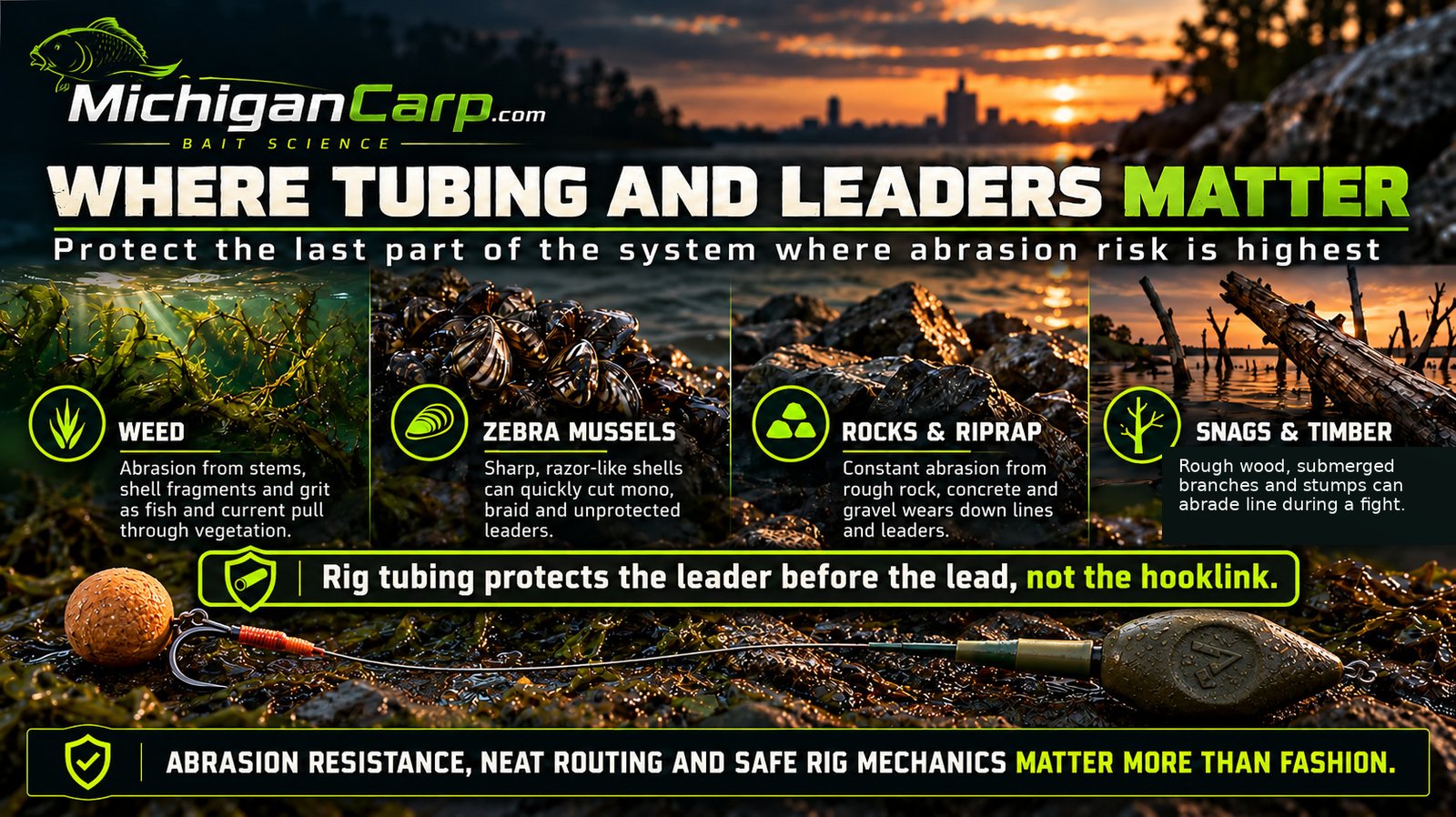
Where Tubing and Leaders Matter
Match abrasion protection to the underwater hazards.
Stems, grit and shell fragments can wear the line.
Sharp shells can cut or abrade unprotected line and leaders.
Rock, gravel and concrete can damage line under tension.
Branches, stumps and submerged debris create damaging contact points.
Fish Safety, Leaders and Break-Off Protection
This is arguably the most important part of the entire article.
A line and leader combination is not properly designed simply because it is strong enough to land a carp under normal conditions.
It must also be considered in the event of failure.
When a mainline breaks, a carp may be left attached to a hooklink, leader, lead and other components. Depending on the arrangement, those components can become caught in vegetation or submerged structure, potentially tethering the fish.
A well-designed system should minimise that risk by allowing the appropriate components to move, separate or release.
The Essential Break-Off Test
Before fishing with a leader or unfamiliar terminal arrangement, work through the following checks:
- Consider where the line could break. What happens if the mainline parts above the leader knot, or the leader itself fails?
- Check the lead system. Can the lead eject or slide free as intended, rather than remaining permanently attached to the fish?
- Check the hooklink and swivel. Where the design requires them to move or separate, can they do so without being trapped by beads, knots, sleeves or other components?
- Test the assembled tackle. Use the actual components and materials you intend to fish with, following the manufacturer’s assembly instructions and checking their behaviour under controlled tension.
- Simplify if the result is uncertain. Do not cast an arrangement whose failure behaviour you cannot confidently explain.
Helicopter systems require particular care because the hooklink swivel may need to pass beyond or release from components above it. A bulky leader knot, an incorrectly fitted bead or a mismatched sleeve can prevent the intended escape mechanism from working.
Lead clips and inline systems have their own requirements. A lead clip that cannot release its lead under the relevant conditions is not performing the job expected of a release system.
Equally, losing the lead does not automatically mean every other component is safe. The complete system must be assessed.
For detailed explanations of the main terminal arrangements, read Carp Lead Systems: Lead Clip vs Inline vs Helicopter.
The broader principle is consistent with the Angling Trust’s Best Practice guidance: fish welfare should influence the way rigs are selected, assembled and used.
No increase in breaking strain can make an inherently unsafe fishing position or badly constructed terminal system acceptable.
Leader Safety After a Break-Off
The complete lead and leader system must remain fish-safe if the line fails.
Confirm the lead can eject or slide free as intended for that specific rig.
On helicopter rigs, check that beads and leader knots cannot trap the hooklink swivel.
Check the actual tackle under controlled tension before casting.
Knots, Line Checks and Maintenance
Even an excellent line can fail through poor handling, unsuitable knots or damage that goes unnoticed.
A connecting knot is particularly important when combining different materials. Heavy monofilament, stiff fluorocarbon and fine braid do not always respond in the same way to a particular knot.
Some connections grip reliably only when tied using the appropriate technique and carefully tightened. Others may slip, cut into adjoining material or become excessively bulky.
When building a new line system, use knots recommended for the particular materials and diameters involved. Lubricate and tighten them as appropriate, then perform a firm, controlled pull test using suitable rig tools rather than your bare hands.
Do not assume that a knot is reliable merely because it looks neat.
Recommended Knots for Carp Leader Materials
Different leader materials and diameters suit different connections. These are practical starting points, not universal strongest-knot claims; always test your actual line and follow the material manufacturer’s instructions.
| Connection | Knots to consider |
|---|---|
| Mono to mono leader | Back-to-back Grinner; Mahin for substantially different diameters |
| Mono to fluorocarbon leader | Back-to-back Grinner; test stiff heavy fluorocarbon carefully |
| Braid to mono or fluorocarbon leader | Mahin, Albright or FG, depending on materials and technique |
| Braid to braid leader | Back-to-back Grinner for suitable, compatible materials |
| Mono to pre-looped lead-free or leadcore leader | Figure-of-eight loop and loop-to-loop, only when manufacturer-approved and break-off safe |
| Mono to terminal swivel | Grinner (Uni) knot |
Safety check: Moisten, dress and pull-test knots with suitable rig tools, check that guide-passing knots do not catch, and confirm that beads, swivels and leads can release as required following a break-off. A stronger knot does not make an unsafe leader or lead arrangement acceptable.
Leader Knots and Rod Guides
A large leader knot can cause problems when casting through rod guides, particularly with smaller tip rings.
An unsuitable connection may catch, reduce casting efficiency or damage a guide insert.
Any leader intended to pass through the guides should use an appropriate connection and be checked against the actual rod before fishing.
Inspect damaged or cracked rings as well. A sharp guide insert can damage new fishing line surprisingly quickly.
Inspecting Line After Fishing
Regular line inspection is one of the simplest ways to avoid unnecessary break-offs.
Check the final section after landing a fish, retrieving through weed or making contact with rocks, mussels or submerged timber.
Look and feel carefully for rough surfaces, cuts, flattened sections, kinks or changes in the line’s appearance.
If abrasion is found, remove enough line to eliminate the damaged section completely. Replacing a leader alone is inadequate if the mainline above it has also suffered damage.
Line should also be replaced when age, repeated use, exposure or poor handling have compromised its reliability. There is no meaningful universal replacement interval for every product and fishing situation.
Discard old line responsibly, keeping it away from wildlife and using fishing-line recycling facilities where available.
My Practical Approach to Michigan Carp Fishing
My own line choices tend towards the heavier end of conventional carp tackle because much of my fishing takes place on large, wild Michigan waters.
These venues can combine deep water, weed, rock, hard structure and considerable abrasion risk. Under those circumstances, I often prefer heavy monofilament mainline with additional leader protection where there is a clear reason to use it.
That is not a recommendation for every angler to copy the same combination.
On a clean, open lake I would be perfectly comfortable simplifying the system. There is no advantage in adding heavy leaders, additional knots and complicated terminal components when straightforward tackle already meets the requirements.
The real benefit of experience is learning when additional protection is justified and when it creates more problems than it solves.
Consider three contrasting examples.
On a clean inland lake, a suitable mono mainline, correctly assembled lead system and uncomplicated terminal arrangement may provide everything required for controlled, enjoyable carp fishing.
On a mussel-covered or rocky lakebed, I would pay much closer attention to diameter, abrasion performance, leader material and the angle at which the line crosses the dangerous area. I would also inspect the line much more frequently.
Around heavy submerged timber, I would begin by deciding whether the fishing position is realistic. Only then would I consider the strength and leader arrangements needed to control a fish safely.
These are different problems, and they deserve different solutions.
One useful habit is to examine the line after every demanding capture. If abrasion appears repeatedly in the same part of the setup, that tells you something about the underwater hazards or the route taken by the fish.
Rather than automatically increasing the breaking strain, consider whether a different presentation, casting angle or fishing position would eliminate the problem.
The objective is not to own the strongest possible line. It is to build a reliable system that allows the carp to be hooked, controlled, landed and released without avoidable harm.
Frequently Asked Questions
What is the best fishing line for carp in Michigan?
For general bank fishing on reasonably clean waters, quality monofilament is a sensible starting point. Its stretch, handling and forgiving nature make it suitable for many conventional carp setups. Heavier or more specialised tackle may be needed around weed, sharp rock, zebra mussels and submerged timber.
Is braid better than mono for carp fishing?
Neither is universally better. Braid provides low stretch, high strength relative to diameter and more direct contact with the fish. Monofilament offers greater cushioning and is often easier to manage. Choose according to the water, casting requirements and complete tackle system.
Should I use fluorocarbon for my carp leader?
Fluorocarbon can be useful where density, stiffness or a particular product’s abrasion resistance offers a practical advantage. However, heavy fluorocarbon knots need careful testing, and it is not automatically superior to heavy mono in every situation.
Do I always need a leader?
No. If the mainline can safely handle the casting load, abrasion risk and expected fish-control requirements, a straightforward arrangement without a leader may be preferable. Adding a leader should solve a specific problem.
Can I use 40 lb monofilament for carp?
Yes, where the fishing conditions justify it. Heavy monofilament may be appropriate around demanding structure, but it is unnecessary on many clean waters. Its diameter, stiffness, reel capacity, knot compatibility and casting characteristics must also be considered.
Can zebra mussels cut fishing line?
Contact with sharp mussel shells or shell-covered structure can severely damage line, particularly under tension. Selecting suitable materials and diameters, maintaining a favourable line angle and checking for damage are all important. No normal fishing line should be considered immune to sharp-edge damage.
How long should a carp shock leader be?
It must be long enough to take the casting load correctly, including adequate turns on the reel spool when the cast begins. The precise arrangement depends on rod length, casting technique, lead weight and leader material. Always follow appropriate casting guidance for the equipment used.
Are leadcore and lead-free leaders safe for carp?
They can be used in suitably designed systems, but the material alone does not make a rig safe. The complete assembly must be checked for its behaviour following a break-off, particularly the release or movement of the lead, hooklink and associated components.
What matters most when fishing around heavy snags?
First establish whether a hooked carp can realistically be controlled and landed from the chosen position. Strong line and leaders may help, but they do not make every snag-filled area safe to fish.
Final Thoughts: Build the System for the Water
Choosing carp fishing line and leaders is not about finding one perfect combination for every venue.
Monofilament remains an excellent general-purpose choice, braid can provide distinct advantages in specialist circumstances, and fluorocarbon has useful applications as a leader material.
The deciding factors are the actual underwater hazards, the behaviour of the line, the strength and balance of the complete tackle, and what happens if something fails.
For a better understanding of how the components work together, explore the Carp Fishing Rods Guide, the Michigan Carp Reels Guide and our Complete Carp Rigs Guide.
For fishing regulations and local restrictions, always consult the current Michigan DNR fishing regulations.
Use the simplest line and leader system that can safely handle the water. Strengthen it when the conditions demand it, not simply because a bigger number appears more reassuring.