
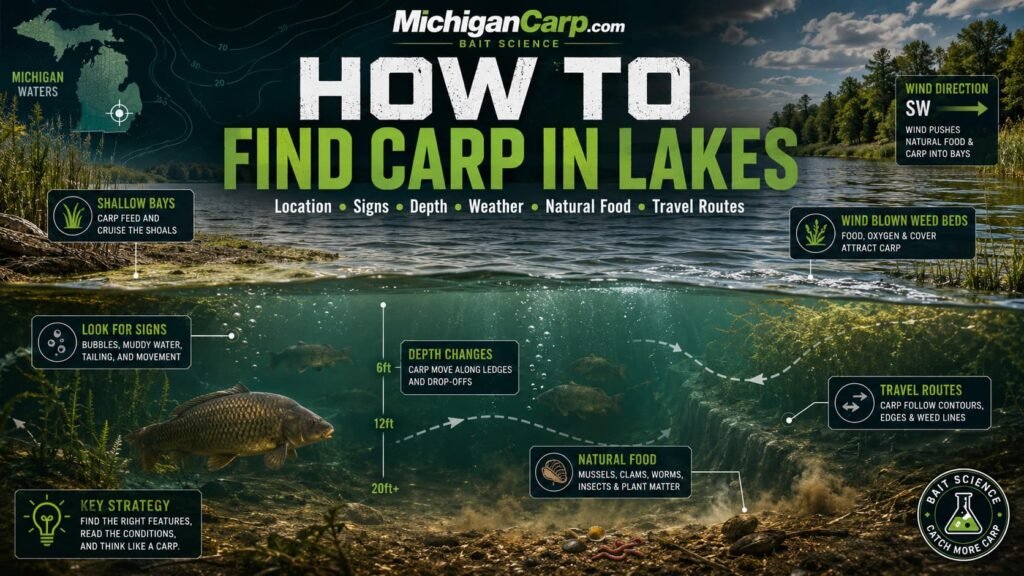
Learning how to find carp in lakes is more important than any bait, rig or flavor. You can have a proven boilie, perfect particles, sharp hooks, good alarms, strong line and a neat baiting plan, but if the carp are not using the water in front of you, the session becomes guesswork.
Carp are not spread evenly around a lake. They move between food, safety, comfort and travel routes. They feed where natural food is available, hold where they feel secure, and adjust their position with season, water temperature, oxygen, wind, light, boat traffic and pressure.
On Michigan lakes, that can mean weed edges, reed margins, lily pads, mussel beds, snail areas, soft silt, insect-rich bottom, gravel transitions, shallow warming bays, inflows, outflows, channels, points, drop-offs, quiet banks and wind-affected water. The best area is rarely good for one reason only. It usually works because several clues overlap.
The useful question is not:
Where is the easiest place for me to fish?
The better question is:
Where do carp have food, safety, comfort, movement and a clean place for me to present a rig?
This guide explains how to find carp in lakes by reading signs, food, depth, weed, wind, oxygen, season, travel routes, bank access, lake maps, boat scouting and safe presentation. It is the parent tactical process for MichiganCarp.com: find the fish first, then choose the bait, rig and session plan.
For the broader tactical hub, use Carp Fishing Tactics in Michigan. For the full condition-reading system, use Watercraft and Conditions for Michigan Carp Fishing.
Table of Contents
Quick Answer: Where to Find Carp in Lakes
The best carp locations usually combine food, safety, comfort, movement and a fishable presentation area. A weed edge is better when it has clean holes, natural food and depth nearby. A shallow bay is better when it warms quickly and gives carp a safe route out. A point is better when it connects wind, depth and patrol routes. A deep edge is better when it links to food or seasonal holding water.
Start by looking for the areas where carp have a reason to be. Do not start with the place that is easiest to sit.
| Lake clue | Why carp may use it | Best first move |
|---|---|---|
| Weed beds and pad edges | Food, oxygen, shade, cover and patrol routes | Fish safe clean edges, holes and lanes |
| Soft silt | Insect larvae, bloodworm-type food, snails and rooting areas | Look for bubbles, clouding and repeated feeding signs |
| Reeds and margins | Cover, insects, shade, silt and low-light feeding | Fish quietly with strong tackle and a safe landing route |
| Depth changes | Routes between shallow feeding water and deeper safety water | Fish shelves, drops, channel edges and transition lines |
| Wind-affected banks | Food movement, oxygen, color, ripple and cover | Fish the wind when it improves the swim, not blindly |
| Inflows and outflows | Oxygen, food movement, temperature change and routes | Fish seams, slacks and safe edges rather than strongest flow |
| Quiet pressure zones | Safety from boats, people and bright open water | Watch dawn, dusk, night and low-traffic windows |
| Repeated signs | Proof that carp are using that exact zone | Trust repeated bubbles, rolling fish, liners and clouding |
The simple rule is:
Find a reason, confirm it with signs, then fish the safest clean edge.
Think Like a Carp Before You Think Like an Angler
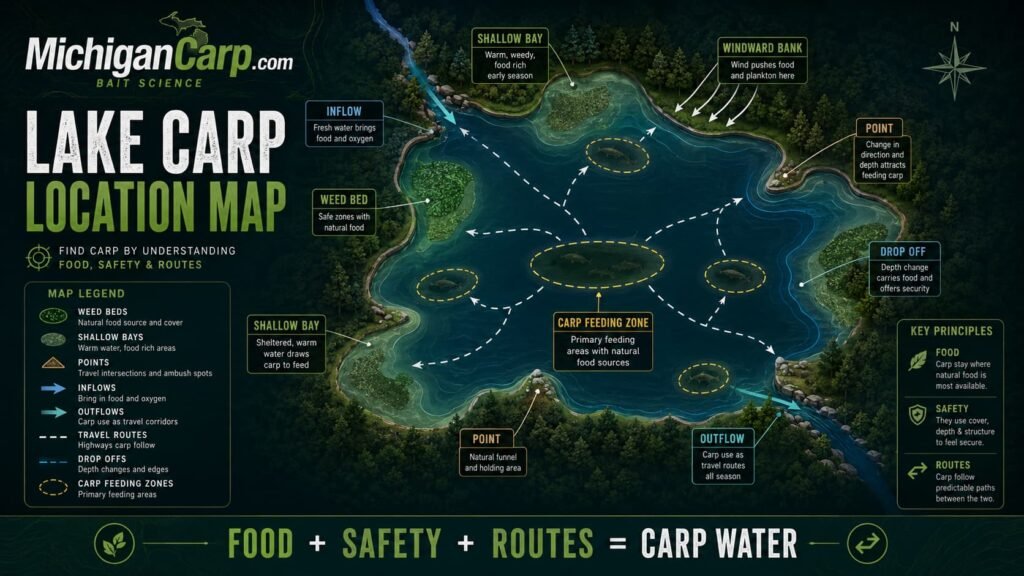
Many anglers choose swims because they are comfortable, accessible or familiar. Carp choose areas because those areas solve problems. They need food. They need safety. They need comfortable water. They need routes between feeding areas and holding areas. They need enough confidence to move and feed.
Those things are not always in the same place. The nicest campsite, clearest bank or easiest casting spot may be almost empty if it gives carp no reason to visit. A rough-looking reed edge, a shallow bay mouth, a weedline beside deeper water, or a quiet corner away from boat pressure may hold fish because it solves more of the carp’s problems.
Good carp location starts with four questions.
Where can carp feed? Look for natural food, silt, weed, mussels, snails, insects, reeds, pads, inflows, food traps and places where the bottom is being disturbed.
Where can carp feel safe? Safety may come from weed, depth, distance, low light, shade, snaggy cover, boat-free zones, reeds, margins, night movement or simply lack of pressure.
Where can carp stay comfortable? Comfort changes with water temperature, oxygen, sunlight, wind, depth, weed, current, weather fronts and season.
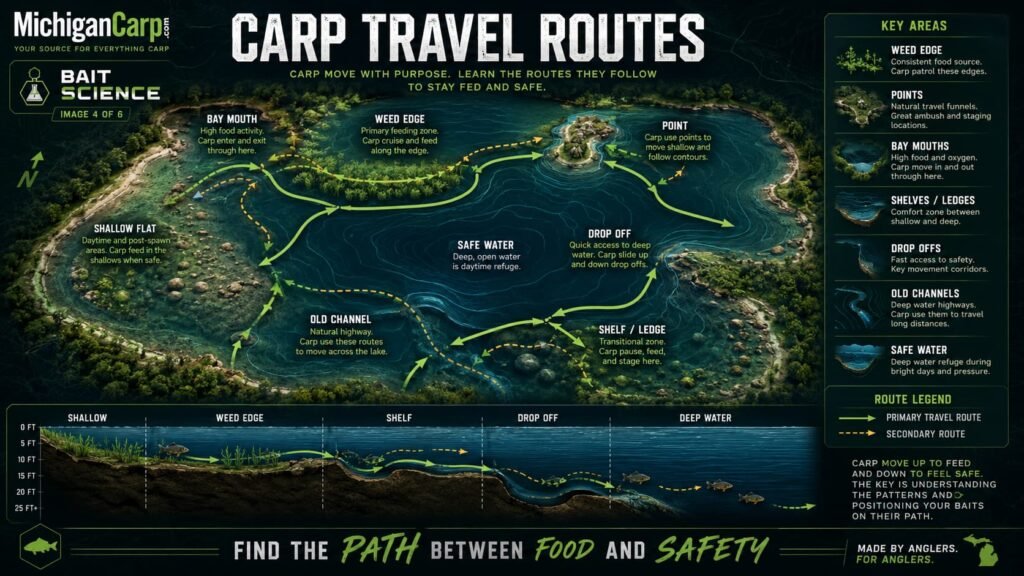
Where can carp travel easily? Routes can include weed edges, points, drop-offs, old channels, bay mouths, reed lines, narrows, bridge gaps, current seams and basin edges.
The best location is usually the one that answers several of those questions at once. A bait placed on a travel route can catch fish even when they are not feeding hard. A bait placed on a natural feeding area can catch when fish settle and root. A bait placed randomly between the two may do nothing.
Start With Observation
Before casting, watch the water.
This sounds obvious, but it is one of the most skipped steps in carp fishing. Many anglers arrive, choose a peg, set up the pod, mix bait, cast three rods and only then start looking for signs. That puts the session in the wrong order.
On a new lake, observation should come first. Walk before you bait. Watch before you cast. Look across several banks if access allows it. Check shallow corners, bay mouths, reed edges, weedlines, windward banks, sheltered water, boat lanes, inflows, outflows, points and quiet margins.
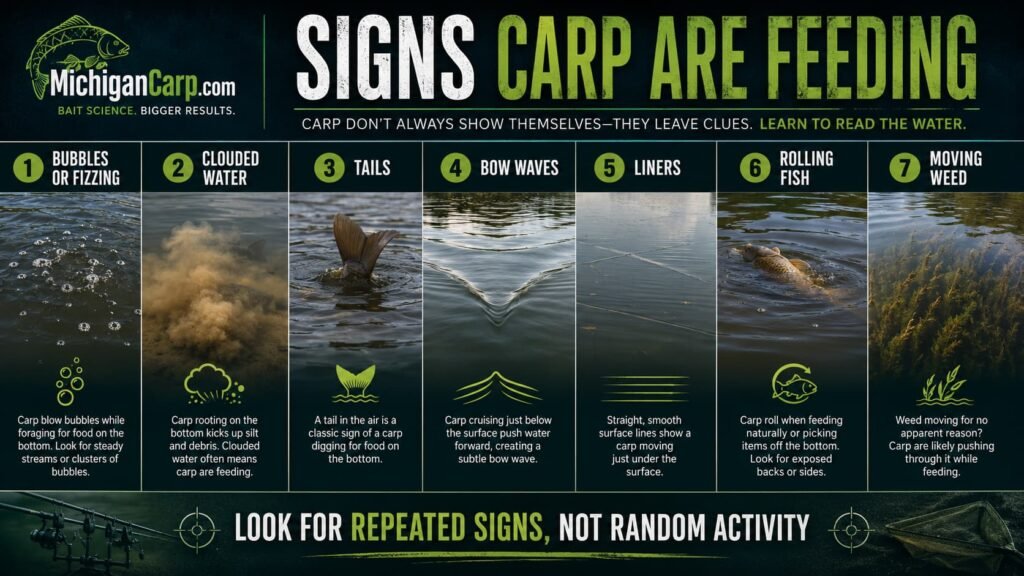
Carp may show themselves through obvious rolling or subtle clues. A single roll in open water may not mean much. Repeated rolling on the same line means more. Bubbles appearing in the same zone every morning mean more. A shallow bay clouding up at dusk means more. Weed moving without wind means more. Liners on one rod while the others sit still can reveal a route.
Repeated signs are stronger than random signs. The lake may look dead at noon and come alive at first light, after sunset or once boat traffic fades. That is why the best scouting often happens at dawn, dusk, during quiet weather windows, after a warm wind, before storms, and when other anglers are not disturbing the bank.
The aim is not just to see carp. The aim is to understand why they are there.
For a dedicated guide to feeding clues, read Signs Carp Are Feeding. For bite timing, read Carp Bite Windows in Michigan.
Read Carp Signs Correctly
Carp signs can be obvious, but they can also fool you.
Bubbles are useful when they are clustered, moving slowly, connected to clouded water, or appear repeatedly over silt, weed edges or shallow flats. Random gas bubbles can rise from the bottom without carp. Feeding bubbles usually look more alive: they shift, appear in groups, follow a line, and often connect to water disturbance.
Clouded water can be a strong clue when it appears in a clear area, especially over silt, inside weed holes, along reed margins or near shallow flats. Carp rooting can dirty a patch of water and leave a visible stain. But wind, boats, waves and other fish can also cloud water, so the best sign is repeated clouding in the same place.
Rolling fish tell you carp are present, but not always feeding. A carp rolling high in open water may be traveling. Several fish rolling near a bay mouth, weed edge, inflow, dusk feeding area or shallow shelf may tell you much more. A roll is useful when it connects to a feature.
Liners can be one of the most useful rod-based clues. If a line tightens, lifts or bumps without a proper bite, carp may be moving through that area. One liner may be random. Several liners on the same rod at the same time each day can reveal a patrol route.
Weed and reed movement can be easy to miss. Pads ticking, reeds knocking, weed shifting against no visible wind, or water bulging along a margin can all show carp moving where you cannot see them directly.
The mistake is treating every sign as equal. The strongest signs are repeated, connected to habitat, and explainable. A single splash in the middle is less useful than quiet bubbles along the same weed edge three mornings in a row.
Find Natural Food First
Carp are built to exploit natural food. If you find the food, you often find the fish.
On Michigan lakes, useful natural-food zones can include soft silt, weed beds, lily pads, reed margins, mussels, snails, insects, larvae, crayfish, algae, detritus, seed fall, wind-blown food lines, inflows and areas where birds or baitfish are active. Some of these are visible. Others are inferred from signs, bottom feel, water color and carp behavior.
Healthy aquatic vegetation is especially important because it can hold food, cover and oxygen. Michigan EGLE describes native aquatic plants as valuable for inland lakes because they oxygenate water and provide habitat and food resources for fish and wildlife. Use Michigan EGLE: Native Aquatic Plants for the habitat background.
Food alone is not enough. A food-rich area may still fish poorly if carp do not feel safe, if oxygen is poor, if the area is too exposed, or if the rig cannot be presented cleanly. The best food areas usually connect to cover and movement. A weed edge beside a depth change. A silt pocket inside a clear hole. A mussel strip on a travel route. A reed line with bubbles and nearby depth. An inflow seam that carries food without being unsafe.
Do not assume your bait is the main meal. Often your bait works because it lands where carp already expect to feed.
For bait decisions after location, read Carp Bait Guide for Michigan Lakes. For particle preparation, read Particle Prep for Carp Fishing.
Use Depth as a Route, Not Just a Number
Depth matters, but not because carp obey one fixed depth rule.
Carp may feed in two or three feet of water when a shallow bay is warming, colored, food-rich and safe. They may patrol six to ten feet along a weed edge. They may hold deeper during bright summer pressure or cold-water stability. They may move between zones several times during a day.
The most useful depth is often the transition between feeding water and safety water. A shallow flat beside a drop-off. A weed edge that falls into deeper water. A channel lip near a bay. A shelf leading from reeds to open water. A point that connects a shallow side and deeper side. Those features give carp options.
This is why “how deep should I fish?” is usually the wrong starting question. Ask what that depth does for the fish. Does it warm first? Does it hold weed? Does it give escape water? Does it connect to food? Does it offer oxygen? Can carp patrol it without crossing dead open water? Can you land fish from it?
A clean six-foot weed edge with signs can beat a random cast to twenty feet. A deep hole can be poor if the lip or route is where the carp actually travel. The best depth is the one that gives carp a reason to use it and gives you a clean way to fish it.
For the full depth system, read Best Depth for Carp Fishing in Michigan Lakes.
Use Weed Beds Without Fishing Them Badly
Weed is one of the strongest carp-location clues on many Michigan lakes, but it is also one of the easiest features to fish badly.
Carp use weed because it can provide food, oxygen, shade, cover, patrol routes and confidence. They may feed in clear holes, move along outside edges, sit under pads, push through reeds, or use a wind-rippled weedline as a safe route. A weed bed with green growth, natural food, clear edges and nearby depth can be a major carp feature.
But thick weed is not automatically a good place to put a rig. If every hooked fish will bury itself, break you off, or be dragged through heavy vegetation, the swim is not responsible. The better spot is often the fishable edge, the clear hole, the open-water side of pads, the reed gap, or the channel where carp can move and you can land them safely.
Weed should make you more precise, not more reckless. Look for clean presentation spots. Check the line angle. Think about where the fish will run. Keep rods close enough to react. Use tackle strong enough for the situation. Have the net and mat ready before the bite.
Good weed fishing is not about casting into a jungle. It is about finding the part of the weed system that carp use and you can fish properly.
For the full weed guide, read Weed Beds and Carp Fishing in Michigan. For rig decisions around weed, use The Complete Michigan Carp Rig Guide.
Use Wind, Waves and Current as Location Clues
Wind can move food, oxygen, warmth, surface drift, color and confidence. Current can create seams, slacks, routes and feeding edges. Waves can give carp cover, but they can also make fishing unsafe. Moving water matters because it changes how carp use the lake.
The windward bank can be good when the wind improves the water. A warm spring wind into a shallow bay can pull carp in. A steady summer ripple on a weed edge can add cover and oxygen. A wind line across a point can concentrate food and movement. But “fish the wind” is not a rule. A cold wind, violent waves, poor presentation, unsafe bank or dead featureless water can make the windy side the wrong choice.
The back of the wind can also be good. Sheltered water may warm faster in spring, give carp quiet cover in clear water, or provide a safe margin away from boat pressure. Current seams and inflows can be excellent when they bring oxygen and food, but the best spot is often the softer edge rather than the strongest flow.
Use wind and current to ask better questions. What is the moving water doing? Is it adding food? Is it improving oxygen? Is it creating cover? Is it warming or cooling the swim? Is it pushing carp onto a route? Can you fish it safely?
For the complete moving-water guide, read Wind, Waves and Current Carp Fishing.
Read Oxygen and Comfort
Oxygen is not something you always see directly, but you can often read its effects through carp location.
In hot weather, carp may avoid shallow stagnant water even if it looks good. A flat, hot, dying-weed bay may be less useful than a wind-rippled weed edge, shaded margin, inflow seam or deeper comfort route. USGS explains that cold water can hold more dissolved oxygen than warm water, and that stagnant water tends to contain less dissolved oxygen than rapidly moving water. Use USGS: Dissolved Oxygen and Water for the science background.
For carp anglers, oxygen is a practical watercraft clue. It helps explain why fish may be on wind, weed, inflows, shade, deeper edges or low-light windows instead of the obvious flat. It also explains why some summer swims look alive but produce poorly during the hottest part of the day.
Do not read oxygen alone. Read it with temperature, weed, wind, depth, light, food and fish signs. A wind-rippled weed edge with bubbles and rolling fish is stronger than a theoretical oxygen guess. A shallow inflow with no signs, poor access and unsafe flow may not be worth fishing just because water is moving.
For the full oxygen guide, read Dissolved Oxygen and Carp Fishing. For water temperature, read Carp Water Temperature Guide for Michigan Lakes
Match Season to Location
Season gives you the first clue about where to look.
In spring, carp often respond to warming water. Shallow bays, dark-bottom margins, reed edges, protected corners and soft-silt flats can become important after several mild days. But cold nights and fronts still matter, so the best spring areas usually have nearby depth or a route back to safety.
In summer, location often becomes a comfort problem. Carp may use weed edges, shade, inflows, wind ripple, low-light windows, deeper safety water and night routes. A shallow bay may produce at dawn and be poor by midday. A mid-depth weedline can quietly hold fish during bright or pressured periods.
In fall, food and routes become important. Carp may continue using productive weed and natural-food areas, but they often tighten around shelves, bay mouths, points, remaining green weed and deeper edges. Do not fish summer memories too long if the weed is dying or the food has shifted.
In winter or very cold water, stability matters. Carp may group in deeper basins, channels, sheltered pockets, slow-current areas or deeper water close to food. Feeding windows can be short, and location becomes more important than bait volume.
Season does not give the exact swim. It gives the first search area. Then signs, water temperature, oxygen, wind, depth and food refine the choice.
For the full seasonal hub, read Michigan Carp Fishing Seasons. For specific seasonal guides, use Spring Carp Fishing in Michigan, Summer Carp Fishing in Michigan, Fall Carp Fishing in Michigan and Winter Carp Fishing in Michigan.
Use Maps Before You Go
Lake maps help you arrive with a plan instead of guessing from the parking lot.
A map can show bays, points, basins, channels, flats, narrows, depth changes, steep banks, public access, road access, boat launches and likely travel routes. Michigan DNR provides inland lake maps that can help anglers understand contours and access before a trip. Use Michigan DNR Inland Lake Maps as a starting resource.
Maps are not proof. They do not always show current weed growth, fresh silt, mussels, snails, fish movement, angling pressure, boat pressure, oxygen comfort, access changes, private property, submerged snags or safe landing positions. A perfect-looking contour can be empty. A plain-looking margin can be full of carp if food and safety are there.
Use maps to create questions. Which bay warms first? Which point connects shallow and deep water? Which channel edge is reachable from shore? Where does wind push into habitat? Where are the public banks? Where can fish move between feeding and safety? Where can I land one safely?
Then use the actual lake to answer those questions.
Bank Scouting System
Bank scouting is about covering water with your eyes before covering it with bait.
Start with access and safety. A swim is only useful if you can fish it responsibly. Look at the bank angle, snags, weed, rocks, boat wakes, landing space, room for an unhooking mat, and whether you can control a fish from the bite to the net.
Then read the water in front of you. Check the margins first. Carp often use edges closer than anglers think, especially at dawn, dusk, night or when pressure is low. Look for bubbles, clouding, reed movement, weed movement, fish rolling, bow waves, color changes, wind lines, foam, floating debris and bird activity.
Next, connect the near water to the wider lake. Is there a bay mouth? A point? A drop-off? A weed edge? A channel? An inflow? A quiet corner? A route from shallow food to deeper safety? Does the wind improve the area or hurt it?
Do not rush to put three rods out just because the swim is open. On unfamiliar water, one accurately placed rod on a confirmed sign can be better than three rods spread across guesses. Let the lake tell you where to expand.
Boat, Kayak and Camera Scouting
A boat, kayak, underwater camera or drone-style overview can speed up scouting, but it does not replace judgement.
From the water, you can often see weed edges, clear holes, depth changes, color lines, silt clouds, mussel patches, channels, bars, reeds, pad beds, shallow flats and fish movement more clearly. That can help you understand why carp use an area and where a bank angler can place a rig safely.
The risk is disturbing the swim. Pushing too close, repeated passes, dropping anchors carelessly, driving over shallow fish or filming too aggressively can move carp away before the session starts. Scouting should be quiet and purposeful.
Use boat-based information to build a better bank plan. Mark safe weed edges, clean holes, shelves, hard spots, soft-silt feeding areas and landing angles. Then fish the water in a way that respects what you learned.
Do not use technology to force a swim that is unsafe. If the fish are buried in impossible pads, heavy timber or thick weed with no landing route, the correct decision is to leave them alone or find the safer edge.
Understand the Job of the Water
A promising area can perform different jobs for carp. Before choosing a rig, baiting pattern or rod position, decide how the fish are actually using the water.
- Holding water: A secure or comfortable area where carp may remain for long periods.
- Movement water: A route used to travel between holding areas, feeding areas and seasonal zones.
- Feeding water: An area where carp slow down, search, root and repeatedly exploit natural food.
- Opportunity water: A place that becomes productive temporarily when wind, warmth, low light, oxygen, reduced pressure or another favorable condition activates it.
These roles can overlap, and they can change during the same day. A carp showing over movement water may only be passing through. A holding area may reveal where fish feel safe without being the best place for a hookbait. Opportunity water may appear lifeless for hours and then produce a short, valuable feeding window.
Use Location, Timing and Presentation in That Order
Build the decision in three stages:
- Location: Where are the carp likely to hold, travel or feed?
- Timing: When are they most likely to use that particular area?
- Presentation: What is the cleanest, safest and most believable way to fish for them there?
Presentation matters, but it cannot compensate for empty water. A simple rig placed safely on a confirmed route or feeding area will usually offer more chance than a highly refined rig cast into a convenient but unproductive swim.
Know When to Stay and When to Move
Stay when you still have meaningful evidence: repeated signs, favorable conditions, correct timing or fish using nearby water even though the rods are temporarily quiet.
Consider moving when:
- A weather or wind change has clearly altered the area
- Repeated signs appear elsewhere
- The original reason for choosing the swim no longer applies
- You are staying only because you have already set up and introduced bait
Do not abandon a good swim simply because a known quiet period produces no bite. Equally, do not remain loyal to dead water when the lake is giving you better information elsewhere.
Once you understand the job of the water, each rod can test a specific possibility rather than covering three random distances.
Where to Put Three Rods
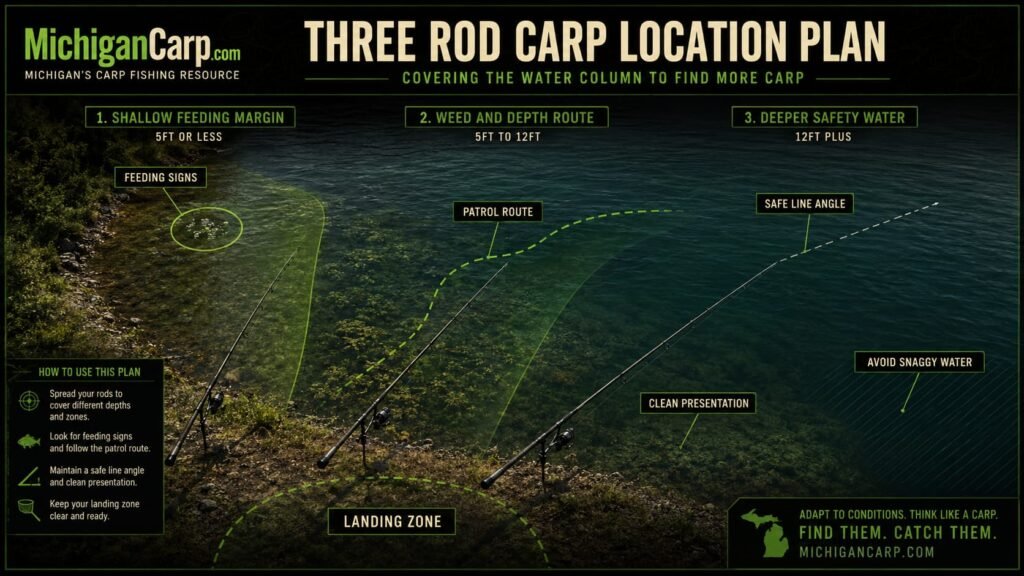
Three rods should not mean three random distances.
A better approach is to cover three reasons. One rod might fish the shallow feeding sign. One rod might fish the weed or depth route. One rod might fish the deeper safety edge. On another water, the three reasons might be a reed margin, a clean hole in weed and a channel lip. The exact layout changes, but the principle stays the same.
Each rod should have a job. A rod on visible bubbles is testing feeding. A rod on the edge of a flat is testing movement. A rod on deeper water nearby is testing holding fish. If one rod gets liners or activity, that tells you something. If one depth produces at dusk two nights in a row, that tells you something. If a margin rod only works after dark, that tells you something.
Do not spread rods so widely that you cannot manage them safely. Do not cross dangerous line angles. Do not put a rod in weed or snags just to cover more water. Three good rod positions are better than three hopeful casts.
On Michigan public waters, this matters even more. Weed, stumps, rocks, mussels, boat wakes, current, reeds and campground banks can all turn a good-looking spot into a bad fish-care decision. A carp location is only useful if you can hook, play, net and release the fish safely.
For rig safety and setup decisions, read The Complete Michigan Carp Rig Guide and Fish Care and Safety.
Match Bait to the Location
Bait should confirm a location, not replace location.
If you have not found carp, heavy baiting can make the problem worse. It can feed nuisance fish, spread bait away from the rig, pull fish into unsafe weed, or lock you into a dead swim. On new water, start with enough bait to create interest without committing the whole session to an unproven spot.
When you have signs, bait with purpose. A few chopped boilies and crumb on a clear hole. Corn and hemp along a shallow margin route. Tiger nuts on a clean hard spot. A small PVA stick on a mid-depth patrol line. A controlled particle patch on the safe edge of weed. The bait should match the place and the way carp are using it.
Location also changes bait volume. Cold water, short windows and cautious fish usually call for less bait. Summer natural-food areas may need careful baiting rather than piles of feed. Weed requires accuracy. Current requires thinking about where bait settles. Night fishing requires a plan before it gets dark.
The bait is the final part of the decision, not the first part.
For bait direction, use Carp Bait Guide for Michigan Lakes. For boilie learning, use Boilie School.
A Simple Lake Carp Location Plan
Step 1: Start with season
Season gives the first search zone. Spring points toward warming shallows and nearby depth. Summer points toward comfort, weed, oxygen, shade and low light. Fall points toward food routes and transitions. Winter points toward stable holding water and short windows.
Step 2: Read the wind and weather
Ask whether wind, temperature trend and weather are improving or hurting the areas you plan to fish. A warm wind into a bay and a cold wind into the same bay are not the same clue.
Step 3: Find food and cover
Look for weed, reeds, pads, silt, snails, mussels, insects, inflows, food traps, birds, baitfish and bottom transitions. Food-rich water gives carp a reason to visit.
Step 4: Find the route
Connect feeding areas to safety water. Look for edges, shelves, drop-offs, channels, points, bay mouths, weedlines and margins that let carp move naturally.
Step 5: Confirm with signs
Watch for bubbles, fizzing, rolling fish, liners, clouding, tails, bow waves, reed movement and repeated activity. Signs refine the theory.
Step 6: Choose safe presentation
Only fish spots where the rig can sit cleanly and the fish can be landed safely. Safe presentation is part of location.
Step 7: Bait lightly until the water proves itself
Start with controlled baiting. Add bait when carp activity gives you a reason, not because the swim is quiet.
Common Mistakes When Trying to Find Carp
Choosing comfort before fish location
The easiest swim for the angler is not always the best swim for carp. Start with the fish’s needs, then choose the safest practical bank position.
Fishing signs without asking why
A rolling carp matters more when it connects to food, depth, weed, wind or a route. Random signs are weaker than repeated explainable signs.
Ignoring shallow water
Carp often feed shallow when warmth, low light, food and safety line up. Do not cast past the fish just because deep water feels safer.
Ignoring deeper routes
Carp may feed shallow but hold deeper. The route between the two can be more reliable than either extreme.
Fishing weed unsafely
Weed can hold carp, but unsafe weed fishing causes lost fish and poor fish care. Fish the safe edge, not the impossible middle.
Following the wind blindly
Wind is useful only when it improves the swim. Cold, violent or unfishable wind is not automatically good.
Baiting before finding fish
Heavy bait can hide poor location. Find signs and reasons first, then bait with control.
Trusting maps more than water
Maps help you plan, but fish signs, current conditions and safe access decide the final swim.
My Practical MichiganCarp View
For Michigan carp fishing, I put location before bait every time.
A good bait matters. A safe rig matters. Strong tackle matters. But none of it replaces finding the water carp are actually using. The more time I spend on big public waters, the more I trust the same basic chain: find signs, understand the season, read wind and oxygen, connect weed and depth, identify a route, then fish the clean safe edge.
I do not want to fish a random swim and hope bait pulls carp in from nowhere. I want to place bait where carp already have a reason to travel, feed or hold. That reason might be natural food, warming water, a wind-rippled weed edge, a soft-silt feeding patch, a channel mouth, a reed line, a bite window or a safety route into deeper water.
The best carp anglers are not just bait anglers. They are water readers.
Find the reason first. Confirm it with signs. Fish it safely. Then let the bait do its job.
FAQ
Where is the best place to find carp in a lake?
The best places usually combine food, safety, comfort and movement. Start with weed edges, reed margins, soft silt, mussels, shallow warming bays, points, inflows, outflows, depth changes and quiet pressure zones.
How do I know carp are feeding?
Look for repeated bubbles, fizzing, clouded water, tails, rolling fish, liners, reed movement, weed movement and bow waves. Repeated signs in the same zone are stronger than random surface activity.
Do carp feed in shallow water?
Yes. Carp often feed shallow during spring warming periods, dawn, dusk, night, colored water, wind ripple and low-pressure windows. Shallow water is best when it has food, cover and nearby safety water.
Do carp feed in deep water?
They can, especially when deeper water connects to food, structure, seasonal holding areas or safe routes. The edge of deeper water is often more useful than the deepest point itself.
Are weed beds good for finding carp?
Yes. Weed beds can provide food, oxygen, shade, cover and patrol routes. Fish the safe edge, clear holes and lanes rather than the thickest unsafe weed.
Do windward banks hold carp?
They can when wind improves the swim by moving food, oxygen, warmth, color or cover. But cold, unsafe or unfishable wind can make the windward bank a poor choice.
What is the best time to find carp?
Dawn, dusk, night, quiet periods before boat traffic, after boat traffic fades, warm spring afternoons, summer low-light windows and stable weather changes can all reveal carp movement.
How do I find carp from the bank?
Walk first, watch the water, use polarized glasses, check the bottom with a lead and choose a zone with food, depth, routes and safe landing access. Do not choose a swim only because it is comfortable.
How should I use lake maps for carp fishing?
Use maps to identify bays, points, drop-offs, channels, flats, narrows and public access before you go. Then confirm the plan with real water signs, weed, wind, access and safe landing options.
How do I use three rods to find carp?
Use one rod on a feeding area, one on a travel route and one on a depth or safety edge. Do not cast all three rods to the same guess unless the signs clearly justify it.
Should I bait heavily when trying to find carp?
No. Start light until you confirm carp are using the area. Increase bait only when signs, liners, bites or repeated activity justify it.
What bait should I use after finding carp?
Match bait to the location. Use tiger nuts, maize and nut boilies around weed and snails; boilies and hard hookbaits around mussels and gravel; balanced hookbaits or small baiting over soft silt.
What is the biggest mistake when trying to find carp?
The biggest mistake is choosing a comfortable swim before understanding why carp would use that water. Location comes before bait, rigs and confidence.
Next Steps
Read these next:
- Carp Fishing Tactics in Michigan
- Watercraft and Conditions for Michigan Carp Fishing
- Signs Carp Are Feeding
- Best Depth for Carp Fishing in Michigan Lakes
- Weed Beds and Carp Fishing in Michigan
- Wind, Waves and Current Carp Fishing
- Dissolved Oxygen and Carp Fishing
- Carp Bite Windows in Michigan
- Michigan Carp Fishing Seasons
- Carp Bait Guide for Michigan Lakes
- The Complete Michigan Carp Rig Guide
- Fish Care and Safety
Finding carp in lakes is not about guessing the magic swim. It is about reading food, safety, comfort, signs, routes and fishable presentation. Once those clues line up, bait and rigs finally have something to work on.