


Potassium sorbate in boilies is normally used for one simple reason: to help control mold and yeast when homemade bait is being stored for longer than ordinary fresh or freezer bait.
But this subject can become far more complicated than it needs to be.
If you make a few kilograms of boilies for your own fishing, dry them properly and freeze them, you probably do not need to turn preservation into a chemistry project.
Freezing remains my preferred and most dependable option for ordinary homemade bait.
Preservatives become more useful when I deliberately want bait that can spend longer at room temperature—for travel, longer sessions, hookbait production or genuine shelf-life development.
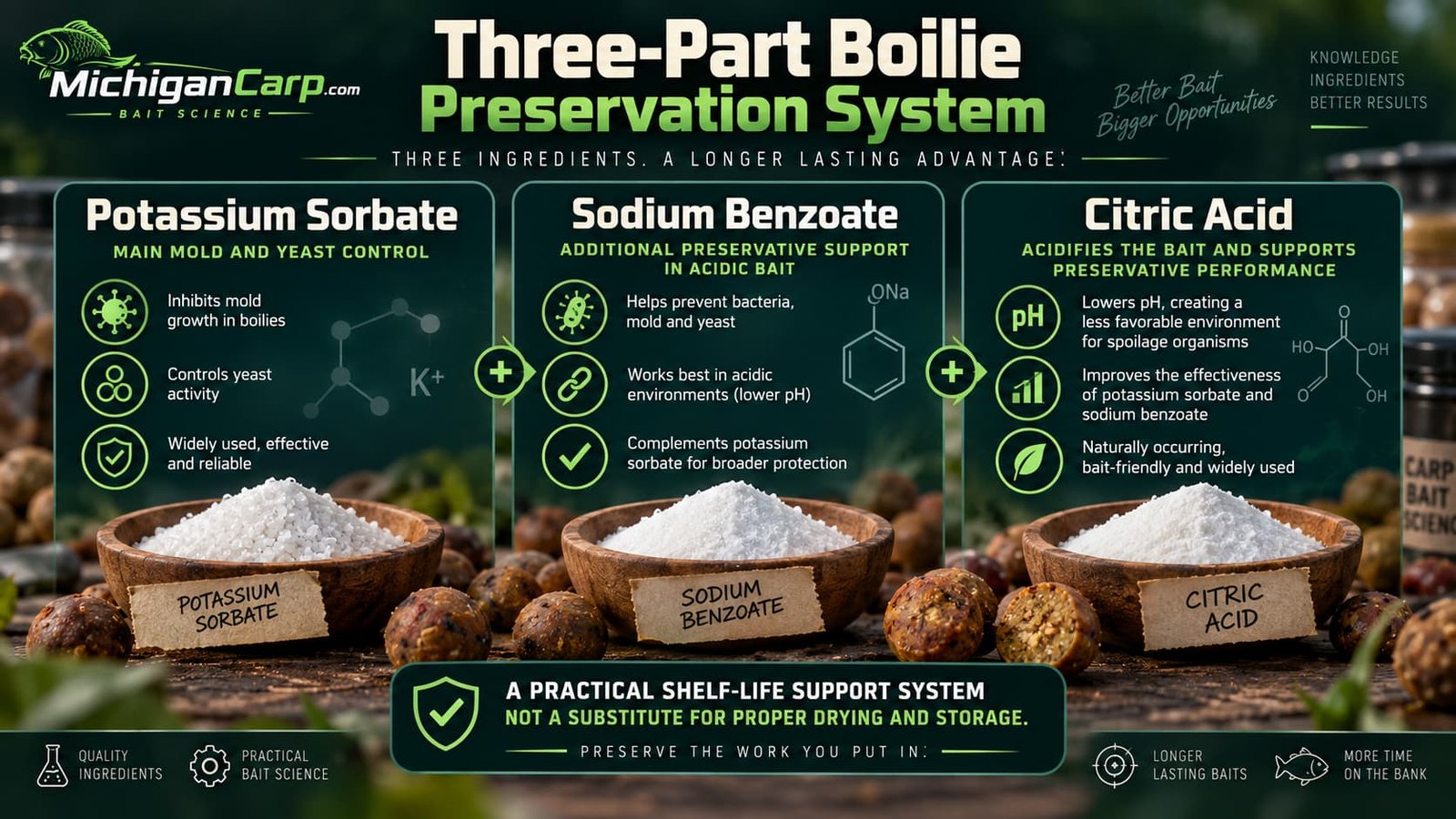
In my own shelf-life milk-and-nut boilies, I have used potassium sorbate, sodium benzoate and citric acid together rather than expecting one ingredient to do everything.
They have different jobs:
- Potassium sorbate provides the main yeast-and-mold control.
- Sodium benzoate provides additional preservative support when the bait is sufficiently acidic.
- Citric acid helps create the acidic environment in which those weak-acid preservatives work more effectively.
None of them makes poor bait indestructible. The boilies still need to be made cleanly, cooked correctly, dried properly, cooled before packaging and stored sensibly.
For most home boilie makers, freezing is the easy option. Use a preservative system when you have a genuine reason to keep bait at room temperature.
For the wider preservation picture, read Carp Bait Preservatives: What They Really Do. For practical freezing and storage, use How to Store Homemade Boilies.
Quick Answer
If you are making freezer boilies for your own fishing, you normally do not need the full potassium-sorbate, sodium-benzoate and citric-acid system.
If you are deliberately making longer-lasting shelf-life bait, the three ingredients can be used together as part of the preservation system.
| Ingredient | Main Practical Job |
|---|---|
| Potassium sorbate | Main control against mold and yeast |
| Sodium benzoate | Additional antimicrobial support in sufficiently acidic bait |
| Citric acid | Acidifies the bait and supports preservative performance |
| Propylene glycol | Liquid carrier and humectant support |
| Glycerin | Humectant and texture support |
| Drying | Removes moisture and improves storage stability |
| Freezing | Best default storage method for most homemade boilies |
Table of Contents
Do Homemade Boilies Actually Need Preservatives?
Not necessarily.
This is the first decision I would make before weighing any preservative.
If I am making bait for my own fishing and have freezer space available, I generally prefer to make the bait, dry it appropriately, divide it into session-sized bags and freeze it.
That keeps the preservation system simple and lets me concentrate on making the bait I actually want to fish with.
A preservative system becomes more useful when I specifically want:
- bait that can travel without remaining frozen;
- longer room-temperature storage;
- session bait that can remain out for several days;
- longer-lasting shelf-life hookbaits;
- a deliberately developed shelf-life boilie.
That is different from adding preservatives automatically to every batch.
If freezer storage already solves the problem, there is little reason to make the recipe more complicated.
What Potassium Sorbate, Sodium Benzoate and Citric Acid Actually Do
Potassium Sorbate
Potassium sorbate is the preservative I mainly associate with controlling molds and yeasts in shelf-life boilies.
It is widely used as an antimicrobial preservative in food systems, and US regulations list food-grade potassium sorbate as generally recognized as safe when used according to good manufacturing practice. See 21 CFR §182.3640 — Potassium Sorbate.
That food regulation does not give us a universal carp-bait recipe, and I would not pretend that it does.
In boilies, potassium sorbate is simply one useful part of a wider preservation system.
Sodium Benzoate
Sodium benzoate is another preservative, but it becomes more useful as the product becomes more acidic.
I therefore do not treat it as a direct replacement for potassium sorbate. In my system it provides additional preservative support alongside sorbate and citric acid.
“US human-food regulation states that sodium benzoate use should not exceed good manufacturing practice and that current usage results in a maximum level of 0.1% in food. That is a human-food reference—not a carp-bait rule—but it is one reason I no longer present my old 2 g inclusion as something readers should automatically copy.”
See 21 CFR §184.1733 — Sodium Benzoate.
Citric Acid
Citric acid has a different job.
I use it primarily to make the bait more acidic and create a better working environment for the sorbate and benzoate system.
It should not be thought of as simply another mold inhibitor that can replace the other two ingredients.
How much the finished bait changes depends on the complete recipe. Eggs, milk proteins, milk replacer, soy, minerals and other ingredients can all resist or buffer changes in acidity.
For anglers who want the deeper chemistry, that subject belongs in How pH Changes Carp Bait Performance. You do not need to understand every part of pH chemistry simply to make freezer bait.
The Preservation System I Have Used in My Own Boilies
My practical experience with this system comes from a rich milk, nut, cereal and birdfood boilie rather than a simple test mix.
The base contained ingredients such as Ultra 24 milk replacer, whey protein, cream powder, lactose, tiger nut flour, full-fat soy, birdfood, semolina and maize.
The older preservation package for a recipe built around a 1 kg core dry mix was:
| Ingredient | Historical Amount | How I View It Now |
|---|---|---|
| Potassium sorbate | 3 g | Still a practical development amount in this type of batch |
| Sodium benzoate | 2 g | Historical amount; I would not automatically repeat it |
| Citric acid | 2 g | Useful starting point for the acidification side of this particular mix |
| Propylene glycol | 20 ml | Carrier and humectant support |
| Glycerin | 10 ml | Humectant and texture support |
Eight eggs and several other liquids took the actual paste well above the original 1 kg of dry base.
That matters because 2 g of sodium benzoate in roughly 1.5 kg of completed paste is approximately 0.13%.
For that reason, I now regard the old 2 g level as part of my development history rather than a blanket recommendation.
If I were developing that same batch again, I would start the sodium benzoate closer to 1.5 g rather than automatically returning to 2 g.
That would give me a working trial of approximately:
3 g potassium sorbate + 1.5 g sodium benzoate + 2 g citric acid
for this specific style and scale of recipe.
I want to be clear about what that means.
It is a practical development starting point from my own bait system. It is not a scientifically validated universal dose for every boilie recipe.
A much drier cereal bait, a very soft high-moisture bait, a small hookbait batch and a heavily glugged boilie are not the same product.
How I Add the Preservatives to the Boilie Mix
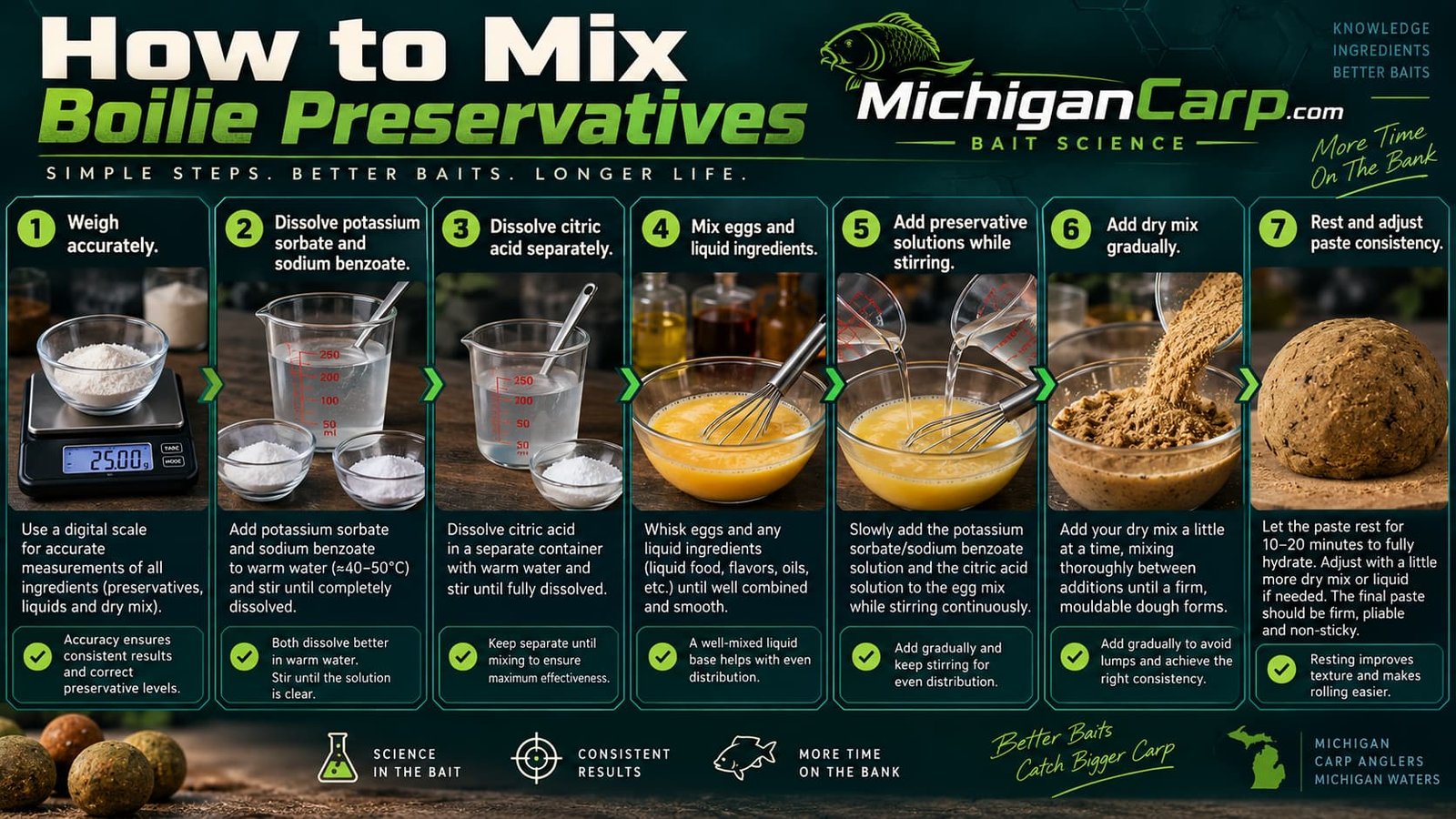
The practical issue is not only how much preservative you use. It also needs to be distributed through the bait.
I would not sprinkle small concentrated amounts of preservative powder randomly into finished dough and hope they spread evenly.
A simpler method is:
- Weigh the preservative ingredients accurately. Small quantities require a scale capable of measuring fractions of a gram reliably.
- Dissolve the potassium sorbate and sodium benzoate. Use a measured portion of the water-containing liquid already going into the recipe where practical.
- Prepare the citric acid separately. Dissolve it in another small measured portion of liquid.
- Mix the eggs thoroughly. Combine yolks and whites before the other liquids are added.
- Add PG, glycerin and the other liquid ingredients.
- Mix in the dissolved preservatives while stirring continuously.
- Add the citric-acid solution into the wider liquid phase.
- Add the dry mix gradually. Build the paste normally and allow it to rest before making final consistency adjustments.
Any water used to dissolve ingredients is still part of the recipe. Do not add a large unmeasured amount simply because the powders dissolve more easily that way.
Preservatives Do Not Replace Proper Drying
This is probably the most important practical warning in the article.
Adding sorbate, benzoate and citric acid does not mean you can bag warm, damp boilies straight from the drying rack and expect them to keep indefinitely.
The bait still needs to be cooked properly, drained, cooled and dried.
Large boilies need particular attention.
A 20 or 24 mm milk-and-nut bait can become firm outside while remaining noticeably softer inside. High-fat ingredients, milk powders and dense dough can also alter how quickly moisture leaves the centre.
I therefore treat drying time as an observation rather than a guarantee.
Forty-eight hours does not automatically mean shelf life. Seventy-two hours does not automatically mean shelf life either.
Use How to Boil and Dry Boilies Properly for the practical production workflow.
Where Propylene Glycol and Glycerin Fit In
Propylene glycol and glycerin are useful supporting ingredients, but I do not count them as substitutes for potassium sorbate or sodium benzoate.
In my own system, PG helps with liquid distribution and acts as a humectant. Glycerin also influences moisture behaviour while helping keep the finished bait less brittle.
The important point is that neither ingredient gives me permission to assume the bait is automatically shelf stable.
For the full comparison, see Propylene Glycol vs Glycerin in Carp Bait.
How I Store Preserved Boilies
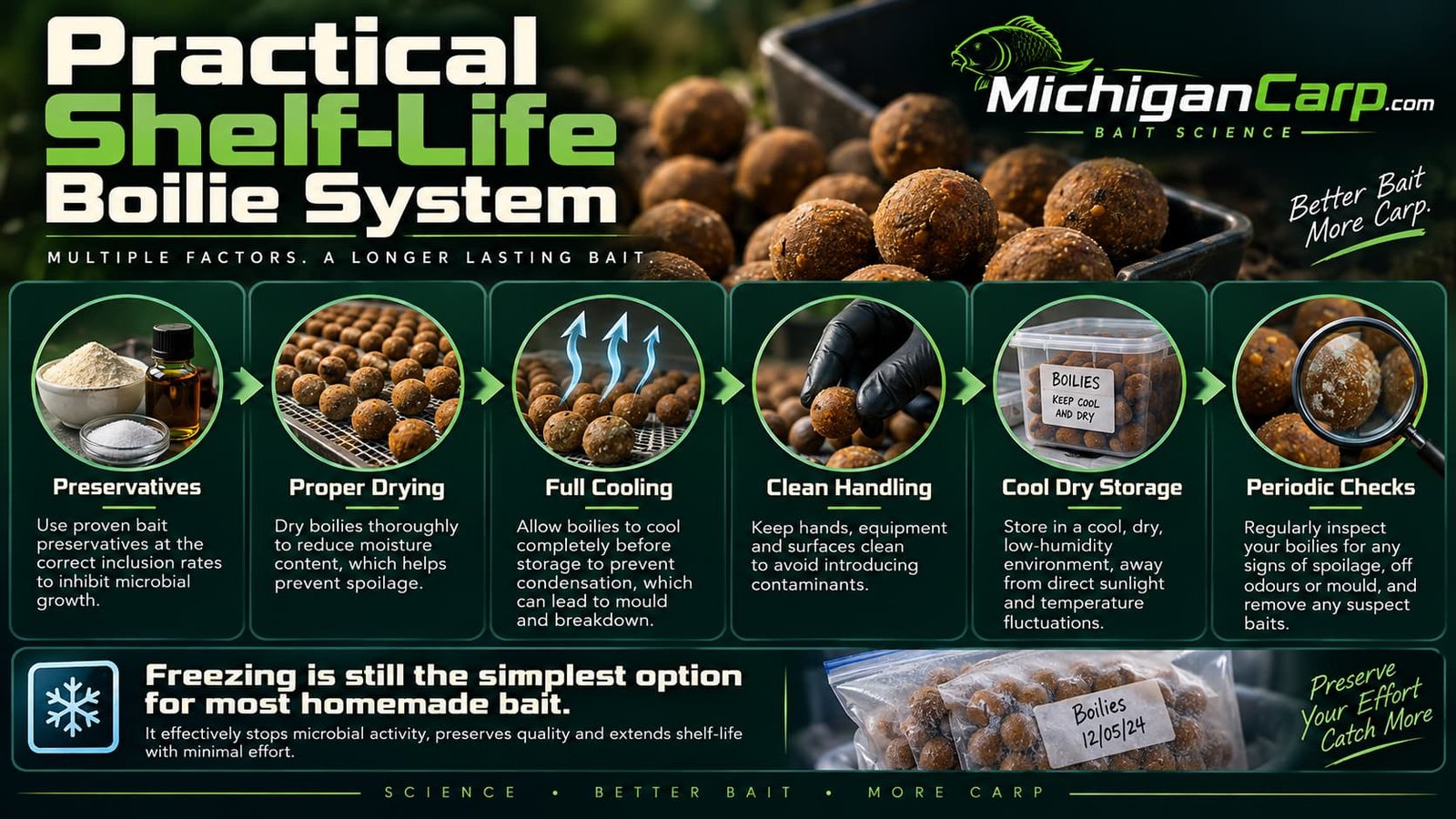
Preserved boilies still need sensible storage.
Before bagging, make sure the bait is completely cool. Warm boilies sealed in a bag can create condensation as they cool.
Store shelf-life bait:
- cool;
- dry;
- out of direct sunlight;
- away from hot vehicles and sheds;
- in clean, dry bags or tubs;
- away from insects and rodents.
I would also check stored bait periodically rather than assuming the preservative has made it maintenance-free.
If bait develops visible mold, abnormal souring, sweating, package swelling or a clearly rancid smell, I would discard it rather than trying to rescue it.
For normal homemade bait, the easier option remains dry, portion and freeze.
What These Preservatives Cannot Do
It is easy to give preservatives too much credit.
Potassium sorbate, sodium benzoate and citric acid do not fix every storage problem.
They cannot:
- turn wet bait into properly dried bait;
- make dirty equipment hygienic;
- repair poor packaging;
- stop bait absorbing moisture from humid air;
- prevent all fat oxidation;
- make stale ingredients fresh again;
- guarantee a fixed number of months of storage;
- make an unattractive boilie into a good carp bait.
That last point matters.
The preservation package exists to help protect the bait. It is not the attraction package.
My Plum–Scopex–Vanilla milk-and-nut boilie still gets its bait character from the milk ingredients, nut meals, birdfood, soluble ingredients, flavour profile and physical structure—not from potassium sorbate.
Mold Control Is Not the Same as Preventing Rancidity
This is particularly important with milk-and-nut boilies.
A bait can remain visibly mold-free and still deteriorate because fats in nut meals, seeds, dairy ingredients or added oils oxidize.
Sorbate and benzoate are antimicrobial preservatives. They are not complete solutions to fat oxidation.
Use fresh ingredients, avoid excessive warm storage and do not assume that “no mold” means “still good.”
Common Preservative Mistakes
- Adding preservatives when the bait will simply be frozen. Often unnecessary.
- Assuming potassium sorbate alone guarantees shelf life. It does not.
- Using more because more sounds safer. The aim is controlled preservation, not maximum chemical loading.
- Copying my historical 2 g sodium-benzoate amount without context. I now treat that as development history.
- Sprinkling tiny amounts into finished dough. Poor distribution creates uncertainty.
- Using an inaccurate kitchen scale. Small preservative quantities need accurate weighing.
- Adding unmeasured water to dissolve the preservatives. That water becomes part of the paste.
- Bagging boilies while warm. Cooling can create condensation inside the package.
- Assuming a hard boilie must be preserved. Hardness and shelf life are not the same thing.
- Ignoring rancidity. Mold is not the only way a bait can deteriorate.
My Practical View
I think homemade boilie preservation should be kept in proportion.
Most carp anglers do not need to reproduce commercial food-production testing to make effective bait.
If you roll bait for your own fishing and have access to a freezer, freezing is still the simplest and most dependable system.
I use the sorbate, benzoate and citric-acid combination when I have a reason to make a more durable shelf-life product.
My historical system showed me that the three ingredients can be used together logically, but it also showed why old recipes should be reviewed instead of copied forever.
The old 3 g sorbate, 2 g benzoate and 2 g citric-acid package is part of that development history.
If I were making the same approximate batch today, I would begin with:
3 g potassium sorbate + about 1.5 g sodium benzoate + 2 g citric acid
and treat it as a practical development starting point for that particular milk-and-nut formula—not a universal prescription for every boilie.
Then I would still make the bait cleanly, dry it properly, cool it fully and store it sensibly.
Use preservatives because they solve a real storage problem—not because every homemade boilie needs them.
FAQ
What Potassium Sorbate in Boilies Actually Does?
No. Freezer boilies normally do not need a full shelf-life preservative system. Potassium sorbate becomes more useful when you deliberately want longer room-temperature storage.
What does potassium sorbate do in boilies?
I use potassium sorbate mainly to help control molds and yeasts in shelf-life bait. It is one part of the preservation system rather than a guarantee by itself.
Why use sodium benzoate as well?
Sodium benzoate provides additional antimicrobial support in an appropriately acidic system. I use it alongside potassium sorbate rather than as a direct substitute.
Why is citric acid added?
Citric acid helps acidify the bait, which can improve the working conditions for sorbate and benzoate. Its exact effect depends on the complete recipe.
How much potassium sorbate have you used?
My historical milk-and-nut shelf-life mix used 3 g of potassium sorbate in a recipe built around 1 kg of core dry base. I treat that as a practical development amount for that type of recipe rather than a universal dose.
How much sodium benzoate have you used?
My older recipe used 2 g, but once the complete paste weight was considered I decided that should remain development history rather than a general recommendation. For the same approximate 1.5 kg finished-paste range, I would begin closer to 1.5 g today.
Can I just use potassium sorbate and leave out sodium benzoate?
You can formulate a simpler preservation system, but it is not automatically equivalent to the three-part system described here. For ordinary home freezer bait, I would usually simplify the storage method before complicating the preservative recipe.
Should I use the full preservative system in freezer boilies?
Usually not. If freezing is providing the main storage protection, the complete ambient shelf-life system is normally unnecessary.
Can preserved boilies still go bad?
Yes. Poor drying, contamination, moisture pickup, damaged packaging and fat oxidation can still damage a preserved bait. Preservatives reduce particular risks; they do not make the bait permanent.
Next Steps
If you are deciding whether you need preservatives at all, start with How to Store Homemade Boilies.
For the wider preservation science, read Carp Bait Preservatives: What They Really Do.
For processing and drying, use How to Boil and Dry Boilies Properly.
For the two main liquid carriers and humectants, read Propylene Glycol vs Glycerin in Carp Bait.
If you want to understand why acidification affects preservatives, use How pH Changes Carp Bait Performance.
And before committing a new batch to a long session, use How to Test Boilies Before Fishing to check how the finished bait actually behaves in water.