

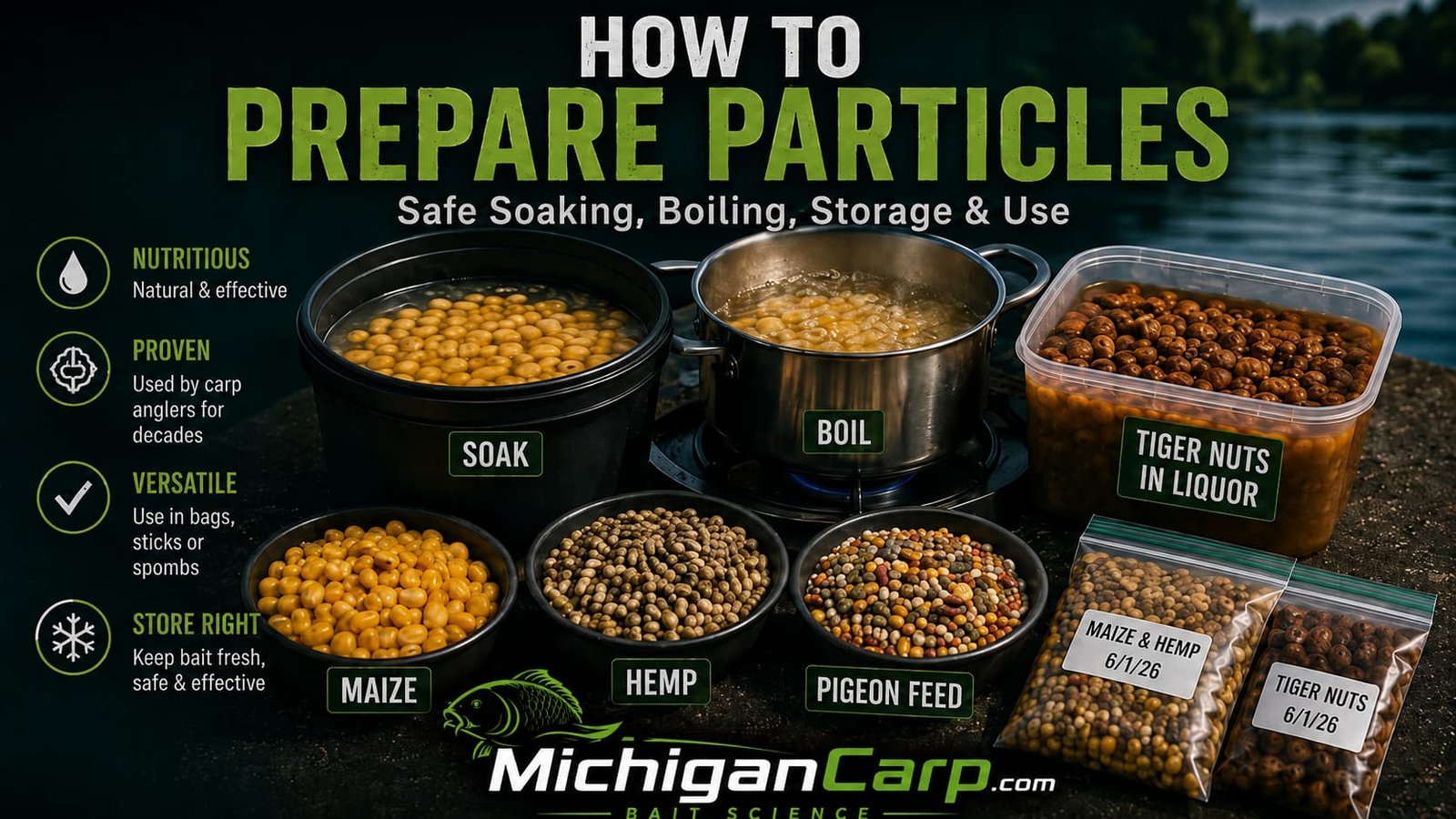
Learning how to prepare particles for carp fishing properly is one of the most useful bait-preparation skills a carp angler can develop.
Canned sweet corn can be opened and fished immediately.
Dry maize, tiger nuts, peanuts, chickpeas, maple peas, hemp, pigeon feed and many other dry grains, seeds and pulses are different.
They normally need to be hydrated and cooked before they become practical carp bait.
The basic preparation route is:
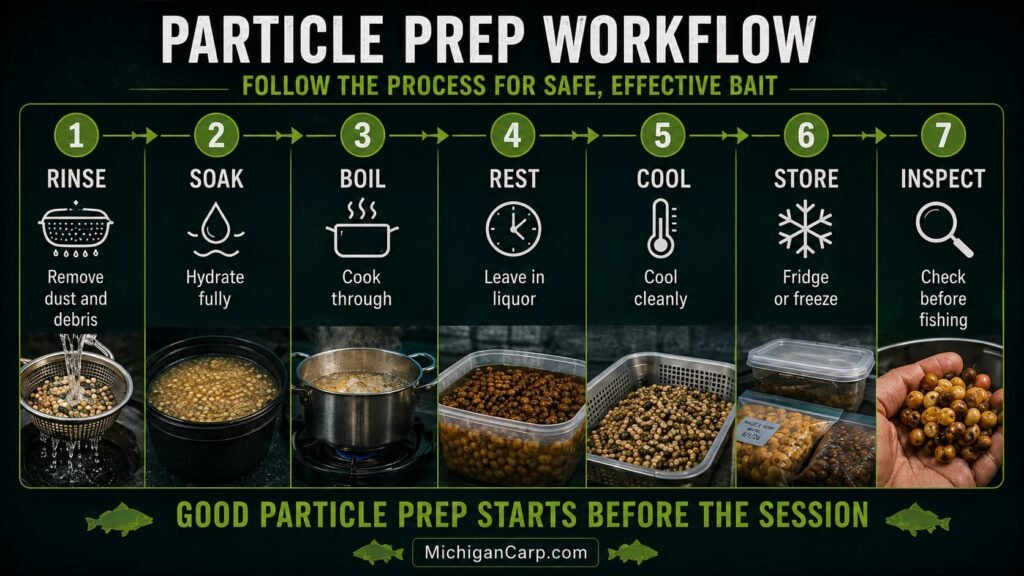
RINSE → SOAK → COOK → CHECK → REST → COOL → STORE.
The exact timing changes with the particle, its size, its age, how dry it is and the particular batch you bought. That is why the times in this guide are practical starting points rather than guarantees.
This page deals specifically with preparation.
For particle choice, feeding amounts, seasonal use and fishing strategy, read Particles for Carp Fishing.
For wider bait preparation, storage and troubleshooting, use The Bait Shed.
My basic rule is simple:
DO NOT PUT DRY, HARD PARTICLES INTO THE WATER AND HOPE THEY WILL BE FINE.
KNOW WHAT YOU ARE USING, PREPARE IT PROPERLY AND CHECK THE FINISHED BAIT BEFORE FISHING.
Table of Contents
Quick Start: How to Prepare Particles for Carp Fishing
If you only need the basic process, use this workflow.
| Stage | What to Do | Why It Matters |
|---|---|---|
| Rinse | Remove dust, chaff and obvious debris | Starts with cleaner raw material |
| Soak | Cover with plenty of clean water | Hydrates dry particles before cooking |
| Cook | Boil or simmer until properly softened | Produces a more consistent prepared particle |
| Check | Cut or crush several of the larger particles | The bait matters more than the timer |
| Rest | Leave suitable particles in their fresh cooking liquor | Allows further hydration and retains soluble material |
| Cool | Cool in clean conditions | Improves handling and storage |
| Store | Use promptly, refrigerate or freeze | Prepared particles are wet food |
| Inspect | Check condition before fishing | Discard suspect bait |
Do not assume something is ready simply because it has been boiling for a specified number of minutes.
Check the actual particle.
Which Carp Particles Need Preparation?
Some particle-style baits are ready to use. Most dry particles are not.
Ready-to-Use Baits
Canned sweet corn is already cooked and can normally be used directly from the can.
Commercially prepared particles sold in jars, tins, pouches or vacuum packs may also be ready to use. Follow the manufacturer’s instructions.
For the difference between canned corn and dry maize, read Corn for Carp in Michigan.
Dry Particles That Normally Need Preparation
Common examples include:
- maize and field corn;
- giant maize;
- hemp;
- tiger nuts;
- peanuts;
- pigeon feed;
- wheat;
- barley;
- maple peas;
- chickpeas;
- other known bait pulses;
- mixed seed and grain blends.
The most important word there is known.
Do not use an unidentified dried bean, seed or pulse simply because it happens to be included in livestock feed or looks similar to a particle you have used before.
Identify the ingredient first.
The Basic Particle Preparation Method
Step 1 — Inspect and Rinse
Start by looking at the dry bait.
Reject anything that is obviously moldy, damp, rancid, badly damaged or contaminated.
Then rinse the particles with clean water to remove dust, loose husks, chaff and obvious debris.
You are not trying to sterilize the bait. You are simply starting with cleaner material.
Step 2 — Soak
Place the particles in a clean food-safe bucket, tub or pan and add plenty of water.
Dry particles can absorb surprisingly large amounts of water, so leave plenty above the bait and check the level during longer soaks.
Do not allow the upper layer to dry out.
Soaking starts hydration before cooking and is especially important with larger, harder particles.
Step 3 — Boil or Simmer
After soaking, cook the particles until they are properly hydrated and softened for their intended use.
Small seeds and grains can cook relatively quickly. Large maize, chickpeas, maple peas and other dense particles usually take longer.
Keep enough water in the pan throughout cooking.
Step 4 — Check the Bait
This is one of the most important stages.
Take several particles from different parts of the batch.
Cut, crush or squeeze them.
If a large grain still has a dry, chalky or very hard center, continue preparing it.
The clock gives you a starting point.
The particle tells you when the batch is ready.
Step 5 — Rest in the Fresh Cooking Liquor
Many prepared particles benefit from being allowed to rest after cooking.
The fresh cooking liquor contains starches and other water-soluble material released during preparation, so it does not automatically need to be discarded.
An overnight rest works well for many grain-based mixes.
Tiger nuts are commonly rested for longer.
For a dedicated treatment of tiger nuts, see Tiger Nuts for Carp Fishing.
Step 6 — Cool Cleanly
Prepared particles are wet food.
Do not seal a steaming bucket of wet bait, leave it in direct summer sun and assume it will remain in good condition.
Use clean tubs, lids and utensils and cool the bait sensibly before longer storage.
Step 7 — Store Properly
Use freshly prepared particles promptly when possible.
For longer storage, refrigeration or freezing is more predictable than leaving wet bait at warm room temperature.
Freezing in session-sized bags is particularly useful because you can thaw only what you need.
Particle Preparation Times
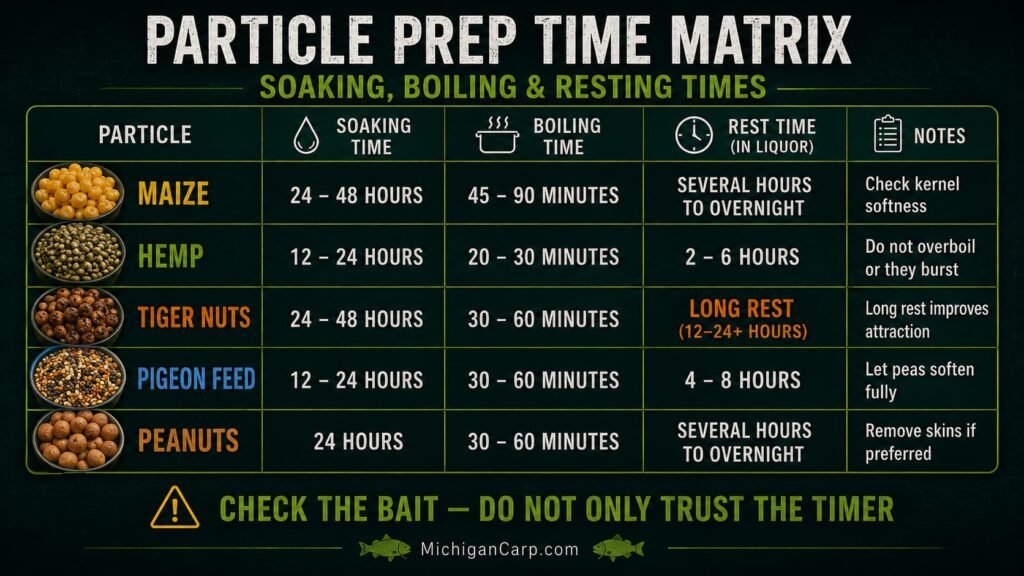
The following table gives practical starting points.
They are not laboratory specifications and they are not substitutes for checking the finished bait.
| Particle | Typical Soak | Typical Cook | Typical Rest |
|---|---|---|---|
| Canned sweet corn | None | None | None |
| Maize / field corn | 24–48 hours | 45–90 minutes | Overnight |
| Giant maize | 24–48 hours | 60–90 minutes | Overnight |
| Hemp | 12–24 hours | 20–30 minutes | Rest after cooking |
| Wheat | 12–24 hours | 20–40 minutes | Several hours / overnight |
| Barley | 12–24 hours | 20–40 minutes | Several hours / overnight |
| Pigeon feed | 12–24 hours | 30–60 minutes | Overnight |
| Maple peas | 12–24 hours | 30–60 minutes | Overnight |
| Chickpeas | About 24 hours | 45–75 minutes | Overnight |
| Tiger nuts | 24–48 hours | 30–60 minutes | 24 hours or longer |
| Peanuts | About 24 hours | 30–60 minutes | Several hours / overnight |
Preparation requirements change with size, hardness and supplier.
If the particle is still dry or hard internally, continue preparing it.
How to Prepare Maize and Field Corn
Dry maize is one of the cheapest and most useful bulk carp particles, but it is completely different from canned sweet corn.
Basic Maize Method
- Inspect and rinse the maize.
- Soak for 24–48 hours in plenty of water.
- Boil or simmer for roughly 45–90 minutes.
- Check several of the larger grains.
- Continue cooking if centers remain dry-hard.
- Rest overnight in the fresh cooking liquor.
- Cool and store cleanly.
The finished maize should be swollen and hydrated rather than resembling the original hard dry grain internally.
For fishing strategy rather than preparation, use Corn for Carp in Michigan.
How to Prepare Hemp
Hemp is much smaller than maize and generally cooks more quickly.
Basic Hemp Method
- Rinse the hemp.
- Soak for around 12–24 hours.
- Boil or simmer for around 20–30 minutes.
- Watch for many seeds beginning to split.
- Allow the hemp to rest in its liquor.
- Cool and store cleanly.
A batch does not need every single seed to open at the same moment, but widespread splitting is a useful practical indicator.
Because hemp is wet and fine-textured after cooking, I prefer to prepare manageable quantities rather than leaving a large warm bucket sitting around for days.
How to Prepare Tiger Nuts
Tiger nuts are dense tubers rather than true nuts, and they make particularly durable particle hookbaits.
They deserve careful preparation because they start out very hard.
Basic Tiger Nut Method
- Inspect and rinse the tiger nuts.
- Soak for 24–48 hours.
- Boil or simmer for approximately 30–60 minutes.
- Check their internal texture.
- Rest in the fresh cooking liquor for at least 24 hours.
- Use promptly, refrigerate or freeze.
Tiger nut liquor may become thicker and sweeter-smelling as the prepared nuts rest.
That is different from simply leaving a dirty bucket of wet bait warm until it spoils.
For hookbait use, feeding levels and Michigan applications, read Tiger Nuts for Carp Fishing.
How to Prepare Peanuts for Carp
Peanuts can be effective carp bait, but quality control matters before they ever reach the soaking bucket.
Start with sound peanuts from a reputable food-grade or properly controlled bait source.
Reject moldy, badly discolored, shriveled, insect-damaged, stale or rancid peanuts.
This is not simply about appearance. Peanuts are among the crops susceptible to mold and mycotoxin problems, and cooking is not a sensible way to try to rescue questionable raw material. The FDA overview of mycotoxins provides useful background on why raw-material quality matters.
Basic Peanut Method
- Inspect the peanuts carefully.
- Discard damaged or questionable nuts.
- Rinse thoroughly.
- Soak for around 24 hours.
- Boil or simmer for approximately 30–60 minutes.
- Check that they have hydrated and softened consistently.
- Rest in the fresh cooking liquor.
- Cool and store cleanly.
Peanuts are richer and oilier than bulk grains such as maize, so I regard them as a controlled component of a particle mix rather than an automatic bucket-filler.
If prepared peanuts smell rancid, stale or otherwise wrong, discard them.
How to Prepare Pigeon Feed
Pigeon feed is not one standardized recipe.
One bag may contain mostly wheat, milo and small seeds. Another may contain substantial amounts of maize, peas or larger pulses.
Read the ingredient list before deciding how to prepare it.
Basic Pigeon Feed Method
- Inspect the blend.
- Identify the largest and hardest important ingredients.
- Rinse the mix.
- Soak for around 12–24 hours, longer if the blend contains substantial hard maize or large pulses.
- Boil or simmer for approximately 30–60 minutes.
- Check the largest particles, not just the small seeds.
- Rest overnight where appropriate.
- Cool and store cleanly.
The mistake is judging the whole bucket by the easiest item to cook.
If the wheat and hemp look ready but the large maize is still hard internally, the mix is not finished.
Chickpeas, Maple Peas and Other Bait Pulses
Chickpeas, maple peas and other established bait pulses can make useful carp particles.
But this is one area where I do not recommend treating every dried bean as interchangeable.
Different legumes contain different naturally occurring compounds and can have different preparation requirements.
For example, the U.S. Food and Drug Administration specifically warns that raw or inadequately cooked kidney beans can contain high levels of phytohaemagglutinin and provides specific soaking and boiling guidance for human food preparation. See the FDA Natural Toxins in Food guidance.
That is human-food safety guidance rather than a carp-feeding study, but it makes an important practical point:
DO NOT ASSUME ONE GENERIC PARTICLE METHOD IS SUITABLE FOR EVERY UNKNOWN DRIED BEAN.
Basic Method for Known Bait Pulses
- Identify what you are using.
- Inspect and rinse it.
- Soak thoroughly — commonly 12–24 hours or longer for large hard items.
- Cook until softened completely through.
- Check several of the largest items.
- Rest where appropriate.
- Cool and store cleanly.
If the center remains hard, chalky or dry, continue preparation.
If you cannot positively identify the dried bean or pulse, there is little reason to experiment with it when established carp particles are readily available.
Wheat and Barley Preparation
Wheat and barley are common small grains in mixed feeds and can create a large number of individual food items.
Basic Wheat and Barley Method
- Inspect and rinse.
- Soak for around 12–24 hours.
- Simmer for approximately 20–40 minutes.
- Check the grains for consistent hydration.
- Rest in their fresh cooking liquor.
- Cool and store.
How much wheat or barley you should actually feed is a baiting-strategy question rather than a preparation question.
That wider subject is covered in Particles for Carp Fishing.
How to Prepare Mixed Particles
Mixed particles cause more preparation mistakes than single-particle batches because different ingredients hydrate and soften at different rates.
Small seeds may look completely cooked while the largest maize or pulse remains firm.
My practical rule is:
PREPARE A MIX FOR THE HARDEST IMPORTANT PARTICLE, NOT THE SOFTEST ONE.
That means checking the ingredient list before soaking and physically testing the larger particles during cooking.
If a mixture contains ingredients with radically different preparation requirements, there is nothing wrong with cooking them separately and combining them afterward.
That can actually give you much better control over the final mix.
Should You Add Salt, Sugar, Molasses or Other Liquids?
You can add attractors to particles, but good particle preparation does not depend on turning the bucket into a chemistry experiment.
Freshly cooked particles already bring their own water-soluble material, starches, oils and natural food signals.
Simple Additions
Depending on the bait and the fishing situation, modest additions might include:
- a little salt;
- a little sugar;
- a small amount of molasses;
- a CSL-style liquid;
- a yeast-based liquid;
- a light flavor or sweetener;
- the fresh cooking liquor from the current batch.
I would rather use one or two additions for a clear reason than pour five different liquids into the same bucket.
Record what you use so a good batch can be repeated.
For broader liquid selection, read When to Use Each Type of Carp Bait Liquid.
For formulation rather than particle preparation, see Boilie Liquids and Additives.
What I Would Avoid
- huge amounts of oil;
- multiple strong flavors fighting each other;
- so much syrup that the mix becomes difficult to handle;
- unrecorded treatments you cannot reproduce;
- routinely carrying old particle liquor from one batch into the next.
If you deliberately ferment particles, treat that as a separate controlled process rather than accidental storage.
Resting Particles Is Not the Same as Fermenting Them
This distinction is worth making clearly.
Normal Resting
Normal resting means allowing cooked particles to remain in their fresh cooking liquor while they cool and continue hydrating.
The smell may become stronger, sweeter, grainier or nuttier depending on the particle.
Tiger nut liquor in particular may become thicker after resting.
Deliberate Fermentation
Controlled fermentation is a separate bait-preparation technique.
It should be intentional and repeatable rather than something that happened because a wet bucket sat warm for several days.
Spoilage
Do not confuse either process with obvious spoilage.
If particles show visible mold, smell putrid or rotten, contain questionable contamination or have been handled so badly that you no longer trust the batch, discard them.
There is no bait advantage worth fishing something you do not trust.
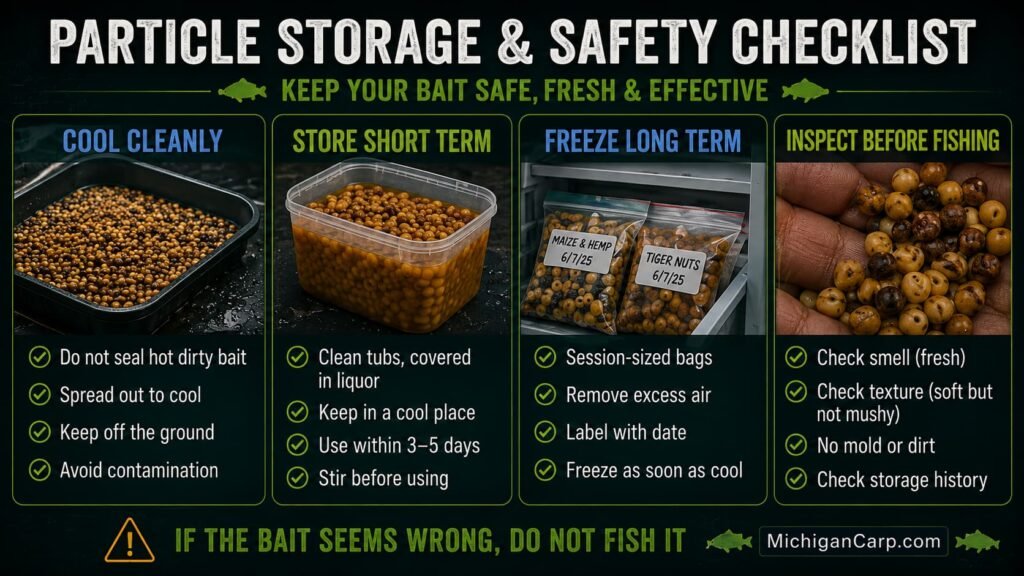
How to Store Prepared Particles
Once water has been added and the bait has been cooked, the storage problem changes completely.
You are now dealing with wet food.
Short-Term Storage
- use clean containers and lids;
- keep the bait shaded;
- refrigerate where practical;
- use clean scoops rather than dirty hands;
- avoid repeatedly warming and cooling the same bucket;
- inspect before fishing.
Freezing
Freezing is one of the simplest ways to manage prepared particles for carp fishing.
- divide bait into session-sized bags;
- include enough fresh cooking liquor to keep the particles moist;
- label the contents;
- label the preparation date;
- flatten bags to save freezer space;
- thaw only what you expect to use.
This is especially useful for multi-day Michigan trips because the main supply can remain frozen or cold while only a manageable quantity travels to the swim.
On the Bank
- keep buckets out of direct sun;
- keep lids on when practical;
- use a cooler during hot weather when possible;
- avoid dipping dirty baiting tools back into stored bait;
- do not keep questionable leftovers just because bait cost money.
For broader bait-storage guidance, use The Bait Shed.
Can You Use Wet Particles in PVA?
Ordinary wet particles can compromise water-soluble PVA before you cast.
That includes wet maize, hemp, corn, pigeon feed and particle liquor.
Do not assume that draining a handful in a sieve automatically makes it PVA-safe.
If you want to use particles with PVA, test the exact particle, liquid and PVA product before fishing.
Otherwise, keep the wet particles separate and use dry boilie crumb, pellets, ground bait or another suitable dry material in the bag or stick.
The important rule is:
TEST IT BEFORE YOU CAST IT.
Hookbait Particles vs Freebait Particles
Safe preparation is the same starting point, but hookbaits and free offerings do not always need exactly the same final texture.
Particle Hookbaits
A maize grain, chickpea, peanut or tiger nut used on the hair needs enough integrity to survive mounting, casting and time in the water.
You may therefore select particularly sound pieces from the finished batch and store them separately.
Tiger nuts may need drilling rather than forcing a baiting needle through a particularly hard specimen.
Freebait
Free offerings can generally be softer because they do not need to remain attached to the rig.
But softer does not mean decomposing.
Prepare the bait properly, store it cleanly and feed amounts appropriate to the fishing situation.
How to Check Prepared Particles Before Fishing
Before a prepared batch goes into the lake, make a final check.
- Do the particles look normal for that bait?
- Are the largest pieces hydrated and cooked through?
- Is there visible mold?
- Does the bait smell clean, cooked or intentionally fermented rather than rotten?
- Has it been stored reasonably?
- Have the peanuts or other high-risk raw materials developed rancid or suspicious odors?
- Has a frozen batch been repeatedly thawed and warmed?
- Would you be comfortable putting this batch into the water around feeding fish?
If you are genuinely doubtful, throw the batch away.
Particles are inexpensive compared with the cost of the trip and the value of fishing responsibly.
Common Particle Preparation Mistakes
Rushing the Soak
Large maize, tiger nuts and hard pulses need time to hydrate.
Trusting the Clock Instead of the Particle
Two batches from different suppliers can behave differently.
Check the bait itself.
Treating Every Particle the Same
Hemp, maize, tiger nuts and chickpeas are physically different ingredients.
A single timetable cannot describe every particle perfectly.
Judging a Mixed Feed by the Small Seeds
Check the maize, peas and other large components before calling a mixed batch ready.
Starting With Poor Raw Material
Soaking and boiling do not magically convert moldy, rancid or badly contaminated ingredients into quality bait.
Using Dirty Containers
There is little point preparing particles carefully and then putting them into a filthy bucket.
Leaving Wet Bait Warm Too Long
This becomes especially important during hot-weather Michigan sessions.
Making Far More Than You Need
Oversized batches create storage problems and can encourage unnecessary baiting.
Overloading the Bucket With Additives
A well-prepared food item does not require half the bait cupboard poured over it.
Confusing Spoilage With Fermentation
If you want to ferment bait, do it deliberately.
Do not automatically rename a neglected warm bucket “fermented particles.”
Michigan Particle Preparation Notes
Particle preparation becomes especially practical on Michigan waters because many of our sessions involve public access, campgrounds, boat-in sites, reservoirs, weedbeds and multi-day fishing.
That changes the storage problem.
A five-gallon bucket that was perfectly fine in a cool garage can become much harder to manage after hours in summer sun.
For longer trips, I prefer preparing particles before leaving home, dividing them into manageable quantities and keeping reserve bait cold or frozen until needed.
That gives me better control over:
- how much bait goes to the swim;
- how warm the reserve bait becomes;
- how often the main supply is opened;
- how much leftover bait needs dealing with at the end of the trip.
It also removes one of the worst particle-preparation habits: making an enormous bucket simply because the raw ingredients were cheap.
Prepare enough bait for the plan.
Then let the fish response determine whether you actually need more.
My Practical View
Particle preparation does not need to be complicated.
What it needs is consistency.
Start with good ingredients.
Know what is in the bucket.
Rinse it.
Soak it properly.
Cook it properly.
Check the largest particles.
Rest it where appropriate.
Cool and store it sensibly.
Then inspect it again before fishing.
The fact that maize, pigeon feed and other particles are inexpensive does not make preparation unimportant.
My rule is:
PREPARE PARTICLES LIKE THEY MATTER, BECAUSE ONCE THEY GO INTO THE WATER, THEY DO.
FAQ
How do you prepare particles for carp fishing?
For most dry carp particles, inspect and rinse them first, soak them in plenty of water, boil or simmer until properly hydrated and softened, check the actual particles, rest where appropriate, cool cleanly and store safely.
Do all carp particles need soaking and boiling?
No. Canned sweet corn and commercially prepared particles may already be ready to use. Dry maize, tiger nuts, peanuts, chickpeas, maple peas and many seed or grain blends normally require preparation.
Can you use dry maize for carp fishing?
Dry maize should be soaked and cooked before it is introduced as carp bait. Canned sweet corn is different because it has already been cooked.
How long should maize be soaked?
Twenty-four to forty-eight hours is a practical starting range for dry maize, followed by cooking until the grain is properly hydrated and softened internally.
How long should tiger nuts be soaked?
A practical starting point is 24–48 hours before boiling or simmering. I then like to rest prepared tiger nuts in their fresh cooking liquor for at least another 24 hours.
How do you know when hemp is ready?
After soaking and cooking, many of the seeds should begin to split and expose the pale inner shoot. Not every seed needs to open at exactly the same time.
Can prepared particles be frozen?
Yes. Freezing prepared particles in session-sized bags is one of the most practical ways to manage larger batches and reduce waste.
Can you ferment carp particles?
Yes, but deliberate fermentation is a separate controlled process. Do not confuse intentional fermentation with particles that have simply been stored warm until they spoil.
Can wet particles be used in PVA bags?
Wet particles can compromise ordinary water-soluble PVA. Test your exact particle, liquid and PVA product before fishing rather than assuming drained bait will be safe.
Should you add flavor to carp particles?
You can, but it is optional. Properly prepared particles already provide natural food signals. If you add liquids, keep the treatment simple and record what you used.
What should you do if prepared particles smell bad?
If the smell suggests rancidity, mold or uncontrolled spoilage and you do not trust the batch, discard it. Do not use questionable bait simply to avoid wasting it.
Next Steps
Once the preparation side is understood, use these guides for the next part of the bait decision:
- Particles for Carp Fishing — particle selection, feeding and strategy.
- Corn for Carp in Michigan — canned corn, maize and practical corn fishing.
- Tiger Nuts for Carp Fishing — preparation, hookbaits and selective feeding.
- The Bait Shed — practical bait preparation, storage and troubleshooting.
- When to Use Each Type of Carp Bait Liquid — choosing liquids for a specific purpose rather than adding them at random.