

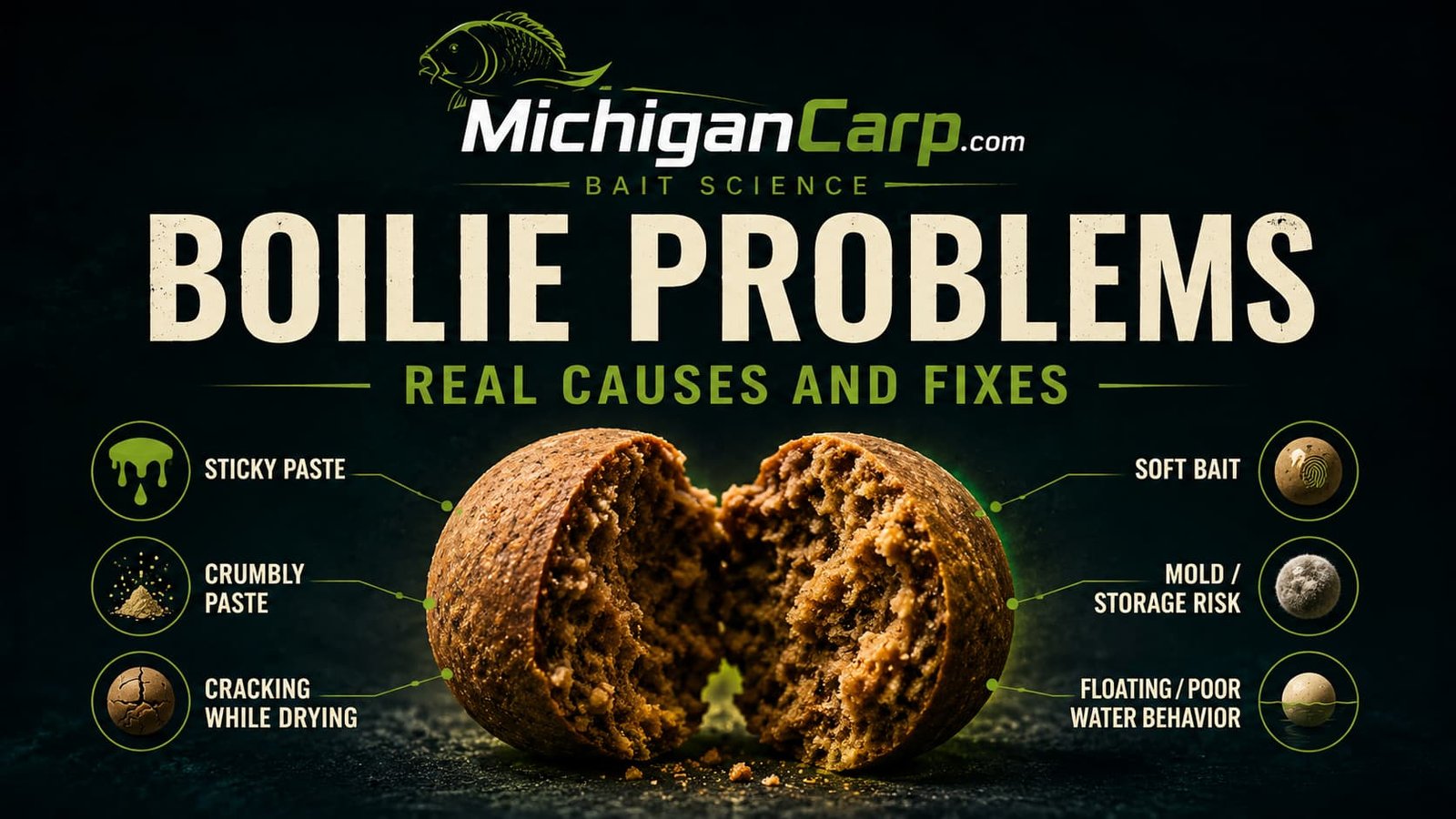
Boilie problems are rarely caused by one dramatic mistake.
Most failures come from small decisions that stack up: too much liquid, not enough rest time, poor cohesion, wrong nozzle size, overboiling, drying too fast, bagging bait too soon or judging the bait before testing it in water.
This page is the fix-it manual for homemade boilies.
Use it when paste is sticky, crumbly, too stiff or too soft. Use it when bait will not roll, splits in the sausage gun, cracks while drying, floats when it should sink, goes rock hard, goes moldy or fails on the bank.
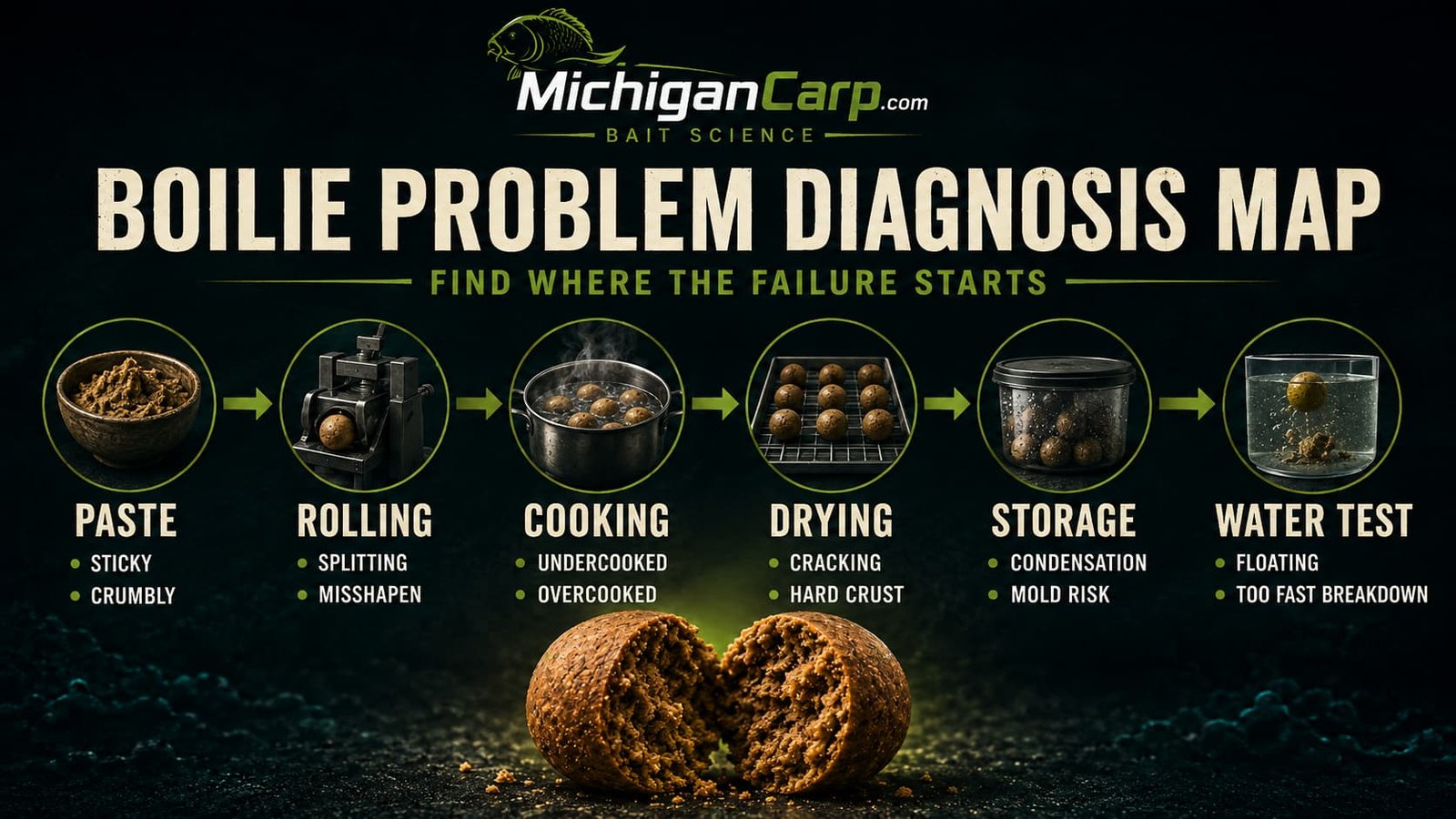
Find where the problem starts. Fix the likely cause. Test again before changing everything else.
This troubleshooting page supports Boilie School BS-05: Making Boilies Step by Step. For storage-specific problems, use How to Store Homemade Boilies. For finished-bait testing, use How to Test Boilies Before Fishing. For bait release and water exchange, use Carp Bait Solubility and Leakage.
For external technical background on feed ingredients and fish nutrition, see FAO: Feed Ingredients and Fertilizers for Farmed Aquatic Animals and National Academies: Nutrient Requirements of Fish and Shrimp. Before fishing unfamiliar water, check the official Michigan DNR fishing information.
Table of Contents
Quick Start: Boilie Problems by Stage
Before fixing a batch, identify when the problem appears.
| Problem stage | Likely area to check | Common examples |
|---|---|---|
| Before rolling | Hydration, liquid level, binders, ingredient absorption and paste rest | Sticky paste, stiff paste, soft paste, crumbly paste |
| During extrusion or rolling | Paste consistency, nozzle size, pressure, particle size and cohesion | Splitting sausages, swelling sausages, flat boilies, holes through the middle |
| During boiling or steaming | Cook time, bait size, batch size, boil intensity and internal structure | Undercooked bait, overcooked bait, splitting, collapsing, smell loss |
| During drying | Drying speed, airflow, humidity, surface crust and internal moisture movement | Cracking, hard crust, sticking together, rock-hard bait |
| During storage | Moisture, ventilation, freezing, preservatives, bagging time and contamination | Mold, sour bait, condensation, freezer damage |
| On the bank | Density, water exchange, hookbait strength, baiting method and water temperature | Floating, swelling, breaking down too fast, poor leakage, bait not waking up |
The safest rule is simple: do not change five things at once. Work through paste feel, rolling behavior, cooking, drying, storage and water testing in order.
The First Rule: Change One Thing at a Time
When a bait goes wrong, the temptation is to rebuild the whole recipe.
That usually makes the next batch harder to understand.
If you change the base mix, liquid phase, flavor level, egg count, oil level, cook time, drying time and storage method all at once, you will not know what fixed the problem.
| Bad troubleshooting | Better troubleshooting |
|---|---|
| Add more liquid, more binder, more flavor and boil longer | Fix paste hydration first, then retest |
| Change the whole recipe after one poor batch | Identify whether the issue is recipe, process or storage |
| Blame the bait before water testing | Test softening, swelling, cracking, buoyancy and hookbait strength |
| Make another large batch immediately | Make a small correction batch first |
| Assume harder bait is better bait | Match hardness to the fishing job |
A bait that rolls well but fishes poorly may not need a new recipe. A bait that fishes well but stores badly may need better drying or freezing, not more attractor. A bait that cracks may need gentler drying, not a different flavor.
Paste Problems
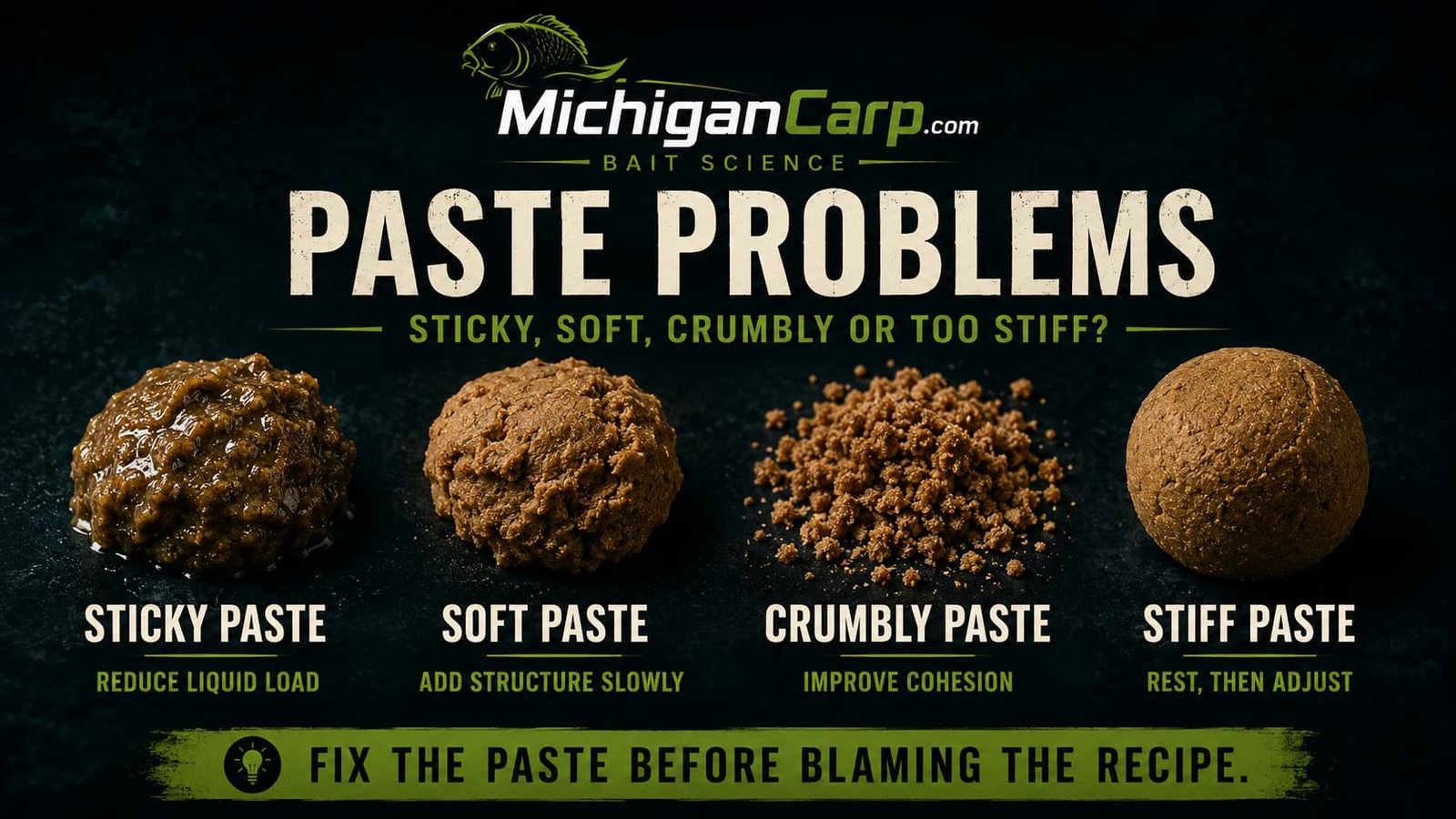
Most boilie problems start in the paste.
If the paste is wrong before it enters the gun or rolling table, the finished bait is already fighting uphill.
Dough Too Stiff
What is happening: the paste starts workable, then tightens. It becomes hard to gun out, hard to roll and puts strain on the sausage gun.
| Likely cause | Immediate fix | Long-term fix |
|---|---|---|
| Slow-hydrating ingredients still pulling liquid | Rest the paste covered, then judge again | Allow a standard rest time before final adjustment |
| Too much absorbent material | Add tiny amounts of reserved liquid and knead properly | Reduce thirsty powders, biscuit meal or coarse birdfood where needed |
| Not enough total liquid | Add liquid slowly, not all at once | Record liquid level and hold a small amount back next time |
| Paste left uncovered | Cover the paste immediately | Work smaller sections and keep the main paste wrapped |
| Warm, dry room | Cool the paste and cover it | Control working time and avoid drying the paste on the bench |
In cool Michigan spring conditions, paste can feel right at first and tighten after resting. Always judge the paste after a short covered rest, not the instant it first comes together.
Dough Too Soft
What is happening: the paste slumps, smears, sticks and will not hold a clean sausage.
| Likely cause | Immediate fix | Long-term fix |
|---|---|---|
| Too much liquid | Rest first, then add small amounts of dry base mix | Hold back liquid until the paste tells you what it needs |
| Too many syrupy liquids | Cool the paste and add dry support carefully | Reduce molasses, syrups, liquid foods or thin oils |
| Under-mixing | Knead properly before adding dry powder | Standardize mixing time |
| Weak dry structure | Add a small amount of structural ingredient if needed | Improve semolina, binder, albumen or functional protein support |
| No rest time | Cover and rest before deciding | Make rest time part of the recipe process |
Practical dry corrections can include semolina for structure, biscuit meal for absorption or a measured binder adjustment. Do not panic-dump powder into the mix.
Sticky Paste
What is happening: the paste clings to hands, gun, worktop and rollers.
| Likely cause | Immediate fix | Long-term fix |
|---|---|---|
| Heavy hydrolysate or liquid-food level | Rest and cool the paste | Reduce the soluble liquid load |
| Molasses, honey or syrupy liquids | Keep the bench clean and work smaller amounts | Use these liquids as supporting signals, not the whole liquid phase |
| Warm paste | Cool it before rolling | Avoid warm working conditions where possible |
| Too much oil with weak structure | Add dry support only if needed | Balance fat with the dry base structure |
| Sticky protein material | Let hydration settle before adjusting | Use high-protein ingredients with measured support |
Sticky does not always mean bad. Some attractive mixes are naturally tacky. The real problem is when the paste stops being workable.
Crumbly Paste With No Cohesion
What is happening: the paste breaks apart instead of knitting together.
| Likely cause | Immediate fix | Long-term fix |
|---|---|---|
| Too much dry cereal bulk | Knead longer and rest covered | Reduce dead dry bulk |
| Not enough binder support | Add a small binder correction if needed | Improve the binder and protein side of the mix |
| Poor hydration | Add tiny amounts of liquid and knead thoroughly | Build a more predictable liquid level |
| Too much coarse material | Use the batch as chops or crumb if needed | Grind coarse ingredients finer for rolled baits |
| Not enough kneading | Knead until the paste forms a proper mass | Standardize the mixing and resting routine |
Rolling and Extrusion Problems
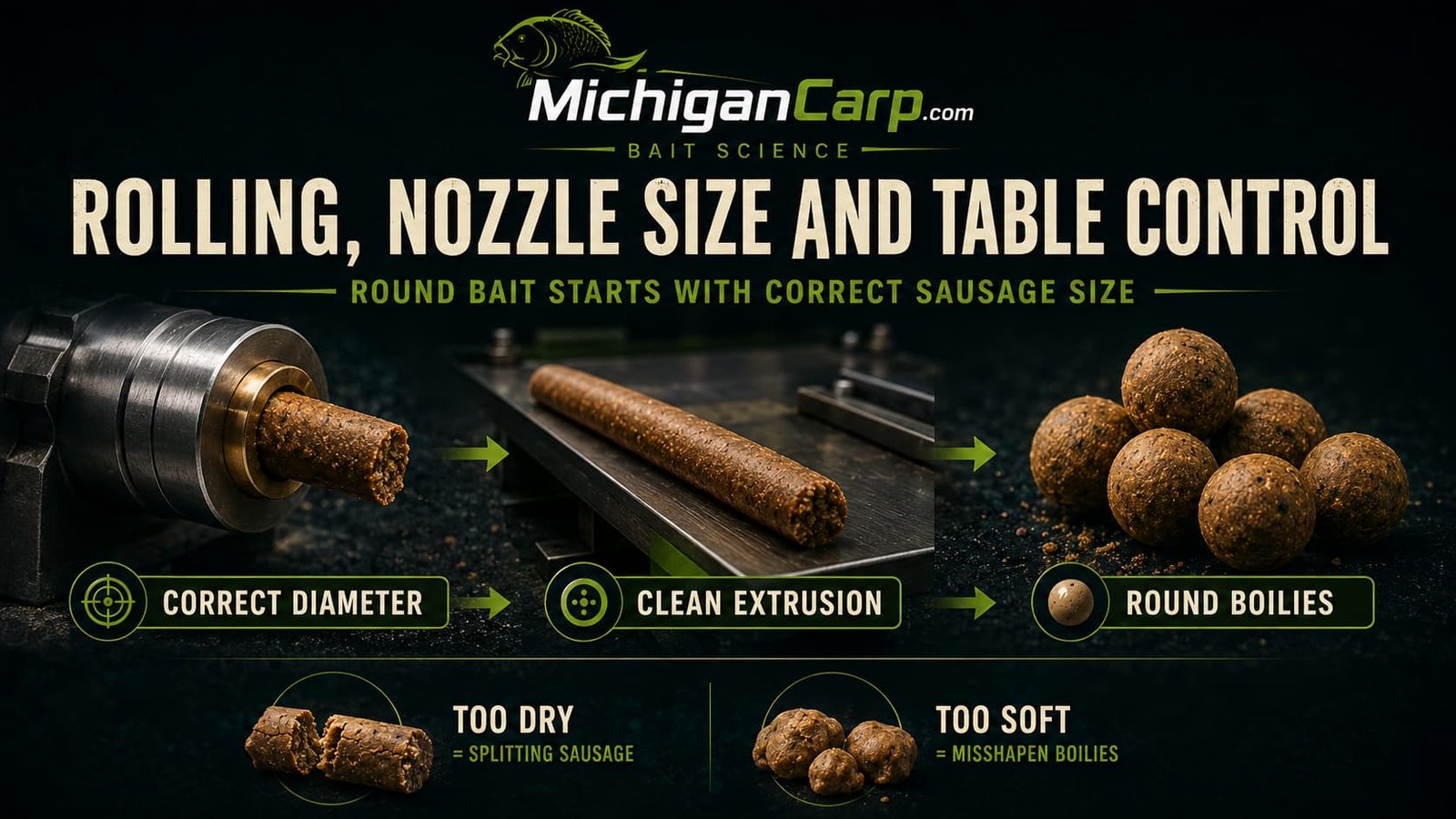
Rolling problems usually come from paste consistency, nozzle size, extrusion pressure, table mismatch or coarse ingredients.
Sausage Splitting During Extrusion
What is happening: the sausage breaks, splits or tears instead of running out cleanly.
| Likely cause | Immediate fix | Long-term fix |
|---|---|---|
| Paste too dry | Soften very slightly with reserved liquid | Increase controlled hydration next time |
| Poor cohesion | Rest and knead again | Improve binder and protein support |
| Too much pressure | Reduce pressure and slow down | Use a consistent gun pressure |
| Coarse particles tearing the sausage | Use batch for chops if needed | Grind coarse material finer for machine rolling |
| Binders not activated | Rest the paste covered | Build rest time into the process |
Sausage Swelling After Extrusion
What is happening: the sausage comes out, then thickens or changes shape before rolling.
| Likely cause | Immediate fix | Long-term fix |
|---|---|---|
| Paste too soft | Rest and firm slightly | Reduce liquid level or improve structure |
| Excess pressure | Reduce pressure | Standardize pressure and gun speed |
| Too much trapped air | Knead and pack the gun more carefully | Improve paste handling before loading the gun |
| Low-density structure | Use the batch for shorter-range bait | Increase density if the fishing job demands it |
Paste Breaking Up on the Rolling Table
What is happening: the sausage reaches the table but tears, crumbles or breaks into sections.
| Likely cause | Immediate fix | Long-term fix |
|---|---|---|
| Poor cohesion | Re-knead and rest | Improve binder and hydration balance |
| Dry outer skin | Cover paste between runs | Work smaller batches on the bench |
| Too much coarse material | Roll by hand or use as chops | Use coarse ingredients deliberately, not blindly |
| Over-rolling | Use fewer table passes | Match pressure and rolling action to paste softness |
Misshapen Boilies
What is happening: the finished baits are oval, flat-sided, rough, lumpy or inconsistent.
| Likely cause | Immediate fix | Long-term fix |
|---|---|---|
| Wrong sausage diameter | Correct the nozzle or sausage size | Use a nozzle matched to the table and bait size |
| Paste too soft or too stiff | Correct paste before rolling more | Standardize liquid level and rest time |
| Too much pressure | Reduce pressure and table force | Use consistent pressure each batch |
| Rolling table mismatch | Test a short sausage first | Record the nozzle/table setup that works |
Boilies With a Hole Through the Middle
What is happening: the bait forms a central cavity or hollow section.
| Likely cause | Immediate fix | Long-term fix |
|---|---|---|
| Trapped air | Use the batch as chops, crumb or free bait if needed | Pack the gun better and knead more evenly |
| Dry outside and wetter inside | Slow the process and correct paste consistency | Improve hydration and rest time |
| Weak cohesion | Do not force the batch through harder | Improve binder and structure |
| Excessive extrusion pressure | Reduce pressure | Match pressure to paste feel |
Nozzle Size and Rolling Table Control
Nozzle size is a practical starting point, not an absolute law. Paste consistency, pressure, rolling table design and ingredient texture can change the final bait size.
| Target boilie size | Approximate nozzle starting point |
|---|---|
| 8 mm | 6.5 mm |
| 10 mm | 8.2 mm |
| 12 mm | 9.8 mm |
| 14 mm | 11.5 mm |
| 16 mm | 13 mm |
| 18 mm | 14.5 mm |
| 20 mm | 16.5 mm |
| 24 mm | 19.5 mm |
| 30 mm | 24.5 mm |
For a simple 14 mm dumbbell variant, a useful starting trick is a 10 mm nozzle on a 14 mm rolling table.
Always test a short sausage before running a full batch.
Cooking and Drying Problems
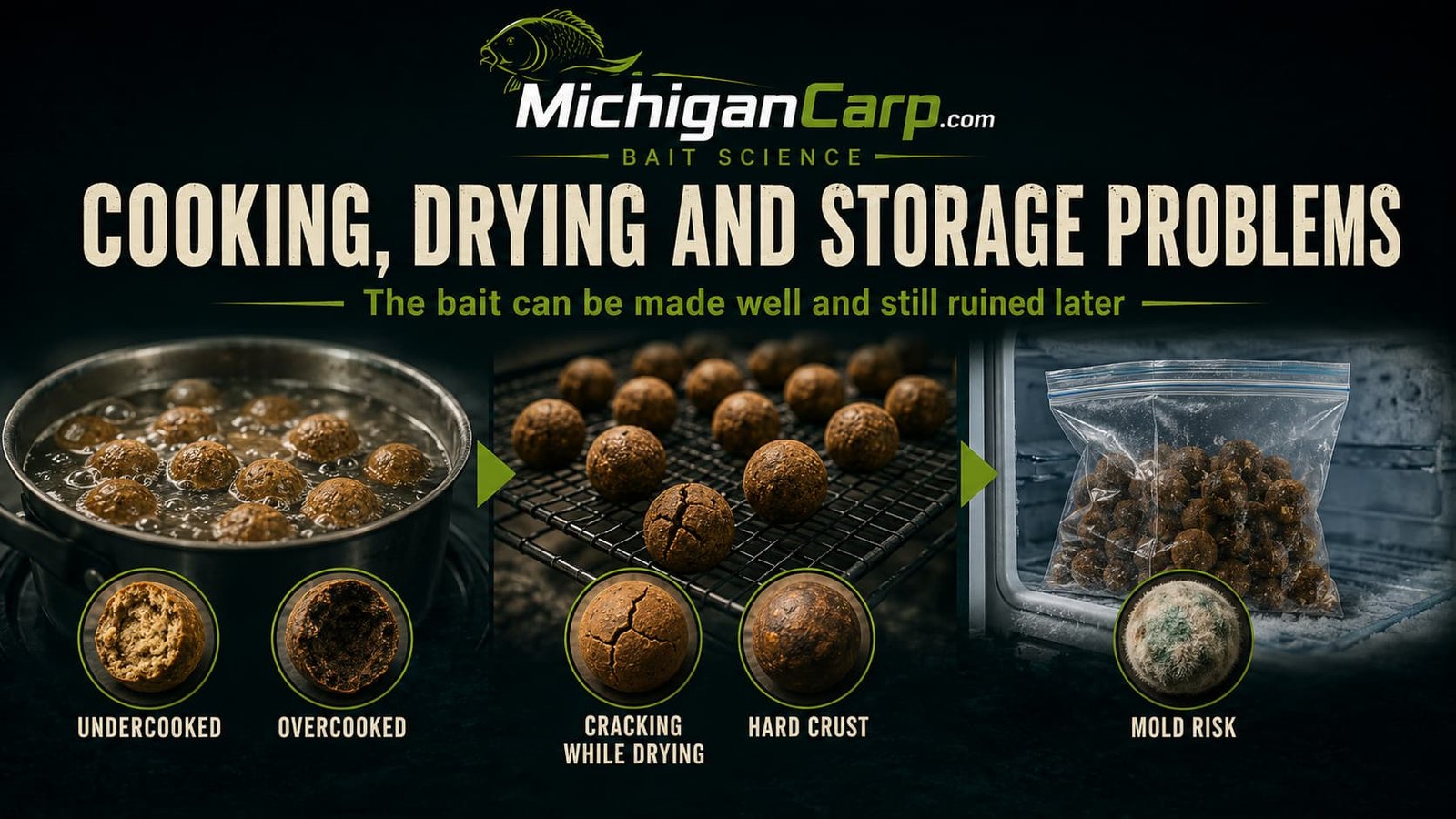
Cooking and drying do not just finish the bait. They change the way the bait handles, stores and behaves in water.
Undercooked Boilies
What is happening: the outer skin looks set, but the inside remains too wet, soft or pasty.
| Likely cause | Immediate fix | Long-term fix |
|---|---|---|
| Boil time too short | Dry carefully and water-test before bagging | Match cook time to bait size and density |
| Large bait treated like small bait | Separate and dry in thin layers | Record boil times by size |
| Too much trapped moisture | Do not bag warm wet bait | Improve paste balance and cooling |
Overcooked Boilies
What is happening: the bait becomes too hard, loses leakage, loses smell or forms a sealed outer skin.
| Likely cause | Immediate fix | Long-term fix |
|---|---|---|
| Boiled too long | Use the batch where harder free bait makes sense | Shorten cook time and test water behavior |
| Small baits cooked like large baits | Use as feed, crumb or longer-lasting bait | Use size-specific boil times |
| Open soluble mix cooked too aggressively | Use post-boil treatment if needed | Treat cooking as part of bait design |
Boilies That Lose Smell
What is happening: the paste smells strong, but the finished bait smells weak after boiling.
This is often caused by volatile flavor being driven off by heat, boiling too long, using the wrong flavor type for a cooked bait, or relying on aroma instead of food signal.
The immediate fix is to use a light matching post-boil treatment where appropriate. The long-term fix is to build attraction around the food profile, solubility, salts, acids, hydrolysates or other real signal ingredients first, then let flavor support the bait rather than carry it.
Boilies Sticking Together
What is happening: freshly boiled baits clump together instead of separating cleanly.
The usual causes are poor draining, over-soft paste, surface starches, syrupy residues or too many hot baits piled together. Spread them out quickly, dry in thin layers and improve draining next time.
Boilies Collapsing
What is happening: the boilies lose shape after boiling instead of staying round and stable.
This usually points to paste that was too soft, weak internal structure, not enough binder support or undercooking. Dry the batch carefully if it is still usable. For the next batch, tighten the mix, improve cohesion and match cook time to bait size.
Boilies Cracking While Drying
What is happening: the outside dries too quickly and the bait splits.
| Likely cause | Immediate fix | Long-term fix |
|---|---|---|
| Drying too fast | Move bait to gentler airflow | Dry steadily rather than aggressively |
| Hot moving air | Remove direct heat or strong fan blast | Use controlled ventilation |
| Too much rigid dry matter | Use cracked bait as chops or crumb | Add more elasticity to the formula |
| Surface drying before the center equalizes | Slow the drying process | Let moisture move out gradually |
Hard Crust on the Outside
What is happening: the bait forms a hard shell that slows water entry and leakage.
This can come from overboiling, overdrying, surface sugars or poor internal porosity. For hookbaits, trimming or skinning may help. For future batches, build for water exchange rather than just maximum hardness.
White Film on the Surface
What is happening: a pale or whitish coating appears after drying.
This may be surface residue, milk-powder movement, salts moving outward or drying imbalance. First check whether it is cosmetic or whether the bait has sealed up. Then review salt level, milk fractions, soluble load and drying speed.
Storage and Mold Problems
Storage problems deserve their own section because bait can be made well and still be ruined after the bench work is finished.
Boilies Going Moldy
What is happening: visible mold appears on the bait during storage.
| Likely cause | Immediate fix | Long-term fix |
|---|---|---|
| Bait bagged too wet | Do not fish questionable moldy bait | Dry longer or freeze sooner |
| Condensation in bags | Discard badly affected bait | Cool fully before sealing |
| No freezer storage for freezer bait | Do not rely on hope | Freeze session bags flat and label them |
| Poor hygiene or dirty containers | Clean all tubs, trays and bags | Use clean drying and storage routines |
| Preservative system not matched to bait | Do not assume one preservative makes bait safe | Use a proper shelf-life system only with testing |
If bait shows obvious mold or smells genuinely spoiled, do not pretend it is “just fermentation.” Mold risk belongs in the storage system, not on the bank.
Condensation Inside Bags
What is happening: water droplets appear inside bait bags or tubs after sealing.
This usually means the bait was sealed while still warm, too wet or still equalizing moisture. Open the bag, dry the bait if it is still safe, and correct the cooling and drying routine next time.
Freezer Burn or Damaged Freezer Bait
What is happening: freezer bait dries out, cracks, loses quality or becomes damaged in storage.
Use proper freezer bags, remove excess air, portion into session bags, freeze flat and label the bait with name, size, date, boil time and drying time.
For the full storage system, use How to Store Homemade Boilies and Freezer vs Shelf-Life: Keeping Bait Safe.
Water and Bank-Side Problems
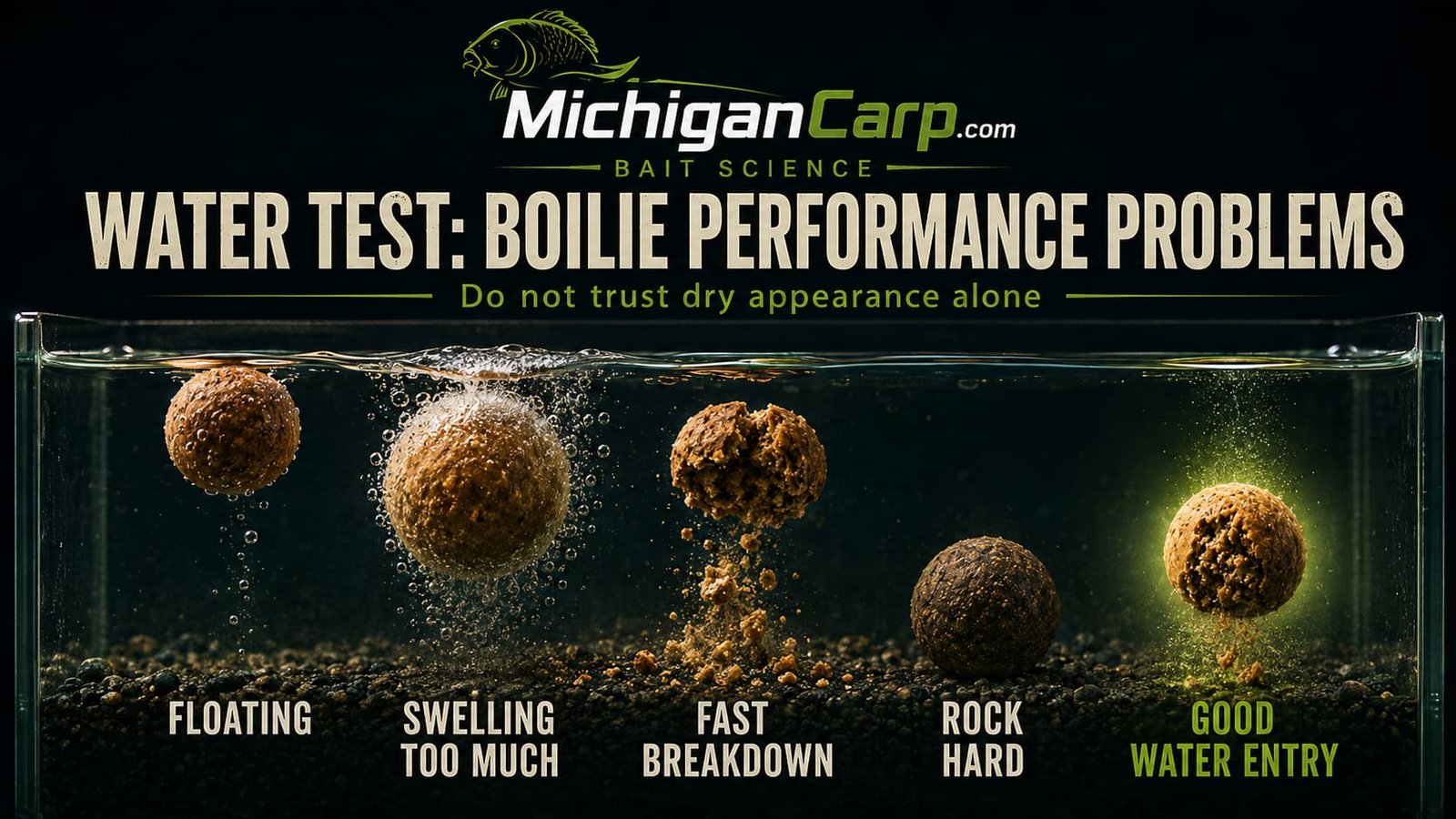
A boilie can look perfect on the bench and still behave badly in water.
That is why every serious batch should be water-tested before an important session.
Boilies Too Light
What is happening: the bait feels too buoyant, airy or unstable for the job.
Likely causes include low-density mix design, internal holes, swelling during cooking or too much trapped air. Use the batch where lighter bait helps, or keep it tight in bags, crumb or short-session traps. Next time, improve density, cohesion and sausage formation.
On soft Michigan silt, slightly lighter baits can be useful. In deeper water, current or tight baiting situations, too much lightness can work against you.
Boilies Floating After Soaking
What is happening: after time in water, some baits lift or remain unnaturally buoyant.
This usually starts earlier with trapped air, internal holes, overdrying or poor density. Use the batch as chops, crumb or trimmed hookbaits if appropriate. Fix paste cohesion and shaping in the next batch.
Boilies Swelling Too Much
What is happening: the bait takes on water too fast, softens too much and loses integrity.
The usual causes are poor cook balance, too much open structure, weak binder system or too much soluble material without enough hold. Use them for short sessions or as feed. Next time, balance leakage with structure.
Boilies Breaking Down Too Fast
What is happening: the bait leaks well but dies too quickly.
This can be useful in a short-session crumb or chop situation, but it is a problem for longer hookbait use. The cause is usually too much solubility, not enough cooking support, weak protein-binder network or too much liquid food without enough structure.
Boilies Going Rock Hard
What is happening: the bait becomes too dry, too hard and poor at exchanging with water.
Extra-hard bait has uses, but rock-hard bait is not automatically good bait. Crumb it, chop it or use it where nuisance resistance matters. Next time, dry less aggressively and freeze sooner where appropriate.
Boilies Struggling to Take on Water
What is happening: the bait stays hard and durable but never really wakes up in the lake.
Likely causes include surface crust, too much starch, poor internal porosity, overcooking or overdrying. For hookbaits, skinning or trimming may help. Long term, remember the rule: if you want signals out, you must allow water in.
Boilies Cracking in the Throwing Stick
What is happening: bait cracks or shatters when fired out.
The usual causes are bait that is too dry, too brittle, too old, too coarse or lacking elasticity. Use the batch by hand, catapult, bag or crumb. For future batches, improve hydration, elasticity and storage so the bait is tough without becoming brittle.
Common Boilie Problems and Fast Fixes
| Problem | Most likely cause | Fast practical fix |
|---|---|---|
| Paste too stiff | Too dry, too absorbent or not rested properly | Rest covered, then add tiny amounts of reserved liquid if needed |
| Paste too soft | Too much liquid or weak dry structure | Rest first, then add small amounts of dry base mix |
| Sticky paste | Too many syrupy liquids, hydrolysates or warm paste | Cool, rest, clean the bench and reduce liquid load next time |
| Crumbly paste | Poor binder, poor hydration or too much dry bulk | Knead, rest and improve cohesion |
| Misshapen bait | Wrong nozzle, paste inconsistency or pressure mismatch | Test a short sausage and correct before rolling the batch |
| Cracking while drying | Drying too fast or rigid formula | Move to gentler airflow and dry more steadily |
| Hard outer crust | Overboiling, overdrying or surface sealing | Trim hookbaits and reduce cook/dry intensity next batch |
| Floating after soak | Trapped air, internal holes or low density | Use as chops or crumb; fix paste and density next time |
| Mold | Too much moisture, warm sealing or poor storage | Discard questionable bait and rebuild storage routine |
| Poor leakage | Overcooked, overdried or sealed bait | Skin, trim, crumb or redesign for better water entry |
Common Troubleshooting Mistakes

| Mistake | Why it causes problems | Better practice |
|---|---|---|
| Judging paste too early | Many ingredients continue hydrating after mixing | Rest covered before final adjustment |
| Adding all liquids at once | You lose control of paste feel | Hold some liquid back |
| Not resting the paste | Binders and absorbent ingredients may not activate evenly | Make rest time part of the recipe |
| Chasing attraction while ignoring mechanics | A sticky, weak bait may smell good but fail physically | Build structure and signal together |
| Using coarse ingredients in fine rolling mixes | Coarse pieces can tear the sausage or weaken the bait | Control grind size |
| Boiling every recipe the same way | Open and dense baits do not cook identically | Match cook time to size and formula |
| Drying too aggressively | The surface can crack or seal before the center stabilizes | Dry steadily in thin layers |
| Confusing hard bait with good bait | Over-hard bait may leak poorly and feel unnatural | Match hardness to the session job |
| Skipping water tests | Dry bait appearance hides underwater behavior | Test before serious fishing |
Michigan Notes
Michigan conditions make troubleshooting more important because many sessions happen on large public waters where one batch of bait may need to handle long casts, nuisance fish, transport, cooler storage, boat traffic, changing temperature and long waits between bites.
For spring and cooler water, I want bait that takes on water and releases signal without collapsing. For summer and multi-day sessions, I care more about storage, nuisance resistance and controlled top-ups. On softer bottoms, I may accept a slightly lighter bait. Around snags, current or deeper water, I want more predictable density and durability.
That is why I do not judge a bait only by how it smells in the bag.
I judge it by whether it rolls, cooks, dries, stores, softens, leaks and stays on the rig long enough for the job.
My Practical View
Most boilie problems are not mysterious.
They usually come from one of six places: paste, rolling, cooking, drying, storage or water behavior.
The job is to find which stage is causing the failure.
If the paste is wrong, fix the paste. If the rolling is wrong, fix the diameter, pressure and cohesion. If the cooking is wrong, fix time and batch handling. If the drying is wrong, slow down and control airflow. If storage is wrong, stop guessing and label, freeze or preserve properly. If water behavior is wrong, test the bait instead of trusting how it looks dry.
Good troubleshooting is not adding more ingredients. It is removing confusion.
Fix one thing, test it, then move forward.
FAQ
Is stiff paste always a sign of a bad recipe?
No. Some mixes hydrate slowly and tighten after resting. The real question is whether the paste becomes predictably workable or turns into a fight every batch.
Should I add water if boilie paste is too stiff?
Usually not straight away. It is normally better to correct with reserved liquid phase, then improve the formula or liquid level next time.
Why is my boilie paste sticky?
Sticky boilie paste often comes from too many syrupy liquids, too much hydrolysate, warm paste, excess oil or weak dry structure. Resting and cooling can help, but the liquid package may need reducing.
Why is my boilie paste crumbly?
Crumbly paste usually means poor cohesion, poor hydration, not enough binder support, too much dry bulk or too much coarse material.
Why do my boilies crack while drying?
Boilies usually crack while drying because the outside dries too quickly, the formula is too rigid, the bait is overcooked, or hot moving air creates a hard surface before the center stabilizes.
Why do my boilies smell strong before boiling and weak after?
Some volatile aromas are reduced by heat. Overboiling can also weaken aroma. Build attraction around the food profile and soluble signal first, then use flavor as support.
Are softer boilies always better in cold water?
Not always. Softer, more open baits may work faster, but they still need enough structure to stay useful on the rig or in the baited area.
Why are my boilies floating after soaking?
Floating after soaking often comes from trapped air, internal holes, low density, overdrying or poor paste cohesion. It usually starts earlier in the process.
Why did my boilies go moldy?
Boilies usually go moldy because they were stored with too much moisture, sealed warm, dried insufficiently, handled with poor hygiene or kept as freezer bait without freezing.
Can moldy boilies still be used as carp bait?
I would not use obviously moldy or spoiled bait. It is better to fix drying, freezing or preservation than to risk using questionable bait.
Why do my boilies go rock hard?
Rock-hard boilies often come from overdrying, overcooking, low retained moisture or an overly rigid formula. Hardness can be useful, but it should not stop water exchange completely.
What matters more, recipe or process?
Both matter. A good recipe handled badly can fail, and a poor recipe handled carefully may only hide the weakness temporarily.
How do I troubleshoot boilies without making things worse?
Change one thing at a time. Identify whether the problem is paste, rolling, cooking, drying, storage or water behavior, then test a small correction batch.
Next Steps
- Boilie School — return to the full step-by-step learning path.
- Boilie School BS-05: Making Boilies Step by Step — fix the full making process.
- How to Boil and Dry Boilies Properly — control cooking and drying.
- How to Test Boilies Before Fishing — test bait before trusting it.
- How to Store Homemade Boilies — prevent mold, freezer damage and storage failures.
- Why Some Carp Baits Leak Faster Than Others — understand bait release rate.
- Why Surface Area Matters in Carp Bait — use whole, chopped, crumbed and dusted bait properly.
- Carp Bait Solubility and Leakage — understand water entry and food-signal release.
- Bait Science — browse the full technical bait library.