
Packbait for carp fishing is one of the most useful bait methods for Michigan carp anglers, but it is also one of the most misunderstood.
Too many anglers treat packbait like a secret recipe.
They argue over one magic ingredient, one famous cereal, one sweet liquid or one exact family formula.
That misses the point.
Packbait is not magic paste.
Packbait is a delivery system.
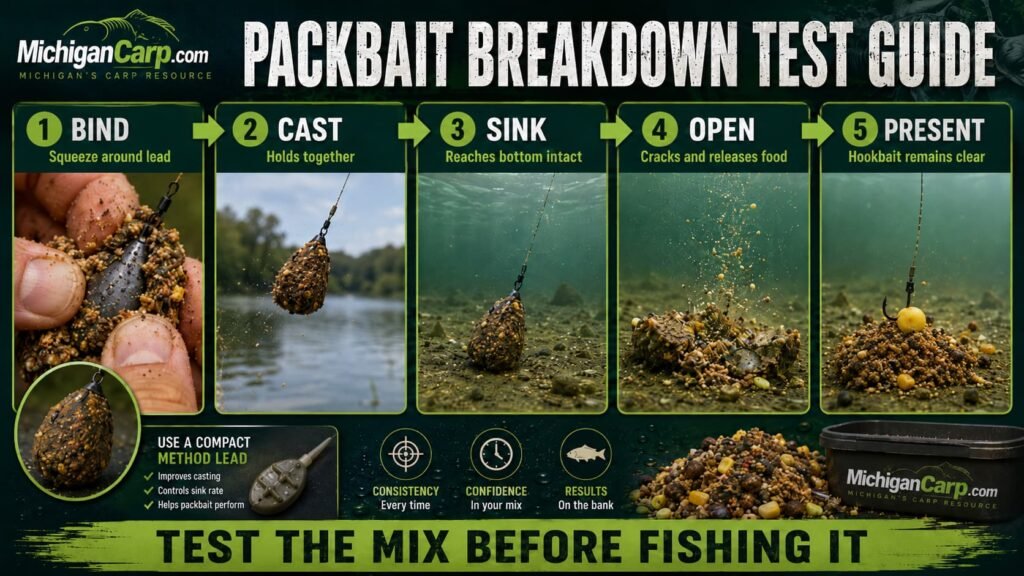
A good packbait should:
BIND.
CAST.
SINK.
BREAK DOWN.
LEAVE FOOD AROUND THE HOOKBAIT.
LET THE RIG FISH CLEANLY.
That is what matters.
The ingredients are important, but only after the mechanics work.
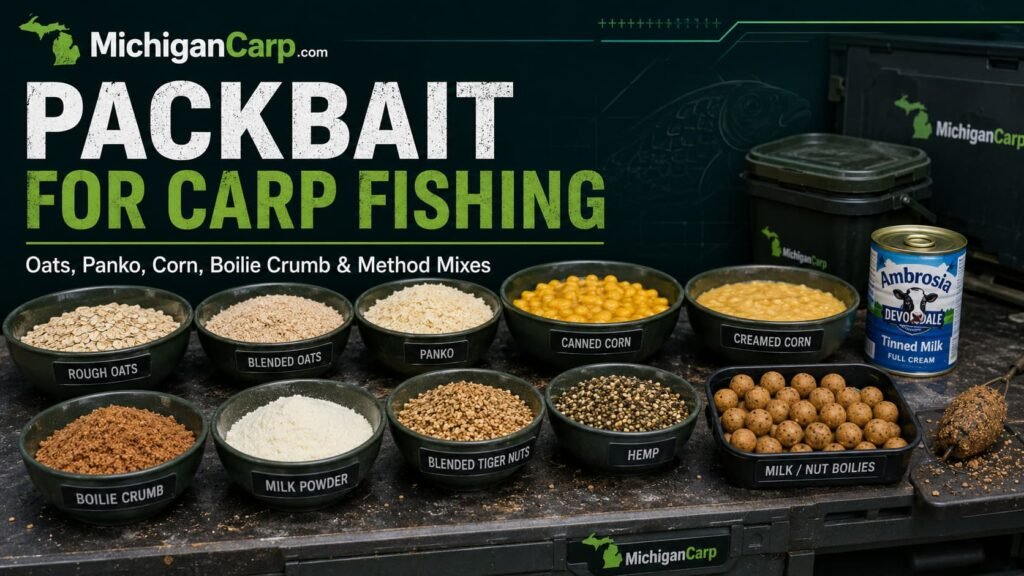
Oats, panko, canned corn, creamed corn, tinned milk, boilie crumb, milk powders, blended tiger nuts, peanuts, hemp and prepared particles can all have a place in a serious carp packbait or method mix.
But none of them fix a mix that is too wet, too dry, too tight, too slow to break down or so messy that it buries the rig.
This is especially important in Michigan.
A lot of Michigan carp waters are public, lightly pressured, full of natural food and not heavily conditioned to boilies. Packbait can create attraction quickly around the hookbait without needing a big baiting campaign.
But there is too much folklore around it and not enough testing.
This guide explains how to build, test, adjust and fish packbait properly.
For the wider bait-prep hub, use The Bait Shed.
For cheap bait choices, read Cheap Carp Baits That Actually Work.
For corn, use Corn for Carp in Michigan.
For particles, use Particles for Carp Fishing.
For boilie fishing, use How to Fish Boilies for Carp.
My view is simple:
A GOOD PACKBAIT IS NOT DEFINED BY THE RECIPE.
IT IS DEFINED BY HOW IT BREAKS DOWN AROUND THE RIG.
Table of Contents
Quick Start: Packbait for Carp Fishing
| Packbait Problem | What It Usually Means | Fix |
|---|---|---|
| Falls apart before the cast | Too dry, too coarse or not rested | Add wet binder slowly and let it rest |
| Explodes on impact | Not enough binding or not compressed properly | Add creamed corn, tinned milk or finer oats |
| Stays like a ball too long | Too wet, too much binder or packed too tight | Add panko, dry oats or crumb and loosen |
| Turns into paste | Too much wet ingredient | Add dry structure and reduce liquid |
| Baits fish but hides the rig | Too much feed or too tight around hookbait | Use less and test breakdown |
| Breaks down too fast in current | Too loose for the swim | Add finer binder and compress more |
| Attracts nuisance fish only | Too much soft corn or loose sweet feed | Use tougher hookbait and reduce loose food |
| Does not match boilies | Random grocery mix around a boilie | Add boilie crumb, milk powders or matching base ingredients |
A good starting packbait should:
- squeeze firmly around the lead or method feeder;
- cast without falling apart;
- sink intact;
- begin opening up on the bottom;
- leave food around the hookbait;
- avoid burying the hook;
- break down in a predictable time.
Do not guess.
Test it in a bucket, margin, clear edge or shallow water before fishing.
What Is Packbait?
Packbait is a damp bait mix packed around a lead, method feeder or bait carrier so it delivers food and attraction close to the rig.
It is often made from simple ingredients such as:
- oats;
- panko;
- breadcrumb;
- cornmeal;
- canned corn;
- creamed corn;
- condensed milk or evaporated milk-style liquids;
- molasses;
- boilie crumb;
- ground particles;
- milk powders;
- nut meals;
- seed meals;
- crushed pellets where appropriate.
The job of packbait is not just to smell good.
The job is to put controlled attraction around the hookbait.
It should form a small feeding zone where the carp can investigate, grub and pick up the hookbait.
Packbait is especially useful when you want attraction without feeding a large loose bait bed.
Packbait vs Method Mix
The terms often overlap.
In practical carp fishing, anglers may use “packbait,” “method mix” and “method bait” to describe similar things.
There are differences in style, but the working idea is the same.
Packbait
Usually packed around a lead or feeder by hand.
Often built from oats, panko, corn and grocery-style ingredients.
Method Mix
Usually designed to work with a method feeder, mold or method lead.
Often finer, more controlled and more deliberately tested for breakdown.
MichiganCarp View
I do not worry too much about the label.
I care whether the mix works.
The question is:
Does it carry attraction to the bottom and release properly around the hookbait?
That matters more than whether someone calls it packbait, method mix or groundbait.
The Five Jobs of a Good Packbait
A good packbait has five jobs.
1. Bind
It must hold together long enough to cast or place.
If it falls apart in your hand, it is not ready.
2. Cast
It must survive the cast or boat drop.
A bait that breaks apart in flight is not controlled baiting.
3. Sink
It must reach the bottom without washing away too early.
4. Break Down
It must open up on the bottom.
If it stays like a hard ball, carp may not find the hookbait properly.
5. Present the Rig
It must not bury the hook, hide the hookbait or leave the rig fishing badly.
This is the part many anglers ignore.
A packbait can smell brilliant and still ruin the presentation.
The Basic Oats, Panko and Corn Packbait
This is a simple starting point.
It is not a magic formula.
It is a reliable base you can adjust.
| Ingredient | Amount |
|---|---|
| Rough oats or rolled oats | 2 parts |
| Panko | 1 part |
| Canned corn | Small amount |
| Creamed corn | Enough to bind |
| Optional sweetener or molasses | Small amount only |
Basic Method
- Add oats and panko to a tub.
- Add a small amount of canned corn.
- Add creamed corn slowly.
- Mix thoroughly.
- Let the mix rest.
- Squeeze-test it.
- Water-test it before fishing.
The rest period matters.
Oats and panko keep absorbing liquid after mixing.
A mix that feels right immediately may become too stiff later.
A mix that feels slightly loose may tighten after ten minutes.
Why I Rate Panko Highly
Panko is one of the most useful packbait ingredients because it helps control texture.
It can:
- lighten a mix;
- improve breakdown;
- absorb liquid;
- stop oats becoming too heavy;
- open the bait up around the rig;
- help prevent dense paste;
- make a mix easier to adjust on the bank.
Oats are excellent, but oats alone can become heavy or sticky.
Panko gives the mix a more open structure.
That is why I rate it highly.
In my own packbait and method-style mixes, panko is not just filler.
It helps the bait behave.
That is more important than chasing secret ingredients.
Rough Oats vs Blended Oats
Oats are one of the main building blocks in many packbaits.
But the grind matters.
Rough Oats
Rough oats give:
- structure;
- visible food;
- slower breakdown;
- texture around the hookbait.
Blended Oats
Blended oats give:
- finer binding;
- tighter packing;
- smoother texture;
- more control when a mix is too loose.
Best Practical Approach
Use both.
A useful packbait often has:
- rough oats for texture;
- blended oats for binding;
- panko for opening and breakdown.
That gives more control than using one oat form only.
A mix built only from fine powder can turn pasty.
A mix built only from coarse material may not bind.
Balance matters.
Creamed Corn, Canned Corn and Tinned Milk
The wet side of packbait controls binding, sweetness, smell and texture.
Creamed Corn
Creamed corn is a very useful binder.
It adds:
- moisture;
- sweetness;
- corn signal;
- stickiness;
- small food particles.
Add it slowly.
Too much creamed corn can turn the mix into paste.
Canned Corn
Canned corn gives larger visible food items.
Use it sparingly in packbait.
Too much whole corn can make the mix break unevenly or draw nuisance fish.
Tinned Milk
Tinned milk-style liquids can be very useful.
This includes evaporated milk or condensed milk-style additions used carefully.
They can add:
- creaminess;
- sweetness;
- milk signal;
- binding;
- cloud;
- a different food profile from plain corn.
Tinned milk can fit especially well with milk, nut and birdfood-style boilies.
Do not pour blindly.
Add slowly and test.
A little can improve a mix.
Too much can make a sticky mess.
Adding Boilie Crumb to Packbait
A lot of anglers use packbait with particles but do not think to use it with boilies.
That is a missed opportunity.
Packbait can be excellent when fishing boilies, especially if the packbait carries some of the same food signals as the hookbait.
Boilie crumb can make a simple packbait more connected to the bait on the hair.
Use boilie crumb when:
- fishing boilies over a small trap;
- introducing a new boilie;
- matching loose attraction to the hookbait;
- using milk/nut boilies;
- fishing low-pressure waters where boilies need context;
- adding food signal without feeding whole boilies.
How Much Boilie Crumb?
Start small.
A practical amount is:
- one small handful per tub of packbait;
- or 5–15% of the dry mix.
More is not always better.
The crumb should support the mix, not turn it into expensive paste.
Why It Works Practically
Boilie crumb helps the packbait say the same thing as the hookbait.
If you are fishing a milk/nut boilie, a packbait containing crumb from that boilie makes more sense than a completely unrelated grocery mix.
That does not prove carp think of it like we do.
But practically, it creates a more consistent bait picture around the rig.
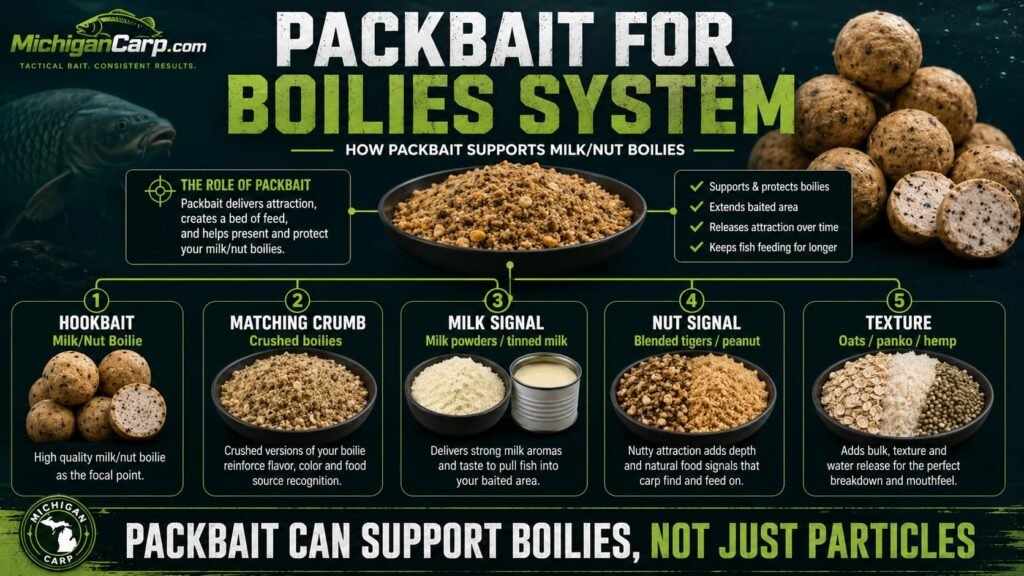
Packbait With Milk/Nut Boilies
When fishing milk/nut boilies, packbait should not be random.
It can be built to support the same bait family.
Useful additions include:
- boilie crumb;
- milk powder;
- whey protein powder;
- calf milk replacer-style powder where appropriate;
- tiger nut flour;
- blended tiger nuts;
- ground peanuts used carefully;
- blended hemp;
- coconut meal;
- biscuit crumb;
- birdfood;
- light sweet creamy liquids;
- tinned milk-style binders.
This is where packbait becomes more than cheap attraction.
It becomes a carrier system.
The boilie is the controlled hookbait.
The packbait delivers supporting food signals around it.
That can be very useful on Michigan waters where carp may accept corn and particles quickly but need more introduction to boilies.
Milk Powders in Packbait
Milk powders can be useful in packbait, especially when you are fishing milk-based or creamy boilies.
They can add:
- creaminess;
- fine cloud;
- food signal;
- binding;
- smooth texture;
- a softer bait profile.
Useful milk-style ingredients may include:
- whole milk powder;
- skim milk powder;
- whey powder;
- buttermilk powder;
- calf milk replacer-style powders where suitable;
- milk powder already used in your boilie base.
Do not overdo them.
Too much fine milk powder can tighten the mix, make it sticky or slow the breakdown.
Start with small amounts.
A practical range is:
- 5–10% of the dry mix for a light milk signal;
- more only after testing breakdown.
Milk powders should improve the bait’s behavior and signal.
They should not turn it into glue.
Blended Tiger Nuts, Peanuts and Hemp
Blended particles can make packbait much more interesting.
They add texture, oils, smell and food particles.
Blended Tiger Nuts
Blended tiger nuts add:
- sweet nutty smell;
- rough texture;
- connection to tiger nut hookbaits;
- small durable particles.
Use them when fishing tiger nuts, nut boilies or maize/hemp particle approaches.
Ground or Blended Peanuts
Peanuts can add a strong nut signal, but use them carefully.
They are rich and oily.
Use clean, suitable peanuts and avoid stale or rancid material.
Peanuts should support the mix, not dominate it.
Blended Hemp
Blended hemp can be excellent.
It adds:
- fine particles;
- oils;
- grubbing signal;
- natural-looking food;
- dark speckling;
- attraction around the rig.
A little blended hemp can do a lot.
Too much can make the mix oily or loose.
Practical Rule
Blended particles should improve the breakdown and food signal.
They should not make the packbait heavy, oily or impossible to bind.
A Serious Milk/Nut Packbait Base
This is a practical advanced base for fishing milk/nut boilies.
It is not a fixed secret recipe.
It is a structure you can adjust.
| Ingredient | Role |
|---|---|
| Rough oats | Structure and visible food |
| Blended oats | Binding and body |
| Panko | Breakdown and openness |
| Boilie crumb | Match the hookbait |
| Milk powder | Creamy food signal and fine cloud |
| Blended tiger nuts | Nut signal and texture |
| Blended hemp | Fine food particles and oil |
| Small amount ground peanut | Rich nut signal |
| Creamed corn | Binder and sweetness |
| Tinned milk-style liquid | Creamy wet side |
| Optional molasses or honey | Light sweetness |
Starting Ratio
A practical starting dry ratio:
| Ingredient | Amount |
|---|---|
| Rough oats | 3 parts |
| Panko | 2 parts |
| Blended oats | 1 part |
| Boilie crumb | 1 part |
| Milk powder | ½ part |
| Blended tiger nuts / hemp / nut meal | ½ to 1 part total |
Then add the wet side slowly:
- creamed corn;
- tinned milk-style liquid;
- small amount of molasses or honey if wanted;
- lake water if adjustment is needed.
Let it rest.
Test it.
Adjust it.
That is the real recipe.
Spring Packbait Adjustment
The spring packbait post that used to stand alone belongs here as a seasonal adjustment, not a separate article.
Spring packbait should be lighter and more controlled.
A useful spring base is:
| Ingredient | Role |
|---|---|
| Panko or breadcrumb | Light breakdown |
| Cornmeal or ground grain | Weight and body |
| Creamed corn | Binder |
| Few corn kernels | Visual food |
| Small honey or molasses addition | Light signal |
| Optional tiger flour or chopped tiger | Tougher nut signal |
April-Style Cold Water
Use:
- smaller balls;
- less feed;
- faster breakdown;
- fewer kernels;
- lighter wet side;
- more single hookbait thinking.
May Warming Water
You can build slightly more when carp show real feeding signs.
Use:
- slightly firmer pack;
- small corn additions;
- light hemp or crumb;
- careful top-ups after signs.
Spring packbait should not become summer baiting just because the sun is out.
For spring particle amounts, use Spring Particles for Carp.
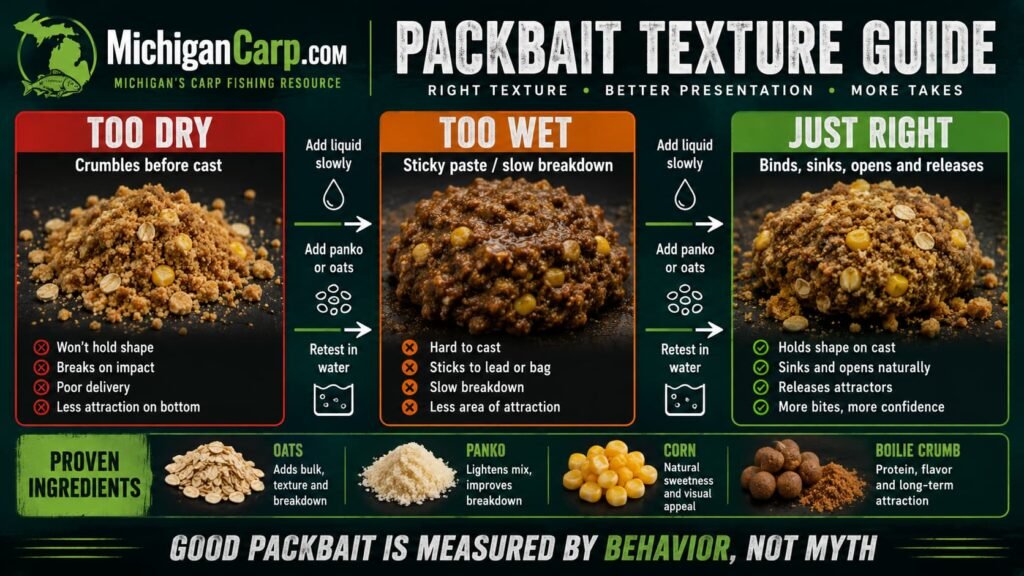
How Wet Should Packbait Be?
Packbait should feel damp and compressible, not sloppy.
A good mix should:
- squeeze into a firm ball;
- hold shape without dripping;
- crack apart with pressure;
- not stick heavily to your hands;
- not crumble instantly;
- not feel like wet cement.
Too Dry
Signs:
- falls apart in your hand;
- will not pack around the lead;
- explodes on the cast;
- separates before it sinks.
Fix:
- add creamed corn slowly;
- add tinned milk-style liquid slowly;
- add small amounts of water;
- mix and rest before adding more.
Too Wet
Signs:
- sticks heavily to fingers;
- smears like paste;
- will not release cleanly;
- stays hard too long;
- buries the rig.
Fix:
- add panko;
- add dry oats;
- add blended oats carefully;
- add boilie crumb;
- let it rest and retest.
The Squeeze Test
The squeeze test is the first check.
Take a handful of packbait.
Squeeze it firmly around your fingers or around a lead.
It should hold together.
Then press it apart.
It should break open without becoming rubbery paste.
If it crumbles instantly, it is too dry.
If it stays like modeling clay, it is too wet or too tight.
The squeeze test does not replace a water test, but it tells you whether the mix is close.
The Edge-Water Breakdown Test
This is the most important test.
Before fishing, drop a ball of packbait into shallow water, a bucket or the lake edge where you can watch it.
Watch what happens.
A good packbait should:
- sink intact;
- sit around the lead;
- begin cracking;
- release small particles;
- open around the hookbait;
- avoid burying the hook;
- leave a small food pile.
Record the time.
Fast Breakdown
Useful for:
- cold water;
- short sessions;
- low feed;
- quick response;
- margin fishing.
Medium Breakdown
Useful for:
- general fishing;
- method-style work;
- short to medium sessions;
- corn or boilie hookbaits.
Slow Breakdown
Useful only when:
- current or wave action requires it;
- casting impact is severe;
- nuisance fish are very active;
- you know it will still open properly.
Slow breakdown is not automatically better.
A packbait that never opens is just a bait ball.
How to Pack Around the Lead
Packbait should be firm enough to cast, but not packed so tightly that it locks up.
Basic method:
- Mold a small amount around the lead or feeder.
- Press firmly.
- Keep the hookbait outside or correctly positioned.
- Avoid burying the hook point.
- Cast smoothly.
- Let the bait break down around the rig.
Do not use huge balls unless the session demands it.
A small controlled pack often works better than a massive lump.
The hookbait should be easy for carp to find.
Hookbait Choices With Packbait
Packbait works with many hookbaits.
Good hookbait choices include:
- corn;
- corn plus plastic corn;
- maize;
- tiger nut;
- boilie;
- wafter;
- snowman-style boilie;
- balanced nut bait;
- small popup where appropriate.
Corn Hookbait
Best for quick response and beginner fishing.
Tiger Nut Hookbait
Best when nuisance fish, turtles or soft bait problems appear.
Boilie Hookbait
Best when you want a more controlled, durable hookbait.
Wafter Hookbait
Useful when you want the bait to behave lightly over the packbait breakdown area.
The hookbait should match the job.
Do not let the packbait bury it.
Packbait With Boilies
Many anglers think of packbait only when fishing particles, corn or method-style bait.
I think that is too narrow.
Packbait can work very well with boilies.
In fact, it can solve a common boilie problem on low-pressure waters:
How do I introduce a boilie hookbait without feeding a lot of whole boilies?
A packbait with boilie crumb, milk powder, nut meal or blended particles can create a small food signal around the boilie without heavy feeding.
This can be especially useful when fishing milk/nut boilies.
You can fish:
- milk/nut boilie over matching crumb packbait;
- boilie tipped with corn over oat/panko/corn packbait;
- tiger nut over nut-and-hemp packbait;
- wafter over milk powder and panko mix;
- boilie over blended particle method mix.
That gives the boilie context.
It also keeps the feed tight around the rig.
Packbait is not only for particle anglers.
It can be a serious boilie-support method.
Packbait With Particles
Packbait also works naturally with particles.
Useful particle additions include:
- maize pieces;
- hemp;
- crushed tiger nuts;
- wheat;
- pigeon feed fragments;
- particle liquor;
- corn;
- small seed meals.
The key is not to overload the mix.
Too many whole particles can stop the packbait from binding.
Too much particle liquor can make it sloppy.
Use particles as part of the structure, not as a wet bucket with oats thrown in.
For safe particle prep, use How to Prepare Particles for Carp Fishing.
Packbait for Short Sessions
Packbait can be excellent for short sessions because it puts attraction near the rig quickly.
Good short-session mix:
- oats;
- panko;
- creamed corn;
- small canned corn addition;
- optional boilie crumb.
Use a small ball.
Test fast breakdown.
Do not feed heavily.
The goal is a quick feeding signal and one clean chance.
Corn or a small boilie often makes the best hookbait.
Packbait for Overnight Sessions
Overnight packbait needs more thought.
Soft packbait may attract nuisance fish.
Corn hookbaits may be stripped.
Use tougher hookbaits if needed.
Good overnight options:
- boilie hookbait over boilie crumb packbait;
- tiger nut over nut-and-hemp packbait;
- wafter over oat/panko/milk powder mix;
- maize hookbait with corn and panko packbait.
Do not assume a big packbait ball will fish better all night.
Often it is better to fish a durable hookbait with a small controlled pack.
Packbait for Spring
Spring packbait should be small and controlled.
Use:
- smaller pack size;
- faster breakdown;
- less whole corn;
- less loose feed;
- light milk or sweet signal;
- tiny hemp or crumb additions;
- single hookbait thinking.
Spring carp may move before they feed hard.
Packbait should create a small opportunity, not a big feed pile.
Packbait for Summer
Summer packbait can be stronger because carp may feed more actively.
Use:
- oats and panko;
- corn;
- maize fragments;
- hemp;
- boilie crumb;
- tiger nut meal;
- milk powder;
- tougher hookbaits where needed.
Summer also means:
- turtles;
- bluegills;
- catfish;
- bait spoilage;
- warm buckets;
- faster breakdown.
Keep bait cool.
Do not leave wet mix in the sun all day.
Make smaller batches and adjust as needed.
Packbait for Michigan Public Waters
Packbait is important in Michigan because many waters are practical, public and lightly carp-pressured.
A good packbait can help when:
- fishing from shore;
- fishing public access sites;
- fishing campgrounds;
- fishing short sessions;
- fishing low-pressure carp;
- using boilies in waters where they are not common;
- creating attraction without heavy prebaiting;
- fishing near weed edges, silt or margins.
But public water also means responsibility.
Do not make a mess.
Do not leave bait waste.
Do not spill sloppy mix around public banks.
Do not dump unused bait into the lake.
A good packbait system should be clean, repeatable and easy to manage.
Common Packbait Problems and Fixes
The Mix Is Too Dry
Add wet binder slowly.
Use creamed corn, tinned milk-style liquid or water.
Let it rest before adding more.
The Mix Is Too Wet
Add panko, oats or dry crumb.
Do not keep adding powders without retesting.
The Mix Is Too Tight
Add panko or rough oats.
Pack less firmly.
Reduce sticky binder.
The Mix Breaks Too Fast
Add blended oats or finer binder.
Compress more firmly.
Reduce coarse particles.
The Mix Does Not Break Down
Add panko.
Reduce fine sticky powders.
Pack less tightly.
Use less creamed corn or condensed-style liquid.
The Hookbait Gets Buried
Use less packbait.
Keep the hookbait outside the ball.
Check rig position after packing.
Nuisance Fish Destroy It
Use a tougher hookbait.
Reduce soft corn.
Use boilie, tiger nut or wafter.
It Works Once but Cannot Be Repeated
Write the mix down.
Measure by parts.
Track wet additions.
Test every batch.
Packbait Experimentation Without Folklore
Packbait needs more experimentation and less myth.
Do not believe a mix just because someone says it is secret.
Test it.
Ask:
- does it bind?
- does it cast?
- does it sink?
- does it break down?
- does it leave the hookbait clear?
- does it fit the bait on the hair?
- does it work in cold water?
- does it work in warm water?
- does it survive nuisance fish?
- can I repeat it?
This is where MichiganCarp bait thinking matters.
Field experience is valuable.
Experimentation is valuable.
But bait folklore should not replace testing.
A packbait does not become good because it has a famous ingredient.
It becomes good because it behaves correctly and catches carp in real conditions.
My Practical Packbait System
For simple fishing, I like:
- oats;
- panko;
- corn;
- creamed corn;
- small liquid adjustment.
For more serious bait work, especially with milk/nut boilies, I like adding:
- boilie crumb;
- milk powders;
- blended tiger nuts;
- blended hemp;
- a little peanut where appropriate;
- rough and blended oats;
- panko for open breakdown;
- tinned milk-style liquids used carefully.
That gives me a mix that is not just cheap attraction.
It supports the hookbait.
It can match the bait family.
It gives carp small food signals around the rig.
And most importantly, it can be tested and adjusted.
That is the difference between packbait as folklore and packbait as a method.
My Practical View
Packbait is important in Michigan.
It gives shore anglers a way to put controlled attraction around the rig without needing a boat, heavy prebaiting or expensive baiting campaigns.
But packbait should be treated seriously.
It is not just oats and corn thrown together.
It is not a secret family recipe.
It is not magic.
It is a mechanical bait delivery system that should be built, tested and adjusted.
I use packbait and method-style mixes with particles, but I also believe they can be very useful with boilies.
Especially milk/nut boilies.
A matching packbait with boilie crumb, milk powders, blended nuts, hemp, oats and panko can make a boilie hookbait feel less isolated on Michigan waters.
My rule is:
PACKBAIT SHOULD SUPPORT THE HOOKBAIT, NOT COMPETE WITH IT.
That is the whole article.
FAQ
What is packbait for carp fishing?
Packbait is a damp bait mix packed around a lead, method feeder or bait carrier to deliver attraction close to the hookbait.
What is the best basic packbait for carp?
A simple starting mix is oats, panko, canned corn and creamed corn. It should bind for the cast and break down around the rig.
Is panko good in carp packbait?
Yes. Panko is very useful because it helps open the mix, absorb liquid and improve breakdown.
Are oats good for packbait?
Yes. Oats provide structure, bulk and binding. Rough oats and blended oats can be used together for better control.
Can I add boilie crumb to packbait?
Yes. Boilie crumb is very useful, especially when fishing boilies. It helps the packbait support the hookbait’s food signal.
Can I use packbait with boilies?
Yes. Packbait can work very well with boilies, especially when it includes boilie crumb, milk powders, nut meals or matching bait ingredients.
Can I add milk powder to packbait?
Yes. Milk powders can add creaminess, cloud, binding and food signal, but too much can make the mix sticky or slow to break down.
Can I add blended tiger nuts or hemp to packbait?
Yes. Blended tiger nuts, hemp and other prepared particles can add texture and attraction. Use them carefully so the mix still binds and breaks down.
How wet should packbait be?
Packbait should be damp and compressible, not sloppy. It should squeeze into a ball, cast, sink and then break down.
How do I test packbait?
Drop a ball into shallow water or a bucket and watch how it breaks down. It should open up and leave food around the hookbait.
Why does my packbait stay like a hard ball?
It is probably too wet, too sticky, packed too tightly or overloaded with fine binders. Add panko or rough oats and reduce sticky liquid.
Why does my packbait fall apart?
It may be too dry, too coarse or not rested long enough. Add binder slowly and let the mix absorb liquid before testing again.
Is packbait good for Michigan carp fishing?
Yes. Packbait is very useful on Michigan waters because it gives controlled attraction around the rig without needing heavy baiting.
Should packbait be used only with particles?
No. Many anglers use it mainly with particles, but packbait can also be very effective with boilies when it is built to support the hookbait.
Next Steps
Use these routes next:
- The Bait Shed
- Cheap Carp Baits That Actually Work
- Corn for Carp in Michigan
- Particles for Carp Fishing
- How to Prepare Particles for Carp Fishing
- Tiger Nuts for Carp Fishing
- Best Carp Bait for Michigan Lakes
- Boilies vs Corn vs Particles for Carp
- Boilie School
- How to Fish Boilies for Carp
- Michigan Carp Guide Library