

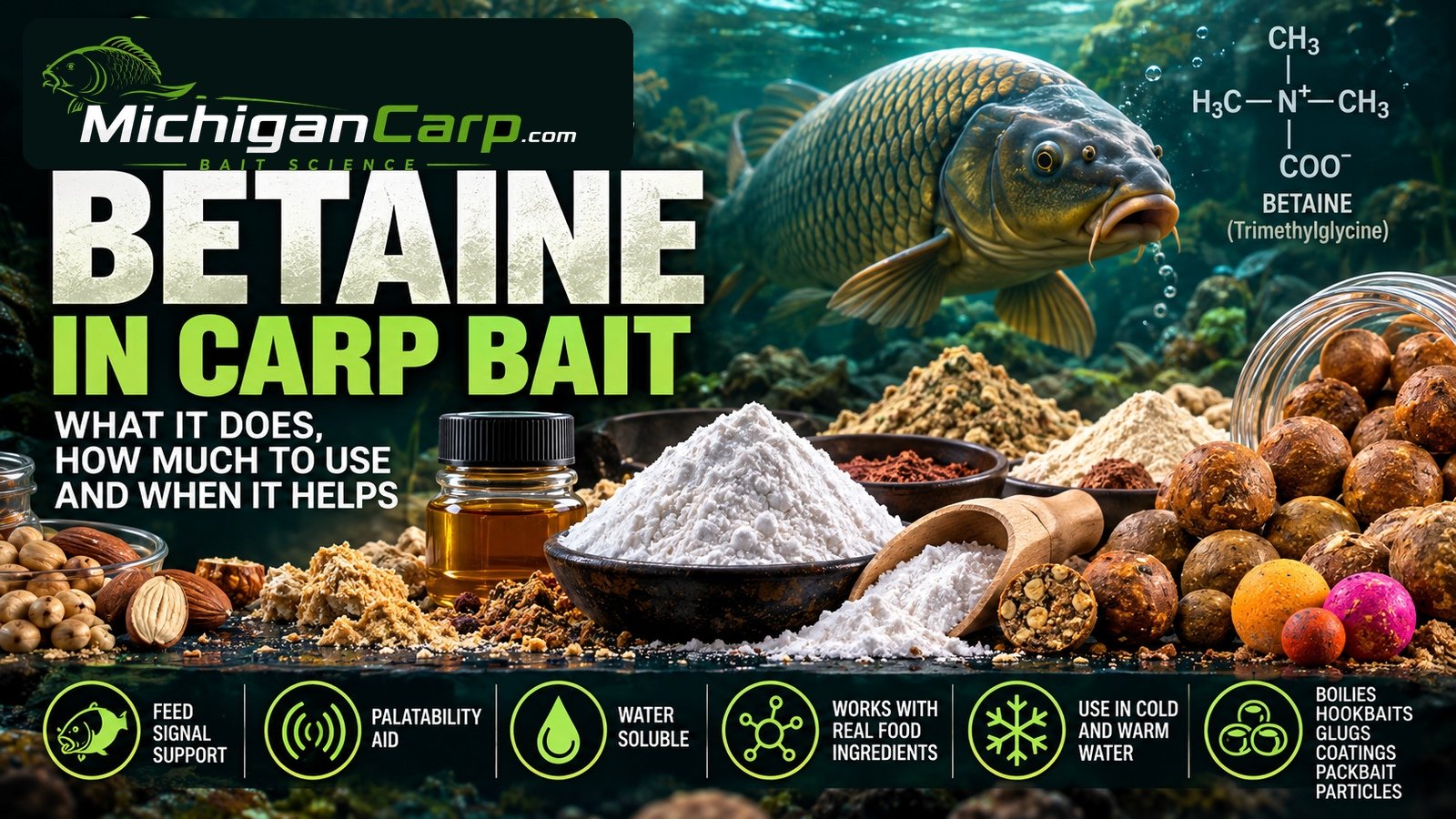
Betaine in carp bait has been talked about for so long that it is easy to treat it as either essential or overrated.
Neither position is particularly useful.
Betaine is a genuine biologically active compound with established use in aquaculture feeds. It has been studied as a feed attractant, palatability aid, osmolyte and methyl donor. There is also common-carp research showing benefits from low dietary inclusion under controlled feeding conditions.
But that does not make betaine a magic carp attractor.
It does not replace good ingredients. It does not rescue a poor boilie. It does not compensate for bad location. And research carried out on complete aquaculture diets should not be converted directly into a boilie recipe without thought.
For practical bait making, I regard betaine as a supporting soluble signal.
It makes most sense when it sits beside genuine food ingredients such as milk proteins, hydrolysates, liver, yeast, nut meals and other water-active compounds.
For the wider soluble-food-signal picture, see How to Use Hydrolysates in Carp Bait and Amino Acids in Carp Bait.
My basic rule is simple:
Use betaine as support, not as the reason the bait exists.
Table of Contents
Quick Start: How to Use Betaine in Carp Bait
For most homemade carp bait, anhydrous betaine is the simplest form to work with.
| Application | Practical Starting Point | Preferred Form | Main Purpose | Main Caution |
|---|---|---|---|---|
| Standard boilie | 1.5–3 g/kg dry mix | Anhydrous | Low-level soluble support | More is not automatically better |
| Strong food boilie | 3–5 g/kg dry mix | Anhydrous | Support liver, yeast and hydrolysates | Test before using routinely |
| Hookbait mix | 3–5 g/kg | Anhydrous | Stronger hookbait identity | Higher levels need testing |
| Specialist hookbait test | Up to 8 g/kg | Anhydrous | Controlled high-signal test | Not a default level |
| Glug or spray | 1–3 g/100 ml | Dissolved anhydrous | Soluble outer signal | Carrier and storage still matter |
| Powder coating | 2–5 g/100 g dust | Fine anhydrous | Rapid outer-layer signal | Do not coat in straight betaine |
| Packbait / method | 1–3 g/kg dry carrier | Anhydrous | Supporting food signal | Texture remains more important |
| Prepared particles | 1–2 g/kg finished particles | Dissolved or dry | Finishing signal | Add after cooking and cooling |
These are practical MichiganCarp starting points, not scientifically established optimum doses for wild carp.
That distinction matters.
Aquaculture research studies complete diets, repeated feeding and production outcomes. A wild carp encountering a boilie or hookbait on a Michigan lake is a very different situation.
For an ordinary boilie, I would normally begin around:
1.5–3 g anhydrous betaine per kilogram of dry mix.
Then change it only if testing gives you a reason.
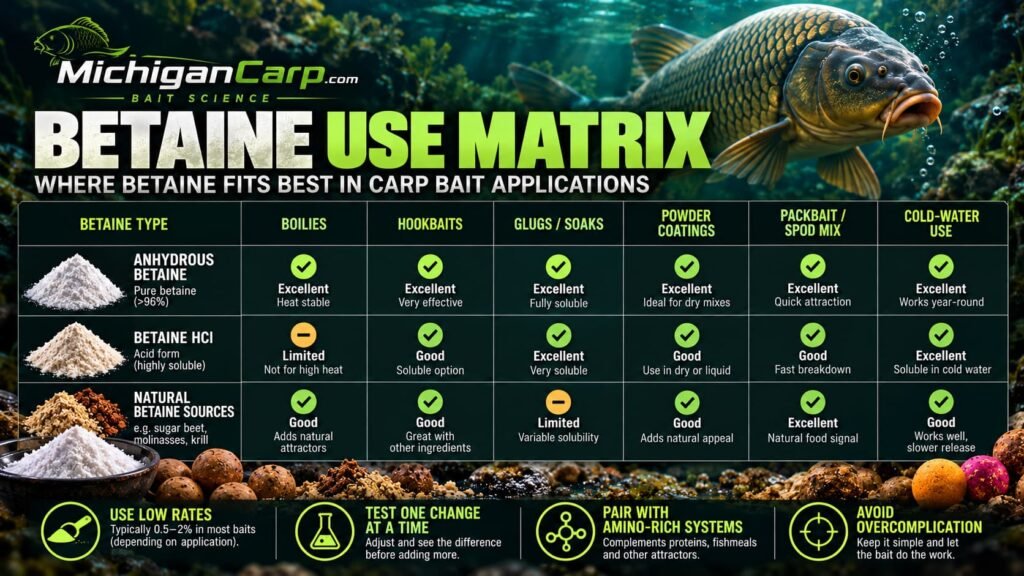
What Betaine Actually Is
Betaine is commonly called:
- betaine;
- glycine betaine;
- trimethylglycine;
- TMG.
Chemically, it is a small quaternary ammonium compound.
PubChem: Betaine lists a molecular weight of approximately 117.15 g/mol.
In aquaculture nutrition, betaine is discussed for several different reasons.
It can function as:
- a feed attractant or palatability-support compound;
- an osmolyte;
- a methyl donor;
- part of the chemical environment influencing feeding response.
The University of Florida Feed Attractants Review describes betaine as a commonly used aquaculture feed attractant and discusses its interaction with taste response, amino acids and feed intake.
That gives betaine a credible scientific basis.
It does not prove that a particular boilie dosage will make wild carp feed.
That is the point where bait science must be separated from bait mythology.
What the Evidence Really Supports
A 2024 meta-analysis, A Meta-Analysis on Dietary Betaine in Aquatic Animals, found positive effects on several growth and feed-utilization measures across aquatic animals receiving betaine-supplemented diets.
The analysis estimated an aquafeed requirement around 0.99% in its particular pooled research context.
That number should not become a carp-bait recipe.
A 0.99% complete aquaculture diet fed repeatedly to captive fish is not equivalent to putting 9.9 g of betaine into every kilogram of boilie mix.
Common-carp work is more directly relevant but still needs careful interpretation.
A controlled feeding study, Effect of Betaine Hydrochloride as Feed Attractant on Common Carp, tested relatively low dietary levels of betaine hydrochloride and reported improved feed-use and growth measures under the experimental conditions.
Again, that supports betaine as a legitimate feed ingredient.
It does not establish a universal angling dose.
There is also evidence against the idea that betaine acts like an automatic feeding switch. In Feeding Stimulants in Crucian Carp, several amino acids produced clearer stimulation than betaine alone in that particular test.
That negative result is useful.
The honest conclusion is:
Betaine is biologically credible.
Its effect depends on species, dose, food context and the rest of the chemical signal.
It is more defensible as part of a food-signal system than as a stand-alone miracle attractor.
Anhydrous Betaine vs Betaine HCl
The two forms most bait makers encounter are anhydrous betaine and betaine hydrochloride.
They are not the same material gram for gram.
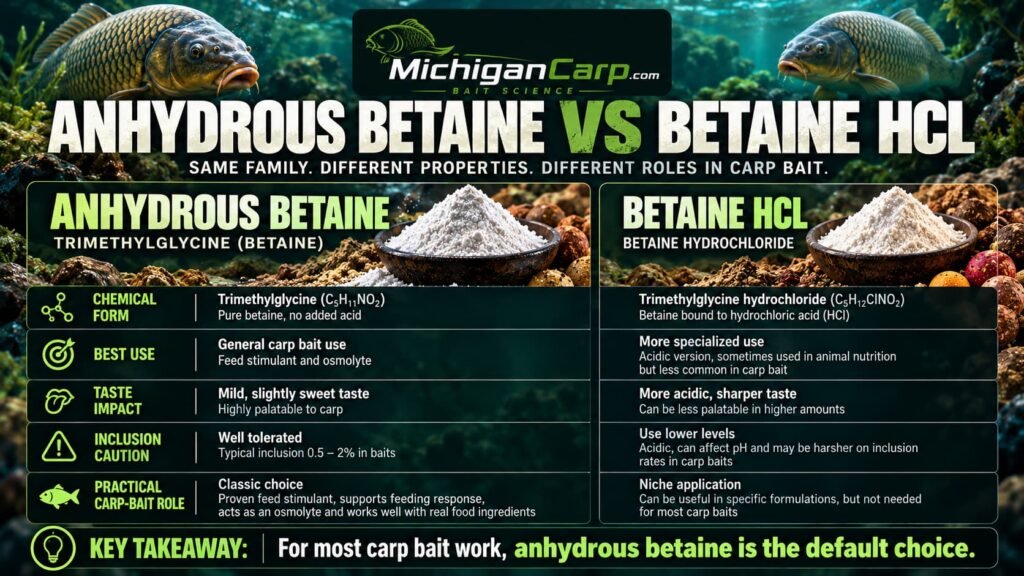
| Property | Anhydrous Betaine | Betaine HCl |
|---|---|---|
| Common names | Betaine, TMG, trimethylglycine | Betaine hydrochloride |
| Molecular weight | ~117.15 g/mol | ~153.61 g/mol |
| Bait-making simplicity | Excellent | More complicated |
| Effect on acidity | Relatively neutral in comparison | More acidifying |
| My default choice | Yes | No |
| Best approach | Start low and test | Start cautiously and test |
NIST Chemistry WebBook: Betaine Hydrochloride lists betaine HCl at approximately 153.61 g/mol.
Because the hydrochloride form contains additional hydrochloride mass, the two forms should not simply be treated as identical ingredients.
For homemade carp bait, anhydrous betaine is my preferred default.
It is easier to understand, easier to weigh into formulas and does not bring the additional acidity of the hydrochloride form.
Betaine HCl can still be used, particularly if that is the material available to you, but I would treat it as a separate ingredient rather than blindly replacing anhydrous betaine gram for gram.
How Much Betaine Should You Use?
This is where restraint matters most.
The useful question is not:
How much betaine can I put in?
It is:
How little betaine can support the bait without distorting it?
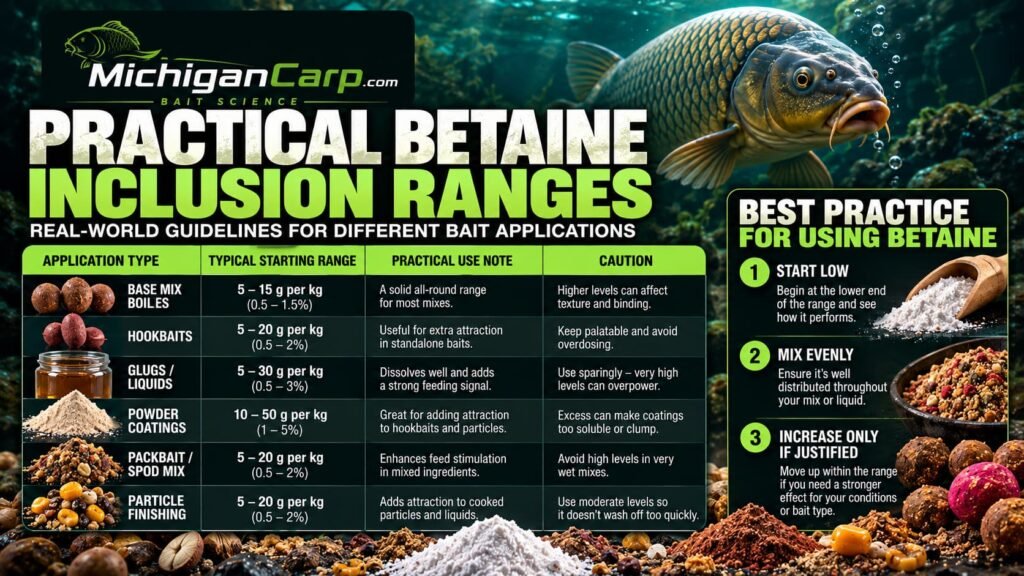
For an ordinary free-bait boilie, I prefer:
1.5–3 g/kg dry mix.
For a stronger food bait containing liver, yeast or hydrolysates:
3–5 g/kg can be tested.
For hookbaits:
3–5 g/kg is a sensible starting region.
Higher specialist hookbait levels can be tested, but I would not jump automatically to 8–10 g/kg simply because the hookbait is supposed to be stronger.
A stronger hookbait still needs to taste like food.
Why I Do Not Start High
Excessive inclusion can complicate rather than improve a bait.
The risks include:
- harsh taste;
- additive overload;
- unnecessary acidity if using HCl;
- masking the underlying food profile;
- confusing field trials because too many variables have changed.
Betaine is measured in grams, not handfuls.
Where Betaine Fits Best
Betaine is versatile because it is a small water-active compound rather than a bulky food ingredient.
That does not mean it belongs everywhere.
Boilies
For ordinary boilies, add anhydrous betaine to the dry ingredients and distribute it evenly before the liquid phase is added.
A normal starting point is:
1.5–3 g/kg dry mix.
It fits particularly well in baits containing ingredients such as:
- hydrolyzed whey;
- liver hydrolysate;
- yeast extract;
- brewer’s yeast;
- milk proteins;
- nut meals;
- tiger nut flour;
- birdfood.
For the broader formulation structure, use How to Formulate a Milk, Nut and Birdfood Boilie Base Mix.
Hookbaits
Hookbaits are one of the better places to test a slightly stronger betaine signal because they have a different job from free bait.
I would begin around:
3–5 g/kg hookbait mix.
If you go higher, test rather than assume.
For wafters and pop-ups, remember that the liquids used alongside betaine may alter buoyancy even if the small quantity of dry betaine does not.
Always test the finished bait with the actual hook and rig.
Glugs, Sprays and Soaks
Betaine can be dissolved into bait liquids, but the carrier system matters.
A simple 100 ml experimental liquid is:
- 50 ml food-grade propylene glycol;
- 30 ml food-grade glycerin;
- 20 ml liquid yeast or compatible hydrolysate;
- 1–3 g anhydrous betaine.
The liquids total 100 ml before the dry betaine is dissolved.
Use it lightly rather than soaking bait until it becomes saturated.
For a deeper comparison of the carriers, read Propylene Glycol vs Glycerin in Carp Bait.
For treatment technique, see How to Prepare Boilies for Carp Fishing.
Powder Coatings
Powder coatings are a particularly clean way to use betaine because the additive can sit inside a wider food dust rather than being applied neat.
A balanced 100 g starting blend is:
- 35 g fine boilie crumb;
- 25 g hydrolyzed whey powder;
- 20 g brewer’s yeast;
- 15 g liver powder;
- 5 g anhydrous betaine.
Total: 100 g.
Lightly wet the bait, apply a thin coating and let it set.
I would not roll a hookbait directly in pure betaine.
Packbait and Method Mix
Betaine can support packbait, but packbait still succeeds primarily through:
- texture;
- breakdown;
- food particles;
- placement;
- attraction from the complete mix.
A starting point of:
1–3 g/kg dry carrier
is enough for experimentation.
See Packbait for Carp Fishing for the complete system.
Prepared Particles
Safe particle preparation comes first.
For maize, hemp or tiger nuts, I would add betaine after cooking and cooling, not as a substitute for correct preparation.
A modest finishing level is:
1–2 g/kg prepared particles.
For safe preparation, use How to Prepare Particles for Carp Fishing.
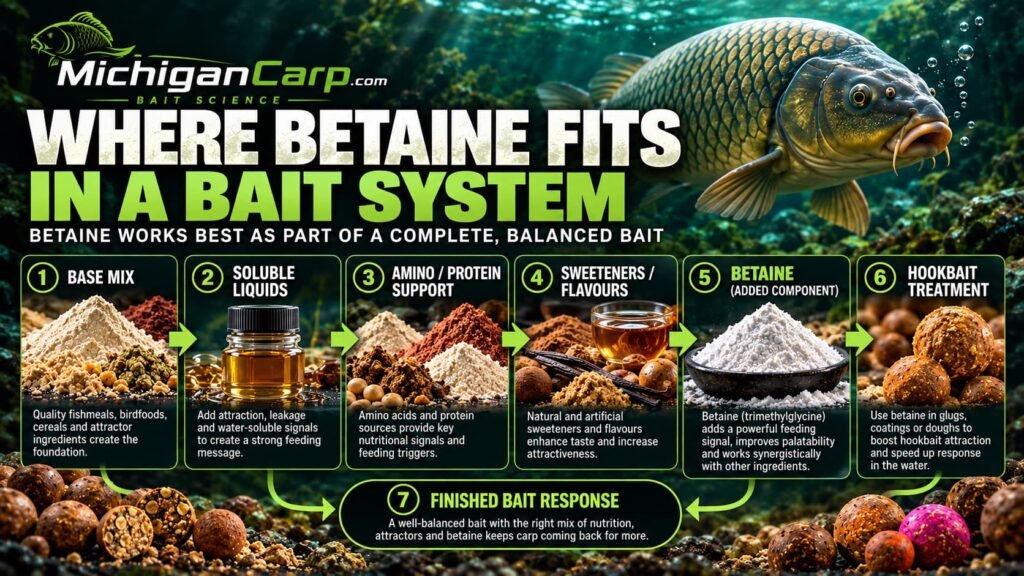
Pair Betaine With Real Food Signals
This is where I think betaine makes the most sense.
Instead of trying to make betaine the attraction system, use it beside ingredients that already create soluble or dispersible food signals.
Useful partners include:
- whey hydrolysate;
- liver hydrolysate;
- yeast extract;
- liquid yeast;
- brewer’s yeast;
- milk proteins;
- amino-rich food ingredients;
- selected nucleotide support.
For hydrolysates, see How to Use Hydrolysates in Carp Bait.
For liver specifically, use Liver Hydrolysate for Carp Bait.
For yeast, see Yeast and Fermented Additives in Carp Bait.
For nucleotide support, use Nucleotides in Carp Bait.
The mistake is not combining ingredients.
The mistake is pushing every ingredient to a high level.
A bait containing maximum betaine, maximum hydrolysate, maximum liver, maximum yeast extract, strong flavor and heavy sweetener is not necessarily sophisticated.
It may simply be overloaded.
Controlled layering is usually better than additive stacking.
Betaine in Milk, Nut and Birdfood Baits
Betaine is particularly easy to integrate into the type of milk, nut and birdfood boilies I use and develop.
These baits can already contain:
- milk proteins;
- whey ingredients;
- tiger nut flour;
- peanut or other nut proteins;
- birdfood;
- yeast;
- liver;
- soluble carbohydrates.
Betaine can sit quietly behind that profile without turning the bait into something else.
For this style of bait, I generally prefer:
1.5–3 g/kg dry mix.
That gives the bait a supporting betaine component while leaving milk, nut, yeast and protein ingredients to define its identity.
It is a good example of why more ingredients do not automatically make a better bait.
The objective is not to make the ingredient list impressive.
The objective is to make the finished bait coherent.
For the full formulation approach, see How to Formulate a Milk, Nut and Birdfood Boilie Base Mix.
Cold Water, Warm Water and Michigan Use
Betaine is highly water compatible, which makes it useful in low-oil, soluble bait systems.
That makes it practical in colder water.
It does not prove that betaine becomes uniquely powerful when the water is cold.
In colder Michigan conditions, my preference is simply to use it as part of a lighter, more water-active signal.
That may mean:
- a single hookbait;
- a lightly coated boilie;
- a small PVA presentation;
- a low-feed milk/nut bait;
- liver, yeast or whey support;
- the lower end of the normal betaine range.
I would normally begin around:
1–2 g/kg in cold-water free bait
rather than increasing the level because fish are feeding less.
In warmer water, richer food bait becomes easier to justify, and betaine can sit comfortably in the normal:
1.5–3 g/kg
region, with higher levels tested only when the overall formulation calls for them.
Warm conditions also increase the importance of storage.
A wet glug containing liver, yeast, dairy liquids or other water-rich ingredients does not become shelf stable because betaine has been added.
Storage, Shelf Life and PVA
Betaine is not a preservative.
Dry betaine incorporated into a dry mix is straightforward.
A water-rich liquid containing dissolved betaine is a completely different storage problem.
Its stability depends on factors such as:
- available water;
- pH;
- preservatives;
- carrier system;
- temperature;
- hygiene;
- storage time.
For deliberately preserved bait, see Potassium Sorbate, Sodium Benzoate and Citric Acid in Shelf-Life Boilies.
For freezer, dried and treated bait, use How to Store Homemade Boilies.
Dry betaine powder is also suitable for dry PVA mixes.
Liquids containing betaine must be tested according to the actual carrier. A glycerin- or glycol-based liquid may behave very differently from a water-rich liquid.
Test the finished liquid with your own bags or mesh rather than relying on the ingredient name.
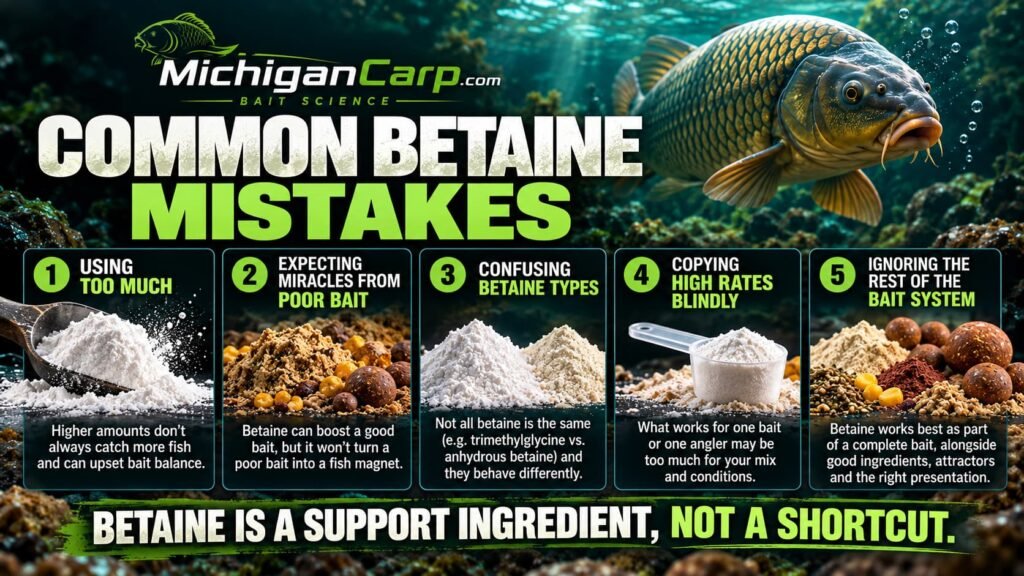
Common Betaine Mistakes
The same problems appear repeatedly.
Using too much.
Higher inclusion does not automatically create a stronger feeding response.
Treating betaine as magic.
It supports bait. It does not replace location, presentation or food quality.
Treating betaine HCl as identical to anhydrous betaine.
The two forms have different molecular weights and different effects on acidity.
Using straight betaine as a heavy coating.
Use it as a fraction of a balanced food dust instead.
Adding it to every bait.
If a bait already works, you do not have to add another ingredient.
Stacking every attractor together.
High liver + high yeast + high hydrolysate + high betaine + strong flavor can create noise rather than improvement.
Changing too many variables during testing.
If you alter betaine, flavor, hydrolysate and boil time at the same time, you learn very little.
How to Test Betaine Properly
You do not need a complicated experiment.
Start with a bait you already understand.
Make three small versions with everything identical except betaine.
For a 1 kg dry-mix equivalent:
- Control: 0 g;
- Low: 1 g;
- Medium: 3 g;
- High: 5 g.
If material is limited, scale each version down proportionally.
Keep constant:
- base mix;
- eggs or liquid phase;
- flavor;
- hydrolysates;
- yeast;
- liver;
- boil time;
- drying time.
Then compare:
- dough behavior;
- taste and smell;
- water leakage;
- texture;
- cracking;
- hookbait durability;
- buoyancy where relevant;
- actual fishing results.
Do not assume the strongest-smelling or strongest-tasting sample is the best one.
The objective is to find the lowest useful inclusion, not the highest level the bait can tolerate.
For a more complete testing framework, use How to Test Boilies Before Fishing.
My Practical View
I use betaine because it can make sense scientifically and practically.
I do not use it because I think carp cannot resist it.
In my own bait development, I prefer it as a quiet part of a much larger food-signal system.
That system may include:
- milk proteins;
- hydrolyzed whey;
- liver hydrolysate;
- yeast;
- nut ingredients;
- birdfood;
- soluble carbohydrates;
- carefully chosen liquids.
In that type of formulation, betaine does not need to dominate.
For normal free bait, 1.5–3 g/kg dry mix is where I would normally begin.
I would use more only when I had a specific reason, particularly with specialist hookbaits or controlled comparison batches.
That also fits my wider approach to bait formulation:
Do not add ingredients simply because they sound technical.
Every ingredient should have a job.
Betaine’s job is support.
FAQ
Is betaine good in carp bait?
Yes. There is credible aquaculture evidence for betaine as a feed-attractant and palatability-support ingredient. In carp bait, I use it conservatively as part of a wider food-signal system rather than as a stand-alone trigger.
How much betaine should I put in boilies?
For normal free bait, a practical starting point is about 1.5–3 g of anhydrous betaine per kilogram of dry mix. These are practical bait-making levels, not scientifically established wild-carp optima.
Is more betaine better?
No. Higher inclusion can make a bait harsher or simply add another unnecessary variable. Start low and test.
What is the best type of betaine for carp bait?
For most homemade bait, I prefer anhydrous betaine, also sold as trimethylglycine or TMG.
Can I use betaine HCl?
Yes, but it is not identical to anhydrous betaine. It has a different molecular weight and adds an acidic component, so it should be treated as a separate formulation choice.
Is betaine useful in hookbaits?
Yes. Hookbaits are a sensible place to test a slightly stronger level. Around 3–5 g/kg hookbait mix is a reasonable starting region before experimenting further.
Can betaine be used in glugs?
Yes. It can be dissolved into glugs and sprays, but the carrier and storage system still determine stability and PVA compatibility.
Does betaine work better in cold water?
Betaine is highly compatible with water-active, low-oil bait systems, which makes it practical in cold water. I would not claim that research proves it becomes uniquely effective at low temperature.
Can I coat boilies directly in betaine powder?
I would not use a heavy coating of straight betaine. It is better used as a small percentage of a food-based dust containing ingredients such as whey, yeast, liver powder and boilie crumb.
Does betaine preserve bait?
No. Betaine should not be treated as a preservative. Shelf life depends on the complete formulation, moisture, pH, preservative system, processing and storage.
Next Steps
For the subjects surrounding betaine, continue with:
- Amino Acids in Carp Bait
- How to Use Hydrolysates in Carp Bait
- Liver Hydrolysate for Carp Bait
- Yeast and Fermented Additives in Carp Bait
- Nucleotides in Carp Bait
- How to Prepare Boilies for Carp Fishing
- How to Store Homemade Boilies
- How to Formulate a Milk, Nut and Birdfood Boilie Base Mix
- Bait Science
- Boilie School