


Milk replacer for carp bait can be a useful ingredient, particularly for U.S. bait makers who can often buy livestock milk replacers more easily and economically than some specialist European milk-protein ingredients.
But there is an important distinction to make immediately.
Milk replacer is a product category. It is not one standardized ingredient.
One product may rely heavily on whey products and skimmed milk. Another may contain substantial added fat, different protein sources, emulsifiers, vitamins, minerals, flavourings or other feed ingredients.
Some milk replacers are also medicated livestock feeds.
That means the words milk replacer on the front of the bag tell us surprisingly little about whether the product belongs in a carp boilie.
The useful information is on the feed tag.
When I evaluate a milk replacer for bait, I ask four questions:
- Is it clearly non-medicated?
- Where does its protein come from?
- How much fat does it add to the complete formula?
- What specific job will it perform in the bait?
A milk replacer should not be bought merely because the front of the bag says 24:24, premium, all milk or multi-species.
Nor should it be treated as cheap WPC80, cheap casein or generic milk powder.
Those ingredients perform different jobs.
For the broader dairy family, read Milk Powders in Boilie Making.
For the direct specialist-protein comparison, use Casein vs WPC for Boilies.
For the deeper protein-science discussion, read Milk Proteins in Carp Bait.
My working rule is simple:
Do not buy milk replacer by the front of the bag. Buy it by the feed tag.
Table of Contents
Quick Start: Is Milk Replacer for Carp Bait Suitable?
Before thinking about inclusion rates, flavours or recipes, check the product itself.
| Check | Better Sign | Reason for Caution |
|---|---|---|
| Medication | Clearly labelled non-medicated | Active drug or medication claim |
| Label clarity | Full guaranteed analysis and ingredient list | Damaged, incomplete or vague label |
| Protein source | Clearly identified milk-derived ingredients | Protein number without useful source information |
| Fat | Known and included in the whole recipe calculation | High-fat product added to an already rich bait |
| Fibre | Relatively low | Unexpectedly high fibre may indicate substantial non-dairy material |
| Freshness | Dry, free-flowing and clean smelling | Rancid, stale, damp, mouldy or badly clumped |
| Function | Performs a defined formulation job | Added merely because “milk replacer” sounds attractive |
The first decision is the easiest.
Do not use medicated milk replacer in carp bait.
The FDA guide to Medicated Milk Replacers explains that adding an approved animal drug makes the product a medicated feed and that medicated feeds must be handled and used according to their approved labelling.
There is no worthwhile reason to introduce that complication into recreational carp bait.
Use a clearly identified non-medicated product instead.
What Milk Replacer Actually Is
Milk replacer is manufactured animal feed designed to replace or supplement milk for young animals.
It is normally a blend, not a purified dairy ingredient.
Depending on the product, that blend may contain:
- dried whey;
- whey protein concentrate;
- whey products;
- dried skimmed milk;
- other milk proteins;
- lactose;
- animal or vegetable fats;
- lecithin;
- vitamins;
- minerals;
- processing aids;
- flavouring;
- and other permitted feed ingredients.
That makes milk replacer fundamentally different from buying one defined ingredient such as WPC80, acid casein or sodium caseinate.
A useful way to think about it is:
MILK REPLACER = A PRE-FORMULATED DAIRY/FEED PACKAGE
rather than:
MILK REPLACER = ONE MILK PROTEIN
That distinction matters when building a boilie.
If you add 70 g of milk replacer, you have not added 70 g of protein.
You may simultaneously be adding protein, fat, milk carbohydrate, minerals and several secondary ingredients.
That versatility is one reason milk replacer can work well in milk/nut bait.
It is also why it is easy to misuse.
Complexity Is Not Automatically Better
A longer ingredient list does not make a powder superior.
Sometimes the more precise ingredient is better because you know exactly what job it performs.
WPC80 provides a concentrated whey-protein fraction.
Casein provides concentrated casein protein and particular structural properties.
Lactose provides a defined milk carbohydrate.
Milk replacer combines several functions, but gives you less independent control over them.
Use that complexity when it helps the formula.
Do not confuse complexity with quality.
How to Read a Milk Replacer Feed Tag
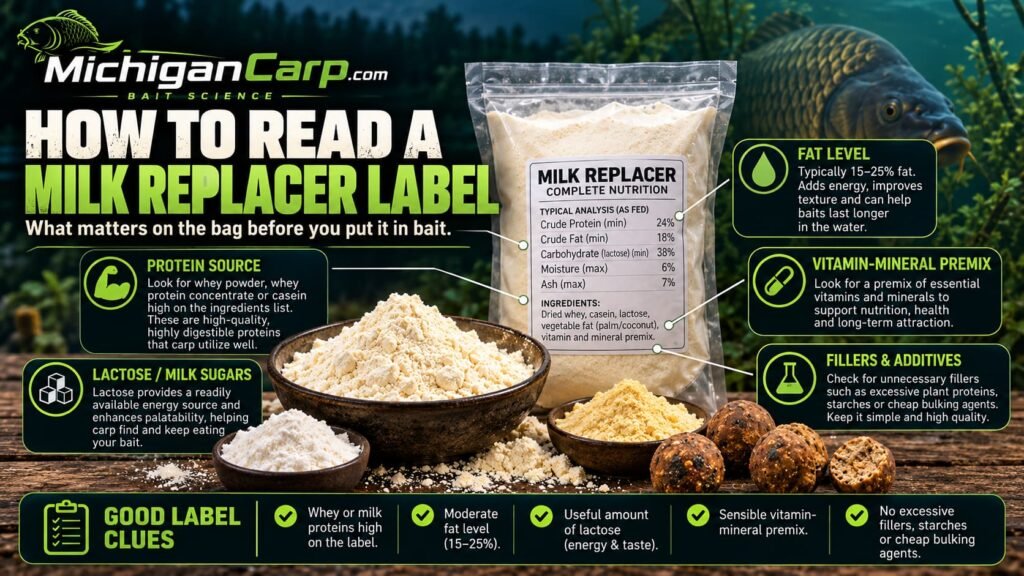
The FDA Animal Food Labeling guide explains that animal-food labels must identify ingredients and that ingredients are generally listed in descending order of predominance by weight.
That makes the ingredient list one of the most useful parts of the bag.
1. Check Medication First
Look for words or statements referring to:
- medicated feed;
- active drug ingredients;
- antibiotics;
- coccidiostats;
- disease prevention;
- disease treatment;
- Veterinary Feed Directive language;
- withdrawal periods.
If it is medicated, leave it out of the bait.
2. Read the Guaranteed Analysis
Milk replacers commonly give guarantees for some combination of:
- crude protein minimum;
- crude fat minimum;
- crude fibre maximum;
- moisture;
- ash;
- calcium;
- phosphorus;
- vitamins;
- minerals.
Do not treat these guarantees as though they necessarily describe the exact average composition of every scoop.
If the bag guarantees 24% crude fat minimum, I use 24% as a useful minimum figure when auditing the bait.
That alone is enough to show why milk replacer can materially alter a milk/nut boilie’s fat level.
3. Identify the Protein Sources
The protein percentage is only half the story.
Look at where the protein actually comes from.
For a dairy-oriented bait, ingredients such as:
- dried whey;
- whey protein concentrate;
- dried skimmed milk;
- milk proteins;
- casein-derived materials
tell you much more than a crude-protein number alone.
A product with an apparently attractive protein percentage may not provide the dairy profile you expected if much of that protein comes from another source.
4. Check the Fat Sources
This is especially important in the milk/nut/seed bait family.
Milk replacer fat must be counted alongside fat from ingredients such as:
- whole-milk powder;
- cream powder;
- peanut;
- tiger nut flour;
- almond;
- coconut;
- full-fat soy;
- oily seeds;
- egg yolk;
- lecithin;
- bottled oil.
Do not decide whether a bait needs additional oil until this has been calculated.
For the complete method, use How to Balance Fat in Boilies.
5. Read the Rest of the Ingredient List
Vitamin/mineral premixes, emulsifiers and other feed ingredients are normal parts of many milk replacers.
That does not mean every minor ingredient deserves its own attraction theory.
The important question remains:
Does this complete product improve the bait I am trying to formulate?
Milk Replacer vs Other Dairy Ingredients

Milk replacer, milk powder, WPC80 and casein overlap in some areas.
They are not interchangeable.
| Ingredient | Main Contribution | Main Formulation Point |
|---|---|---|
| Milk replacer | Mixed protein, fat, carbohydrate and minerals | Composition varies by product |
| Skimmed milk powder | Broad dairy solids with relatively low fat | Useful general milk powder |
| Whole-milk powder | Dairy solids plus substantial milkfat | Count carefully in rich mixes |
| WPC80 | Concentrated whey protein | Much greater protein density |
| Casein | Concentrated casein protein | Strong protein and structural role |
| Caseinate | Functional casein-derived protein | Hydration and dispersion depend on type |
| Lactose | Milk carbohydrate | Not a protein ingredient |
Milk Replacer Is Not WPC80
The U.S. Dairy Export Council WPC80 reference describes WPC80 as a concentrated whey-protein ingredient.
That is a very different proposition from a 24:24 livestock milk replacer.
Using representative figures:
| Ingredient | Protein | Fat |
|---|---|---|
| 24:24 milk replacer | ≥24% | ≥24% |
| WPC80 | approximately 80%+ | comparatively low |
If you replace 100 g WPC80 with 100 g of 24:24 milk replacer, you have fundamentally changed the formula.
You have sharply reduced its whey-protein contribution while increasing the fat and wider feed-package contribution.
They can work together very well.
They do not perform the same job.
Milk Replacer Is Not Casein
Casein and caseinates are selected for much more specific protein and physical functions.
A milk replacer may contain milk proteins, but that does not mean it duplicates:
- acid casein;
- rennet casein;
- micellar casein;
- sodium caseinate;
- calcium caseinate.
When the formula genuinely requires those properties, choose the appropriate ingredient directly.
For the full comparison, use Casein in Boilies: Acid, Rennet, Micellar and Caseinate Types.
How Much Milk Replacer Should You Use?
There cannot be one universal inclusion rate because different milk replacers have very different compositions.
Protein matters.
Fat matters.
The rest of the formula matters.
For a relatively rich 24% protein / 24% fat product, I prefer a conservative starting point.

For a 24:24 product:
| Milk Replacer in 1 kg Dry Mix | Minimum Protein Contribution | Minimum Fat Contribution |
|---|---|---|
| 30 g | 7.2 g | 7.2 g |
| 50 g | 12.0 g | 12.0 g |
| 70 g | 16.8 g | 16.8 g |
| 80 g | 19.2 g | 19.2 g |
| 100 g | 24.0 g | 24.0 g |
The calculation is:
ingredient weight × declared percentage = nutrient contribution
For example:
70 g × 0.24 = 16.8 g
So a 70 g inclusion of a 24% fat milk replacer contributes at least approximately 16.8 g of crude fat to the dry mix before any other ingredient is counted.
My Practical Starting Range
For a rich 24:24 product in a milk/nut/birdfood boilie, I would normally begin around:
50–80 g/kg dry mix.
That is a practical bait-development range, not a scientifically established nutritional requirement for wild carp.
If the formula already contains substantial levels of:
- whole-milk powder;
- cream powder;
- peanut;
- coconut;
- full-fat soy;
- egg;
- or added oil,
I would normally begin toward the lower end.
If the rest of the mix is considerably leaner, the upper end may fit more comfortably.
Do not increase milk replacer simply because it is inexpensive.
The ingredient should have a job.
Ultra 24: A Real U.S. Example
Ultra 24 is useful as a real-world example because it is readily available in the United States and demonstrates why the label matters.
The current Sav-A-Caf Ultra 24 Multi-Species Milk Replacer specification guarantees:
- 24% crude protein minimum;
- 24% crude fat minimum;
- 0.15% crude fibre maximum;
- 10% ash maximum.
Its current ingredient list begins with:
- dried whey;
- dried whey protein concentrate;
- dried whey product;
- dried skimmed milk;
followed by animal fat, coconut oil and a wider vitamin/mineral and feed-ingredient package.
That gives us a much clearer formulation picture than the product name alone.
My 70 g/kg Use
A practical inclusion I have used is:
70 g Ultra 24 per kilogram of dry mix.
At the guaranteed 24:24 figures, that contributes at least approximately:
16.8 g crude protein
and
16.8 g crude fat.
I use it as one component of the dairy section.
I do not expect it to replace every separate milk ingredient.
WPC80 still provides a more concentrated whey-protein contribution.
Lactose can still be added independently where wanted.
Selected caseins can still be used where their particular structural properties are required.
The complete bait has caught carp for me, including fish in the twenties.
That is useful field experience with the complete bait.
It does not prove that Ultra 24 alone caused the captures.
My confidence is in the complete tested formulation—not in one livestock-feed ingredient being a magic attractor.
Product formulations can change, so always check the physical bag or current manufacturer specification before reformulating around it.
Where Milk Replacer Fits in a Milk-Nut Boilie

Milk replacer works best when it has a defined place inside the bait rather than being asked to perform every dairy function.
A useful section-based view is:
| Section | Example Ingredients | Main Job |
|---|---|---|
| Broad dairy | Milk replacer, skimmed milk, whole-milk powder | Dairy solids and background food profile |
| Concentrated protein | WPC80, casein, caseinate | Protein and specific functional properties |
| Nut component | Tiger nut, peanut, almond, coconut | Food value, texture and fat |
| Cereal structure | Semolina, maize, wheat products | Rolling and cooked structure |
| Birdfood / coarse fraction | Birdfoods and seed ingredients | Texture and matrix variation |
| Soluble support | Hydrolysates, yeast | Faster water-active food signals |
| Liquid phase | Eggs and selected liquid foods | Hydration, binding and liquid food value |
Milk replacer belongs principally in the broad dairy section.
For the complete formulation framework, use How to Formulate a Milk, Nut and Birdfood Boilie Base Mix.
Using Milk Replacer With WPC80
This is often a very useful combination.
A moderate milk-replacer inclusion gives you a broad dairy/feed contribution.
WPC80 allows you to increase the whey-protein component without having to add much more fat-rich milk replacer.
That provides considerably more control.
Using It With Whole-Milk or Cream Powder
Be careful here.
Milk replacer + whole-milk powder + cream powder + nut flour + egg can produce a very rich formula before bottled oil is even considered.
Calculate the total first.
Using It With Casein
Casein should be present because the bait needs its particular protein or physical role.
Do not add casein merely to make the ingredient list look more sophisticated.
Every ingredient needs a reason.
How to Test a New Milk Replacer
Different products can behave differently enough that I would not put an unfamiliar milk replacer straight into a large batch.
Use matched small-batch testing.
A simple first test is:
CONTROL
Your established base mix without the new milk replacer.
TEST
The same basic mix with one planned portion replaced by milk replacer.
For a 24:24 product, a useful 500 g dry-mix test is approximately:
25–40 g milk replacer
equivalent to:
50–80 g/kg.
Keep the other variables as stable as practical:
- dry ingredients;
- egg weight;
- liquids;
- flavours;
- paste-rest time;
- bait diameter;
- cooking;
- drying;
- storage;
- water-test temperature.
Compare:
- paste smell;
- stickiness;
- greasiness;
- extrusion;
- rolling;
- cooking behaviour;
- surface oil;
- drying;
- texture;
- cracking;
- water uptake;
- hookbait attachment.
If the milk-replacer version becomes greasy, do not immediately throw additional binder into it.
First inspect the complete fat system.
If the cooked bait is too soft, review the formula rather than automatically boiling it longer.
For the full procedure use How to Test Boilies Before Fishing.
For processing use How to Boil and Dry Boilies Properly.
Common Milk Replacer Mistakes
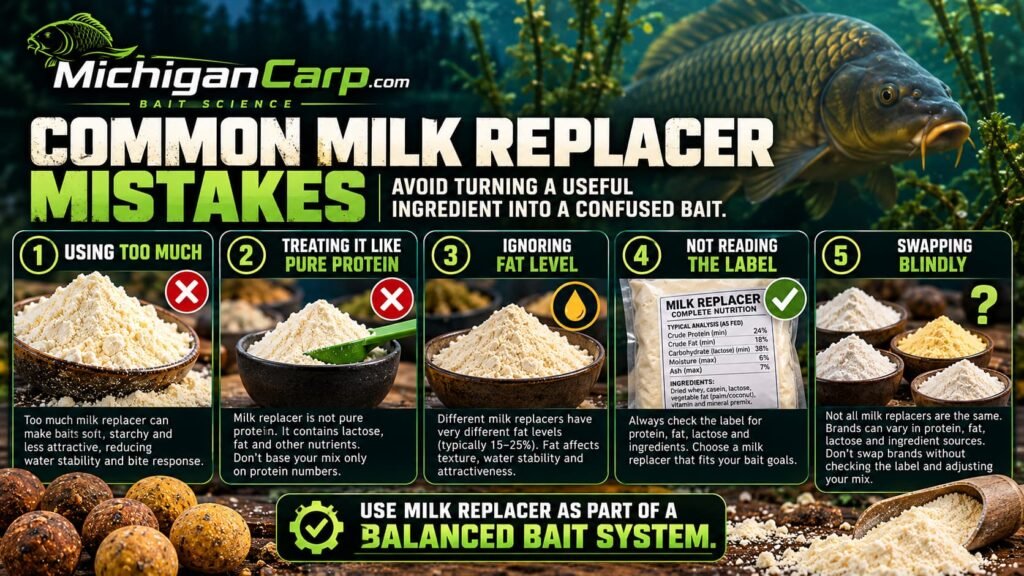
Using Medicated Milk Replacer
Avoid it.
Choose a clearly non-medicated alternative.
Buying by the Front of the Bag
A big 24:24 printed on the front is not a complete formulation specification.
Read the guaranteed analysis and ingredients.
Treating Milk Replacer as Pure Protein
A rich replacer may supply almost as much fat as protein.
Count both.
Ignoring the Fat Budget
This becomes especially important in milk/nut/seed formulas.
Use How to Balance Fat in Boilies before deciding whether the formula needs additional oil.
Replacing WPC80 Gram for Gram
This completely changes the protein and fat system.
They are not equivalents.
Replacing Casein Gram for Gram
Again, they perform different jobs.
Choose casein for casein-specific properties.
Assuming Every Milk Replacer Is the Same
The words milk replacer describe a category.
Always check the actual product.
Adding More Because It Is Cheap
Ingredient cost does not determine the correct inclusion.
The formula does.
Over-Interpreting Vitamins and Minerals
A vitamin/mineral premix can be nutritionally appropriate in the original livestock feed.
That does not establish it as a special wild-carp attraction package.
Keep the claims proportional to the evidence.
Using Stale Product
This is especially important with a high-fat product.
If the powder smells rancid, stale or clearly wrong, discard it.
Flavour cannot repair oxidized fat.
The overall principle is:
Use milk replacer as part of a balanced bait system—not as the identity of the bait.
FAQ
Is milk replacer good for carp bait?
It can be. A suitable non-medicated product can contribute milk-derived ingredients, fat, carbohydrates, minerals and useful food value. Its real usefulness depends on its label and the complete boilie formula.
Can I use calf milk replacer in boilies?
Yes, provided you have checked the product and it is appropriate and non-medicated. Different calf milk replacers can have substantially different formulations.
Can I use medicated milk replacer?
I would not. The FDA Medicated Milk Replacer guidance explains that these products are medicated feeds intended for approved labelled animal uses.
How much milk replacer should I use?
For a rich 24% protein / 24% fat product, approximately 50–80 g/kg dry mix is a sensible first-test region in a milk/nut/birdfood boilie.
That is a practical bait-development starting point, not a universal carp nutritional requirement.
Is milk replacer the same as milk powder?
No.
Milk replacer is a formulated animal-feed blend. Ordinary milk powders have much more specific compositions.
See Milk Powders in Boilie Making.
Is milk replacer the same as WPC80?
No.
WPC80 is a concentrated whey-protein ingredient.
Milk replacer is a broader feed blend containing protein plus other components such as fat and minerals.
See Casein vs WPC for Boilies.
Can milk replacer replace casein?
Not directly.
Casein and caseinates have their own protein and physical functions.
Use Casein in Boilies when those properties are required.
Does milk replacer automatically improve boilie leakage?
No.
Some components may interact readily with water, but finished release depends on the complete cooked bait matrix, drying, diameter and immersion conditions.
Does milk replacer make boilies shelf stable?
No.
Milk replacer is not a preservation system.
For most homemade milk-replacer boilies, freezing remains the simplest storage choice unless a complete shelf-life system has deliberately been developed.
Use How to Store Homemade Boilies.
Is Ultra 24 useful for carp bait?
It can be useful as one component of a milk/nut/birdfood formulation.
The current Ultra 24 manufacturer specification lists 24% crude protein minimum and 24% crude fat minimum, so the fat contribution must be included in the complete formula calculation.
Next Steps
Continue with Milk Powders in Boilie Making for the wider dairy-powder family.
Use Casein vs WPC for Boilies when choosing between concentrated milk proteins.
Read Milk Proteins in Carp Bait for the deeper protein-science discussion.
Use Casein in Boilies when the formula needs a specific casein-family ingredient.
Use How to Balance Fat in Boilies before combining milk replacer with nuts, seeds, whole milk, cream powder or additional oil.
Use How to Formulate a Milk, Nut and Birdfood Boilie Base Mix to build the complete formula.
Use How to Boil and Dry Boilies Properly for processing.
Use How to Store Homemade Boilies for freezer and storage decisions.
Use How to Test Boilies Before Fishing for controlled batch comparisons.
Return to Bait Science for the technical ingredient library or Boilie School for the structured boilie-making route.