

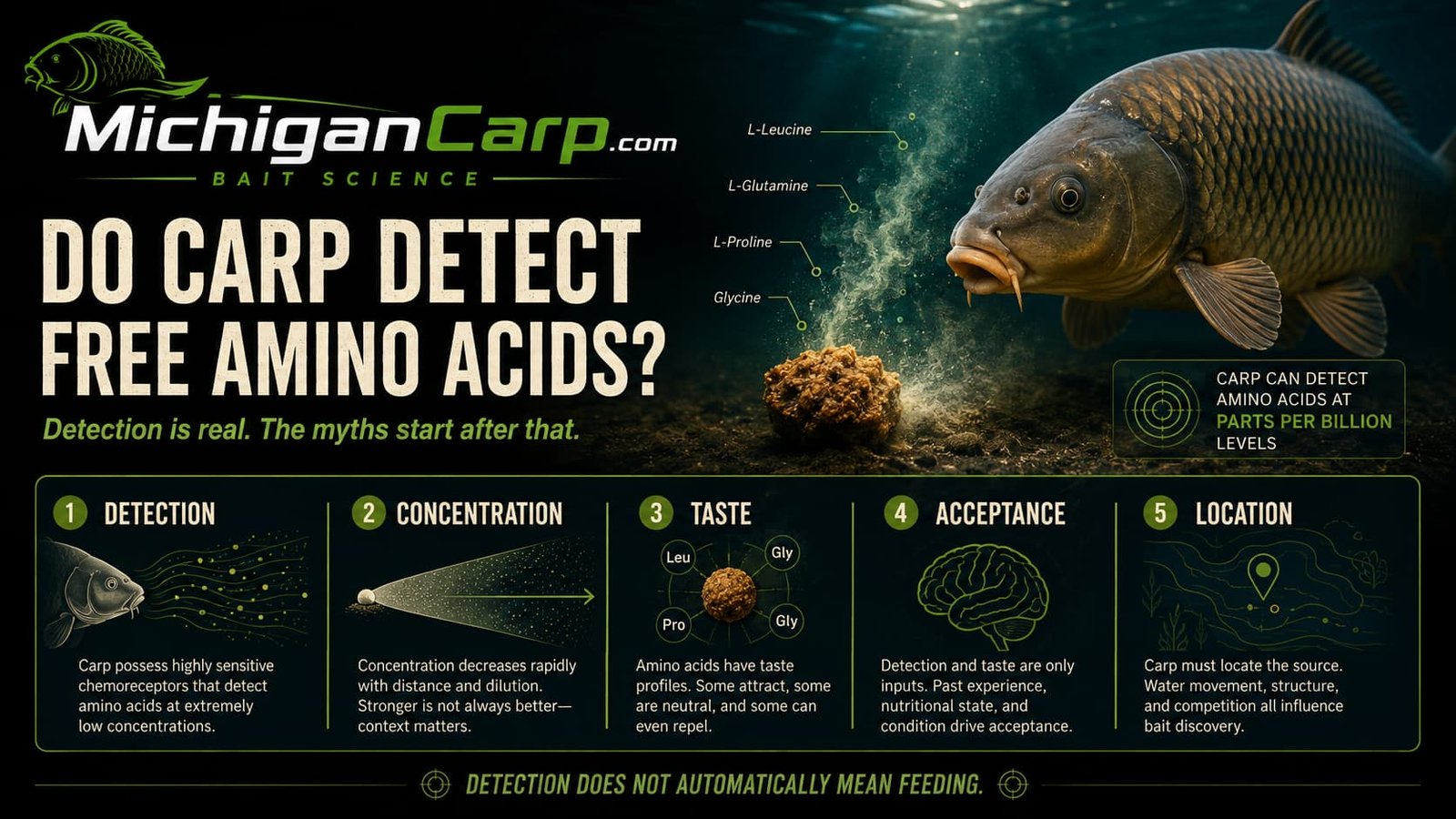
Do carp detect free amino acids? Yes. Common carp can detect and respond to specific free amino acids.
That part is not bait-company fantasy.
The problem starts when anglers turn that real fact into much bigger claims:
- amino acids pull carp from enormous distances;
- all amino acids create the same feeding response;
- more amino acids always mean more attraction;
- hydrolysates work simply because they contain amino acids;
- carp can identify the perfect nutritional profile before eating the bait;
- any bait releasing amino acids must automatically outperform one that does not.
The real picture is more useful than that.
Carp have sophisticated chemical senses. Specific free amino acids can stimulate those systems. But detection is not feeding. Taste is not automatic acceptance. A chemical cue in the wrong location still has to reach a fish, be investigated, be sampled and then be accepted as food.
The practical question is not simply:
Do carp detect amino acids?
They do.
The better question is:
What does amino-acid detection actually mean for real carp bait design?
That is the question this article answers.
For the wider response chain, read Carp Feeding Attractants Explained. For the direct protein comparison, read Amino Acids in Carp Bait: Free vs Intact Proteins.
Table of Contents
Quick Answer
Carp detect free amino acids, but that does not mean every amino acid ingredient triggers feeding. Common carp can respond to particular amino acids, but the result depends on the compound, concentration, bait form, leakage rate, water movement, taste response, carp condition and location.
| Question | Practical answer |
|---|---|
| Can carp detect free amino acids? | Yes, specific free amino acids can stimulate carp chemical senses. |
| Do all amino acids attract carp equally? | No. Different compounds can produce different responses. |
| Does detection mean feeding? | No. Detection is only one stage before investigation, tasting and acceptance. |
| Is more always better? | No. Concentration, mixture and context matter. |
| Are free amino acids the same as intact protein? | No. Free amino acids can act as soluble signals; intact proteins mainly provide nutrition and structure after eating. |
| Can amino acids replace location? | No. Bait chemistry supports good fishing. It does not replace watercraft. |
The short version is this: amino acids matter, but they are not magic.
What Free Amino Acids Are
Amino acids are the building blocks from which proteins are made.
In an intact protein, amino acids are joined together in chains through peptide bonds. When proteins are digested, hydrolyzed or processed, smaller protein-derived fractions can be produced.
Those fractions may include:
- large peptides;
- medium peptides;
- short peptides;
- dipeptides and tripeptides;
- free amino acids.
A free amino acid is an individual amino acid that is not attached to a peptide chain.
That distinction matters. A free amino acid and the same amino acid locked inside an intact protein do not have the same immediate relationship with the surrounding water.
The intact protein can be nutritionally valuable. The free amino acid is already a small individual compound that may be part of the water-active chemical profile around bait.
For the wider protein breakdown ladder, read Proteins, Peptides and Hydrolysates in Carp Bait.
What the Research Actually Supports
Common carp have been studied through several kinds of sensory and feeding-response work, including taste-response experiments, concentration-response trials, electrophysiological studies and feeding-behavior observations.
The useful conclusion is not that carp are attracted equally to every amino acid.
The useful conclusion is more careful:
Specific amino acids can act as chemical stimuli, but response depends on the compound, concentration and sensory context.
A common-carp gustatory study reported that carp possess a highly developed taste system and that free amino acids such as L-cysteine and L-proline were stimulatory in the tested context. For the original study summary, read Gustatory Response of Common Carp to Variable Concentrations of Two Stimulatory Amino Acids.
Older electrophysiological work on carp taste responses also showed that molecular form matters. In work on L-glutamate and related compounds, the L-isomer was stimulatory while the corresponding enantiomer was not in that external gustatory system. For that background, read Taste Responses to Monosodium Glutamate and Its Derivatives in Carp.
That evidence is useful, but it should not be stretched into a bait myth. It does not prove that every amino acid attracts carp, that every amino blend improves bait, or that every hydrolysate is automatically superior.
It supports a better bait-making principle:
Use amino-acid logic deliberately, not blindly.
Detection Is Not Feeding
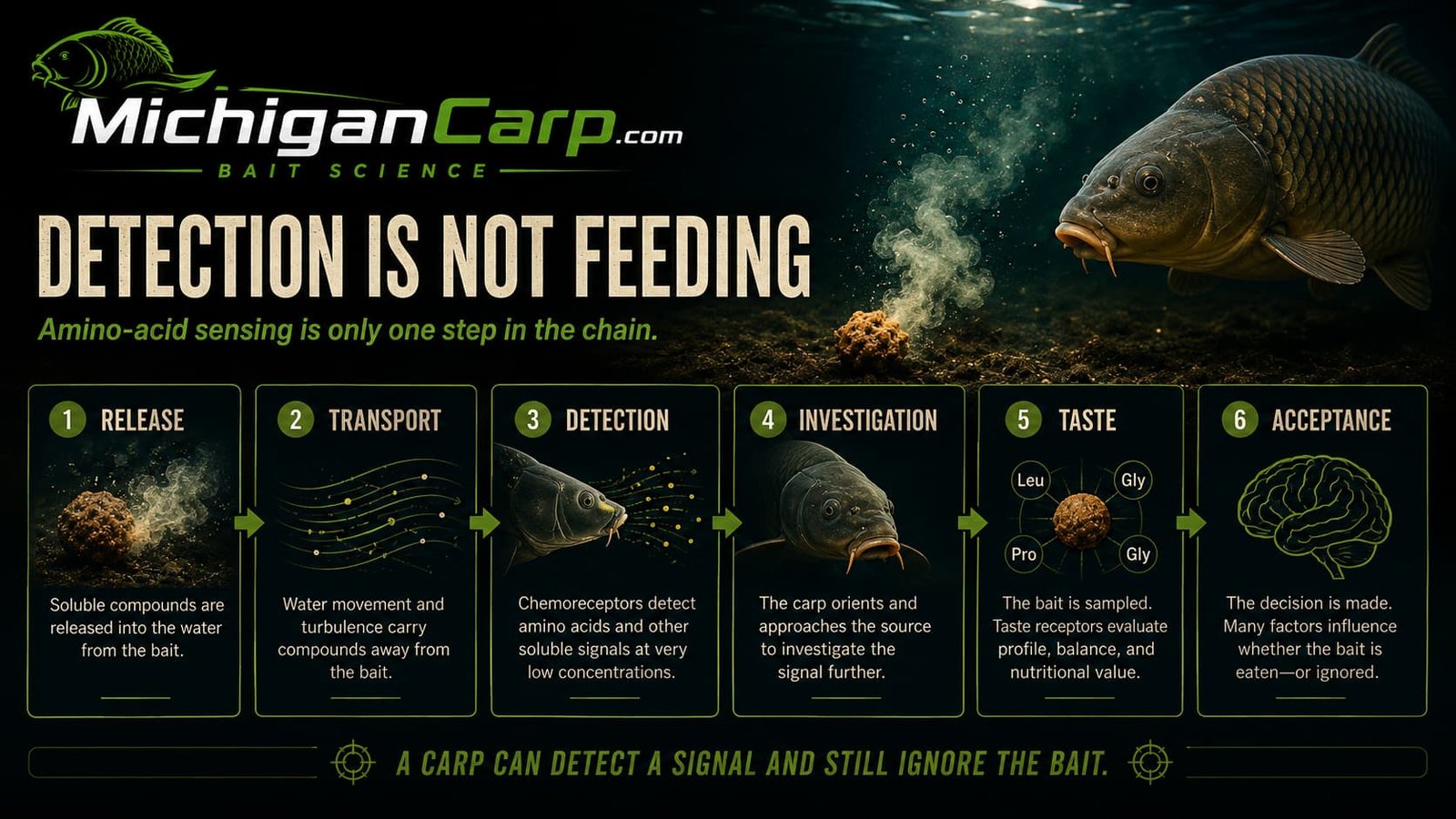
This is the most important practical point in the whole article.
A carp can detect a signal and still ignore the bait.
The bait-response chain is not:
detection → instant feeding
It is closer to:
release → transport → detection → investigation → tasting → acceptance
Each stage can fail.
Release
The amino-acid material must become available from the bait. A highly water-active compound locked inside a dense, dry, poorly hydrated bait may not communicate the way it does in a lab or in a liquid sample.
Transport
Once material leaves the bait, water movement, turbulence, undertow, diffusion and dilution decide where that information goes. This is why amino-acid talk has to be connected to real water behavior.
Detection
The carp must encounter a relevant concentration of the compound and detect it through the appropriate sensory system.
Investigation
Detection may lead to orientation, searching or closer inspection, but that still does not guarantee the fish will eat the bait.
Taste
Once the bait is mouthed or sampled, taste becomes more important. A compound that helps detection may not automatically create acceptance after sampling.
Acceptance
Acceptance depends on more than the presence of an amino-acid signal. Texture, bait familiarity, safety, hunger, competition, prior experience, hookbait mechanics and the whole bait package can influence the final decision.
For the full attraction framework, read Carp Feeding Attractants Explained.
Olfaction and Gustation Are Different Jobs
Anglers often use the word smell for every chemical response. That makes the subject messy.
Carp use more than one chemosensory route. Olfaction and gustation both matter, but they should not be treated as identical.
Olfaction
Olfaction involves detecting dissolved chemical information through the olfactory system. In practical fishing terms, it can contribute to awareness, orientation and searching, but detecting something in the water is not the same as deciding to eat a hookbait.
Gustation
Gustation is taste. Carp taste and evaluate food objects, and that process is closer to sampling, testing, acceptance and rejection.
This is why the phrase “amino-acid attraction” is too blunt. A compound may contribute to detection, taste, investigation or acceptance, but those are not the same event.
A useful bait does not simply shout louder. It releases the right kind of information in the right place and still behaves like something the carp will accept.
Free Amino Acids vs Intact Proteins
One of the biggest bait-science mistakes is treating free amino acids and intact proteins as if they do the same job.
They do not.
Free Amino Acids
Free amino acids already exist as individual compounds. Their practical bait role belongs mainly in discussions about:
- chemical detection;
- taste;
- sensory response;
- short-range bait communication;
- water-active food signals.
They can be important, but they are not a complete food by themselves.
Intact Proteins
Intact proteins are larger nutritional molecules. Their bait roles can include:
- food value;
- amino-acid supply after digestion;
- bait structure;
- texture and rolling behavior;
- longer-term nutritional contribution.
The mistake is saying that intact proteins automatically leak useful free amino acids just because the bait is wet. Amino acids inside intact proteins are still peptide-bound until suitable hydrolysis or digestion occurs.
A good bait can logically contain both a nutritional protein backbone and smaller soluble fractions for chemical signal support. They are related, but they are not the same job.
For the dedicated comparison, read Amino Acids in Carp Bait: Free vs Intact Proteins.
What Controls Amino-Acid Response in Real Bait?
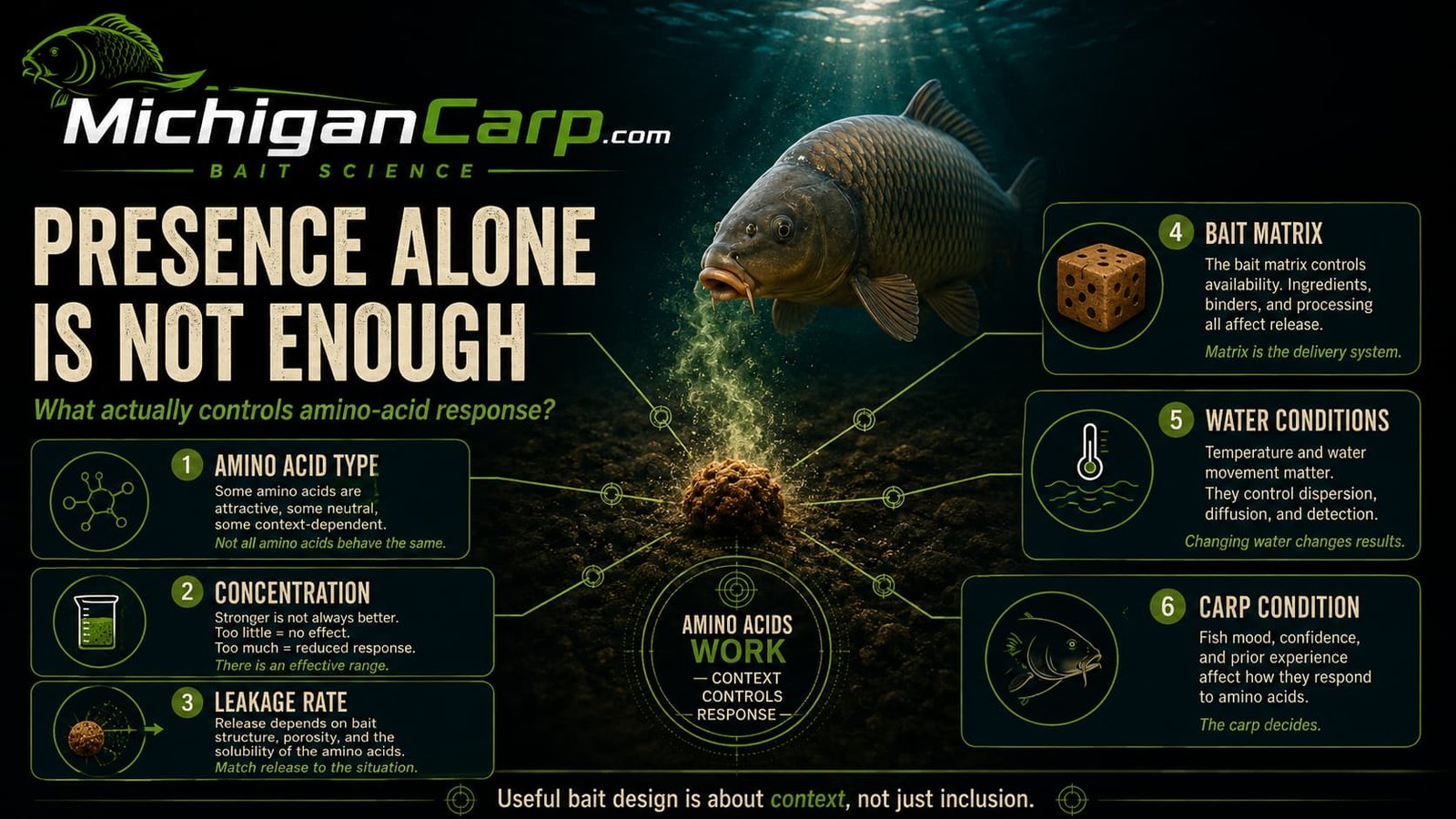
Presence alone is not enough.
A bait can contain amino acids and still fail to use them well. The useful question is what actually controls the carp’s response.
Amino Acid Type
Not all amino acids behave the same. Some may be stimulatory in a given sensory context, some may be weaker, some may be neutral, and some may depend heavily on mixture and concentration.
The phrase “contains amino acids” is not enough information.
Concentration
More is not automatically better. Too little may produce no useful effect. Too much may waste ingredient, create an unnatural profile, increase harshness or move outside a useful response range.
In bait making, concentration should be treated as a design choice, not a competition.
Leakage Rate
A water-active compound has to leave the bait before it can become part of the surrounding chemical picture. Release depends on solubility, particle size, bait hydration, porosity, surface area, cooking, drying and whether the ingredient is in the bait or applied to the outside.
For the full release pathway, read The Science of Carp Bait Solubility and Leakage.
Bait Matrix
The bait matrix controls delivery. A free amino acid in a liquid, a hydrolysate in crumb, a soluble powder inside a hard boilie and a hookbait coating will all behave differently.
Do not judge the ingredient separately from the bait carrying it.
Water Conditions
Temperature, water movement, depth, undertow, wave action and turbidity all affect how soluble material moves and how quickly it becomes diluted.
This is why a treatment that looks active in a bucket may behave differently in a deep lake, river channel, weed edge or cold spring margin.
Carp Condition
The carp still decides. Feeding state, pressure, confidence, competition, previous experience and natural food availability all affect whether a detected signal becomes an accepted bait.
Good bait chemistry improves a system. It does not control the fish like a switch.
Where Hydrolysates Fit
Hydrolysates are often discussed in amino-acid conversations because hydrolysis breaks protein into smaller fractions.
Depending on source and process, a protein hydrolysate may contain:
- larger peptide fragments;
- medium peptides;
- short peptides;
- dipeptides and tripeptides;
- free amino acids;
- source-specific soluble material.
That can make hydrolysates useful as protein-derived soluble ingredients. But there are three important cautions.
Hydrolysates Are Not All the Same
A liver hydrolysate, whey hydrolysate, fish protein hydrolysate and yeast hydrolysate may all sit in the same broad category, but they do not necessarily taste, release or behave the same way.
Hydrolysate Does Not Mean Pure Free Amino Acids
A hydrolysate is normally a mixture of protein-derived fractions. It should not be described as a bottle or powder of pure free amino acids unless the product actually is one.
Hydrolysate Does Not Automatically Mean Long-Range Attraction
The material still has to leave the bait, move through the water, reach the carp and produce a relevant sensory or feeding response.
For practical placement, read How to Use Hydrolysates in Carp Bait. For the deeper technical breakdown, read What Hydrolysates Really Do in Carp Bait.
Fermented Liquids, Yeast and Betaine Are Related but Not the Same
Old bait articles often blur these categories together. That makes the science weaker and the bait decisions less clear.
Fermented Liquids Are Not Hydrolysates
Fermentation and protein hydrolysis are different processes. A fermented food liquid may contain transformed compounds from microbial activity. A protein hydrolysate is produced by breaking protein into smaller protein-derived fractions.
Some overlap can occur in the final chemical mixture depending on the substrate and process, but the categories are not interchangeable.
For the modern fermented-bait overview, read Fermented and Food-Signal Baits for Carp. For practical liquid choice, read When to Use Each Type of Carp Bait Liquid.
Yeast Products Are Their Own Tool
Yeast products can contribute savory character, soluble food material, B-vitamin background, nucleotide-related fractions and compatibility with milk, nut, cereal and non-marine bait systems.
But yeast extract is not simply another name for free amino acids, and it should not automatically be treated as a fermented liquid without considering the actual product.
For the specialist compound side of this subject, read Nucleotides in Carp Bait.
Betaine Is Not an Amino Acid
Betaine often appears in amino-acid conversations, but it is not itself an amino acid. That does not mean it has no place in carp bait. It means we should describe it correctly.
In practical formulations, betaine may be used alongside amino-acid-rich ingredients, hydrolysates, yeast products and other soluble food compounds. Combining ingredients in a bait does not make them chemically identical.
Natural Food Contains Amino Acids, but That Argument Needs Care
Carp eat natural foods that contain protein and amino-acid-related material. Depending on the water, that food may include insect larvae, mollusks, crustaceans, worms, snails and other invertebrate material.
But this argument is too simple:
Natural food contains amino acids, so adding any amino-acid blend makes artificial bait natural.
A natural food item is a complete physical and chemical package. It may include texture, movement, soluble compounds, protein, lipids, minerals, microbial activity and many other compounds.
Free amino acids can be part of the food-information picture. They are not the whole natural-food experience.
For the wider diet context, read Natural Carp Foods Explained.
Practical Michigan Application
On large Michigan waters, I use amino-acid thinking as part of bait placement, not as a substitute for it.
Big Lakes and Dam Ponds
Find the carp first. Look for travel routes, feeding zones, weed edges, hard spots, natural-food areas, useful depth changes and seasonal movement. Then use bait chemistry to make the rig area more convincing.
Do not reverse that order.
Short Sessions
A short session often favors small, accurate traps. Crumb, chopped boilies, crushed pellets and selected liquid treatments can make more sense than large amounts of bait.
This is where soluble food-signal thinking can be useful, because you are trying to improve the immediate area around the rig rather than feed heavily for days.
Cold and Cool Water
The claim that amino acids “beat cold water” is too simple. A better practical view is that cold-water fishing often suits small bait quantities, open bait forms, crumb, chops, pellets and accurate hookbait treatments.
Those systems can use soluble signals without introducing excessive food volume.
Longer Sessions
On longer sessions, the food base becomes more important. I would not build a three-day feeding campaign around free amino acids alone. A proper bait campaign needs food value, digestibility, texture, baiting strategy and confidence.
For the nutrition side, read Carp Bait Digestibility.
How I Would Test Amino-Acid Logic
Amino-acid claims are easy to overstate because carp fishing has so many variables. The best way to learn is to control what you can and test one change at a time.
| Rod | Treatment | Purpose |
|---|---|---|
| Rod 1 | Untreated bait | Shows what the base bait does without extra treatment |
| Rod 2 | Protein-derived liquid or hydrolysate | Tests soluble amino/peptide-rich food-signal support |
| Rod 3 | Different profile or lower/higher concentration | Tests whether the response changes with treatment and strength |
Keep the rest of the system as similar as possible: same rig style, same hookbait size, same baiting level, similar distance, similar bottom type and similar fishing time.
Record:
- time to first bite;
- number of takes;
- liners and signs of investigation;
- nuisance-fish response;
- hookbait condition after fishing;
- whether the same pattern repeats across sessions.
One fish proves very little. Repeated patterns are more useful.
For broader home bait testing, read How to Test Boilies Before Fishing.
Common Mistakes
Treating All Amino Acids as Equal
They are not equal. Compound identity matters.
Assuming Detection Means Feeding
Detection is only one stage. A carp can detect a signal, investigate it and still refuse the bait.
Assuming More Always Means Better
Response is concentration-dependent and context-dependent. More ingredient does not automatically mean more attraction.
Treating Amino Acids as a Long-Range Beacon
Water movement, dilution and fish location matter. Do not imagine a perfect permanent scent road across the lake.
Confusing Free Amino Acids With Protein Nutrition
Free amino acids and intact proteins are related, but they perform different jobs in bait.
Calling Fermented Liquids Hydrolysates
Fermentation and protein hydrolysis are different processes. Do not merge them just because both can produce food-signal liquids.
Ignoring Bait Form
The same ingredient behaves differently in whole boilies, crumb, pellets, paste and hookbait coatings.
Ignoring Location
No amino-acid formulation rescues an empty swim.
FAQ
Do carp detect free amino acids?
Yes. Common carp can detect and respond to specific free amino acids, but detection does not automatically mean feeding.
Do carp smell or taste amino acids?
Both olfactory and gustatory systems can be involved, but they perform different jobs. Detection in the water and taste evaluation after sampling are not the same event.
Do all amino acids attract carp?
No. Different amino acids can produce different sensory and behavioral responses. The phrase “contains amino acids” is too vague to judge a bait properly.
Are L-amino acids better than D-amino acids?
Classic carp taste work showed stereospecificity for the amino-acid compounds tested, but the practical conclusion should stay careful: molecular form matters, and you should not assume every amino-acid form stimulates carp receptors identically.
Can you use too many amino acids in carp bait?
Yes. More is not automatically better. Response depends on compound, concentration, mixture, bait form and fishing context.
Are hydrolysates a good source of amino-acid signal?
They can be useful because hydrolysates may contain mixtures of peptides, smaller protein-derived fractions and free amino acids. Their value depends on source, process, concentration and how they are used in the bait.
Do intact proteins release free amino acids into water?
Not automatically. Amino acids inside intact proteins remain bound until suitable hydrolysis, digestion or breakdown occurs. Do not assume every protein flour releases free amino acids just because the bait is wet.
Are fermented liquids the same as hydrolysates?
No. Fermentation and protein hydrolysis are different processes, even though some finished products may contain overlapping types of water-active compounds.
Do amino acids work in cold water?
They can contribute to bait signals in cold-water fishing, but the practical value is best understood through small, accurate baiting systems, not as a claim that amino acids overcome temperature.
Can amino acids replace good location?
No. Bait chemistry supports good fishing. It does not replace finding carp.
Final Thoughts
Yes, carp detect free amino acids.
But that fact is only the beginning of the bait conversation.
The real questions are:
- which compounds?
- at what concentration?
- in what mixture?
- carried by what bait?
- released how?
- placed where?
- under what conditions?
That is where amino-acid science becomes useful.
Not as a magic bottle. Not as a replacement for good food. Not as an excuse to ignore location. But as one part of a complete bait system.
My approach is simple:
- build real food value first;
- use smaller soluble fractions deliberately;
- match the signal ingredient to the bait form;
- test controlled changes;
- keep location above chemistry.
That is the real value of amino-acid science for carp anglers.
Next Steps
Continue through the MichiganCarp.com bait-science series with these related guides:
- Carp Feeding Attractants Explained
- Amino Acids in Carp Bait: Free vs Intact Proteins
- Proteins, Peptides and Hydrolysates in Carp Bait
- How to Use Hydrolysates in Carp Bait
- What Hydrolysates Really Do in Carp Bait
- Fermented and Food-Signal Baits for Carp
- Nucleotides in Carp Bait
- The Science of Carp Bait Solubility and Leakage
- Carp Bait Digestibility
- Bait Science