

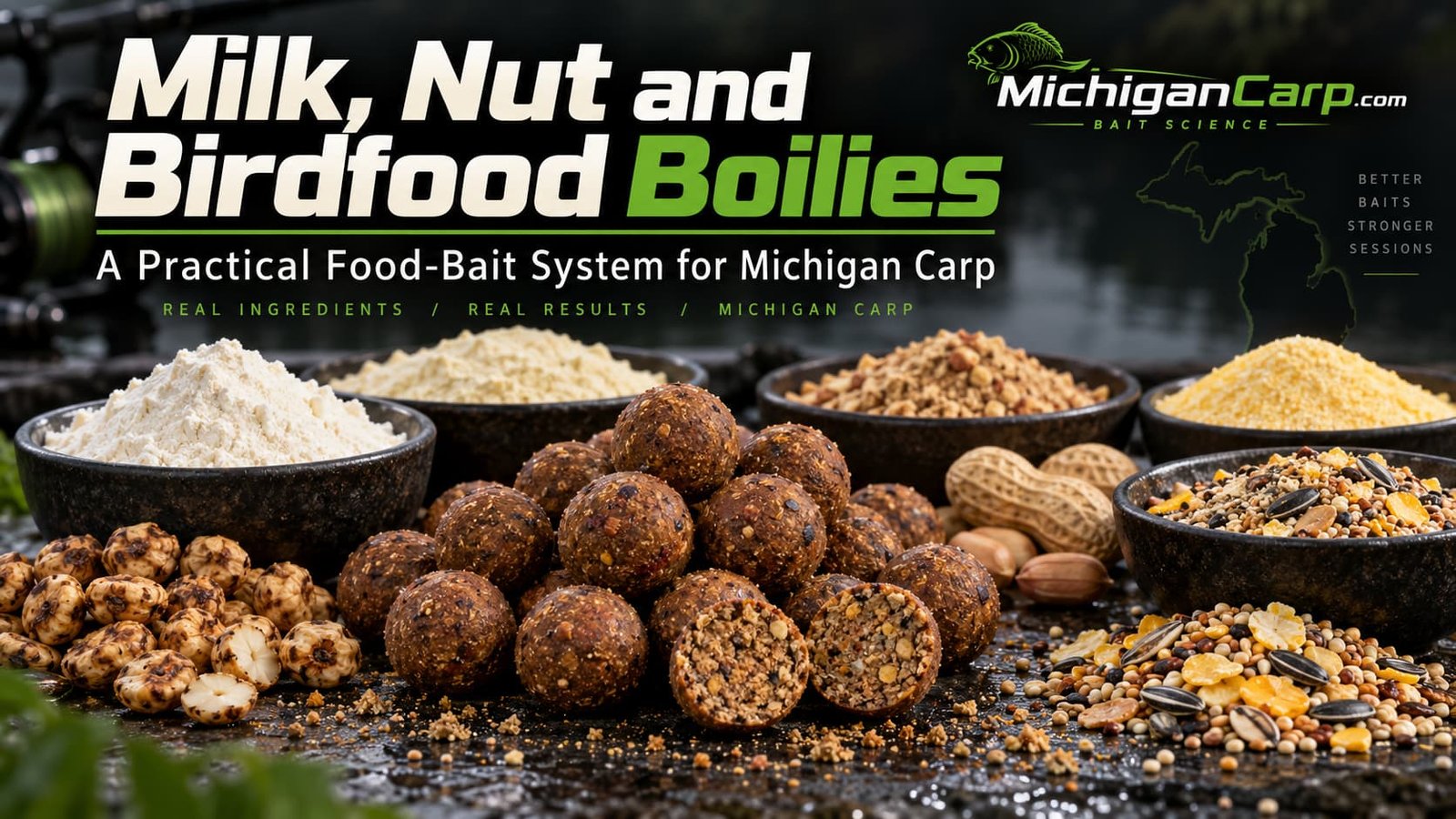
Milk, nut and birdfood boilies have become the direction I return to repeatedly when developing bait for wild Michigan carp.
That does not mean fishmeal is wrong.
It does not mean carp have some natural biological preference for milk powder, tiger nut flour or birdfood.
And it certainly does not mean that adding more expensive dairy proteins, more nuts or more flavour automatically produces a better boilie.
The argument is much simpler.
A properly designed milk, nut and birdfood boilie can combine useful food value, controlled fat, cereal energy, varied texture, water-active food materials and a flexible flavour profile without making marine ingredients the foundation of the bait.
For the kind of carp fishing I do in Michigan, that is a very useful starting point.
I am often fishing wild public-water carp in lakes, reservoirs, river systems and large impoundments. These are not necessarily fish that have spent their lives eating commercial pellets or beds of European-style boilies.
They are adaptable fish living on whatever their environment provides.
The Michigan Department of Natural Resources describes common carp as feeding on plants, insects, crustaceans and other bottom-dwelling organisms. The USGS common carp species account describes a broad diet that can also include vegetation, detritus, plankton, gastropods and small crustaceans.
That broad feeding ecology does not prove that a carp sees a milk-and-nut boilie as natural food.
It does tell us that we are dealing with an adaptable omnivorous feeder rather than a fish biologically dependent on one narrow ingredient family.
The practical question is therefore whether we can build a bait that carp can find, investigate, accept and continue eating while also making it practical enough for the angler to roll, cook, store, bait with and reproduce consistently.
Milk, nut and birdfood boilies provide one very good way of doing that.
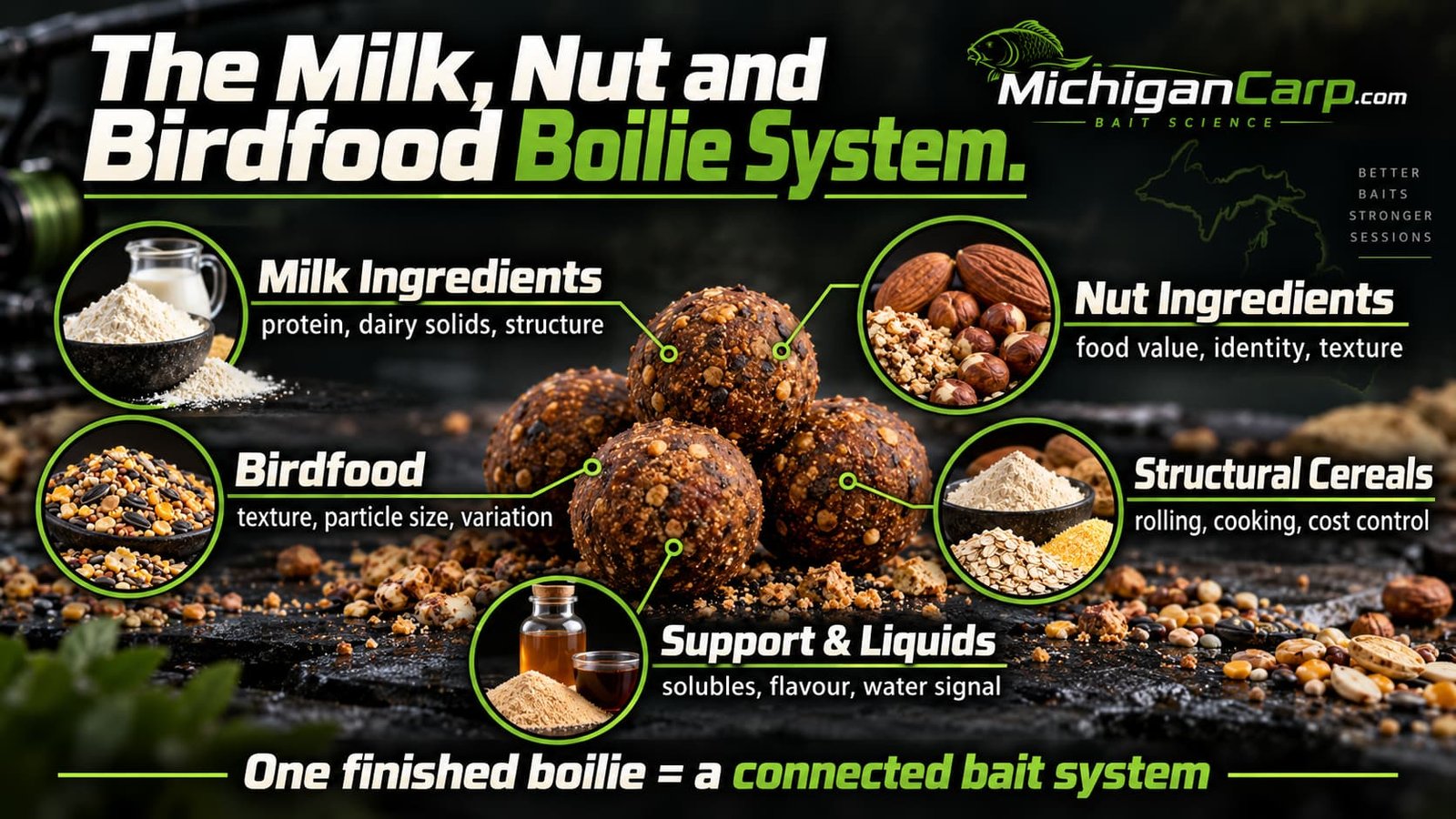
Table of Contents
Quick Answer
A good milk, nut and birdfood boilie is a complete food-bait system, not simply a sweet boilie made without fishmeal.
Milk ingredients can provide dairy solids, protein and useful physical properties. Nut and seed ingredients can provide food value, texture and bait identity. Birdfood can change texture and particle structure. Cereals provide the practical chassis that allows the bait to roll, cook and remain usable. Eggs, yeasts, liquids and selected support ingredients then help complete the system.
The finished bait should therefore be judged as one connected whole.
- Not by how much milk protein it contains.
- Not by how many nuts are in it.
- Not by how strongly it smells.
- And not by the price of the ingredient list.
If you already understand the philosophy and want to design the actual dry formula, go directly to How to Formulate a Milk, Nut and Birdfood Boilie Base Mix. That article owns the percentage ranges and formulation process.
Why This Bait Style Makes Sense for Wild Michigan Carp
One reason I like this bait family is that it fits the wider feeding systems I already use.
My boilies may be fished alongside maize, hemp, tiger nuts, peanuts, pigeon feed, packbait, boilie crumb or other carefully prepared particles.
The boilie does not have to pretend to be a grain of corn or a natural bloodworm. Its job is to become another accepted food item within the feeding situation I create.
There is sometimes an assumption in carp-bait discussions that an unfamiliar fish somehow has to recognise the ingredients inside a boilie before it will eat it.
That is not how I think about bait.
A wild carp does not need to understand that a boilie contains whey protein, tiger nut flour, yeast or semolina. It encounters the finished bait.
Water reaches the surface and mobile compounds can move into the surrounding water. The fish can investigate the bait chemically and physically, take it into the mouth, taste and manipulate it, reject it or swallow it.
Common carp have well-developed chemical senses. Laboratory work has demonstrated responses to compounds including amino acids, salts, acids and betaine. One classic electrophysiological study also found comparatively small responses to sucrose. The carp taste-receptor study is indexed by PubMed.
That is a useful reality check for bait makers.
Human aroma is not the same thing as carp chemoreception.
A bait that smells wonderful when I open the bucket has not automatically proved that those same aroma compounds are producing the most important underwater food signals.
That is why my modern bait thinking places more emphasis on the complete food system, solubility and leakage, physical behaviour and actual fish response than on flavour alone.
This Is a Food-Bait Philosophy, Not a Flavour Profile
“Milk and nut” is sometimes treated almost like a flavour description: creamy, sweet, perhaps vanilla, maple, plum or another fruit note.
That misses the more important part.
The real value is underneath the flavour system.
A serious milk, nut and birdfood boilie uses different ingredient families for different jobs. Structural ingredients create the physical bait. Milk ingredients can contribute food value and functional properties. Nut and seed materials help create identity and texture. Birdfood adds another layer of particulate structure. Eggs bring water, protein, fat, phospholipids and heat setting. Yeast and selected liquids can add further food-derived material.
That is why I do not describe this simply as a “sweet bait.”
It can carry plum, maple, peach, vanilla, cream, citrus or many other flavour directions very effectively. But the dry bait should still make sense if the flavour bottle disappeared.
The complete bait matters more than the flavour name.
What the Science Actually Supports
Carp-bait discussions become unreliable very quickly when aquaculture research is converted directly into angling claims.
There is useful research on common-carp nutrition, digestion, protein sources, lipids and chemical sensing.
There are not controlled scientific trials demonstrating that a particular Michigan milk-and-nut boilie will catch more large wild carp than a properly designed fishmeal boilie.
We should not pretend otherwise.
The science is still extremely useful because it can help us avoid poor assumptions.
Carp do not require fishmeal as an ingredient
Fish require nutrients. They do not have a biological requirement for a bag labelled fishmeal.
Experimental common-carp diets have used different protein sources, including casein, yeast and plant proteins. Older work examining alternative protein sources can be found in the scientific literature on protein sources for common carp.
That does not make every non-fishmeal recipe nutritionally equivalent. Research replacing fishmeal with soybean meal also demonstrates why amino-acid balance, energy and overall formulation matter. See the common-carp soybean-meal research record.
Ingredient balance matters more than ingredient ideology.
More protein is not automatically better bait
The FAO common-carp nutrition reference provides useful information about protein requirements in complete aquaculture feeds.
Those numbers should not simply be copied into an angling boilie recipe as though there were one scientifically proven protein percentage for catching carp.
An adult wild carp eating natural food, particles and occasional boilies is not the same management problem as a fish receiving a nutritionally complete production ration every day.
The useful lesson is that crude-protein percentage by itself does not tell us whether an angling bait is well designed.
Milk proteins are legitimate ingredients, not magic attractors
Casein and other dairy proteins have been used in experimental carp diets. Research involving casein, caseinates and hydrolysed casein provides evidence that dairy proteins can be legitimate nutritional ingredients. One example is available in the published common-carp casein research.
That does not prove that casein, whey or milk powder is a magical carp attractor.
It establishes the more useful point that milk proteins can have legitimate nutritional and functional roles in a formulated bait.
The detailed dairy science belongs in Milk Proteins in Carp Bait, Milk Powders in Boilie Making and Casein vs WPC for Boilies.
How the Ingredient Families Fit the Philosophy
This pillar is not intended to teach the percentage structure of a base mix. That is the job of the milk, nut and birdfood formulation masterclass.
At this level, the more important question is what each broad ingredient family contributes to the philosophy of the bait.
Milk ingredients should be chosen by function
Milk powders are not interchangeable. Whey products, concentrated whey proteins, caseins, caseinates, cream powders and milk replacers can differ dramatically in protein, fat, lactose, solubility and physical behaviour.
The principle is simple: choose a dairy ingredient because it performs a useful job in the complete bait, not because “more milk protein” sounds more advanced.
An expensive dairy-heavy boilie can still be dense, difficult to roll or needlessly hard. The dairy section has to cooperate with the rest of the mix.
Nut and seed ingredients give identity — but also bring fat
Nut and seed ingredients can give this bait family a strong food identity, but product names can hide important differences.
Tiger nuts, for example, are actually tubers rather than botanical nuts. Peanut flour may be heavily defatted, partially defatted or little more than finely ground whole peanut. Almond, coconut and seed products can also vary significantly.
That variation matters because rich ingredients can contribute substantial hidden fat.
Before adding bottled oil, count the fat already coming from nut products, full-fat soy, eggs, dairy ingredients, birdfood and other oil-bearing materials. The detailed method belongs in How to Balance Fat in Boilies.
Birdfood is a compositional category, not a magic ingredient
“Birdfood” can describe very different products. Some are cereal-heavy. Some contain egg food, biscuit, seeds or oil-rich ingredients. Others are much finer or coarser.
Birdfood can contribute texture, particle-size variation and physical complexity, but it does not automatically make a boilie highly soluble, nutritionally superior or more attractive.
Know what is in the birdfood before deciding what job it performs.
For prepared compound birdfoods, commercial products and homemade house blends, read Birdfood for Carp Boilies.
For the seed-by-seed route—including hemp, millet, canary seed, linseed, sunflower, sesame, niger and other individual ingredients—read Individual Birdseeds Explained for Boilie Making.
Do not dismiss the cereal chassis as filler
Semolina, maize meal and other cereal ingredients may not sound as exciting as WPC80, casein, hydrolysates or specialist yeast extracts.
But a boilie still has to become a boilie.
It has to form workable paste, travel through a sausage gun or extruder, roll cleanly, survive cooking, dry without falling apart and remain usable for the intended fishing period.
A properly designed cereal chassis supporting more distinctive milk, nut, seed and birdfood ingredients is not automatically cheap filler. It is functional formulation.
The mistake is not using cereal. The mistake is building a bait almost entirely from cheap cereal and then using token specialist ingredients to make it sound sophisticated.
The Six Jobs I Want the Complete Boilie to Perform
When I judge this bait family, I am looking for six things.
1. It must process properly
An impressive ingredient list is worthless if the paste splits, smears, sticks or produces inconsistent boilies.
2. It must contain worthwhile food ingredients
That does not require maximum protein. It requires a sensible combination of protein, carbohydrate, fat and supporting food materials.
3. The richness must stay under control
Nut products, full-fat soy, dairy ingredients, egg and birdfood can already make a bait much richer than the formula first appears.
4. It must interact with water
The bait should allow useful water-active material to become available without sacrificing the structure needed for the fishing situation. Faster leakage is not automatically better; the release profile has to match the job.
5. It must remain durable enough
A free bait intended for quick consumption, an overnight hookbait and a long-session hookbait do not all need identical hardness. Durability should be designed for the fishing job.
6. I must be able to reproduce it
If every batch behaves differently because ingredients, measurements and processing are uncontrolled, it becomes very difficult to learn what is actually working.
Repeatability matters because bait development is a process of comparison.

Why USA Ingredient Availability Is Actually an Advantage
North American bait makers sometimes look at European specialist ingredient catalogues and assume we are working at a disadvantage.
I do not necessarily see it that way.
We have access to an enormous food, baking, agricultural-feed and nutritional-supplement market.
Depending on the formula, useful ingredients can come from ordinary cereal products, soy, dairy powders, whey proteins, suitable milk replacers, nut meals, seeds, birdfoods, yeast products, molasses products and many other mainstream food or feed sources.
The important question is not whether the packet has a carp printed on it.
Specification beats branding in both directions.
A specialist carp-bait product can be excellent. An ordinary food ingredient can also be excellent. Both should be judged by composition, freshness, physical behaviour, suitability and the job they perform in the finished bait.
This is particularly valuable in the United States because it encourages bait makers to understand ingredients rather than simply copy European product names.
Milk, Nut and Birdfood Does Not Mean Fishmeal Is Banned
This is not an anti-fishmeal argument.
A well-designed fishmeal bait can be excellent. Fishmeal also combines very well with milk proteins, birdfoods, cereals, yeast ingredients and other materials in hybrid formulas.
My point is simply that a bait does not need fishmeal at its center before it deserves to be considered a serious food bait.
Milk, nut, cereal, seed and birdfood boilies deserve to be treated as a first-choice bait philosophy rather than a second-best alternative for many Michigan waters, seasons and baiting systems.
For the deeper comparison, read Milk Proteins vs Fishmeal in Carp Bait.
Support Ingredients Should Support, Not Take Over
Yeast, hydrolysates, betaine, salts, organic acids and other additions can all have a place.
The problem begins when a functioning bait becomes an ingredient collection.
A bait already contains cereals, milk ingredients, nut or seed materials, birdfood, eggs and liquids. It may then receive brewer’s yeast, yeast extract, a hydrolysate, betaine, MSG, organic acids, sweetener, salt, several flavours, an essential oil and another liquid food.
There may be an argument for every individual addition.
That does not mean they all belong together.
The carp sensory literature can show that particular compounds are detectable. It does not automatically tell us an optimum boilie inclusion rate or prove that combining many detectable compounds improves catch rate.
What additional job is this ingredient performing?
If I cannot answer that reasonably clearly, the ingredient probably does not need to be there.
For the specialist application route, read How to Use Hydrolysates in Carp Bait.
The Biggest Mistake: Trying to Make Every Part of the Bait Rich
This bait family gives us a dangerous amount of choice.
We can use rich nut products, dairy powders, full-fat soy, oilseeds, eggs, cream powder, nut oil, concentrated proteins, yeast, hydrolysates and liquid foods.
It is tempting to believe that using the richest or most expensive version of every category must produce the best bait.
Usually it produces a confused one.
The nut section does not need to be maximum strength. The dairy section does not need to be maximum strength. Birdfood does not need to dominate the matrix. The liquid phase does not need every attractor in the cupboard.
Good formulation involves restraint.
One part of the bait may establish its main identity. Other sections support that identity while also performing structural, nutritional or practical jobs.
The complete bait matters more than ingredient bragging rights.
My Practical Michigan Approach
For my own fishing, I want this bait family to work as part of the complete session rather than exist in isolation.
I may fish boilies over particles. I may use chopped boilie and crumb. I may use relatively little free bait. On another water I may introduce considerably more food over several days.
Sometimes the boilie is doing much of the feeding work. Sometimes it is principally the more selective hookbait sitting among maize, hemp, tiger nuts or other particles.
Those situations place different demands on the bait.
That is why I do not believe there is one perfect milk-and-nut recipe.
There can be a consistent bait philosophy without one frozen formula.
A campaign bait may place greater emphasis on economical structure and repeatability. A smaller specialist batch may justify more expensive ingredients. A hookbait version may need more durability. A cold-water approach may use very little feed and place greater emphasis on location and accessible waterborne signal rather than simply adding more oil.
The practical storage side is covered separately in How to Store Homemade Boilies.
Build a food bait. Control the richness. Understand the ingredients. Make it reproducible. Test it in water. Then let the carp judge it.
How This Article Connects to the Rest of Boilie School
This pillar is deliberately not a recipe.
If you want to move from the philosophy into actual formulation, continue with How to Formulate a Milk, Nut and Birdfood Boilie Base Mix.
That guide owns the percentage structure, cereal chassis, nut and seed section, dairy section, birdfood inclusion, support layer and worked base-mix construction.
After that, use How to Balance Fat in Boilies: Milk, Nut and Seed Mixes to calculate the lipid already coming from full-fat soy, nut products, birdfood, dairy, eggs, lecithin and added oil.
The dairy branch then continues through Milk Proteins in Carp Bait, Milk Powders in Boilie Making and Casein vs WPC for Boilies.
When a formula is working on the bench, use How to Test Boilies Before Fishing rather than assuming that a bait which rolls well automatically behaves well in water.
- The pillar explains why the system makes sense.
- The formulation masterclass explains how to design the base mix.
- The fat guide solves the lipid-budget problem.
- The specialist ingredient guides explain individual technical questions.
- The Plum, Scopex and Vanilla article will show the real bait, its development and Michigan results.
Common Mistakes With Milk, Nut and Birdfood Boilies
The most common failures are not necessarily caused by poor ingredients. They are often caused by poor relationships between good ingredients.
- Assuming more dairy protein automatically means a better food bait.
- Ignoring the fat already contained in nuts, seeds, soy, dairy, birdfood and eggs.
- Treating every product sold as birdfood as though it has the same composition.
- Reducing the structural ingredients until the bait becomes difficult to roll or process.
- Adding oil automatically because the bait is described as a nut bait.
- Using every soluble attractor available instead of choosing a controlled support layer.
- Judging the bait mainly by how strongly it smells to the angler.
- Assuming a good dry recipe will compensate for poor cooking, drying, storage or presentation.
- Changing several ingredients at once and then having no idea which change affected the result.
This is why I prefer bait development to bait collecting.
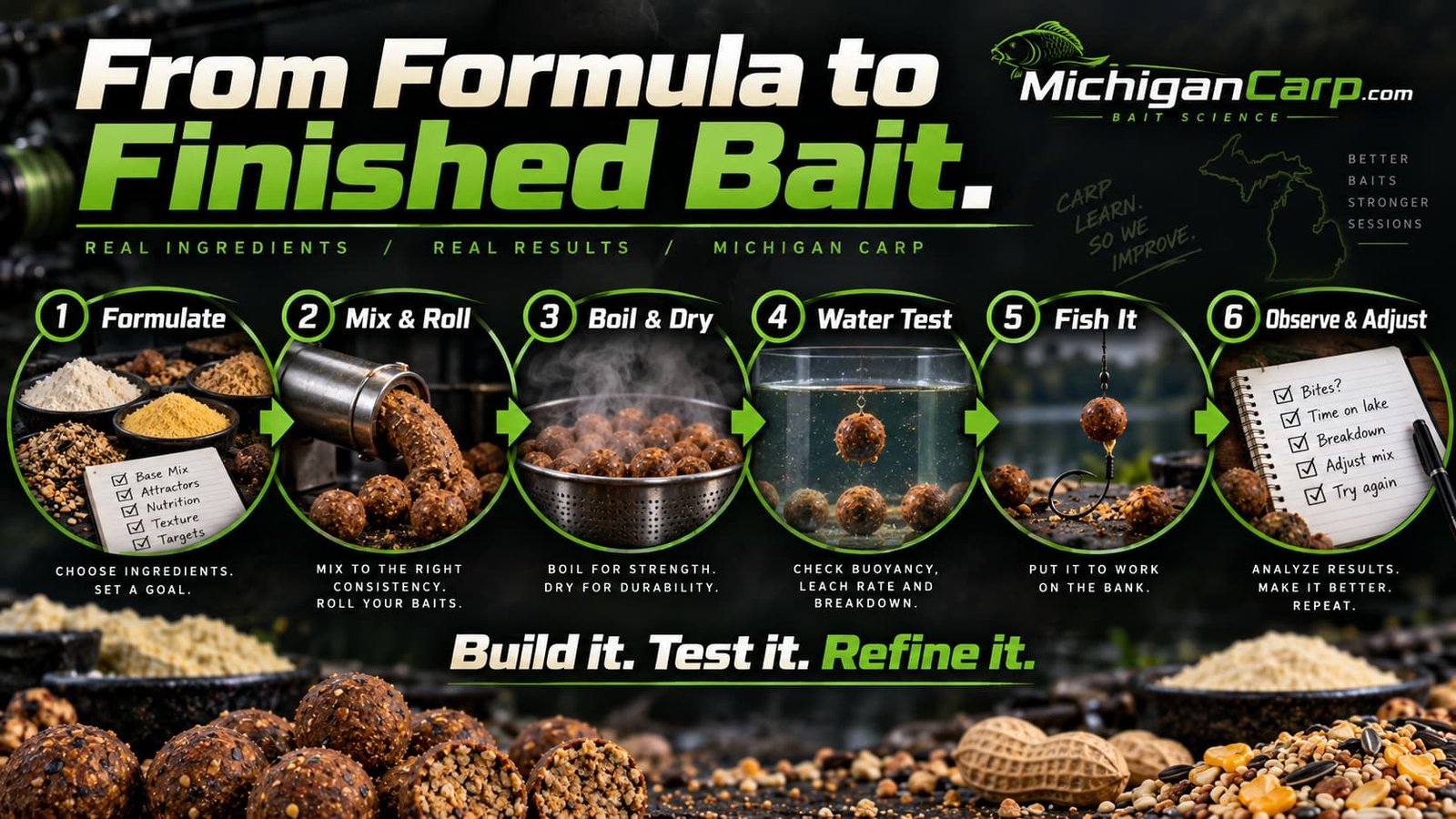
Change something for a reason. Record it. Roll it. Cook it. Dry it. Put it in water. Fish it. Then decide what the next change should be.
The MichiganCarp boilie testing guide goes much further into that process.
My Final View
After more than five decades around carp fishing and many years making my own bait, I do not believe serious carp bait has to begin with fishmeal.
Nor do I believe milk protein, nuts or birdfood are magic.
The strongest argument for this bait family is much more practical.
Common carp are adaptable omnivorous feeders. They can utilize a wide range of nutrient sources. Their chemical senses can detect many food-related compounds. And the modern bait maker has access to an enormous range of dairy, cereal, nut, seed, yeast and food ingredients from which a technically sound boilie can be built.
That gives us an opportunity to design a bait around the fishing we actually do rather than automatically copying somebody else’s bait culture.
For MichiganCarp.com, that means treating milk, nut, cereal, seed and birdfood boilies as a serious first-choice food-bait philosophy for wild North American carp.
Not because fishmeal is wrong.
Not because carp have a mystical love of cream and nuts.
And not because one recipe has become sacred.
Because the system is flexible, understandable, repeatable and capable of being formulated intelligently.
That is the foundation.
Everything else in this series builds from it.
FAQ
Are milk, nut and birdfood boilies good for carp?
They can form a highly effective food-bait system when the ingredients are balanced for structure, food value, fat, texture, water behaviour and the intended fishing situation. There is no scientific evidence that the bait family is automatically superior to fishmeal.
Do carp naturally eat milk or milk proteins?
Milk is not a natural food of wild carp. Milk proteins are formulated-feed and bait ingredients valued for nutritional and physical properties. Their successful use in carp nutrition research should not be confused with proof of a special natural attraction to milk.
Do I need fishmeal to make a high-quality carp boilie?
No. Carp can utilize diets containing a variety of nutrient and protein sources. That does not mean every fishmeal-free recipe is automatically well balanced; the complete formula and its processing still matter.
Are tiger nuts actually nuts?
No. Tiger nuts are tubers from Cyperus esculentus. Carp anglers commonly group them with nut baits because of their use and compatibility with nut-style bait systems.
Does birdfood automatically make a boilie leak faster?
No. Birdfood can change texture, particle size and porosity, but finished-bait behaviour also depends on the rest of the formula, cooking and drying. Read Carp Bait Solubility and Leakage for the detailed explanation.
Should a milk-and-nut boilie contain added nut oil?
Not automatically. Nut products, full-fat soy, dairy ingredients, birdfood and eggs may already contribute substantial lipid. Calculate the existing fat contribution before adding bottled oil. Use How to Balance Fat in Boilies for the full method.
How much protein should a carp boilie contain?
There is no scientifically established universal protein target for an angling boilie. Aquaculture research provides useful nutritional context, but a complete daily production diet is not equivalent to an intermittently eaten fishing bait.
Where is the actual milk, nut and birdfood recipe?
This article deliberately explains the philosophy rather than publishing one recipe as the answer. Use How to Formulate a Milk, Nut and Birdfood Boilie Base Mix for the formulation method. The separate Plum, Scopex and Vanilla article will document my actual working milk-nut bait and its Michigan development.
Next Steps
If you want to move from the philosophy into practical bait design, continue through these guides:
- How to Formulate a Milk, Nut and Birdfood Boilie Base Mix — build the actual dry formula.
- How to Balance Fat in Boilies: Milk, Nut and Seed Mixes — calculate the hidden lipid before adding oil.
- Milk Proteins in Carp Bait — understand the nutritional and functional dairy side.
- Milk Powders in Boilie Making — compare dairy ingredients by function.
- Birdfood for Carp Boilies — understand what different birdfoods actually contribute.
- Carp Bait Solubility and Leakage — understand how useful material can move from the bait into water.
- How to Test Boilies Before Fishing — evaluate a finished batch before relying on it.
- Return to Boilie School — follow the complete bait-making learning route.
- Individual Birdseeds Explained for Boilie Making — compare hemp, millet, canary seed, linseed, sunflower and other individual seeds by function, fat, grind and formulation use.
- Plum, Scopex and Vanilla Milk-Nut Boilie: Development and Michigan Results