

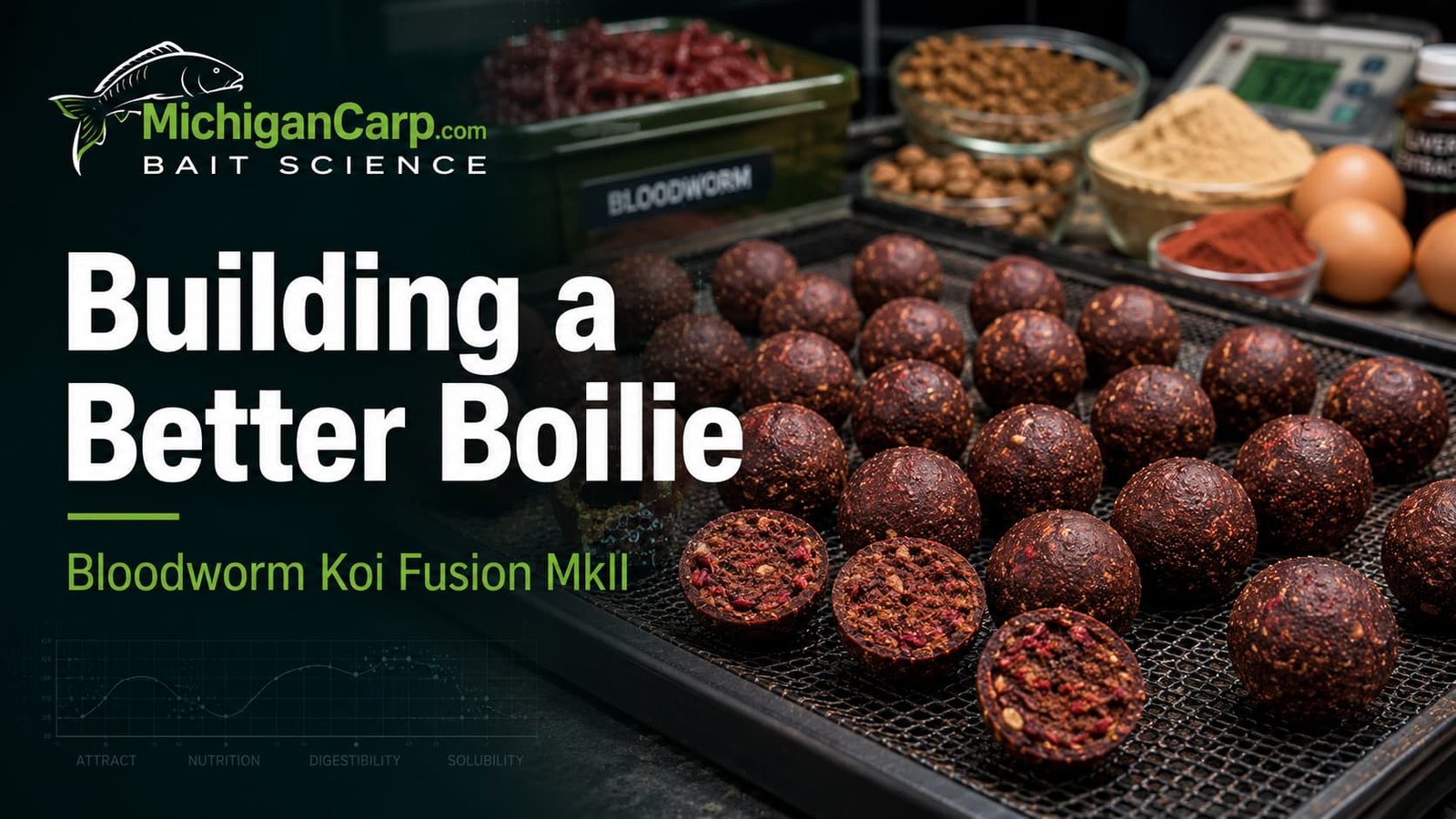
A better boilie is not simply one with more ingredients, more protein or more expensive additives.
It is a bait in which the ingredients, physical structure, soluble food signal, processing and intended fishing job make sense together.
This page takes that idea and applies it to one worked example: the Bloodworm Koi Fusion MkII.
It is a 20 mm bottom-bait hookbait built around ground koi food, bloodworm pellets and a controlled marine-and-liver support system. The objective is not to create a universal “ultimate boilie.” It is to show how I approach a bait when every major ingredient is expected to perform a recognizable job.
For the general theory of why boilie ingredients are used, start with Boilie Ingredients Explained: Structure, Proteins, Solubles, Fats and Additives.
This page has a different job:
Table of Contents
Quick Start: What the Bloodworm Koi Fusion MkII Is
The Bloodworm Koi Fusion MkII is designed primarily as a high-quality hookbait and small-batch fishing boilie, rather than an economical bulk prebait.
The basic idea is:
- 20 mm sinking bottom bait
- exactly 500 g dry mix
- koi pellets provide an economical nutritional backbone
- bloodworm pellets provide the main bait identity
- krill and liver add supporting animal-food material
- semolina, soy, albumin and maize provide structure
- the liquid phase reinforces the bloodworm profile
- cooking is controlled rather than excessive
- a separate post-boil treatment can be used for stronger hookbait signal
- finished bait is water-tested before being trusted
The important lesson is not that every angler needs to copy this recipe.
It is that every major part of the recipe should have a reason for being there.
Why This Article Is a Worked Example, Not Another Ingredient Guide
MichiganCarp now has dedicated articles explaining proteins, binders, solubles, fats, hydrolysates, liquids, heat processing and bait texture.
There is little value in repeating all of that here.
Instead, this recipe demonstrates how those ideas come together.
A useful boilie has several practical requirements:
STRUCTURE — it must mix, roll, cook and survive on the rig.
FOOD VALUE — the dry ingredients should form a coherent food system rather than a ball of flavor and binder.
AVAILABLE SIGNAL — some useful material must become available to the surrounding water.
TEXTURE — it must be durable enough for the job without becoming unnecessarily hard.
REPEATABILITY — the recipe and process must be measurable enough to make again.
The Bloodworm Koi Fusion MkII was built around those requirements.
Bloodworm Koi Fusion MkII: Corrected 500 g Dry Mix
The previous version of this formula was described as a 500 g dry mix, but the listed ingredients exceeded 500 g once lecithin was counted.
This corrected formula totals exactly 500 g.
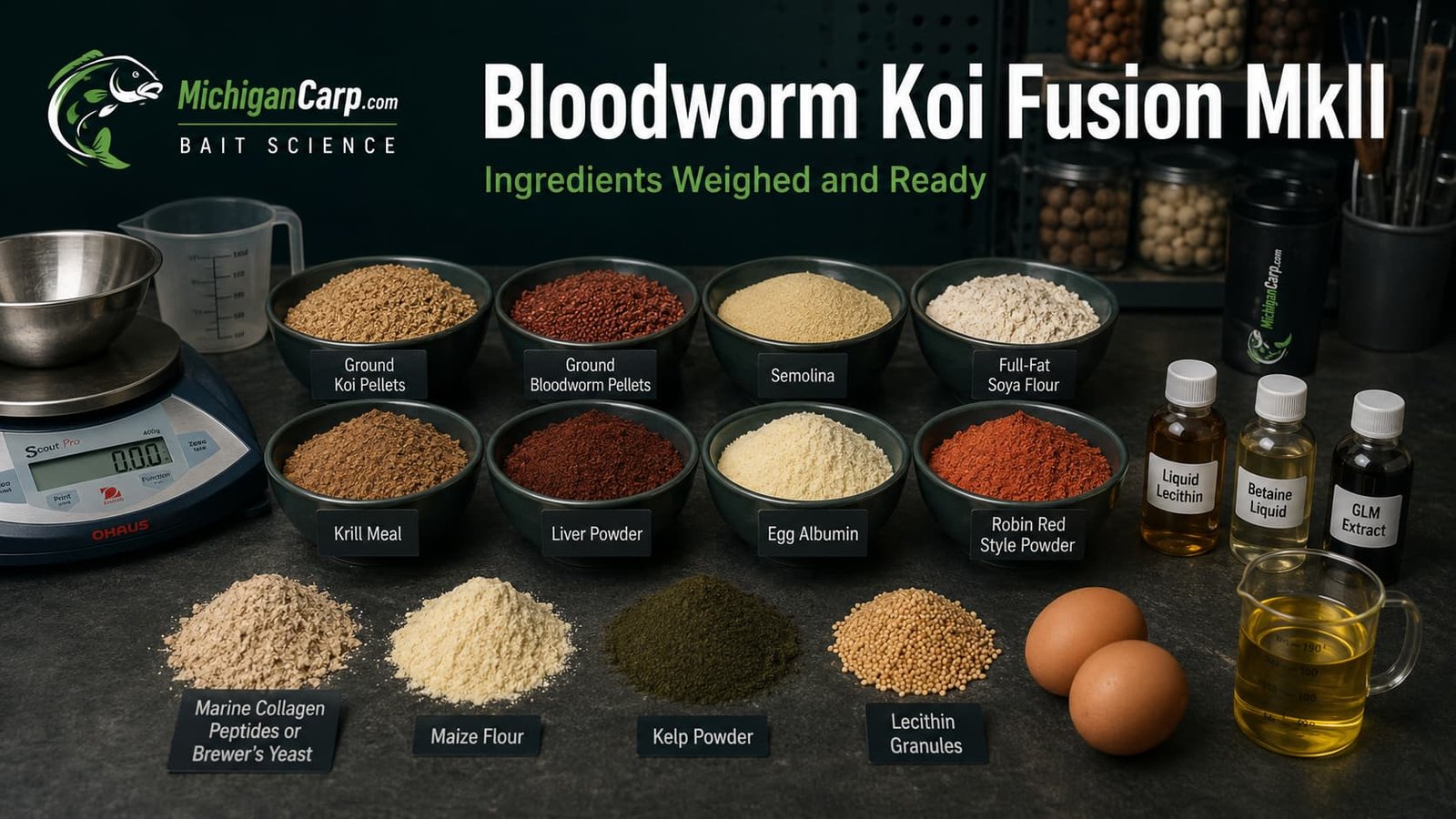
| Ingredient | Amount | Main job |
|---|---|---|
| Ground Mazuri Koi Pond Nuggets | 120 g | Nutritional and structural backbone |
| Ground CC Moore Bloodworm Pellets | 60 g | Main bloodworm-led bait identity |
| Fine semolina | 75 g | Paste structure, rolling and firmness |
| Full-fat soy flour | 50 g | Protein, body, binding and fat |
| Krill meal | 50 g | Marine protein and savory food character |
| Freeze-dried beef liver powder | 30 g | Animal-food depth and soluble material |
| Egg albumin | 30 g | Heat-setting structure and hookbait strength |
| Robin Red or suitable spice/birdfood ingredient | 30 g | Spice, color and background food character |
| Marine collagen peptides | 20 g | Hydrolyzed-protein fraction |
| Maize flour | 20 g | Cereal structure and carbohydrate |
| Kelp powder | 10 g | Small marine/mineral background component |
| Soy lecithin granules | 5 g | Emulsification and mixing support |
| TOTAL | 500 g | — |
Scenario B: Without Marine Collagen Peptides
If marine collagen peptides are unavailable, replace the 20 g collagen with:
20 g brewer’s yeast
The total remains 500 g.
However, this is important:
brewer’s yeast is not a functional duplicate of collagen peptides.
Collagen peptides are a hydrolyzed animal-protein ingredient.
Brewer’s yeast provides a different nutritional and savory profile.
Scenario B should therefore be treated as a different version of the bait, not as a nutritionally identical substitution.
For the broader differences between yeast products and hydrolysates, read How to Use Hydrolysates in Carp Bait and Yeast and Fermented Additives in Carp Bait.
Why Ground Koi Food Makes Sense Here
One of the useful features of this recipe is the use of Mazuri Koi Pond Nuggets as part of the base.
That does not mean koi food is automatically superior to a purpose-made carp ingredient.
It means the actual product specification gives it a useful role.
The current product contains a combination of ingredients including soybean meal, corn, fish meal, wheat middlings, corn gluten meal, betaine, brewer’s yeast and spirulina.
For anyone wanting to check the current formulation rather than relying on an old bait recipe, use the manufacturer page for Mazuri Koi Pond Nuggets.
I use it here as 120 g of a 500 g mix.
That is enough to give the formula a useful backbone without asking one manufactured pellet to become the entire bait.
Why Bloodworm Pellets Define the Bait
The main identity ingredient is 60 g of ground bloodworm pellets.
Bloodworm is familiar natural-food territory in freshwater environments, especially around softer lakebed areas where chironomid larvae occur.
That does not mean adding “bloodworm” to a bait guarantees attraction.
The useful point is that a bloodworm-based pellet provides a food-derived ingredient with a distinct savory profile that can be combined with the wider formula.
I use CC Moore Bloodworm Pellets in this worked example.
Grinding them also changes the way they behave.
Instead of relying on an intact pellet to break down, the pellet becomes part of the boilie matrix.
The Structural Side of the Recipe
The less glamorous ingredients are doing important work.
Semolina
The corrected formula contains 75 g semolina.
Its main jobs are:
- paste handling
- rolling
- structural consistency
- helping the finished bait retain shape
It is not included because semolina is a powerful attractor.
It is included because a boilie must physically work.
Full-Fat Soy
At 50 g, full-fat soy contributes several things at once:
- protein
- some lipid
- body
- water absorption
- paste structure
Because it is full-fat soy, its contribution to the overall fat budget should not be ignored.
Egg Albumin
The 30 g egg albumin is especially relevant because this is primarily a hookbait-style formula.
Albumin helps the bait set during heating.
That allows me to build durability through the formulation rather than trying to achieve everything through prolonged boiling and extreme drying.
Maize Flour
The 20 g maize flour is another modest structural ingredient.
It contributes cereal carbohydrate and supports the physical matrix without dominating the bait.
Krill, Liver and the Supporting Food Layer
The recipe contains:
- 50 g krill meal
- 30 g freeze-dried beef liver
- 20 g collagen peptides in Scenario A
These ingredients make the formula relatively rich for a hookbait.
That is deliberate.
But they should not be described as magical feeding triggers.
Krill Meal
Krill contributes marine protein, lipid and a strong savory raw-material character.
At 50 g it is significant, but it is still only 10% of the dry formula.
Beef Liver Powder
The liver powder adds another animal-food fraction.
Dry liver powder should also be distinguished from liver hydrolysate.
A hydrolysate contains more extensively broken-down protein fractions and can behave differently in water.
For that distinction, read Liver Hydrolysate for Carp Bait.
Marine Collagen Peptides
Collagen peptides provide a hydrolyzed protein fraction.
I regard them as one supporting part of the recipe rather than the reason the bait works.
If they are difficult or expensive to source, I would rather make and test Scenario B than assume an obscure ingredient is essential.
Liquid Phase
Start with:
| Ingredient | Starting amount | Purpose |
|---|---|---|
| Medium eggs | 5 | Main hydration and heat-setting protein |
| Additional beaten egg | Up to 1 if required | Final hydration adjustment |
| Blended and finely strained thawed bloodworm | 15–20 ml | Bloodworm-derived food material |
| CC Moore Liquid Bloodworm Compound | 15 ml | Compatible bloodworm liquid |
| Squid extract | 10 ml | Supporting savory liquid |
| Betaine HCl | 3 g | Small supporting addition |
| Citric acid | 2 g | Acidification/taste and processing support |
Five medium eggs are the starting point, not a command to force the paste into a predetermined liquid ratio.
Egg sizes vary.
Dry ingredients vary.
Ground pellets vary.
Humidity varies.
Add the dry mix progressively and judge the paste after it has had time to hydrate.
Keep a sixth beaten egg available and use only what is needed.
That is more repeatable than automatically adding six eggs and then repairing an excessively wet paste with extra flour.
About Extra Amino Acids and Butyric Acid
The old formulation used several additional amino acids, calcium chloride and n-butyric acid.
Those can be experimented with, but I would no longer present that package as though each component has a proven optimum inclusion for wild carp.
If you want to test an additional amino acid, mineral salt or butyric product, change one variable at a time.
For concentrated butyric products in particular, follow the supplier’s concentration and safety instructions. A diluted bait flavor and concentrated n-butyric acid are not interchangeable products.
This makes the recipe easier to understand and the results easier to interpret.
Step-by-Step: Making the Bloodworm Koi Fusion MkII
1. Prepare the Dry Ingredients
Grind the koi nuggets to a relatively fine meal.
Grind the bloodworm pellets separately.
Grind freeze-dried liver if you are starting with larger pieces.
Weigh every dry ingredient individually.
Then combine all 500 g and mix thoroughly.
Pay particular attention to low-inclusion ingredients such as lecithin and kelp. They should be distributed through the mix rather than left in concentrated pockets.
2. Prepare the Bloodworm
Frozen bloodworm is highly perishable.
Thaw only what you need.
Blend it to a slurry and pass it through a fine sieve if larger particles are likely to interfere with rolling.
Wear disposable gloves when handling bloodworm. Repeated exposure to chironomid material can cause sensitivity in some people.
Keep unused bloodworm refrigerated only for immediate use or return suitable portions to frozen storage according to the original product instructions.
3. Build the Liquid Phase
Beat five medium eggs.
Add:
- bloodworm slurry
- Liquid Bloodworm Compound
- squid extract
- betaine
- citric acid
Mix thoroughly.
Do not add the optional sixth egg yet.
4. Make the Paste
Add the dry mix gradually.
Do not dump the full 500 g into the liquid in one movement.
Work the dry material in until the paste begins forming.
Then allow the paste to rest briefly so the ground pellets, semolina, soy and other powders can continue absorbing moisture.
Reassess it after resting.
If too dry, use a little of the reserved beaten egg.
If too wet, first give it more rest before changing the formula.
If you repeatedly need additional dry mix to rescue the paste, reduce the liquid phase in the next batch rather than hiding the problem.
Rolling 20 mm Hookbaits
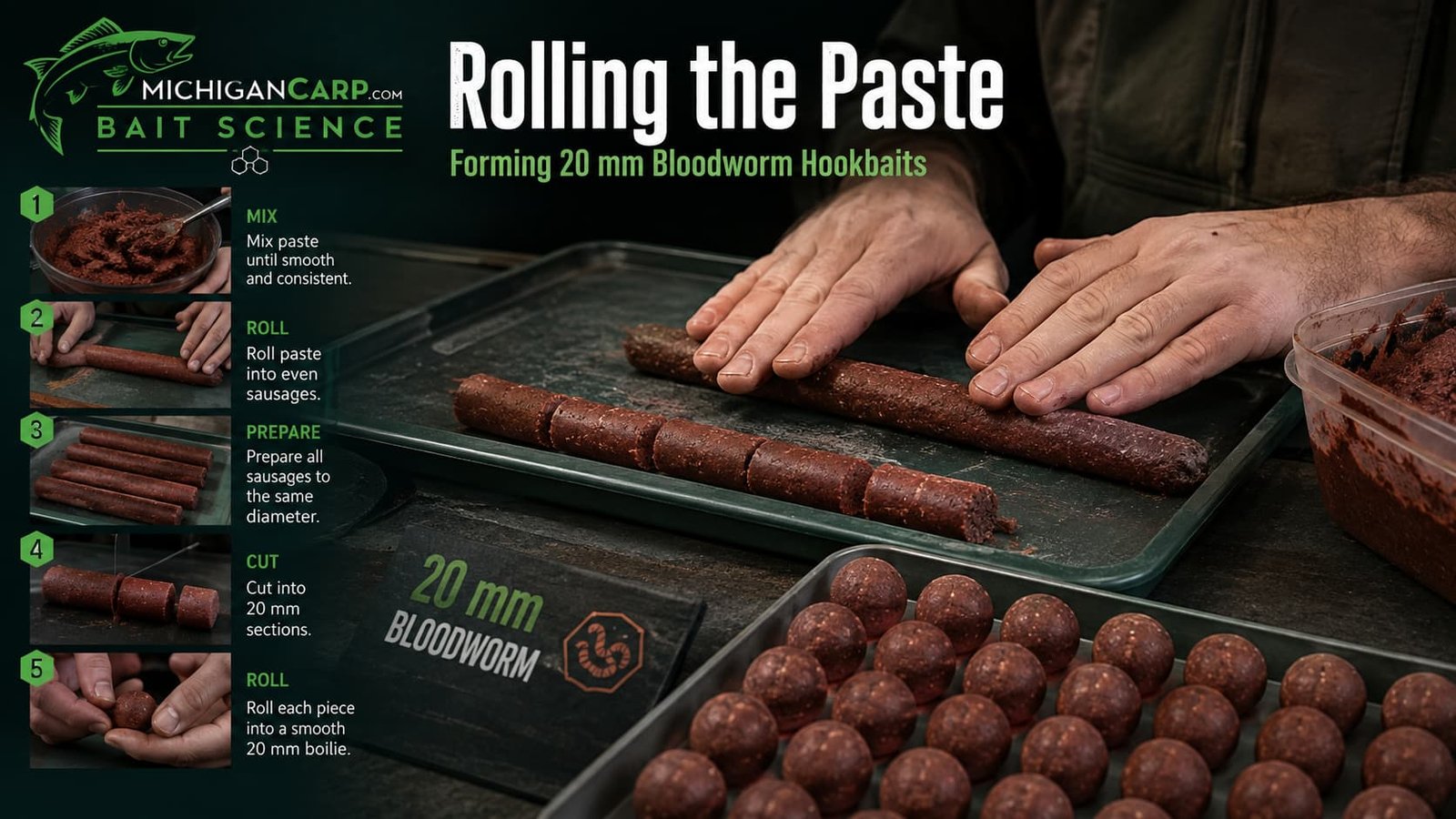
Roll the paste into even sausages that match your rolling table or intended bait diameter.
Cut or roll into approximately 20 mm boilies.
Consistency matters more than making every bait visually perfect.
Uneven boilies cook unevenly.
If one batch contains 16 mm, 20 mm and 24 mm baits, one cooking time will not treat all of them identically.
From a 500 g dry mix plus eggs and liquids, expect roughly 140–170 20 mm baits, depending on egg weight, hydration, rolling diameter and wastage.
Treat that as a practical range rather than a guaranteed count.
Cooking the Bait
The old version of this recipe specified 75 seconds maximum.
I would not use that as a fixed rule.
There is no universal cooking time that is correct for every 20 mm boilie.
Cooking depends on:
- bait diameter
- paste hydration
- batch size
- pan size
- water-temperature recovery
- albumin and protein content
- starch content
- desired finished texture
For this bait, start with a small controlled test batch and use the same process every time.
For the full cooking procedure and current starting-point guidance, use How to Boil and Dry Boilies Properly.
The objective is:
SET THE BAIT ENOUGH TO PERFORM ITS JOB WITHOUT COOKING IT LONGER SIMPLY TO MAKE IT HARD.
Remove the bait, drain it and allow it to cool before judging the texture.
Drying
Spread the boilies on clean mesh trays with airflow around them.
For a freezer hookbait of this type, I would normally begin by evaluating the bait after approximately 18–24 hours of controlled air drying.
That is not a universal moisture target.
Ambient humidity, airflow, bait diameter and recipe composition all change the result.
Turn the bait during drying and look for:
- even surface drying
- no deep cracking
- no sweating
- no greasy patches
- no extreme case-hardening
- a center that remains structurally sound
The correct drying period is the one that gives the water life and handling strength required for the session.
Optional Bloodworm Finishing Treatment
A post-boil treatment can give the hookbait a stronger surface signal without forcing every soluble ingredient through the cooking stage.
However, the old finishing glug was very large and water-rich for a small hookbait batch.
This version is more controlled.
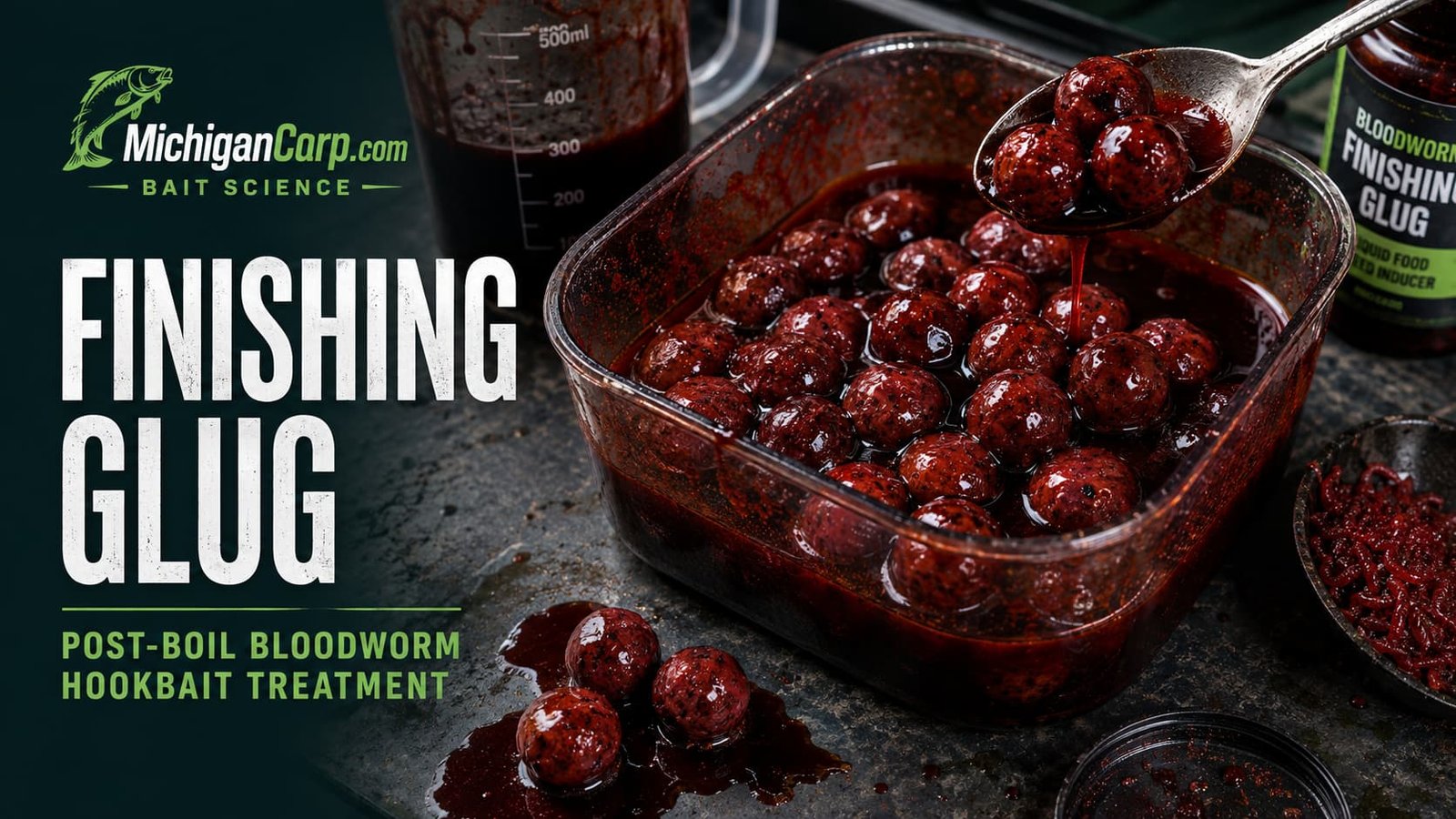
Small-Batch Bloodworm Hookbait Treatment
| Ingredient | Amount |
|---|---|
| Warm water | 35 ml |
| Food-grade glycerin | 25 ml |
| CC Moore Liquid Bloodworm Compound | 20 ml |
| Finely strained bloodworm slurry | 10 ml |
| Squid extract | 10 ml |
| GLM-style blend | 3 g |
| Betaine HCl | 2 g |
| L-alanine | 1 g |
| L-proline | 1 g |
| Citric acid | 0.5 g |
Dissolve the dry materials into the warm water first.
Add the glycerin and remaining liquids.
Mix thoroughly.
Add only enough treatment to coat the hookbaits evenly.
Do not assume that drowning the bait is better.
For the wider technique, read How to Treat Boilies for Carp Step by Step.
Important Storage Point
This treatment contains:
- water
- real bloodworm
- other food liquids
It should therefore be treated as a fresh refrigerated/freezer hookbait preparation, not as an automatically shelf-stable glug.
Keep the treatment refrigerated while using it.
Treat the boilies under refrigeration, allow the surface to absorb or dry as required, then freeze the finished hookbaits in sensible session-sized packs.
Do not leave a water-rich bloodworm treatment at room temperature for prolonged storage.
For longer-term bait storage, use How to Store Boilies.
What the Nutritional Numbers Can — and Cannot — Tell Us
The previous version gave a finished-bait protein estimate of approximately 31–32%.
That looked precise, but it implied more certainty than the recipe can support.
The finished percentage changes with:
- actual supplier specifications
- egg size
- amount of additional egg used
- water loss during cooking
- drying time
- final moisture content
The dry mix itself is clearly protein-rich.
Mazuri currently declares 33% crude protein for its Koi Pond Nuggets, while krill meal, albumin, liver, soy and collagen also contribute significant protein.
A reasonable working formulation estimate therefore places the dry mix somewhere in the high-30% protein region, depending on the actual products used.
But that is not the same as saying:
the finished boilie contains exactly 31.5% protein.
Once eggs and liquids are added, the wet-paste percentage changes.
Once the bait is cooked and dried, it changes again.
Without measuring the final moisture content or sending the finished bait for analysis, I would describe the nutrient profile rather than invent false precision.
The practical conclusion is enough:
THIS IS A RELATIVELY PROTEIN-RICH, MODERATE-BATCH HOOKBAIT FORMULA — NOT A CHEAP CEREAL BULK BAIT.
Why Lecithin Is Included
Soy lecithin is included at 5 g, or 1% of the dry formula.
Its main practical role here is emulsification.
It can help distribute lipid-containing and water-containing components through the wet mix more consistently.
I would not claim that lecithin automatically makes every attractor travel farther through the lake.
What matters is how the complete bait behaves once hydrated.
That can be tested.
How I Would Fish This Bait
The Bloodworm Koi Fusion MkII makes most sense when used as a hookbait-led system.
I would not produce ten kilograms of it simply because the recipe contains good ingredients.
Instead, I would use the boilie as the durable center of a more economical feeding approach.
Around it I could use:
- bloodworm pellets
- crushed pellets
- matching boilie crumb
- chopped boilies
- small PVA presentations
- compatible particle feed where appropriate
That creates two different jobs:
THE WIDER FEED AREA gets carp feeding.
THE HOOKBAIT provides the controlled presentation.
This is often more economical and more flexible than trying to feed large quantities of an expensive specialist hookbait.
Michigan Application
Michigan waters contain everything from clean gravel and zebra-mussel areas to weed, silt, soft deposits and natural-food-rich margins.
A bloodworm-led bait is particularly interesting where carp are already feeding in or near softer natural-food areas.
But bait identity does not compensate for poor location.
I would still put these questions first:
- Are carp actually using the area?
- Is the rig presented cleanly?
- Is the bottom suitable?
- Are fish showing or feeding?
- Is the baiting level appropriate?
- Is nuisance pressure likely to destroy the hookbait?
Only after those questions would I start blaming or praising the recipe.
That is why the wider Carp Bait Guide and Bait Science sections matter.
Bait works inside a fishing situation.
Not outside it.
Test the Finished Boilie Before Fishing
A recipe is not finished because the bait looks good on a drying tray.
Put it in water.
For a new batch I want to inspect samples after:
- 1 hour
- 4 hours
- overnight
- the maximum time I realistically expect the hookbait to remain fishing
Look for:
- surface softening
- swelling
- cracks
- splitting
- center hydration
- loss of structural strength
- glug wash-off
- hookbait durability
If you are using a bait screw, hair or other attachment, test the actual presentation.
Do not water-test one bait loose in a glass and then assume it behaves identically when pierced, drilled or mounted.
Use How to Test Boilies Before Fishing for the complete method.
What I Would Change First During Development
If this bait did not behave the way I wanted, I would not immediately add another attractor.
I would identify the actual problem.
Paste too soft
First review:
- egg quantity
- bloodworm liquid
- paste-rest time
Do not automatically add more albumin.
Paste too stiff
Review hydration before removing structural ingredients.
Bait too hard
Review:
- albumin level
- cooking
- drying
Do not assume hard equals good.
Bait softens too quickly
Determine whether the weakness comes from:
- paste structure
- under-setting
- excessive liquid treatment
- storage
- over-soaking
Signal seems too weak
Before adding more flavor, consider:
- crumb
- chopped bait
- pellet
- light hookbait treatment
- increased exposed surface
The dedicated troubleshooting route is Boilie Problems: Real Causes and Fixes.
US Sourcing and Cost
One reason this recipe remains useful for MichiganCarp is that much of it can be sourced in the United States.
Relatively straightforward US ingredients include:
- Mazuri koi food
- semolina
- soy flour
- maize flour
- egg albumin
- collagen peptides
- brewer’s yeast
- kelp powder
- lecithin
- citric acid
- glycerin
- frozen bloodworm from aquarium suppliers
More specialist components include:
- CC Moore Bloodworm Pellets
- Liquid Bloodworm Compound
- krill meal
- suitable liver products
- squid extract
- GLM-style materials
The first purchase can appear expensive because specialist powders and liquids are bought in quantities larger than one recipe requires.
The more useful calculation is therefore:
COST PER ACTUAL BATCH — NOT COST OF BUYING EVERY CONTAINER FOR THE FIRST TIME.
Because I regard this primarily as a hookbait and small-batch recipe, I am more interested in repeatability and performance than forcing it to compete with maize as a bulk feed.
Common Mistakes With This Recipe
Treating the Ingredient List as Magic
The recipe works as a system.
Copying one expensive ingredient into an otherwise poor formula proves nothing.
Automatically Using Six Eggs
Start with five.
Hydrate.
Rest.
Then adjust.
Boiling Every 20 mm Bait for Exactly the Same Time
Recipe density and process matter.
Test the actual bait.
Over-Drying for Security
A rock-hard hookbait is not automatically a better hookbait.
Drowning It in Glug
Surface treatment should have a purpose.
More liquid is not automatically more attraction.
Leaving Bloodworm Treatment Warm
Real bloodworm and water-rich liquids require cold-storage discipline.
Assuming Collagen and Brewer’s Yeast Are Equivalent
They are not.
They produce two different versions of the bait.
Changing Five Things After One Blank
One fishing result tells you very little about the formula when location, fish activity, weather, rig presentation and baiting level also changed.
My Practical View
What I like about this recipe is not its complexity.
It is the way the different parts can be explained.
The koi food provides a broad base.
The bloodworm pellet defines the identity.
Krill and liver deepen the animal-food side.
Semolina, soy, maize and albumin make the bait practical.
The liquid phase reinforces the same broad direction.
The optional finishing treatment is kept separate so it can be tested rather than buried inside the recipe.
That makes the bait understandable.
And an understandable bait is much easier to improve.
The lesson from the Bloodworm Koi Fusion MkII is therefore not:
THIS IS THE PERFECT BOILIE.
It is:
BUILD WITH A PURPOSE. RECORD THE FORMULA. CONTROL THE PROCESS. TEST THE FINISHED BAIT. THEN CHANGE ONE THING AT A TIME.
That is how a recipe becomes bait development rather than ingredient collecting.
FAQ
Is the Bloodworm Koi Fusion MkII a hookbait or free bait?
I regard it primarily as a high-quality bottom-bait hookbait and small-batch fishing boilie. It can be used as free bait, but there are cheaper ways to build the wider feeding area.
Is the dry mix really 500 g?
Yes. The corrected formula totals exactly 500 g, including 5 g of lecithin.
Can I replace collagen peptides with brewer’s yeast?
Yes, gram for gram in this particular 500 g formula to preserve the dry-mix total, but the two ingredients do not perform the same nutritional or chemical role. Treat Scenario B as a different version and test it accordingly.
How many eggs should I use?
Start with five medium eggs and keep a sixth beaten egg in reserve. Add only what the paste actually requires.
How long should I boil 20 mm Bloodworm Koi Fusion boilies?
There is no universal exact time. Use a small test batch and follow the principles in MichiganCarp’s boil-and-dry guide. Adjust according to the actual recipe, batch size and finished texture rather than relying on the old 75-second maximum.
Do I need real bloodworm?
No. The recipe can be made without it, although the bloodworm slurry reinforces the bait’s intended identity. If you remove it, account for the lost liquid when adjusting paste hydration.
Do I need the finishing glug?
No. Make and test the base boilie first. The finishing treatment is an optional hookbait layer, not a requirement for the recipe to function.
Is the finished bait 31–32% protein?
I would not claim an exact finished-bait percentage without measuring final moisture or obtaining laboratory analysis. The dry mix is relatively protein-rich, but the finished percentage changes with eggs, liquids, cooking and drying.
Can these hookbaits be stored at room temperature?
Not by default. This version contains fresh egg and potentially real bloodworm and is designed as freezer bait. The water-rich finishing treatment also requires refrigeration during preparation and frozen storage afterward unless a separately validated preservation system is used.
Next Steps
If you want to understand why the ingredients in this formula perform different jobs, read Boilie Ingredients Explained.
For the production stage, use How to Boil and Dry Boilies Properly.
For post-boil coatings and soaking, read How to Treat Boilies for Carp.
For finished-bait testing, use How to Test Boilies Before Fishing.
For the complete learning route, return to Boilie School.
And for the wider science behind food signals, ingredient behavior and bait release, use Bait Science.