

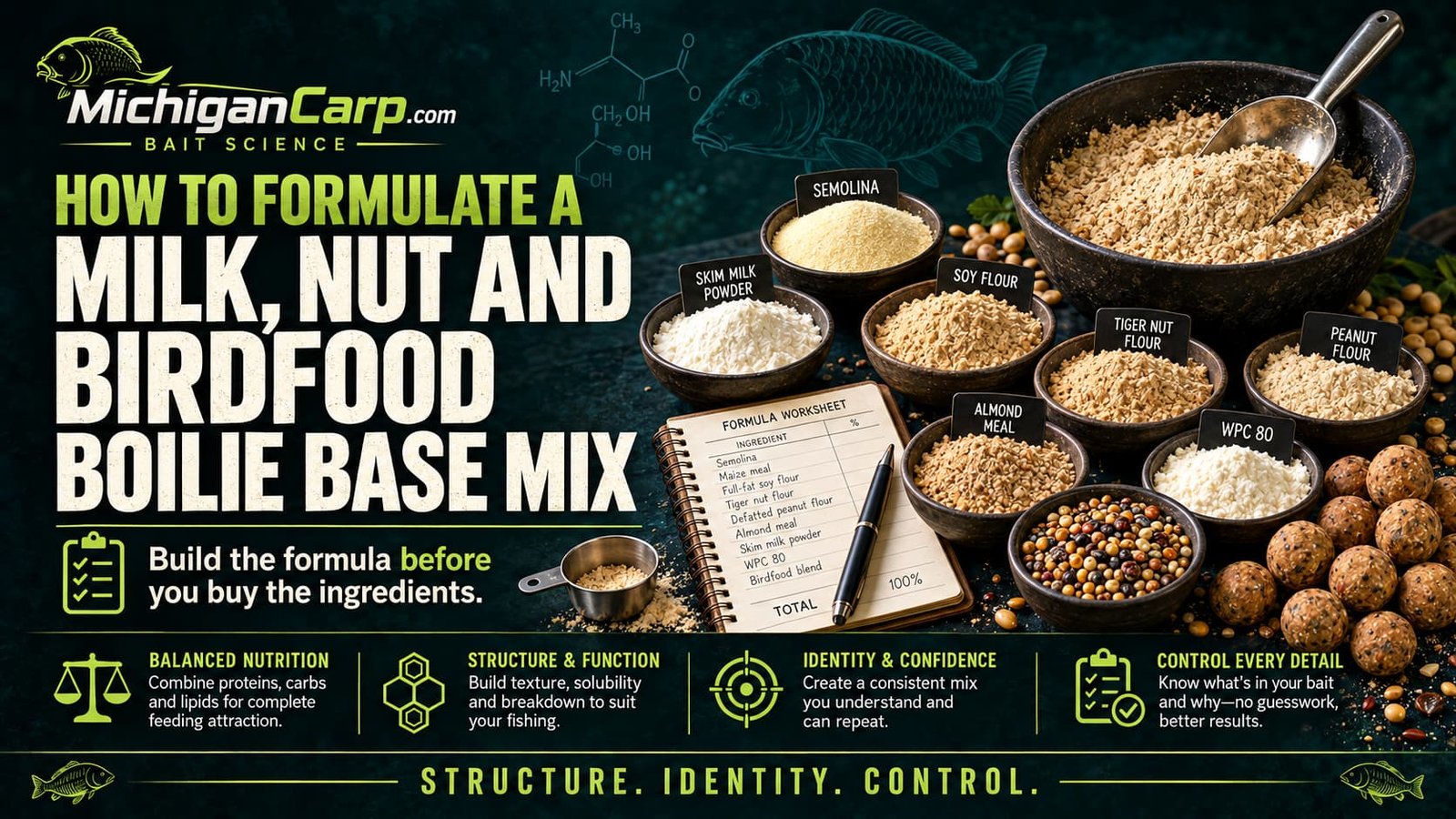
How to formulate a milk, nut and birdfood boilie base mix is not just a matter of finding one good recipe. It begins with understanding what every section of the bait is supposed to do.
A milk nut and birdfood boilie base mix works best when structure, nut identity, dairy function, birdfood texture and support ingredients are balanced before the liquid phase is designed.
A good milk, nut and birdfood boilie does not begin with a shopping list. It begins with a series of decisions that have to work together. How much of the base mix should provide structure? How large must the nut section be before it gives the bait a real identity? Is the birdfood there for texture, nutrition, processing behavior or simply because an old recipe used the word CLO? What is the dairy section expected to do: add creamy character, increase protein, strengthen the bait or provide a more soluble background?
Those questions matter because a boilie can contain several expensive and attractive ingredients and still be badly designed. It can be greasy, soft, difficult to roll, slow to dry and impossible to reproduce. The problem is not necessarily the quality of the ingredients. The problem is that the ingredients were collected before the bait was formulated.
My approach is to design the bait as a connected system. I first decide what the finished boilie has to do, then build the structural chassis, set the nut identity, define the dairy section, use birdfood deliberately and keep the smaller support ingredients under control. Only after that do I design the liquid phase, flavor profile and preservation strategy.
This is not another page of recipes. For four finished formulas, use Nut Boilie Base Mix Recipes: 4 Practical 1 kg Formulas. This guide has a different job: it explains how to build and judge a formula for yourself.
Formulate the system first. Buy the specialist ingredients second.
Table of Contents
Milk, Nut and Birdfood Boilie Base Mix Framework
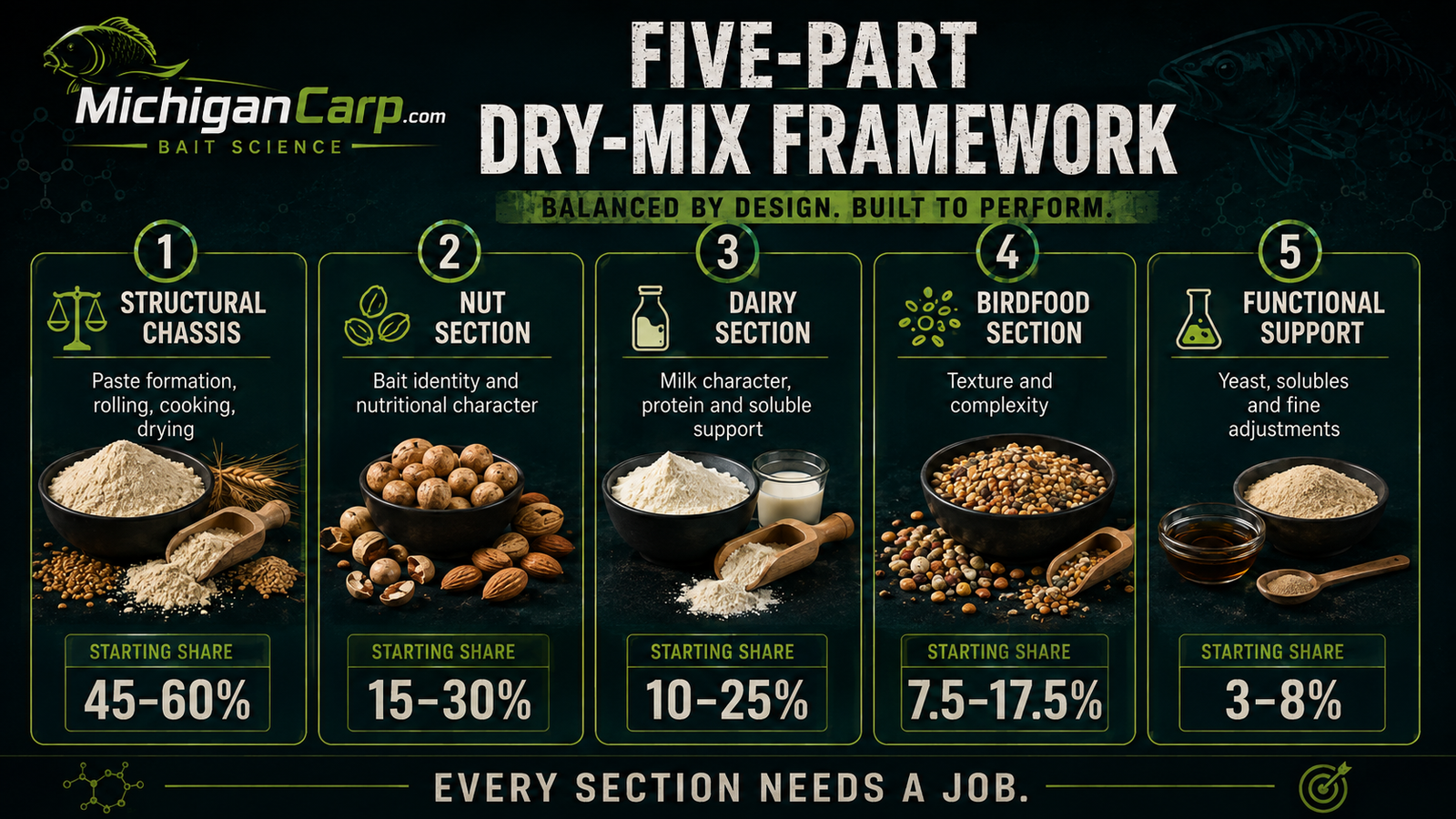
For a balanced milk, nut and birdfood boilie, I prefer to view the dry base mix as five connected sections. The percentages can change, but the logic remains useful because it forces every part of the formula to have a clear purpose.
| Section | Main job | General starting share |
|---|---|---|
| Structural chassis | Paste formation, extrusion, rolling, cooking and physical control | 45–60% |
| Nut section | Bait identity, food value and nutritional character | 15–30% |
| Dairy section | Milk character, protein, structure and soluble support | 10–25% |
| Birdfood section | Texture, ingredient complexity and physical variation | 7.5–17.5% |
| Functional support | Yeast, selected solubles and small structural or taste adjustments | 3–8% |
A balanced general-purpose 1 kg design might begin at 480 g of structural ingredients, 220 g of nut ingredients, 150 g of dairy ingredients, 100 g of birdfood and 50 g of supporting materials. That totals 1,000 g, but it should be understood as a design framework rather than a universal recipe.
The important part is not memorizing those numbers. It is understanding what happens when one section changes. If the birdfood section becomes coarser and larger, the chassis may need more binding strength. If the nut section contains oily ground peanut instead of defatted peanut flour, the fat budget and dough behavior change. If the dairy section moves from skim milk powder toward concentrated casein and WPC, the cost, protein level and physical behavior change with it.
A formula becomes easier to control when those relationships are visible.
Start With the Job of the Bait
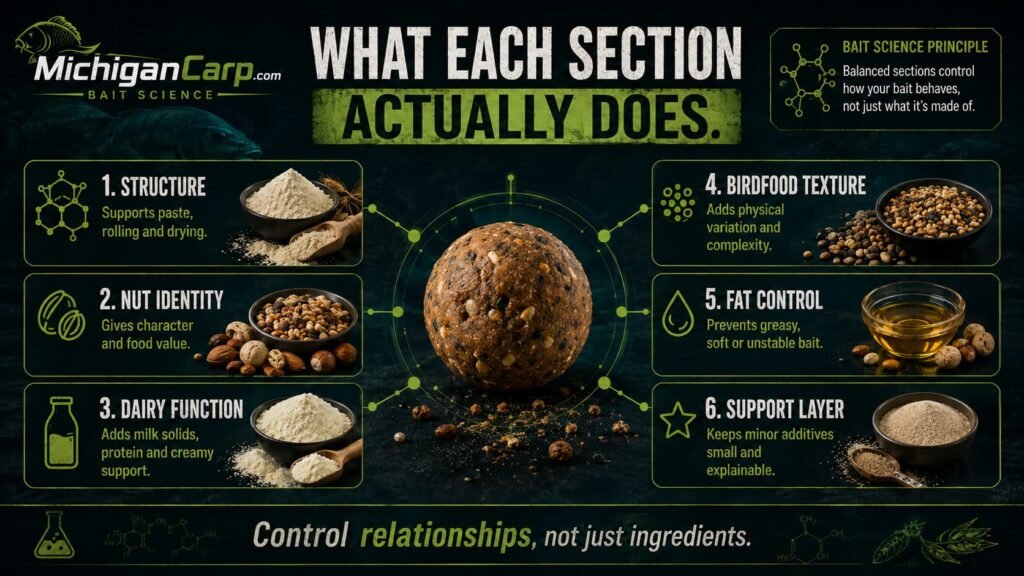
Before choosing ingredients, decide what the bait is being built to accomplish. A boilie for a short evening session does not have exactly the same job as a campaign bait used over several days on a large reservoir. A bait made mainly for hookbaits can tolerate costs and physical properties that would make little sense in ten kilograms of free offerings.
My own Michigan fishing makes this especially important. I may be fishing a natural lake, an impoundment, a river channel or a large open-water venue where location and fish movement can matter more than tiny differences in additive levels. The boilie may be used beside maize, hemp, pigeon feed, tiger nuts, peanuts, packbait or boilie crumb. I therefore want a bait that belongs within a wider feeding system, not a bait that has to imitate every other food item in the swim.
A campaign bait often needs repeatable sourcing, sensible cost and a robust structural chassis. A short-session bait may place more emphasis on finely controlled soluble materials, crumb, chop and precise application. A bait intended for warm water and nuisance-fish pressure may need more physical durability. A bait for colder conditions may be used more sparingly and should not depend on adding more fat simply because the ingredient sounds rich.
This first decision prevents a common problem: building a luxurious formula on paper that is too expensive, too complicated or too physically unstable to use properly.
The right question is not, “What is the most impressive ingredient I can add?” It is, “What does this bait need to do during the type of fishing I actually undertake?”
Understand Birdfood Before You Formulate With It
The word birdfood causes more confusion than almost any other term in home bait making. In North America, a beginner may reasonably assume it means a bag of mixed birdseed. In traditional boilie recipes, however, it can refer to several very different materials.
Birdseed and prepared birdfood are not the same thing
Plain birdseed may contain millet, canary seed, hemp, linseed, niger seed or sunflower. Those ingredients may be used whole, cracked or ground, but they remain raw seed ingredients. A prepared birdfood or egg-food product may also contain cereals, biscuit material, egg-derived ingredients, oils, sweet components and manufactured binders.
That is why the exact product matters. Haith’s Nectarblend is sold specifically as a fishing-bait ingredient and has a defined analytical profile. CC Moore’s CLO is described by its manufacturer as a blend containing ground and whole seeds, cereals, egg protein and cod liver oil. Neither product can be reduced to the vague instruction “add birdseed.”
For the broader ingredient explanation, read Birdfood for Carp Boilies.
Do you need an imported European birdfood?
No. A specialist product can be very useful, but it is not compulsory. For a North American bait maker, availability and repeatability matter. If the formula depends entirely on one imported product that disappears or doubles in price, the bait may have to be redesigned.
There are three sensible routes. You can use a known commercial birdfood and record the exact product. You can use a consistent domestic egg food or cereal-and-seed product after reading the label. Or you can build a house birdfood-style component from ingredients you can source reliably.
How much birdfood should you use?
For a balanced milk, nut and birdfood hybrid, I would normally begin testing around 75–125 g/kg of a known birdfood component. At that level it can create a clear supporting layer without automatically dominating the structure. Around 125–175 g/kg, the bait becomes more obviously birdfood-led. Above that, the chassis, grind and total fat need increasingly deliberate control.
More birdfood does not automatically mean better leakage. Coarse particles can alter porosity and water entry, but a bait that splits during rolling or falls apart before it has completed its intended fishing time is not technically better. My preference is controlled physical variation: fine flour for continuity, medium meals for body and a limited amount of visible particulate material for texture.
For physical failures, use Boilie Problems: Real Causes and Practical Fixes.
Building a House Birdfood Component
A North American bait maker does not need to depend on one imported commercial birdfood. The useful approach is to decide what the birdfood section needs to contribute—cereal structure, seed texture, oil, egg, soy, yeast or spice character—and then either choose a suitable commercial product or build a repeatable house component.
Do not simply replace CLO, Nectarblend or another prepared birdfood gram-for-gram with ground mixed seed. Their composition and physical behavior can be very different.
For practical 100 g house blends, including balanced, oil-rich, cereal-and-egg, red-spice, low-cost feed-store and leaner milk-and-nut versions, use Birdfood for Carp Boilies: CLO, Nectarblend, Egg Foods and Seed Blends Explained.
The formulation principle here remains the same: define the birdfood section by function, count its fat and structural contribution, then balance it against the rest of the complete base mix.
Build a Nut Section With Identity and Control
The phrase nut boilie hides major differences between ingredients. Tiger nut flour, defatted peanut flour, full-fat ground roasted peanuts, almond meal and coconut meal do not contribute the same amount of fat, protein, fiber or binding behavior.
This matters most when a recipe is copied by ingredient name rather than specification. Three hundred grams of defatted peanut flour is not physically equivalent to three hundred grams of oily ground peanut. USDA Agricultural Research Service work on commercial peanut flours found that residual oil level affected their rheological behavior. For bait makers, the practical lesson is simple: the product you actually own matters. Read the USDA ARS peanut-flour study.
For this type of hybrid bait, 100–150 g/kg gives a supporting nut character, while 150–250 g/kg usually produces a clear nut identity. Once the complete nut section moves toward 250–350 g/kg, the bait becomes nut-led and requires much closer attention to fat, dough handling and structural strength.
A practical house nut blend
If you intend to make the bait repeatedly, a defined house blend can make development easier. It gives you a fixed ratio that can be used across several formulas and compared from one batch to the next.
| Ingredient | Amount | Percentage |
|---|---|---|
| Tiger nut flour | 500 g | 50% |
| Defatted peanut flour | 350 g | 35% |
| Almond meal | 150 g | 15% |
| Total | 1,000 g | 100% |
Tiger nut flour provides the main identity. Defatted peanut flour contributes roasted character and protein with better fat control than whole ground peanut. Almond meal adds richness as a smaller supporting component. I would not describe this as a perfect universal blend. Its real value is repeatability.
Once the blend is defined, 200 g always means 100 g tiger nut flour, 70 g peanut flour and 30 g almond meal. If a supplier changes or one ingredient is replaced, the change can be documented instead of disappearing into an undefined “nut mix.”
Estimate composition honestly
You can estimate the protein, fat, fiber and ash of a house blend by applying a weighted average to current supplier specifications. For the blend above:
Estimated protein % = (0.50 × tiger nut flour protein %) + (0.35 × peanut flour protein %) + (0.15 × almond meal protein %)
The same method can be used for fat and other declared values. It is useful because it exposes obvious formulation problems, but it is not laboratory analysis. Supplier values can vary, natural ingredients can change and crude composition does not by itself establish digestibility, amino-acid balance, palatability or water behavior.
The FAO’s feed-formulation material is a useful reminder that protein, lipid, fiber, ash and carbohydrate should be evaluated as parts of a wider composition rather than reducing the formula to one headline number. An angling boilie is not the same as a complete aquaculture production diet, but the discipline of looking beyond crude protein remains valuable. Read the FAO common-carp nutrition reference.
For complete formulas rather than blend design, continue to Nut Boilie Base Mix Recipes.
Design the Dairy Section by Function
A recipe that calls for “150 g milk ingredients” does not tell us enough. One hundred and fifty grams dominated by skim milk powder and buttermilk is very different from 150 g dominated by WPC80, casein and caseinate.
For a balanced hybrid, 100–175 g/kg is a useful starting zone for a clear dairy layer. Around 50–100 g/kg, milk ingredients are more likely to provide background support. Between 175 and 250 g/kg, the bait becomes increasingly dairy-led. Above that, you are moving toward a specialist milk-protein formulation whose structure and cost need to be designed accordingly.
The correct ingredients depend on the job. Skim milk powder and buttermilk powder can provide broad dairy solids and creamy character. Cream powder adds richness but also contributes fat. WPC can increase concentrated whey protein. Casein and caseinate may contribute protein and physical properties, but they should not be added merely because they sound advanced.
If the goal is stronger structure, the correct answer may involve casein, egg albumen, the cereal chassis or the cooking process. If the goal is more material moving into water, simply increasing expensive intact protein may not achieve it. Solubility, particle size, processing and the surrounding matrix all matter. Read Carp Bait Solubility and Leakage before treating concentrated protein as a shortcut to a more active bait.
The deeper ingredient routes are:
My practical rule is straightforward: do not build a dairy section from ingredient names. Build it from jobs.
Build a Structural Chassis That Supports the Identity
The structural chassis is the least glamorous part of many bait discussions, yet it is the section that determines whether the formula can be turned into a usable boilie. It has to absorb liquid, form paste, extrude, roll, survive cooking and dry to the strength required for the intended fishing time.
For this type of hybrid, I often begin around 450–600 g/kg of structural ingredients. That does not mean using 600 g of semolina. A chassis is a formulation inside the formulation, normally built from several ingredients that contribute different starch, protein, absorption and processing behavior.
| Example structural chassis | Amount |
|---|---|
| Semolina | 200 g |
| Maize meal | 120 g |
| Full-fat soy flour | 120 g |
| Wheatgerm | 40 g |
| Subtotal | 480 g |
Semolina and maize meal provide useful working structure. Soy contributes protein and affects dough behavior, while wheatgerm adds a different physical and nutritional component. The exact combination can change, but the principle remains: the chassis must be large enough and suitable enough to carry the richer identity ingredients.
It is a mistake to dismiss every inexpensive cereal as filler. A campaign bait may deliberately use a larger economical chassis because many kilograms are required and the more expensive ingredients need to be controlled. The problem is not that a formula contains semolina or maize. The problem is when the bait contains little else of purpose, or when the chassis is allowed to dominate simply because it rolls easily.
Good structure is not an embarrassment. It is what allows the rest of the bait to function.
Count the Complete Fat System Before Adding Oil
Milk, nut and birdfood baits can become rich before a bottle of oil is ever opened. Fat may already be entering the formula through full-fat soy, tiger nut flour, whole peanut, almond meal, hemp, sunflower, milk replacer, cream powder, birdfood and egg.
This is why I do not start a nut-bait recipe by automatically writing “add 20 ml nut oil.” First calculate what the dry ingredients and egg are already contributing. Then ask what the additional oil is intended to do.
Oil may influence texture, paste lubrication, energy density, flavor carriage and storage stability. Those are real functions, but they do not mean every nut bait needs more of it. A formula can become greasy, soft and more vulnerable to oxidation while still looking attractive on paper.
A simple spreadsheet with estimated protein, fat, fiber and cost columns is extremely useful. Even imperfect supplier data may reveal that the combination of full-fat soy, almond, birdfood, cream powder and eggs has already produced a rich bait.
For the broader science, read Oils, Fats and Energy in Carp Bait. The more focused practical article How to Balance Fat in Boilies: Milk, Nut and Seed Mixes should be linked here after publication.
Keep the Functional Support Layer Small and Explainable
The final 30–80 g of a base mix is where many formulas lose discipline. Yeast, betaine, liver powder, HVP, hydrolysate powder, nucleotides, salt, minerals, amino acids and sweeteners can all sound useful in isolation. That does not mean they should all be added to the same bait.
I ask one question of each supporting ingredient: what job is it doing that is not already being performed?
A simple support layer might use brewer’s yeast for background nutrition and taste, a small amount of autolyzed yeast for soluble savory material, molasses powder for mild sweetness and color, and albumen only where the physical formula needs additional strength. Another formula might use one controlled liver-derived ingredient or a modest hydrolysate component instead.
The support layer should remain subordinate to the bait’s main identity. A milk, nut and birdfood boilie does not become more advanced because its final 50 g contains twelve fashionable powders. In many cases, reducing the number of minor ingredients makes the bait easier to understand, repeat and evaluate.
For the practical hydrolysate route, read How to Use Hydrolysates in Carp Bait. For liquid selection, use When to Use Each Type of Carp Bait Liquid.
Formulate in Percentages, Then Build Test Batches in Grams
Percentages make the structure of a formula visible. Grams make it practical on the bench. A 1 kg dry mix connects the two perfectly because every one percent equals ten grams.
| Percentage | Grams per 1 kg |
|---|---|
| 1% | 10 g |
| 2.5% | 25 g |
| 5% | 50 g |
| 7.5% | 75 g |
| 10% | 100 g |
| 15% | 150 g |
| 20% | 200 g |
| 25% | 250 g |
This allows related baits to be compared properly. The same broad milk, nut and birdfood identity can be built as a balanced all-round bait, a more textured birdfood hybrid, a dairy-led formula or an economical campaign mix.
| Design | Chassis | Nut | Dairy | Birdfood | Support |
|---|---|---|---|---|---|
| Balanced all-round hybrid | 48% | 22% | 15% | 10% | 5% |
| More textured birdfood hybrid | 45% | 20% | 12.5% | 17.5% | 5% |
| More dairy-led hybrid | 45% | 18% | 25% | 7% | 5% |
| Economical campaign hybrid | 60% | 18% | 10% | 8% | 4% |
All four formulas belong to the same family, yet they are not the same bait. That is the real value of percentage-based formulation: it helps you understand what has changed instead of treating every new ingredient list as an unrelated recipe.
Build a 1 kg Formula Step by Step
The following worked example turns the five-part framework into a complete dry mix. It is not presented as a universal recipe. Its purpose is to show how a formula can be assembled section by section without losing control of the total.
This example shows how a milk nut and birdfood boilie base mix can be built from section totals instead of random ingredient additions.
Once the dry mix is balanced, the next stage is the liquid phase. Use Boilie Liquids and Additives to build the egg-and-liquid side of the bait. The specialist articles Lecithin in Carp Bait and Propylene Glycol vs Glycerin in Carp Bait expand on emulsification, carriers and liquid control.
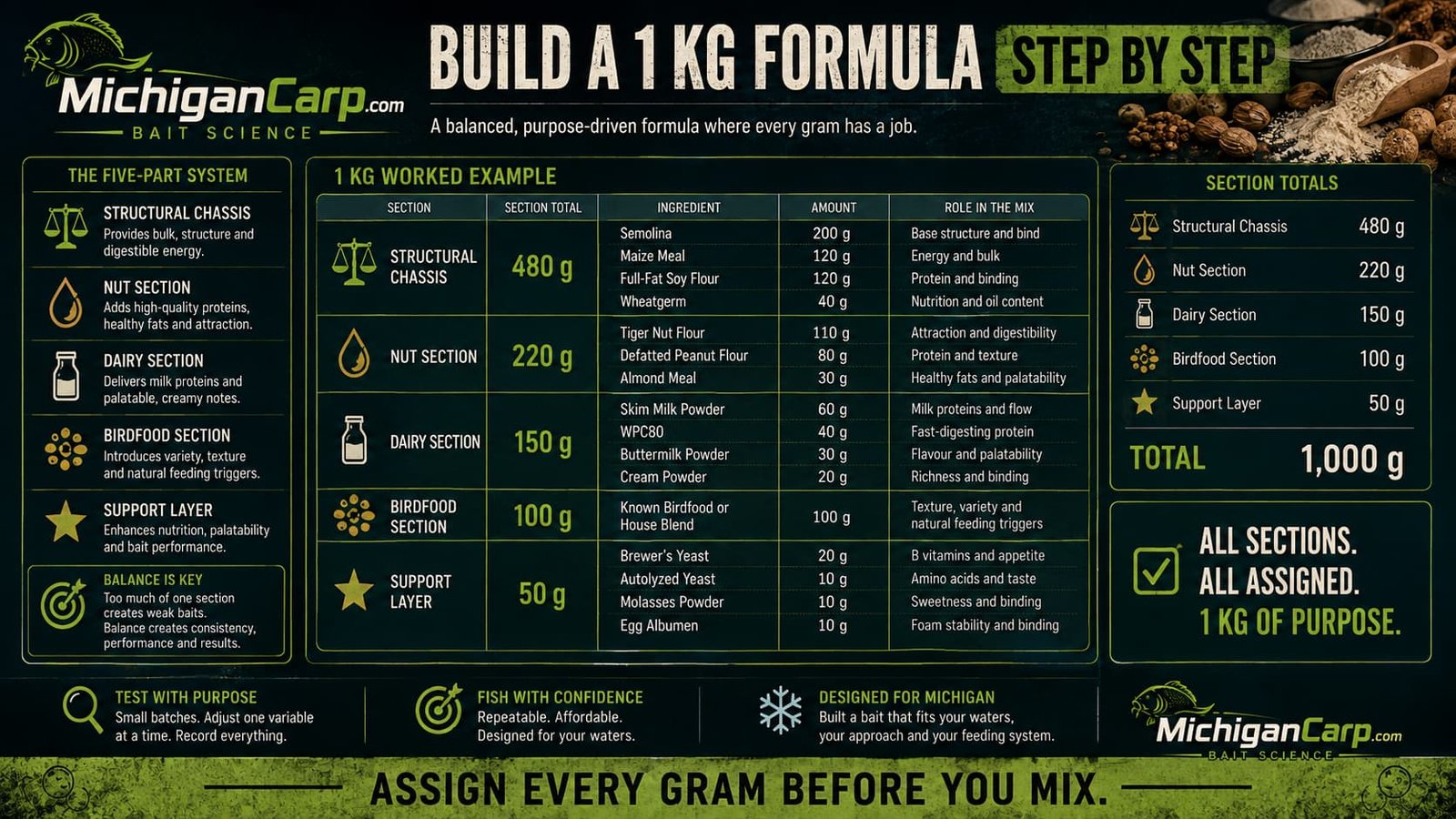
| Section | Ingredient | Amount |
|---|---|---|
| Structural chassis | Semolina | 200 g |
| Structural chassis | Maize meal | 120 g |
| Structural chassis | Full-fat soy flour | 120 g |
| Structural chassis | Wheatgerm | 40 g |
| Nut section | Tiger nut flour | 110 g |
| Nut section | Defatted peanut flour | 80 g |
| Nut section | Almond meal | 30 g |
| Dairy section | Skim milk powder | 60 g |
| Dairy section | WPC80 | 40 g |
| Dairy section | Buttermilk powder | 30 g |
| Dairy section | Cream powder | 20 g |
| Birdfood section | Known commercial birdfood or house blend | 100 g |
| Support layer | Brewer’s yeast | 20 g |
| Support layer | Autolyzed yeast product | 10 g |
| Support layer | Molasses powder | 10 g |
| Support layer | Egg albumen | 10 g |
| Total | — | 1,000 g |
The formula contains a 480 g structural chassis, 220 g of nut ingredients, 150 g of dairy ingredients, 100 g of birdfood and 50 g of support. Every gram has been assigned before the ingredients are mixed.
The chassis is large enough to carry the richer sections. The nut identity is clear without turning the mix into a high-fat block. The dairy layer combines broad milk solids, concentrated protein, tangy character and creaminess instead of relying on four ingredients to perform the same job. The birdfood remains meaningful but controlled. The support layer is small enough that it does not overwhelm the main food identity.
For my current Ultra 24-based reference system, nutritional estimates and Michigan application, continue to
Adjust and Test the Formula Without Losing Control

A formula is not improved by adding weight to a finished kilogram. If you increase one section, remove the same amount elsewhere so the dry mix remains at 1,000 g and the change can be understood.
If you want more birdfood character, moving the birdfood section from 100 g to 150 g might require reducing the chassis from 480 g to 430 g. If you want more nut identity, moving the nut section from 220 g to 250 g requires removing 30 g from another section. The resulting formula must then be reassessed for fat, paste behavior, rolling, drying and water life.
When a paste appears too wet or too dry, resist the urge to reformulate immediately. Nut flours, seed meals, wheatgerm, cereals and birdfood can continue absorbing liquid after mixing. I normally allow this style of paste to rest for around 10–15 minutes before making major corrections.
The first test batch should also be small. Around 250–300 g of dry mix is enough to expose many failures without wasting a large quantity of ingredients. The useful observations are practical: does the paste hydrate evenly, extrude smoothly and roll without splitting? Does the cooked bait crack or deform? How does it behave after one hour, four hours and overnight in water?

Record the ingredient, supplier, product name, grams and percentage. Record the liquid phase, paste rest, bait diameter, cooking time, drying time and water-test results. A note saying “nut mix, birdfood and some milk powder” is almost useless six months later.
For the full process, use How to Test Boilies Before Fishing and How to Boil and Dry Boilies Properly.
One controlled change teaches more than five simultaneous improvements. If the bait catches, do not immediately replace the nut blend, dairy section, flavor and liquid phase. Establish a repeatable version, fish it, observe it and then alter one meaningful variable.
A Practical Michigan Formulation Approach
My formulation decisions are shaped by the waters I fish. Large natural lakes, reservoirs, impoundments and channels do not give the controlled feedback of a small stocked water. Carp may move through a feeding area only during a short window, and a blank session may reflect location, weather or fish movement rather than a ten-gram difference in one powder.
That pushes me toward bait that is technically sound, repeatable and affordable enough to use properly. A milk, nut and birdfood system fits well because it can sit beside maize, hemp, tiger nuts, peanuts, pigeon feed, packbait, crumb and chopped boilies without needing to contain every one of those ingredients.
The boilie provides one controlled food item within a wider feeding system. On some sessions it may be the main feed. On others it may be the selected hookbait and high-value component within a larger particle area. The formula should be designed with that reality in mind.
This is also why I value consistency more than constant novelty. On big water, reliable bait allows location, baiting quantity and presentation to be evaluated with fewer moving parts. A formula that changes every week makes field results almost impossible to interpret.
Common Mistakes That Derail Good Mixes
Most formulation failures do not come from one obviously terrible ingredient. They come from several individually reasonable decisions being stacked without a plan.
Adding ingredients because they sound attractive
Tiger nut flour, peanut flour, WPC, casein, cream powder, yeast, liver and hydrolysates can all be useful. The formula can still be confused if several ingredients duplicate the same function or push the bait beyond the structure that supports them.
Treating ingredient categories as specifications
“Birdfood,” “peanut flour,” “milk replacer” and “casein” are not complete technical descriptions. Read the label, record the product and understand whether it is high-fat, low-fat, coarse, fine, concentrated or blended.
Chasing crude protein while ignoring the rest of the bait
Protein is one part of the formula. The bait also contains lipid, carbohydrate, fiber, minerals and physical structure. A high headline protein number does not guarantee good paste, sensible cost, digestibility or useful water behavior.
Adding oil because the bait contains nuts
Count the existing lipid first. Full-fat soy, nuts, seeds, cream powder, milk replacer, birdfood and eggs may already make the bait rich enough.
Making the first batch too large
A ten-kilogram failure is not more informative than a 300 g failure. Small tests reveal paste, rolling and drying problems at a fraction of the cost.
Changing too many variables after one session
One successful or unsuccessful session does not isolate the effect of one ingredient. Location, timing, fish movement, baiting quantity and presentation all influence the result. Change the formula slowly enough that the bait can actually teach you something.
My Practical View
Good boilie formulation is not about discovering one secret percentage. It is about controlling relationships.
The chassis has to support the identity ingredients. The nut section must be large enough to matter without creating uncontrolled richness. The dairy section needs defined jobs. Birdfood should be selected for what it contributes rather than added because an old recipe used a familiar name. The support layer should remain a support layer.
For me, a milk nut and birdfood boilie base mix is successful when it is repeatable, fishable, affordable and easy to adjust without losing its identity.
The complete formula then has to be reproducible, processable, testable and affordable enough to use in the real fishing situation for which it was designed.
That is why I like section-based formulation. It changes the question from:
I have fifteen good ingredients. How do I fit them all into one bait?
to:
What does this bait need, and which ingredient performs each job?
That is the point at which copying recipes begins to turn into making bait.
FAQ
What does birdfood mean in a boilie recipe?
It may refer to prepared bird foods, egg foods, CLO-style products or controlled seed-and-cereal blends. It does not automatically mean plain whole birdseed. The exact product should be identified because different birdfoods can have very different grind, fat, protein and binding characteristics.
How much birdfood should I use in a milk and nut boilie?
For a balanced hybrid, 75–125 g/kg is a sensible starting range for testing. Higher inclusion can work, but the correct amount depends on the product, particle size, fat level and strength of the structural chassis.
How much nut material should I use?
A complete nut section of around 150–250 g/kg usually creates a clear nut identity in this type of hybrid bait. Nut-led mixes can go higher, but tiger nut flour, defatted peanut flour, whole ground peanut and almond meal should not be treated as interchangeable.
How large should the dairy section be?
Around 100–175 g/kg is a practical starting zone for a clear dairy layer. Milk-led formulas may use more, but the real question is which dairy ingredients are being used and what jobs they are expected to perform.
Do nut boilies need added oil?
Not automatically. Count fat contributed by nuts, seeds, soy, dairy ingredients, birdfood and egg before deciding whether additional oil has a useful purpose.
Should I formulate in percentages or grams?
Think in percentages and build test batches in grams. In a 1 kg dry mix, one percent equals ten grams, making scaling and comparison straightforward.
How large should the first test batch be?
For an unfamiliar formula, approximately 250–300 g of dry mix is normally enough to assess hydration, paste rest, extrusion, rolling, cooking, drying and water behavior without wasting ingredients.
What is the biggest mistake when designing a boilie?
For me, it is adding ingredients without defining their jobs. A bait can contain many expensive ingredients and still be structurally confused, unnecessarily rich or impossible to reproduce.
Next Steps
Use this article as the formulation framework, then move to the guide that matches the next decision:
- Nut Boilie Base Mix Recipes — four complete 1 kg formulas.
- Birdfood for Carp Boilies — understand CLO, egg food and seed blends.
- Milk Powders in Boilie Making — choose dairy ingredients by function.
- Oils, Fats and Energy in Carp Bait — understand the complete lipid system.
- How to Test Boilies Before Fishing — evaluate the finished bait before trusting it on a session.
- Boilie School — follow the complete learning route.
For the complete Ultra 24 reference mix, estimated nutritional profile and Michigan application, continue to