


Birdfood for carp boilies is one of the most useful—and most misunderstood—ingredient categories in homemade bait.
A recipe says CLO.
Another says Nectarblend.
An older formula may specify Sluis CLO, Red Factor, Prosecto, egg food or Robin Red.
After seeing those names repeated for decades, it is easy to assume that the product itself contains some indispensable secret and that a successful bait must use exactly the same imported ingredient.
That is the wrong lesson.
Classic European birdfoods have earned their reputation through long practical use, and there is nothing wrong with using them when they are available and make sense. But what matters to a bait maker is what the ingredient actually contributes to the finished formula.
A prepared birdfood may supply some combination of:
- cereal and starch;
- small seeds;
- oil;
- soybean material;
- egg solids;
- yeast;
- sugar or honey-derived material;
- spices;
- protein;
- physical texture;
- binding and water absorption.
Those functions can often be built deliberately from ingredients readily available in the United States.
That is particularly useful for North American bait makers. Millet, milo, maize, wheat products, hemp, sunflower, flax, canary seed, soy flour, wheatgerm, brewer’s yeast and egg products are widely available through feed suppliers, bird-feed suppliers, grocery channels and food-ingredient sources.
The objective is not to pretend we have discovered the proprietary formula for CLO, Nectarblend, Robin Red or any other commercial product.
The objective is much more useful:
Understand what the commercial ingredient is doing, then decide whether to buy that function or build it yourself.
For the individual properties of hemp, millet, canary seed, linseed, sunflower, sesame, niger and other seeds, use Individual Birdseeds Explained for Boilie Making.
That article owns the individual seeds.
This article owns the next step: turning cereals, seeds and supporting ingredients into a repeatable compound birdfood component.
Table of Contents
Quick Start: Birdfood Is a Formulation Tool, Not a Magic Ingredient
The simplest way to understand birdfood is to stop thinking first about product names and start thinking about jobs.
| Birdfood Type | Broad Character | Main Question |
|---|---|---|
| CLO-style product | Cereal, seed and relatively substantial oil contribution | Does the rest of the bait need that additional lipid? |
| Nectarblend-style softfood | Strong cereal/starch base with soy, egg, yeast and smaller seed fractions | Can I reproduce those functions locally? |
| Egg-food style product | Cereal/biscuit material plus egg and supporting ingredients | How much binding, protein and richness does it add? |
| Red Factor-style product | Cereal-led compound with seed and spice/color character | Is the identity useful or am I buying a famous name? |
| Prosecto-style product | Richer compound feed containing substantial soy, cereal and lipid components | How does it alter protein, fat and hydration? |
| Plain birdseed | Individual seeds or a defined seed mixture | Which seeds, what grind and how much fat? |
| House birdfood component | A bait maker’s repeatable cereal/seed/support mixture | Does every ingredient have a defined job? |
The important point is that these ingredients cannot be treated as interchangeable simply because carp anglers put all of them under the word birdfood.
Two hundred grams of an oily CLO-style product is not equivalent to 200 g of ground millet.
Neither is equivalent to 200 g of a cereal-rich egg food.
The weight may be identical.
The formula is not.
Why Birdfood Became Important in Carp Bait
Birdfood did not become successful because carp understand cage-bird product names.
It became useful because some bird foods happened to combine several properties that boilie makers wanted in one ingredient.
A prepared birdfood might provide:
- usable cereal structure;
- moderate binding;
- protein from soy or egg;
- oil from seeds;
- small particles;
- nutritional diversity;
- coarse and fine texture;
- aroma from food ingredients;
- useful paste behavior.
That made birdfood convenient.
Instead of buying six individual ingredients, a bait maker could sometimes add one compound product and obtain several functions at once.
The problem came later.
Successful product names became part of carp-bait folklore. Recipes were copied repeatedly and eventually anglers sometimes knew that a bait was supposed to contain CLO or Nectarblend without knowing why it was there.
That is exactly the situation we want to avoid.
A famous ingredient can be excellent.
It is still an ingredient.
The bait should not depend on the name printed on the bag. It should depend on what is inside the bag and what that material does in the formula.
Birdfood Is Not the Same as Birdseed
This distinction must remain clear.
Birdseed means individual seeds or mixtures of seeds.
Examples include:
- millet;
- canary seed;
- hemp;
- linseed or flax;
- niger;
- sunflower;
- safflower;
- sorghum or milo.
Prepared birdfood is a compound product.
It may contain seeds, but it can also contain wheat flour, maize, soybean products, egg powder, yeast, sugar, oils, minerals, biscuit material and other ingredients.
That distinction matters enormously when adapting a recipe.
Replacing a cereal-rich prepared birdfood with an equal weight of oily ground seeds can:
- reduce starch;
- increase fat;
- alter water absorption;
- weaken extrusion;
- change drying;
- change particle size;
- make the finished bait much richer.
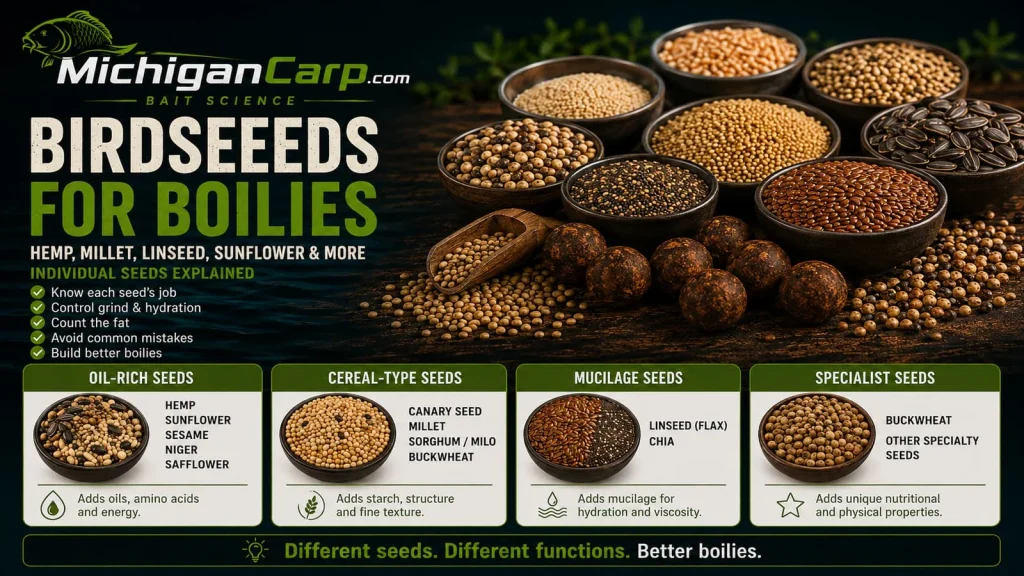
For seed-by-seed formulation, return to Individual Birdseeds Explained for Boilie Making.
What CLO, Nectarblend, Red Factor and Prosecto Actually Tell Us
The current products are useful because they demonstrate how misleading the single word birdfood can be.
CLO
Current Haith’s CLO lists approximately:
- 15.0% crude protein;
- 12.54% total oil;
- 44.9% starch.
That is a meaningful oil contribution.
If a boilie already contains full-fat soy, peanut, hemp, sunflower, whole egg, cream powder or other lipid-rich ingredients, CLO cannot simply be treated as neutral texture.
Nectarblend
Current Haith’s Nectarblend lists wheat flour, yeast, toasted soybeans, soya flour, egg powder, nigerseed and hempseed among its ingredients.
Its current analytical figures include approximately:
- 12.5% crude protein;
- 4.2% total oil;
- 61.1% starch.
Compared with current CLO, Nectarblend is much more strongly cereal/starch-led.
That alone demonstrates why:
CLO = Nectarblend = birdfood
is not a useful substitution rule.
Red Factor
Current Haith’s Red Factor is different again.
Its manufacturer lists cereal material, soybean ingredients, ground seeds, sugar, vegetable oil and capsicum-related ingredients.
Current listed figures include approximately:
- 10.66% protein;
- 3.87% oil;
- 61.3% starch.
Again, this is primarily a compound cereal-style ingredient with its own seed and spice character—not simply red-colored CLO.
Prosecto
Current Haith’s Prosecto shows another completely different direction.
Its ingredient list includes toasted soybeans, maize, palm-kernel material, molasses, wheat, soybean meals, oil, oats, hempseed and other ingredients.
The fishing version also currently lists fishmeal, despite the manufacturer specifically noting that the product does not contain insects.
This is useful information for anyone designing a non-marine bait.
You may like what a Prosecto-type ingredient does—rich soy, cereal, oil, molasses and seed character—without needing to reproduce the commercial product ingredient-for-ingredient.
That function can be rebuilt differently.
Robin Red Is a Different Question
Robin Red deserves separate treatment because anglers often group it mentally with classic birdfoods even though it performs a different job.
Current Robin Red Natural lists:
- capsicum;
- red beet extract;
- sucrose;
- vegetable oil;
- maltodextrin.
That is obviously not the same type of ingredient as Nectarblend or CLO.
It is much closer to a concentrated spice, color and food-identity component.
Its exact proprietary history is not something a homemade bait maker needs to reverse-engineer.
We should also avoid calling a mixture of paprika and beet powder “homemade Robin Red.”
It is not.
What we can make is a red-spice house component that performs some broad functions we may want:
- warm spice character;
- food-derived red/brown coloration;
- small sugar contribution;
- integration into a cereal birdfood.
That is honest formulation.
Copy the Function, Not the Formula
This is the most important section of the article.
When an old recipe calls for a commercial birdfood, break that ingredient into functional questions.
1. How much of it is cereal structure?
Look for wheat, maize, biscuit, starch-rich meals or similar ingredients.
A strongly cereal-led birdfood may partly replace semolina, maize meal or other structural carbohydrates in the main formula.
2. How much seed material does it bring?
Identify whether the product contains oil-rich seeds or mainly small cereal-type seeds.
Hemp and sunflower do not behave like millet and canary seed.
3. Is it adding significant fat?
Never count only bottled oil.
Oil may already come from:
- hemp;
- sunflower;
- linseed;
- sesame;
- full-fat soy;
- peanut;
- egg yolk;
- cream powder;
- milk replacer;
- commercial birdfood.
Use Oils and Fats in Carp Bait to assess the complete lipid system.
4. Is it contributing soy or egg?
Soy and egg change more than crude protein.
They can affect:
- hydration;
- binding;
- paste texture;
- firmness after cooking;
- fat level;
- nutritional profile.
5. Is yeast part of the character?
Brewer’s yeast can be a useful food ingredient.
It is not the same thing as yeast extract, autolyzed yeast or a concentrated soluble yeast product.
Use exactly what you intend and record it.
6. Is spice, sugar or molasses part of the identity?
These can be deliberate supporting features.
They do not need to become mysterious attractors.
7. What particle size is doing the work?
Two mixtures containing identical ingredients can behave differently if one is powdered and the other is coarse.
Grinding is formulation.
A Simple House-Birdfood Framework
Instead of beginning with a commercial name, build a 100 g test component.
A useful general framework is:
| Section | Broad Starting Area |
|---|---|
| Cereal / structural fraction | 40–60 g |
| Seed fraction | 15–30 g |
| Soy / egg / protein-support fraction | 10–25 g |
| Wheatgerm / yeast / support fraction | 5–15 g |
| Spice / sweetness / specialist identity | 0–10 g |
| Total | 100 g |
These are development zones, not biological requirements.
The important part is that the total always returns to 100 g.
Once the 100 g prototype behaves properly, multiply every ingredient by ten to make a 1 kg supply of the house blend.
Then use the finished blend as one defined ingredient in future base mixes.
Record its composition.
Do not write simply:
Birdfood — 150 g
Write:
MichiganCarp House Blend A — 150 g
and keep the recipe for House Blend A in your bait notebook.
That is how a homemade ingredient becomes reproducible.
Seven Practical North American House Birdfood Blends
House Blend 1 — Balanced North American Birdfood
This is the simplest general-purpose starting blend.
It is intentionally close to the existing MichiganCarp house component because the original idea was sound.
| Ingredient | Amount |
|---|---|
| Fine maize meal | 30 g |
| Ground millet | 20 g |
| Ground canary seed | 15 g |
| Ground hemp | 10 g |
| Wheatgerm | 15 g |
| Brewer’s yeast | 10 g |
| Total | 100 g |
What it is designed to do
The maize provides cereal support.
Millet and canary seed provide smaller cereal-like seed particles.
Hemp introduces a controlled richer oilseed fraction.
Wheatgerm broadens the cereal/food component.
Brewer’s yeast adds another food-derived support ingredient.
This is not trying to imitate any particular European product.
It is simply a practical, repeatable compound birdfood.
Starting use
Approximately 100–150 g/kg of complete dry mix is a sensible first development area.
House Blend 2 — Oil-Rich Cereal-and-Seed Blend
This is the direction I would explore when an old recipe appears to need something closer to the broad functional character of an oilier CLO-style birdfood.
It is not CLO and contains no cod liver oil.
| Ingredient | Amount |
|---|---|
| Fine maize meal | 25 g |
| Wheat flour | 20 g |
| Ground hemp | 20 g |
| Ground sunflower kernel | 10 g |
| Ground millet | 10 g |
| Wheatgerm | 10 g |
| Brewer’s yeast | 5 g |
| Total | 100 g |
Why it is different
Thirty percent of this component consists of hemp and sunflower.
That makes it materially richer than the balanced house blend.
Therefore, if the complete bait already contains:
- full-fat peanut;
- full-fat soy;
- almond;
- cream powder;
- whole egg;
- other oily seeds;
do not automatically add more bottled oil.
Starting use
Begin around 75–125 g/kg.
This is deliberately a little more conservative because the component is richer.
House Blend 3 — Cereal, Egg and Yeast Softfood Blend
This is the direction I would test when the desired function is closer to a Nectarblend-style cereal/softfood component.
Again, this is not a Nectarblend copy.
| Ingredient | Amount |
|---|---|
| Wheat flour | 35 g |
| Fine maize meal | 20 g |
| Toasted soy flour | 15 g |
| Whole-egg powder | 10 g |
| Brewer’s yeast | 8 g |
| Ground millet | 5 g |
| Ground niger seed | 4 g |
| Ground hemp | 3 g |
| Total | 100 g |
What this blend emphasizes
The dominant section is cereal.
Soy and egg provide a richer food layer.
Yeast contributes another food-derived component.
The seeds are deliberately restrained rather than allowed to dominate the formula.
This is an excellent example of why birdfood does not need to mean a bag full of seeds.
Starting use
Approximately 100–175 g/kg can be explored in a properly structured base mix.
Remember that the whole-egg powder is a dry ingredient. It does not replace the liquid egg or water requirement of the finished boilie automatically.
House Blend 4 — Red-Spice Cereal Birdfood
This blend is for someone wanting the broad cereal + seed + red food/spice character associated with traditional red birdfoods.
It is not homemade Robin Red and should never be described that way.
| Ingredient | Amount |
|---|---|
| Wheat flour | 30 g |
| Fine maize meal | 20 g |
| Fine plain biscuit crumb | 20 g |
| Toasted soy flour | 10 g |
| Ground linseed | 5 g |
| Ground niger seed | 4 g |
| Brewer’s yeast | 5 g |
| Sweet paprika | 3 g |
| Beet powder | 3 g |
| Total | 100 g |
What the red section is doing
Paprika supplies a mild food-spice component and color.
Beet powder supports color and food identity.
Neither ingredient should be presented as a secret carp attractor.
The cereal fraction still does most of the physical work.
Starting use
Approximately 50–100 g/kg is enough for the first trials because spice and color do not require the whole birdfood section to dominate the bait.
If using commercial biscuit crumb, read the label. Salt, sugar and fat can vary substantially.
House Blend 5 — Rich Soy, Seed and Molasses Blend
This is the direction I would test when looking for some of the broad nutritional and processing character associated with richer compound products such as Prosecto, while retaining a non-marine formula.
| Ingredient | Amount |
|---|---|
| Toasted full-fat soy flour | 30 g |
| Fine maize meal | 20 g |
| Wheatgerm | 15 g |
| Defatted soy flour | 10 g |
| Ground hemp | 10 g |
| Ground sunflower kernel | 5 g |
| Molasses powder | 5 g |
| Brewer’s yeast | 5 g |
| Total | 100 g |
Why use both full-fat and defatted soy?
They are not identical ingredients.
The full-fat product contributes more lipid.
The defatted product increases the soy-protein fraction without adding the same amount of oil.
Together they allow better control than simply loading the mix with full-fat soy.
The hemp and sunflower reinforce the richer seed side.
Molasses powder supplies a small sweet food-derived component.
Starting use
Begin around 75–125 g/kg.
This blend should be counted as part of the complete protein and lipid system rather than treated only as texture.
House Blend 6 — Low-Cost North American Feed-Store Blend
This is the version I think could be especially useful to American bait makers.
Nothing here depends on an exotic imported carp-bait ingredient.
| Ingredient | Amount |
|---|---|
| Fine maize meal | 30 g |
| Ground millet | 20 g |
| Milled sorghum / milo | 15 g |
| Wheatgerm | 15 g |
| Toasted soy flour | 10 g |
| Ground hemp | 5 g |
| Brewer’s yeast | 5 g |
| Total | 100 g |
Why this matters
Maize and milo are normal North American feed ingredients.
Millet is readily available through bird-feed channels.
Soy is widely available.
Wheatgerm and yeast are easy to obtain.
Hemp is the smallest specialist portion.
This produces a recognizable birdfood-style component without requiring the bait maker to build the entire formula around an imported bag.
Starting use
Approximately 100–200 g/kg can be tested, depending on the rest of the base mix.
At the higher end, treat this as part of the structural cereal section rather than adding it on top of an already oversized cereal chassis.
House Blend 7 — Leaner Milk-and-Nut Birdfood Component
This is the house blend I would look at particularly closely for the MichiganCarp milk/nut direction.
The objective is controlled seed character without stacking another large lipid load onto nuts, dairy, full-fat soy and whole egg.
| Ingredient | Amount |
|---|---|
| Fine maize meal | 30 g |
| Wheat flour | 20 g |
| Ground millet | 15 g |
| Ground canary seed | 10 g |
| Wheatgerm | 10 g |
| Brewer’s yeast | 10 g |
| Ground hemp | 5 g |
| Total | 100 g |
Why the hemp is only 5%
A milk/nut boilie may already contain substantial fat.
Potential sources include:
- peanut;
- almond;
- tiger nut;
- full-fat soy;
- cream powder;
- milk replacer;
- whole eggs.
The birdfood section does not need to compete with all of them.
Millet and canary seed provide seed character without making the entire component oilseed-heavy.
Starting use
Approximately 100–150 g/kg is a sensible development area.
This would be one of my preferred directions when designing a birdfood section for a richer milk/nut bait.
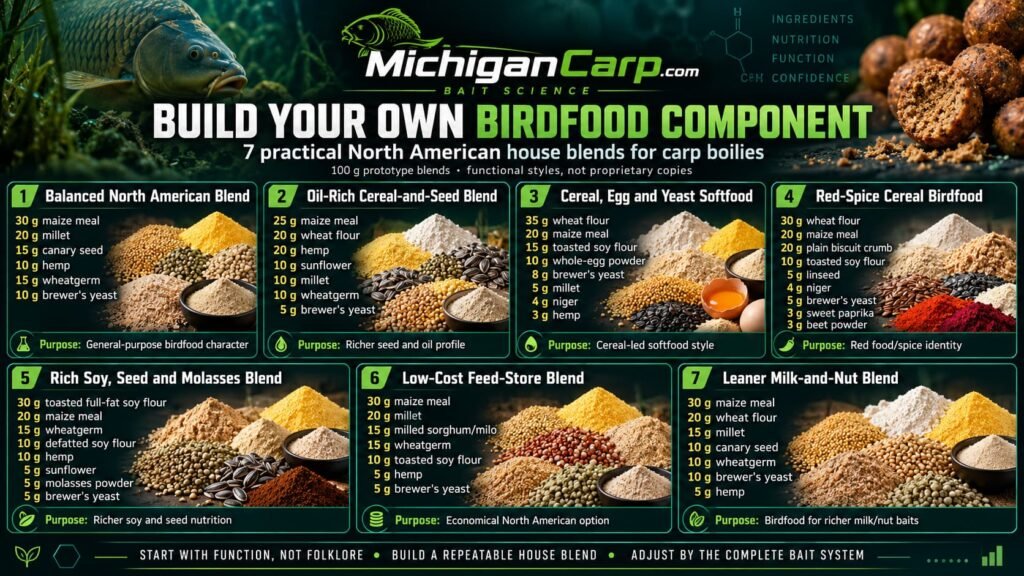
How to Choose Birdfood for Carp Boilies: Seven House Blends
Do not choose the recipe with the most interesting ingredient list.
Choose the one that solves the formulation problem.
| If the Complete Bait Needs… | Start With… |
|---|---|
| General birdfood character | Balanced North American Blend |
| More oil and seed richness | Oil-Rich Cereal-and-Seed Blend |
| More cereal, egg and yeast character | Cereal, Egg and Yeast Softfood |
| Red food/spice identity | Red-Spice Cereal Birdfood |
| Richer soy and seed nutrition | Rich Soy, Seed and Molasses Blend |
| Economical locally sourced bulk | Low-Cost North American Blend |
| Birdfood in an already rich milk/nut bait | Leaner Milk-and-Nut Blend |
That table is more useful than asking:
Which homemade birdfood is best?
There is no universal best.
There is only a better match for the rest of the formula.
How to Substitute a House Blend Into an Existing Boilie Formula
This is where anglers often make another mistake.
Suppose an existing 1 kg recipe already totals 1,000 g and contains:
CLO — 150 g
You cannot simply add another 150 g of homemade birdfood.
That would produce 1,150 g.
You need to replace or rebalance the existing section.
If your replacement house blend is more cereal-heavy than the original, you may need less maize, wheat or semolina elsewhere.
If it is richer in hemp and sunflower, you may need less:
- full-fat soy;
- peanut;
- oil;
- other rich seeds.
If it contains egg powder or substantial soy, those ingredients also belong in the wider protein and hydration calculation.
This is why the section-based method in How to Formulate a Milk, Nut and Birdfood Boilie Base Mix matters.
The house blend is not an extra.
It becomes part of the architecture.
Scaling a 100 g House Blend
The 100 g recipes are deliberately easy to scale.
To make 500 g, multiply everything by five.
To make 1 kg, multiply everything by ten.
For example, the 100 g Leaner Milk-and-Nut Blend becomes:
| Ingredient | 1 kg House Blend |
|---|---|
| Fine maize meal | 300 g |
| Wheat flour | 200 g |
| Ground millet | 150 g |
| Ground canary seed | 100 g |
| Wheatgerm | 100 g |
| Brewer’s yeast | 100 g |
| Ground hemp | 50 g |
| Total | 1,000 g |
Now store that as a defined ingredient.
If a future boilie uses:
125 g MichiganCarp Lean Milk/Nut Birdfood
you know exactly what those 125 grams contain.
That is far better record keeping than writing:
mixed birdfood.
Grinding Your Own Birdfood
Grinding strategy matters just as much as the ingredient list.
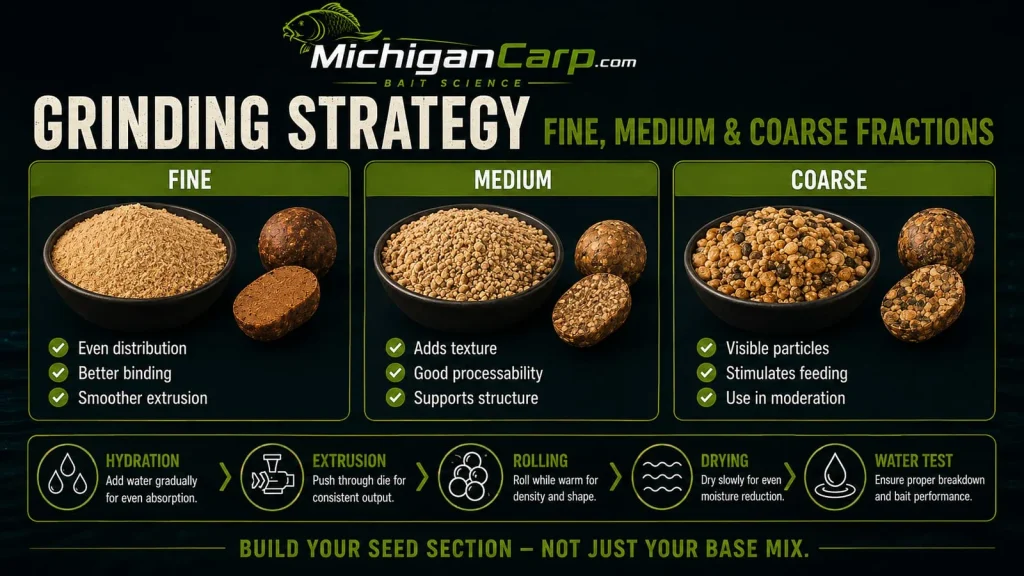
The seed article goes into the individual ingredients in greater depth, but a useful general approach is to think in three particle fractions.
Fine fraction
Provides:
- even distribution;
- smoother extrusion;
- more continuous paste;
- easier small-diameter rolling.
Medium fraction
Provides:
- visible texture;
- seed identity;
- controlled physical variation.
Coarse fraction
Can provide stronger visible particles, but excessive coarse material can create:
- torn sausages;
- split boilies;
- inconsistent diameter;
- weak spots;
- cracking during drying.
For many house birdfoods I would start with roughly:
- 50–70% fine-to-medium material;
- 20–40% medium material;
- 0–20% genuinely coarse material.
Those are processing guidelines rather than fixed recipe requirements.
A 24 mm boilie can tolerate particles that would be troublesome in a 12 mm bait.
Do not turn oily seeds into nut butter
Hemp and sunflower can release substantial oil during aggressive grinding.
Use short pulses.
Allow the grinder to cool.
Accept a controlled meal instead of insisting on flour.
If the ingredient begins smearing against the grinder wall, you have probably gone far enough.
Sourcing House-Birdfood Ingredients in North America
One advantage of this approach is that the ingredients do not all have to come from a carp-bait company.
Useful sources can include:
- feed stores;
- pigeon and poultry-feed suppliers;
- wild-bird suppliers;
- grocery stores;
- baking suppliers;
- brewing and fermentation suppliers;
- food-ingredient companies.
The important word is suitable.
Do not assume every livestock or poultry product belongs in carp bait.
Avoid products containing:
- medications;
- unknown treatment chemicals;
- mold or spoilage;
- excessive salt;
- unexplained proprietary additives;
- ingredients you cannot identify.
Fresh, simple ingredients with understandable labels are easier to formulate with.
How Much House Birdfood Should a Boilie Contain?
There is no universal percentage.
As a general development guide:
| Inclusion | Practical Interpretation |
|---|---|
| 50–75 g/kg | Light supporting character |
| 75–125 g/kg | Clear birdfood section |
| 125–175 g/kg | Stronger birdfood presence |
| 175–250 g/kg | Birdfood-led hybrid requiring deliberate rebalancing |
| Above 250 g/kg | Specialist formulation rather than routine substitution |
A cereal-rich blend can often be used more heavily than a very oily seed blend.
The complete formula decides.
Do not ask how much birdfood a boilie should contain. Ask how much of this birdfood this particular boilie can use while remaining balanced and processable.
Do Not Confuse Cheap Ingredients With Poor Ingredients
This is especially important in North America.
Maize meal, wheat flour, millet, milo and soy can be inexpensive.
That does not automatically make them filler.
An ingredient is filler when it occupies space without a useful reason.
Maize can provide structure and starch.
Millet can provide small cereal-like seed particles.
Soy can contribute protein, structure and—depending on the product—fat.
Wheat products can provide useful structural carbohydrate.
Wheatgerm contributes its own nutritional and processing characteristics.
The fact that these ingredients can sometimes be bought cheaply is an advantage.
Paying more for an ingredient does not automatically make the finished bait better.
Homemade Does Not Automatically Mean Better Either
The opposite mistake is equally easy to make.
A homemade birdfood is not superior merely because you assembled it yourself.
Commercial products offer advantages:
- manufacturing consistency;
- convenient preparation;
- historical experience;
- known product identity;
- reduced preparation time.
A house blend earns its place only when it gives you something useful:
- lower cost;
- easier sourcing;
- better control;
- a particular nutritional direction;
- better compatibility with your existing base mix;
- repeatability.
Sometimes buying CLO is the sensible decision.
Sometimes building your own component is.
The point is having enough understanding to choose.
Birdfood in Milk, Nut and Seed Boilies
Birdfood fits naturally into a milk/nut bait, but this is also where ingredient stacking becomes dangerous.
Consider a formula containing:
- full-fat soy;
- tiger nut flour;
- peanut;
- almond;
- whole egg;
- cream powder;
- hemp;
- sunflower;
- an oil-rich birdfood;
- additional nut oil.
Each ingredient sounds attractive individually.
Together they may create an unnecessarily rich, greasy and difficult bait.
That is why I generally prefer the Leaner Milk-and-Nut House Blend when the main formula is already rich.
The birdfood should add another layer.
It does not need to become another complete bait inside the bait.
For finished examples, use Nut Boilie Base Mix Recipes: 4 Practical 1 kg Formulas.
Birdfood and Soluble Attraction Are Not the Same Thing
One of the longest-running assumptions about coarse birdfoods is that they automatically make a bait leak more attractors.
That is too simplistic.
Coarse particles can change water access and physical structure.
But actual release depends on the complete matrix:
- soluble ingredients;
- cooking;
- drying;
- particle packing;
- starch gelatinization;
- protein setting;
- pore structure;
- hydration.
A rough-looking boilie is not automatically highly soluble.
A smooth boilie is not automatically inactive.
Use Carp Bait Solubility and Leakage for that distinction.
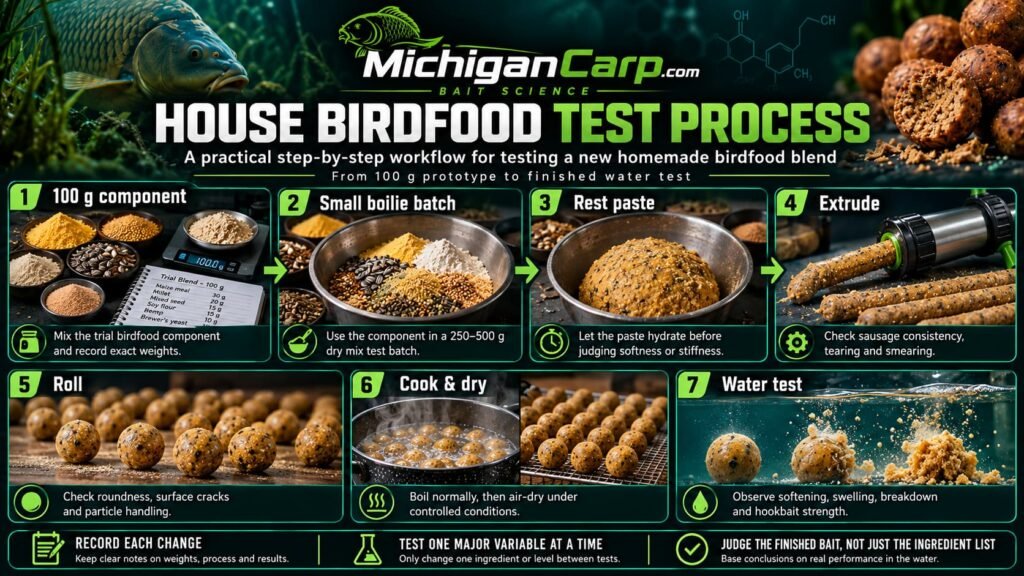
How to Test a House Birdfood
A new birdfood component should begin as a bench test, not a five-kilogram production run.
Stage 1 — Make the 100 g component
Check:
- smell;
- freshness;
- particle size;
- oiliness;
- repeatability.
Stage 2 — Make a small boilie batch
Approximately 250–500 g of dry base mix is enough to expose many processing problems.
Stage 3 — Rest the paste
Do not correct every soft paste immediately.
Cereal, seed, soy and egg ingredients can continue hydrating.
Stage 4 — Extrude
Record:
- tearing;
- smearing;
- collapse;
- inconsistent sausage diameter.
Stage 5 — Roll
Check:
- roundness;
- surface cracking;
- sticking;
- large particles breaking the skin.
Stage 6 — Cook and dry normally
Do not change boiling time merely to rescue a bad formulation.
Use How to Boil and Dry Boilies Properly for the processing stage.
Stage 7 — Water test
Check:
- one-hour condition;
- four-to-six-hour condition;
- overnight condition where relevant;
- softening;
- cracking;
- swelling;
- particle release;
- hookbait strength.
Use How to Test Boilies Before Fishing for the complete testing method.
Common Birdfood Mistakes
| Mistake | Why It Causes Problems | Better Approach |
|---|---|---|
| Assuming famous means irreplaceable | Product reputation replaces formulation | Identify the job first |
| Calling every seed mixture birdfood | Hides major compositional differences | Separate raw seeds from compound birdfoods |
| Calling a DIY mix CLO or Robin Red | Claims an equivalence that has not been demonstrated | Call it a house blend |
| Replacing commercial birdfood gram-for-gram | Starch, fat and hydration may change | Replace the function and rebalance |
| Adding birdfood on top of a finished 1 kg recipe | Destroys the formula total | Remove or rebalance other sections |
| Grinding every seed to dust | Oily seeds can smear and release excessive oil | Control the grind by ingredient |
| Making everything coarse | Damages extrusion and rolling | Maintain enough fine continuous material |
| Automatically adding oil | Nuts, soy, seeds, eggs and birdfood may already supply enough | Count total lipid first |
| Assuming cheap cereals are filler | Confuses price with function | Judge each ingredient by its job |
| Assuming homemade is automatically superior | Ignores commercial consistency and convenience | Use whichever system better fits the bait |
| Changing several variables together | Makes troubleshooting impossible | Change one major variable at a time |
My Practical Michigan View
For me, this is where birdfood becomes much more interesting.
I do not need an ingredient to be mysterious.
I need to know what it does.
If I can buy a classic European birdfood easily and its composition suits the bait, I have no objection to using it.
But if I am making bait in Michigan and I can build the required cereal, seed, yeast, soy or egg function from ingredients available locally, I do not see the value in believing that an imported name is compulsory.
That becomes even more important when developing a bait over several seasons.
I want ingredients that I can:
- source again;
- identify;
- weigh accurately;
- grind consistently;
- store properly;
- adjust deliberately;
- explain.
A successful homemade bait should become less mysterious as you develop it, not more.
That is the principle behind these house blends.
They are not secret recipes.
They are starting systems.
Once you understand why 20 g of millet is there, why the hemp is only 5 g in another blend, why one component contains egg powder and another does not, you are no longer copying birdfood recipes.
You are formulating bait.
The real alternative to a famous birdfood is not another famous birdfood. It is understanding the job well enough to build the function yourself.
Frequently Asked Questions
Do I need European birdfood to make good carp boilies in the USA?
No. Classic European birdfoods can be excellent ingredients, but they are not compulsory. A North American bait maker can build useful cereal, seed, egg, soy and yeast components from suitable locally available ingredients.
Is homemade birdfood the same as CLO?
No. CLO is a specific commercial/traditional birdfood style associated with cod liver oil and its own formulation. A homemade cereal-and-seed mixture should be described as a house birdfood component, not CLO.
Can I copy Nectarblend at home?
You can design a blend that performs broadly similar cereal, soy, egg, yeast and seed functions. That does not mean you have reproduced the proprietary commercial product.
Can I make homemade Robin Red?
Not in any responsible sense unless you know the proprietary formula.
You can make a red-spice food component using ingredients such as paprika and beet powder, but call it what it is.
Which house blend is best for a milk-and-nut boilie?
I would start with the Leaner Milk-and-Nut Birdfood Component because the wider bait may already receive considerable fat from nuts, soy, dairy ingredients and eggs.
Which blend is cheapest?
The Low-Cost North American Blend is designed around maize, millet, milo, wheatgerm and soy—ingredients that can often be sourced economically through North American feed channels.
Actual price varies by supplier and pack size.
Can I use pigeon feed?
Possibly, after identifying exactly what is in it and processing it appropriately.
A pigeon mixture is still a mixture of individual ingredients. Hard whole grains should not automatically be ground into a boilie without understanding what they are and how they behave.
How much homemade birdfood should I use?
For many mixed boilies, 75–150 g/kg is a useful development area.
Cereal-rich blends may tolerate more.
Oil-rich, coarse or specialist blends may deserve a lower starting level.
Should I add oil to a homemade birdfood?
Not automatically.
First count hemp, sunflower, flax, full-fat soy, nuts, dairy fat and egg in the complete formula.
Do birdfoods make boilies leak faster?
Not necessarily.
They can alter texture and water access, but soluble release depends on the whole cooked and dried bait matrix.
Do I need every ingredient listed in these recipes?
No.
The formulas demonstrate functional directions.
If an ingredient is unavailable, determine what it was doing before substituting it.
Do not replace ingredients simply because two powders look similar.
Next Steps
To continue building the system:
- Individual Birdseeds Explained for Boilie Making — understand hemp, millet, canary seed, linseed, sunflower and other seeds individually.
- How to Formulate a Milk, Nut and Birdfood Boilie Base Mix — place the birdfood component into a complete section-based formula.
- Nut Boilie Base Mix Recipes: 4 Practical 1 kg Formulas — see complete working formulas.
- Oils and Fats in Carp Bait — calculate hidden lipid from soy, nuts, seeds, eggs and birdfood.
- Carp Bait Solubility and Leakage — separate coarse texture from genuine release behavior.
- How to Test Boilies Before Fishing — prove the finished bait rather than trusting the ingredient list.
- Boilie School — return to the complete boilie-making learning route.
Final MichiganCarp rule:
Do not use CLO because an old recipe says CLO.
Do not use Nectarblend because generations of carp anglers used Nectarblend.
Do not add Robin Red because somebody called it essential.
Understand what the ingredient contributes.
If the commercial product performs that job well and is practical to obtain, use it.
If the same broad function can be built reliably from maize, millet, milo, soy, egg, yeast, wheatgerm and selected seeds available in North America, build it yourself.
The important ingredient is understanding.