

Learning how to balance fat in boilies becomes important as soon as a formula contains several naturally rich ingredients.
Milk powders, milk replacer, nuts, seeds, full-fat soy, birdfood, eggs, lecithin and bottled oil can all contribute lipid.
The common mistake is to count only the oil poured from a bottle.
By that stage, a milk, nut or seed boilie may already contain a substantial amount of fat.
That can affect:
- paste lubrication;
- extrusion;
- rolling;
- cooked texture;
- drying;
- surface oil;
- storage;
- and oxidative rancidity.
The answer is not to remove every fat-containing ingredient.
Fat is a normal part of food and can contribute energy, fatty acids and useful processing characteristics.
The better approach is to calculate what is already present and add extra oil only when it performs a defined job.
My basic rule is:
Count the fat already inside the complete recipe before deciding whether the bait needs more.
For the wider nutritional role of lipids, read Oils, Fats and Energy in Carp Bait.
For the complete base-mix framework, use How to Formulate a Milk, Nut and Birdfood Boilie Base Mix.
Table of Contents
Quick Start: How to Balance Fat in Boilies
The calculation itself is simple.
Ingredient weight × fat percentage ÷ 100 = grams of fat contributed
Then repeat the calculation for every meaningful fat source.
| Step | What to Do |
|---|---|
| 1 | Record the weight and fat percentage of each significant dry ingredient |
| 2 | Calculate the grams of fat supplied by each ingredient |
| 3 | Add the dry-mix contributions together |
| 4 | Count whole eggs, extra yolk and lecithin separately |
| 5 | Convert bottled oil from volume to weight where practical |
| 6 | Compare the result with the purpose and behaviour of the bait |
| 7 | Change one ingredient at a time and test a small batch |
The most important point is that dry-mix fat percentage, wet-paste fat percentage and finished-bait fat percentage are different measurements.
Do not mix them together.
For home formulation, the dry-mix calculation is usually the easiest place to begin because the denominator is clear and repeatable.
Where the Fat in a Boilie Really Comes From

The bottled oil may be one of the smallest parts of the complete lipid system.
Full-Fat Soy
Full-fat soy can make a meaningful contribution before nuts or eggs are considered.
If 120 g of full-fat soy contains 20% fat:
120 × 0.20 = 24 g fat
Changing to a lower-fat soy product may reduce the total substantially, but it can also change protein concentration, hydration and paste behaviour.
Do not assume the replacement is mechanically identical.
Nuts and Nut Flours
Nut products vary enormously.
Whole ground peanut can be very rich in oil.
Partially defatted peanut flour may contain far less.
Two products both labelled peanut flour can therefore behave differently in the mix.
The practical lesson is simple:
use the label from the product you actually own.
A USDA Agricultural Research Service study of peanut flour also demonstrates that changing residual oil changes physical behaviour in flour systems.
That is relevant to bait formulation: lowering fat may alter hydration and thickening as well as the nutrient calculation.
Tiger Nut, Seeds and Birdfood
Tiger nut flour contains natural lipid as well as carbohydrate, fibre and flavour.
Hemp, sunflower, linseed and sesame can increase the fat content quickly.
Birdfood must also be treated as an actual product rather than a generic category.
Some birdfoods are predominantly cereal based.
Others contain seeds, egg products, nuts or added oil.
Read the ingredients and nutritional information where available.
Dairy Ingredients
Skimmed milk powder is relatively lean.
Whole-milk powder, cream powder and some milk replacers are not.
The Milk Replacer for Carp Bait article shows why a 24:24 milk replacer can add meaningful fat even at a moderate inclusion.
For the wider dairy comparison, use Milk Powders in Boilie Making.
Eggs and Lecithin
Whole eggs are not simply liquid binder.
Egg yolk contains lipid and phospholipids.
Extra yolk raises the contribution further.
Record shell-free egg weight rather than relying only on the number of eggs.
Use Eggs in Boilie Making for the complete wet-phase and structure discussion.
Lecithin should also be included in the calculation according to the product you actually use.
Liquid lecithin, granules and de-oiled powders can have different compositions.
Added Oil
Added oil is the easiest part to see, which is probably why anglers concentrate on it.
But it should normally be the last fat source considered.
If the base mix already contains ample fat, the correct quantity of added oil may be:
zero.
How to Calculate Total Fat Correctly
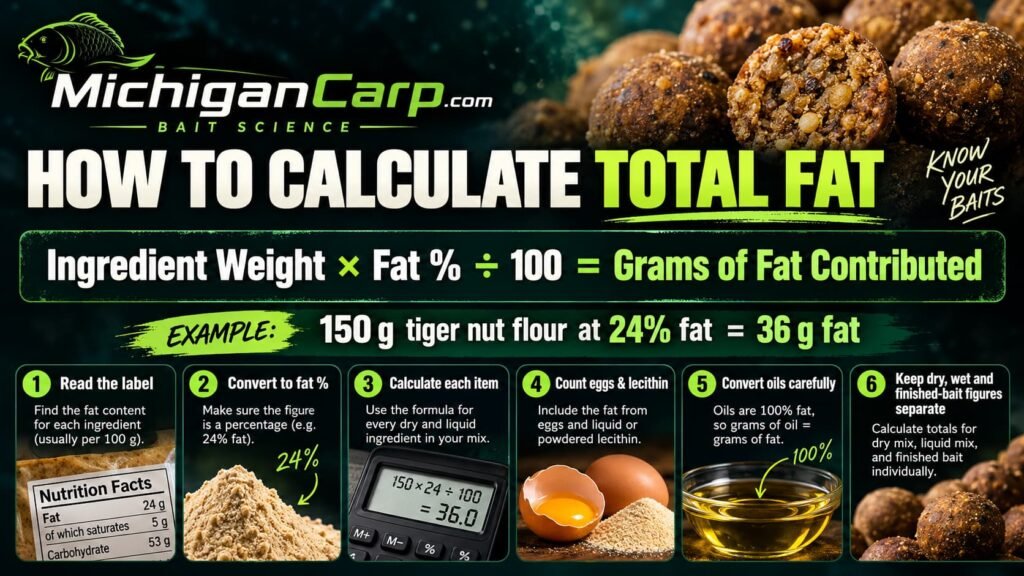
Suppose a product label shows:
9 g fat in a 30 g serving
Calculate the percentage:
9 ÷ 30 × 100 = 30% fat
Convert that to decimal form:
30% = 0.30
If the boilie formula uses 100 g:
100 × 0.30 = 30 g fat
If it uses 150 g:
150 × 0.30 = 45 g fat
Do this for every significant ingredient.
Keep the Calculation Basis Clear
| Calculation | What It Means |
|---|---|
| Dry-mix fat % | Fat in dry ingredients ÷ total dry-mix weight |
| Wet-paste fat % | Total fat ÷ total weight of dry mix plus wet phase |
| Finished bait % | Fat relative to bait weight after processing and drying |
| Laboratory dry-matter % | Fat expressed after moisture is removed from the analytical basis |
These numbers can all be different without any of them being wrong.
As a boilie dries, water leaves.
The amount of fat does not need to increase for fat to become a larger percentage of the remaining finished weight.
Bottled Oil: Convert Volume to Weight
Where the manufacturer’s density is available, use it.
For workshop estimation, many edible oils are somewhat lighter than water.
If a particular oil weighs approximately 0.90 g/ml:
20 ml × 0.90 = approximately 18 g oil
Because an ordinary pure oil is essentially lipid, that contributes approximately 18 g of fat.
Do not automatically treat:
20 ml = 20 g
when you are trying to make a reasonably accurate audit.
Worked 1 kg Milk-Nut-Seed Boilie Fat Audit
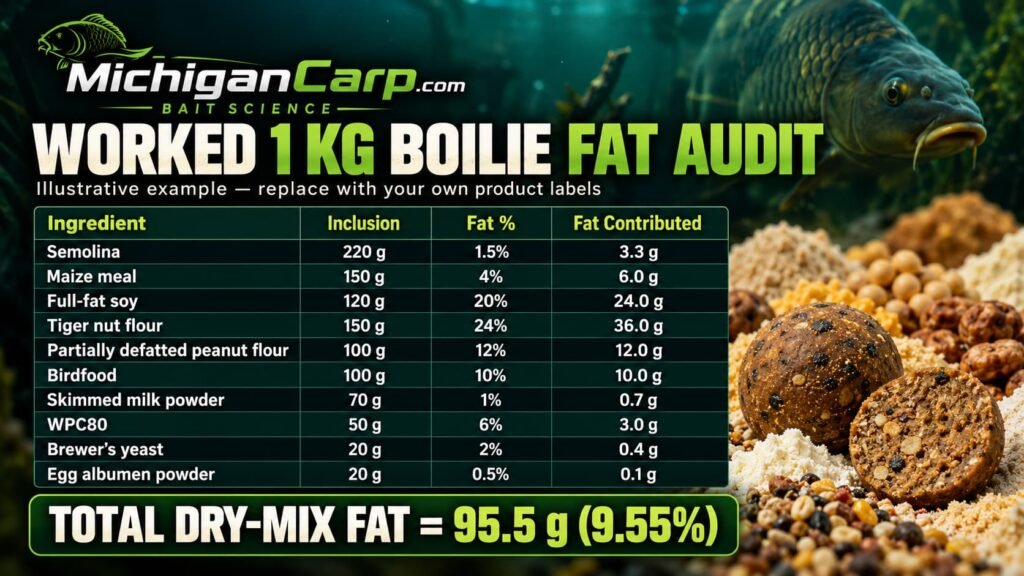
The following example is illustrative.
The ingredient values are not universal specifications.
Replace them with the labels from your own bait room.
| Ingredient | Inclusion | Illustrative Fat | Fat Contributed |
|---|---|---|---|
| Semolina | 220 g | 1.5% | 3.3 g |
| Maize meal | 150 g | 4% | 6.0 g |
| Full-fat soy | 120 g | 20% | 24.0 g |
| Tiger nut flour | 150 g | 24% | 36.0 g |
| Partially defatted peanut flour | 100 g | 12% | 12.0 g |
| Birdfood | 100 g | 10% | 10.0 g |
| Skimmed milk powder | 70 g | 1% | 0.7 g |
| WPC80 | 50 g | 6% | 3.0 g |
| Brewer’s yeast | 20 g | 2% | 0.4 g |
| Egg albumen powder | 20 g | 0.5% | 0.1 g |
| TOTAL | 1,000 g | — | 95.5 g |
Dry-mix fat percentage:
95.5 ÷ 1,000 × 100 = 9.55%
Notice something important.
There is no bottled oil in that calculation.
Yet the base mix already contains nearly 96 g of estimated fat per kilogram.
That is why the calculation must come before the oil bottle.
If I then add whole egg, lecithin, cream powder, milk replacer or additional oil, the complete wet system becomes richer again.
How to Interpret the Fat Result
There is no scientifically established universal perfect fat percentage for an angling boilie.
Aquaculture research shows that lipid quantity and source matter in complete fish diets, but those controlled feeding situations should not be converted directly into a wild-carp boilie target.
The FAO review of fish lipids and fatty acids is useful background for nutritional principles, but it does not establish a magic boilie percentage.
For my own formulation work, I use broad review bands, not biological requirements.
| Estimated Dry-Mix Fat | Practical Interpretation |
|---|---|
| Below roughly 6% | Relatively lean |
| Roughly 6–10% | Moderate working territory |
| Roughly 10–14% | Rich formulation |
| Above roughly 14% | High-fat or specialist territory |
These are MichiganCarp workshop flags, not carp requirements and not shelf-life guarantees.
A bait at 12% can roll, dry and fish perfectly well.
A bait at 8% can perform poorly if hydration, structure or processing are wrong.
The percentage is a warning and comparison tool.
It is not a quality score.
Choose the Ingredients That Define the Bait
A milk-and-nut boilie does not need maximum quantities of:
tiger nut;
peanut;
almond;
coconut;
full-fat soy;
oily birdfood;
cream powder;
milk replacer;
and bottled nut oil
all at once.
Choose the ingredients that define the bait.
Let the others support them.
A tiger-nut-led bait may retain a meaningful tiger nut inclusion while using a lower-fat peanut flour and no additional nut oil.
That often makes more formulation sense than stacking every rich ingredient available.
How Fat Changes Paste, Rolling and Drying
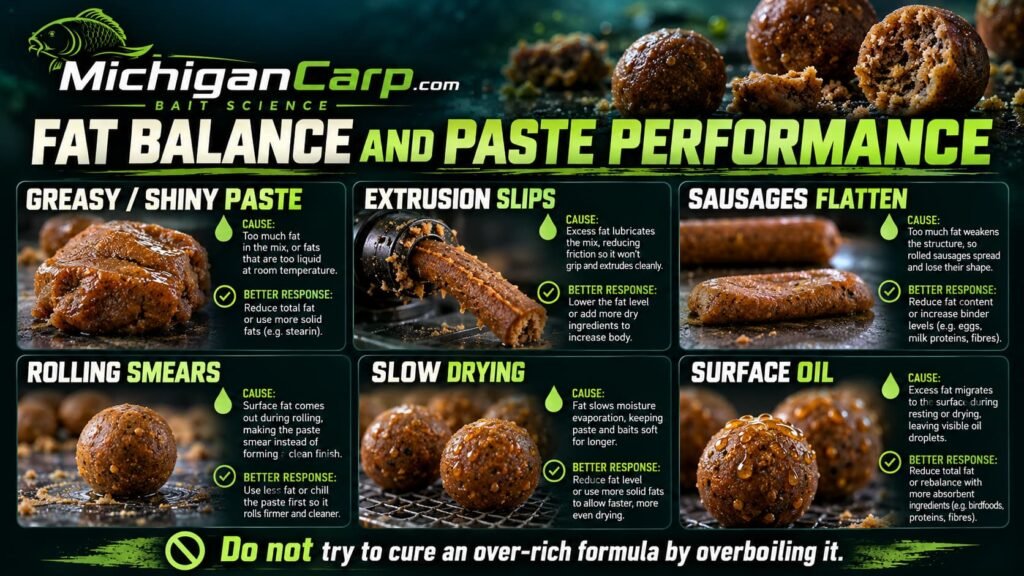
A rich mix often warns you before it reaches the lake.
| Symptom | Possible Cause | Better Response |
|---|---|---|
| Greasy or shiny paste | High ingredient fat or excess oil | Review the formula before adding more binder |
| Paste slips in extrusion gun | Excess lubrication | Reduce unnecessary oil and review full-fat ingredients |
| Sausages flatten | Soft paste, excessive liquid or high fat | Rest first, then reassess hydration |
| Rolling table smears | Rich paste or weak structure | Add controlled lean structure rather than another egg |
| Slow drying | High moisture, fat or poor airflow | Improve drying conditions and review the formula |
| Surface oil appears | Free lipid or overloaded fat system | Reduce added oil and check ingredient freshness |
Do Not Automatically Add More Egg
A rich paste can sometimes feel weak or crumbly because oil interferes with the normal relationship between dry ingredients and water.
Adding another whole egg may appear to solve it.
But it also adds:
water;
protein;
and more yolk fat.
Rest the paste before making corrections.
If it still needs adjustment, determine whether the real problem is hydration, dry structure or excessive lipid.
Do Not Cure High Fat by Overboiling
Cooking cannot remove excess oil from the formula.
Longer boiling may create a harder exterior while leaving the underlying formulation unchanged.
For controlled processing, use How to Boil and Dry Boilies Properly.
An Oil Slick Is Not the Same as Soluble Leakage
Oil does not dissolve in water in the same way as salts, sugars, small organic acids or other genuinely water-soluble components.
A visible slick can look impressive without proving that the bait is releasing a strong dissolved food signal.
Use Carp Bait Solubility and Leakage for the distinction between dissolution, diffusion and dispersion.
How to Adjust an Over-Rich Boilie
Do not rebuild the entire recipe immediately.
Start with the easiest variable.
Remove Unnecessary Bottled Oil First
If a formula already contains:
- full-fat soy;
- tiger nut;
- peanut;
- milk replacer;
- whole egg;
- lecithin;
the easiest first comparison may be to make a batch with no added bottled oil.
If it rolls, cooks, dries and fishes properly, the extra oil may never have been needed.
If some lubrication or a deliberate fatty-acid source is genuinely useful, add a small measured amount back.
Testing:
0 ml/kg vs 5 ml/kg
is far more informative than automatically pouring in 20–30 ml.
Use Lower-Fat Versions Deliberately
Partially defatted peanut flour can retain peanut character while reducing lipid substantially compared with whole ground peanut.
But that substitution may also increase liquid absorption.
The correct response is not to change three more ingredients simultaneously.
Make the substitution.
Rest the paste.
Record the result.
Then adjust hydration only if required.
Do Not Stack Rich Dairy Ingredients Without Calculation
Cream powder, whole-milk powder and a 24% fat milk replacer can all be useful.
That does not mean they all need to be used heavily in the same recipe.
Use Milk Replacer for Carp Bait and Milk Powders in Boilie Making to choose them according to function.
Michigan Seasonal Use and Storage
I would not use a rule such as:
low-fat bait in spring, high-fat bait in summer.
That is too simplistic.
Cold Spring and Late Fall
When the water is cold, I place more emphasis on:
- location;
- sensible bait quantity;
- water-active food signals;
- and avoiding unnecessary heavy oil additions.
A milk/nut bait may already contain plenty of natural lipid from the base ingredients.
Reducing an unnecessary bottled oil is different from trying to make the whole bait fat-free.
Warmer Water and Longer Sessions
Summer feeding can justify a substantial food bait.
But the formula should still be calculated.
A bait containing nuts, seeds, full-fat soy, dairy ingredients and whole egg may already be rich enough.
Season is not a reason to pour oil into the mix automatically.
Fat Also Creates a Storage Problem
Lipid oxidation and microbial spoilage are different processes.
A boilie can be mould-free and still contain stale or rancid fats.
Heat, oxygen, light and time can damage vulnerable oils and oily meals.
The Frontiers review of lipid oxidation in foods provides useful background on the chemistry.
For bait-room practice:
keep oily ingredients sealed;
protect them from heat and light;
buy vulnerable nut and seed meals in sensible quantities;
date opened containers;
and discard anything that develops obviously stale, cardboard-like, paint-like or rancid odours.
For the specialist article, read Rancidity in Boilies.
For finished bait storage, use How to Store Homemade Boilies.
Common Fat-Balance Mistakes
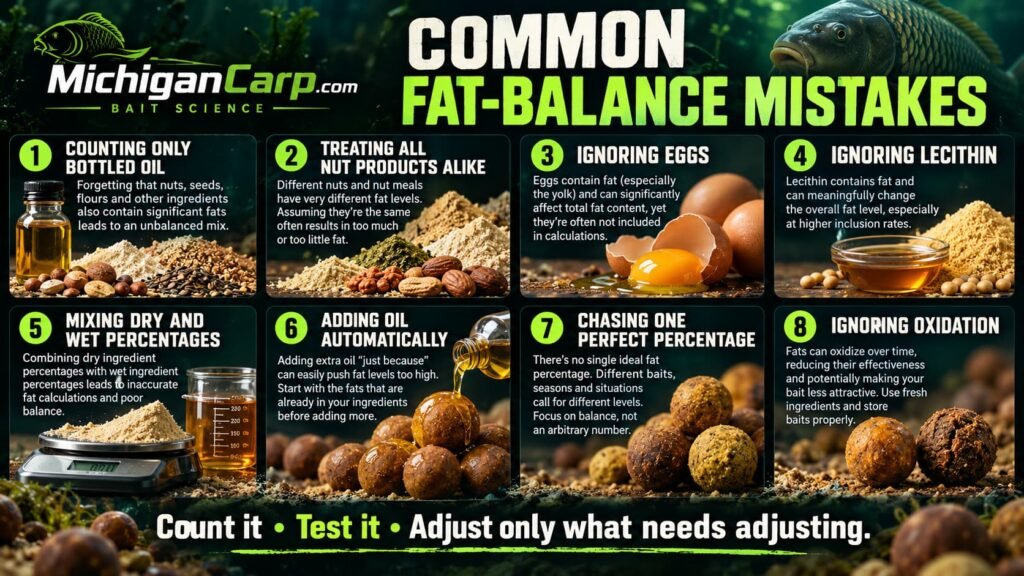
Counting only bottled oil.
The base ingredients may contain much more fat than the bottle contributes.
Treating all nut flours as identical.
Whole ground nut and defatted flour can have radically different compositions.
Adding nut oil because the bait contains nuts.
Flavour identity does not create a nutritional requirement for extra oil.
Ignoring eggs.
Whole egg and extra yolk contribute lipid.
Ignoring lecithin.
Its contribution depends on the actual product.
Comparing dry-mix and wet-paste percentages directly.
They use different total weights.
Using generic internet numbers when the packet is available.
Your actual ingredient label should take priority.
Searching for one perfect fat percentage.
No universal angling-boilie target has been established.
Correcting greasy paste with more whole egg.
That may add more water and more fat.
Overboiling a rich bait.
Cooking cannot remove excess lipid.
Confusing visible oil with soluble food signal.
A surface slick and dissolved attraction are different phenomena.
Ignoring oxidation.
Dry-looking bait can still contain deteriorating fats.
The practical rule is:
Count it, test it, and adjust only what actually needs adjusting.
FAQ
How do I calculate fat in a boilie?
Multiply the weight of each ingredient by its fat percentage, then add the contributions.
For example:
150 g × 24% = 36 g fat.
Should I count fat from eggs?
Yes.
Whole eggs and egg yolks contribute fat and should be included when assessing the complete wet paste.
Should I count lecithin?
Yes, when the product contains meaningful lipid.
Read the label or technical specification for the lecithin you actually use.
How much fat should a boilie contain?
There is no scientifically established universal optimum for an angling boilie.
Use the percentage as a formulation-review tool and judge the complete bait through paste behaviour, processing, water testing, storage and fishing.
Is 10% fat too high for a boilie?
Not automatically.
A well-designed 10% dry mix may perform perfectly well.
The percentage alone does not determine bait quality.
Do milk and nut boilies need added oil?
Not necessarily.
Many already contain significant fat from milk ingredients, nuts, soy, eggs and lecithin.
Calculate those first.
Should I add more oil in summer?
Not automatically.
Seasonal conditions may alter feeding and bait usage, but they do not erase the fat already present in the formula.
Can too much fat make boilie paste greasy?
Yes.
Excess ingredient fat or bottled oil can contribute to greasy, slippery paste, poor extrusion and slow drying.
Does a visible oil slick mean the boilie is leaking well?
No.
Oil can disperse as droplets or a separate phase. That is different from water-soluble compounds dissolving into the surrounding water.
Can preservatives prevent fat rancidity?
Not necessarily.
Microbial preservation and lipid oxidation are separate issues.
For oxidation specifically, use Rancidity in Boilies.
Next Steps
Use Oils, Fats and Energy in Carp Bait for the wider nutritional science.
Use How to Formulate a Milk, Nut and Birdfood Boilie Base Mix for complete base-mix design.
Use Milk Replacer for Carp Bait when evaluating rich livestock dairy powders.
Use Milk Powders in Boilie Making for dairy ingredient selection.
Use Eggs in Boilie Making for the wet phase and yolk contribution.
Use Carp Bait Solubility and Leakage to separate oil release from dissolved food signal.
Use How to Boil and Dry Boilies Properly for processing.
Use Rancidity in Boilies for oil, nut and seed freshness.
Use How to Store Homemade Boilies for finished-bait storage.
Use How to Test Boilies Before Fishing when comparing fat adjustments.
Return to Bait Science or Boilie School for the wider technical library.