

Fishmeal Boilies vs milk baits, and wild Michigan carp: what really makes sense here?
Fishmeal boilies have caught a huge number of big carp.
That is not up for debate.
Across Europe and the UK, fishmeal baits have built reputations, won campaigns, caught famous fish, and shaped the way many carp anglers think about bait. If you spend any time watching European carp fishing videos, reading bait articles, or looking at commercial boilie ranges, fishmeal is everywhere.
That influence has reached American carp fishing too.
Many Michigan carp anglers learn from UK and European carp media. That can be useful. There is a lot to learn from anglers who have spent decades refining rigs, bait, watercraft, fish care, and campaign fishing.
But there is also a danger.
The danger is copying bait thinking from one carp fishing world and applying it blindly to another.
Michigan carp fishing is not the same as fishing a heavily stocked European carp lake. Many Michigan carp are wild public-water fish. Some may never have been caught. Many may never have seen a boilie. They have not necessarily grown up around fishery pellets, regular baiting, or years of angler-introduced boilies.
That does not make fishmeal wrong.
But it does mean Michigan anglers should ask a better question:
Does a fishmeal-heavy boilie make sense for the carp, water, ingredients, and fishing situation in front of me?
Sometimes the answer may be yes.
Sometimes a milk, nut, cereal, birdfood, or particle-friendly bait may be the more logical starting point.
This article is not about attacking fishmeal. It is about understanding context.
For more general bait guidance, start with Best Carp Bait for Michigan Lakes. For bait-building and boilie-making guides, visit Boilie School and Bait Science.
Quick Answer
Fishmeal boilies can work for Michigan carp, but they should not be copied blindly from European stocked-fishery bait thinking.
Many Michigan carp are wild public-water fish with little or no boilie history. They may be feeding on natural lake food, corn, seeds, nuts, insects, snails, mussels, weedbed food, and soft-bottom food rather than pellets and regular beds of boilies.
That makes milk, nut, cereal, birdfood, corn, and particle-friendly baits a very practical starting point.
The best bait direction depends on the water, season, food history, ingredient quality, and whether the carp have already been conditioned to boilies or pellets.
Table of Contents
Fishmeal Boilies vs Milk Baits for Michigan Carp
| Bait Direction | Best Use | Strengths | Watch Out For |
|---|---|---|---|
| Fishmeal boilies | Warm water, longer campaigns, savory bait approach | Strong food signal, proven in carp fishing, can work well when made properly | Quality fishmeal can be hard to source in the USA; poor fishmeal baits can be heavy, oily, or low grade |
| Milk baits | Wild public waters, spring, early summer, particle fishing | Clean food value, creamy leakage, works well with corn, nuts, seeds, oats, and birdfood | Needs proper structure and drying; too much soluble dairy can make baits soft |
| Hybrid baits | When you want both food value and wider appeal | Can blend milk, yeast, nut, cereal, and low-level savory ingredients | Easy to overcomplicate if not tested |
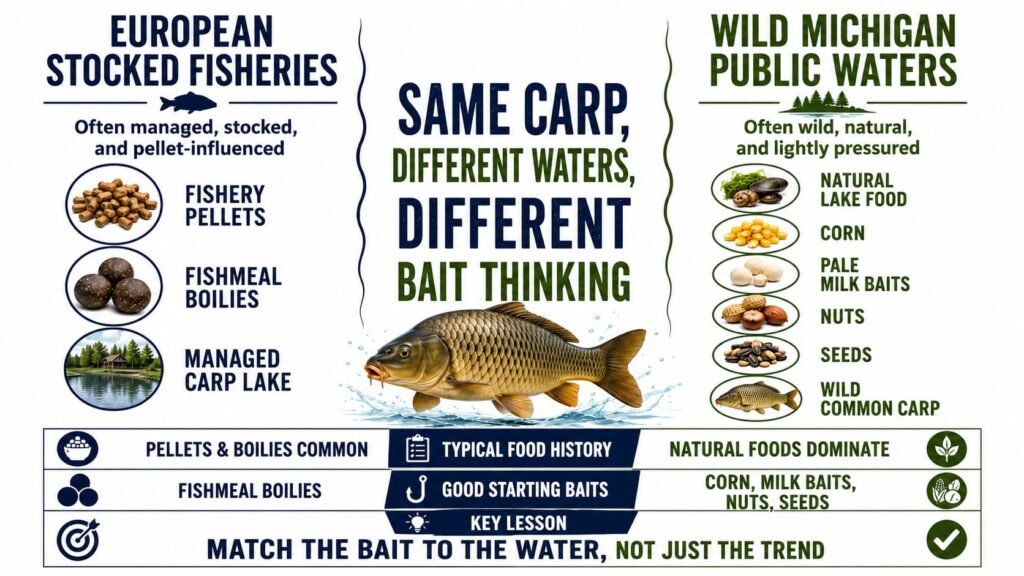
The point is not that one bait type is always better.
The point is that Michigan carp bait should match Michigan carp fishing.
A bait that dominates a stocked, managed, pellet-influenced fishery may not always be the best first choice on a wild public water where carp have never seen that bait profile before.
Fishmeal remains important in aquafeed because it is a concentrated animal protein source with useful amino acids, oils, vitamins and minerals, although quality varies by source and processing. For a technical ingredient overview, see the Feedipedia fish meal profile.
The European Fishmeal Influence
Modern carp fishing owes a lot to European and UK bait development.
Fishmeal boilies became popular because they worked. Good fishmeal can bring protein, oil, savory attraction, amino acid profile, digestibility, and a strong natural food signal. Used correctly, it can be an excellent carp bait ingredient.
But the fishing culture around those baits matters.
Many European carp waters are stocked, managed, and fished heavily. Carp may grow up around formulated feeds, pellets, grains, boilies, and regular angler bait. Some waters receive large amounts of bait over a season. Some fish have been caught multiple times on boilies. Some carp have been conditioned for years to investigate round baits and prepared feed.
That does not make European carp fishing easy.
It simply means the background is different.
A bait that becomes dominant in a stocked, bait-influenced fishery does not automatically become the best first choice on a wild Michigan lake where carp may never have seen a boilie.
That is the point.
Michigan anglers should learn from European bait thinking, but not copy it without adjustment.
For background on why ingredient quality, processing, inclusion level and fish digestive capacity all affect feed value, see FAO’s material on fish-feed digestibility.
Wild Michigan Carp Are a Different Proposition
Many Michigan carp are wild public-water fish.
They live in natural lakes, drowned river systems, reservoirs, rivers, marinas, channels, and Great Lakes-connected waters. They feed on what the water provides. They may move over weedbeds, silt, mussel beds, gravel, soft-bottom areas, inflows, warming bays, and wind lanes.
Their food can include:
- snails
- mussels
- insect larvae
- worms
- crayfish
- seeds
- algae
- plant material
- detritus
- soft-bottom food
- angler bait such as corn or particles
On some waters, carp may have seen corn, oats, packbait, or particles.
On many waters, they may not have seen fishmeal boilies.
That matters.
A bait does not need to be familiar to work, but familiarity can affect how quickly carp accept it. A fishmeal boilie can still be attractive, but it may not be the automatic answer simply because it has caught fish elsewhere.
For wild Michigan carp, bait needs to do several things:
- be easy for carp to investigate
- fit the feeding situation
- release attraction in the water
- offer food value
- match the season
- be practical to use repeatedly
- work with the baiting approach
- avoid overcomplicating the fishing
That opens the door for milk, nut, cereal, birdfood, sweet, creamy, and particle-friendly baits.
Fishmeal Is Not Unnatural to Carp
It would be wrong to say wild carp cannot understand fishmeal.
Carp are not strict vegetarians. They eat animal-based natural food. Snails, mussels, insect larvae, worms, crayfish, and other protein-rich items can all be part of their feeding world.
So the argument is not:
“Fishmeal is unnatural.”
The better argument is:
“A fishmeal-heavy boilie profile may not always be the best starting point for wild Michigan public-water carp.”
That distinction matters.
A good fishmeal bait can still work in Michigan. It may be especially useful in warmer water, on longer campaigns, or where carp have time to investigate and accept it.
But fishmeal should be one bait direction, not the default answer to every bait question.
Modern aquafeed formulation often compares different protein sources instead of assuming that one ingredient automatically replaces another. FAO’s overview of farm-made aquafeeds and ingredient interchangeability is useful background for that idea.
Ingredient Quality Matters More Than the Word Fishmeal
One of the biggest bait mistakes is trusting the label.
A bait can say “fishmeal” and still be average.
Fishmeal quality depends on many things:
- type of fishmeal
- freshness
- oil condition
- digestibility
- heat treatment
- storage
- soluble fish protein content
- binder quality
- inclusion level
- overall recipe balance
- how the bait is cooked and dried
The word fishmeal does not automatically mean premium bait.
This matters in the USA.
American anglers may be able to source some fishmeal ingredients, especially menhaden-based products, but that is not the same as having easy access to the full European bait-making range: LT fishmeals, pre-digested fishmeals, soluble fish proteins, krill meals, squid meals, high-grade marine extracts, and specialist bait liquids.
Some USA-made fishmeal baits may be perfectly usable.
Some may not be built from the quality of ingredients that serious bait makers have in mind when they talk about top-end fishmeal boilies.
That does not mean American fishmeal bait is automatically bad.
It means the angler should ask better questions.
What fishmeal is actually being used?
How fresh is it?
How soluble is the bait?
How digestible is the finished boilie?
Is it built as a serious food bait, or is it just a strong-smelling bait with fishmeal on the label?
For more on the USA fishmeal bait angle, read Marine Fishmeals for Carp Boilies: USA Guide.
Why Milk Baits Make Sense in Michigan
Milk baits are sometimes treated as old-fashioned, but for Michigan carp fishing they make a lot of sense.
A good milk bait can offer:
- clean food value
- digestible protein
- creamy attraction
- controlled leakage
- low-oil performance
- good cold-water potential
- compatibility with sweet and nut profiles
- compatibility with corn and particles
- practical USA ingredient sourcing
Milk-based baits do not rely on carp already being conditioned to fishmeal boilies.
They can sit naturally alongside baits Michigan carp already accept, such as:
- corn
- tiger nuts
- hemp
- birdseed
- oats
- peanuts
- sweet liquids
- nut meals
- cereal meals
- milk powders
That is a big advantage.
On wild waters, confidence matters. If carp will eat corn, tiger nuts, hemp, oats, birdseed, and sweet creamy food items, then a milk, nut, cereal, or birdfood boilie is not a strange bait direction.
It is a logical one.
For more on the milk-protein side, read Milk Proteins in Carp Bait: Digestibility, Solubility, and Food Value and Casein, Caseinate, WPC, and Skimmed Milk Powder — What Each One Really Does in Boilies.
The Practical USA Ingredient Problem
Bait theory is one thing.
Buying ingredients is another.
A European bait maker may have better access to specialist fishmeals, marine extracts, bait liquids, krill products, soluble fish proteins, and commercial boilie ingredients.
A Michigan angler may not.
That matters because a bait system has to be repeatable.
If you build a bait around ingredients you cannot source consistently, you do not have a real system. You have a one-off experiment.
This is where milk, nut, cereal, and birdfood baits become very practical.
Many useful dairy and bait-support ingredients are easier to find in the USA:
- skimmed milk powder
- WPC80
- milk replacer
- whey powder
- birdfood
- cereals
- semolina
- corn meal
- oats
- wheatgerm
- nut meals
- peanut products
- tiger nut flour
- yeast products
- molasses powder
- sweeteners
That does not mean every one of those ingredients is perfect.
It means a Michigan angler can build a repeatable bait system from realistic sources.
Repeatability is underrated.
A bait you can make properly again and again is more useful than a theoretically superior bait built around ingredients you cannot get twice.
For a simple dairy starting point, read Milk Powders for Carp Boilies.
Milk Baits Are Not Just Sweet Baits
Another mistake is thinking milk baits are only sweet, soft, creamy baits.
They can be, but they do not have to be.
A good milk bait can be built in many directions:
- milk and nut
- milk and birdfood
- milk and cereal
- milk and yeast
- milk and tiger nut
- milk and maple
- milk and fruit
- milk and spice
- milk with low-level savory support
- milk with hydrolysates
- milk with fermented liquids
This gives a lot of flexibility.
A milk bait can be soft and quick.
It can also be firm and durable.
It can be used as a freezer bait.
It can be developed as a shelf-life bait.
It can be made into bottom baits, wafters, pop-ups, or hookbaits.
It can be fished over particles, method mix, stick mix, chopped boilies, or light scattering.
That makes milk bait a strong Michigan direction because it does not force you into one narrow style.
Fishmeal Still Has a Place
This article is not saying fishmeal should be ignored.
Fishmeal can still be excellent.
It may make sense when:
- water is warm
- carp are feeding heavily
- you are fishing longer sessions
- you can bait consistently
- nuisance fish are manageable
- you have access to good ingredients
- you want a savory food signal
- the carp have already accepted boilies
- you are fishing a water where richer bait works
A good fishmeal boilie can be a serious bait.
The problem is not fishmeal.
The problem is assuming fishmeal is automatically the best option because European anglers catch on it.
That is too simple.
Michigan carp bait should be chosen for Michigan carp.
Spring and Early Summer
In spring and early summer, milk baits can be especially useful.
Carp are often moving into warming areas. Feeding windows may be shorter. Water temperatures may be changing quickly. Cold fronts can affect digestion and movement.
In that situation, a heavy oily bait may not always be ideal.
A clean milk bait with WPC80, skimmed milk powder, low-level caseinate, nut meal, birdfood, cereal, and soluble liquids can give attraction without becoming too heavy.
This is where creamy, sweet, nutty, and fruit-based milk baits can shine.
They leak.
They are not too rich.
They pair well with corn and particles.
They can be made active without relying on heavy oil.
For more on cold-water and early-season bait thinking, read Best Liquids for Carp Fishing in Cold Water.
Summer and Warm Water
Summer opens the door for richer bait.
Fishmeal may become more viable as water temperatures rise and carp can process heavier food more easily.
But summer also brings problems:
- nuisance fish
- turtles
- gobies in some waters
- fast bait breakdown
- weed growth
- oxygen swings
- angling pressure
- bait souring in heat
A summer bait needs durability.
This is where both bait directions can work.
A fishmeal bait may do well if it is built properly.
A milk, nut, cereal, or birdfood bait may also do well if it has enough structure and water life.
The choice should depend on the water, not fashion.
Fall
Fall is one of the best times to think about food value.
Carp often feed heavily before winter, and longer sessions can be productive. A bait with real nutritional value can make sense.
This is where both strong milk baits and quality fishmeal baits can work.
For Michigan, a milk, nut, cereal, or birdfood bait can be very effective because it offers food value without forcing a heavy marine profile.
A good fall bait should be:
- digestible
- attractive
- repeatable
- durable enough
- not overloaded with oil
- suitable for the baiting situation
Fall is not about choosing a trendy ingredient.
It is about giving carp something worth returning to.
Winter and Cold Water
Winter and very cold water are different.
Carp may feed less often. Digestion slows. Shorter attraction windows matter. Smaller amounts of bait can be more effective than heavy feeding.
In cold water, a lighter, more soluble bait often makes sense.
This is another reason milk baits are useful.
WPC80, skimmed milk powder, controlled caseinate, sweeteners, yeast, and low-oil liquids can create a bait that leaks without being too heavy.
Fishmeal can still work in winter if built correctly, but poor-quality, oily, dense fishmeal bait can become a bad choice.
Again, the question is not “fishmeal or milk?”
The question is:
What will work in this water, at this temperature, with these carp?
Public Water Confidence
Wild public-water carp often need confidence.
Not because they are clever in the same way as pressured syndicate carp, but because they may not understand the bait instantly.
A boilie can be a strange object to a carp that has never seen one.
That is why baiting strategy matters.
Milk, nut, cereal, and particle-friendly baits can help because they bridge the gap between boilies and familiar food signals.
If you are feeding corn, hemp, tiger nuts, oats, birdseed, or crushed boilie, a milk, nut, or cereal boilie fits naturally into the area.
The carp can investigate the loose feed, then accept the boilie as part of the same food patch.
That can be more useful than dropping a strong fishmeal bait into a water where fish have no history with that profile.
The European Success Bias
American carp anglers should absolutely learn from Europe.
The rigs, fish care, bite indication, bait theory, and session planning are often years ahead of casual carp fishing in the USA.
But there is a difference between learning and copying.
European carp media often reflects:
- stocked carp
- managed fisheries
- known fish
- heavy baiting
- boilie culture
- pellet use
- bait sponsorships
- high angling pressure
- specialist ingredient access
Michigan carp fishing often involves:
- wild carp
- public water
- unknown stocks
- low boilie exposure
- natural food
- long blanks
- difficult access
- fewer carp anglers
- limited ingredient availability
- more particle-based baiting
Those are different worlds.
A bait that makes sense in one world may need adjusting in the other.
That is not anti-European.
It is just practical.
Choosing a Bait Direction for Michigan
A simple way to decide is to ask what job the bait has to do.
Choose a milk, nut, cereal, or birdfood bait when:
- carp are wild or unpressured
- you want a clean food signal
- you are fishing over particles
- you want a sweet or creamy profile
- water is cool
- you want practical USA ingredients
- you want a repeatable homemade bait
- you are starting a new water
- you do not know how carp will react to fishmeal
Choose a fishmeal bait when:
- water is warm
- carp are feeding confidently
- you want a savory bait
- you can source good ingredients
- you can bait consistently
- nuisance fish are manageable
- the bait is digestible and not too oily
- the water has shown a response to fishmeal or pellets
Choose a hybrid bait when:
- you want some savory depth without going full fishmeal
- you want milk and yeast with low-level animal protein
- you want to test without committing fully
- you want a bait that works across more conditions
A hybrid approach can be excellent.
For example, a milk, nut, and cereal bait with low-level liver, yeast, hydrolysate, or soluble protein can give food value without becoming a heavy marine bait.
Do Not Build Bait Around Fashion
Carp do not know what is fashionable.
They respond to food, attraction, location, timing, and presentation.
A bait can be trendy and still poor.
A bait can be simple and still excellent.
For Michigan carp fishing, the best bait is often the one that:
- you can make consistently
- you can afford to use properly
- matches the season
- suits the water
- fits your baiting strategy
- carp accept confidently
- stays on the rig
- leaks enough attraction
- gives real food value
- does not create unnecessary problems
That might be fishmeal.
It might be milk.
It might be nut and cereal.
It might be particles.
It might be a combination.
The label matters less than the finished bait.
A Practical Michigan Starting Point
For many Michigan waters, I would start with a bait direction like this:
- milk protein
- nut meal
- cereal
- birdfood
- yeast
- sweet or creamy liquids
- low-level soluble support
- practical particle pairing
That type of bait works well with:
- corn
- tiger nuts
- hemp
- birdseed
- oats
- peanuts
- method mix
- chopped boilie
- PVA sticks
- light baiting
It gives you a bait that feels natural enough for wild carp, but still has the structure and food value of a proper boilie.
If the water later shows a strong response to fishmeal, then you can build in that direction.
But you do not have to start there just because European anglers catch on fishmeal.
FAQ
Are fishmeal boilies good for Michigan carp?
Yes, fishmeal boilies can catch Michigan carp, especially in warm water or on longer campaigns. The mistake is assuming they are always the best starting point simply because they are successful on European stocked carp waters.
Are milk baits better than fishmeal boilies for wild carp?
Not always, but milk baits can be a very logical starting point for wild Michigan carp because they offer clean food value, creamy leakage, and good compatibility with corn, nuts, seeds, oats, and other particle-style baiting.
Why might European carp bait thinking not transfer directly to Michigan?
Many European carp waters are stocked, managed, and influenced by pellets, boilies, and repeated baiting. Many Michigan carp are wild public-water fish with little or no boilie history, so bait acceptance can be different.
What is the best starting bait for wild Michigan carp?
A practical starting point is often corn, hemp, tiger nuts, oats, birdseed, milk baits, nut-based boilies, or cereal and birdfood-style baits. Fishmeal can still work, but it should be chosen because it suits the water, not just because it is popular elsewhere.
Should Michigan carp anglers avoid fishmeal?
No. Fishmeal is still a useful bait direction. The point is to choose it for the right reason. Use fishmeal when the water, season, ingredient quality, and baiting approach support it.
What is a good alternative to fishmeal boilies in Michigan?
A milk, nut, cereal, and birdfood-style boilie is a strong alternative. It pairs well with corn, tiger nuts, hemp, oats, peanuts, and method or packbait approaches commonly used on Michigan waters.
The Honest Takeaway
Fishmeal boilies have earned their reputation.
Good fishmeal bait can catch carp anywhere, including Michigan.
But Michigan anglers should understand the context behind that success. Much of modern fishmeal boilie culture comes from waters that are stocked, managed, baited, and influenced by pellets and boilies in ways that many wild Michigan waters are not.
Michigan carp are often public-water fish with very different feeding histories.
That does not make them impossible to catch.
It means the bait should match the situation.
Milk, nut, cereal, birdfood, and particle-friendly baits are not second-best choices. On many Michigan waters, they may be the most logical starting point.
Fishmeal is one tool.
Milk protein is another.
The best Michigan carp anglers will not copy a bait trend blindly. They will look at the water, the fish, the season, the ingredients, and the baiting approach — then choose the bait direction that actually makes sense.
Related Michigan Carp Bait Guides
For a deeper look at milk bait ingredients, read Milk Proteins in Carp Bait: Digestibility, Solubility, and Food Value.
For the practical breakdown of casein, caseinate, WPC, and skimmed milk powder, read Casein, Caseinate, WPC, and Skimmed Milk Powder.
For a USA-focused look at marine ingredients, read Marine Fishmeals for Carp Boilies: USA Guide.
For general bait direction, read Best Carp Bait for Michigan Lakes.
For the full bait-making route, visit Boilie School.
For all site guides organized by topic, use the Michigan Carp Guide Library.