

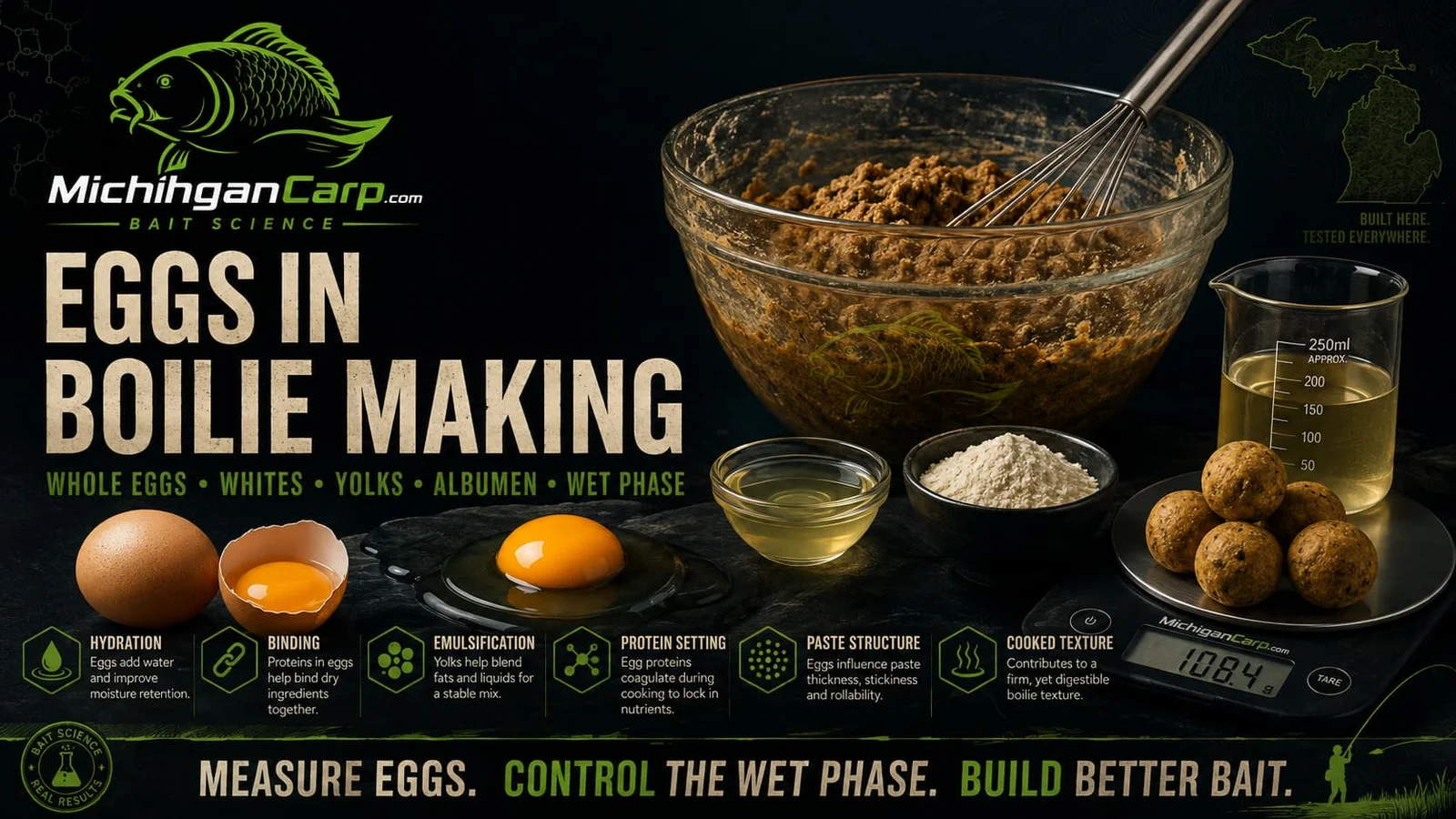
Eggs in boilie making supply much more than a convenient binder.
Whole eggs add water, protein, yolk fat, phospholipids and food solids. They help turn a dry base mix into a workable paste, distribute oils and liquid additives and create part of the structure that sets during boiling or steaming.
For the wider base-mix framework, start with How to Formulate a Milk, Nut and Birdfood Boilie Base Mix, then use this guide to control how whole eggs, yolks, whites and albumen affect the wet phase, binding and finished boilie structure.
That is why changing the egg level can affect almost every stage of bait production.
Too little liquid may leave the paste dry, cracked and difficult to extrude. Too much may create sticky dough, flattened sausages, poor rolling and slow drying. Replacing whole egg with egg white, extra yolk, powdered albumen or an egg-free liquid system changes the formula again because those ingredients do not supply the same balance of water, protein, fat and emulsification.
The most useful improvement is to stop treating every egg as an identical unit.
A recipe that says “use eight eggs” may work perfectly with one carton and behave differently with another. Egg sizes vary, and the other liquids in the recipe also count. Eight eggs plus tiger-nut extract, liquid yeast, propylene glycol, honey and flavor create a larger wet phase than eight eggs used alone.
The better method is to record the shell-free egg weight and then calculate the complete wet phase.
Count eggs for convenience, but weigh them for repeatable formulation.
This guide explains whole eggs, whites, yolks, liquid egg, powdered albumen and egg replacement options; shows how to calculate the complete wet phase; and connects egg use with paste consistency, cooking, texture, leakage and storage.
For the wider liquid system, read Boilie Liquids and Additives. For the full heating discussion, use What Boiling Does to Carp Bait: Heat, Steaming, Leakage and Structure.
Table of Contents
Quick Start: 7 Rules for Better Boilie Paste
- Weigh eggs after removing the shells.
- Count every additional liquid in the complete wet phase.
- Add the dry blend gradually rather than forcing in the complete kilogram.
- Cover and rest the paste before making major corrections.
- Correct a dry paste with small measured additions—not an automatic full egg.
- Correct a wet paste with the original dry blend rather than random semolina.
- Record the final wet phase, dry mix used and paste behavior.
For many traditional one-kilogram free-bait mixes, approximately 350–420 g of shell-free whole egg is a reasonable development area before substantial supporting liquids are added.
Once extracts, hydrolysates, yeast liquids, syrups, propylene glycol, water and flavor carriers are included, the complete wet phase may be closer to 400–500 g—or occasionally higher in a very absorbent formula.
Those are working ranges, not universal recipe rules.
| Control point | Practical method |
|---|---|
| Egg measurement | Record shell-free weight rather than count alone |
| Additional liquids | Include every carrier, extract, syrup, hydrolysate, oil and water addition |
| Dry mix addition | Add gradually and retain some original blend for corrections |
| Resting | Cover and rest for approximately 10–15 minutes |
| Final correction | Use measured egg liquid or measured original dry blend |
| Batch record | Record wet-phase weight, dry mix accepted and final paste condition |
The correct egg level is the amount that allows the complete bait to mix, rest, extrude, roll, cook and dry predictably.
Eggs in Boilie Making: What They Actually Do
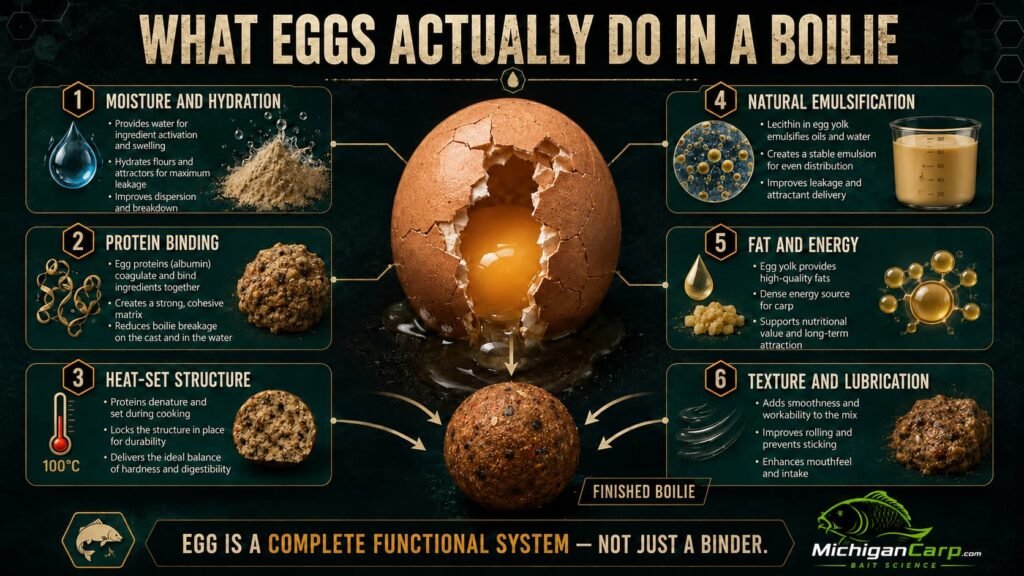
Calling egg a binder is useful, but incomplete.
Eggs perform several connected functions at the same time. Their water hydrates the base mix. Egg proteins help form a heat-set structure. Yolk fat affects lubrication and richness. Yolk phospholipids help distribute oil through the water-containing liquid phase.
The American Egg Board identifies binding, coagulation, emulsification and texture among the established functions of egg ingredients in food formulation. See REAL Egg Functionality.
| Egg contribution | Practical effect in a boilie |
|---|---|
| Water | Hydrates cereals, proteins, fibers, meals and powders |
| Egg proteins | Denature and aggregate during heating, helping the bait set |
| Yolk fat | Adds energy, lubrication, richness and some softening |
| Phospholipids | Help distribute modest oil additions through the liquid phase |
| Natural solids | Add food value and contribute to finished texture |
| Liquid viscosity | Helps distribute flavors and small-dose ingredients |
Hydration happens before the bait sets
Whole egg is largely water even though it does not behave like plain water in the bowl.
That moisture is absorbed by semolina, maize, soy, birdfood, nut flour, milk powder, casein, albumen, wheatgerm and other dry ingredients.
Absorption continues after the first mix. A slightly soft paste may firm during resting, while a paste that appears perfect immediately may become too stiff ten minutes later.
This is particularly important in milk, nut and birdfood bait containing several absorbent powders.
Egg proteins help form the cooked matrix
During heating, egg proteins unfold and interact, helping form a three-dimensional network within the bait.
The food-science process is described in Egg Coagulation and Thickening.
Inside a boilie, that egg-protein network interacts with starches, soy proteins, dairy proteins, casein, particles, fats and the available moisture.
The completed matrix—not egg count alone—determines whether the finished bait becomes cohesive, soft, firm, rubbery or brittle.
Yolk helps emulsify oil
Egg yolk contains lecithin and other phospholipids that can help divide oil into small droplets and distribute it through the water-containing liquid phase.
The oil should still be added gradually while the eggs are mixed. See the American Egg Board guide to emulsification.
This does not make oil genuinely water-soluble. It produces an emulsion or dispersion whose stability depends on the complete formula.
For that distinction, read Carp Bait Solubility and Leakage.
Whole Egg, Egg White, Yolk and Powdered Albumen

Whole egg is normally the best starting point for free boilies because it combines water, protein, fat and natural emulsification in one ingredient.
Egg white, yolk, liquid egg products and powdered albumen are useful when they have a defined job.
| Egg form | Main contribution | Main caution |
|---|---|---|
| Whole egg | Balanced moisture, protein, yolk fat and emulsification | Individual eggs vary in shell-free weight |
| Liquid whole egg | Consistent large-batch measurement | Check whether salt, stabilizers or other ingredients are present |
| Egg white | Water and heat-setting protein with little yolk fat | Can produce a leaner, tighter or less lubricated paste |
| Egg yolk | Fat, phospholipids, richness, color and lubrication | Can overload an already rich milk-and-nut bait |
| Powdered albumen | Concentrated dry egg-white protein and structure | Supplies no replacement water and can increase liquid demand |
| Whole-egg powder | Concentrated dried white and yolk solids | Needs deliberate water adjustment or reconstitution |
Whole egg
Whole egg is suitable for most freezer boilies, cereal baits, birdfood mixes and milk-and-nut food baits.
Its main weakness is variation. Egg size and the relative amount of white and yolk differ, so record both count and shell-free weight.
Pasteurized liquid whole egg can improve batch consistency when making larger quantities. Read the label because commercial egg products may contain salt or other functional ingredients.
Egg white
Egg white supplies water and protein with very little fat compared with whole egg.
It can be useful in specialist hookbaits and pop-ups where stronger heat setting is wanted without adding more yolk fat or density.
Replacing whole egg with white also removes part of the yolk’s lubrication, color, richness and emulsification. The substitution should therefore be treated as reformulation rather than a direct one-for-one exchange.
Egg yolk
Additional yolk can help a lean, stiff paste by adding fat, phospholipids and lubrication.
It is less useful when the formula already contains full-fat soy, whole nuts, tiger-nut flour, oily seeds, cream powder, milk replacer and added oil.
In that situation, extra yolk may contribute to greasy paste, soft sausages, slow drying and greater oxidation risk.
The complete fat calculation belongs in How to Balance Fat in Boilies: Milk, Nut and Seed Mixes.
Powdered egg albumen
Powdered albumen is a dry structural ingredient—not a replacement for liquid egg.
It can increase heat-set firmness, strengthen hookbaits and support corkball or cork-dust pastes. It can also make the paste more absorbent.
Many ordinary free-bait recipes need little or no additional albumen beyond the egg already present. When a modest structural adjustment is needed, approximately 10–30 g per kilogram of dry mix is a sensible first test.
Higher levels belong in specialist hookbait formulations. The hardened, wafter and pop-up systems in How to Make Wafters and Pop-Ups From a Boilie Base Mix use deliberately higher albumen percentages because those baits have a different physical job.
Excess albumen can produce rubbery paste, difficult extrusion, brittle dried bait and very slow softening.
Whole-egg powder
Whole-egg powder contains concentrated dry white and yolk solids.
Use it according to the supplier’s product specification or reconstitution guidance. Adding it to a normal fresh-egg recipe increases dry protein and fat and normally increases the water requirement.
Egg Replacement Options: Liquid and Powder Alternatives
Whole egg is difficult to replace with one single ingredient because it performs several jobs at once. It supplies water, helps hydrate the mix, contributes protein that sets during cooking, adds emulsification through the yolk, improves paste texture and contributes fat and nutritional value.
That is why egg replacement in boilies is never really about finding one magic substitute. It is about deciding which egg functions matter most in the bait you are building, then replacing those functions deliberately.
If the bait still contains some egg, replacement is usually easier. If you are trying to build a true low-egg or egg-free boilie, the whole formula normally needs redesign rather than one simple swap.
Liquid egg replacement options
Liquid substitutes are mainly useful for replacing the moisture, hydration and attractor-delivery side of egg. They do not automatically replace heat-setting protein.
| Liquid option | Main job | Main limitation |
|---|---|---|
| Water | Basic hydration and paste formation | Provides no binding, emulsification or food value by itself |
| Water plus lecithin | Hydration plus improved oil dispersion and wet-phase mixing | Still does not replace egg protein setting |
| CSL, liquid yeast, hydrolysates or liquid foods | Add solubles, taste and feeding signals while contributing liquid | Can loosen paste if overused; not a true binder |
| Milk-based liquids | Add creamy character and some solids alongside moisture | Usually weaker structurally than whole egg |
| Glycerin or propylene glycol systems | Useful in some hookbait or shelf-life systems for moisture control | Not a direct replacement for egg in a normal boiled bait |
A practical liquid approach is often to begin with water as the base hydration source, then add a small amount of lecithin and only enough liquid food material to support the bait’s purpose. In other words, build the liquid phase by function rather than trying to force one liquid to “become egg.”
Powder egg replacement options
Powder substitutes are more useful when you need to replace the binding, structure, emulsification or dry-mix control that egg normally helps provide.
| Powder option | Main job | Main limitation |
|---|---|---|
| Egg albumen | Strong binding and heat-set structure | More structural than nutritional; too much can harden or rubberize the bait |
| Wheat gluten | Elastic binding and improved cohesion | Can make the bait rubbery if pushed too far |
| Pre-gelatinized starches | Binding, paste control and improved cohesion | Do not replace egg emulsification or fat contribution |
| Milk proteins or whey proteins | Support structure and food value | More expensive and not always equivalent to albumen for setting power |
| Soy flour or semolina-rich chassis support | Helps build a workable structural base | Works as part of a system, not as a complete egg substitute |
| Lecithin powder | Supports emulsification where oils are used | Only replaces one part of the egg system |
The most common practical route is not a single powder but a combination system. For example, albumen may provide the setting and binding, lecithin may help oil dispersion, and the cereal/soy chassis may provide the bulk structural support.
Practical low-egg and egg-free thinking
If you want to reduce egg rather than eliminate it, that is usually the easiest path. A bait that uses fewer eggs but keeps some whole egg often remains easier to roll and more predictable during cooking.
- Light reduction: keep some whole egg, then support structure with a little albumen or stronger dry-mix design.
- Low-egg system: use a smaller egg level, then deliberately rebuild hydration, binding and emulsification with water, albumen, lecithin and chassis control.
- Egg-free system: design it from scratch as an alternative bait system, not as a normal egg recipe with one ingredient removed.
In practice, the further you move away from whole egg, the more important it becomes to test paste behavior, rolling, cooking response, drying, cracking resistance and water life. That is because whole egg quietly performs several stabilizing jobs at once.
My practical view on egg replacement
For most boilie makers, I think the best question is not “What replaces egg?” but rather:
Which part of the egg system am I trying to replace: water, binding, structure, emulsification, nutrition or texture?
Once that is clear, the answer becomes much easier. A low-egg or egg-free bait can certainly work, but it normally works best when it is treated as a different formulation problem, not as a standard egg bait with one convenient shortcut.
For the emulsification side, use Lecithin in Carp Bait: Emulsification, Boilie Paste and Oil Control. For liquid-phase design, read When to Use Each Type of Carp Bait Liquid.
Measure the Complete Wet Phase

The phrase “six eggs per kilogram” is convenient, but it is not precise enough for controlled bait development.
Using about 50 g as a working reference for a large whole egg, eight eggs might provide roughly 400 g of shell-free egg. The actual batch can differ, which is why the next production run should record the real weight.
Weigh the eggs that enter the actual batch.
Shell-free egg weight is only the beginning
Suppose a one-kilogram milk-and-nut mix uses:
| Wet-phase component | Weight |
|---|---|
| Shell-free whole egg | 380 g |
| Tiger-nut extract | 30 g |
| Liquid yeast | 25 g |
| Propylene glycol | 20 g |
| Honey | 10 g |
| Flavor, acid and minor liquid support | 5 g |
| Total wet phase | 470 g |
380 + 30 + 25 + 20 + 10 + 5 = 470 g complete wet phase
This recipe does not contain a 380 g liquid phase. It contains a 470 g wet phase.
If the supporting liquids increase by another 50 g while the egg weight remains unchanged, the paste receives 50 g more wet material.
Calculate egg from the target wet phase
When a proven dry mix performs well around a 470 g complete wet phase and the supporting liquids total 90 g:
470 g target wet phase − 90 g supporting liquids = 380 g shell-free egg
This approach is more controlled than adding the usual egg count and then pouring every other liquid on top.
Weigh liquids when practical
Water can often be approximated conveniently because one milliliter weighs close to one gram.
Honey, molasses, glycerin, propylene glycol, lecithin, syrup and oil have different densities. Twenty milliliters does not always equal twenty grams.
Either measurement system can work, but the batch record must state clearly whether an ingredient was weighed or measured by volume.
A repeatable recording method
- Place the mixing bowl on the scale and tare it.
- Crack the eggs into the bowl and record the shell-free weight.
- Add and record every supporting liquid.
- Record the complete wet-phase total.
- Add the dry blend gradually.
- Record how much dry blend the paste accepted.
- Record the paste condition after resting.
Sometimes a recipe described as a one-kilogram mix reaches the correct paste condition after only 930–970 g of dry blend has been added. Recording the amount used reveals that fact instead of hiding it.
Build and Adjust the Paste Properly
Egg should form the foundation of the wet phase rather than being treated as a separate step followed by unrecorded additions.
| Wet-phase section | Main job |
|---|---|
| Whole egg | Main hydration, protein setting and natural emulsification |
| Main food liquid | One defined yeast, hydrolysate, extract or fermented-food signal |
| Supporting liquids | Carrier, sweetener, acid solution or preservative solution when justified |
| Flavor | One clear flavor direction |
| Oil | Optional lipid addition after the existing fat has been reviewed |
Egg first. One main liquid signal second. Supporting additions only when they have a defined job.
Standardize ingredient temperature
Egg and paste temperature can change how the mix feels.
Very cold eggs may make honey, oil and fat-rich ingredients temporarily more viscous. A warm paste may feel softer and stickier than the same recipe mixed under cooler conditions.
Do not deliberately leave raw eggs warm. Use refrigerated eggs, work cleanly and promptly and record unusual temperature conditions when comparing batches.
Beat the eggs first
Beat the eggs until the whites and yolks are combined before adding flavor, carriers, salts, sweeteners or other small-dose materials.
Some powders dissolve in the egg phase. Others only disperse or remain suspended. Do not claim complete dissolution merely because a powder is no longer visible.
Add oil slowly
When oil is justified, add it gradually while mixing.
A modest amount may distribute successfully through beaten whole egg. A large oil layer that repeatedly separates may indicate an overloaded fat system rather than an automatic need for more emulsifier.
The specialist explanation belongs in Lecithin in Carp Bait: Emulsification, Boilie Paste and Oil Control.
Add dry mix gradually
Add most of the dry blend, mix thoroughly and then introduce the remainder in smaller quantities.
Keep part of the original blend aside for corrections. Using only semolina to repair a wet paste changes the protein, fat, solubility and flavor concentration of the intended formula.
Rest before correcting
Cover the paste and rest it for approximately ten to fifteen minutes before making a major adjustment.
Nut flours, milk powders, casein, albumen, birdfood, wheatgerm and coconut ingredients continue absorbing moisture.
After resting, knead again and assess surface cracking, stickiness, greasiness, elasticity, extrusion pressure, rolling behavior and whether the sausage retains its shape.
Make small measured corrections
When the paste needs slightly more liquid, adding another complete egg may be excessive.
- Beat one egg in a separate cup.
- Add approximately 10 g to the paste.
- Knead thoroughly.
- Rest briefly.
- Reassess before adding more.
When the paste is too wet, add a measured amount of the original dry blend, rest again and record the correction.
Cooking, Texture and Leakage
Cooking changes the raw egg-bound paste into a more stable bait matrix.
The outer surface heats first. The center follows more slowly. Egg proteins denature and aggregate while starches absorb water and gelatinize. Milk, soy and other proteins interact with that changing structure.
The result depends on bait diameter, batch size, cooking method, egg level, starch, structural proteins, fat, particles and available moisture.
Heat changes protein—it does not remove it
Cooking changes the physical structure of egg proteins, but it does not make them disappear or stop being protein.
The practical change is denaturation and aggregation within the bait matrix.
More egg does not automatically mean harder bait
Whole egg adds heat-setting protein, but it also adds water and yolk fat.
Hardness is also affected by albumen, casein, gluten, starch, cooking intensity, drying and final moisture.
A very wet whole-egg paste may remain softer than a lower-moisture paste containing a controlled amount of albumen or casein.
Do not overcook a poorly balanced paste
A soft raw paste should be corrected before cooking.
Extended boiling may create a hard outer shell around a wet or weak center without solving the underlying formula problem.
Use How to Boil and Dry Boilies Properly for the controlled production process.
Egg structure and leakage
A strongly set bait can remain intact while still releasing soluble material. Durability and leakage are not direct opposites.
Water entry and outward movement also depend on drying, diameter, particle size, porosity, soluble ingredients, fats and cooking intensity.
Reducing egg does not automatically create a more attractive or faster-leaking bait. Too little structure may cause cracks and uncontrolled breakdown rather than useful progressive release.
For the complete mechanism, read Carp Bait Solubility and Leakage.
Egg Systems for Different Boilie Types
The following ranges are practical development starting points. The dry mix determines the actual requirement.
| Bait type | Shell-free egg starting area per 1 kg dry mix | Supporting liquids | Main consideration |
|---|---|---|---|
| Cereal or birdfood free bait | 330–390 g | 20–50 g | Often rolls with a moderate complete wet phase |
| Absorbent milk-and-nut bait | 370–430 g | 40–90 g | Rest before correcting because powders continue hydrating |
| Rich high-fat nut bait | 350–410 g | 20–60 g | Do not confuse oiliness with sufficient water |
| Hardened hookbait | Formula-specific | Usually restrained | Albumen and casein should be designed separately |
| Wafter or pop-up | Formula-specific | Keep dense liquids controlled | Egg-white-led systems may reduce yolk fat and density |
| Ambient shelf-life bait | Complete-paste calculation required | Every liquid included | Egg increases the wet and nutrient load that must be controlled |
Freezer bait
Whole egg is normally the simplest and most dependable starting system for freezer boilies.
Make the bait cleanly, dry it enough for handling, package it in session-sized quantities and freeze it promptly.
Shelf-life bait
Boiling does not make an egg-rich boilie automatically stable at room temperature.
The complete system still depends on moisture removal, water activity, pH where relevant, preservatives, hygiene, packaging, temperature and retained-sample testing.
Water Activity in Boilies: Moisture, Mold and Shelf-Life Control owns the storage measurement, while Potassium Sorbate, Sodium Benzoate and Citric Acid in Shelf-Life Boilies owns Robert’s combined antimicrobial system.
Hardened bottom hookbaits
Hardened hookbaits may use whole egg with additional albumen and casein. The specialist mix should be developed separately instead of cooking ordinary free boilies for much longer.
Wafters and pop-ups
Egg white can be useful in wafters and pop-ups when you want more heat-setting protein without adding extra yolk fat.
The bait still needs sufficient liquid to hydrate the albumen, casein and cork-containing paste.
The complete formulas belong in How to Make Wafters and Pop-Ups From a Boilie Base Mix.
My Eight-Egg Plum Boilie Working Point
For my Plum, Scopex and Vanilla milk-and-nut mix, eight eggs for a one-kilogram dry batch produced a paste that was close to ideal.
That is useful practical experience, but “eight eggs” is not yet a complete formulation record.
Using the USDA average for a large whole egg, eight eggs might weigh about 400 g shell-free. The actual batch could differ, which is why the next production run should record the real weight.
The useful record should look like this:
| Batch record | Amount |
|---|---|
| Egg count | 8 |
| Actual shell-free egg weight | Record during production |
| Tiger-nut extract | Record exact weight or volume |
| Liquid yeast or CSL-style liquid | Record exact weight or volume |
| Propylene glycol, glycerin, honey and other liquids | Record each separately |
| Complete wet-phase total | Calculate before adding dry mix |
| Dry mix accepted | Record actual amount |
| Rested paste condition | Record extrusion and rolling behavior |
Eight eggs weighing this much, plus this exact liquid package, accepted this amount of dry mix.
That record is much more valuable than writing only “use eight eggs.”
It also allows the egg quantity to be reduced deliberately when the liquid yeast, tiger-nut extract, propylene glycol or other wet ingredients increase.
The complete recipe and field history belong in Plum, Scopex and Vanilla Milk-Nut Boilie: Development and Michigan Results.
Common Egg and Paste Problems
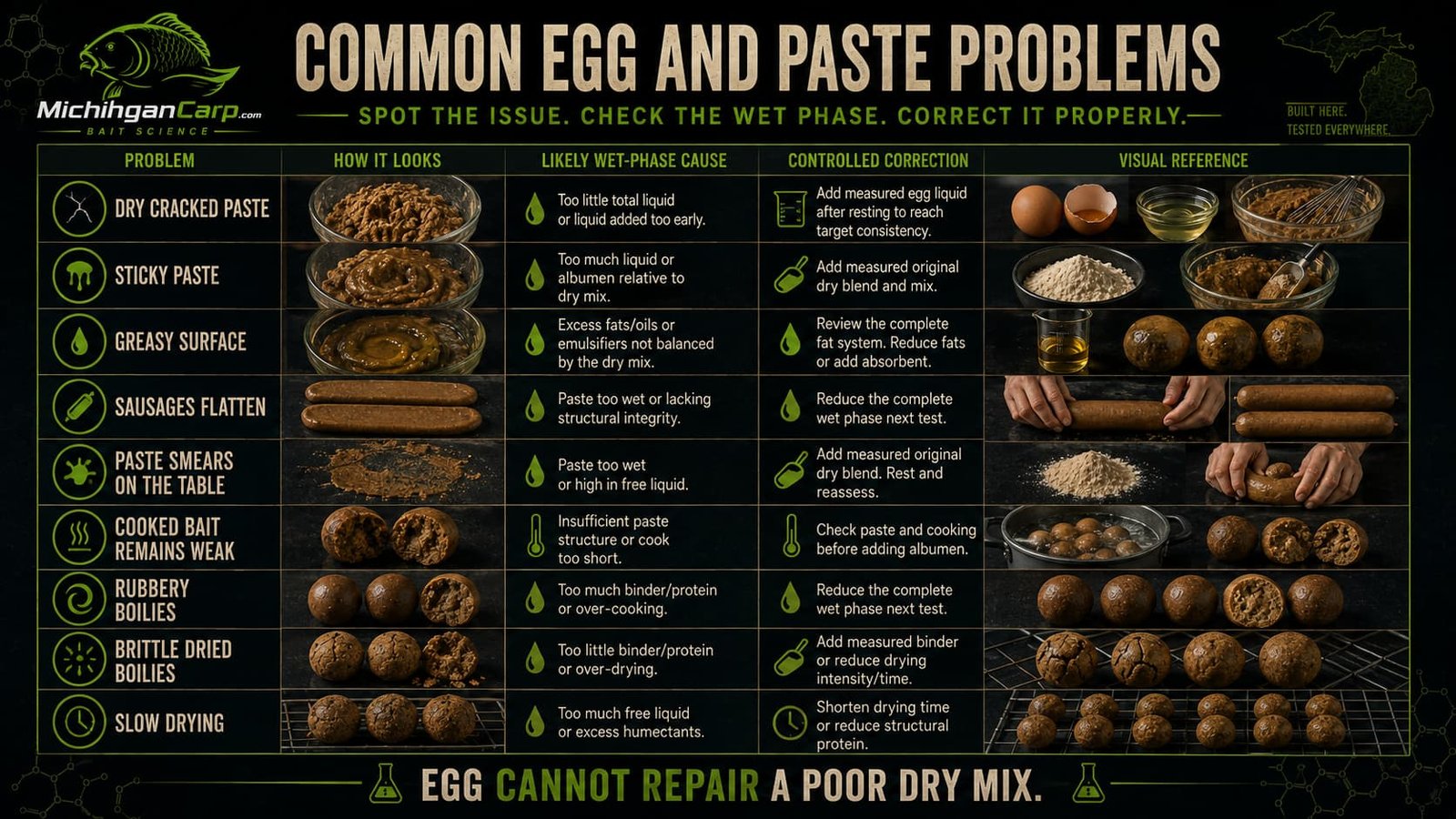
| Problem | Possible wet-phase cause | Other causes to check | Controlled correction |
|---|---|---|---|
| Dry cracked paste | Insufficient water-containing liquid | High albumen, casein, peanut flour or coarse material | Rest first, then add 10 g measured egg liquid at a time |
| Sticky paste | Excess egg or supporting liquid | Syrup, lactose, sticky milk powder or warm paste | Cool and rest, then add measured original dry blend |
| Greasy surface | Excess yolk or oil | Full-fat soy, nuts, seeds, cream powder or milk replacer | Review the complete fat system |
| Sausages flatten | Wet phase too high | Weak dry structure, excess oil or insufficient resting | Reduce the complete wet phase in the next test |
| Paste smears on the table | High liquid or yolk-rich lubrication | Warm paste or excessive total fat | Cool, rest and add measured original dry mix |
| Cooked bait remains weak | High moisture or insufficient setting protein | Undercooking, high fat or weak base structure | Check paste and cooking before adding albumen |
| Rubbery boilies | Excess egg white or albumen structure | High gluten, casein or excessive cooking | Reduce the elastic protein system |
| Brittle dried boilies | High albumen combined with moisture loss | Dense casein system or aggressive drying | Shorten drying or reduce structural protein |
| Slow drying | High complete wet phase | Large bait, high fat, poor airflow or deep trays | Review wet-phase weight and drying conditions |
Egg cannot repair a poor dry mix
A formula overloaded with oily meals, large particles, very fine sticky milk powders or weak structural ingredients may remain difficult across a wide range of egg levels.
At that point, correct the dry architecture rather than repeatedly adding more egg and powder.
Use Boilie Problems: Real Causes and Practical Fixes for broader diagnosis.
Raw-egg hygiene
Keep eggs refrigerated until needed. Use clean bowls, utensils and hands, and clean work surfaces after handling raw egg and uncooked paste.
Do not taste raw boilie paste. Mix and cook the bait promptly rather than leaving cracked eggs or uncooked paste warm for prolonged periods.
Finished bait remains perishable
Whole egg, milk powders, nuts and seeds do not become permanently shelf-stable simply because the bait has been boiled and air-dried.
For most homemade milk, nut and birdfood boilies, freezing remains the dependable default.
Read How to Store Homemade Boilies for drying, freezing, thawing and session storage.
My Practical View
For my milk, nut and seed mixes, eight eggs per kilogram has often been close to the correct working point.
That does not make eight eggs a universal rule.
It worked because the particular dry mix contained several absorbent ingredients and because the supporting liquid package remained within a workable range.
When tiger-nut extract, liquid yeast, propylene glycol, honey, hydrolysate or water changes, the egg requirement should be reviewed.
The best egg level is not the maximum amount of egg a dry mix can absorb.
It is the amount that produces a paste that hydrates evenly, rests without becoming excessively stiff, extrudes without unreasonable pressure, rolls without smearing and sets predictably during cooking.
The finished boilie should then dry consistently and soften in water at a rate suited to its job.
Whole egg is my normal starting point for free bait. Egg white and albumen are specialist structural tools. Extra yolk is useful only when the complete fat system genuinely needs it.
If I reduce or replace egg, I do not treat it as a simple swap. I rebuild the wet phase, structure, emulsification and paste behavior as a complete system.
Count the eggs, weigh the complete wet phase and judge the finished bait—not the recipe tradition.
FAQ
How many eggs should I use for one kilogram of boilie mix?
Many free-bait recipes use approximately seven to nine large eggs, but shell-free weight is more useful than count. The supporting liquids and absorption of the dry mix determine the final requirement.
Should eggs be weighed with or without the shell?
Weigh only the shell-free egg because the shell does not enter the wet phase.
How much does a large egg weigh without its shell?
USDA FoodData Central lists a large whole egg at approximately 50.3 g. Actual eggs vary, so weigh the eggs used in the batch.
Why did the same number of eggs produce different paste?
Egg weight varies. Dry ingredients can also change in moisture, particle size and absorption, while the amount of supporting liquid may differ between batches.
Can I use only egg whites in boilies?
Yes, especially in specialist hookbaits, but the formula loses much of the yolk’s fat, phospholipids, richness and lubrication. Reformulation and testing are required.
What does egg yolk do in boilies?
Yolk contributes fat, protein, phospholipids, color, richness and emulsifying capacity. Too much can make an already rich bait greasy and slow-drying.
What does powdered egg albumen do?
Albumen adds concentrated dry egg-white protein and can increase heat-set structure and hookbait durability. It also increases dry solids and may increase liquid demand.
How much albumen should I use in free boilies?
Many free-bait formulas need none. When additional structure is required, approximately 10–30 g per kilogram is a controlled first test. Specialist hookbaits may use considerably more.
Can more egg repair dry boilie paste?
Sometimes. Rest the paste first, then add beaten egg in small measured amounts rather than adding a complete egg immediately.
Can too much egg make boilies soft?
Yes. Excess wet phase may create sticky paste, flattened sausages, slow drying and softer bait. The complete starch, protein and fat system also matters.
Do more eggs make harder boilies?
Not automatically. Whole egg adds protein, water and yolk fat. Final hardness also depends on albumen, casein, starch, cooking, drying and moisture.
Do whole eggs remove the need for lecithin?
Not in every formula, but yolk already contains natural phospholipids. Additional lecithin should have a defined purpose rather than being added automatically.
Can I replace eggs with water in boilies?
Water can replace some hydration, but it does not replace egg protein setting, yolk fat, emulsification or food value. A water-based boilie needs the dry structure and binding system redesigned.
What is the best egg replacement for boilies?
There is no single best egg replacement. A practical low-egg or egg-free system usually combines hydration, binding, structure and emulsification from several ingredients such as water, albumen, lecithin, gluten, starches and a stronger dry chassis.
Can egg-based boilies be stored at room temperature?
Not safely by assumption. Homemade egg-based boilies should normally be frozen unless drying, water activity, preservation, packaging and storage have been deliberately controlled and tested.
Next Steps
- Boilie Liquids and Additives — build the complete wet phase around the egg foundation.
- How to Make Wafters and Pop-Ups From a Boilie Base Mix — use egg white and albumen in specialist hookbait systems.
- Soft vs Hard Boilies: How Texture Affects Carp Feeding Confidence — connect egg structure with finished-bait texture and durability.
- Lecithin in Carp Bait: Emulsification, Boilie Paste and Oil Control — decide whether additional emulsification is actually justified.
- How to Balance Fat in Boilies: Milk, Nut and Seed Mixes — calculate yolk, dairy, nut, seed and added-oil contributions together.
- What Boiling Does to Carp Bait: Heat, Steaming, Leakage and Structure — understand egg-protein setting, starch changes and the effects of heat.
- How to Boil and Dry Boilies Properly — standardize cooking, cooling and drying.
- Boilie Problems: Real Causes and Practical Fixes — diagnose sticky paste, crumbly dough, rolling failures and finished-bait problems.
- Potassium Sorbate, Sodium Benzoate and Citric Acid in Boilies — understand the preservation system used when deliberately developing shelf-life bait.
- How to Test Boilies Before Fishing — test finished texture, softening, swelling, cracking and hookbait durability.
- How to Store Homemade Boilies — manage egg-based bait after cooking, including freezing, thawing and session storage.
- Bait Science — explore the wider technical library covering structure, leakage, preservation and ingredient behaviour.
- Boilie School — follow the structured boilie-making route from formulation through production and testing.
- Michigan Carp Guide Library — browse the wider MichiganCarp technical library.